


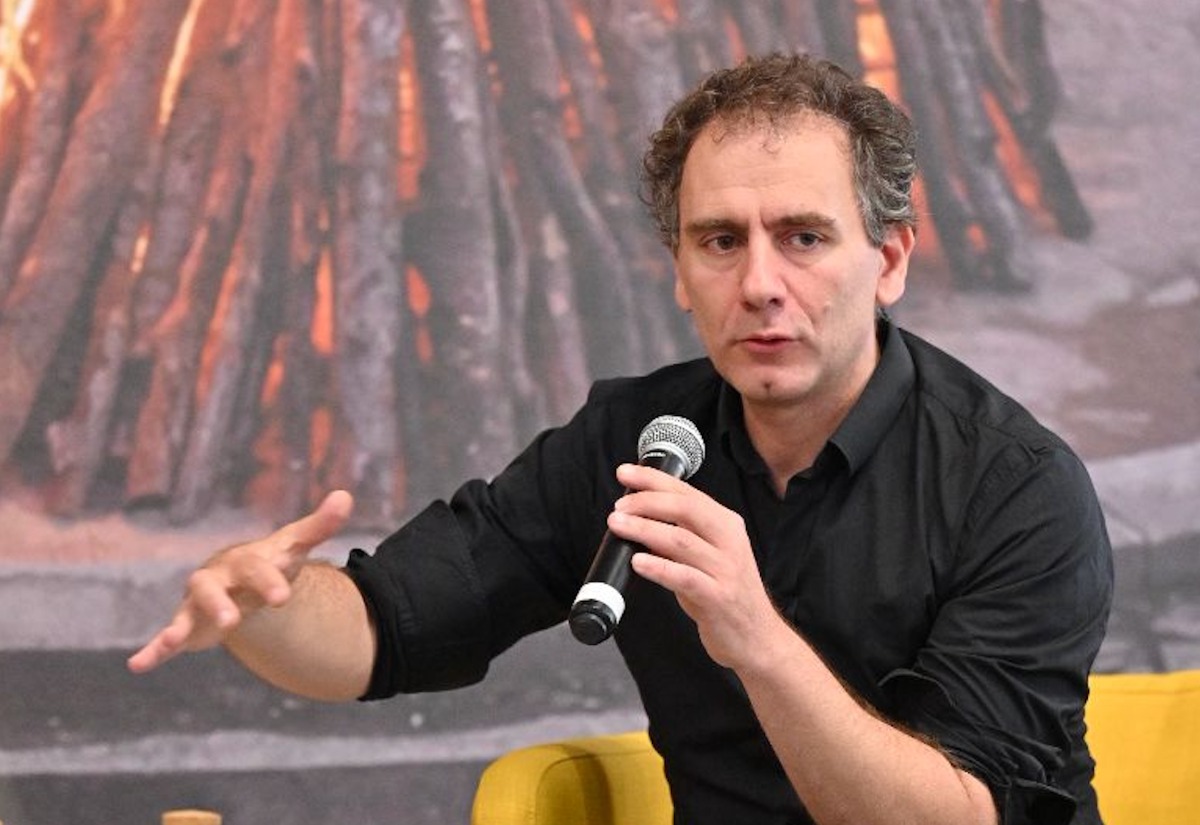
The Exhibition Can Be a Timeline, a Choreography, a Process
An interview with curator and art writer Martí Manen
For Martí Manen, the exhibition is never a fixed container. It can be a floor plan, but it can also be a timeline, a choreography, a situation, a moment of encounter or a process unfolding over several years. This way of thinking has shaped his work across very different scales – from early exhibition projects staged in his student room in Barcelona to the Spanish Pavilion at the 2015 Venice Biennale and Momentum10: The Emotional Exhibition in Moss, Norway.
Born in Barcelona and based in Stockholm, Manen has worked as a curator, writer and institutional thinker across both independent and museum contexts. From 2018 to 2026, he directed Index – The Swedish Contemporary Art Foundation in Stockholm, and since 2024, he has led CuratorLab at Konstfack University of Arts, Crafts and Design. He came to Riga during Riga Art Week 2026 as one of the international guests of the VV Foundation Visitors Programme, which introduces invited art professionals to Latvia’s contemporary art scene.
Our conversation moved through many of the questions that define his practice: what an exhibition can be today; how curating works with time, perception, emotion and memory; why uncertainty is not an obstacle but part of the field; and how institutions might remain generous, open and capable of complexity at a moment when speed often works against thought. Manen also spoke about “wrong spaces” – hair salons, markets, TV shops or waiting rooms – where art can disturb familiar codes of behaviour and make both the artwork and the place visible in a different way.
Your book To Leave the Exhibition (If We Had Ever Entered It) suggests that the exhibition must be reconsidered constantly. Is the exhibition still the main curatorial form today, or is it just one moment within a larger process?
For me, the exhibition is still what we do curatorially. It remains our field. But at the same time, we are constantly questioning the idea of the exhibition itself – what an exhibition is, and how we understand the exhibition as a form.
Traditionally, when you begin working on an exhibition, you start with a floor plan, with a space. But perhaps it would be more interesting to start with a timeline – to understand the exhibition as time, as a process, as a choreography.
In that sense, there are still many ways to understand how we work and what an exhibition can be. If we think of the exhibition through time, it can be something very short or something very long. It can be a glimpse, a moment, or it can unfold over several years. And then, in a way, you begin to dismantle or deconstruct the very idea of the exhibition.
Some exhibitions are slow, complex, not immediately readable or visible. How do you balance challenging the audience while still making sure that the work reaches them? And if I may ask it a bit provocatively: where is the line between uncertainty and simply losing the audience?
It is a crucial question, because if we work as curators, it is because we want to create a connection. There is artistic practice, but there are also visitors, users, audiences – people we want to reach. We want this interaction. If we forget this part, we are missing something extremely important: the transmission of content, ideas and feelings.
For me, it is a way of thinking in which you try to find the best possible form for each specific case. Contemporary art has many forms and practices, and not all of them require the same kind of exhibition. Sometimes you need something slow and complex. Sometimes you need something very fast, with a desire for empathy. Sometimes the work is more linguistic or conceptual. All of these possibilities are important.
When I work, I always have the visitors in mind. An exhibition can offer pleasure, but it can also offer frustration. There are many tools for making things memorable. In the end, what we want is to affect memory and life. It is a dance, a game of how to make something stay with people.
This also brings me to the visitor’s experience. Do curators today work as much with perception as with meaning?
There are many ways to understand the curatorial, and what I see all the time is variety. One thing does not cancel the other. Perception is one aspect, but so is the physicality of the exhibition – how we move through it, how we visit it, how it affects the body.
At the same time, the conceptual remains a key factor. Ideas, content, history – all of that is there. Politics is there as well. For me, what makes curating interesting is precisely the need to navigate this constellation of different ways of understanding.
Sometimes we need the sensorial, sometimes the psychological, sometimes the conceptual. This reflects the complexity of our time. We do not have simple answers to what is happening around us. And perhaps this is where art has its strength: in its capacity to offer something specific to each person.
In that sense, what we do is probably less for the masses and more for the individual. Of course, that makes things more difficult. Not every exhibition is for everyone, but there may be a person for every exhibition.
I would like to continue with the role of emotion. In Momentum10: The Emotional Exhibition, you spoke about the need to stop and feel. Can emotion sometimes communicate complexity more deeply than explanation?
Sometimes poetry defines reality – or the way we feel reality – much more precisely than explanation. Poetry is a field of interpretation, an invitation to think otherwise. And emotions are always there. They will always be there, because they define how we act.
We can see this more and more in politics today: how the emotional often takes the place of language. Not always in good ways, of course, but it shows how this atavistic part of humanity is always present – how feelings appear, how they cannot always be controlled, how they shape behaviour.
I think we should not be afraid to talk about this. It is a difficult matter. How do we talk about rage? Can we talk about rage, or love? Can we talk about fear? Can we actually feel fear in an exhibition?
It is also a question of where we stand in relation to reality. What is our responsibility towards the emotional? How can we create a space for feelings, but also speak about them and invite a discussion around them?
The good thing about art is that it has always operated in this field – in the emotional, in the space of reaction. And again, as with poetry, art offers a field for possible discussion and encounter precisely because it does not give clear instructions. To say, “This is what you should feel,” would be completely wrong. It is you as a visitor, it is me as a visitor, reacting and feeling something.
But I am also very interested in the structural level of this – how certain emotions are connected to certain ways of doing things, and how politics, too, is defined through the emotional.
Talking about politics and the atmosphere we live in today, the last years, the pandemic, wars, instability, changes around the world – do curators today work more with uncertainty than with solid knowledge?
To work with art means to work with uncertainty forever, because art is unstable; it is never fully defined. In that sense, we are trained to deal with uncertainty. We know how to work with this lack of future that we are experiencing now – with the impossibility of knowing what might happen even two weeks from now. Our future is becoming shorter and shorter. The possibility of imagining a future is somehow being captured.
But I think there is something important in how art allows us to address reality: to be inside and outside at the same time. For me, this is crucial. We can speak about the complexity of reality, and we can also be complex ourselves. We can speak about difficulties, about politics, about what it means to be both involved and at a distance. This gives us a great deal of freedom, but also a great deal of responsibility.
From the arts, we can still define structures and proposals, if we want to, precisely because no one is expecting it from us in a direct or instrumental way. There is a possibility there. There is still an idea of freedom – linguistic freedom, structural freedom, the freedom to organise things differently. And this is something we should not underestimate: the capacity we have in this field to help define the future we need now.
Has curatorial work become more fragile?
Definitely. Because the structures are more fragile. Not because of the curatorial itself, which is always in process and in need of constant negotiation with others. But when structures are in danger, all the agents are in danger.
We see censorship taking more and more space. We see fear controlling the institutional. We see economic trouble. All these factors define the capacity or the possibilities of working.
At the same time, art is always in crisis. This is what defines artistic practice – to be in crisis, to be critical, to be in this non-knowledge, let’s say. So I think we are trained. We are, let’s say, lucky, because this is our environment: to navigate, to think in difficult circumstances. But generally, yes, we see that it is a difficult time.
Installation view of Call It Museum at Index, Stockholm, featuring a storage space for the following exhibition and video interviews on institutional desire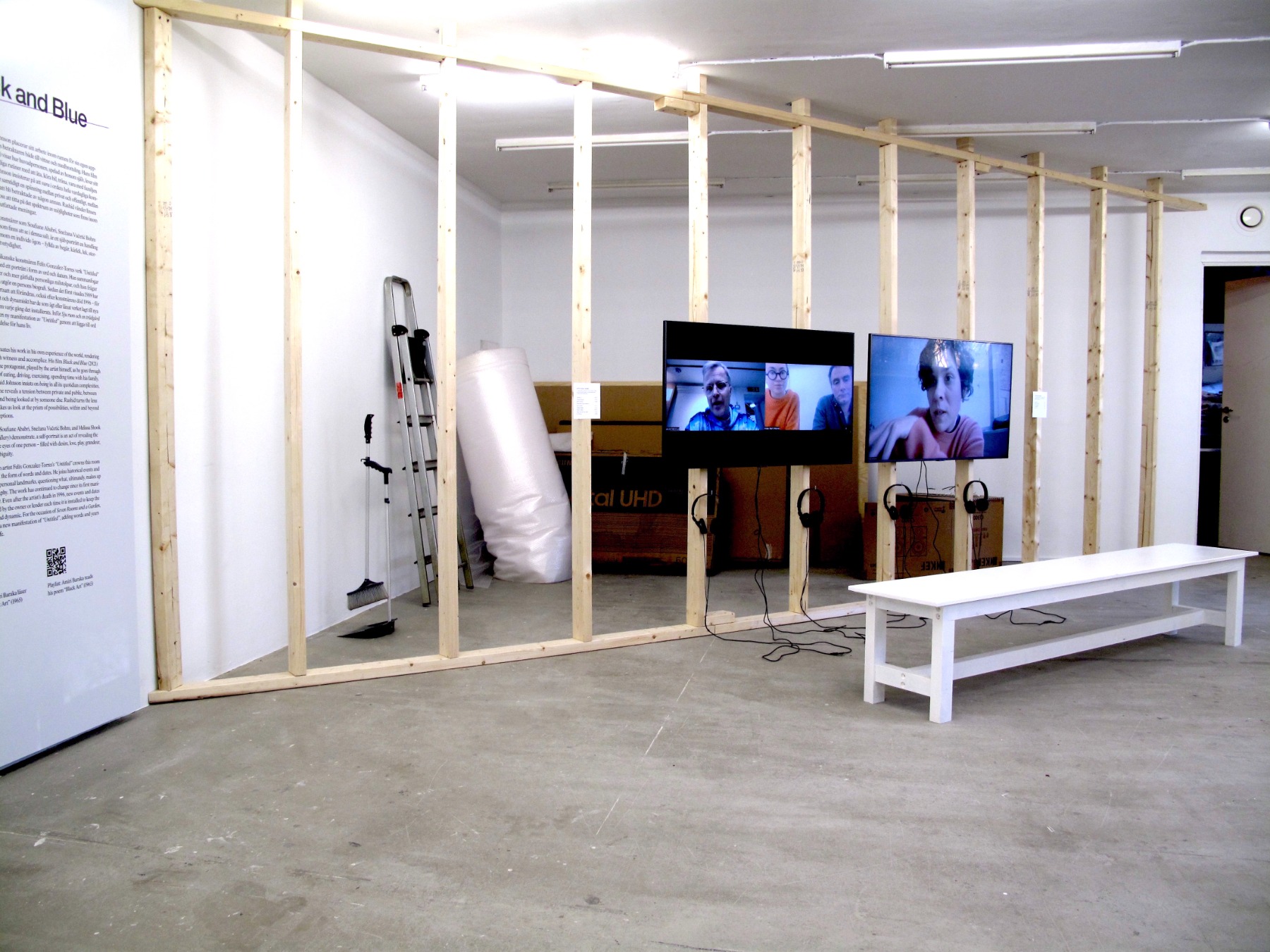
I would like to turn our attention to space. You have worked with very different scales – from your student room in Barcelona to biennials and institutions. What have these experiences taught you about space?
Space is always connected to movement – to how we interact, how we feel, and how we read reality.
Right now, for example, I am curating an exhibition project for MACBA in Barcelona that presents part of the museum’s collection outside the museum. The idea is to take the collection into unexpected places: a hair salon, a dentist’s waiting room, a market, a TV shop. You might encounter an artwork while having your hair cut, waiting for an appointment, buying groceries or looking at televisions.
For me, this is a way of thinking about what space is, and how strongly it defines our relationship with art. Of course, it is not the same thing to see an artwork in a museum and to see it in a dentist’s waiting room. The space changes how you interact with the work, but it also changes your sense of what the work belongs to, and who it belongs to.
The project takes place across the whole region of Catalonia and includes around sixty artworks from the MACBA collection. But in each case, the people who inhabit or work in those spaces also need to understand the artistic practice. For example, there will be a Bruce Nauman video in a TV shop. You have all these televisions, and suddenly, among them, a classic video artwork appears. The first thing is that the person working in the shop needs to understand that this is an artwork – and that it is important for them as well. It is not just footage of mountains used to calibrate colour. It is a Bruce Nauman.
But then, if you go there, what are you doing? Are you watching a video, or are you buying a TV? What is happening in that moment? The space defines how you interact, and also what your role is. When you break, or even slightly disturb, these rules, something very interesting can happen. You suddenly ask yourself: where are we now? Is this a museum? Is it a shop?
For me, this questioning of space is deeply connected to the preconceptions we have about space. Every space has rules. Every space defines how we move. In a shop, you are not a visitor; you are a buyer, a consumer. In a church, your body already knows how to behave. In a football arena, again, your role is different. So what happens when you place parts of a museum collection in these supposedly wrong places?
Because a collection is history. A collection is a desire to write history, somehow, from the perspective of a museum. And when these things appear in the wrong places, you begin to see both the place and the collection differently. You can read the rules, the assumptions, the codes that are usually hidden because we take them for granted.
You enter a shop, and you know how to behave. You enter a church, and you know how to behave. Your body is ready for that space. So can we play with this? Can we find other ideas of spatiality?
Can these “wrong spaces”, or alternative spaces, still do something that large institutions cannot?
Yes, I think so. I really believe so. But it is also a question of what institutions can do, and what they want to do.
Institutions are ways of defining things. Through an institution, you construct something: if it is a museum, perhaps history; if it is an art centre, perhaps the future. You create a platform for the production of art, for the production of knowledge, or for receiving things critically. But institutions are also codified. Every institution has to understand its own code – what it is supposed to do, what it wants to do, and whether those two things actually match.
Sometimes institutions have a desire to do something, but not the capacity to do it. And then there is trouble. It becomes a question of how to balance desire, structure and preconception. Sometimes things can be redefined; sometimes they cannot, because they are too loaded.
Still, I think there are possibilities beyond the institution – also from an institutional perspective. Institutions have a lot to learn from independent spaces, and a lot to adopt from them. At the same time, institutions also have a lot to give. What we need now is a moment of generosity from the institutional: institutions that are open, that want to establish dialogues, to be in contact, to become part of something larger.
The atomisation of the system has placed everyone in a rather lonely position. What we need now is a sense that we are together somehow. These are difficult times, and this is a moment to talk, to stay in contact, and to define things together.
I would also say that the differences between these positions are becoming less clear. We see institutions acting as independent spaces, museums acting as art centres, and universities acting as platforms for debate. The strict definition of the institutional is also being redefined, because the context itself demands new forms of institutional reaction.
Today, institutions are expected to react quickly and clearly to social and political events. Is there still space for ambiguity, uncertainty and slower reflection?
Fantastic question. I truly believe this is one of the most important issues today.
We have seen this almost obligatory demand for institutions to be fast – to answer, to react, to issue statements. But perhaps what we need is a slower tempo. Perhaps we need to understand the institution as a public arena: a place where things can be discussed, where complexity is allowed to exist.
Velocity goes against complexity. If you have to be fast, you cannot be complex. And what we truly need is complexity, because the world itself is complex. We need forms that can respond to urgency, but from a broader perspective.
Of course, this also depends on the type of institution. I would like to see more slow-tempo institutions, or at least a combination of faster and slower ones. We need dialogue, and dialogue means time. It means the capacity to gather, to listen, to think together. You cannot do that quickly. You need time to really consider the situation in order to be able to think.
Participants of CuratorLab at Konstfack, Stockholm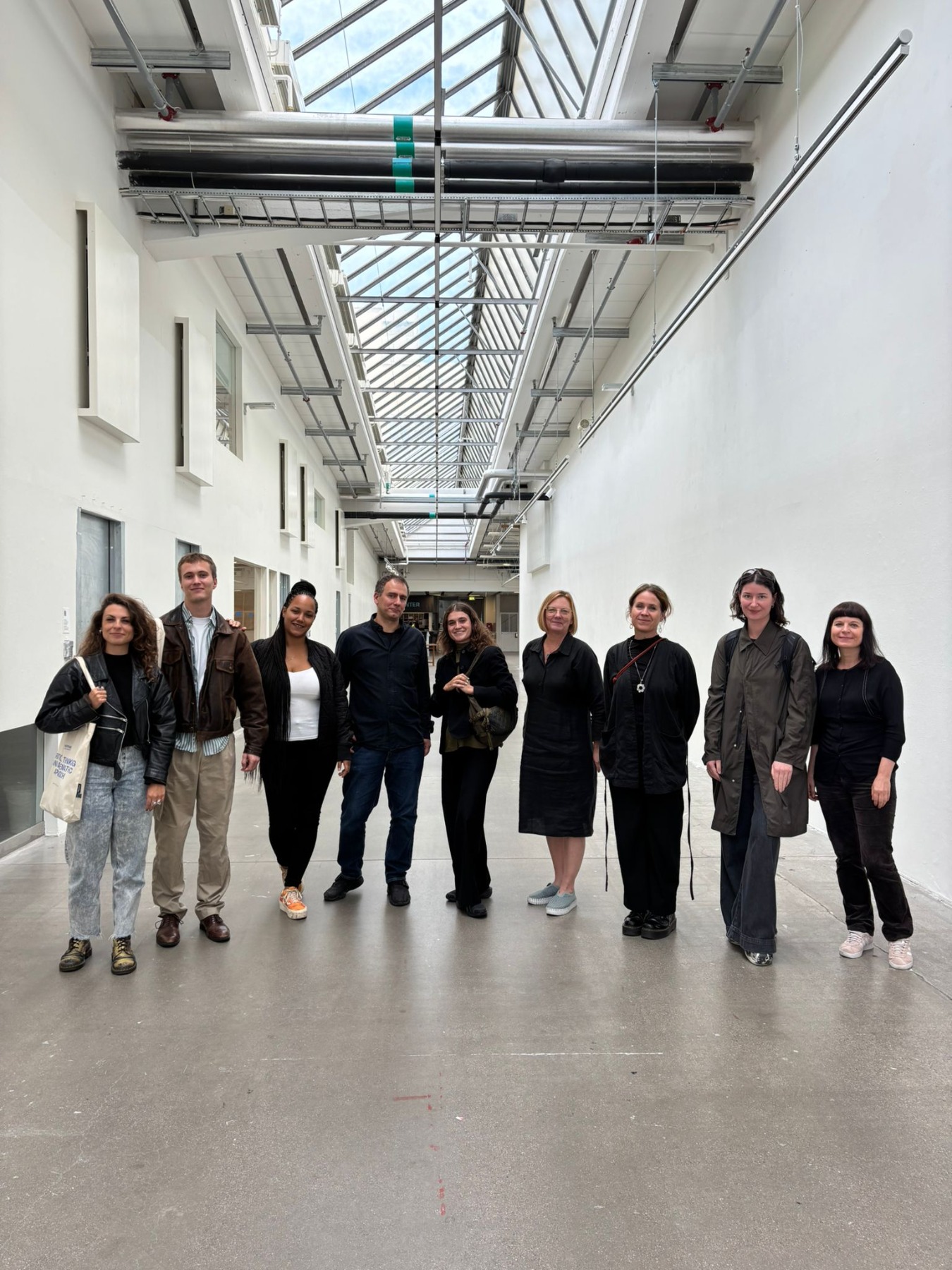
I would like to talk about CuratorLab at Konstfack, which is not a traditional school, but rather a one-year international programme for curatorial thinking, experimentation and shared research. You are now leading the programme, and it seems to function less as a place where curating is simply “taught” and more as a situation where curatorial practice is questioned and tested together. Can curating actually be taught?
I am not sure, because curating is a practice. It is about doing.
CuratorLab is a platform for meeting other people, exchanging information, discussing the curatorial, thinking together and imagining possibilities – but probably not for simply learning how to curate, because curating is something you do.
This is also why CuratorLab is structured the way it is. It takes place over one year, with a group of people meeting for several intense weeks – in September, November, February and May – while a slower conversation continues in parallel. The idea is to meet, sit, talk, listen, invite others into the conversation, and question the curatorial: why are we doing this, and what can it become?
Perhaps what education can offer is precisely this time for reflection, testing and experimentation. But I am not so sure about the idea of “learning” curating in a direct way. You learn it by meeting artists, visiting exhibitions, being in performances, observing structures, seeing what is happening, and developing ideas.
No one can simply say: “Now you are a curator.” It is your work that shows that – your capacity to work with others and to imagine possible ways of doing things.
CuratorLab has lasted for more than twenty-five years at Konstfack, probably because it is this different kind of structure. It is not only about learning; it is about thinking together, putting things into practice and testing the limits of curatorial practice.
Do young curators need different skills today than they did twenty-five years ago?
You need different skills because reality is different. A curator is always reacting to reality.
Today, the lines between communication, curating, platforms and even personal life have become increasingly blurred. The construction of personas on social media has changed a great deal. Sometimes we see art through Instagram and think we are seeing art, but this completely changes the conditions of reception. If you encounter art through your phone, the whole idea of space – and of artistic experience – becomes something else.
So yes, the conditions are different. At the same time, the fundamental questions remain the same. As human beings, we will always ask: how do we feel, how do we speak, what kind of content do we create, how do we make situations meaningful, how do artistic practices speak to one another, how do we follow the work of an artist?
The main questions are the same, but the context has changed. And as a curator, you have to understand that context in order to create your own situations within it. That demands different tools, and a different tempo.
In the 2025/2026 CuratorLab programme, you focus on platforms and performativity. Could you elaborate a bit more on this focus?
Every year in CuratorLab, we focus on certain concepts and look at them from many different perspectives, together with different people. This year, we have been thinking about platforms and performativity. They are two different things, but they are closely connected to what we were just discussing.
The platformisation of the world is changing the way we interact – from digital platforms to distribution channels, from internet cables linking places to trucks transporting goods, or Instagram defining a certain mode of interaction. It affects artistic practices, curatorial practices, politics – everything. For me, it was important to sit with this and think about it through both theoretical and practical approaches.
Performativity, in this context, does not necessarily mean performance. It is more about how things are done: what kinds of interaction are created, how we act, how we produce situations. This completely affects the way we understand the curatorial. It also means that time and social interaction become even more important in defining an exhibition, or any situation with art.
At CuratorLab, I invite external lecturers who also have the agency to invite others. For these themes, we worked with Carmen Lael Hines, who researches platforms, capital and culture, and Pontus Pettersson, an artist, choreographer and curator working with performativity. Together, we built a programme of people thinking, speaking and doing around these questions.
Next year, we will move towards the institutional – towards the idea of expanding the institution. How can we define new models of institutions? How can we look at historical moments when communities created their own systems of presentation, collection and production? I think we need this moment of asking: what is needed now, what can we do, and what can we offer?
As a final question, I would like to ask about Index – The Swedish Contemporary Art Foundation in Stockholm, which you directed from 2018 to 2026, and which has often been described through ideas of dialogue, experimentation and human scale. What does a human-sized institution mean to you today? Can smaller institutions sometimes be intellectually freer?
Index is a fantastic institution, a testing ground for experimenting with institutional behaviour. It has a long history, and I am extremely honoured to have been part of it as its director for eight years.
At Index, I was able to test different temporalities, experiment with exhibition-making, and work within a distinct institutional environment, doing so transparently and in dialogue with both artists and visitors. The human scale is important and perhaps easier to achieve in smaller institutions. The real challenge is to define large institutions through the human factor.
I often think about the idea of a warm institution: an institution that can listen and respond, that understands both contextual needs and the specific needs and desires of every individual agent. Large institutions tend to forget that they work with people and often find comfort in administrative language. Yet human language is not merely administrative; there is much more to it.
Experimentation lies at the core of many small and medium-sized institutions. They serve as testing grounds for possible futures, places where methodologies can be imagined and later implemented elsewhere. At Index, we often discussed this as a team: how to make what we were testing accessible to others and how to facilitate the application of these ideas in different contexts. Ultimately, it is about generosity and the understanding that institutional practices and methodologies need to be shared if they are to have a broader impact.
