


Art Supporting Art
An interview with art collector Christine Mack
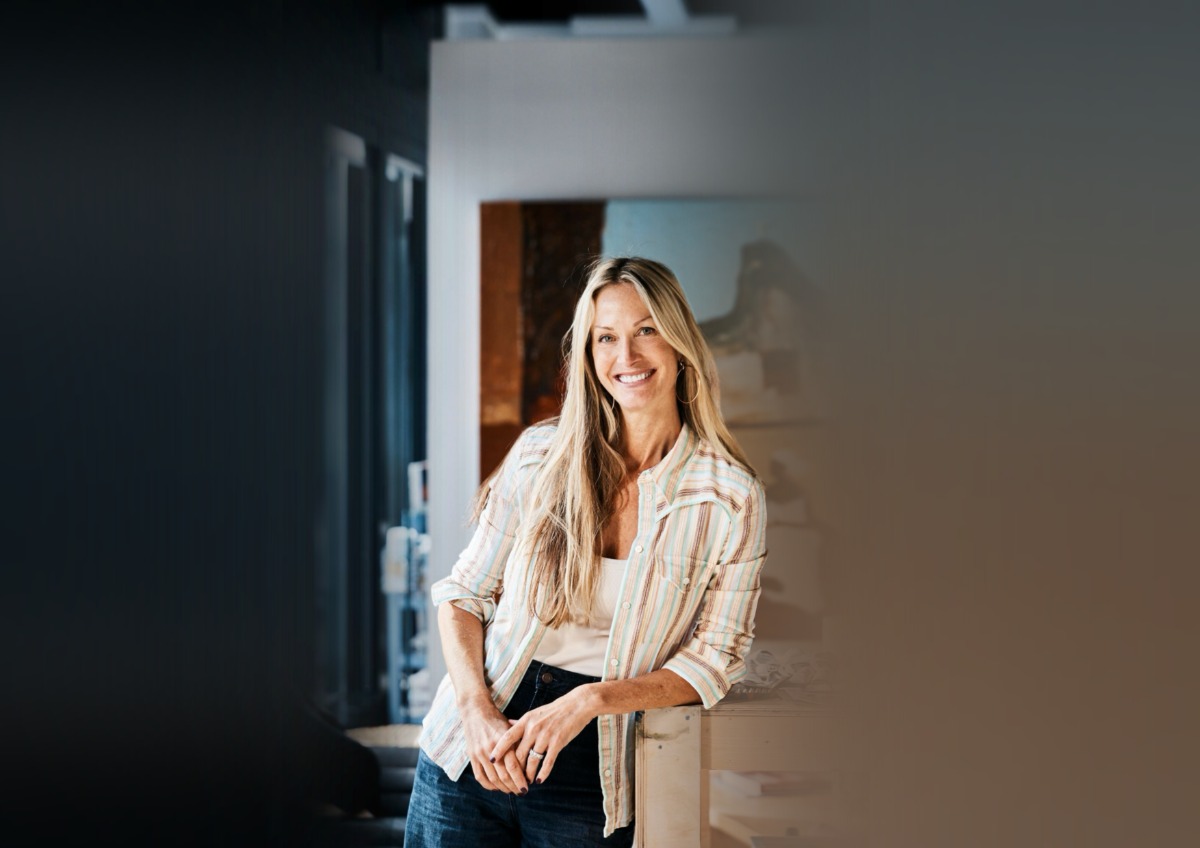
Swedish-born American art collector Christine Mack did not come to art through the usual routes. Born in Manila, Philippines, she moved to Stockholm at the age of seven. At nineteen, she relocated to New York to study graphic design at Parsons School of Design. In a way, art became part of her life journey – a guiding thread, always expanding the horizon.
Her entry into the art world was shaped less by theory than by curiosity and instinct. Without a defined framework, she was guided instead by perception and intuition – of images, of atmospheres, of something that holds. Over time, it has evolved into a collection that resists fixed categories, unfolding through recurring themes and affinities. Works are brought together not to complete a system, but to remain in dialogue – across generations, geographies, and sensibilities. A Nordic thread runs through it, less as identity than as a way of seeing and creating – defined by restraint, interiority, and a quiet tension that continues to surface.
Over more than two decades, Mack has built a collection that moves between emerging practices and established voices, often placing them in proximity rather than hierarchy. In recent years, her focus has extended beyond collecting itself. With the founding of the Mack Art Foundation in 2023, she began to work more directly with artists – through residencies in Brooklyn that provide studio space, housing, and sustained support, while also exploring new models of patronage and ways to sustain the art ecosystem.
Alongside this, she has been involved with several institutions, serving on boards and committees at the Solomon R. Guggenheim Museum, Moderna Museet, Studio Museum in Harlem, The Brooklyn Museum and the Buffalo AKG Art Museum. She has also served on the board of the Child Mind Institute since 2011, alongside her husband Richard Mack, reflecting a parallel commitment to mental health and advocacy. She received the Champion of the Arts Award at the Southampton Arts Center in 2025 and will be honored with the Visionary Award at the Art Students League of New York gala this fall.
Across these contexts – private, institutional, and community-based – her practice is shaped less by accumulation than by connection. Collecting becomes a point of departure rather than an endpoint, opening onto collaborations, residencies, and new forms of exchange.
This conversation traces that movement – between intuition and responsibility, intimacy and structure – and reflects on what it means to live with art today, not only as a collector, but as someone actively shaping the conditions in which art is experienced and shared, and who never stops being curious.
Exhibiting the artworks by MAF artists at the Southampton Art Center, 2025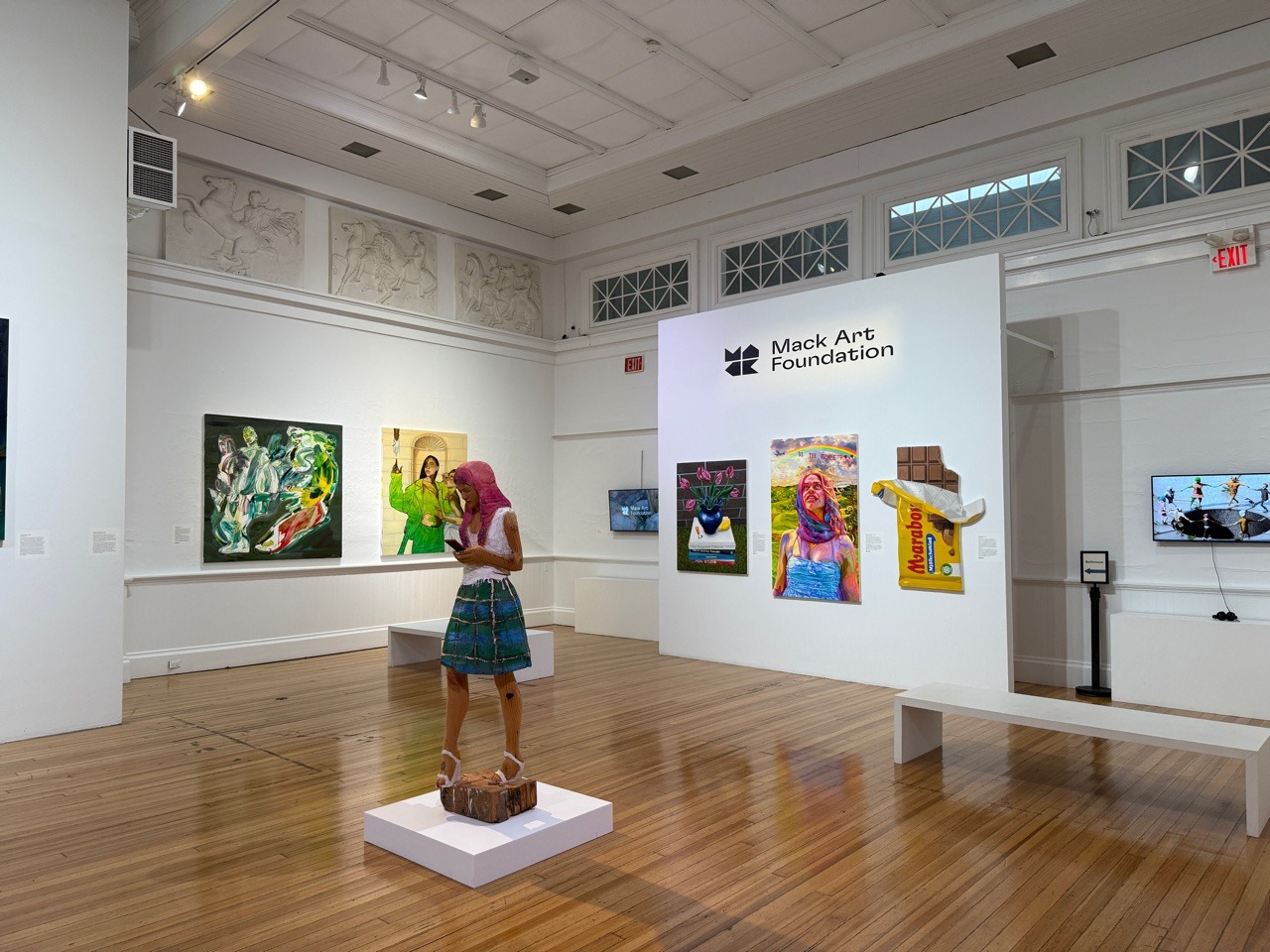
How have your background in graphic design and your Swedish roots – shaped in part by being born in the Philippines – influenced the way you view and collect art?
I think it’s made me more open-minded about collecting art from regions I feel connected to – especially Nordic art and artists. I think living in New York has also made me realize that there’s such a void in the art world here – there simply aren’t enough Nordic artists being represented.
So I try to collaborate as much as I can with Sweden – obviously, that’s where I’m from. My goal is to bring more Swedish talent to the US, and I already have some ideas and projects I’m working on.
At the same time, my background in the Philippines feels very much like home to me. I found a gallery in Chelsea that represents Filipino artists, and naturally I became friendly with them. I even bought a piece by one of the Filipino artists whose work I really liked. They also host gatherings where they serve Filipino food, which adds to that sense of connection.
I moved to New York when I was 19, and I do love the fact that it’s such a diverse place – you become very open. I just feel like we’re all kind of immigrants living in New York; there aren’t that many true New Yorkers. But when we all get along, it creates a very interesting culture in that way.
I’m always curious about new cultures, and I collect across different themes – I often describe them as “groups” or “themes,” because I’ve always followed what I’m drawn to. It’s very personal; I just feel when I need to have a certain work, when something speaks to me. That often naturally broadens my collecting in a particular direction.
I didn’t grow up with art; we didn’t have that in my family, and we didn’t really have access to it culturally. So I think coming to New York, being exposed to so much energy and so many different cultures, and then also going to Parsons to study advertising and graphic design – I’ve always loved anything creative.
So my collecting has been quite thematic – similar to how you think in terms of themes in graphic design or advertising. I tend to get very involved in a certain kind of art, and then I move on to something else. I don’t know if that’s good or bad, but it’s just the way I work.
I know every collector is very different. Some people go very deep and focus on one artist. What I try to do, if I can, is buy three works by each artist, especially emerging ones. It’s a kind of formula: I can keep one, donate one, and maybe pass one on to my children. Of course, that doesn’t apply to very expensive works, but it’s something I’ve been working with so far.
As I evolve as a collector, I’m also becoming more careful – not as impulsive or spontaneous. I take more time, sometimes at least a night to think about a work, and I try to do my due diligence on the artist, the work, and the market. So I’m definitely more considered now.
At the same time, I collect the way I want – I don’t really worry about what others think. Every piece I have is something I feel emotionally connected to. I’m also becoming more confident in that approach, knowing that not everything will necessarily increase in value.
That said, I do try to diversify. If there’s something I’ve been looking for over time, I know I can plan for it. But if I come across a work, say, at an art fair – that I really feel I need to have, I try not to get too carried away, while still leaving myself enough room to go for it. Otherwise, I just keep thinking about it.
And then I also collect works that I really study and wait for – because I know they are the kind of pieces that will accumulate in value. That’s actually how I fund my foundation. In those cases, I usually work closely with galleries: I wait for the right artist, buy on the primary market, and then hold the work as it appreciates. Eventually, I donate it to my foundation, and the gallery can resell it.
I’ve been doing this for some time now, and it’s been working really well. It allows me to generate funding for the foundation without having to raise money externally. So in a way, it’s like art supporting art.
I just love art so much – my husband thinks I’m a bit crazy – but it’s something I truly enjoy. And now, with the foundation, it’s really the artists who matter most to me, even more than artworks themselves. It’s become like a new kind of family. I’ve worked with 14 artists so far, and it’s been incredibly rewarding.
How did the idea for the foundation come to you? You also mentioned your model of supporting it, which isn’t very common – by donating works, you’re actively supporting emerging artists. It’s not a typical practice.
I just knew I didn’t want to fundraise – I didn’t want to ask anyone for money. So I started thinking about how I could do it differently. I called my accountant because I had a painting that had gone up in value, and he explained that it was possible to donate it to the foundation – you just need an appraisal, and of course there’s tax paperwork involved. It’s not completely simple, but it’s doable.
I then consigned the work back to the gallery where it was originally purchased, allowing them to place it with another collector. The gallery understands that all proceeds from the sale go directly to my foundation to support artists, making this an initiative they are fully supportive of.
In this way, it creates an ecosystem where art actively supports artists. Of course, the only downside is saying goodbye to a painting, but when I think about how many artists I’ll be able to support, and bring to New York, it feels more than worth it.
I even spoke on a panel at J.P. Morgan, as part of the Blue Rider Group at Phillips, about how I fund my foundation without relying on outside money. So I guess I’ve done something right. I also want to be able to control my foundation. I do have an advisory board, but I reach out to them only when I need something. Otherwise, I really want to do it my way and see how long that works.
Recently, I signed another lease, and I’m looking at more studio space in Brooklyn so I can bring over more artists. I’m also working on a new concept – a kind of cohort model, an art hub where three artists would work together for two or three months. It would likely be by invitation only. For example, I might bring in three Nordic artists to work together, and then we would present an exhibition afterward.
So it’s a different kind of model that I’m developing. I’ll continue with the residency I already have, but I’m also building something more community-oriented. The idea is to involve people from the neighborhood – inviting them into the studios, creating programming, and developing projects with the artists. It’s about building a stronger sense of community around them and, as we said, bringing people back together. It’s all become so digital, and I think in a way we’ve become quite disconnected. I want to open up that experience – because spending time with artists has been so meaningful to me. That’s something I’m working on now, and it’s a lot of fun. I’m very excited about it. The only thing that makes me a little sad is when they leave – but they always come back, and they can always stay with me. For me, it feels like a family.
So in a way, collecting has led me here. I still love collecting – I was just in Miami at Art Basel, but I’m more careful now about how I spend, because it also supports my foundation.
That said, I probably still bought too many works, I can’t help myself. But I’ve started to look at it differently: if I collect well, I can always resell a piece through a gallery. I know I’m buying strong works, so I try to think of it not just as spending, but as investment. And often, the prices do go up.
So I think that loving art, combined with doing your due diligence, can also become something that’s financially sustainable. I’m still figuring it out, but it’s fun, and I truly love it.
In the studio with MAF artist Melissa Rios. Photo: Christian Hogstedt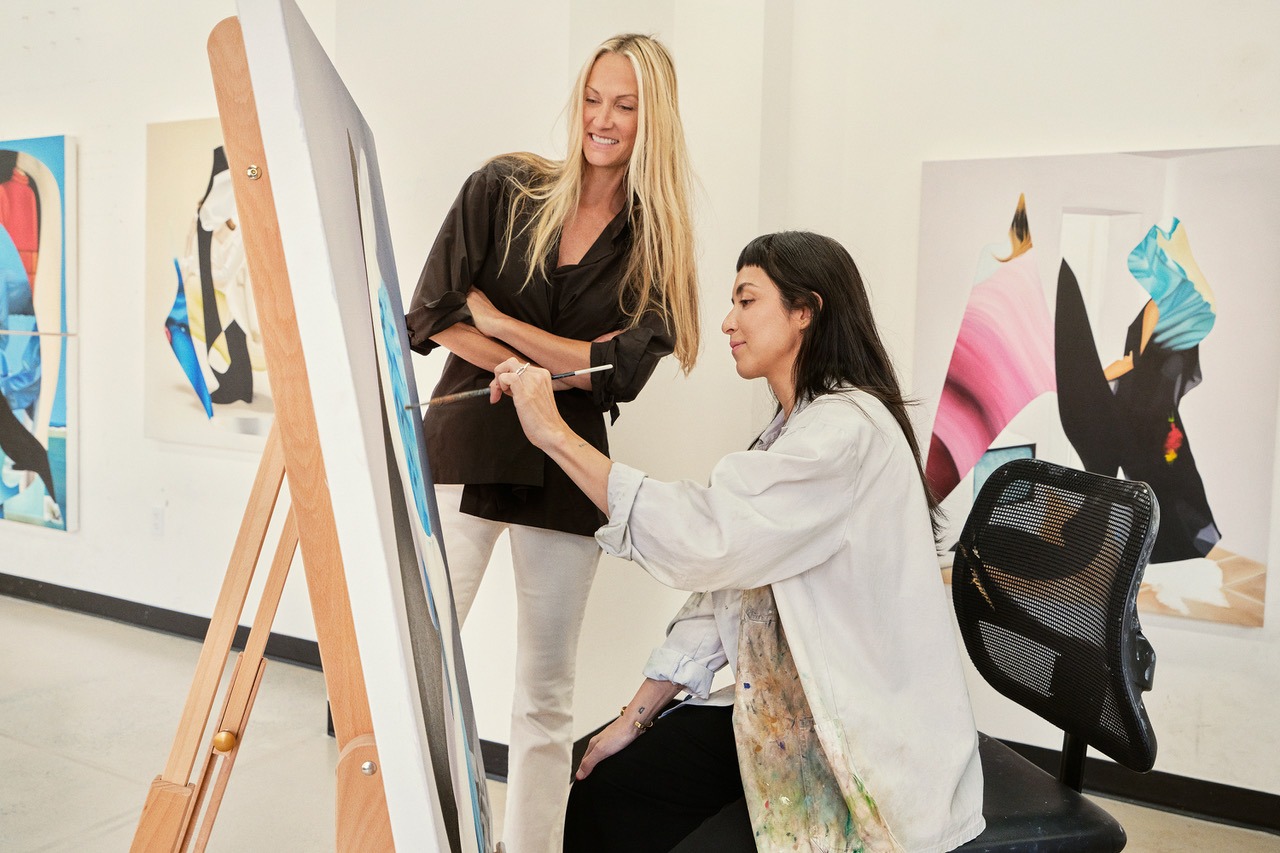
Listening to you, it feels like your collection is constantly in motion, and the artworks become entities in themselves – part of a wider community. Almost like pieces with souls, helping other souls. Is it like that for you?
I like to lend my art out. I recently had a sculpture that I donated to Bellevue Hospital, and I’m also working on a collaboration – an art initiative with the Child Mind Institute. I’m on the board, and we commission artworks for the children there. I’ve donated several works to them as well. For me, it’s really meaningful to be able to share the art I have, especially with children who are dealing with mental health challenges, or in hospital environments.
Of course, I can look at a painting I love and enjoy it privately, but if I can share it – if other people can experience it too, that makes me even happier. So I think I’ve come to see collecting differently. I don’t feel that we should simply own art. In a way, it doesn’t feel fair to the artist if the work just sits in someone’s home, or even more so, in storage.
And I say that knowing I’m also part of that reality – I have hundreds of works, and some of them are in storage. But I try, as much as I can, to bring them out, to place them, or to lend them. That feels much more meaningful to me.
People know that I have art available to lend, so I end up doing a lot of different collaborations. For example, I work with a bakery in Brooklyn where I hang works by artists from my residency – I really want their work to be visible in the local community. I also have pieces on view at a couple of private club, Casa Tua and Zero Bond. So there are many different ways of sharing the work, and that makes me happy – it’s not just art sitting in storage.
I’m still expanding my platform and thinking about how to bring my foundation and my collection closer together. Ideally, I would love to have a larger space where I can curate exhibitions, show parts of my permanent collection, and continue running a residency, but in a much more community-driven way. I want to bring people in, create opportunities for them to meet the artists.
I especially love when artists lead projects. We’ve done that with several residents – people can come in not only to meet the artists, but also to participate, whether it’s a drawing session, ceramics, or other kinds of workshops.
Art is something very powerful, and I believe it should be more accessible – not only experienced in galleries or museums. For me, the artist is the most important part. Once you get to know them, you realize they’re all geniuses in their own way. I try to support artists I genuinely believe in and want to help. I also have a very good relationship with galleries – they know that many of the works I acquire will eventually be shared in public contexts or through my institutional connections. Even if I can’t directly advance every artist’s career, they know the work is in good hands with me.
What makes artists so important to the ecosystem today, especially in the world we’re living in now?
I think it’s very hard for artists to support themselves, and their voices are incredibly important – maybe now more than ever. There’s just so much happening in the world, so much that feels difficult or fragmented. And art still has this unique ability to act as a kind of language – a catalyst that helps people see what they have in common, not just what separates them.
If it’s curated thoughtfully, art can create space for dialogue. It allows us to approach complex or sensitive issues in a way that feels more open, more human. I’ve seen that myself in many different contexts, especially in exhibitions that deal with difficult subjects – art creates another way of communicating, and I think that’s very powerful.
At the same time, the art market is a huge business, with a lot of money involved. But in the end, most artists – apart from the very few at the top – are still struggling. And for me, it doesn’t feel right to be a collector without also supporting artists directly.
That’s part of what I’m trying to build with this new platform – an art hub where collectors can contribute financially, and that support goes directly to the artists. They can also get to know them, engage with their practice while they’re in residence, and feel part of the process.
I think there are many collectors with significant resources who rarely have direct contact with artists. So I’m trying to create a model where that connection becomes more immediate, and where support is more meaningful and direct. Even going to art school is very expensive, and then, after graduating, finding representation and building a career is incredibly challenging. So financial support – especially early on – can make a huge difference. I’ve seen this firsthand through the artists I’ve worked with, mentored, and hosted in my residency. You want to give them opportunities they might not otherwise have – exposure, connections, and the chance to come to a place like New York, where there’s always a search for new talent. That kind of exposure is so important. In a way, I become something like a mentor; I try to give them as much guidance and support as I can. And the works I receive from them carry that relationship – they’re deeply personal.
I’m still a bit amazed by how meaningful this has become for me, and how much joy it brings. That’s also why I want to share this experience with others – to give people the opportunity to be part of it. I’m still working on how to do that, but that’s really the next step.
In the studio with artist Adele Aproh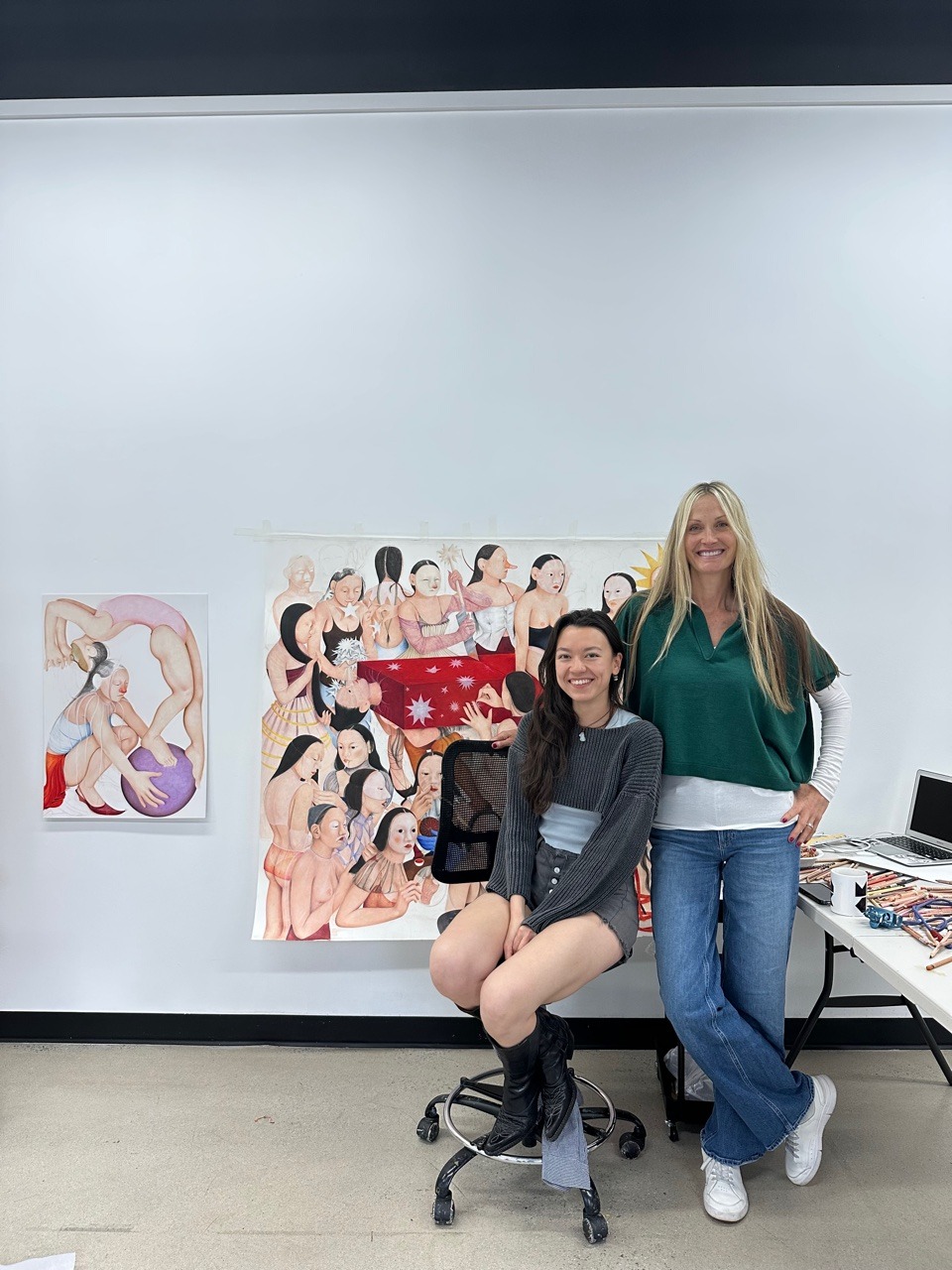
In a way, encounters with art bring us back to a sense of physicality. We’re losing that today, living so much in a virtual world. And emotionally as well – we suppress so much, and I think that’s part of why we’re facing so many mental health challenges. Bringing art into the community can awaken something in people, a kind of spirit that may be dormant, but is still there. It just needs to be activated.
We need to wake it up, I think. You know, back in the day, artists would sit in cafés and make a drawing in exchange for a cup of coffee – it was about conversation, about being part of everyday life.
That’s really the mission behind what I’m trying to do with my foundation in Greenpoint, Brooklyn. The neighborhood is changing so quickly – it’s being gentrified, developers are coming in, everything is getting more expensive, and artists are being pushed out. And yet it’s such a vibrant, creative community.
I keep thinking – how wonderful would it be if artists were still part of that daily fabric? If there was an artist living in the building, or a studio just around the corner. You go for coffee, and the artist is there. You meet them, you can visit their studio. Why not? It would only enrich the neighborhood.
So through these initiatives, and as I continue to expand, I’m also looking at ways to apply for grants, especially for projects that benefit the community and involve local residents. Hopefully, that can become another way of supporting this work.
And it really comes back to mental health, as you said. Artists need to create – it’s essential for them. I’ve gotten to know many of the artists I work with quite deeply, and they open up. A lot of them have gone through difficult experiences, or deal with anxiety, or restlessness, and creating art is crucial for them to process that. So how can we not support that?
In the studio with MAF artists Joey Healey, Jordan Rubio, Piper Bangs and Megan Gabrielle Harris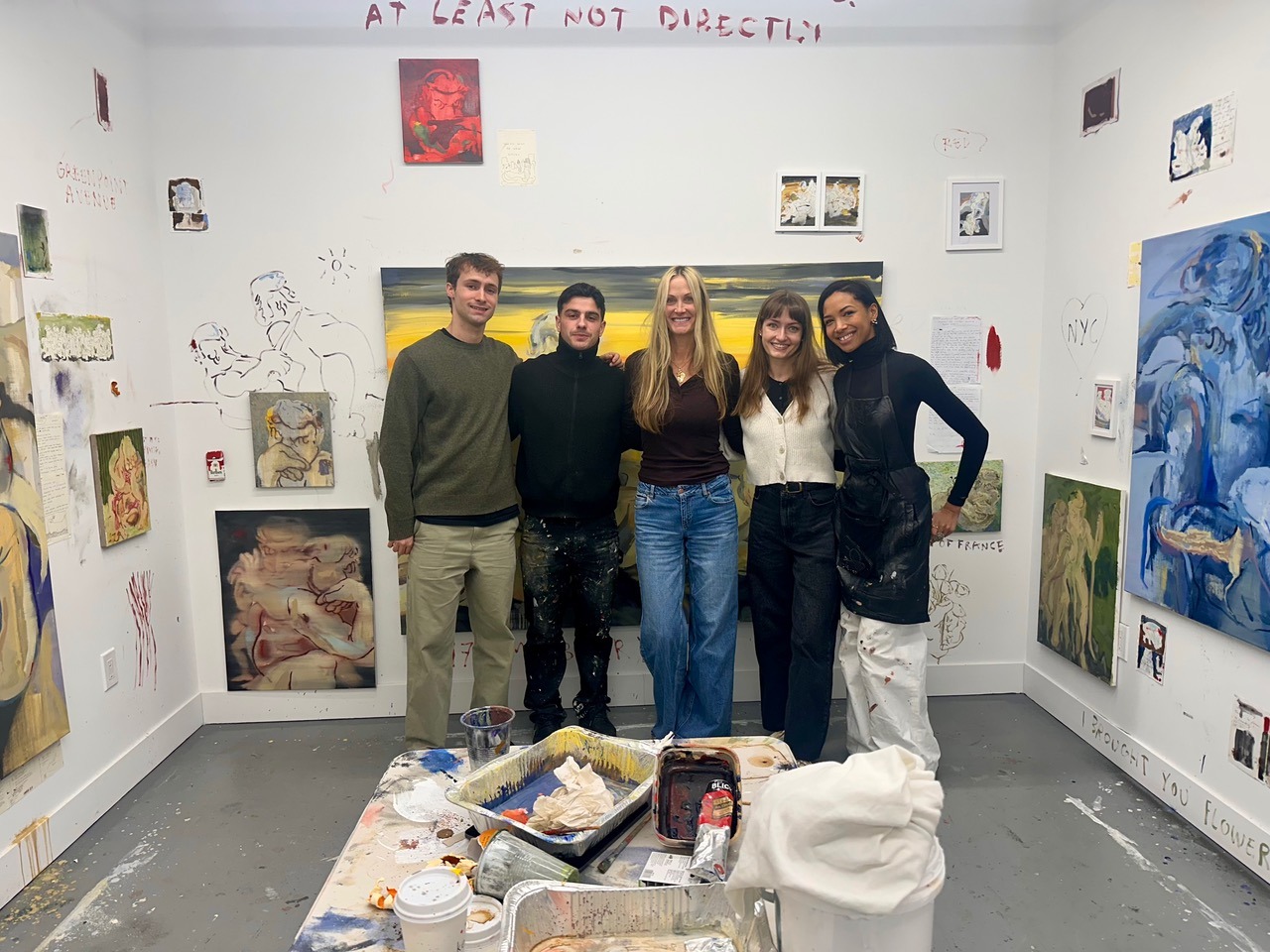
It’s important for all of us – both inside and beyond the art world.
So I’ve started to look at art very differently. It’s no longer about having this or that piece on the wall – I honestly care much less about that now. What matters to me is knowing the artists. I think I have a personal relationship with almost every artist in my collection – except, of course, for a few who are no longer alive. But otherwise, I always meet them, visit their studios, and over time we often become friends.
We stay connected, I see them when I travel, whether it’s in Paris during the fairs, or at dinners, or through the museums and foundations I’m involved with. It becomes this interconnected world, and I really love that. What’s also beautiful is how even very established artists are genuinely interested in meeting younger ones, mentoring them, supporting them.
That’s something I’m also trying to foster in Brooklyn – bringing together established artists, emerging artists, and those in residence. It creates a really meaningful sense of community. And for artists coming from abroad, it’s especially important – they arrive here and suddenly find themselves surrounded by this network of inspiring people.
It’s incredible to see the relationships that form. I’ve seen artists meet through the residency and become very close – supporting each other, even traveling to see one another. I had two artists, one from Israel and one from London, who became best friends. Truly inseparable, it was amazing to watch. They even stayed with me in New York for a week when one of them was curating an exhibition and included the other’s work.
They really do feel like family to me, like my children in a way. They’re such generous, thoughtful people, and so appreciative. And that, in turn, brings me a lot of joy. I get so much out of it myself. It is very personal. But at the same time, I want to share that experience with others. That’s really my goal for 2026 – to open it up, and allow more people to be part of it.
You’ve also started the curatorial platform Space2Create. What was the idea behind it?
I actually started that before Covid; it was about trying to activate empty storefronts and spaces. My partner and I ended up doing a lot of curatorial work – collaborations, exhibitions – and that became a really exciting process.
Then during Covid, I had the time to really immerse myself in it. My kids were home from college, and in a way, that period became a kind of silver lining for me. I learned so much – I gave myself a crash course in everything: how to curate an exhibition, how to run a gallery, understanding the global art market, even art history, since I didn’t come from that background.
So after Covid, I felt ready to do what I had really wanted – to engage more deeply with art, to write about it, and to understand how the whole ecosystem works.
Now, even though my time is quite full, I still do a lot of collaborations. I work closely with galleries, especially in New York, and with some of them we regularly co-curate exhibitions. I’m also starting to connect with other residencies. I receive so many strong applications, and I can only host a limited number of artists each year. So it feels important to build partnerships, so I can share artists with other programs, and they can share theirs with me. Collaboration naturally brings more people together and creates new opportunities. That’s how things start to grow and evolve.
At the Armory Fair with MAF artists Callum Eaton, Megan Gabrielle Harris, Piper Bangs, Andrei Kozlov and Yam Shalev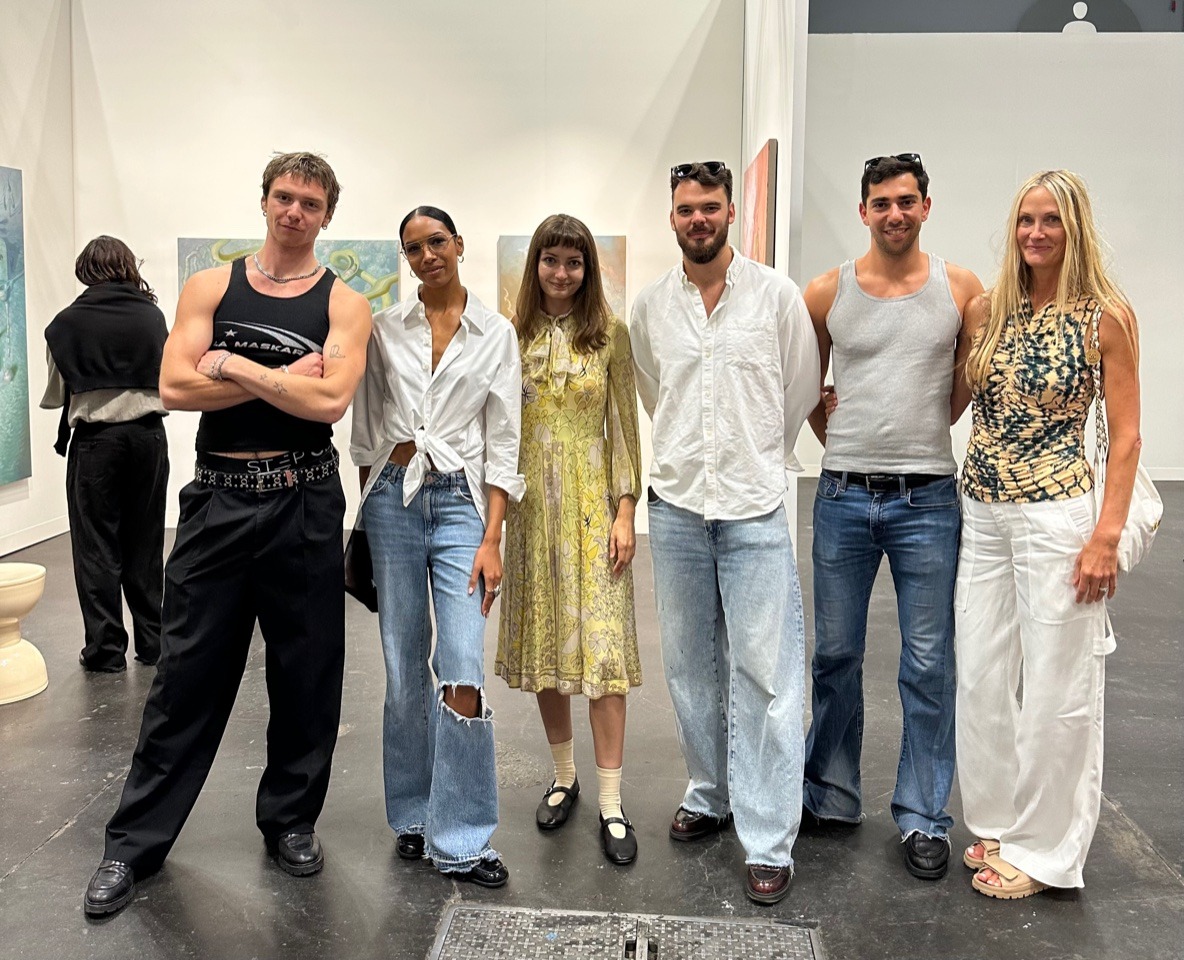
You’re also involved with several museums as a board member. How do you see their role changing today? It feels like museums are becoming more relevant than ever – as places where open dialogue is still possible, especially in the context of today’s political climate.
Yes, I think museums have definitely been changing. Especially in Europe, there’s been a strong effort to address gaps in collections – whether that’s around diversity or representation – bringing in artists who were previously overlooked. So there’s been a significant shift in that direction.
I also see how much depends on leadership. When a new director comes in, there’s often a moment for change, which I think is both natural and healthy. From my experience with the museums I’m involved in – like the Solomon R. Guggenheim Museum – I’ve seen a growing emphasis on education and accessibility. Museums are becoming more open, more public-facing. There shouldn’t be a sense of hierarchy, they should feel welcoming to everyone.
Museums shouldn’t feel stiff or outdated. Bringing in younger voices, new perspectives – it all helps them evolve. At the same time, having been involved in different committees, I’ve come to understand how complex these institutions are: how collections are built, how programming is developed, how acquisitions happen, and how much effort goes into fundraising, which is always a challenge.
There needs to be a balance – on one hand, museums rely on major exhibitions to attract international audiences, but on the other, they also have a responsibility to create thoughtful, inclusive programming.
What I would love to see more of – although I know it’s not easy – is the development of satellite initiatives. Programs that extend beyond the main museum spaces and reach communities outside the city center. For example, MoMA PS1 in Queens is a great model. It brings art closer to people, rather than expecting people to come to the institution, often at a cost.
Because ultimately, it comes down to funding. Transporting art, insuring it, organizing exhibitions – it’s all expensive. But my dream would be to help bring art into communities, and also to bring works out of storage and back into circulation.
That’s why I keep coming back to the idea of working with collectors. Many collectors hold significant collections, and as they get older, there’s an opportunity to rethink how those works are used. Instead of selling and losing a large portion to taxes, there could be more structures where works are donated to foundations, and the value can be redirected toward cultural or community initiatives.
I would love to see more models like that – where private collections help fund public programs, satellite spaces, or exhibitions outside major cities. That’s something I’m also trying to explore within my own foundation: creating a pool of resources that can support projects – whether it’s a mural in a public school or helping an initiative reach completion. Often, the missing piece isn’t huge funding, it’s just that people don’t know where to find that last bit of support.
In the studio with artist Megan Gabrielle Harris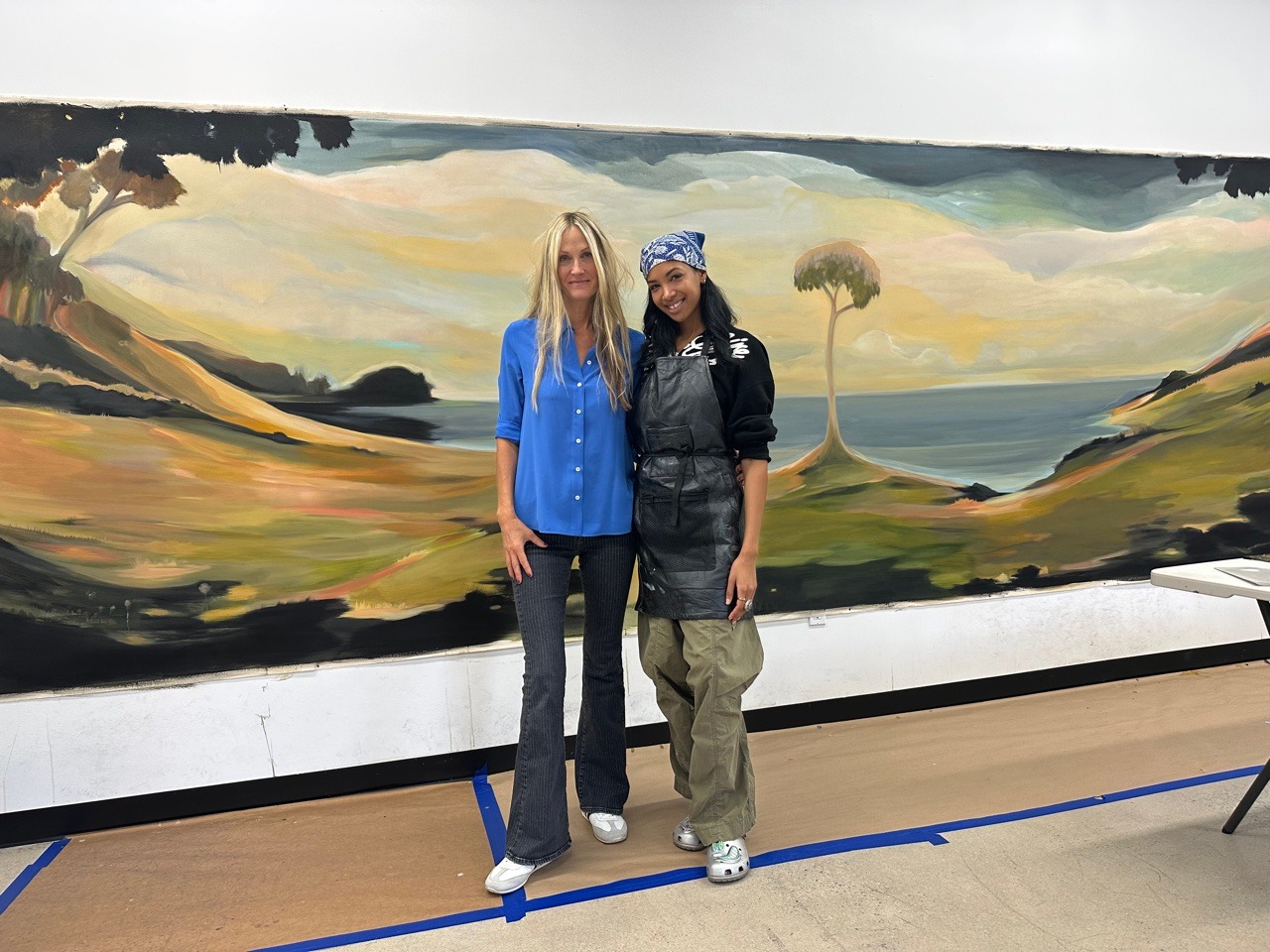
Perhaps, alongside art weeks and art fairs, there could also be open-storage weekends – ways of making works in storage accessible to the public.
Yes, exactly. There are actually some foundations and museums that have large storage facilities and occasionally use them for exhibitions. I know that the Solomon R. Guggenheim Museum has done that, although access is often limited to members. Still, these are great initiatives, because there’s so much incredible work in storage, and so many talented curators who could bring it into new contexts.
For me, that’s really the dream: to get more art out into the world – especially work that isn’t always visible – and to create thoughtful, engaging, and educational curatorial projects around it.
Right now, for example, I have an artist in residence who is doing something extraordinary. His work draws on historical references, uncovering narratives that have been largely forgotten – particularly in Brazil, where documentation is often limited, but which also connect to the United States. The storytelling in his work is incredibly powerful.
I’ve been very excited to have him in New York. I invited the director of the Museum of the African Diaspora to see his work, and today I have a curator from Museum of Modern Art coming as well. For me, artists who can tell these kinds of stories through their work are truly fascinating. I try to support and encourage that – to help artists share their voices more widely, especially in a place like the US, where these histories and perspectives are so important and relevant.
In the studio with MAF artist Elian Almeida. Photo: Weston Wells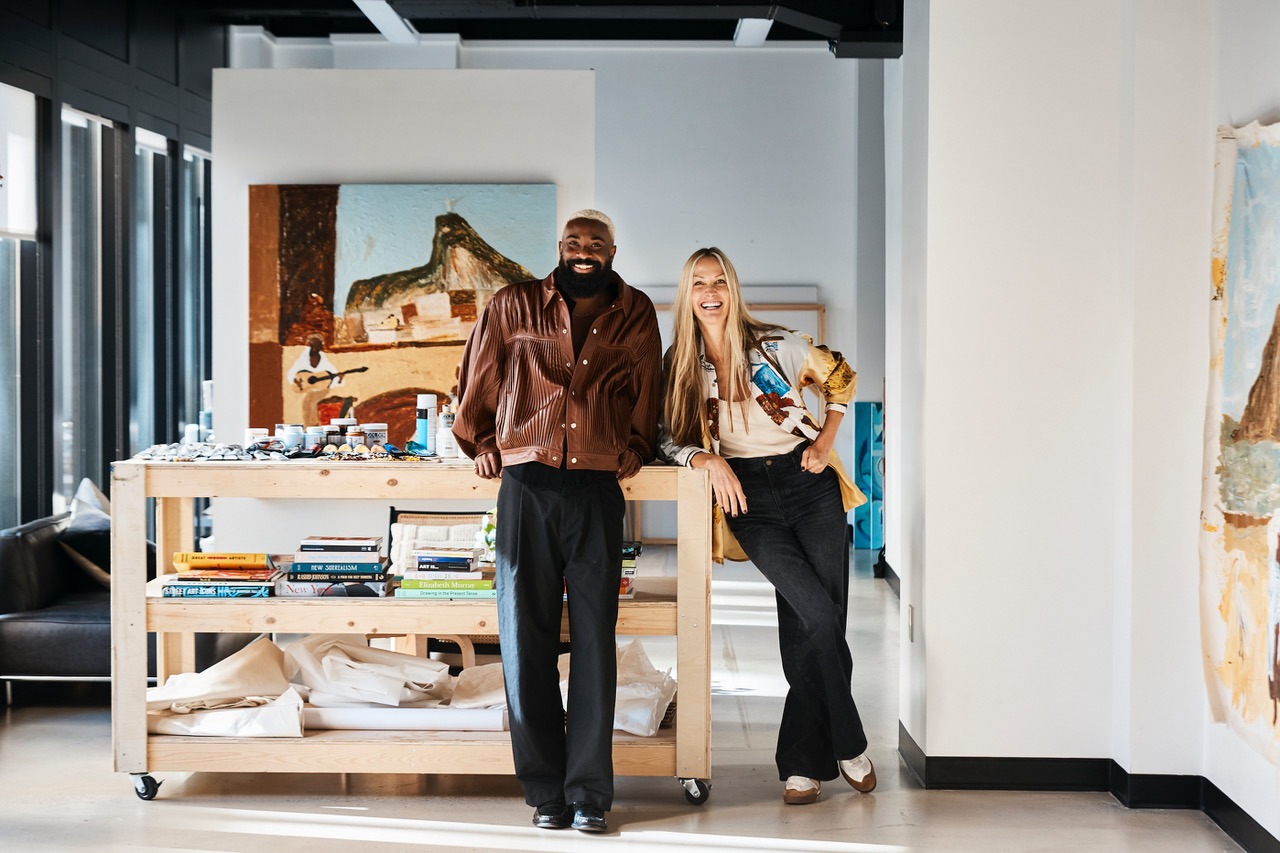
You also mentioned education, and I think that’s a crucial issue. When we talk about the power of art, we also have to consider how we engage with it. Most people look at artworks in museums for just a few seconds. In a way, we need to relearn how to look at art – how to read it, how to receive it, otherwise we simply pass by without really experiencing it. And I think this is closely connected to education. In the Baltics, and also in the United States, art is often not meaningfully integrated into school programs. So people aren’t really taught how to engage with art in a deeper way.
I know, and it really should be part of it. So many important things tend to get cut first – art, physical activity, yet these are exactly the things that support our mental health.
At the same time, I do think technology brings something positive. I’m seeing more and more tools – apps where you can scan an artwork and instantly access background information about the artist, the context, the story behind it. It goes beyond just QR codes; it creates a deeper layer of engagement.
There are also platforms emerging where you can actually connect with artists directly. I recently heard about one – there are so many new initiatives that allow you not only to explore the work, but also to interact with the artist in some way.
I think for younger generations, this could open up entirely new pathways. They’ll have access to resources that allow them to navigate the art world more independently, to make connections they might not otherwise encounter through traditional institutions like museums. So I try to see technology as something that could actually support that – making it more accessible, more interactive. Hopefully, as we move forward, it becomes a positive force in how people experience and connect with art.
At the beginning of our conversation, you mentioned Nordic art and your efforts to bring it more to the United States. From your perspective, what makes Nordic art distinct? You have Nordic roots, but at the same time you’re also able to look at it from the outside.
I do feel there’s something distinct in the Scandinavian artists I’ve collected. Not always, but often there’s a connection to nature, or something that reminds me of Sweden – of my childhood. Many of the artists I’m drawn to carry a certain Nordic sensibility in their work.
For example, Andreas Eriksson creates these beautiful, almost meditative abstract landscapes. And Clara Kristalova, who represented Sweden at the Venice Biennale, works with ceramics in a way that feels deeply rooted in Nordic folklore. That’s something I’m very attracted to – that sense of atmosphere, of narrative, of something slightly mysterious.
I’ve also been discovering many strong emerging Swedish artists, and I try to support them – bringing one or two into my residency each year. At the same time, I really feel there’s a gap in the US. There simply isn’t enough Nordic art being shown here. There are a few well-known names, but beyond that, there’s so much that remains unseen.
When you think of someone like Karin Mamma Andersson, there’s a very particular Scandinavian mood – something darker, more introspective, almost like there’s always something happening beneath the surface. You feel it. And there are so many artists working in that space.
That’s why I’m really interested in expanding this, perhaps through exhibitions, or collaborations to create opportunities and visibility. Because for me, having Scandinavian art around me is very personal. It makes me feel at home. It’s like carrying a piece of Sweden with me. And at the same time, if these artists are part of my collection, I also feel a responsibility to create more opportunities for them – to show their work, to bring it into new contexts, and to support their development.
In the studio with studio manager and artist Joey Healey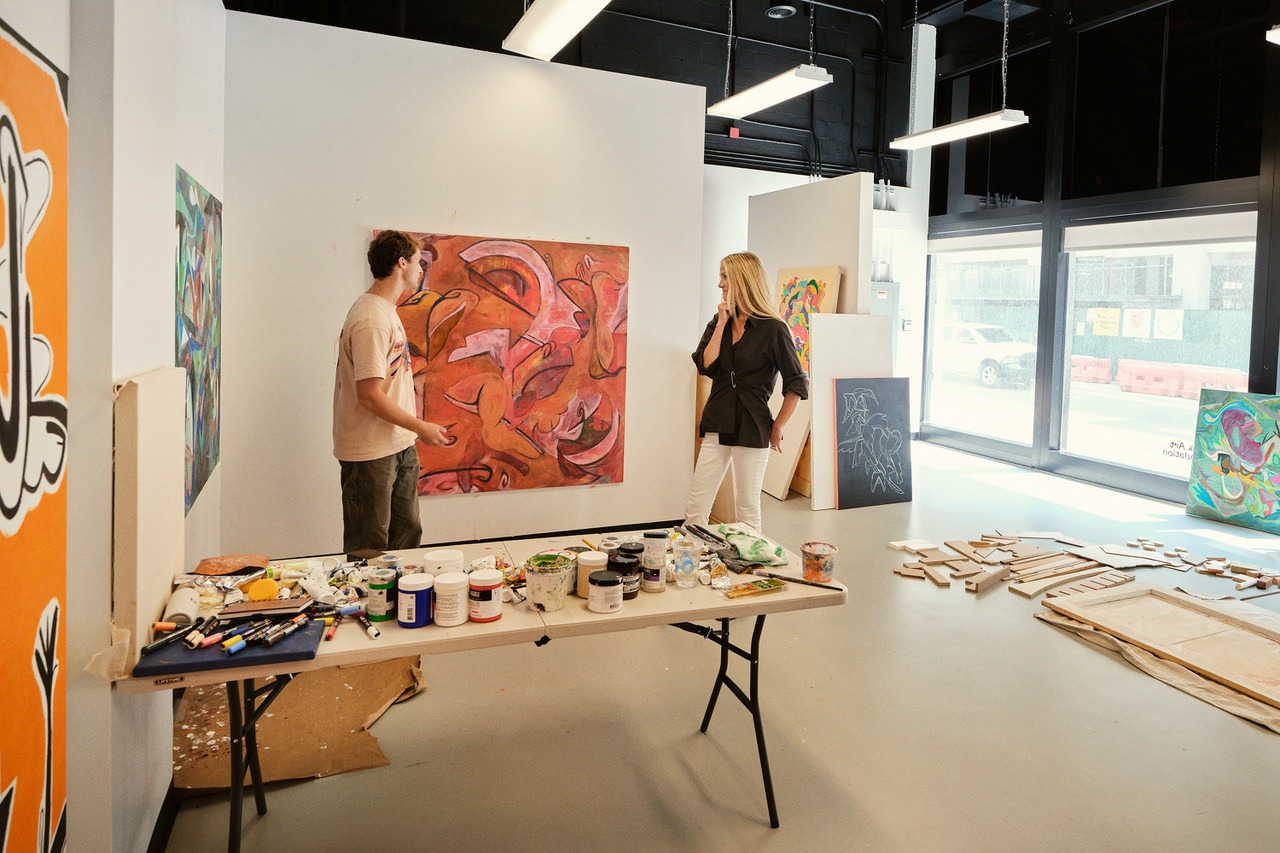
Your collection includes a strong presence of women artists. Was that a deliberate focus, or did it emerge more intuitively over time?
I think it’s a combination of both. There was a moment when I became very aware of how many strong emerging female artists were working, and I felt it was important to start collecting in that direction. I was also particularly drawn to women painting women – I found that perspective, that female gaze, very powerful.
What I’m really drawn to is work that feels courageous, strong, and expressive – something that has a sense of bravery. I find that very inspiring. And I do think it’s important that women support other women, so that’s definitely part of it as well.
That said, I don’t approach it in a restrictive way – I collect male artists too, of course. But there was a moment when focusing more on female artists felt right, and I followed that instinct. I still do.
I also think I relate to these works on a more personal level. There’s something in them that speaks to the experience of being a woman – of being present in the world, standing your ground, expressing yourself. That connection feels very real to me.
In fact, I’m currently collaborating on an exhibition that focuses on this idea – it’s going to be strong, but also engaging and accessible. So yes, looking around now, I realize many of the works I live with are by women artists.
The human body seems to be a recurring presence in your collection. Do you see that as an emotional thread, or more as an exploration of human nature and identity?
Well, yes, I do have quite a few works with female nudes, and most of them are painted by women. That’s really the key for me. It’s about the female gaze. I feel much more comfortable with that perspective.
Sometimes, when male artists depict the female body, it can feel different, occasionally even uncomfortable. But with the artists I’ve collected – like Camilla Engstrom, Ana Beneroya, Kelli Vance, and Laura Berger, there’s a sense of ownership and agency in how the body is represented. It feels more natural, more self-defined. That’s what draws me to those works.
I don't necessarily relate to them in a direct way, but I see them as brave, beautiful, and important. I like that women are taking control of how their bodies are seen and expressed. At the same time, I didn’t consciously set out to collect works like this. But looking back, I can see that I was drawn to that energy – that sense of confidence and strength. It just felt right.
I’ve also realized that I have quite a few queer artists in my collection, although that wasn’t something I actively planned either. It’s more that there’s a certain intimacy in these works – something open and honest – but in a very natural and positive way.
So yes, that kind of presence is definitely there in my collection. And, I have to say, my sons don’t seem to mind at all, I have three of them. For example, I have a large-scale painting by Christina BanBan – it’s a huge work with three nude women, covering almost an entire wall, and no one complains.
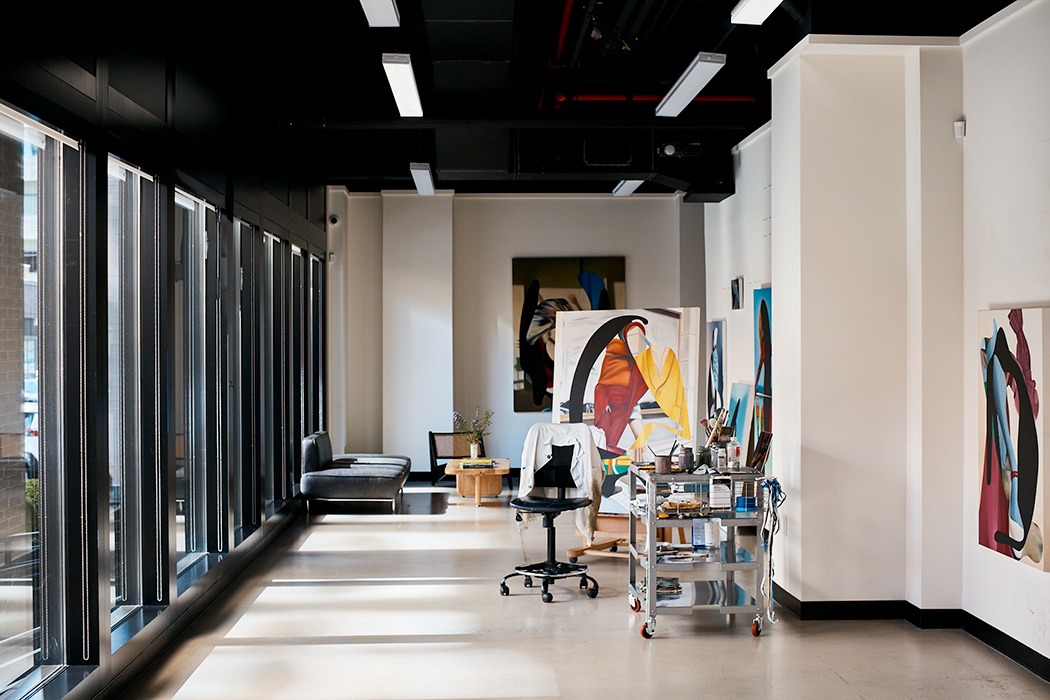
MAF studio
In a way, it seems you’re constantly looking for both intellectual and emotional challenges in art. Would you say that’s true?
Absolutely, and I’m also always looking for new directions. Part of what I’m trying to do now is offer residency prizes, which has been really valuable for the foundation. I collaborate with different art fairs and platforms to discover new talent – artists whose work feels authentic, fresh, and distinct.
That’s how I approach collecting. I’m always asking: what’s new here? What is this artist doing differently? Who is pushing something forward in a meaningful way? Those are artists who can become real trailblazers. And that also shapes my collection – I don’t like to stay in one place for too long. I move between different ideas, different artists. I’m not interested in repeating the same thing over and over again.
Can you recall a moment with art that felt almost cathartic – something you experienced both physically and emotionally, in an overwhelming way? Like the kind of feeling you can sometimes get from music.
I experience that with art all the time. It’s funny, especially during studio visits. You can literally become breathless. With music, I think the response is often connected to memory – you feel something familiar, emotional, or energizing. But with visual art, for me, it’s different.
Sometimes I encounter a work that feels so strong, so personal, or simply so beautiful that I can’t even explain it – I just stop. It’s almost physical. I become breathless. It’s an incredible feeling.
And that’s often the moment when I know – I need to live with that work, or support that artist. It’s something deeply exciting, very personal, and genuinely moving.
Of course, it’s a bit like falling in love. You can fall in love with a work, but you can also fall out of love. That’s why I try to be careful not to rely only on that first emotional reaction. You also have to bring in a certain level of rationality – like in any relationship, whether with people or with art.
But those moments – they are very real. Especially when you see a work in person that you’ve only known from images or studied before. It can be completely overwhelming in the best way.
Do you still have a special relationship with the first artwork you ever bought – by Amy Myers?
Yes, you know, that painting is very special to me. I bought it at a time when I didn’t really know anything about art. I simply responded to it – it moved me. There was something about it that felt calming, almost spiritual. It just felt right.
I also remember that it was quite a lot of money for me at the time, but I trusted my instinct and bought it anyway. And I think that’s part of why it still means so much to me – I trusted my gut. Even today, if I saw that painting for the first time, I would still love it just as much.
Back then, I wasn’t thinking in terms of artistic innovation or looking for something “different.” It wasn’t about the art world at all – it was just about that immediate emotional connection.
Over time, it became even more meaningful. I later reconnected with Amy Myers, and now we’re actually friends. When my partner and I were working on Space2Create, we reached out to her again. She had taken some time away from exhibiting, but when we visited her studio, it was full of work – it was incredible. We ended up curating an exhibition with her and inviting her to speak on a panel as well. She’s a very interesting artist.
But that first painting, it has stayed with me in a very particular way. I never put it into storage, even though I rotate many other works. It always has a place in my home in the Hamptons. It’s just gorgeous.
Would you say that, in a way, all art can be experienced as spiritual? Perhaps not always, especially in the case of overtly political work – but still, from a certain perspective?
I don’t think all art is spiritual in the same way, but I do think that when you look at art, there’s often an element of the unknown, and maybe that’s where the sense of spirit comes in. It activates something. It changes how you feel in the moment, much like music can.
That said, I do feel that some works are more spiritual than others, and I’ve always been drawn to those. I love surrealist art, and I’m very responsive to abstraction – works that create a feeling rather than explain something directly. But for me, it’s also about the artist’s voice, and getting to know the artist. When I learn that an artist has a spiritual dimension to their thinking, it deepens my connection to the work. Artists like Hilma af Klint or Agnes Pelton – there’s something in their work that feels connected to another layer of reality. That sense of mystery – something present, but not fully visible – has always resonated with me.
I think spirituality in art is very personal. Everyone responds differently. But it’s definitely there, and it can be very powerful. Art can shift your mood, take you somewhere else. If I’m feeling unsettled, I might go for a walk, or spend time in nature, but art can do the same thing. It can ground you, or lift you out of a certain state.
And that’s also why I believe so strongly in bringing art into places like hospitals. It plays a role in healing. It gives people something to connect to, a kind of emotional space or distraction that is actually very necessary.
Which brings us back to education and support – we need to support artists, bring art back into schools, involve children in creative processes. It’s not just cultural, – it’s developmental, it’s emotional. It’s essential.
Christine Mack. Photo: Weston Wells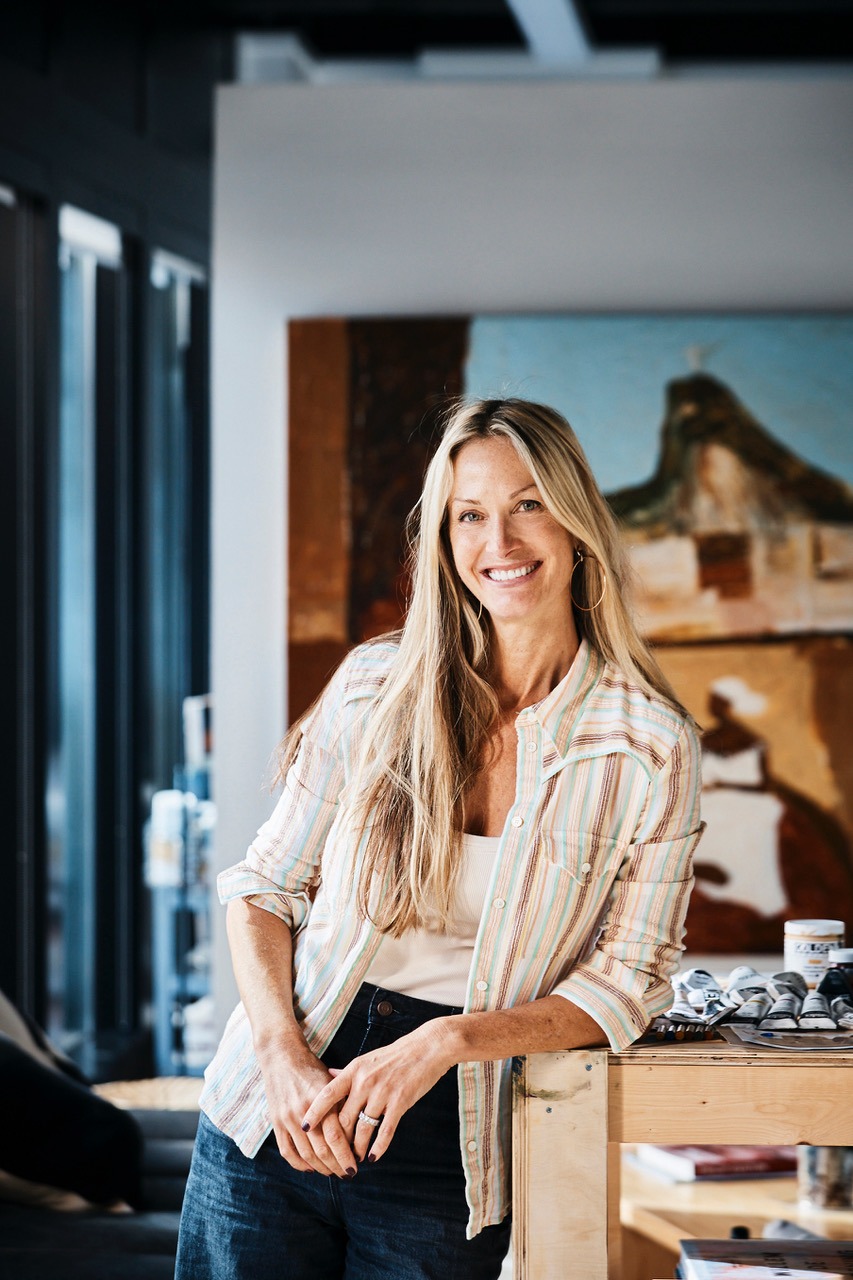
What does it mean to be a responsible collector today? The landscape has changed, and with the older generation, certain traditions are also disappearing. What should define a collector’s role now?
Well, I think people collect for very different reasons. Some are more speculative, they buy with the intention of reselling, of making money. It can feel good in the moment, but I don’t think that approach is fair to the artists or to those representing them. And we’re seeing more of that now, because the art world has become such a large financial industry. In that process, the artist can easily get pushed into the background.
So for me, being a responsible collector means being more respectful of the artist – taking the time to understand their work, to get to know them, and to recognize that what they create is not just something decorative to hang on a wall.
I also believe collectors should think about access. If possible, lending works, supporting initiatives that allow art to be seen – because it’s a shame when so much art disappears into storage and is never experienced again. I often ask artists how they feel about that. Some are fine with it, but others aren’t.
That’s why I try, especially with emerging artists, to be mindful of works that are particularly meaningful to them. I remember buying a painting by Martine Johanna that had a very personal history, it was painted into her grandmother’s frame. When she later came to New York and saw it hanging in my home, she became very emotional, because she didn’t know where it had ended up. Moments like that stay with you.
In a way, I see myself as a caretaker – a kind of safe keeper of the work. For example, I recently acquired a large painting by Sam McKinniss through Jeffrey Deitch. The gallery had hoped to place it in a museum, but that process could take time. So I said, I’ll take care of it, I’ll live with it, show it, and if the right opportunity comes, we’ll place it where it belongs.
For me, that’s part of the responsibility – to think about what is best for the artwork and the artist. Artists give us so much, and I think that should be met with a certain level of care and respect.
Of course, everyone will approach it differently. But I would like to see less focus on status, on ownership, on “having” something, and more emphasis on understanding, supporting, and engaging with the work. Because collecting shouldn’t just be about acquiring a name. It should be about forming a relationship – with the artist, with the work, and with what it represents.
What would you consider the most significant insight art has given you over the years of living with it?
Oh God, it has taught me so much. Art has changed how I see the world. It has enriched my life. I think it has also created for me a sense of community. I am very social, I love traveling, I love all my art friends. I now have friends all over the world – from galleries to museum directors, committees, artists. So it has enriched my life to a level I could never have imagined. So it’s not just about art, it’s about something else.
It has definitely changed my life in such a positive way. I wake up every morning excited. I am never bored. Art is always there. I don’t like taking vacations, I don’t like having time off. Art is, for me, my kind of mental health support. It has been very good for me – finding opportunities through art, building bridges through art, creating opportunities through art, helping artists through art.
I love the global aspect of it, the narratives, and all the good that can come out of it. It goes back to why we have to keep supporting artists and making sure they can survive and tell the stories that really need to be told.
So I feel there is a responsibility that collectors should have – to do something good. Even just buying an artwork by an emerging artist helps – not only financially, but also by giving them recognition, knowing their work is part of a collection. And I really try to encourage collectors – your collection becomes so much more interesting that way. I mean, I have a George Condo next to an artist from Brooklyn. Everything in my house is mixed together, and the dialogue between them makes it so much more interesting. So maybe be braver with it too. Why not? It’s all good.
Thank you!
