


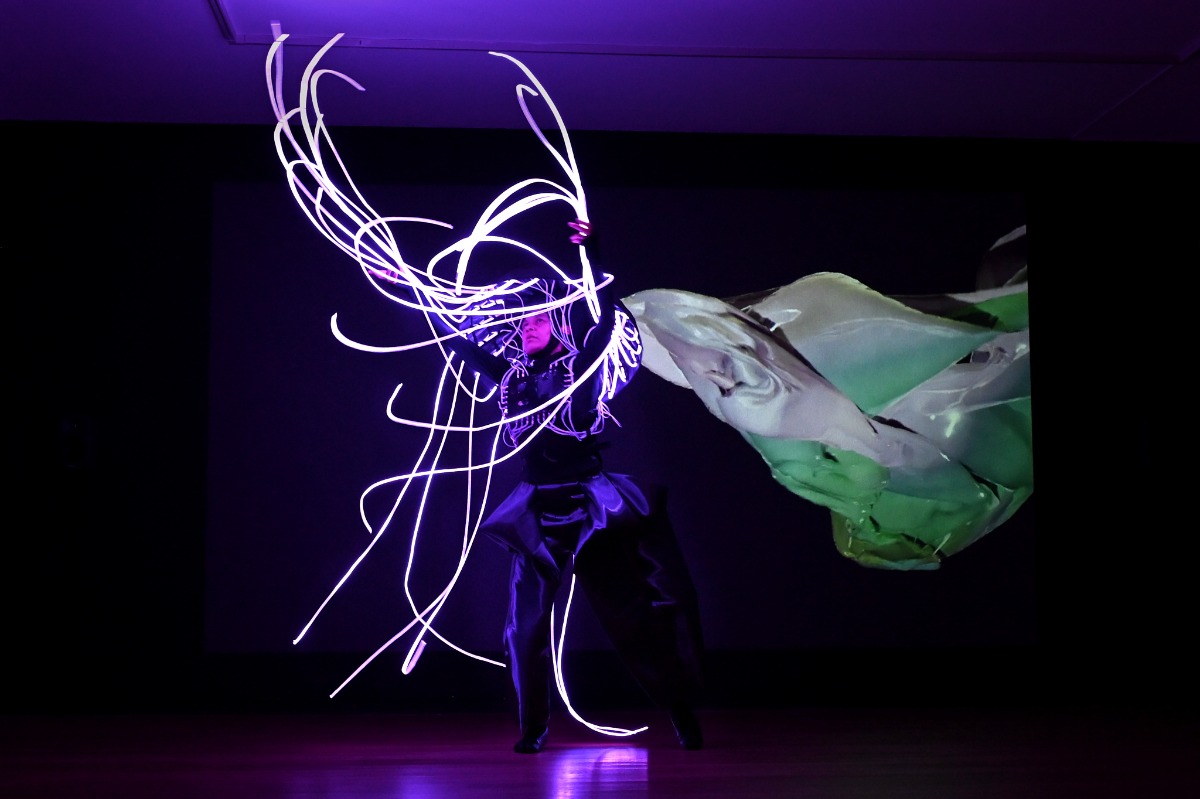
The Immortal Body: Lilibeth Cuenca Rasmussen and the Performance of Regeneration
Zanda Jankovska
Conversation with Lilibeth Cuenca Rasmussen about the shifting landscapes of performance art
Lilibeth Cuenca Rasmussen (b. 1970, Manila) stands among Denmark’s most internationally recognized artists, celebrated for her multidisciplinary practice bridging performance, video, installation, and sound. Her work is shaped by experiences of migration, cultural displacement, and hybrid identity, deeply rooted in her biography: born in Manila, the Philippines, to a Filipino mother and a Danish father, she moved to Denmark at the age of eight. At a time when questions of identity, migration, and hybridity are at the forefront of cultural debates, Cuenca’s practice offers both critical inquiry and embodied experience. Alongside her intensive artistic career, she is currently Professor of Time-based and Performance Art at the University of Bergen.
Cuenca began to emerge on the Danish art scene in the late 1990s through photography and video. Soon after completing her studies at the Royal Danish Academy of Fine Arts (1996–2002), she fully dedicated her artistic practice to performance art. Through her own body, voice, and presence, Cuenca investigates how identities are socially constructed and negotiated across cultural, political, and historical contexts.
Her artistic language combines theatricality with critical inquiry, often infused with irony. Costumes, songs, ritualized gestures, and staged environments function as tools through which Cuenca examines different dimensions of identity: ethnicity, gender, religion, colonial inheritance, and belonging. Moving fluidly between autobiographical material and broader socio-political structures, she exposes the instability of fixed identity categories while emphasizing transformation as a continuous process.
As a visual artist, she also emphasizes the relationship between time-based work and static forms. Her practice is characterized by powerful material and sensory dimension. Elaborate textiles, masks, sculptural costumes, and immersive installations blur distinctions between performance, ritual, and visual art. Costumes underscore the body's unrepeatable movements, intensifying the aesthetic expression. Sound and voice play an equally significant role, extending the body into a spatial and emotional register that engages viewers beyond purely visual perception.
Ahead of her upcoming performance T.B. TURRITOPSIS DOHRNII, dedicated to the immortal jellyfish, at the Riga Performance Festival Starptelpa, we spoke with Lilibeth Cuenca Rasmussen about her creative evolution, the role of body and language in her work, and the shifting landscapes of performance art.
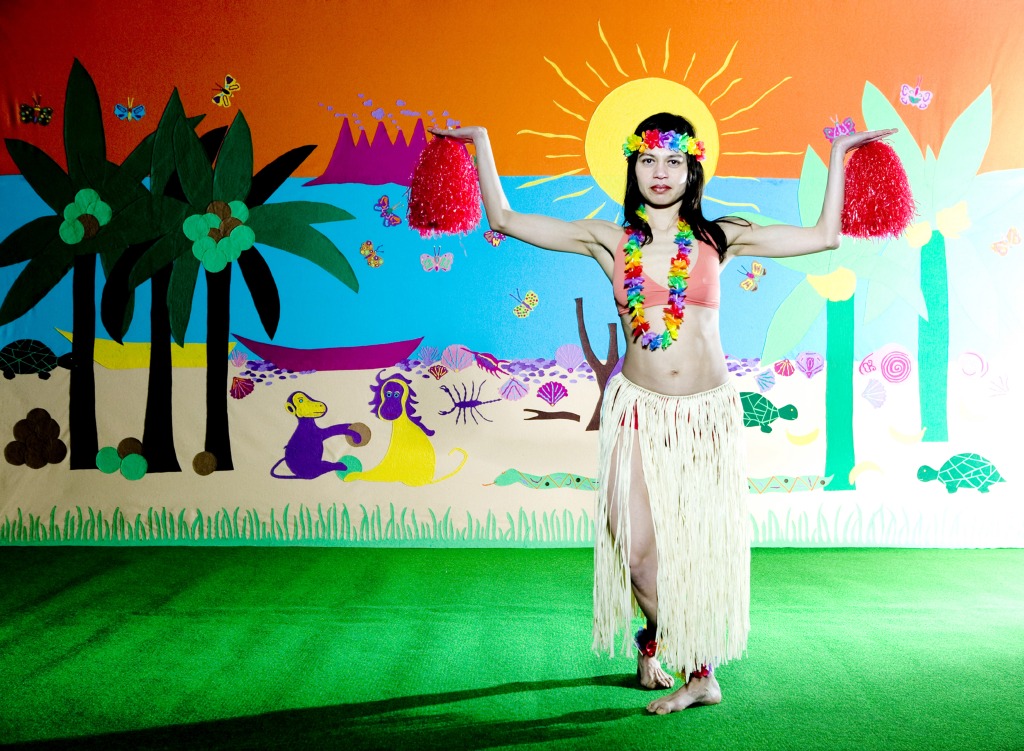
Absolute Exotic. Crediting: Ulrik Janzten
How did you arrive at performance as your primary medium?
Before attending the Academy of Fine Arts, I attended a preparatory school on Ærø in Denmark, where we had a performance class. Back then, I was thinking that this was something I should do – to work performatively. When I entered the academy, it was a different era. I was very interested in documenting reality. Video was a big thing in the 1990s, and I was very attracted to that medium. I would call it a kind of pre-beginning of reality TV. Artists were filming their grandmas and random people from the provinces.
I was also inspired by the music video genre. In fact, that is how my performance practice began. My gallerist at the time, Birgitte Kirkhoff Eriksen, said to me: “Why don’t you do this piece – the video piece Absolute Exotic – live?” She was organising interesting events alongside her exhibitions, and she invited me to perform them live. I thought that was a good challenge.
I did my first performance in her gallery in 2005. It literally felt as if I were jumping out of the flat screen and becoming physically present in three dimensions, performing my own video live. It was like a four-minute live music video: me dancing alone and singing my song. I used a prerecorded backing track for the music. Meeting the audience and experiencing the power of presence and immediate feedback was incredibly powerful. I became completely hooked on that energy. Since then, I have continued to work on performance.
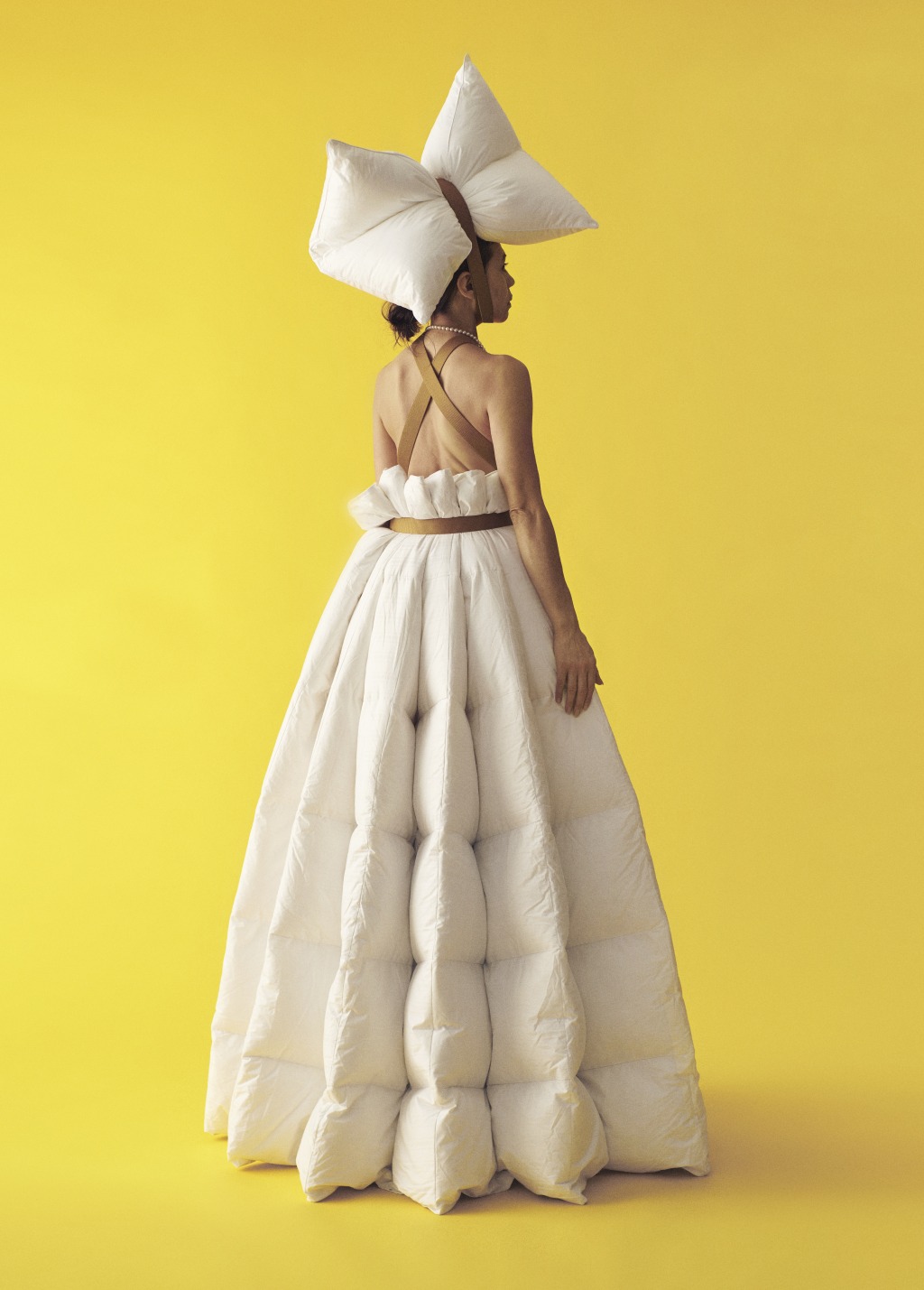
Cocktails. Crediting: Bjarke Johansen
The art historian RoseLee Goldberg has described performance as an unlimited medium. In your works, sound and costume seem to play a particularly crucial role. How did you choose them in your performance practice?
I come from an academic background, and for my generation in the 1990s, relational art was very influential. In a way, that led me to do the opposite. I wanted to create something more immediate, something that could invite the audience, or the guests, directly into the work.
Inviting people into your own story is something they can relate to. When you use yourself as a medium, that vulnerability becomes an invitation people respond to. There is a certain power in that.
For example, music for me is a language I do not really know. I do not play any instruments. It functions more as an abstract dimension in relation to the text. The text operates more intellectually. It gives focus to a story, to a linear narrative, while the music works more subconsciously. It supports the story in a more immediate, bodily, and psychological way. Music has great power to invite the audience in and strengthen the narrative. Ideally, all these elements melt together into one.
The costumes are also important because they help construct and support the persona I am performing. In a way, they also function as a shield against being too vulnerable. Behind the costume, I am simply Lilibeth, who becomes a persona. All these different elements support the story.
T.B. TURRITOPSIS DOHRNII. Crediting: Markus Liljedahl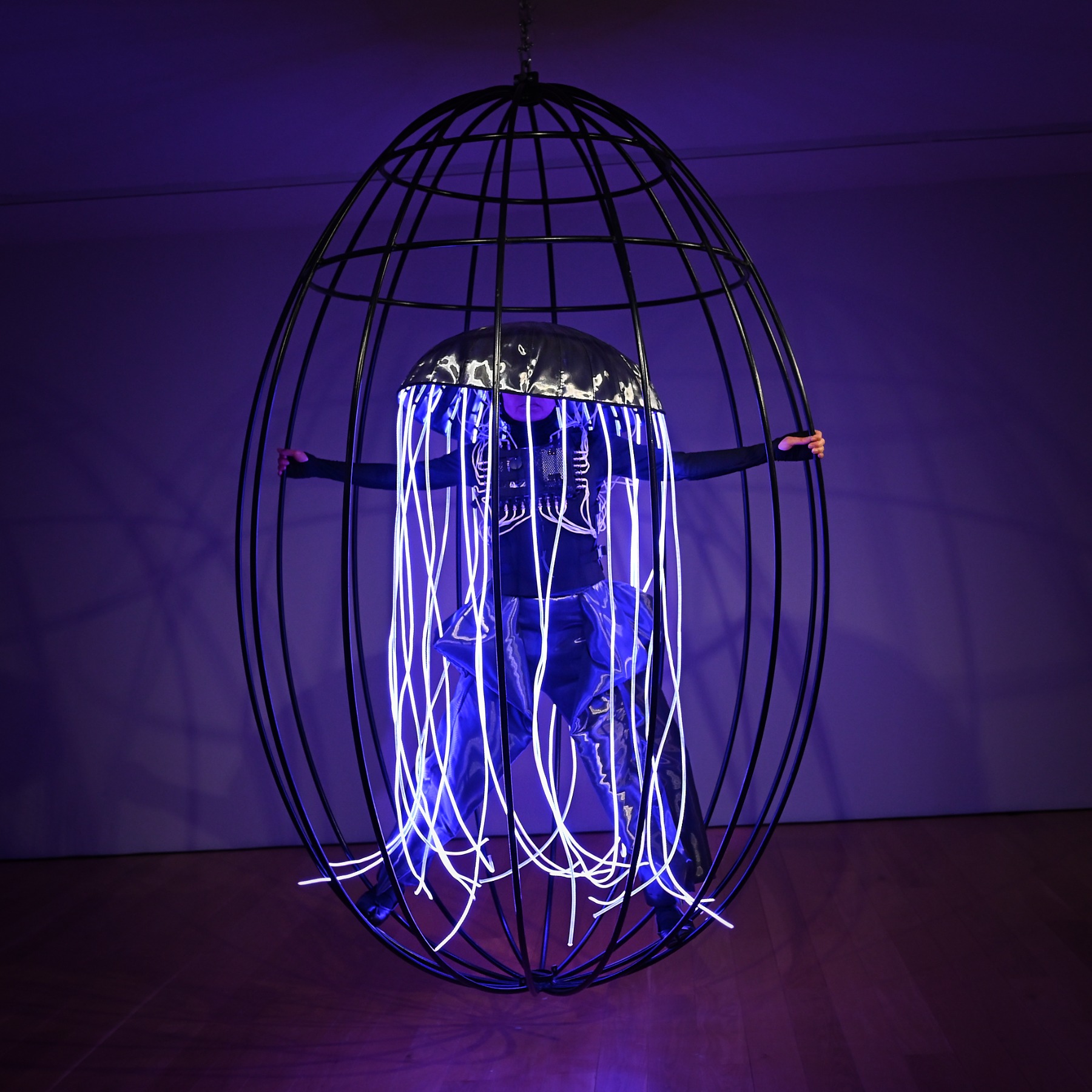
How do you understand the term “relation art”?
I do work with collaborators, but I also involve my family or my students in the work. In a way, that is also relational. All my works are inspired by real stories. I use my imagination to shape them, but all the material comes from real life. My creativity lies in transforming real life into a staged situation. Through that transformation, a certain distance from reality emerges. It becomes tangible or gains a visual dimension, rather than remaining one-to-one with reality. For me, transformation always carries an aesthetic value. The aesthetic dimension is very important because it can create a distance from reality, but in doing so, it can also make you relate to it in a completely new way.
Text has played an important role in your performances from the very beginning. Does language still occupy a central place in your practice today?
Text gives direction. It always creates a frame. Once you use text, it immediately becomes a leading element. If I combine text and music, the text somehow wins the hierarchy, because people instinctively try to understand it. When there is text, we feel we have to follow it. If there were no text, people would simply listen to the music or focus on the body's movement.
The text always guides you in a certain direction. In some ways, that is exactly what I want. But at the same time, it also narrows the work. Without text, the work expands. It becomes more open. In the new work I am creating for Riga, for example, there is no text, and that opens the narrative completely, allowing the audience to project their own meanings onto it. If there were text, it would immediately define the direction more clearly.
When I present work abroad, and the audience is not fluent in English, people still relate to what they do understand: the movement of the body, the music, the costumes, the persona. They may not understand the text at all.
All these layers within the work, the different components open multiple points of connection, allowing more people to relate to it in different ways.
Ego Song. Crediting: Jesper Jon Sørensen
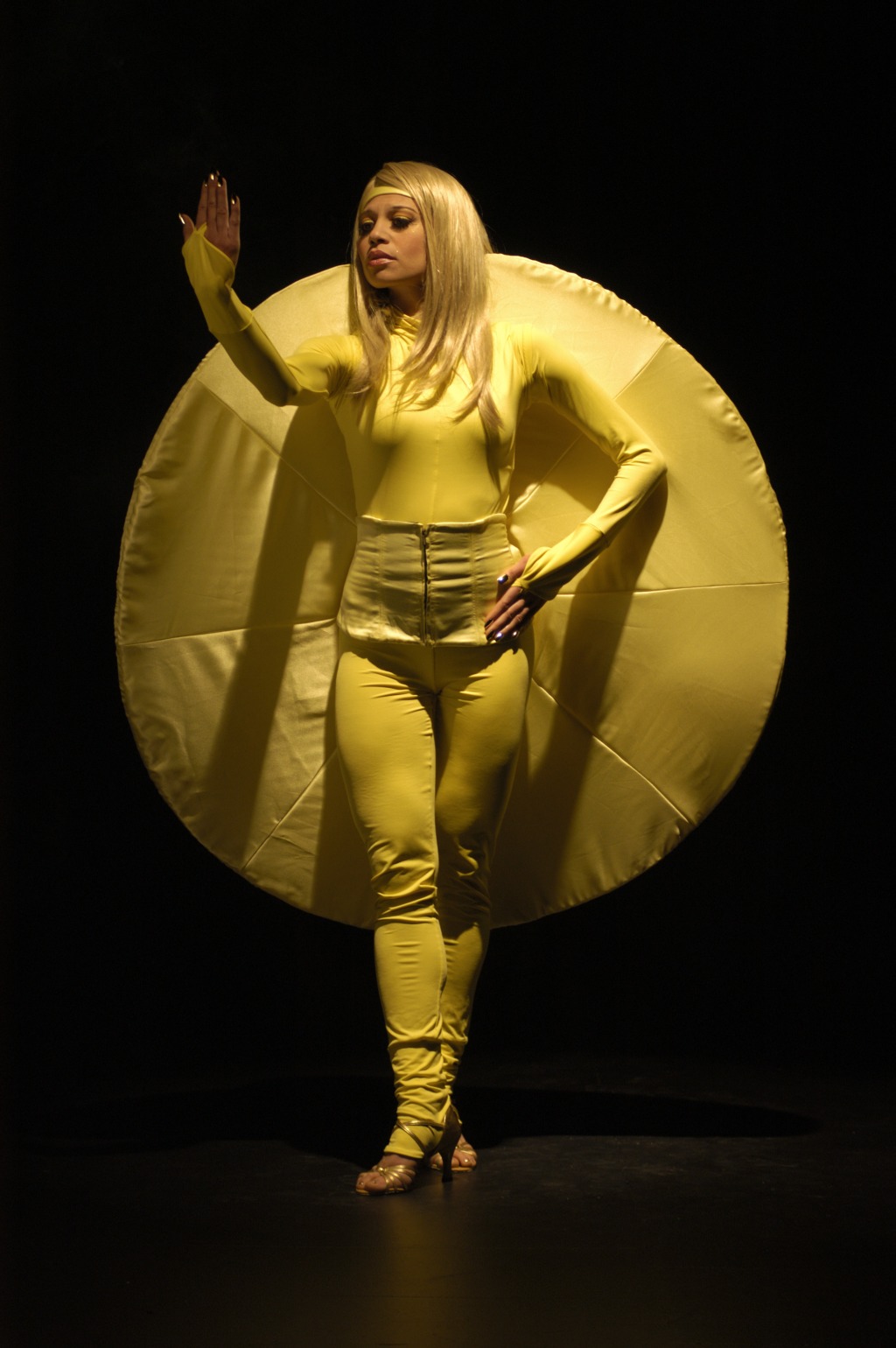
In your earlier performances, objects and installations seemed less present. Later, in the 2010s, the performative act itself often began producing objects or sculptural elements. And now it feels as though the objects and the performances develop simultaneously, almost in dialogue with one another.
In the beginning, I worked more autonomously, focusing on the work itself. I was not thinking about where it would be exhibited or in what context it would appear. I was simply working on the concept independently.
But over time, things have changed. I have produced more work, and the workload has become heavier. Over the last ten years, I have increasingly been working on a site-specific basis. That site-specific element has become very important to me. Many of my ideas emerge from the invitations I receive. I begin by thinking about the context and the situation, because I also experience the place itself. Once an idea emerges through that process, however, I can still translate the work to other places quite easily. That is not a problem at all. But at first, I was afraid of that.
I value ephemeral work - live work, just as much as static work. For me, they are equally important. But I realized that working only ephemerally was also very vulnerable. I was often invited only to do performances and was excluded from exhibitions. At some point, I realised that if I wanted to maintain a place in the visual arts world, I needed to continue producing static works as well. I began translating my performances into objects and installations.
I was invited to take part in the Danish Pavilion at the Venice Biennale in 2011. It was a group exhibition with 18 other artists. I remember being very frustrated that the curator would not let me include any physical works in the show. I was only invited to perform there. That experience made me realize how vulnerable it can be to work exclusively with performance art. In the end, I managed to get a photograph included in the exhibition.
After that, I returned more consciously to working with static forms again. I also began using video once more as a medium. Since then, I have simply been doing everything. At the same time, my awareness of three-dimensional space has expanded enormously through performance. When I was primarily working with video, the story itself was the most important thing for me. But moving literally out of the flat screen and into physical space deeply changed my perception of spatiality. Today, I see myself as both a sculptor and a performance artist. Sculpture and performance are my strongest media.
Artist Song. Crediting: Jesper Jon Sørensen
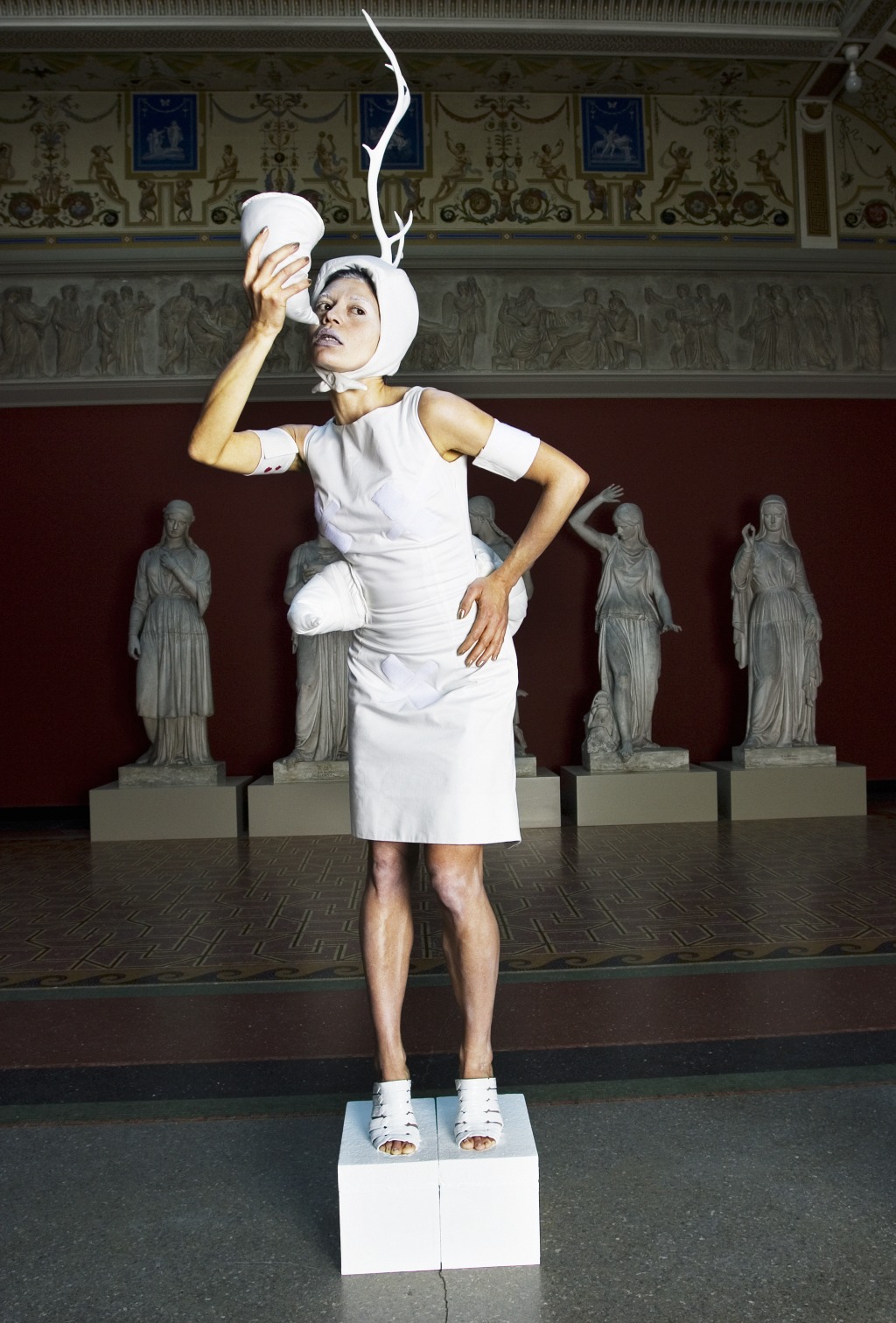
Collaboration has been an important part of your practice across performance and installation. How do you find your collaborators?
They just kind of evolve. When I did my first song with Absolute Exotic, my video editor was there. I asked: “Do you know someone who can make music? I wrote this song, and I was thinking hip hop.” So, I was working with this artist Anders Christophersen, from Denmark. That was my first collaborator. He made very good tracks for me. But then I moved to New York, where I worked with composer Pete Drungle, who works more experimentally, and he made the music for T.D. (Turritopsis Dohrnii).
The live musicians I am using help support the story and atmosphere. Music can just penetrate the body and go into your mind unconsciously, in a way that the words do not. The intellectual will start reflecting on the words, but the music will carry the mood and will help the audience to kind of digest the work. This is what I love about music.
It is amazing to collaborate with professional dancers or musicians. If I know clearly what I want to do, then I also know how to guide them. And they can give you exactly what you need. That is amazing.
I also give my collaborators responsibility, and I trust them. That creates space for things to grow. I trust them in what they do, and I give them freedom. I am not trying to control everything. For me, collaboration has to be built on trust.
I do like changing collaborators, but I also enjoy working repeatedly with some of the same people. For example, I often collaborate with the composer and singer Randi Pontoppidan. We work so well together that we do not even have to talk. We just do it.
Miss Fabula. (From the left – Randi Pontoppidan, Lilibeth Cuenca Rasmussen). Crediting: Ole Jørgensen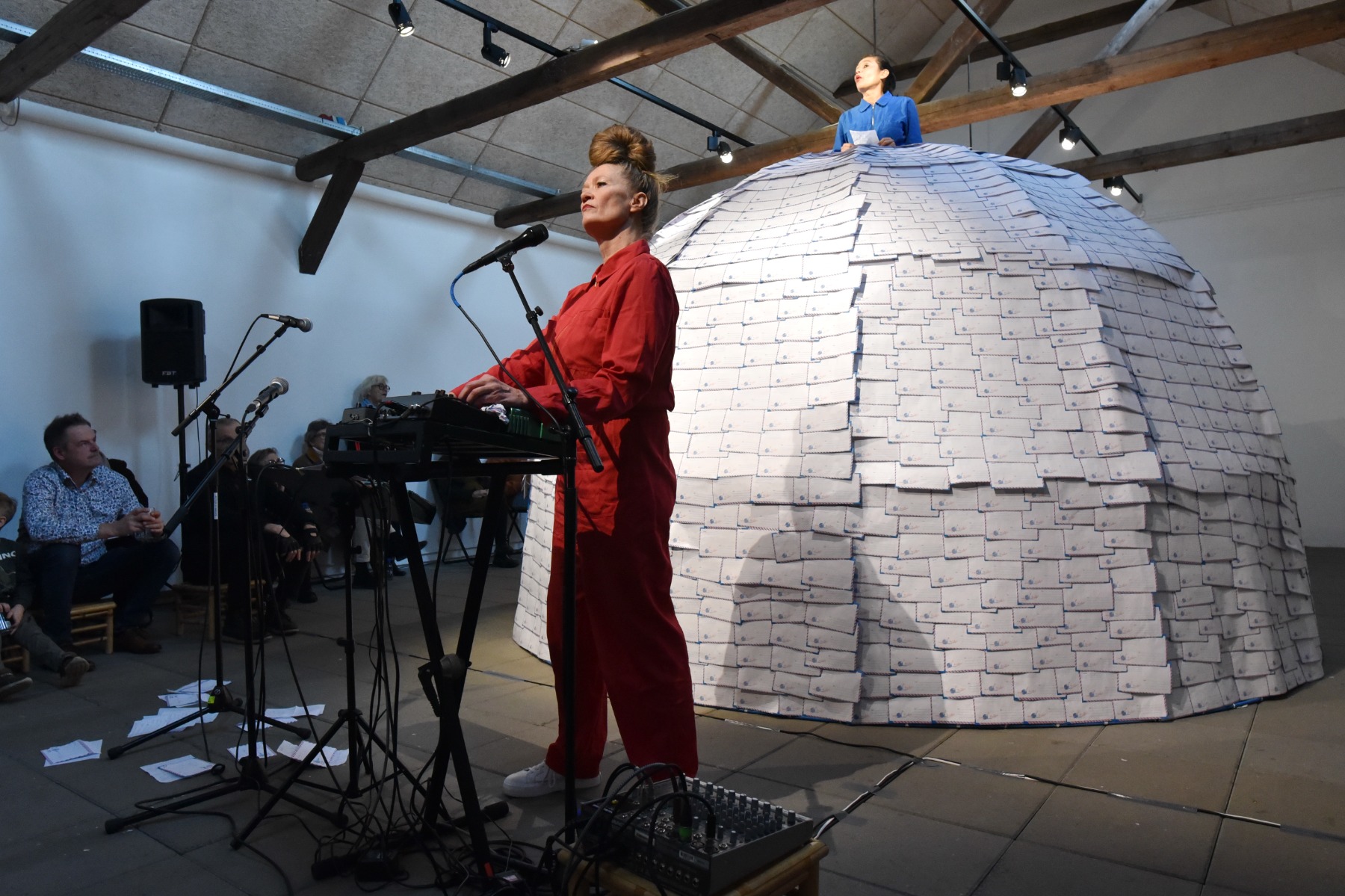
Can you share more about your artistic activities during your time in New York?
I spent a lot of time in New York. Although I only lived there permanently for one year. I had a residency with the ISCP, which I received through the Danish Arts Council in 2009–2010. My daughter was still very young. She was nine. It was difficult to leave her.
In 2007, I participated in the exhibition Global Feminisms at the Brooklyn Museum, curated by Linda Nochlin and Maura Reilly. The exhibition attempted to define feminism from different parts of the world. It was a large and a multicultural exhibition. There were about 90 female artists under 40. After the exhibition, many of the artists received representation by galleries in New York. I did as well, and I began collaborating with Renwick gallery there. From 2007 until 2013, I travelled to New York frequently.
Octopada. Crediting: Johan Persson
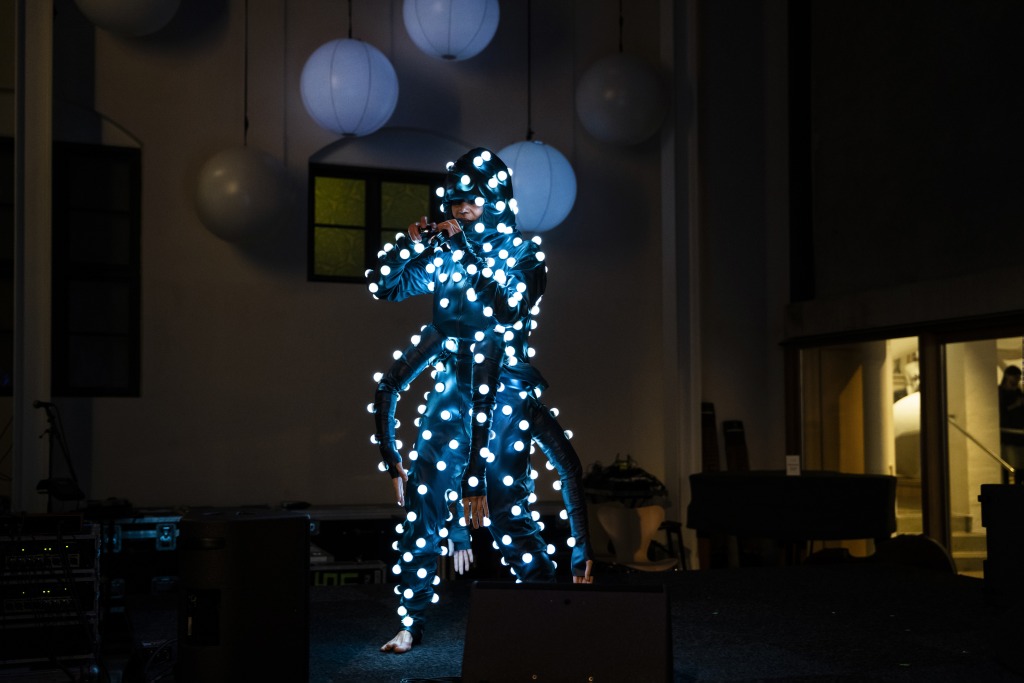
How do the narratives within your performances emerge?
It is very different each time. Sometimes the work emerges very autonomously, beginning simply from an idea. But more and more, I have been working with site-specific projects.
For example, at the end of May, I am opening a solo exhibition at Oslo Kunstforening. It is conceived as a retrospective of my work. I began researching the historical relationship between Denmark and Norway, including its colonial dimensions. The research led me to the exhibition's central idea. There is a very special room in the building at Oslo Kunstforening, made entirely of stucco and filled with fantasy creatures and hybrid animals. It is incredibly beautiful.
I took many photographs of the room. After visiting it, I had the idea of working with the figure and symbolic values of the Chimera, in the context of Denmark and Norway’s shared history. In classical Greek mythology, the Chimera is a hybrid creature composed of different animals – a lion, a dragon or snake, and a goat united in one body. Suddenly, I recognized myself in that figure: being from the Philippines, raised in Denmark, and now earning my pension in Norway. In a way, I am also a hybrid, a chimeric figure.
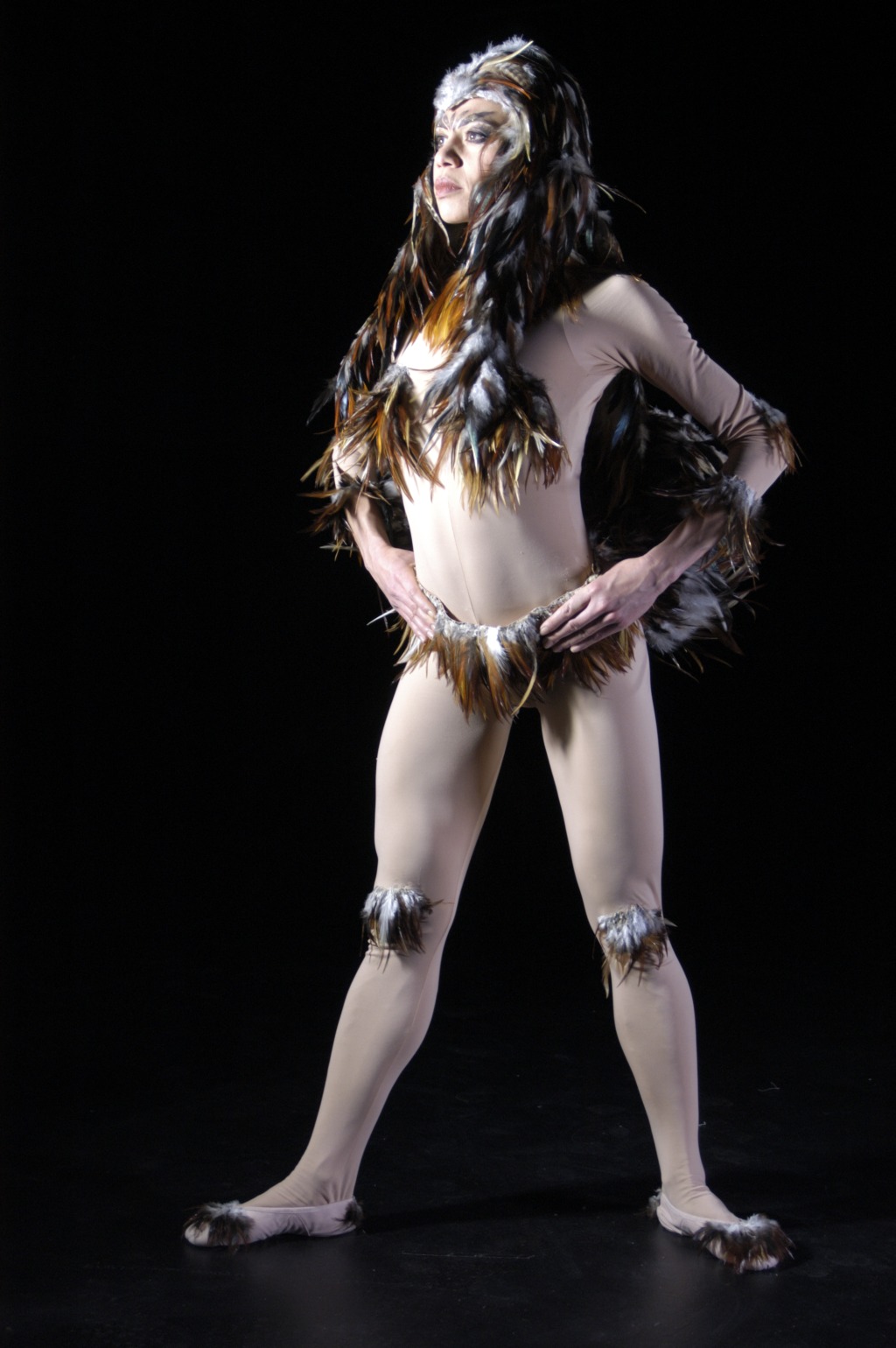
This became the theme of the exhibition, titled A Chimera Full of Love, Guilt and Frozen Figure. As I developed the project, I realized that many chimeric figures had already existed throughout my artistic practice. T.D. (Turritopsis dohrnii), for example, it is also a kind of chimera – a hybrid between animal and human. I have other figures as well, like Octopada, where I appeared as a hybrid octopus figure wearing an octopus costume with eight arms / tentacles. Or Cockfight Song from 2006, where I embodied a hybrid between a Filipino fighting cock and a female figure. In fact, I have been working with the Chimera for a very long time. Now I am also bringing these earlier works back into the exhibition retrospectively, placing them within this new framework.
This is increasingly how I work site-specific. Partly it comes from having more experience, but also from receiving more invitations. I find this way of working very strong. I think site-specific projects are especially interesting when there is enough time to develop them properly. At the same time, I also see how these works can travel and still retain a universal quality.
Cockfight Song. Crediting: Jesper Jon Sørensen
Do you experience differences in how performance is approached or understood in different parts of the world? For example, are there certain boundaries, expectations, or even restrictions in Asia that differ from those in Western Europe?
For sure, there are differences. In many parts of Asia, for example, nudity is an absolutely no-go. You could even end up in prison for it. It is not that I necessarily need to be naked in my work, but the fact is that certain things simply are not possible there.
The audience also makes a huge difference. The atmosphere and the consensus within the room are really shaped by the audience itself. It is not only I, as a performer, creating the situation. I do my work, and people resonate with it in different ways. The group dynamic in space gives me something back, and I respond to that energy. That is why performance is so unique, even when the concept is the same. The performance can never truly be repeated. Each situation becomes completely different.
If I compare, for example, China and the Philippines. The Chinese are such an interesting audience. They are so immediate. They can just go up to you and start touching you. Even though they are not supposed to touch me like that. That is so funny. But the Filipino, they are very reserved and almost shy. And that is so interesting. And the difference I could also feel between Denmark and Sweden. I am always scared of performing in Sweden because they are so distant. I cannot read their faces. They are very formal when they are watching. Like in Denmark, they are more like, “Yeah!” (Z.J. – Lilibeth screams happily.) Sometimes, when I have been performing in Sweden, it feels like, “Oh my god, they really hate this.” But later, they are very good at coming up and giving feedback.
Octopada. Crediting: Johan Persson
The performance you are presenting in Riga is inspired by the immortal jellyfish. What drew you to this figure, and what attracted you to it conceptually?
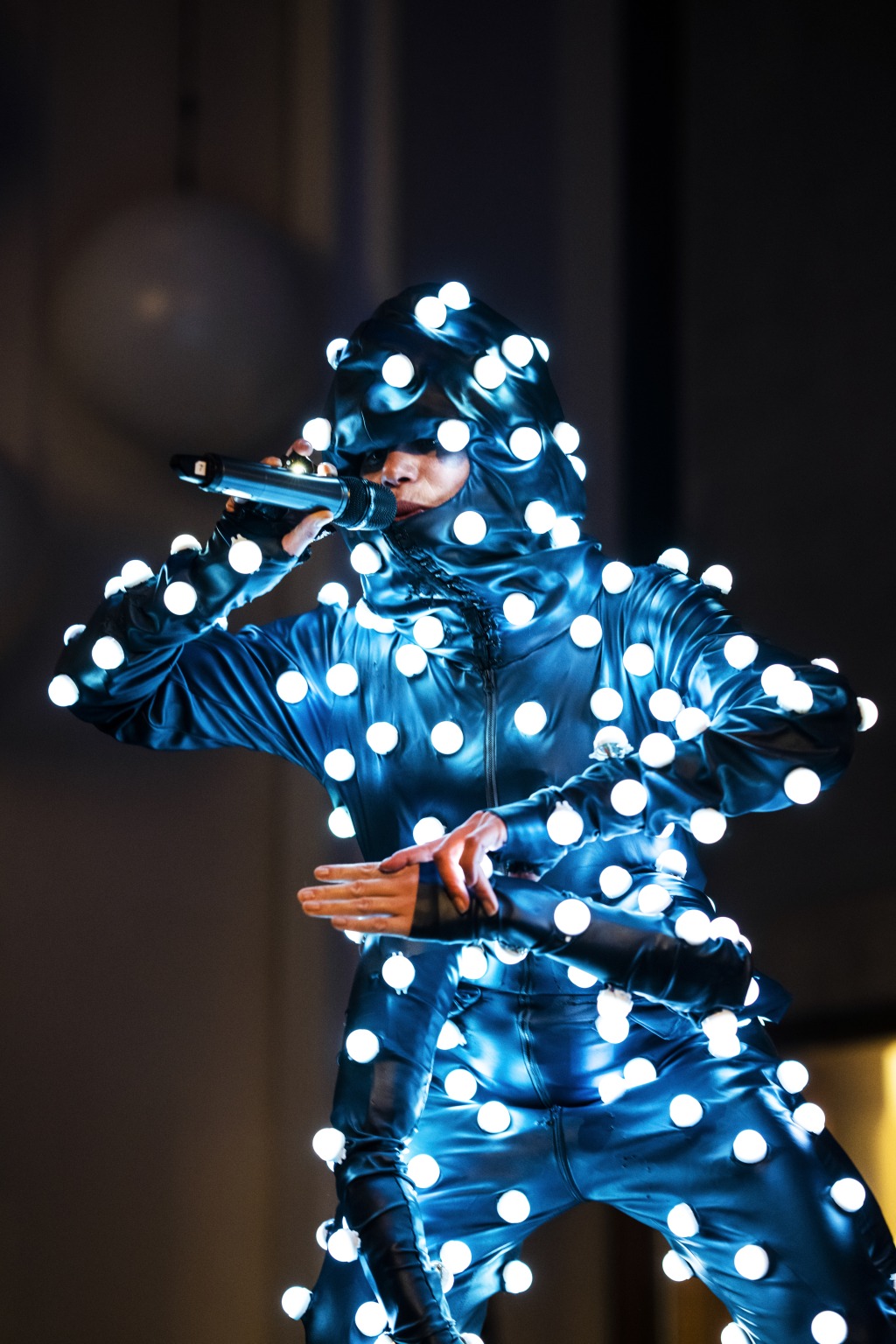
It came from a character I had already created called Octopada. It was an electronic light costume inspired by an octopus. But the costume broke down. It was not constructed very well. Afterwards, I wanted to make a new one. At the same time, I became bored with simply repeating the same thing. I wanted to create something different, and then I discovered this amazing animal. Instead of making another octopus costume, I decided to create a jellyfish light costume.
What fascinated me was its incredible regenerative ability. It fits so strongly into our own time and culture of recycling. Can you imagine being able to regenerate yourself? To be completely self-sufficient? In our culture, that is almost the ultimate ideal: to produce your own nourishment, regenerate yourself, and reuse your own body to become young again.
This is like so much into recycling, upcycling, and immortality. We want to keep on moving and keep on living, repairing ourselves or having society repair us. You are not even allowed to die anymore. It is interesting how you can keep on living and getting repaired. This is so much, I think the immortal jellyfish is so relevant in the time we are living in now. It is spot on.
The immoral jellyfish is as small as the top of my thumb. It is a contemporary animal. It is also super beautiful. If you look at pictures of it, it is transparent. You can see its veins, blood, organs, entire anatomic mechanism.
How does this performance differ from your previous works?
I did not write a text to the immortal jellyfish. I have performed it with Randi Pontoppidan in Borås Konstmuseum. Together, we created this feeling that she was giving the immortal jellyfish a voice, and the immortal jellyfish was like pure body and light, just energy.
People were so happy. You cannot imagine the faces of how people filmed it. Once I put the costume on, I went straight out onto the street and started interacting with people, and people were just like [gasps]! I am giving out energy. I am giving energy to space and making people look up from their iPhones. I am not using text this time, but I am using my body. I am using the elements of the lights and movement to create this interaction.
I am looking forward to performing it in Riga, because then I will get another feedback and I will see how people relate to it.
Does the costume respond to the audience in any way, for example, does the light change through interaction with people?
I decided to control the interaction. When I had octopus’ persona, I changed the light if, for example, I met a person wearing a green dress. I would point at the green dress, and it would be all green. The octopus was changing light and trying to adapt to its environment. I decided not to have this in the jellyfish. I am the one who controls the mood. I am reacting to the world and transmitting my reaction out through light.
There are five different animations incorporated in the costume. I call it animations because the lights have different colors and movements. There is a blue light that is glittering like a sunny day. There is a turquoise animation that looks like a waterfall. And there is one purple light that is more like nervous. It feels like there is a beat in the light, and it is going fast. Kind of anxiety light. And then there is a red light that is exploding like an alarm.
T.B. TURRITOPSIS DOHRNII. Crediting: Markus Liljedahl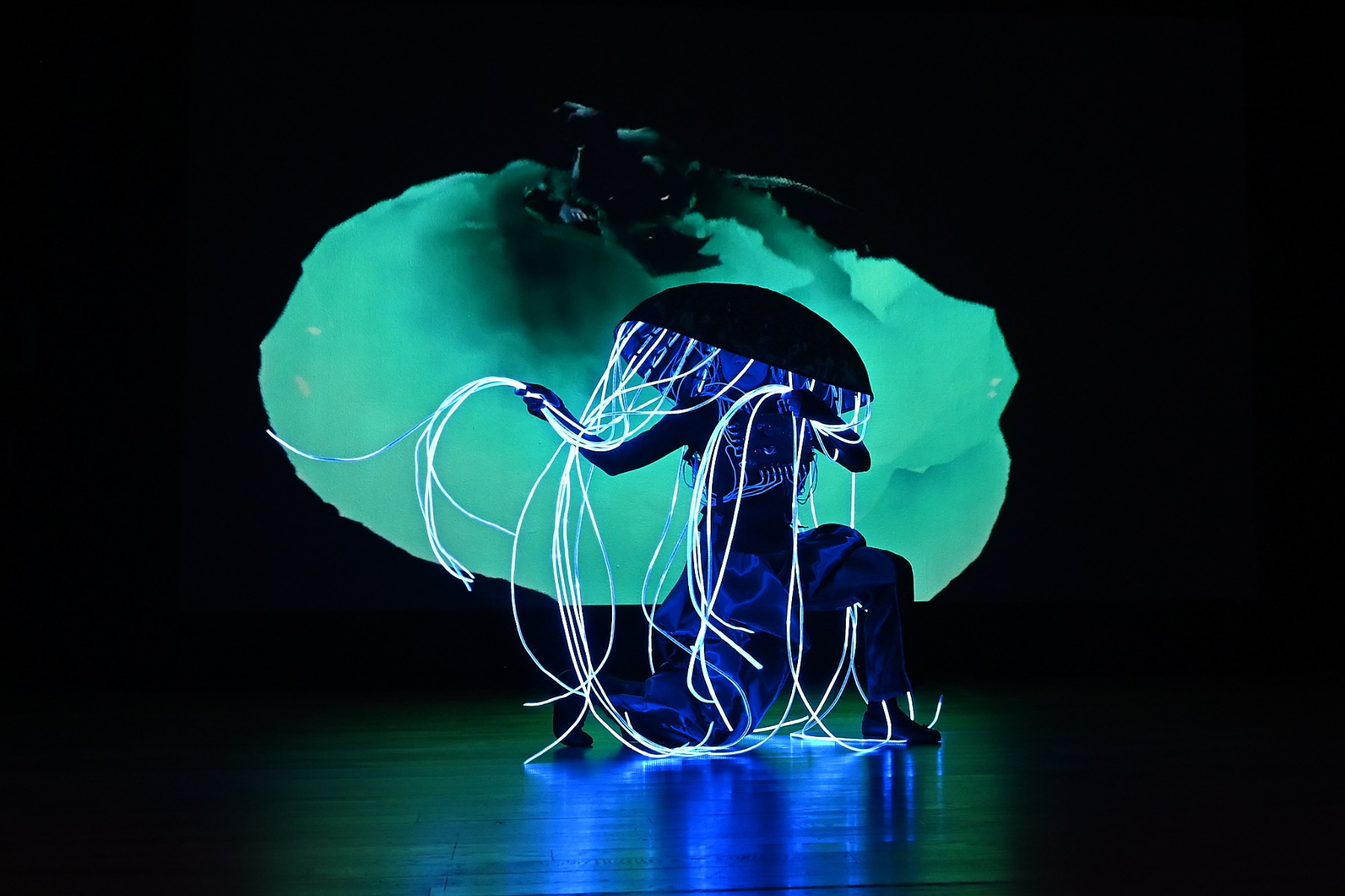
Since you are travelling with the jellyfish performance across different countries (Sweden, Norway, Latvia, China, and Denmark) - does the jellyfish somehow transform from one place to another?
I started working with Randi Pontoppidan in Sweden, and she will also be with me in Denmark. But in Riga I will be alone. It will be more like being in the flow with people. Not a staged situation. But I do have the music, so I am going to make my movements.
I am trying to push myself in a new direction. In the immortal jellyfish, I am trying not to use words this time. I just want to say that I fear not using the words because this is my signature. Many times, people know that I work with words and they are waiting for the story, but this time I will challenge myself and note use words. I hope that the performance will be powerful without.
