


The Possibility Space
An interview with Nari Ward on the occasion of the opening of his exhibition Until That Day at the DESTE Foundation Project Space on Hydra
It was windy on Hydra during the opening of Nari Ward’s exhibition Until That Day. The sea surrounding the island was restless, carrying voices, boats, memories, and the reminder that life unfolds according to its own rhythm. It felt like an apt setting for Ward, an artist whose work repeatedly returns to uncertainty, transformation, and the often fragile connections between people, places, and histories.
The opening marked DESTE’s annual summer art project at the DESTE Foundation Project Space, Slaughterhouse, on the island of Hydra, a long-standing tradition initiated by collector Dakis Joannou. Yet this time, something felt different. With domino tables placed along the path leading to the DESTE Slaughterhouse, Ward subtly shifted the focus from arrival to presence.
As he reflects in our conversation, the sea becomes both a space of contemplation and a reminder of everything that exceeds our ability to contain, understand, or control. In Until That Day, created for the DESTE Slaughterhouse, it appears as a route and a border, a source of rescue and danger, a medium of communication, and a metaphor for the unknown.
Over the past three decades, Ward has returned repeatedly to the stories embedded within objects. Rather than treating materials as passive matter, he approaches them as witnesses to human experience – carriers of memory, movement, loss, resilience, and possibility. Developed in dialogue with Hydra’s landscape, communities, and histories, Until That Day brings together fire hoses, anchors, bottles, emergency blankets, keys, and music inspired by Haile Selassie’s historic speech and Bob Marley’s song War.
In this conversation, Ward reflects on improvisation and chance, the meaning of home, the transformative power of materials, and why art remains one of the few spaces where uncertainty can still be embraced rather than feared.
Opening event of the exhibition "Until That Day" at the DESTE Foundation Project Space on Hydra on June 23, 2026. Photo: George Skordaras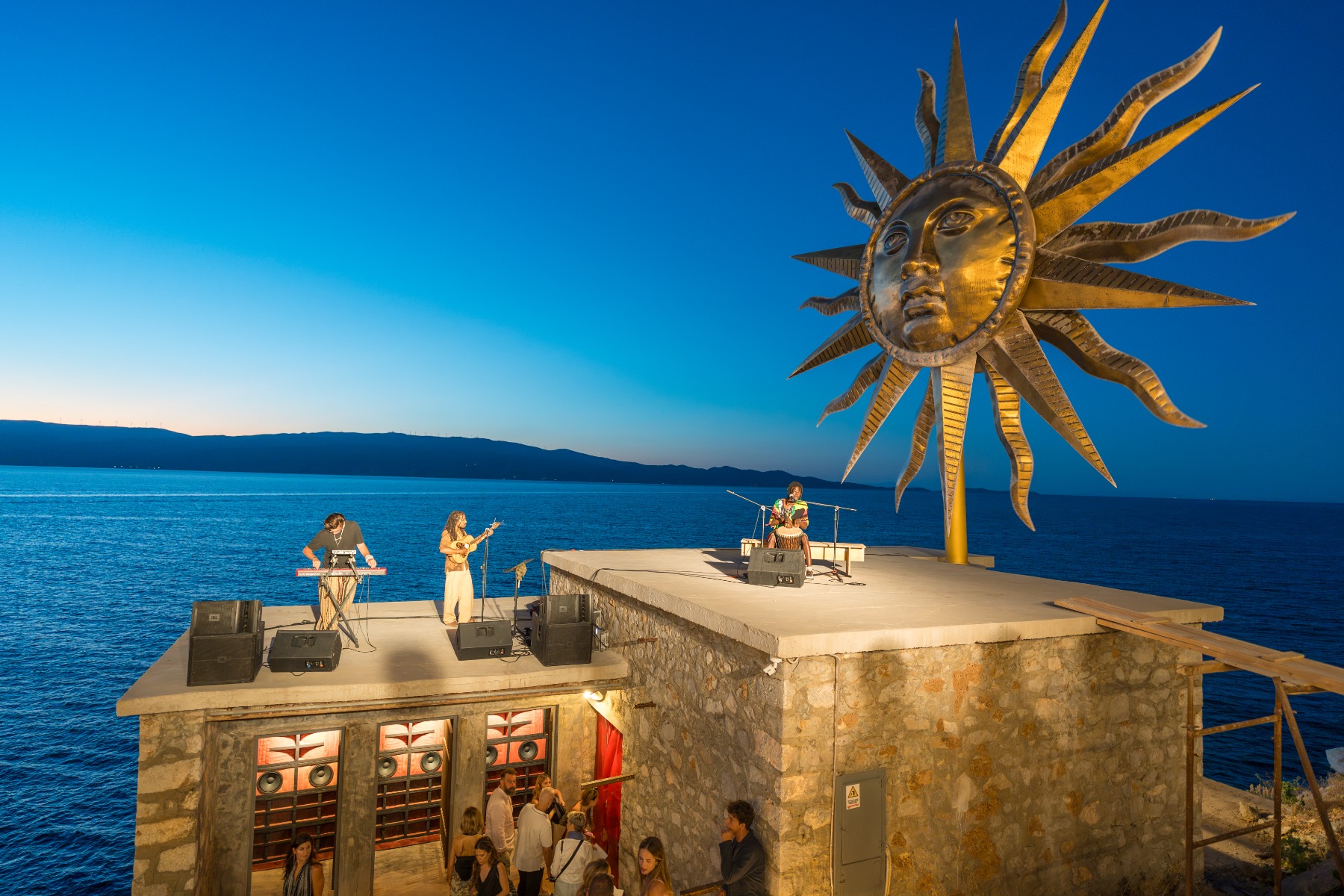
Your work often emerges through encounters, improvisation and unexpected discoveries. What role does uncertainty play in your creative process? Has art taught you a different way of relating to the unknown?
Yeah, I think from the very beginning, my engagement with the found object has always been a dialogue with chance. That’s been really pivotal because it allows me to reimagine something that already exists in the world and then build a story around it, rather than beginning from a story I already know. In a way, that sense of the unexpected is essential to how I grow, both as an artist and as an individual. It has made me more open to things not always going, so-called, “right”, and much nimbler in adjusting to events in life that can be difficult to deal with. It’s given me a kind of flexibility, a willingness to stay open to possibility, even when something is challenging or difficult to process.
Installation view of Nari Ward's "Until That Day" at the Deste Foundation Project Space, Hydra, 2026. Photo: Pinelopi Gerasimou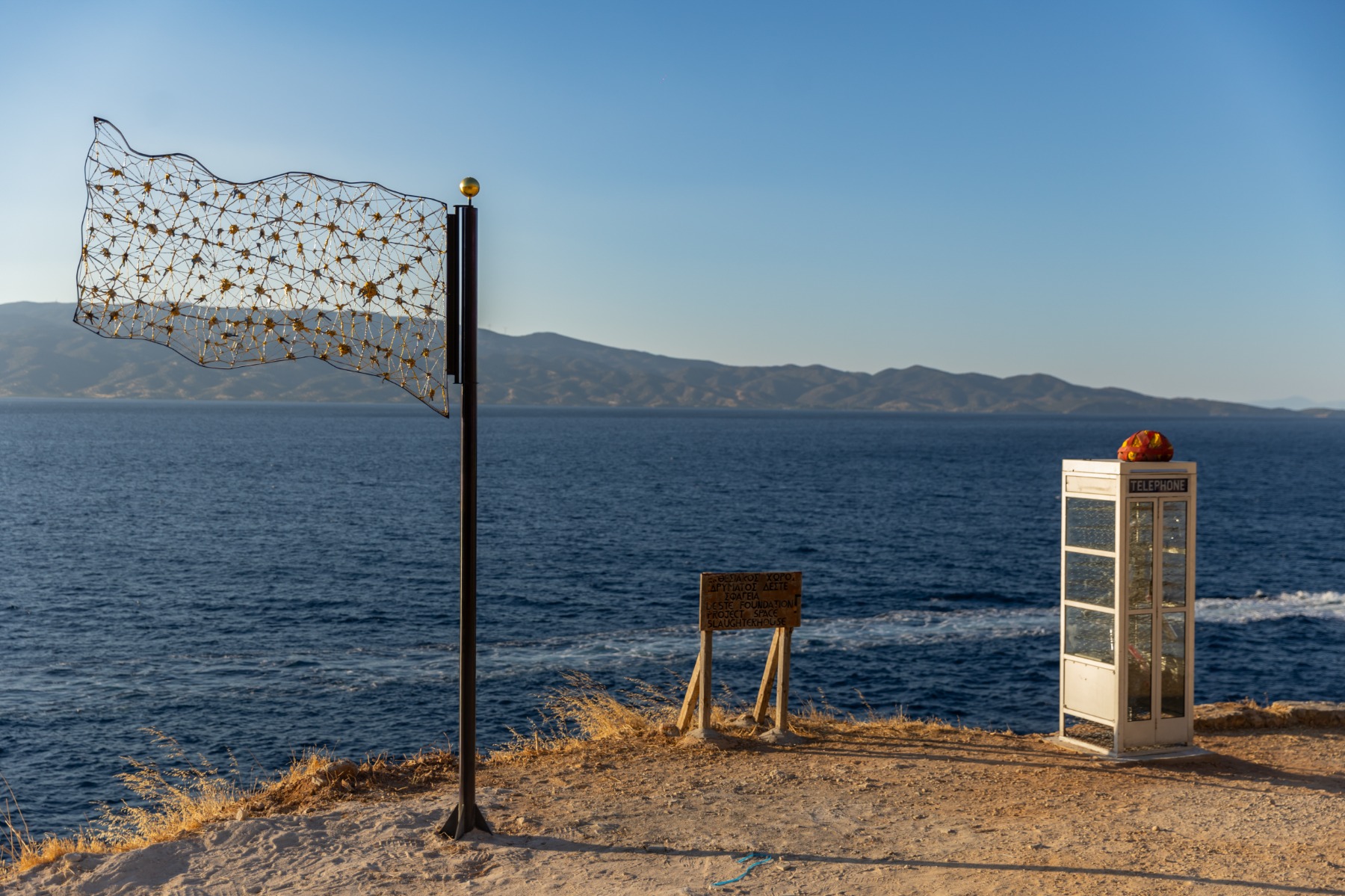
Your exhibition at the DESTE Slaughterhouse emerged from a very specific encounter with Hydra. How did the island change the work, and how did the work change your experience of the island?
I think the site-specific nature of the project really allowed me to evolve. It also brought me back to a material I was deeply interested in early in my career. In the 1990s, I worked extensively with fire hose, but over time I moved on to other materials and other stories. When I arrived on Hydra, I noticed the island’s small fire department and began to understand the essential role it plays. Because Hydra is an island with limited access and difficult terrain, responding quickly to a fire is critical. The realities of both fire and water became much more meaningful in that context. The vulnerability of the landscape and the urgency of protecting it gave those materials a new resonance. That sense of vulnerability made me want to revisit the fire hose – not simply as a material, but as a way of engaging with the anxiety and responsibility surrounding fire. I was interested in bringing that story into a conversation people might not expect. The project also changed the way I approached the exhibition itself. The slaughterhouse is a relatively small space, but I realized the work couldn’t be confined to the interior. I had to think about how it would extend beyond the building and engage with the landscape. That led me to consider the relationship between inside and outside, culminating in the deck at the back with the anchor, which became a kind of threshold between the two. The project ultimately became an exploration of interior and exterior space, of the building, the landscape, and the sea. Thinking through those different relationships was one of the most exciting aspects of the work.
Nari Ward’s Coupling (2026). Installation view of the exhibition "Until That Day" at the Deste Foundation Project Space, Hydra, 2026. Photo: Pinelopi Gerasimou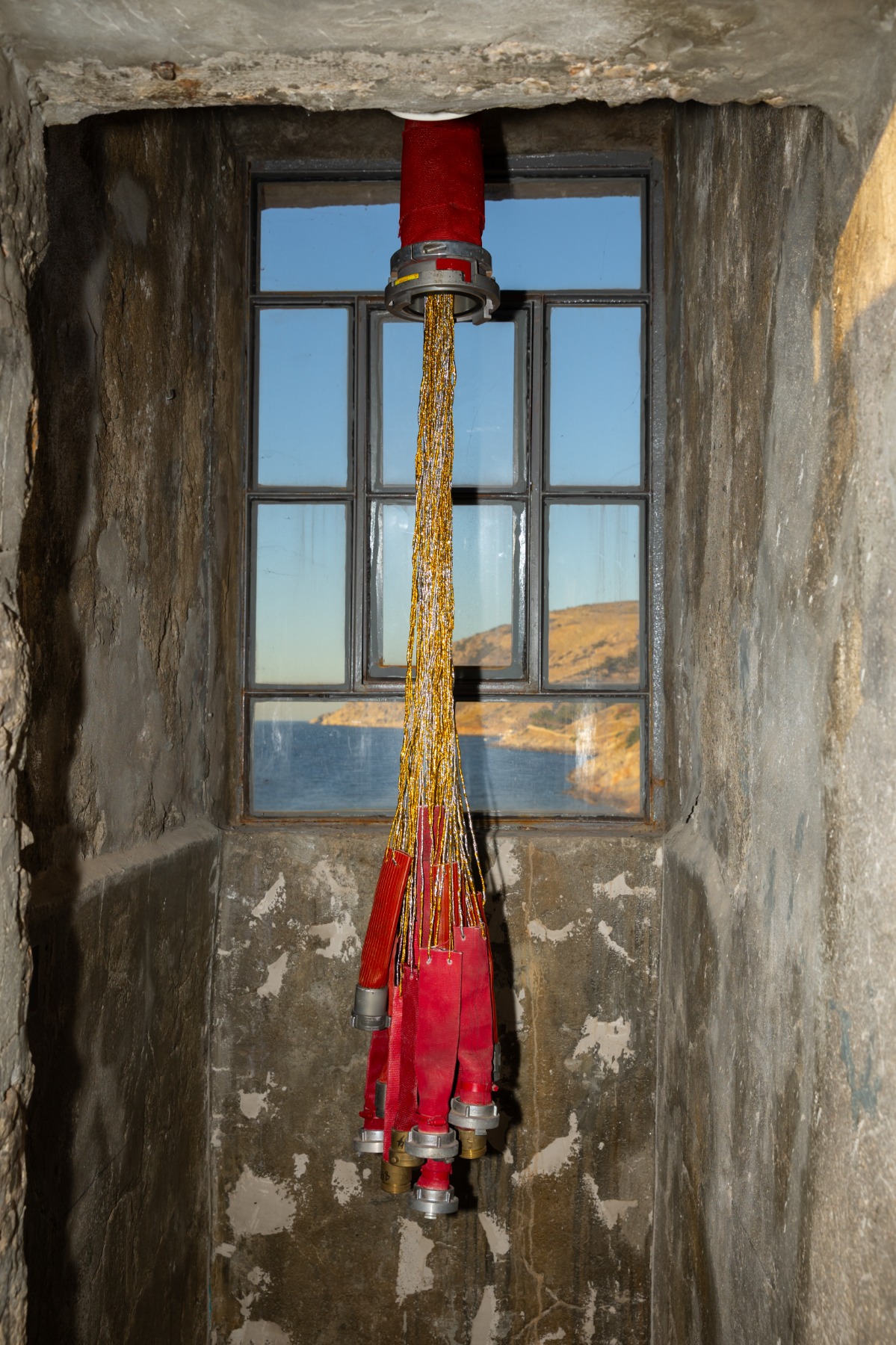
You often describe site-specific projects as exercises in improvisation. Looking back, which unexpected obstacle or accident in Hydra ultimately improved the exhibition?
Yeah, I think a couple of things happened. In my mind, the space had become much larger than it actually was. I had visited the slaughterhouse before for other exhibitions and had even participated in a group exhibition there, so I thought I knew it well. But somehow my memory expanded its scale. Working from that imagined space, I made an anchor that was intended to echo the one you encounter on the walk from the port to the Slaughter House, in front of the History Museum. I wanted to bring that familiar landmark into the exhibition and create a dialogue between the two anchors. I had envisioned a very specific location for it inside the building, but once I arrived, it became clear that it simply wouldn’t fit. The real dimensions of the space were very different from the ones I had been carrying in my mind.
Placing the anchor on the back deck became a last-minute decision, but it turned out to be incredibly fortunate. It actually strengthened the conversation I wanted the work to have. I had become fascinated by the island’s fire-fighting system, where seawater is pumped directly from the harbor through aqua pumps to extinguish fires. I wanted to reference that technology by creating an anchor that also functioned as a fountain, connecting the ideas of anchoring and pumping water. Once the piece moved outside, that relationship became much clearer. The anchor fountain entered into a direct dialogue with the sea itself, making the connection between water, fire, and the island’s infrastructure much more immediate. In the end, that unplanned placement made the project stronger.
Nari Ward’s Fire Hose Man (2026) at Deste Foundation’s Slaughterhouse Project Space. Photo: George Skordaras, courtesy of Deste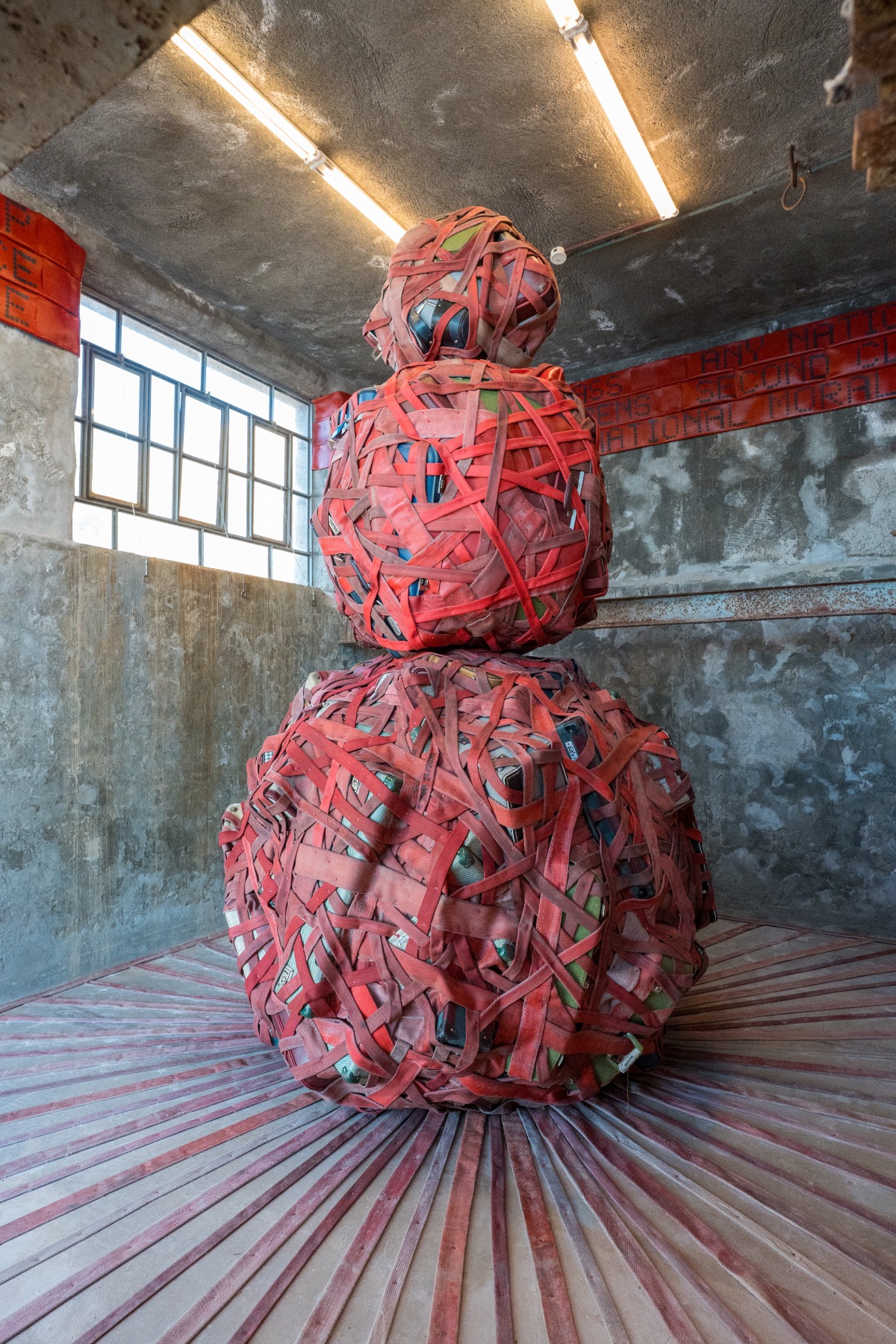
The sea is present everywhere in the Hydra project - as a route, a border, a source of rescue, a source of danger, and even a medium for communication through the “message in a bottle” works. What does the sea represent to you personally?
I was thinking about the sea as a space of the unknown, but also as a space of reflection. For me, it represents the unconscious, something vast that lies beyond our awareness and our control. That’s why, in Distance Sound, the bed springs in the telephone booth supporting the bottles become a dialogue with sleep, another state that occupies such a large part of our lives but remains fundamentally beyond our control. Sleep is a place we enter every day, yet we never fully command what happens there. In that sense, the sea becomes a kind of mirror. It reflects us, but it also reminds us of what exceeds our ability to contain, understand, or control. It is both familiar and unknowable, holding the tension between reflection and mystery.
Nari Ward’s Distant Sound (2026). Installation view of the exhibition "Until That Day" at the Deste Foundation Project Space, Hydra, 2026. Photo: Pinelopi Gerasimou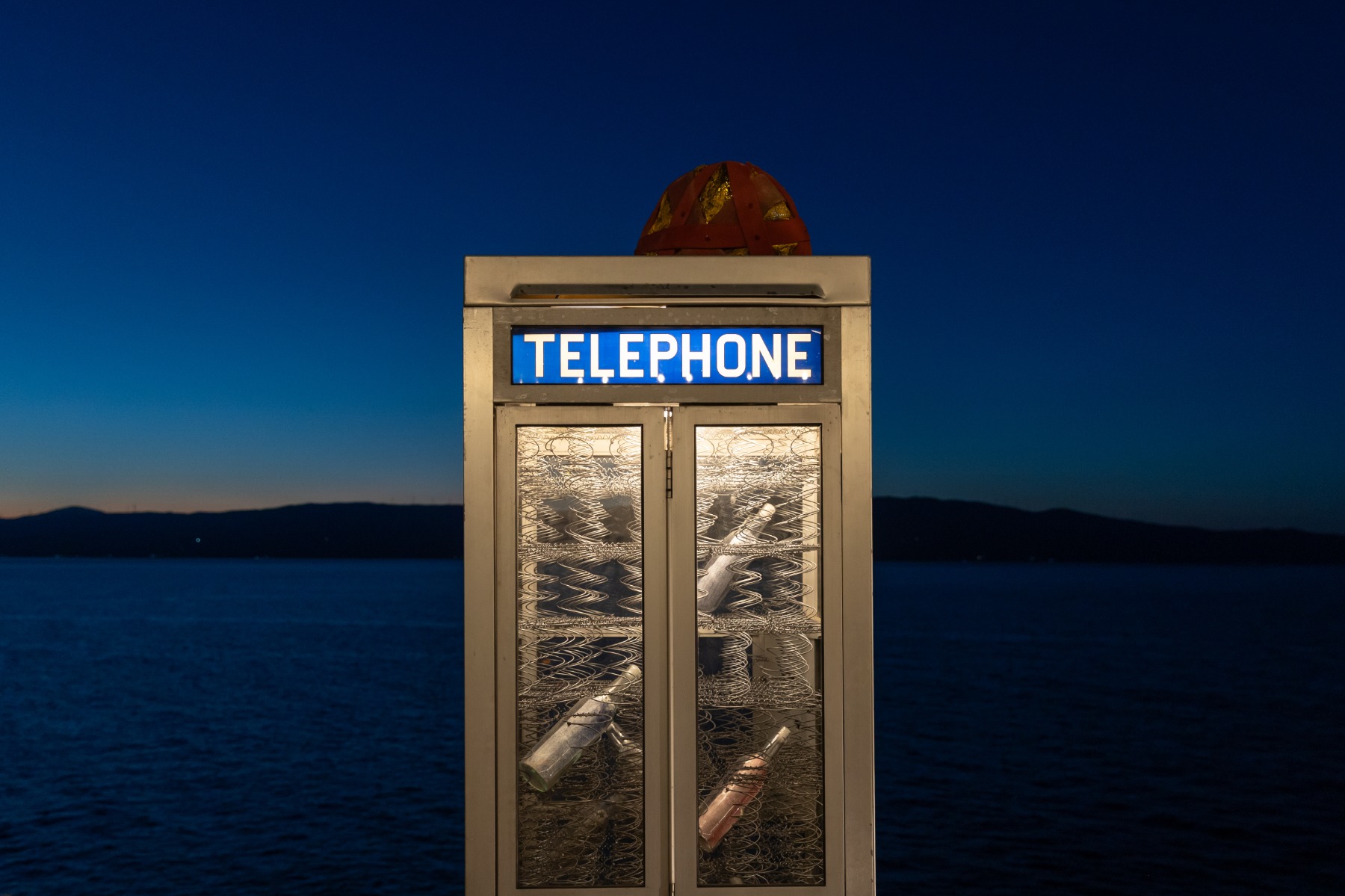
The title Until That Day carries both hope and postponement. It speaks of something anticipated but not yet realized. What is the "day" you are waiting for?
That’s a great question. I think the day I’m imagining is one without borders, a day when our shared humanity matters more than the divisions that define us now. Today, we’re often shaped by nationalism and by institutions, whether governments or corporations, that claim to keep us safe but also reinforce separation. I’m interested in the possibility of an idea or ethic that brings people together. I don’t think it takes the form of religion, government, or nationalism. Instead, I imagine it as something we create collectively through empathy, care, and a continual commitment to hope. That’s the day I’m thinking about. It’s an imagined future that I try to evoke through my work in response to the present moment. My hope is that it isn’t just a personal vision, but one that can gather collective momentum and become something we move toward together.
Throughout your career you have worked with objects that society has discarded or overlooked. What interests you about histories that survive only through traces rather than official narratives?
That’s exactly it. Official narratives often come from positions of power, and those in power are usually invested in preserving the systems that sustain them. I’m interested in other voices and other stories, ones that exist at the margins or have been overlooked, dismissed, or excluded.
I want those stories to be in conversation with, and sometimes challenge, the dominant narratives that are presented as historical truth. That’s where found objects become important. Because they’re familiar and recognizable, they give people an immediate point of entry into the work. But once that connection is made, those same objects can open up unexpected stories about society and history, stories that may not fit within the accepted discourse or the official record.
Nari Ward’s Power Anchor (For Jack Whitten) (2026) at Deste Foundation’s Slaughterhouse Project Space. Photo: George Skordaras, courtesy of Deste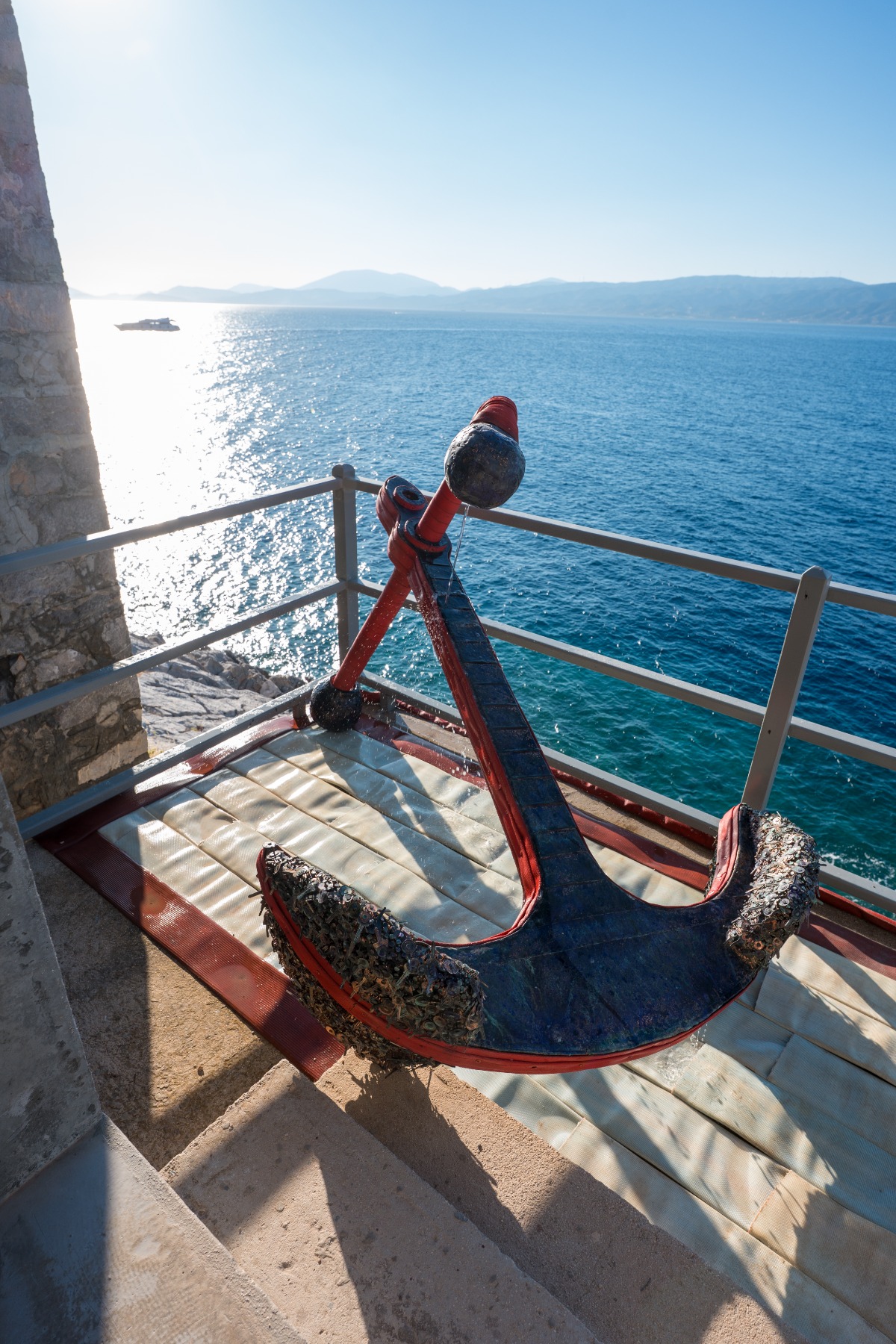
You have often spoken about transformation rather than redemption. In Until That Day, many materials - fire hoses, emergency blankets, anchors - are associated with rescue and recovery. Do you think repair is possible without first acknowledging damage?
I think healing begins with acknowledging that there is damage. If we think about it in relation to the body, we first have to recognize what needs to be healed before we can direct care and resources toward it. But some forms of damage are much harder to identify. They’re diffuse, like a virus, an invisible crisis whose effects are widespread but not always easy to trace to a single source. In those cases, healing has to be just as complex as the injury itself. It can’t rely on a single solution; it requires multiple approaches operating on different levels. That’s where I think abstraction becomes important. It creates space to address complexity without reducing it to a single explanation or image. It may not offer a direct cure, but it can become part of the healing process by opening up new ways of understanding, feeling, and responding to the condition.
Nari Ward’s Redacted Sound (2026). Installation view of the exhibition "Until That Day" at the Deste Foundation Project Space, Hydra, 2026. Photo: Pinelopi Gerasimou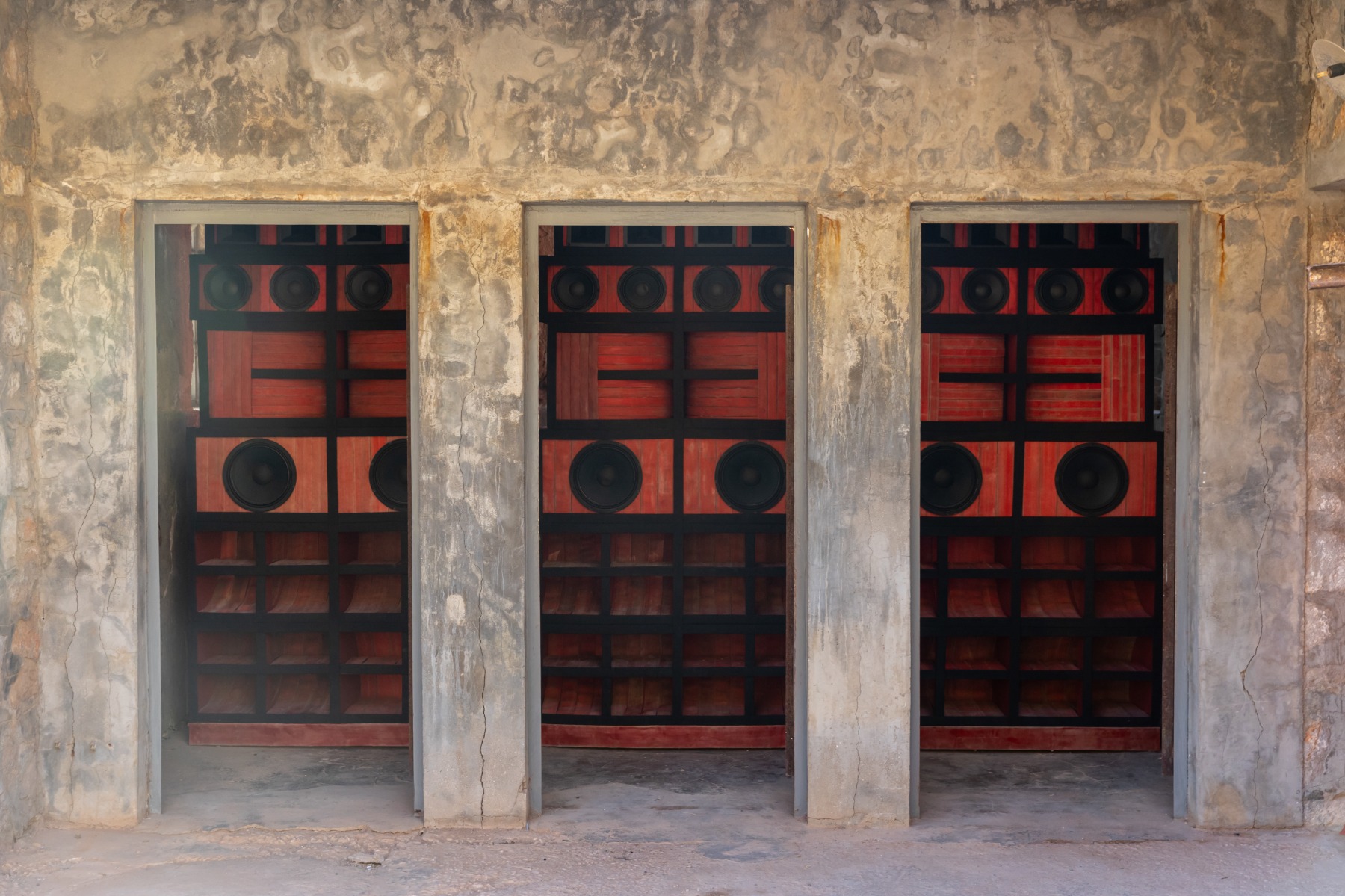
You spoke about your aunt’s notes as messages containing things she could never say. Do you think every artwork begins as a message to someone? And what did your aunt teach you about communication that language alone cannot convey?
I do think an artwork carries a message, but that message isn’t always direct. Every work tells a story, and within that story there is an acknowledgment of something. It may address an experience, a history, or an emotion that is difficult, or even impossible, to put into words. That’s why abstraction is so important to me. It allows the work to remain open. Rather than delivering a fixed meaning, it invites viewers to reconfigure the different elements for themselves and discover their own relationship to the work. In that sense, they become active participants in making meaning. I think that’s something I learned from my aunt and from her practice of making drawings. Looking back, I realize I see a great deal of my own practice reflected in hers. There was a meditative quality in the repetition of her marks, and repetition has become central to my own work as well. Throughout my practice, there is a continual return to pattern, surface, mark-making, and material. That repetition functions as a form of meditation, a way of entering an introspective space. Within those repeated gestures, I hope to create the conditions for something unexpected to emerge, making room for new ways of seeing and new forms of understanding.
Nari Ward’s Travel Flag (Below), 2026, at Deste Foundation’s Slaughterhouse Project Space. Photo: George Skordaras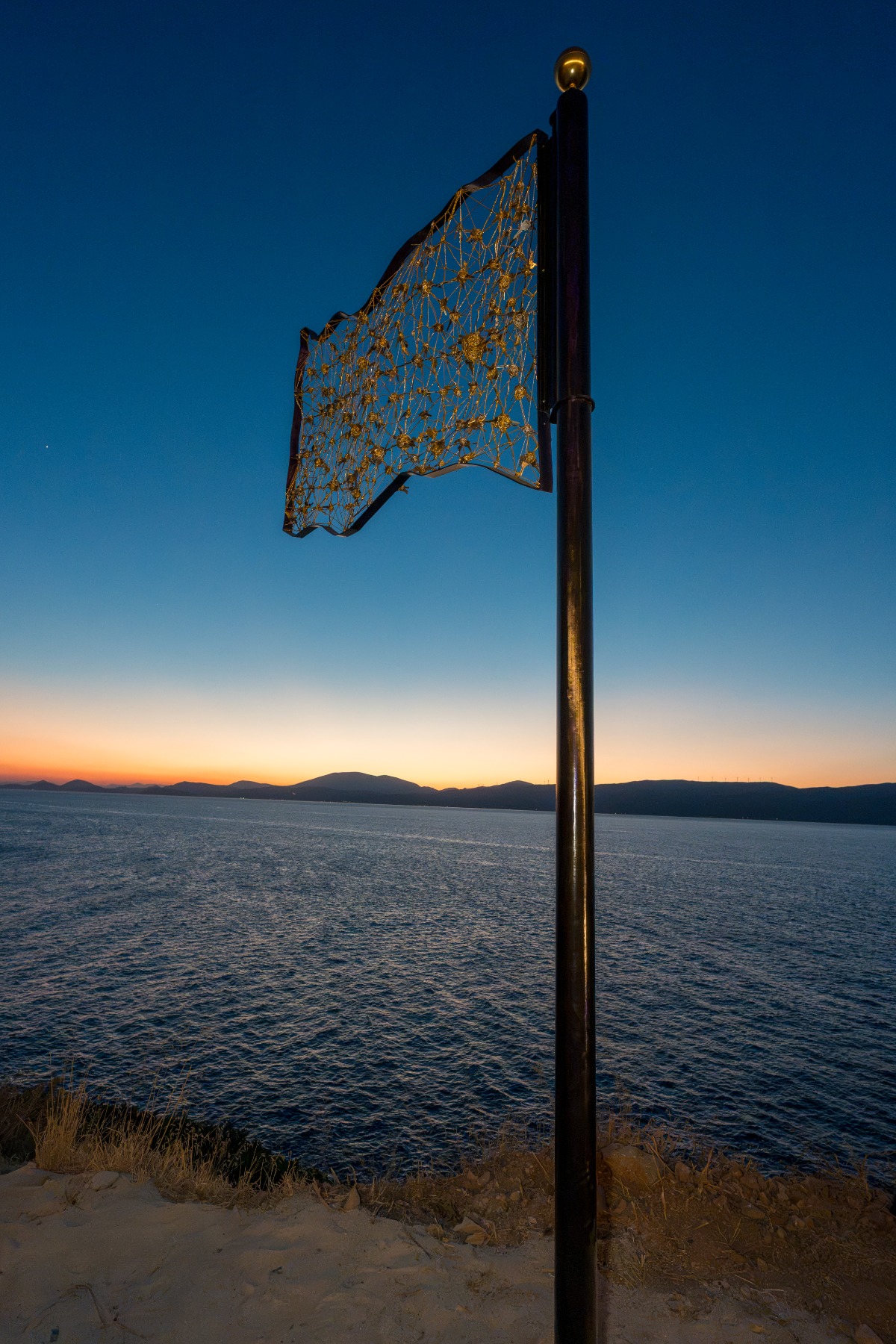
If you had never become an artist, do you think you might have become a poet?
Probably, yes. But I think I would miss what is most important to me as a visual artist: my engagement with material. I love the dialogue with craft and the possibility of taking familiar, recognizable objects and transforming them so they serve a more abstract conversation about life, experience, and human connection. Poetry can certainly do that, but for me the physical encounter with materials is something I would never want to give up. The act of making, touching, assembling, and transforming objects, is inseparable from the way I think. That said, poets have been a tremendous source of inspiration for me, as have musicians. When I think about pattern, I also think about rhythm. Music and poetry both shape the way I approach repetition, structure, and improvisation in my work. So if I weren’t a visual artist, maybe I would have been a poet, or perhaps even a rapper. Laughs.
Nari Ward’s Warnings (2026) at Deste Foundation’s Slaughterhouse Project Space. Photo: George Skordaras, courtesy of Deste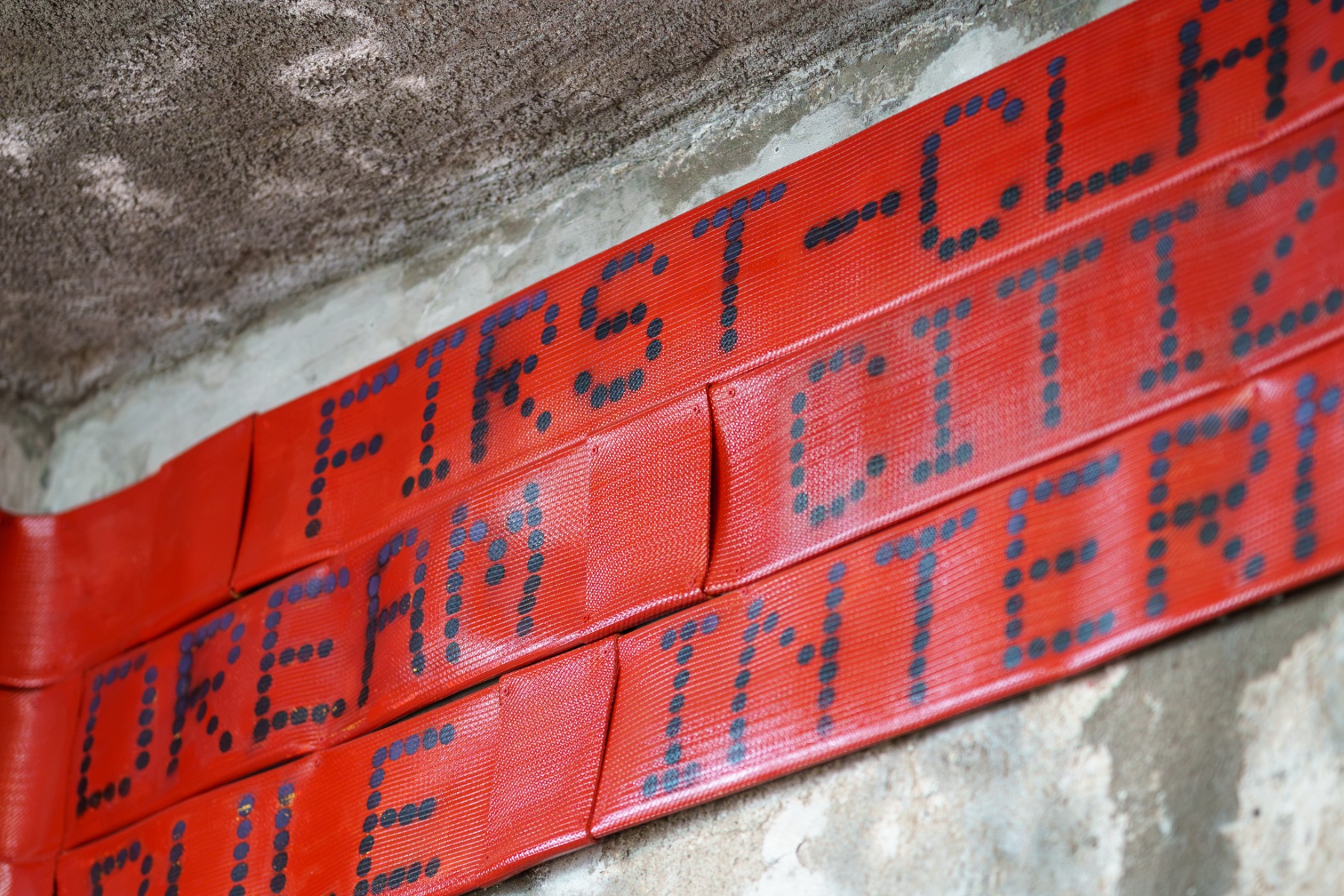
Throughout your career you have returned to themes of movement, migration and displacement. Yet in Hydra you also spoke about home as "where you feel most comfortable." Has your understanding of home changed over the years?
I’m a little suspicious of the idea of home. Of course, the places where we feel most comfortable help shape who we become, and that’s important. But at this stage of my life, I’m also wary of becoming too comfortable. Whenever I feel I’ve settled into something too completely, I see it as a warning. It suggests that I’ve begun to normalize things that, as an artist, I should continue to question. I don’t want the idea of home to become something fixed simply because it makes me feel secure. I’m always asking myself how home can be reimagined. For me, home is ultimately something you carry with you. It’s a portable state of mind rather than a fixed location. That feels much more powerful because it means home isn’t dependent on where you are. You could be stranded in an airport or living through a moment of crisis and still find a sense of home within yourself. Thinking about home as something portable makes it more resilient. It becomes a way of navigating change rather than resisting it. For me, that’s a more meaningful, and perhaps more practical, understanding of what home can be.
Installation view of Nari Ward's "Until That Day" at the Deste Foundation Project Space, Hydra, 2026. Photo: George Skordaras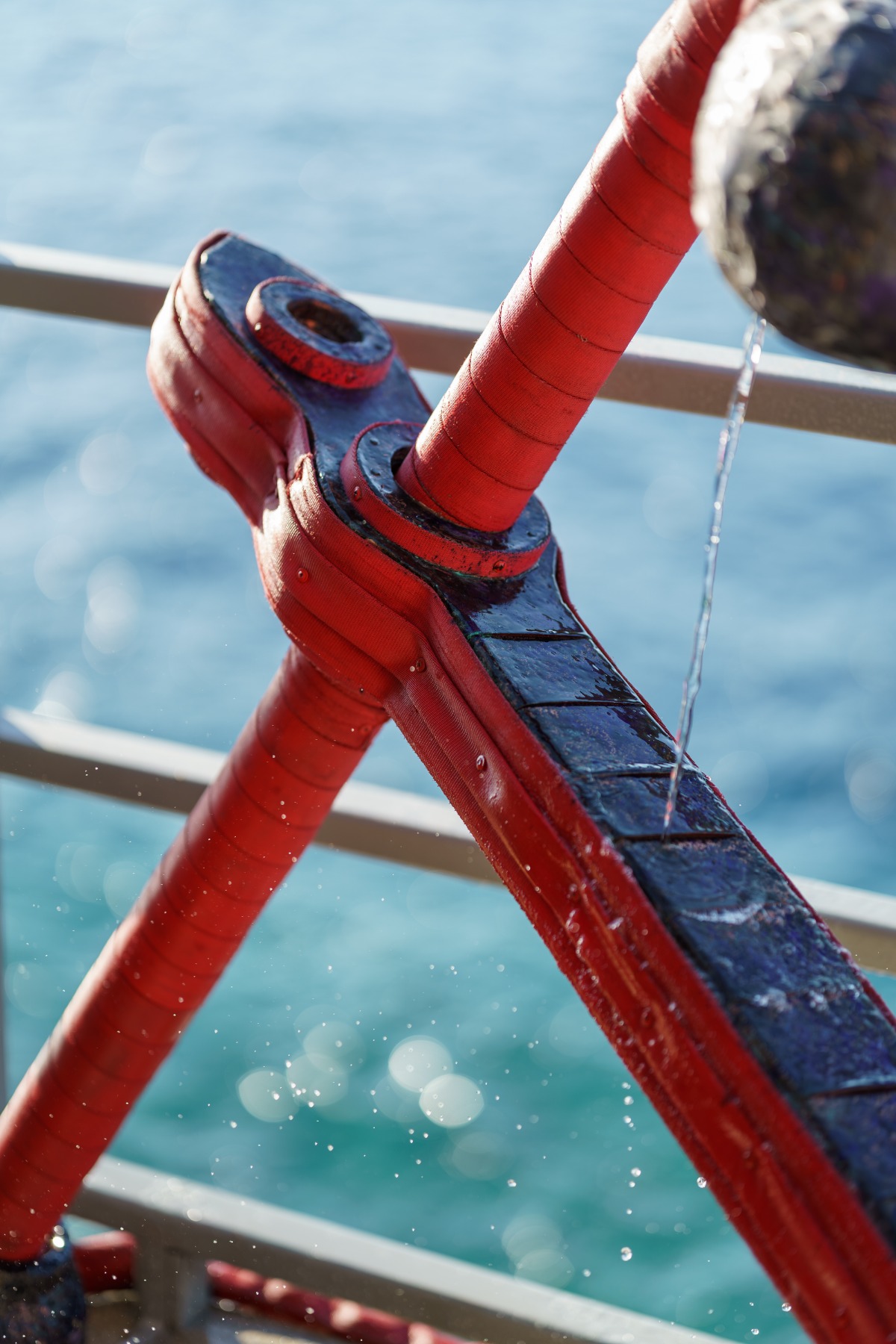
In this project, Haile Selassie’s speech becomes Bob Marley’s song, and Bob Marley’s song becomes an artwork. What interests you about the way ideas transform as they move between people, places and generations?
I think that’s a responsibility we all share. In my work, I’m drawn to abstraction because I don’t want an artwork to simply illustrate an idea or deliver a fixed message. I’m interested in making objects that remain open, works that can hold multiple meanings, including ones that neither the viewer nor I can fully explain. For me, mystery is an essential part of the artistic process. There’s an expectation that artists should be able to explain exactly what their work means, but I’m more interested in starting with something personal and allowing it to evolve into something that exceeds my own understanding. If the work only ever means what I intended, then its possibilities remain limited. As time passes, I think a work of art should become more mysterious, not less. As it moves further from the moment of its making, new viewers, new contexts, and new histories continue to reshape its meaning. The work begins to live a life independent of the artist. I think about someone like Jean-Michel Basquiat. His work continues to generate new interpretations because he is no longer here to define it. The mythology surrounding the work has become part of its meaning, allowing it to remain alive and open. That’s what I hope for in my own work. The artist begins the conversation, but doesn’t have the final word. Over time, ideas become mystery, and that mystery is what allows a work to endure.
Opening event of the exhibition "Until That Day" at the DESTE Found on June 23, 2026. Photo: Pinelopi Gerasimou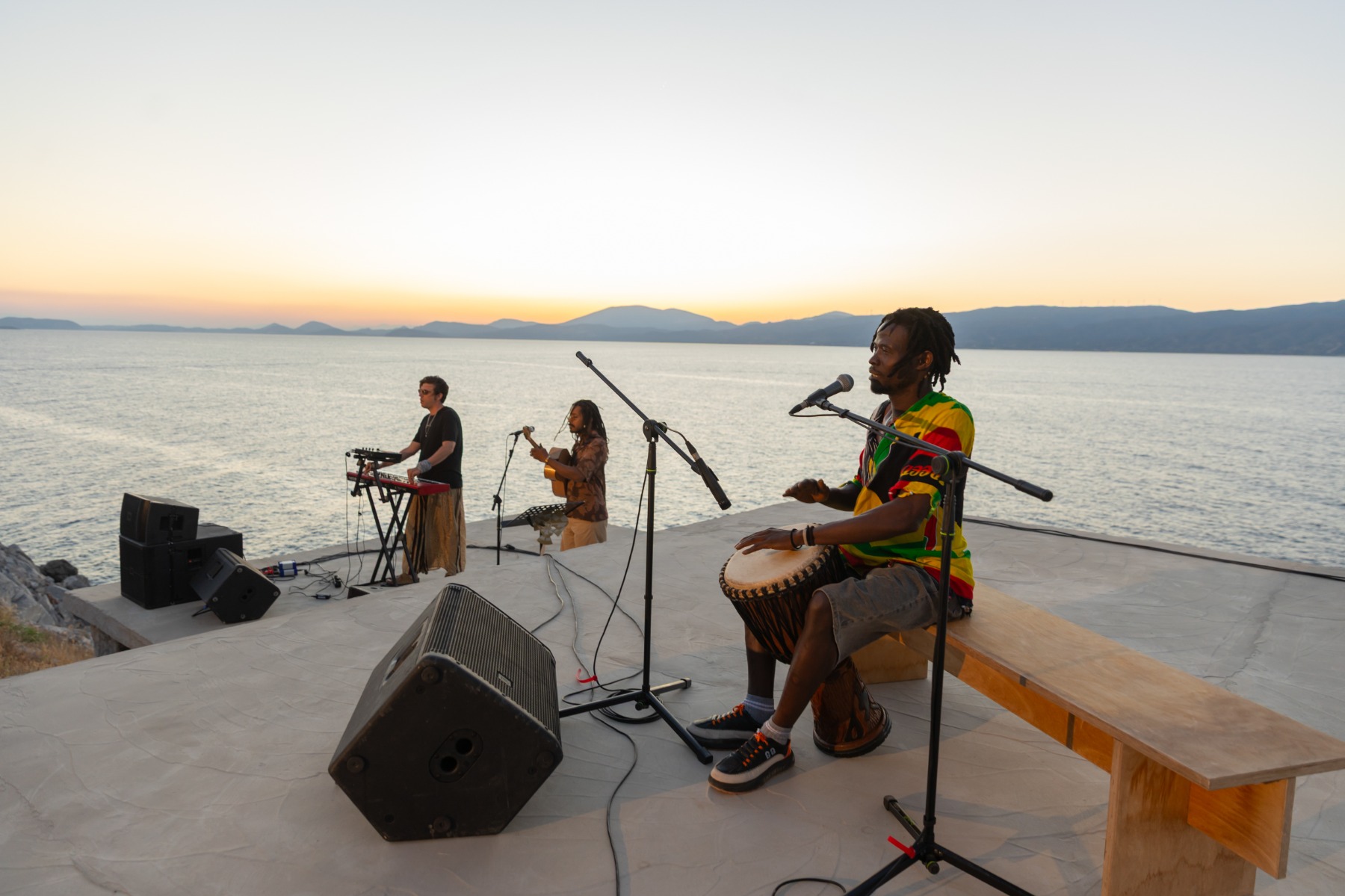
Many of your works seem to function almost like gathering places rather than autonomous objects. In Hydra, the domino tables invite visitors to stay, talk and spend time together. What role does creating space for human encounters play in your practice?
I think this is a really important question. One of the key intentions for me was that, even after the performance had ended, someone could come into the space and simply spend time there. By spending time, I don’t just mean looking at the artwork. I mean being with it while life continues around you, thinking your own thoughts, talking with someone, noticing the landscape, hearing the sounds of the space, or sharing it with other visitors. All of those experiences become part of the work. That kind of immediacy is something you can’t experience through a computer screen. It’s the tactility of the present moment. I wanted to create a space where people felt free to linger without any expectation of what they should do. They might sit quietly, scroll through their phone, read a book, finish a meal, play dominoes, watch someone else play, or simply look at the work. None of those actions are separate from the experience – they all become part of it. For me, it was important that the space feel habitable rather than simply something to pass through. I wanted it to be a place where ideas, emotions, and questions could unfold naturally, but also where people could simply be present. That sense of presence, the opportunity to inhabit the space in whatever way feels meaningful, is really the heart of the project.
In your public conversation with Massimiliano Gioni, you spoke about empathy, attention, and the difficulty of truly listening to one another. In a world that often encourages division rather than dialogue, can art still create spaces where genuine encounters become possible?
Oh, I definitely feel that’s what art should serve as, because it asks for a different kind of investment. When you go into other spaces, a coffee shop, a sporting event, or any place organized around a specific activity, there’s usually a shared purpose. People are there to compete, participate, consume, or witness something. That idea of witnessing is really important to me, especially the experience of witnessing something collectively. With art, I’m not asking anyone to think in a particular way or arrive at a predetermined conclusion. I’m inviting people to spend time reflecting on the work: the materials, the choices the artist made, what they respond to, what they don’t respond to, how the work makes them feel, or even what their indifference reveals. Those are all valuable questions. They help develop critical thinking. I also think it’s important to be comfortable not fully understanding something. You don’t need to know exactly what a work means. Learning to sit with uncertainty and think differently than you did before you entered the space is a meaningful part of the experience. That’s really the goal for me, to create an encounter where you come in with one way of seeing and leave changed in some way. Not because the work confirms what you already know, but because it opens up new questions. If you leave with more questions than you had when you arrived, then I think something genuinely generative has happened.
Nari Ward’s Domino Tables (2026). Installation view of exhibition the "Until That Day" at the Deste Foundation Project Space, Hydra, 2026. Photo: Spyros Stergiou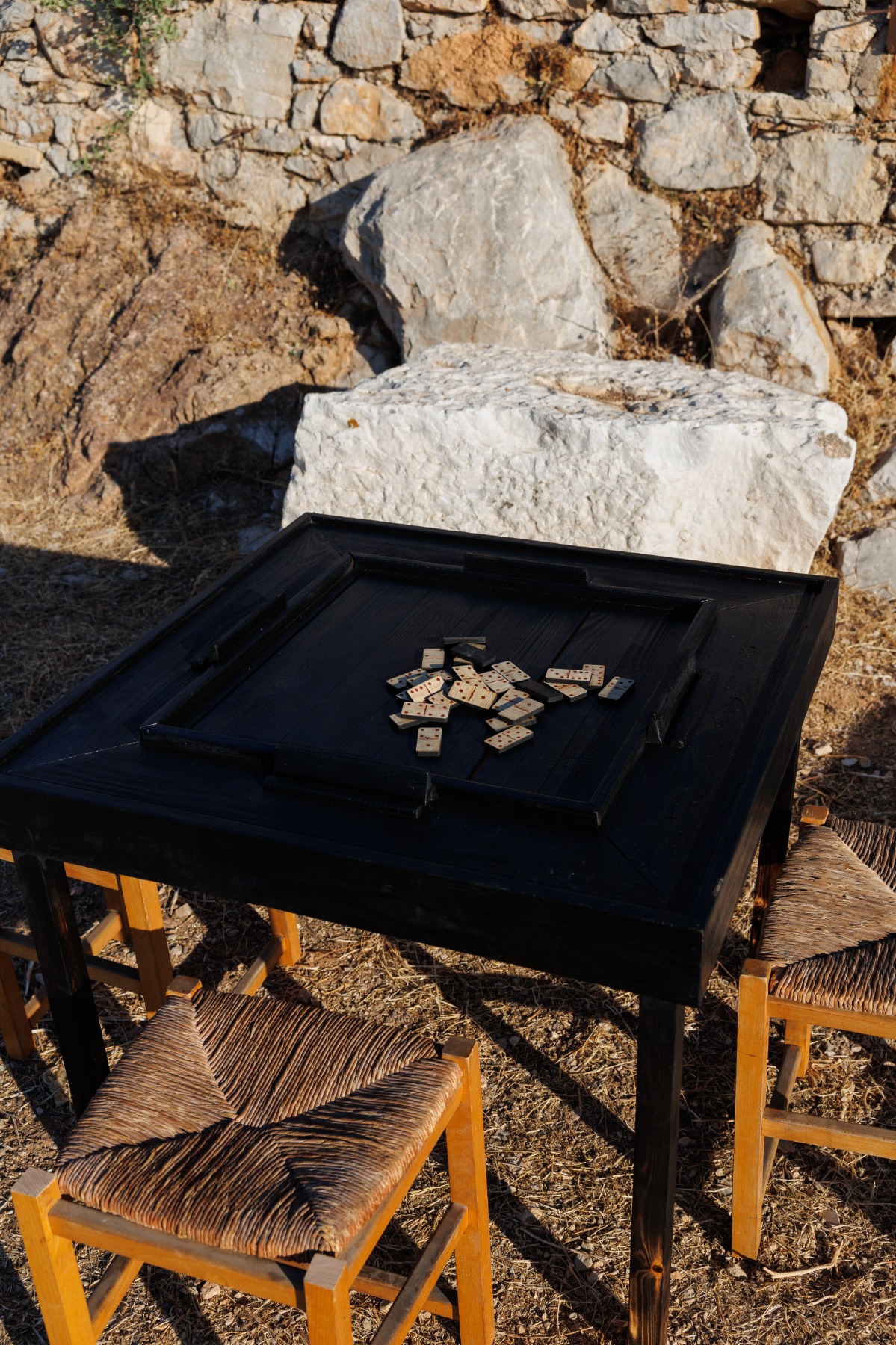
Your work often begins with what others fail to notice. What role does attention and presence play in the way you understand the world?
One thing I’ve become increasingly aware of, and it’s something I struggle with as I become more embedded in my phone, is the need to be present. Being present means slowing down. It means not always feeling like you have to be somewhere else or moving on to the next thing. It means allowing yourself the time to simply be. We’re taught to think of our lives as a sequence with a beginning, a middle, and an end. That’s how stories are structured, and we’ve come to organize our days the same way: we start a task, work through it, finish it, and move on. But I’m trying to think differently. Instead of one beginning, one middle, and one ending, what if there were many beginnings, many middles, and many conclusions? That way of thinking has become an important practice for me. The idea of an ending, or of completion, is never really absolute. Something only feels finished because we’ve decided to stop paying attention to it. In reality, things continue to unfold. Recognizing that everything is still in motion changes how we think about beginnings and middles. It reminds us that we’re always entering into something that’s already in progress and leaving something that continues after we’re gone.
Opening event of the exhibition "Until That Day" at the DESTE Foundation Project Space on Hydra on June 23, 2026. Photo: George Skordaras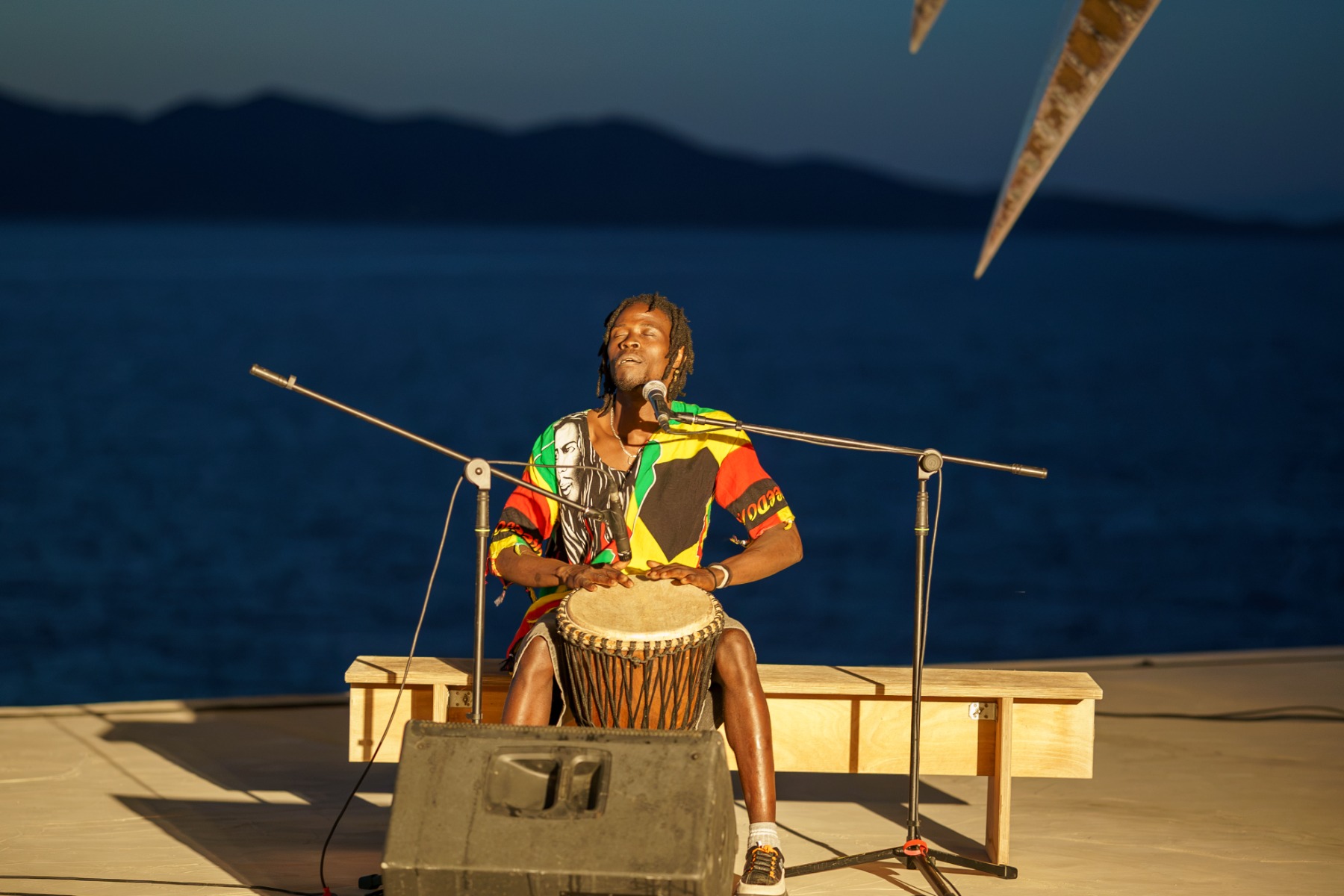
Your work is deeply aware of histories of displacement, exclusion and violence, yet it rarely feels driven by anger. Many people today feel trapped between fear and certainty. What role do hope, compassion and art play in keeping open what you call a “possibility space”?
I think the reason my work doesn’t come across as angry is that I use fear, anxiety, and even anger to drive the questions rather than the expression itself. The repetition in the work is a form of meditation, a way of working through those emotions. The act of making becomes a kind of mantra, a practice for navigating moments of crisis. There’s something powerful about giving shape to what frightens you. When you name the monster, you begin to take away some of its power. That’s what I’m trying to do through the work: place that anxiety into the object through the process of making it. Once it’s embodied there, it becomes less overwhelming, less dangerous. This reminds me of a conversation I had while working on my project in Athens. I was talking with an older resident about an immigrant neighborhood that I enjoyed spending time in. They said something about the neighborhood that has stayed with me: “It’s not dangerous, but it’s not safe.” I became fascinated by the distinction between danger and safety. In many ways, it’s where I think my work exists. The objects begin with a sense of danger and anxiety, but the process of making transforms that feeling. The goal isn’t to make it completely safe. It’s to move it from being dangerous to simply not safe. To me, those are very different conditions. Danger suggests that you have no agency, no control. “Not safe” acknowledges uncertainty, but it still leaves room for awareness, choice, and possibility. That’s the space I’m interested in. I think that’s what the work can do, it de-escalates danger without eliminating uncertainty. That possibility space, the place that is not entirely safe, is where I think art is most alive.
Thank you!
Nari Ward’s Until That Day is on view at the DESTE Foundation Project Space, Slaughterhouse, Hydra, through October 31, 2026.
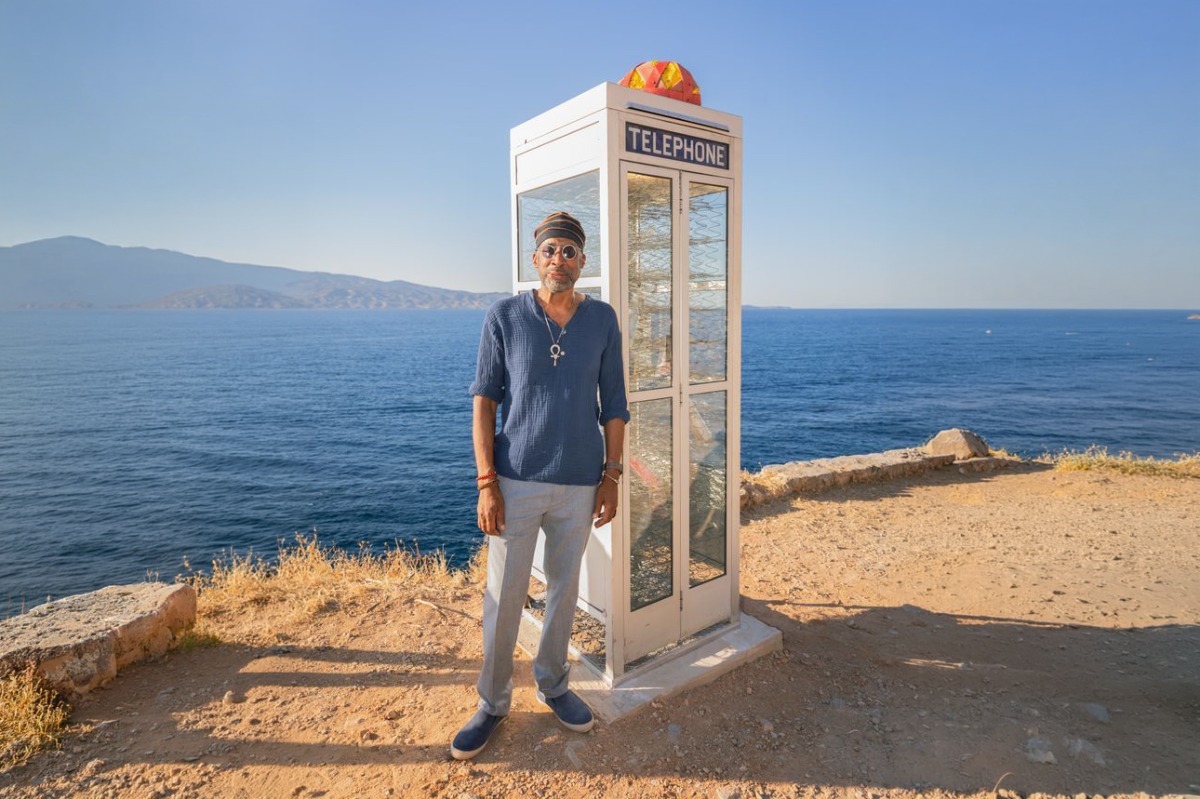
Title image: Nari Ward. Photo: Pinelopi Gerasimou
