


Worlds Up Close
A Conversation with Margarita Frančeska Loze
London-based Latvian artist Margarita Frančeska Loze likes to look closely and follow curiosity. A plant vein can become a landscape and a root system can turn into an intricate embroidered world. She explores patterns, cycles and relationships in the living systems around us, translating them into artworks. Her practice moves between textile, painting, sculpture, moving image and sound.
Born in Riga, Loze first studied Textile Design at the Riga School of Design and Art before moving to London, where she graduated with a BA in Fine Art: Painting from Wimbledon College of Arts, UAL and an MFA in Fine Art from Kingston School of Art. She has exhibited internationally and participated in residencies across Europe and Taiwan. Recent group exhibitions have taken place at Roman Road, Hypha HQ and Blanco Gallery in London and 1/2 Room Gallery in Changhua, Taiwan. Two years ago, she had her first solo exhibition in Riga at LOOK! Gallery. Now her works are back in the city, inhabiting Kalnciema Kvartāls Gallery as part of her solo exhibition Microcosm, on view until September 27.
We spoke about inspiration, processes, paying attention and bringing things that might otherwise escape our senses into something we can see and hear.
For someone encountering your work for the first time, how would you introduce your practice?
I’m a visual artist who works with expanded textiles. I predominantly use hand embroidery on hessian fabric, using wax and cotton thread and I usually make large-scale pieces, up to two metres, and with quite vivid colours, mostly red, green and blue. Lately I’ve also been exploring other mediums and surfaces. Currently I’m experimenting with ceramic and epoxy resin in my studio.
I would say that my practice is quite experimental, and I love moving between different forms and materials. Something interesting usually emerges when I bring them together. That’s what I like about the idea of expanded textiles, that the work can move beyond the traditional boundaries of textiles.
Touched by Sun, hand-embroidery with wax coated thread on coloured hessian fabric, dried branch, 2026. Photo: Marina Tsaregorodtseva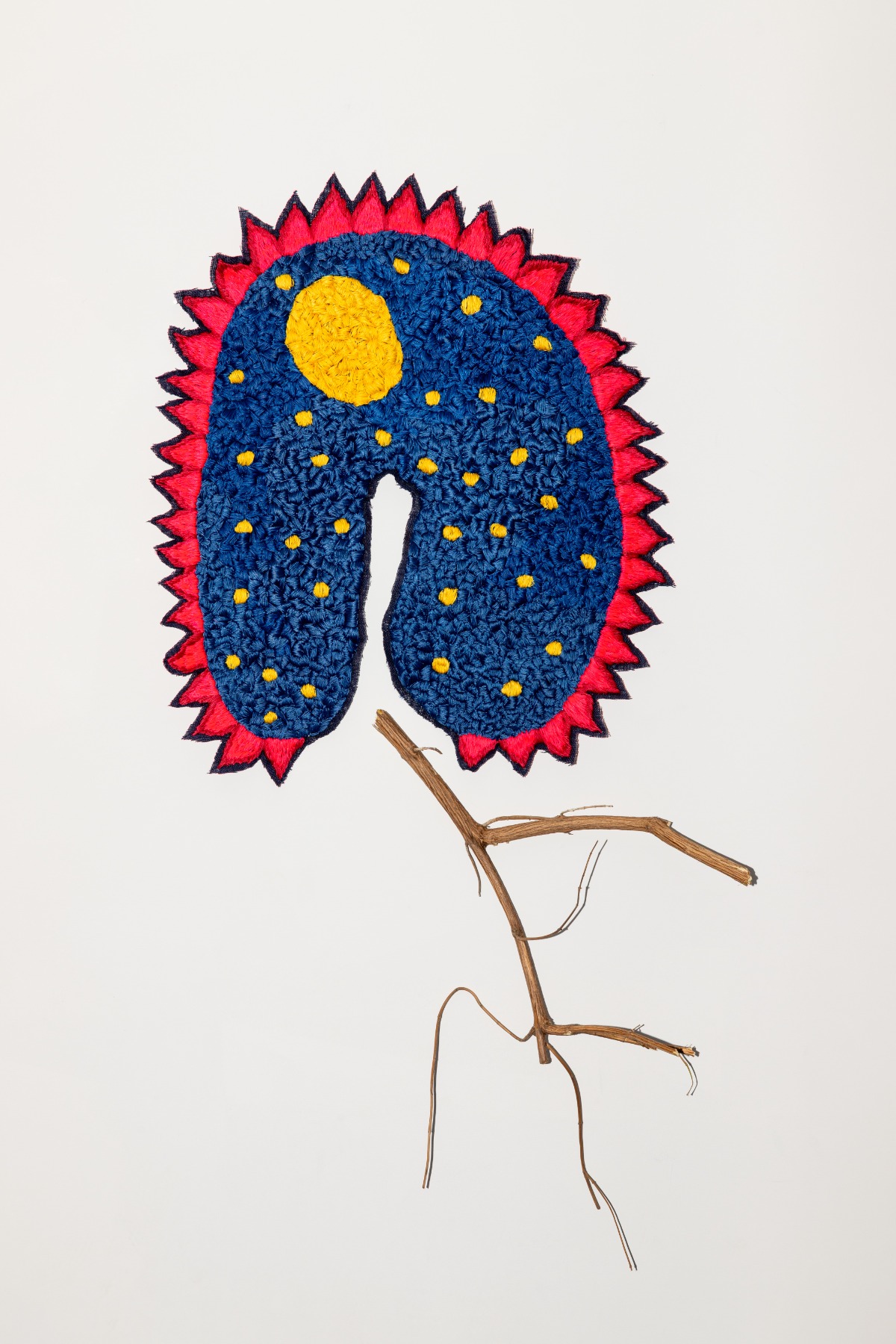
A lot of your works begin with elements you find in nature: plants, roots, veins, fragments, textures. How much does research enter your process? Do you find yourself reading about plant anatomy and biology, or are you more interested in what a form makes you imagine?
I look at plant anatomy, but I’m also interested in underwater creatures and living organisms in general. Through books about wildlife, I look at patterns seen on animal fur and insect wings. Sometimes I use them to visually explore shapes and translate their colours into my work.
I’m also fascinated by natural phenomena that happen in the world, such as sun dogs, Fata Morgana [a complex form of mirage - ed.], nacreous clouds, meteor showers, the rotation of the Earth, and many more. I often find myself thinking about what the world is built from, what we can see and what we cannot, and why. There is something ungraspable about the way we perceive our surroundings. Last year, I saw a forest full of shiny fireflies at Sun Moon Lake in Taiwan, and I still cannot fully explain the feeling I had while looking at them. These fleeting moments can feel almost eerie once they are gone, as if they never happened. You can be having a completely ordinary day, and then suddenly see a rainbow. I find these moments exciting, the fact that something so beautiful can appear unexpectedly, only to disappear again a few seconds later.
I also read around ideas of perception, including the work of Don Ihde, Maurice Merleau-Ponty and David Abram, as well as more poetic writing such as Gaston Bachelard’s The Poetics of Space. And I like to explore Art Brut.
When it comes to the making itself, an artwork usually first appears in my mind, where I mentally edit, move things around and reorder the idea before I even start making it. Most of the time that happens quite quickly, sometimes within a couple of days. Then I start working directly with the materials and allow the idea to guide me through the making.
You started out as a painter, and now embroidery has become such an important part of your practice. How did that shift happen?
I did study painting, and I graduated from both my BA and MFA with hand-drawn stop-motion films, alongside some experiments with embroidery on found objects. But I still think in a painterly way. I have never studied embroidery, and I see thread almost like blocks of colour that cover a surface.
During my studies, I was always thinking about how to visually create an environment. I was looking at ideas around false nostalgia and sensorium, and quite naturally that led me towards exploring stop-motion through drawing, because I could create my own world. I became very obsessed with it and spent three years making a six-minute film during my BA, and then another two years making a five-minute film during my MFA.
My first video work was more personal and looked at memories and the passing of time. The second one was more about the cycle of day and night and the rhythms of nature waking up and falling asleep. At some point I realised that I wanted to make the stop-motion more physical. I wanted to bring it out of the screen and expand it into space.
This is where I started making small experiments with embroidery, using either elements that had appeared in the videos or specific images taken from the stop-motion. That was how I discovered embroidery as a medium. Slowly, I started trying it on different surfaces and found objects. In 2024, I created my first large-scale hand-embroidered series based on the four seasons: Spring, Summer, Autumn and Winter.
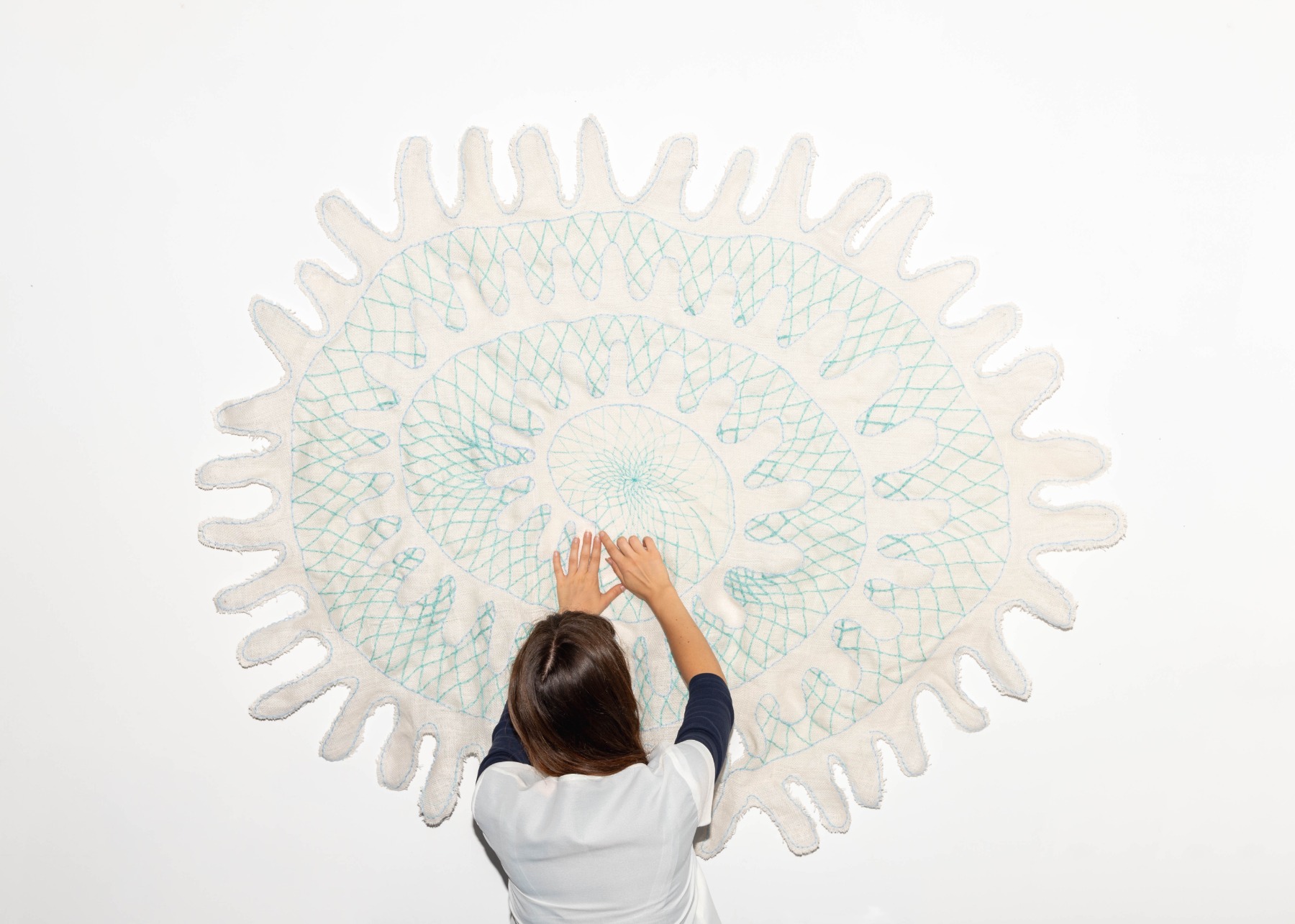
Forming Through, hand-embroidery and watercolour on coloured hessian fabric, 2026. Photo: Marina Tsaregorodtseva
I imagine your embroidery takes an incredibly long time to make. What happens to your thoughts when you spend hours and hours making the same kind of movement with your hands?
It depends on the scale of the embroidery, but the larger ones usually take up to seven months to make.
Usually what happens is that I go into a flow state and listen to my favourite musicians, pre-recorded theatre plays or live concerts on repeat while I work. But, to be fair, it is also a very active time for my thoughts, as I use it as my research time and listen to things I am interested in at that exact moment.
You currently have a solo exhibition at Kalnciema Kvartāls Gallery in Riga. Tell us more about it.
Central to the exhibition is a set of questions I’ve been returning to for some time: What is the world made of, and how can we perceive it from different perspectives? I’ve become fascinated by nature’s hidden geometry and rhythms. My perspective shifted when I started looking at the natural world through a magnifying lens. I became interested in the shapes of flower petals, roots, the veins of leaves, and the tiny structures that are usually invisible to us. What interests me is how these units come together to form larger structures, which in turn contribute to much broader ecosystems.
Roots, part of solo exhibition Microcosm, Kalnciema Kvartāls Gallery, Riga, 2026. Photo: Paula Betija Antenišķe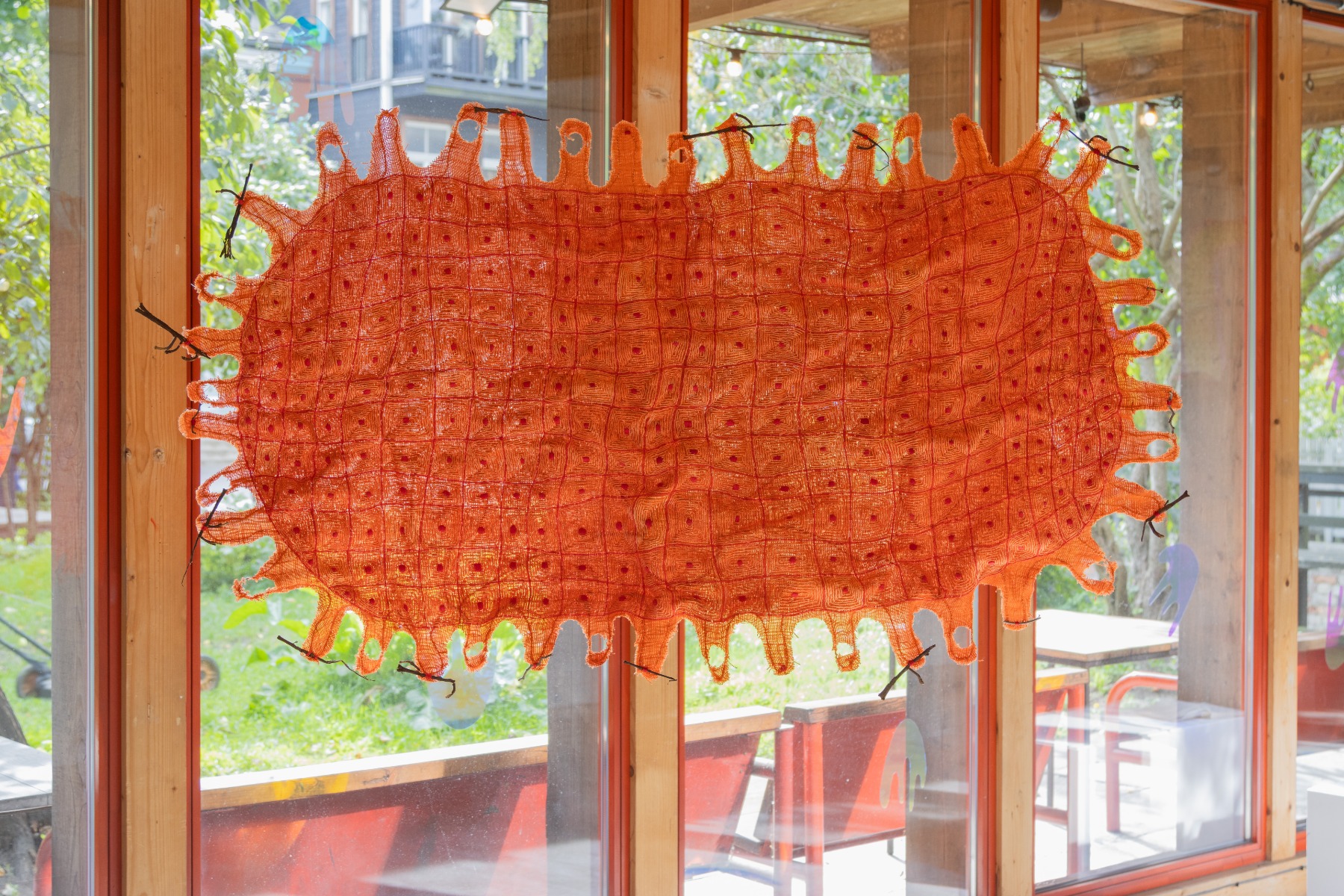
For the exhibition, I have created six large-scale hand-embroidered works that reflect my thoughts on these explorations. Alongside the embroideries, there are also some glazed stoneware objects, featuring fragments of human body parts as points of contact with the surrounding environment. These artworks are scattered around the gallery, following ideas of fragmentation and growth observed in nature, creating a space where individual elements gradually reveal their connections to one another.
Together with the curator, Anna Vilāne, we wanted to introduce an element of chance and surprise into the exhibition. There are elements on the window that only appear when the sun is shining, creating a shadow dance across the space, inside and outside. We also decided to include actual plants alongside the artworks that are hung from the ceiling. They point back to the starting point of my observations: the lines, structures and forms. There are also magnifying lenses that visitors can take as they move through the exhibition, encouraging slower movements.
I wanted to create a space and an atmosphere around the exhibition. There is an extended sensory programme that Anna and I carefully put together. It invites visitors to explore processes happening in nature alongside the rituals humans have developed around them. The programme included a mushroom cultivation workshop, a deep listening session incorporating fragrances, composing a tea blend with a tea ceremony taking place around the autumn equinox, and a soundscape workshop involving plants and mushrooms.
Part of solo exhibition Microcosm, Kalnciema Kvartāls Gallery, Riga, 2026. Photo: Paula Betija Antenišķe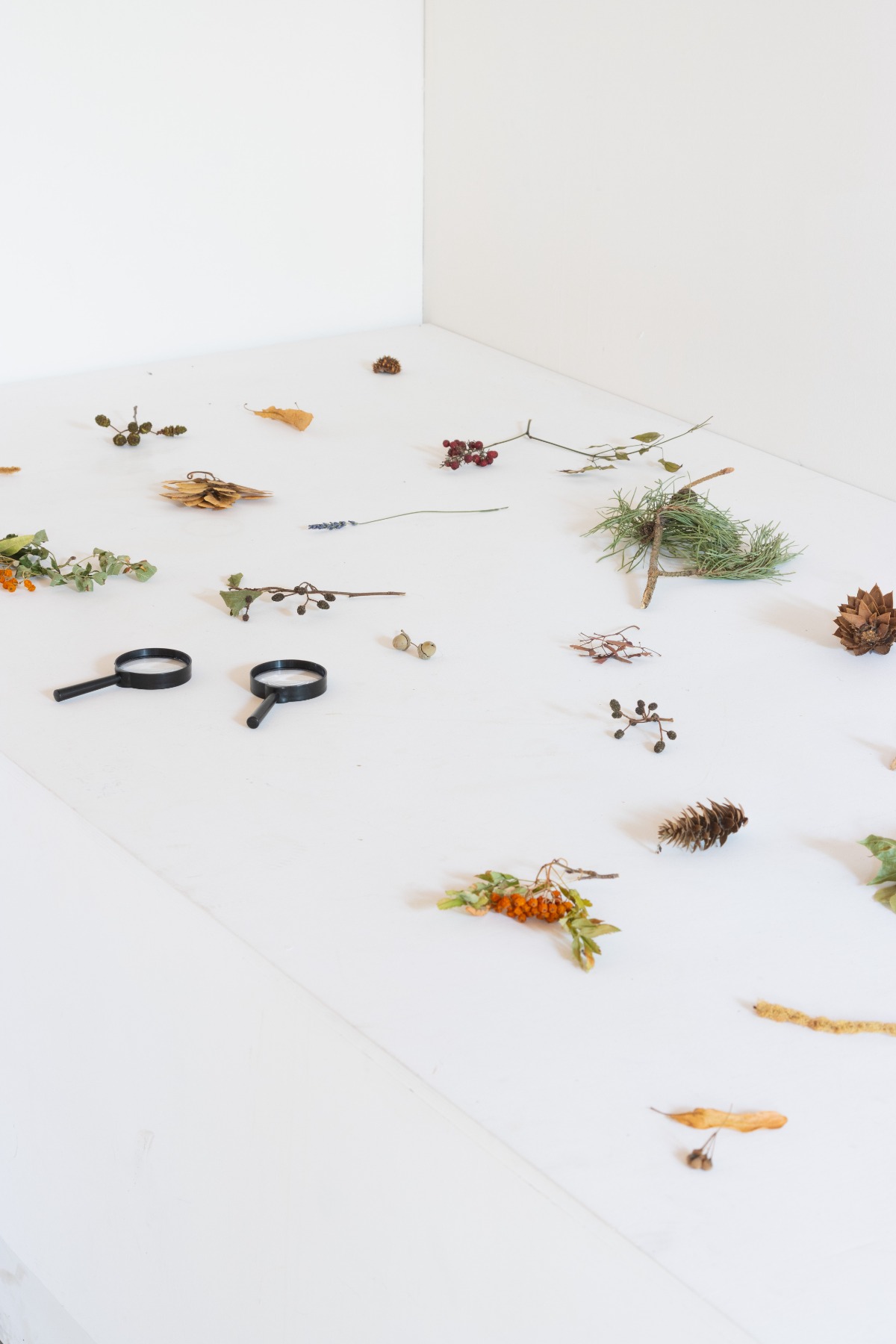
The title Microcosm suggests a small world that contains or reflects a larger one. What does “microcosm” mean to you in relation to this exhibition?
When the curator and I were considering the title, we were thinking about different micro-threaded environments, and about how each of these embroideries contains its own world, its own little system.
How do you decide when something should become an embroidered work, a sculpture, or remain a found object? How do you know which medium a particular idea belongs to?
It comes quite intuitively for me. I do like to step back and think about all the works that I’m making at that moment as little fragments, and what kind of conversation they’re having with each other. Through that, I start thinking about the material, because each material has its own qualities, and what that particular presence means to me within that composition, within that storytelling. And then I like to step back and observe, and eventually I decide.
So it means that it’s very crucial for you to have a studio space, right?
Yes, yes. I do like to have everything in one place so I can see it as a whole.
I want to talk more about the soundscape you have brought into the exhibition through Jamie Lee’s recordings.
One of my favourite things to do is collaborate with musicians, so I was very happy to work with Jamie. When he learned about the ideas in the exhibition, he decided that he wanted to look at the plants from another perspective, so he suggested using contact microphones.
Maybe for those who are not familiar with the realm of audio creation, we should explain what contact microphones are.
They are little microphones that you attach to an object. You can then hear the vibrations coming from that object.
I love using them because it almost feels like I’m reading the surfaces. But it also means that you’re reading what’s happening nearby and how that affects the vibration of a particular surface.
Yeah, and it’s also very interesting to hear what comes through, because each surface is very different.
Back to your collaboration with Jamie. He suggested using contact microphones…
So we could not only see the exhibition about plants, leaves and natural systems, but hear it as well. We can hear the plants breathing, their internal processes, and the systems within them. The soundscape is on a loop and is around 27 minutes long. To create it, he used moss, fern and grass, as well as worms and ants.
So it’s all kinds of soily and foresty creatures. If you could give a contact microphone to any plant, living organism or natural phenomenon, what would you choose?
I would definitely like to put a contact microphone on a Fata Morgana. I’m really curious to find out what a mirage would sound like. And I would also love to hear what a firefly sounds like.
Part of duo exhibition An Allegory Rooted in Thought, 1/2 room gallery, Changhua, Taiwan, 2025. Photo: Bluewein 王家駒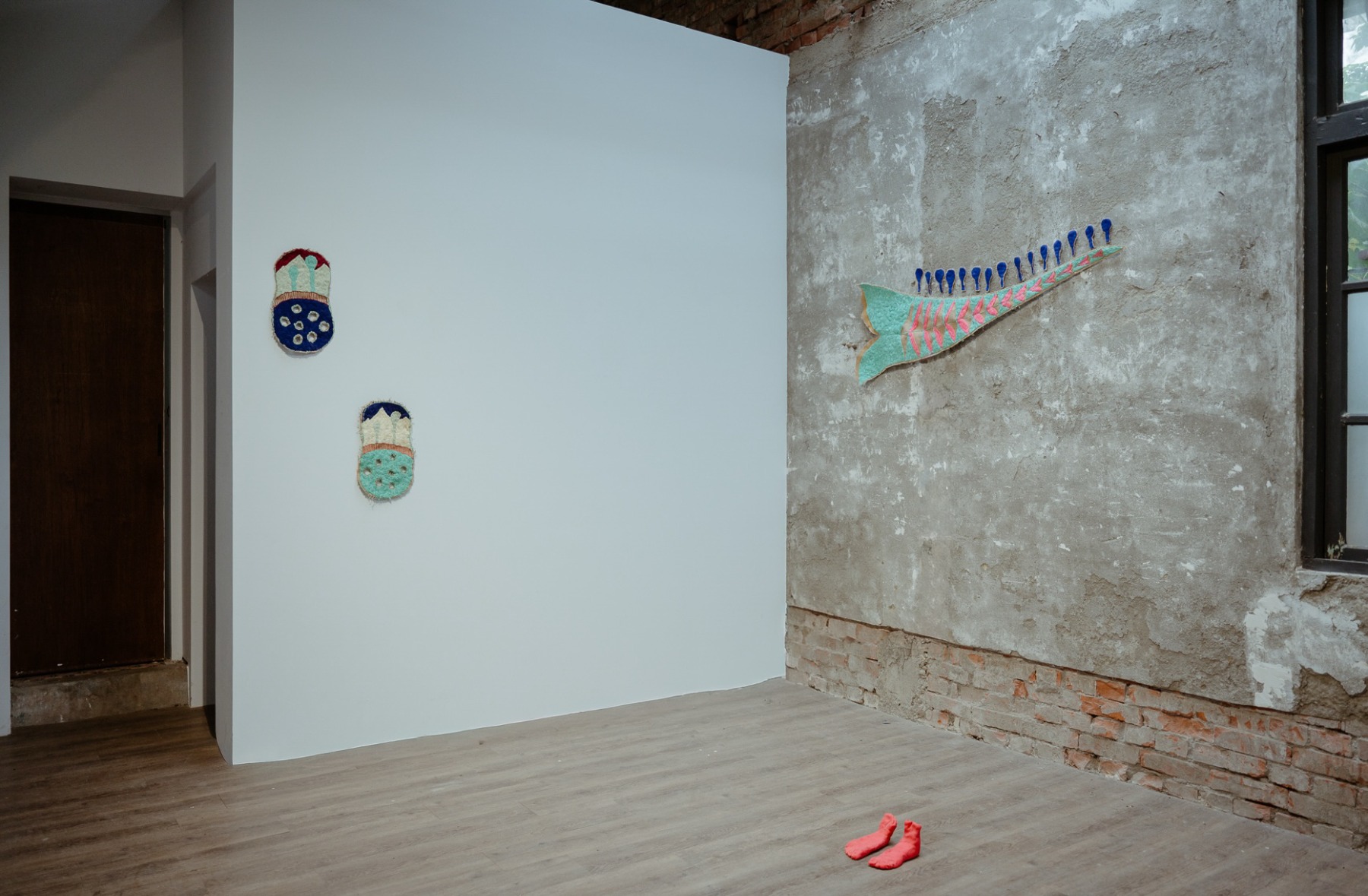
What is it about looking closely at a small structure that keeps pulling you in?
I think there is something very intriguing for me about looking at small, zoomed-in things. If I think about, for example, a leaf, there are so many ways to look at it. Perhaps this comes from ideas around the phenomenology of appearance, thinking about individual ways of looking at one thing.
But when I think about a leaf, I also think about a seed, a tree, its roots. It is one component of something much larger. And there’s also a belief system attached to it, through human perception, mythology and symbolism. But when I zoom in on a single leaf, I can really see what it is as a thing in itself. I’m very interested in looking at the patterns on it and then zooming in as close as I can.
How important is it for you to leave some mystery around what we are looking at?
Mystery is very present in my practice. It is important for me to preserve it and not overexplain my work, but to leave space for others to interpret it in their own way.
As I research perception, I think that, at its core, there is an awareness of individual experience, and I feel that mysticism is a big part of that. For me, I can study as much as I want about, let’s say, how rainbows are formed, but when I see one in real life, there is still something that goes beyond that knowledge and affects me on another level.
That’s another reason why I wanted to play with light in the Microcosm exhibition through the dichroic film on the window. I liked that it introduced an unexpected element that I couldn’t completely control.
Spring: The Flower Garden, hand-embroidery on hessian fabric, maple fruits, 2024. Photo: Rūdolfs Zarāns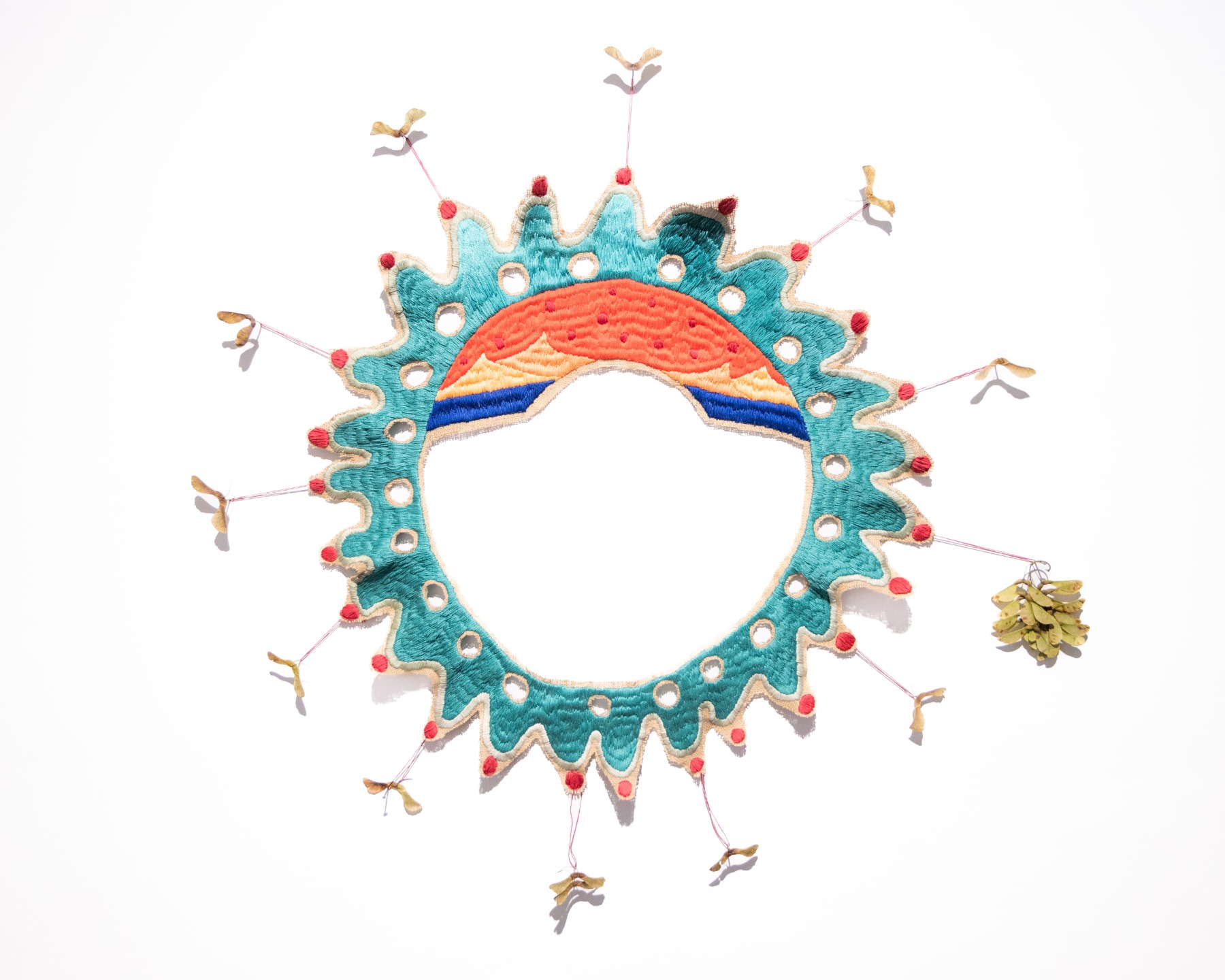
You spend most of your time in London. What made you move there?
I never really planned to move to London. It just kind of happened. I didn’t get accepted to the Art Academy of Latvia, so I had a gap year, and I was thinking a lot about what to try and which direction to take. From today’s perspective, I’m very proud of myself for having the courage to apply to study in London, and I’m glad my life journey took me there.
I moved there when I was 21, and most of my life as an artist has happened there. It’s also the first place where I started thinking about questions like, what does art really mean to me? I started making my first professional contacts there, too. It’s a place where I have people who have followed my practice from the beginning. London feels familiar, and I feel that I’m part of the art scene there.
Riga brings me slightly different things. I feel much more vulnerable here, and I’m not as familiar with the art circles. But I’m very happy that I’ve had the opportunity to have two solo exhibitions here so far.
The Calmness of a Night, hand-embroidery on coloured hessian fabric, dried pine needles, 2025. Photo: Marina Tsaregorodtseva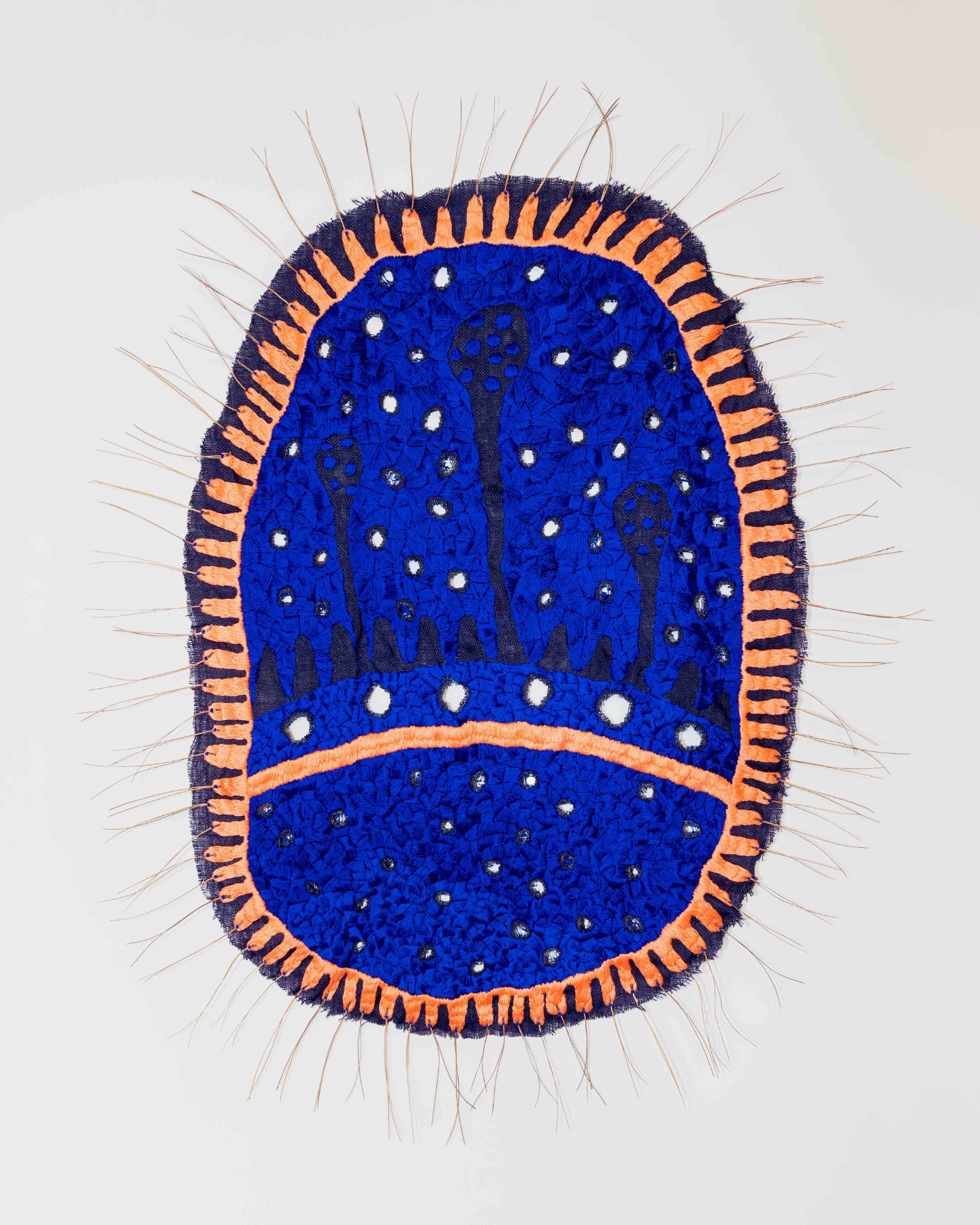
You’ve also been doing residencies and professional-development programmes alongside making your own work.
I learn a lot from changing my environments, and it’s crucial for me to continuously discover new sides of my practice. I also enjoy working with a limited timeframe. Having a deadline and needing to complete a project within a specific period gives me structure.
Last year, I had a wonderful experience in Taiwan with Something Useful Project, which has been one of the most professionally challenging residencies I’ve done so far. I spent three months there developing my own project. I spent time looking at the biological landscape of Taiwan after discovering the Anping Tree, which is known for its roots growing on the outside. I was also fascinated by Taiwan’s temple culture, and I think I ended up visiting around 40 different temples.
Alongside my own research, I was leading weekly creative workshops on embroidery and storytelling for students at National Changhua University of Education. The workshops were intense, but I also managed to create six new works in three months, which felt like a huge achievement for me.
After I returned to London, I had an urge to somehow organise what I had taken from the residency, but I knew I didn’t want to pursue another academic degree or PhD at that point. Instead, I wanted to find a mentor who could help me make sense of it.
Eventually, I discovered the newly established Beyond Studio nine-month programme, led by curator Marisa Bellani, that is designed to support artists. It was a timely opportunity and I learned a lot. It made me rethink my research and approach to making, and helped me to redefine my next steps in a more strategic way.
Family Roots (detail), hand-embroidery on hessian fabric, glazed stoneware, 2026. Photo: Marina Tsaregorodtseva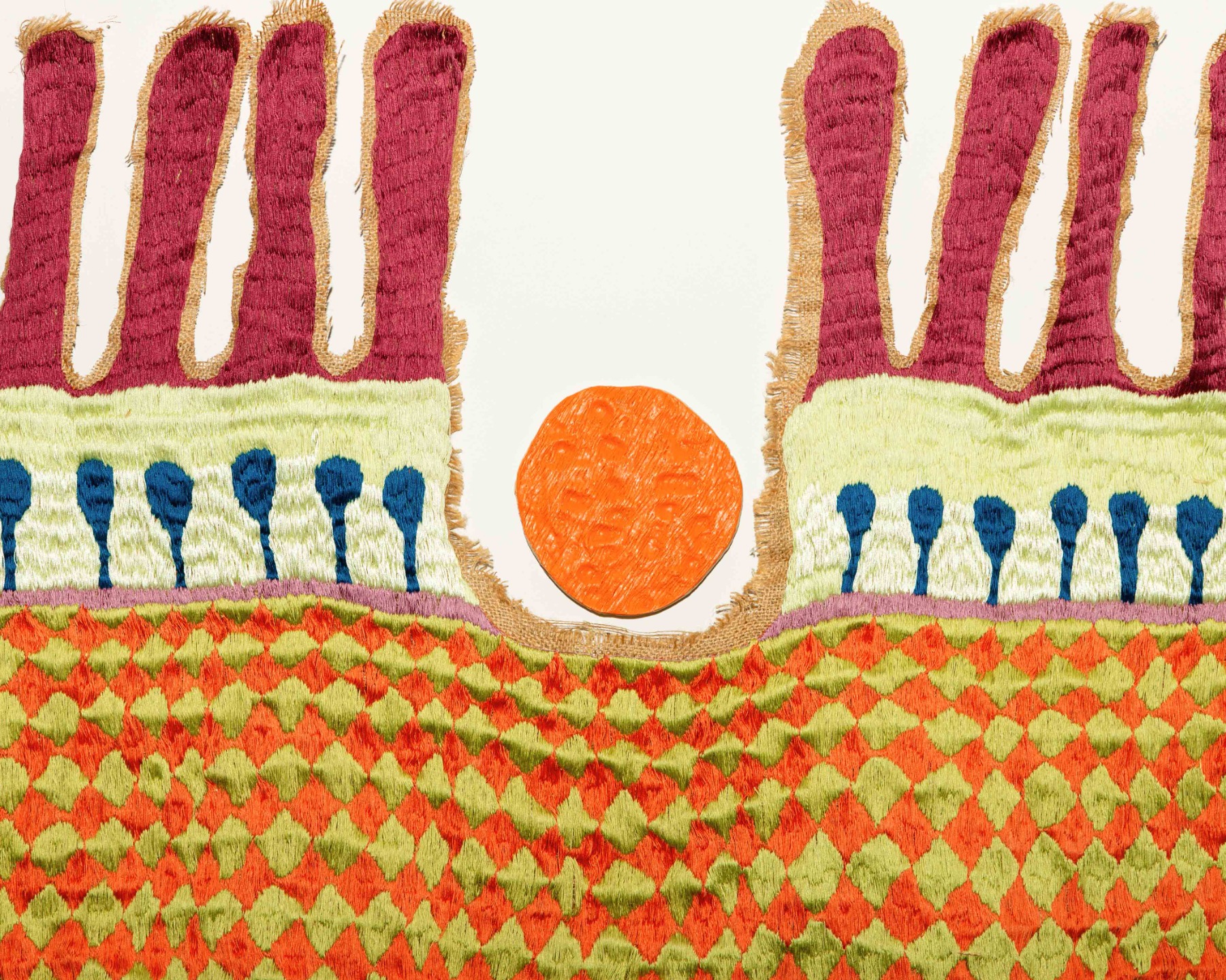
You have a busy autumn ahead, with several upcoming exhibitions in London. Tell us a little about what you’re currently working on.
October in London is all about Frieze, and this year, I am happy to be part of two group exhibitions that will coincide with Frieze Week. On October 2, the nine-month programme with Beyond Studio will have its final exhibition and will open at Roman Road, where I’ll be presenting a new work. It’s the first time I’m combining painting with hand embroidery. Then, on October 15, Sculpture Now, a group exhibition at The Muse Gallery’s new space in Mayfair, will open. I’ll also be moving my studio there in early October, so there are quite a few things happening simultaneously.
At the same time, I’m already looking ahead to summer and autumn of 2027. Together with curator Francesca Dobbe, we’re organising my first solo exhibition in London. I don’t want to reveal too much about it yet. Then, in November 2027, I’ll return to Taiwan for a duo exhibition with Taiwanese artist Hsin Hwang at Shalom Shalom Gallery in Taipei. We’ll be working independently on our own artworks, but we’ll also create one collaborative piece together. Since April 2026, we’ve been exchanging postcards that will eventually come together in an artist book. It’s been such a lovely process, and I’ve always wanted to do something with letters. We send each other one postcard every month, and it’s been really fun receiving them from different parts of the world.
Part of solo exhibition Microcosm, Kalnciema Kvartāls Gallery, Riga, 2026. Photo: Paula Betija Antenišķe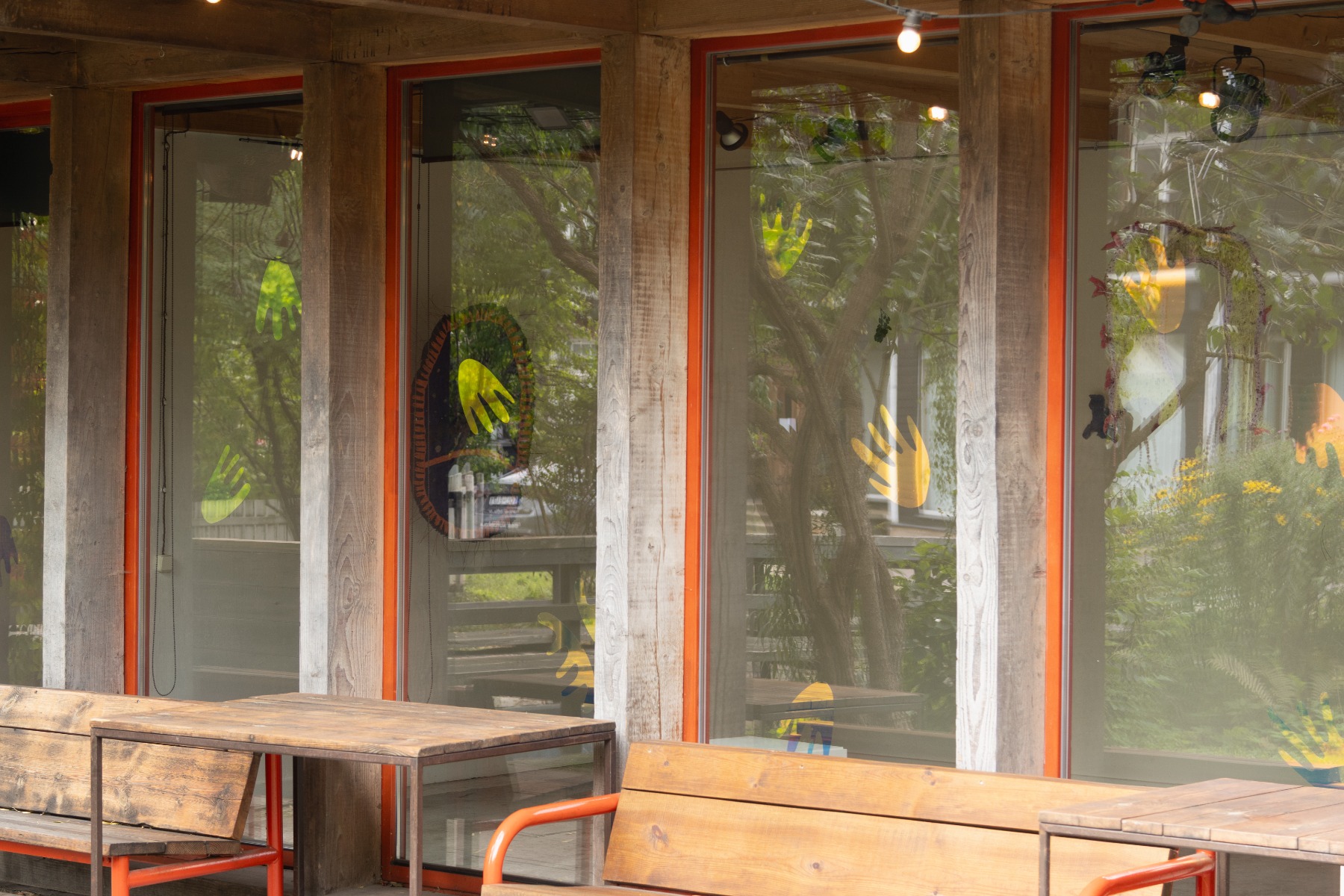
Part of solo exhibition Microcosm, Kalnciema Kvartāls Gallery, Riga, 2026. Photo: Paula Betija Antenišķe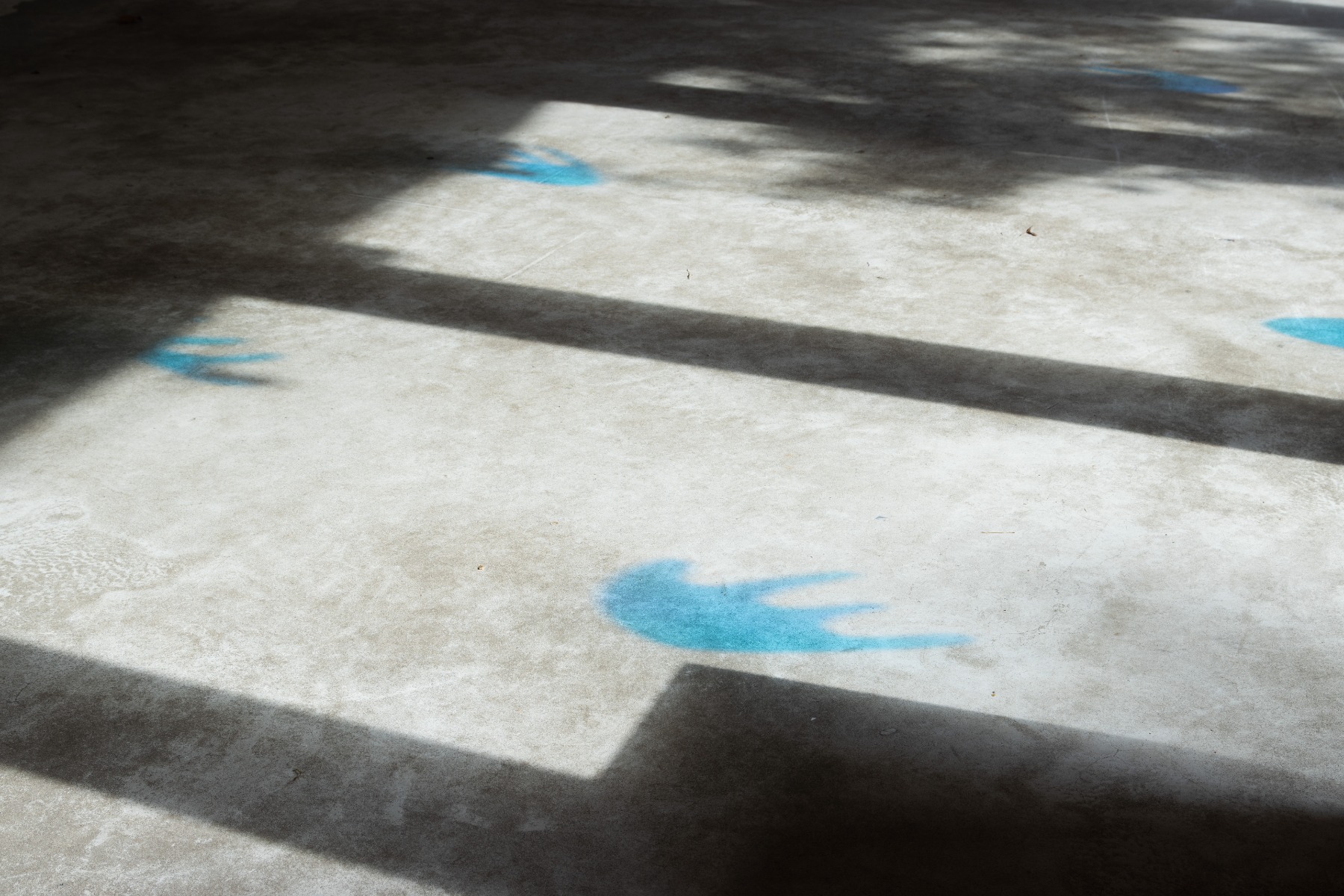
We’ve talked a lot about art. I’d also like to hear about something completely unrelated to it that has influenced your work recently.
At the moment, I’m obsessed with learning about historical events. I’ve been listening to podcasts about the origins of random things, for example, why do we use certain spices in food and how that started, or how people first began rapping. Every now and then, I choose a country and start learning about its history. I try its national recipes, listen to music and watch some films by its national directors. I go on Google Maps to virtually explore its cities. If I don’t know the language, I like to listen to how it sounds and, just for fun, try to guess what people are talking about.
All this is to say that I think this kind of wandering through different subjects is very much part of who I am as a person and how I work as an artist. I follow something that catches my interest, and I want to understand what sits behind it and see where it leads me.
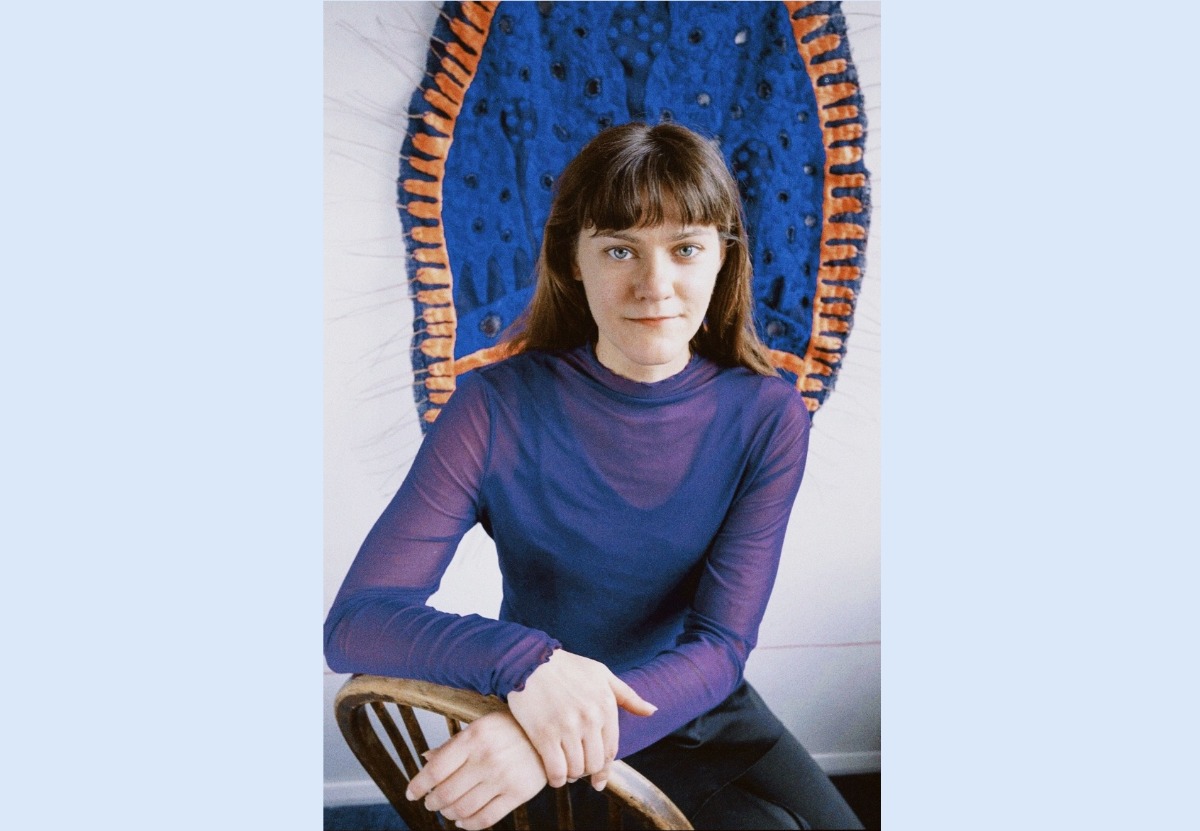
Title image: Margarita Frančeska Loze. Photo: Marina Tsaregorodtseva
