


Notes from the Edge of Collapse
Emilija Lipska
About Playa!: Art as Poetry in the Nordics exhibition at the Bonniers Konsthall in Stockholm
Everyday life is full of poetry. It’s a rather banal phrase, but it’s been on my mind lately. A golden autumn leaf silently drifting to the ground, or landing softly in my hair, where another hand reaches to remove it. Raindrops sliding down the window, the soft percussion of their fall on the sill. Moments like these keep unfolding, yet we rarely notice them. We move too quickly, too rationally, through our routines to sense how much quiet poetry they hold.
Playa!, 2025. Installation views, Bonniers Konsthall. Photo: Jean-Baptiste Béranger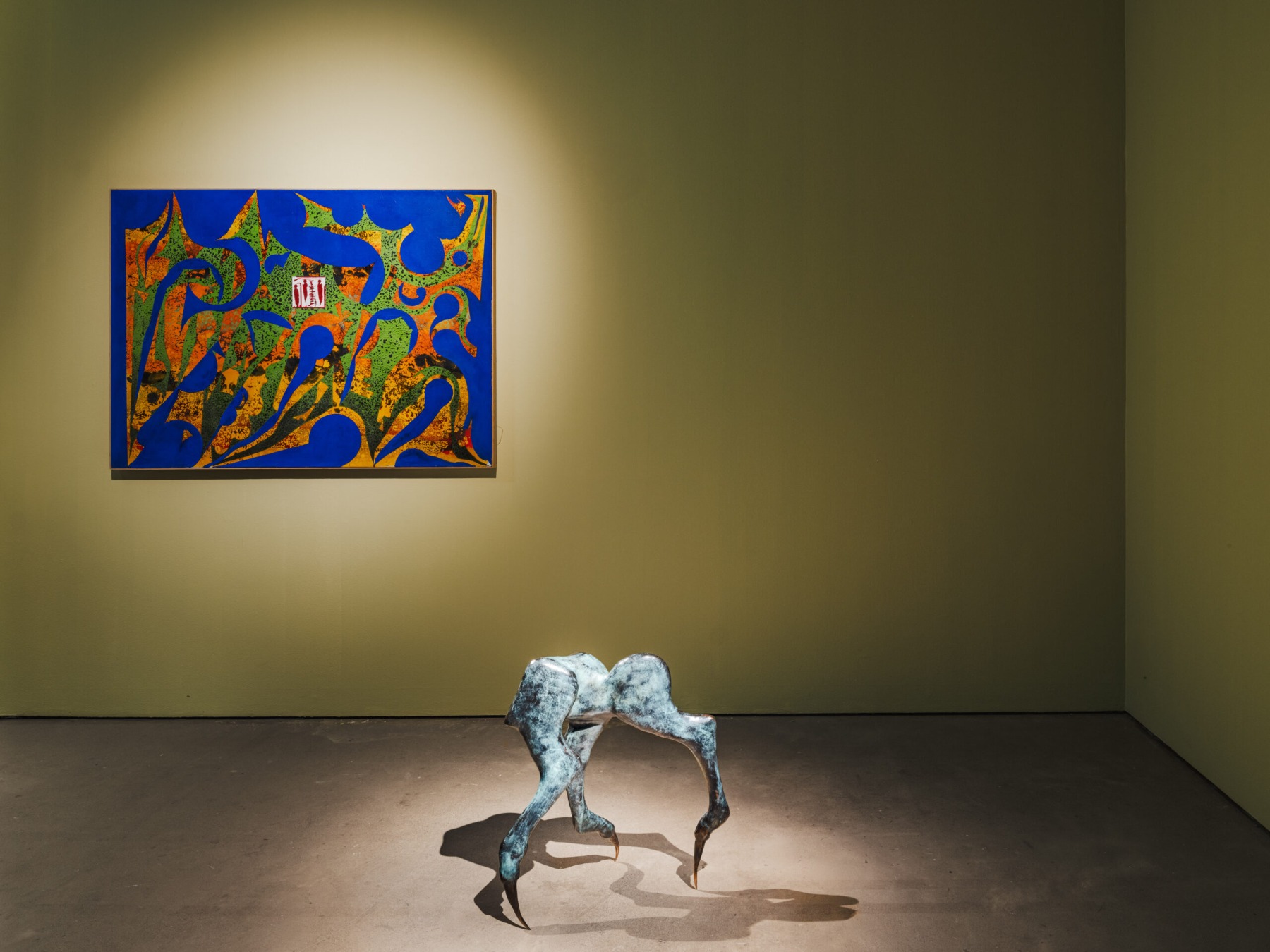
At Bonniers Konsthall, the exhibition Playa!: Art as Poetry in the Nordics turns this question toward art itself. As curator and artistic director Joanna Nordin states in the exhibition text, “in a time of cascading shifts and unravelling certainties, it explores art and poetry as a necessary means of self-defence.” In an era of overstimulation, exhaustion, and climate crisis, poetry becomes a way to stay alive, a survival strategy.
The exhibition begins with an ending, with Ursula Reuter Christiansen’s video “It Is Not Yet Too Late/ It is Too Late” (2024). We follow the 82-year-old artist, dressed in her beloved wolf-fur coat, walking slowly through a misty meadow at dawn. Her voice repeats the phrase like a mantra – it is not yet too late, it is too late. Autumn has already claimed the landscape; yellow-brown leaves drift silently toward the ground. In an accompanying text, the artist describes this as her “last journey”, and the coat she wears is the same one she wishes to be buried in. It turns the performance into both farewell and ritual of continuity.
It is a reckoning, yes, but not a tragic one. Death here is approached with a curious tenderness, as if the artist was testing the threshold, pacing along it like someone unsure which side she belongs to. The fog softens the end. What we witness is not a grand finale, but quit rehearsal for departure, infused with the stubborn insistence that, perhaps, it’s not yet too late.
Sally von Rosen’s “Mrs Sphere” (2024) continues this mood of unease – a bronze, coppery, three-legged, headless creature feels ancient and uncanny. Tripod-like zoomorphic figure stands awkwardly, its legs tapering into sharp, almost weapon-like points. The creature feels both vulnerable and threatening, like a relic of a world that has mutated past recognition. Nearby, Alfred Boman’s “I drakens mage” ( 2022) – echoes the sculpture’s form and shadow, as if the painting and the creature share the same genetic code. Their proximity creates an uncanny dialogue between abstraction and embodiment, between the imagined and the material.
Then, suddenly, everything opens. From darkness, the viewer steps into binding white light – a space so sterile it feels almost surgical. Boman’s sculptural objects lie there like dried organisms abandoned in the desert, waiting for rain. The atmosphere is both sacred and post-apocalyptic: a laboratory of ghosts.
Christiansen reappears in this room through her diptych “Rotten Eggs Against Bombs” (2020). The first canvas is covered with negative words – tears, sorrow, dependence, pain, shame – while the second has been wiped clean, though both are streaked with the residue of smashed eggs. The gesture feels primal, cathartic: anger literally thrown at the canvas. The work pulses with the tension between purification and contamination, protest and surrender.
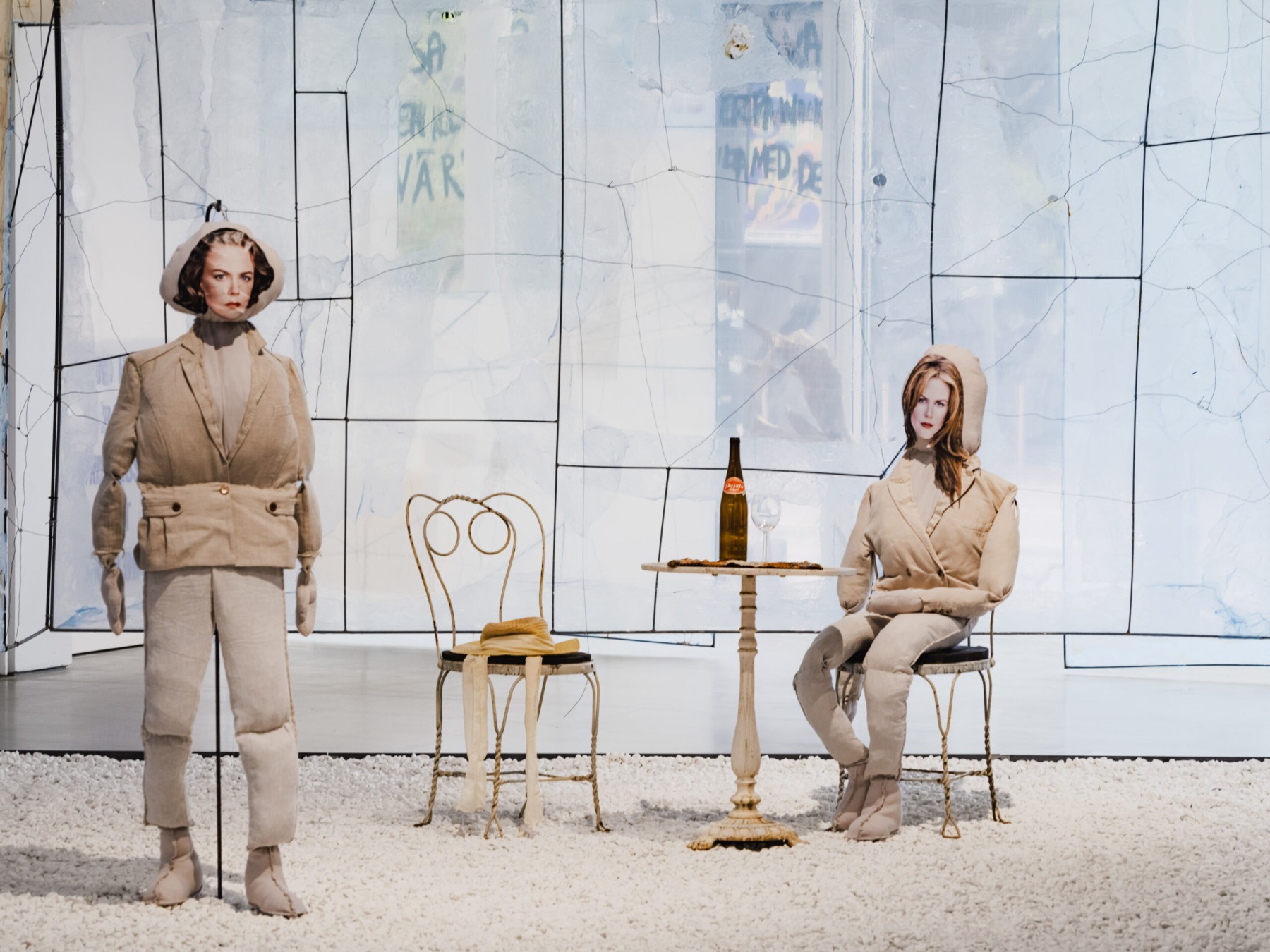
Further in, Hilde Retzlaff's installation “Nicole Kidman with Nicole Kidman” (2024) stages a domestic scene. Two soft-bodied figures, both eerily voodoo-dolls-like, appear in a white stone oasis. One stands, one sits at the cafe table, a bottle and board game between them. Their beige padded clothing, stitched faces, suggest protection and suffocation – a softness that barely conceals discomfort. It feels like an afterimage of an encounter that doesn’t make sense.
Nearby, Edith Sihlberg’s still lifes quietly echo the old vanitas tradition – the slow decay of fruit, the delicate reminder of passing time, collapse of abundance into rot. Her compositions shimmer with an almost guilty beauty: overripe lemons, wilting flowers, glass vessels. Everything looks lush, but just past its prime. The paint itself seems to sag a little. If the Dutch masters warned viewers about the transience of earthly pleasures, Sihlber’s version feels more like a shrug – yes, everything dies, but at least it looked good going so.
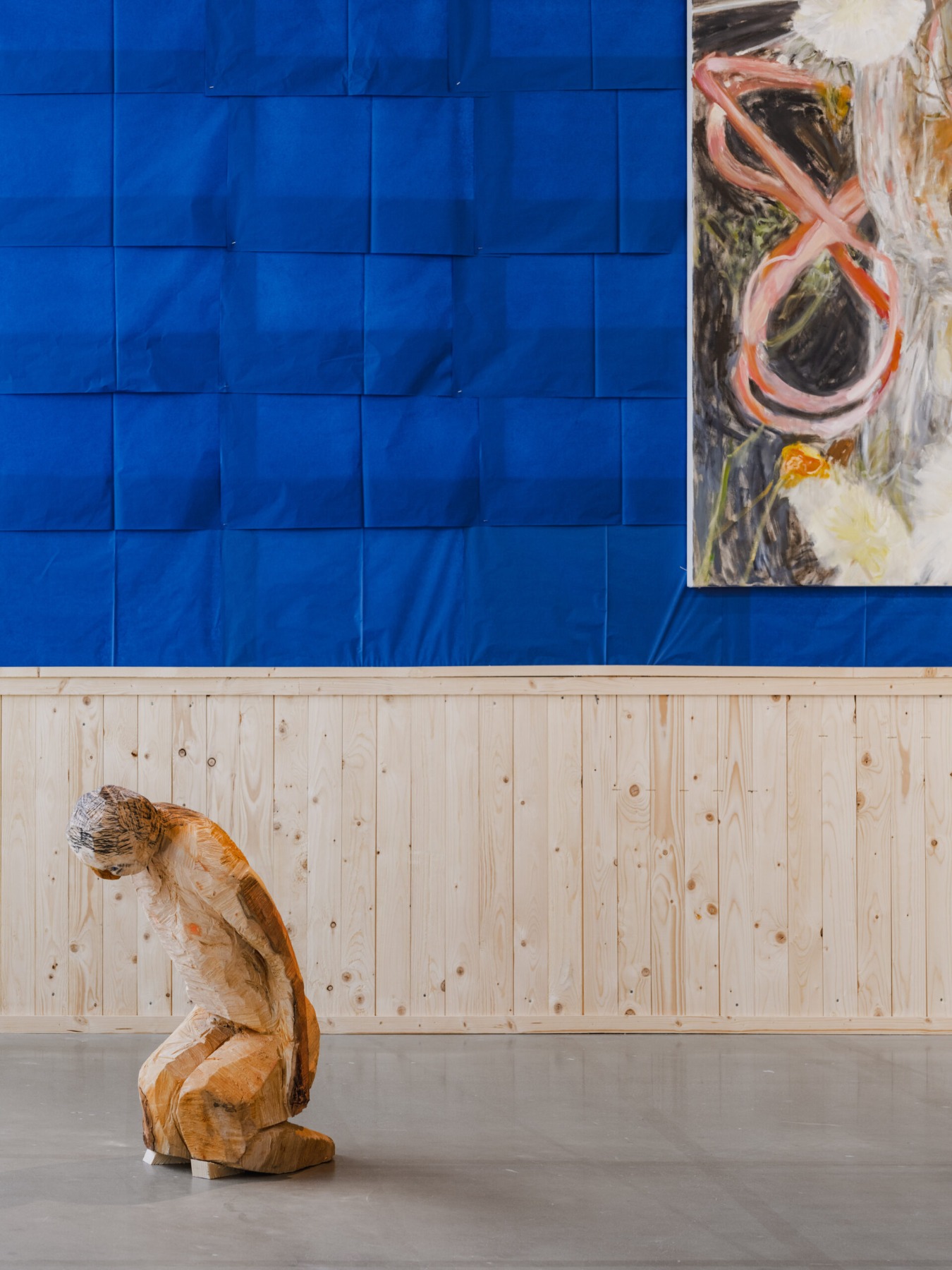
In the corner, Hedda Hultman’s wooden sculpture “Woman with Thoughts” (2024) kneels, her back pierced by two small holes where wings might have been. A fallen angel, perhaps. Or just a woman who’s been thinking too much. Her carved posture radiates weariness more than holiness. She could be praying, repenting, or simply out of options. The sculpture captures that familiar mood: wanting transcendence but settling for self-reflection.
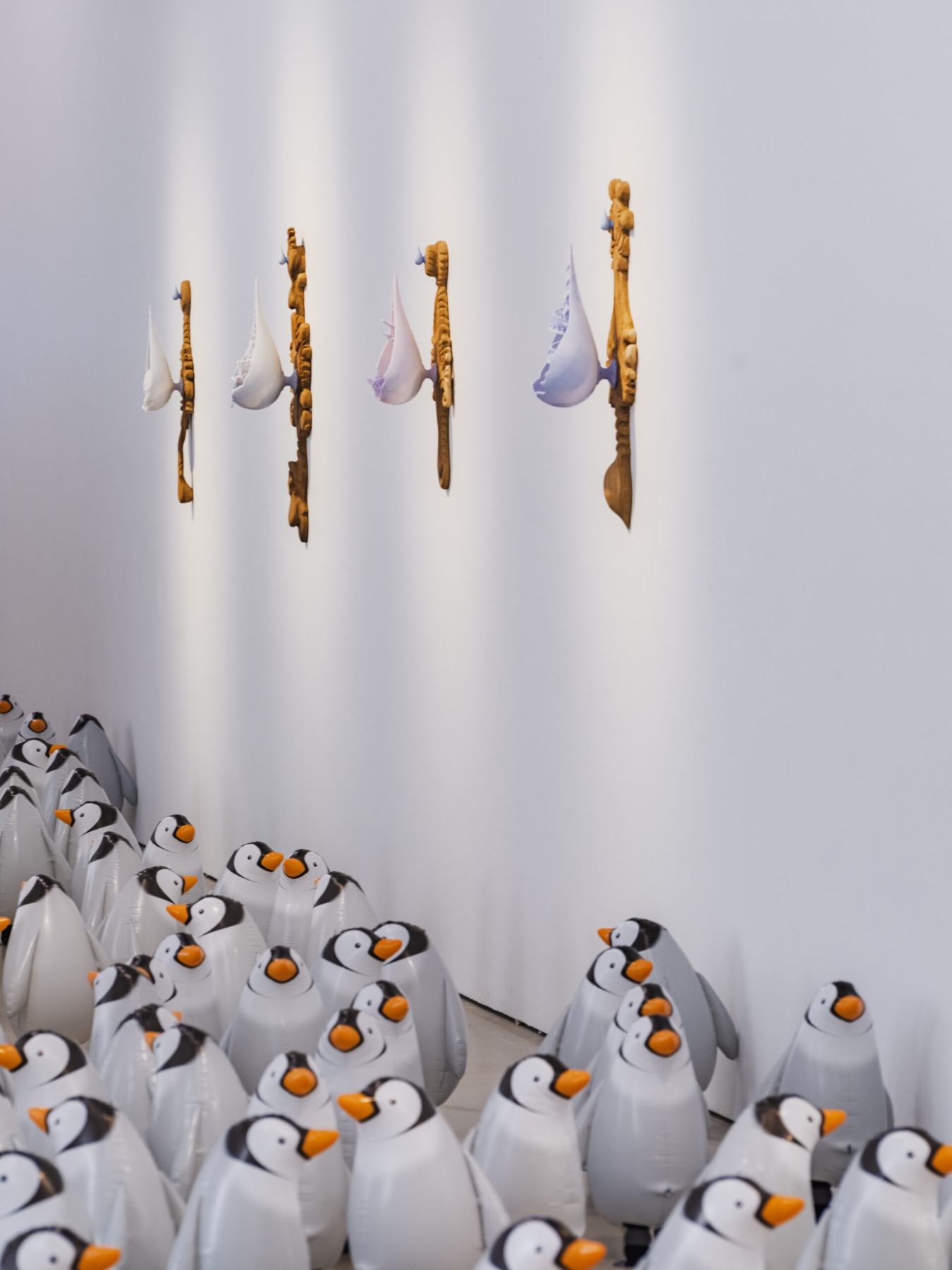
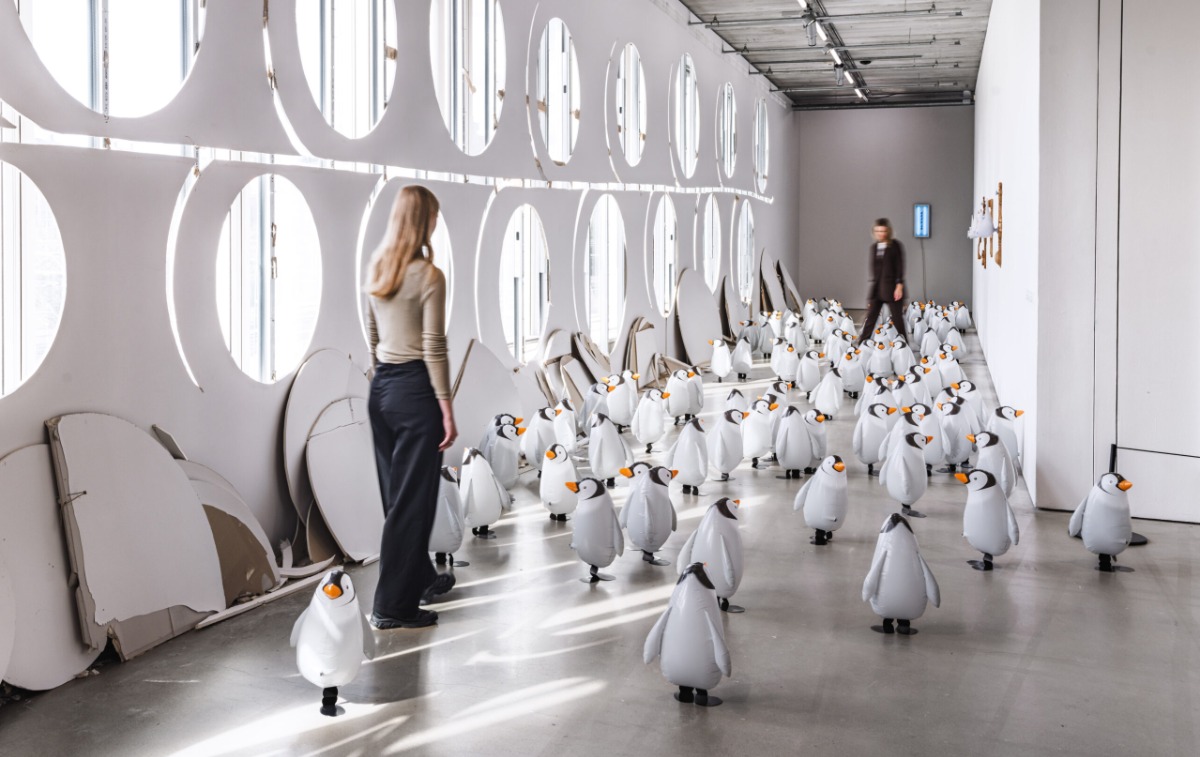
Moving through the exhibition, one begins to sense a recurring undertone – funny and somewhat ironic melancholy of a world in slow collapse. Benedikte Bjerre’s “The Birds” (2017) captures it: a group of penguins, trapped behind glass, able to see the world but not reach it. They are spectators of a vanishing planet. Dozens of small, helium-filled, round, identical penguins. They occupy a long corridor like a silent army of innocence. It feels almost sacrilegious to walk among them. The floor shifts slightly; my skirt brushes one, then another. Their fragile balance disturbed. For a moment I feel guilty – as though I’ve intruded upon their rest. In the Anthropocene, every movement we make disturbs someone else’s peace. Next to this fragile scene, Eetu Sihvonen’s “Mourning Dews” (2024) glimmer quietly. Half exposed capsules hang like suspended raindrops – small ecosystems of their own. They show balance between decay and survival, between mourning and maintenance.
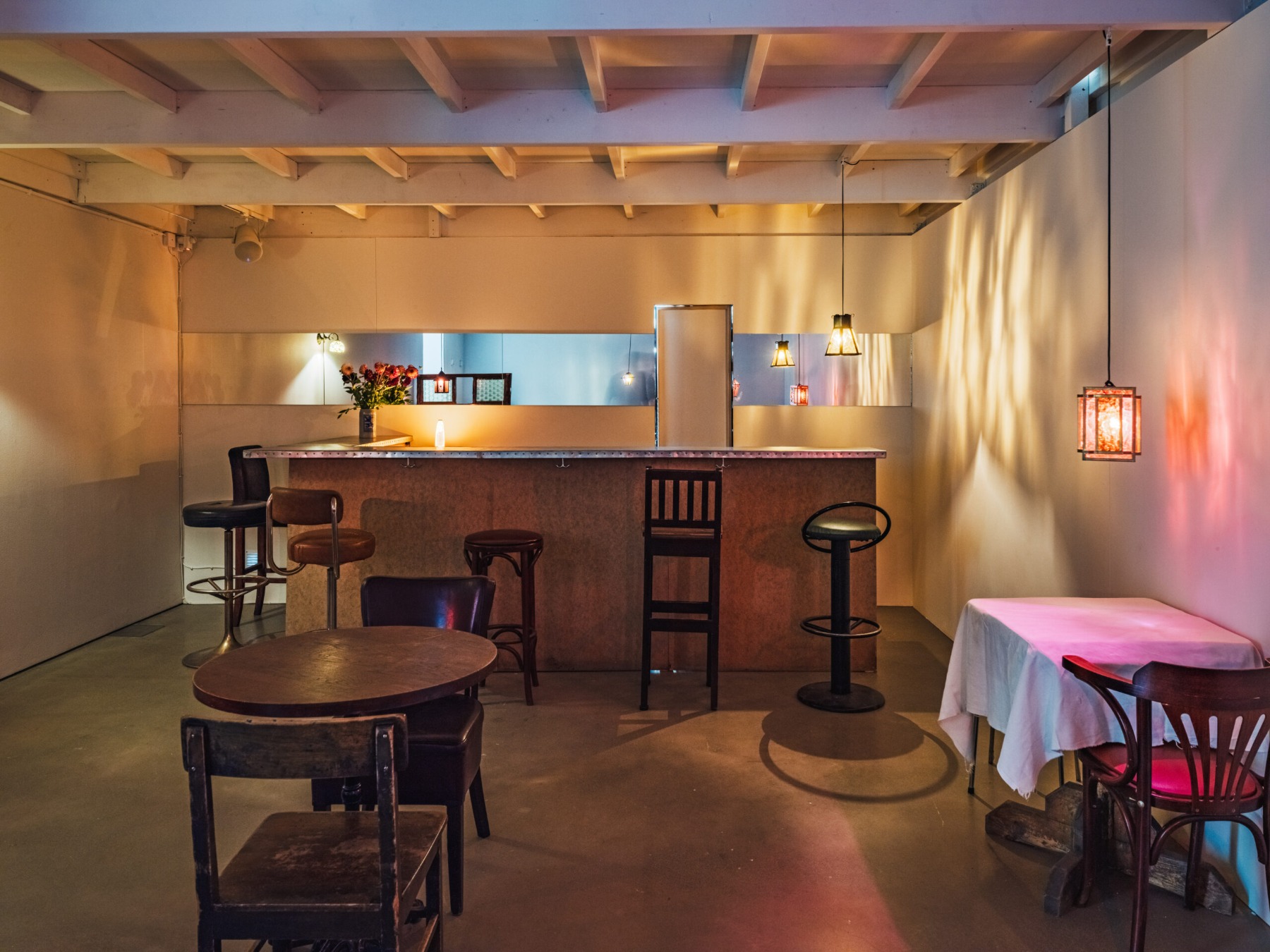
The corridor leads into what looks like an abandoned bar – a place where songs and shattering glasses seemed to have been heard; as if the laughter or loud arguments evaporated just a moment ago. Perhaps performances once happened here; you can almost sense their afterglow, the trace of voices. The atmosphere is faintly apocalyptic – a hangover of civilization. Apparently, throughout the exhibition, performances and other social encounters were taking place – fleeting, dissolving back into the space as quickly as they appeared. It is relational aesthetics where art becomes an encounter, audience as collaborator. But I didn’t witness any of it. What’s left are traces of moved chairs, rearranged fabrics, a faint echo of presence.
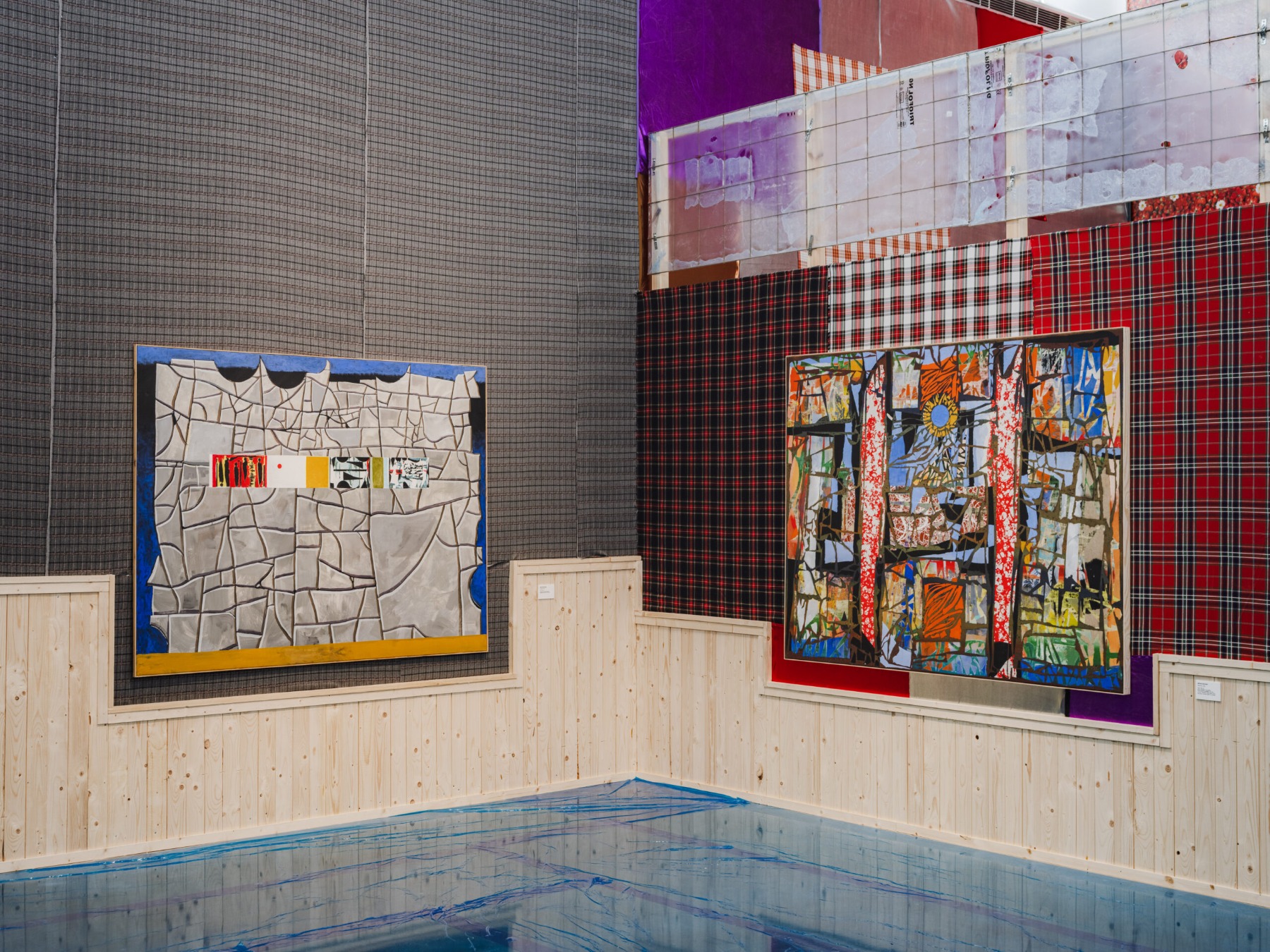
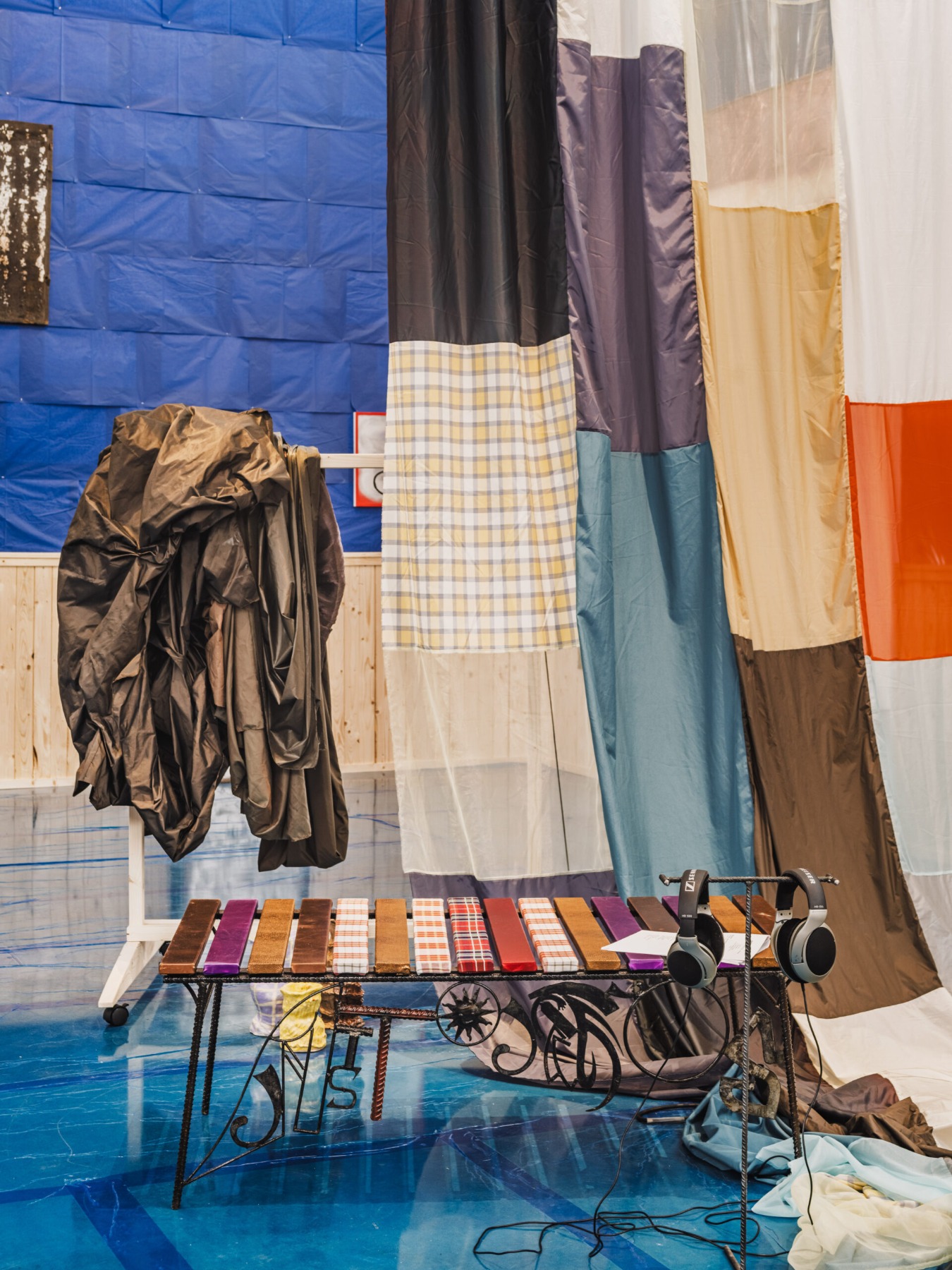
From here the space fractures again. I enter a schizophrenic room draped with textiles from ceiling to floor. The sound of my steps changes – the floor seems cracking. I realize I’m walking over blue tape that feels like thin ice. Each step releases a tiny pop, as if bubbles trapped beneath a frozen surface are bursting underfoot. It’s playful but also frightening – the boundary between stability and collapse is thinner than we like to admit.
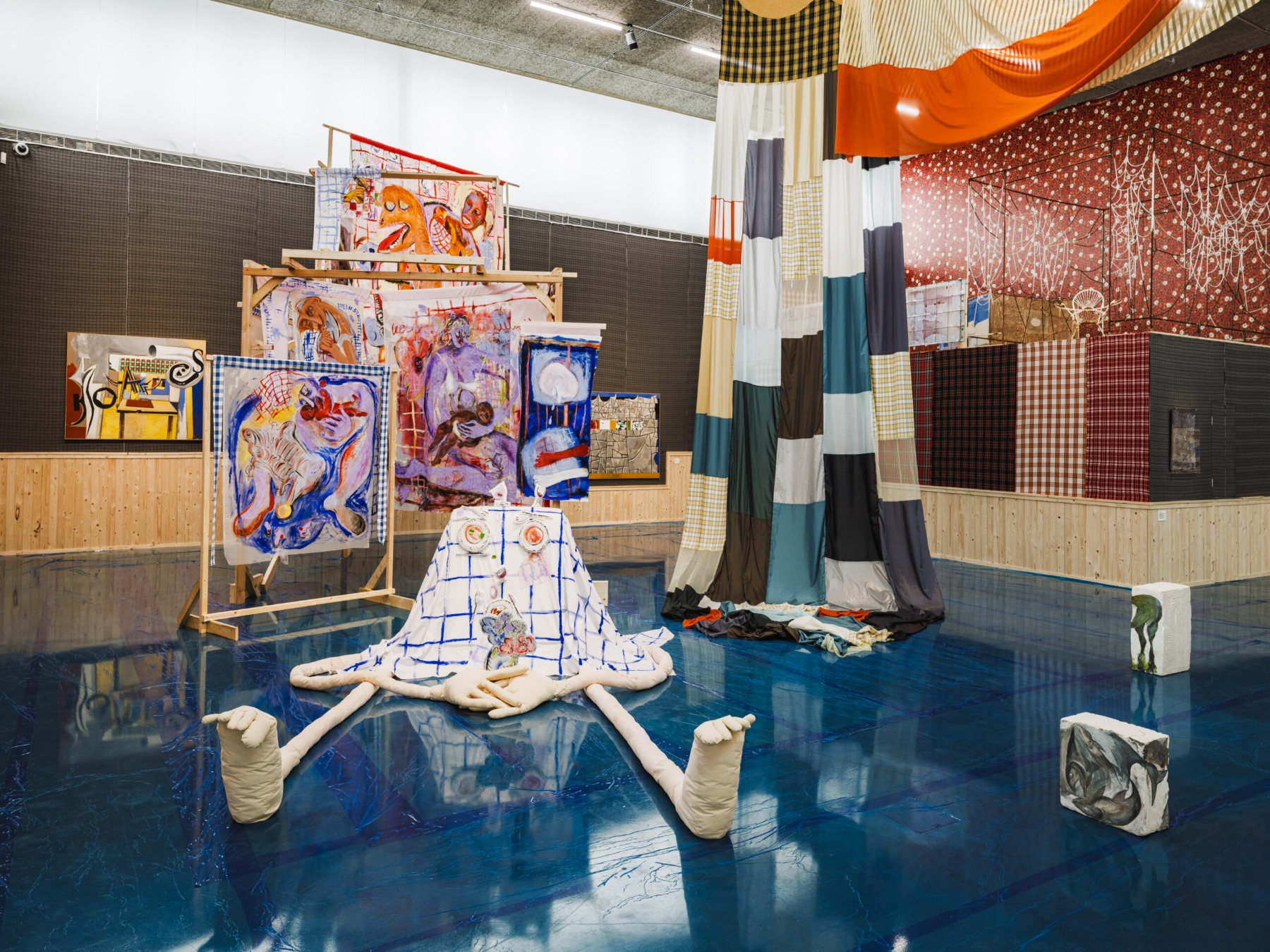
The space feels like a stage assembled from fragments of forgotten plays, a scenography built from a year’s theater repertoire. Everything seems borrowed from somewhere else: some parts once belonged to Essi Kausalainen’s performance “Margulis and mud”; wooden frames now repurposed as skeletal architecture for displaying Jenny Kalliokulju’s “Curtains” (2023-ongoing). Around it, patchwork textiles hang from ceiling to floor, forming makeshift walls. Their mismatched patterns suggest that the apocalypse, when it comes, will look more like a student theater production than a divine revelation. The whole room feels like a squat – improvised, chaotic, yet weirdly alive. You can almost hear echoes of those who were there before, rearranging things, making something out of nothing. There is a kind of resistance in the mess, a stubborn refusal to be polished or complete. It’s a theater of survival, where art keeps performing even when the audience has gone.
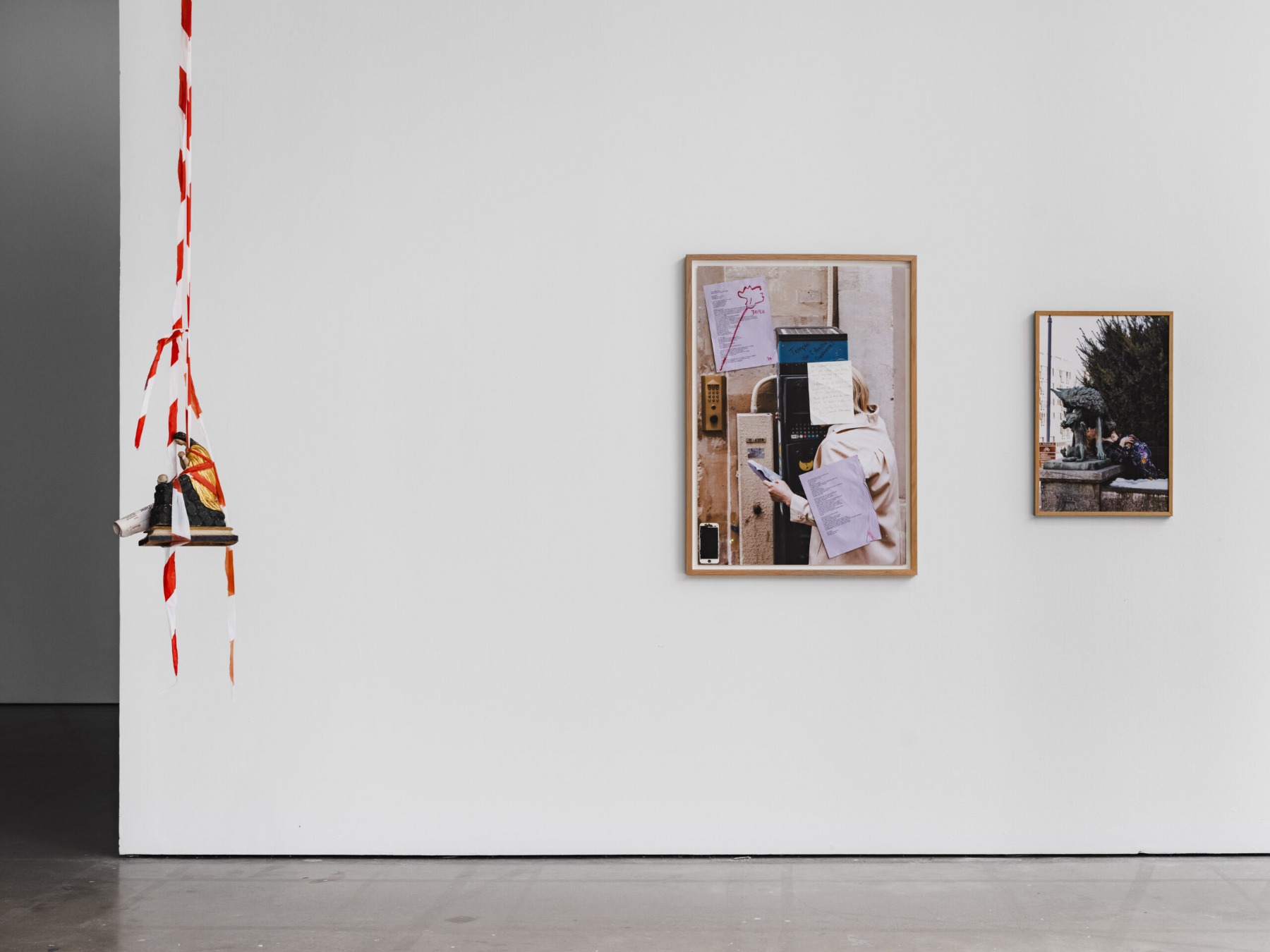
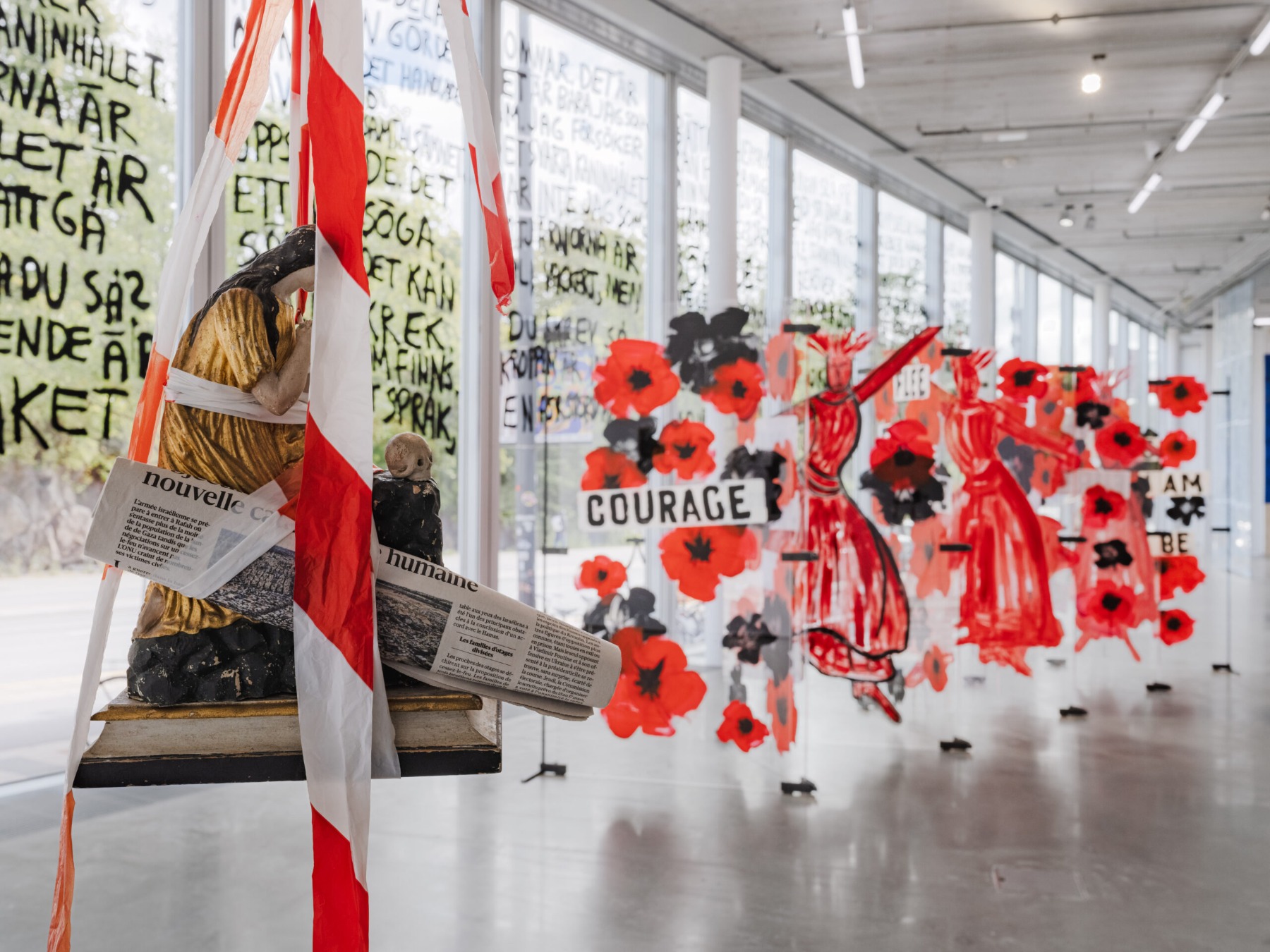
In the final hall, words take over. Fragments of letters on photos, text on transparent glass painted with poppies and dancing girls. Somewhere a wooden figure resembling Mary Magdalene kneels in prayer – perhaps on Golgotha. Faith itself seems suspended, hovering at the red stop line. The air feels devotional but uncertain, caught between reverence and irony. Through the large gallery windows Elis Monteverde Burrau’s poems appear – written directly on the glass. Here, poetry and daily life literally merge. You read the words while looking out at the city beyond: buses sliding past, people rushing by. The everyday becomes a way of looking at the everyday. It's a quiet revelation that poetry already saturates the world around us if we only pause to notice.
Perhaps that’s what Playa! leaves behind: not a conclusion, but an aftertaste. A recognition that art, poetry, and ruin coexist; that beauty and despair are parallel languages describing the same collapse, the same sublime. And that perhaps, even now, poetry is not a luxury, but a way to survive the slow unraveling of the world. The exhibition itself feels built like a poem. Like a collage, it’s composed of fragments that shouldn't fit together, yet somehow do. A cacophonous constellation of scattered words, gestures and materials forming their own fragile system of meaning. Nothing here resolves neatly; instead, it vibrates, alive.
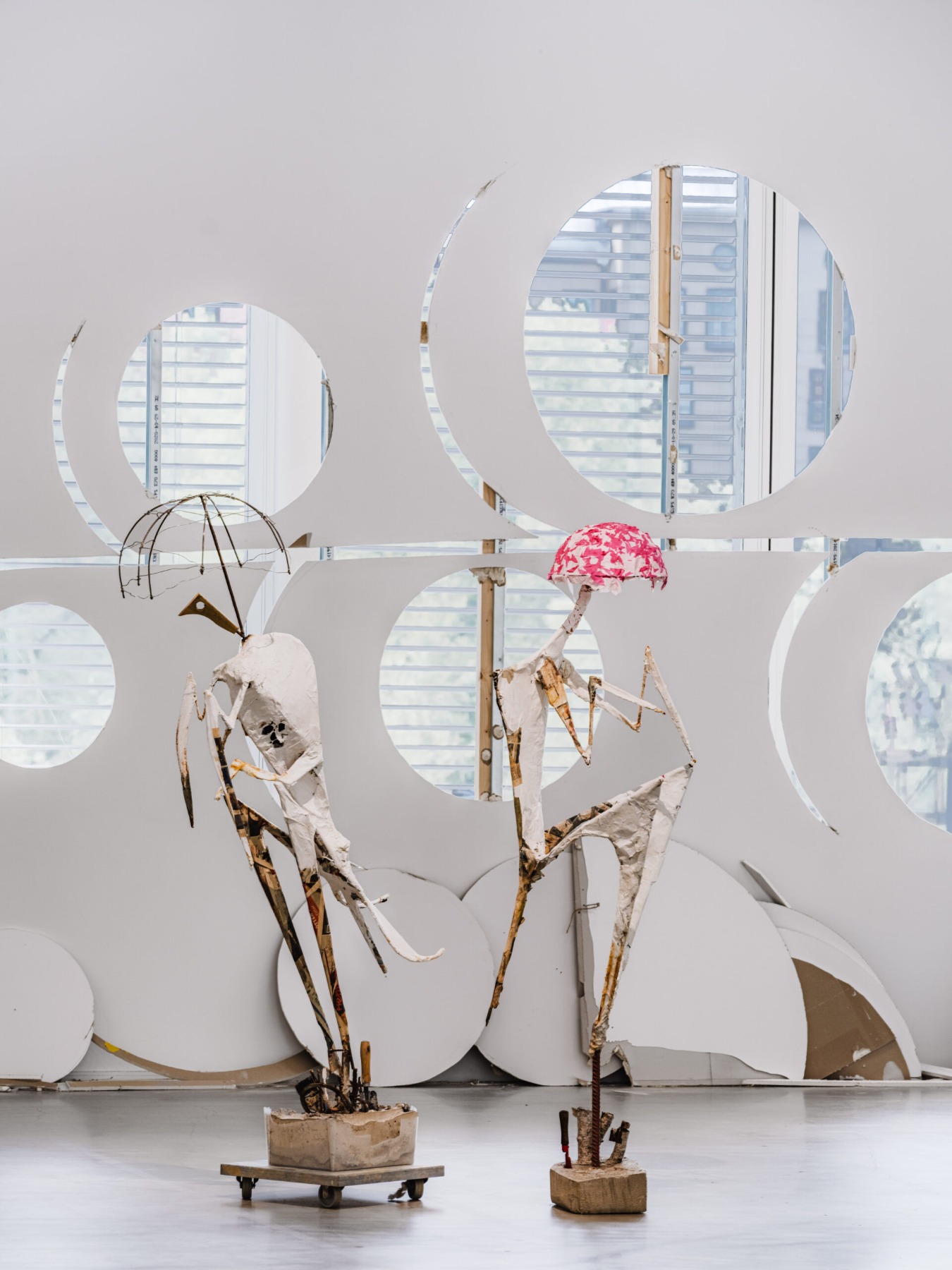
Standing at the edge of this collage-world, one senses that Playa! is less an exhibition than a field note from the brink – a document of survival, of holding on to sensitivity when everything else is hardening. These are, perhaps, the notes we write when the center no longer holds.
***
Playa!: Art as Poetry in the Nordics is on view at the Bonniers Konsthall till November 9, 2025
