


Standing in Line for Art
Anna Iltnere
04/07/2011
Venice hosts the 54th International Art Exhibition from June 4 through November 27, with exhibits at the Arsenale, Giardini di Castello, city pavilions, and collateral events.
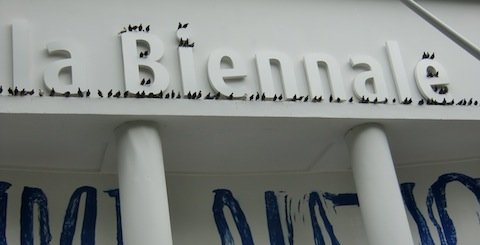
Since the early twentieth century, a cluster of pavilions from various countries has been set up for the Venice Biennale in the Giardini di Castello. Over the last hundred years, this cluster has grown and multiplied. It was precisely the Biennale that brought the life back to this park built during the Napoleonic period, which stood for many years as the city’s forgotten child. Yet a century later, life effervesces almost excessively on the opening days of the Venice Biennale, and people have to wait in long queues to visit certain pavilions. This stimulates us to contemplate the power and weapons of contemporary art.
A historical aside: Shortly before the start of the nineteen century, in 1797, Napoleon Bonaparte conquered Venice and decided to “improve” it according to his own ideas. Bonaparte wanted to expand the furthest point of Venice—the Arsenale—and turn it into the most important harbor in the Adriatic Sea. In answer to his ruler’s desire, local architect Giannantonio Selva developed a project in 1802 to cultivate the region’s green zone, transforming it into a beautiful park. The project was accomplished by contracting local botanists and even by constructing an artificial hill. Yet just a few years after completion, the park had turned into a failure; it was too far from the heart of Venice, which beat in the neighborhood of San Marco, Rialto, and San Lucia. Almost nobody went out to the Giardini di Castello.
Years later, the Venice Biennale changed everything. After the first exhibits in the late nineteenth century, at the Arsenale’s Palazzo, Italian artists complained that, due to the event’s international character, they were being allotted too little space to exhibit their works. And so the organizers struck upon an idea. Artists from other countries were offered pavilions in the nearby park, Giardini di Castello. The first pavilion was constructed in Belgium in 1907; the newest is South Korea’s, built in 1995. There are currently thirty pavilions owned by thirty-four countries (the United States, Russia, Great Britain, Australia, Finland, Sweden, etc.).
A large crowd of visitors always gathers in the gardens during the Biennale—and this is certainly the case this year as well. The length of the queues at the pavilions created an enticing impression about how much a given country’s exposition must be seen. Meanwhile, those pavilions without a queue seemed slightly suspicions—like products without a well-known brand, which you turn over in your hand, study the ingredients, and doubtfully wonder whether or not it is any good. And if it is, then why aren’t people standing in line for it?
Of course, the thronging crowds are understandable. The pavilions have limited space, and there are huge masses of people because it is the opening day of the Biennale. This must be taken into account. Later, it’s not so bad. Yet either way, I don’t like to stand in line for art. And this has nothing to do with patience.
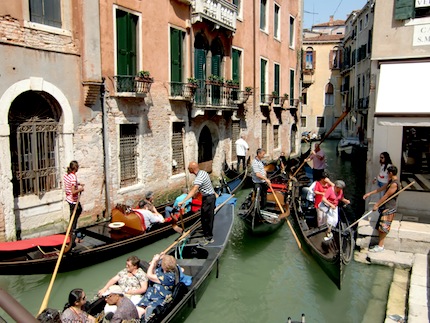
This is similar to the situation with the most sought-after routes for Venetian boats: you shove past the damp shoulders of other sweaty travelers, until you can seen the shore right above the deck, with Venice’s picturesque architecture. And there’s Piazza San Marco—look and enjoy! Maybe you’re seeing it for the first time! Meanwhile, somebody has set his suitcase down on your foot. Of course, there are always alternative paths for tourists to check out. For example, you can take a walk down the side streets.
As a “tourist” at the Venice Biennale, I much prefer to stroll and get lost down narrow Venetian streets, occasionally stumbling across a country’s pavilion in the city, temporarily housed in its historical architecture. By the way, this opportunity was introduced relatively recently, in 1995 (the hundredth anniversary of the Venice Biennale). Starting then, all those countries that have never had a pavilion in the park could find a place for themselves at the Biennale. The Baltic states first took part in the Venice Biennale in 1999. Of course, people still want to see the exposition of the large nations; that’s why they must head to the Giardini di Castello, accepting the fact that sometimes they’ll have to wait in line.

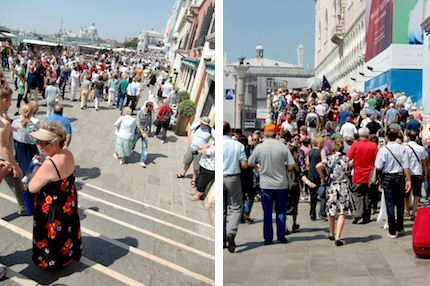
Entrance of the Giardini di Castello. Queue at the ticket office
Let’s look at things from a wider perspective. Today’s world is overflowing with anxious jostling between others and sweating at work; on a daily basis, only the rare few enjoy such luxuries as being alone and experiencing a leisurely, undisturbed enjoyment of culture.
That’s why the question arises about the role of contemporary art today. I can’t rid myself of the conviction that art must assist, and not hinder even more, the already beleaguered contemporary person. That doesn’t mean it must immediately stroke the viewer’s head. It must help. But how? What is the role of contemporary art? I doubt it’s entertainment; it seems as if that belongs to the daily jostling I’ve already described. Dance clubs, bars, the movies—all this is a massive rubbing of shoulders. Leisure is most often sought in bars. But a work of art demands free space, both physically and mentally. That’s how it seems to me.
After standing in the long queues at the Venice Biennale, what can a visitor hope to achieve at the pavilion? Definitely something that was “worth” standing so long for it. And what is “worth it” for a modern person, who has come to the pavilion from a traffic jam in the city, from the queues at the airport, from packed airplanes and then crammed trains or buses, and then made his way from the tourist-clogged streets, or with the abovementioned boats, to the Giardini di Castello? And now he’s ready to stand once again in long queues with the hopes of seeing…what?
Squeeze
Recalling those expositions that remained vividly in my mind, I later analyzed what it was that made them settle into my heart and brain cells and not just vanish into the horde of impressions. Perhaps through a subjective prism I could at least make a sketch with an ordinary pencil about what the task of contemporary art could be in relation to the viewer.
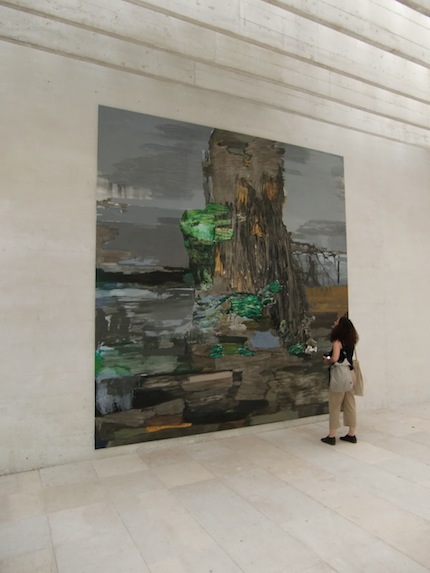
Andreas Eriksson painting in the Swedish Pavilion
Peace. I’m not sure if the people standing in line consciously hope to see works of art that will have a relaxing effect (in that case, they could just go to a spa). Rather, they strive to be surprised, shocked, and saturated. Yet they can unexpectedly realize how pleasant it is to be in the epicenter of the Biennale’s anthill, and feel warm sensations that are similar to peace. I experienced this in the Swedish pavilion, where the strange natural lighting and trees growing there organically coexisted with the earth-toned paintings of Andreas Eriksson (1975), with their strokes as rough and sure as a ploughman’s hands.
A while ago Eriksson lived in Berlin, where he found himself in the wheel of a flourishing career—huge exhibits, lots of stress. As a result, in the late nineties, he was diagnosed with electromagnetic hypersensitivity. For health reasons, the artist was forced to abandon the city and move to the country. Perhaps the natural rhythms and calm environment is “to blame” for the energy of his paintings. It was hard to decided which had a more therapeutic effect: the pavilion’s architecture or the artist’s works.
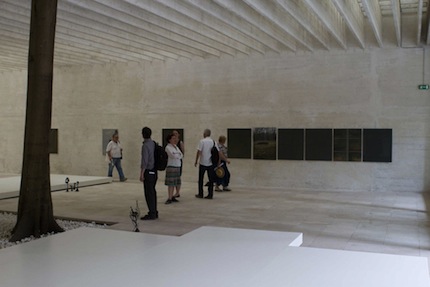
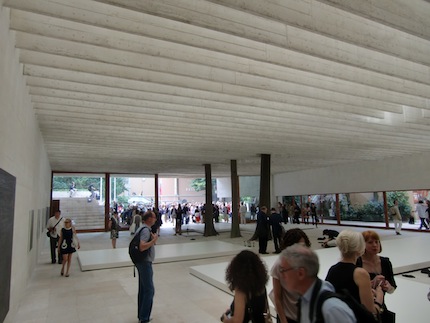
Of the Swedish pavilion in the Giardini di Castello
The Nordic pavilion was constructed in 1962, based on a project by Norwegian architect Sverre Fehn (1924–2009). At the pavilion, I heard comments that the warm yellow lighting motivated a few to leave as quickly as possible, and in a critique of the Venice Biennale I read that Eriksson’s exhibit seemed depressing.
This made me wonder how the subjective occasionally isn’t objective at all. I must add that the Swedish artist Fia Backström (1970) exhibited her works alongside Eriksson, yet a more lasting impression was left by precisely Eriksson’s paintings, in the context of the pavilion’s architecture.
The Latvian pavilion in the city—Artificial Peace (Contemporary Landscape)—created by Kristaps Ģelzis (1962), had a relaxing effect too. I thought I knew what to expect, but was surprised how incredibly pleasant it was to spend time in the exposition. For example, the artist’s Nightly Bedtime Story, creating during the 2008 Cēsu Art Festival according to a similar principle, with dark walls in an old beer brewery, pressed itself upon my eyes. It was physically difficult to spent long amounts of time in the visually beautiful exposition. But being in the bright space of the Venice pavilion, which was specially renovated by the artist and his assistants, was like soaking in a pool of air—very relaxing. A refreshing spa for the mind.
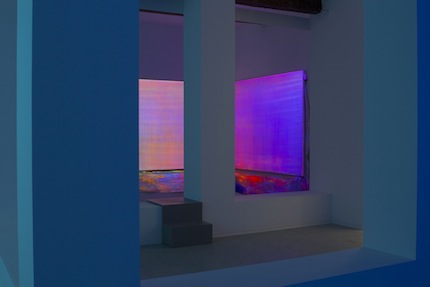
Peace opens up a large furrow for contemplation—you start to think in complete sentences and resolve thoughts from start to finish. And a desire to spend long amounts of time beside or inside a work of art is an achievement both for the artist and for the viewer.
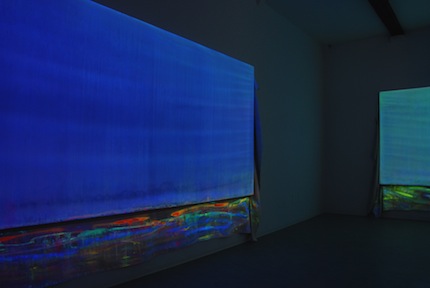
The Latvian pavilion in Venice. Kristaps Ģelzis, Artificial Peace (Contemporary Landscape)
A smack in the face. I agree with the Polish art critic Anda Rottenberg who, in a recent interview with Arterritory.com, said that she is engaged by art that unveils a special point of view, a new perspective for how to see the world: “The artist places this before my eyes and says, ‘Did you notice it?’” I’m fascinated by artists who know how to do this directly. Not by poking their finger in your eye, showing you the obvious, but rather with a smack in the face—a visually impressive hammer of impressions comes at you, melted down into symbols but indubitable in meaning.
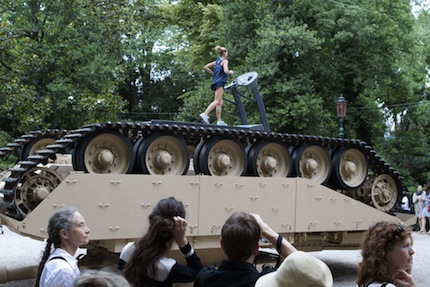
Installation / Performance at the entrance of the U.S. pavilion
This is precisely how I would describe the exposition in the U.S. pavilion. First and foremost, an upside-down army tank, with a jogging treadmill set up on its tracks, where a U.S. Olympic champion runs for fifteen minutes every hour. When the athletes runs, the tracks of the tank turn too, making a grating, metallic noise. It had been a while since I had seen such a precise and witty symbol of the large scale of the United States’ identity. The authors of the American exhibit, Gloria, were Jennifer Allora (1974) and Guillermo Calzadilla (1971), both of whom currently live in Puerto Rico. Shocking works of art can also smack you in the face. At least if the shock isn’t an end in itself, but pokes through you like a needle laced with a bit of thread, so that you pull the thread through yourself for a long time to come. It hurts, you could even say you don’t like it, but mere liking or disliking doesn’t have a place in works that harshly remind us of life and death. You might ask who needs this—people are exhausted enough by daily life. But this is exactly why it is needed: so that the ants can climb off the track and celebrate the limited time that they spend here.
Here I’m talking about the German pavilion, whose author is Christoph Schlingesief (1960–2010). In May 2010, the curator and Frankfurt Museum of Modern Art director Susanne Gaensheimer invited the artist to represent Germany at the Venice Biennale. He agreed, and made sketches for the exposition, but in August of 2019 Schlingesief died of lung cancer.
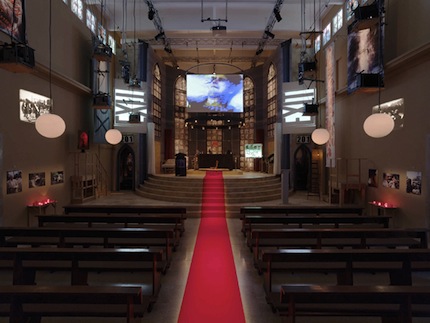
Gaensheimer and the artist’s wife, Aino Laberenz, made the decision to create the pavilion anyway, without displaying Schlingesief’s sketches and plans but showing his existing works. As a result, the exposition is like a monument to the artist. The existential themes of his works—life, death, and suffering—affect the viewer with nauseating power, tearing down the border between art and life and driving into your head a long moment of silence. The German national pavilion was awarded the Golden Lion this year.
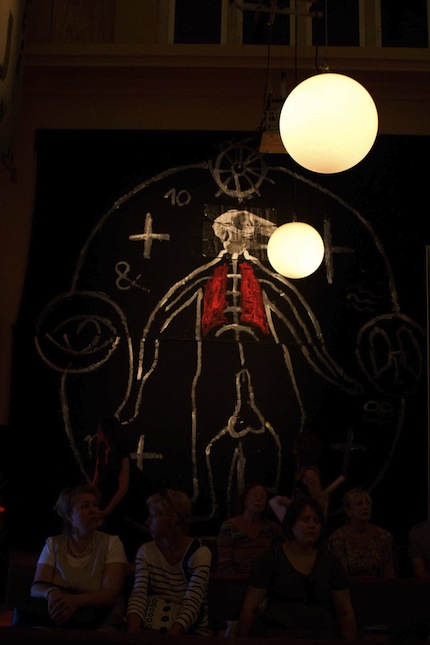
Of the German Pavilion, Giardini di Castello
Surprise over something new. Wandering through the pleasantly cool side streets of Venice, following the signs as if I were in some adventure game, I found the way to Palazzo Malipiero, the home base for the national expositions of Central Asia, Iran, Cyprus, Montenegro, and Estonia. A small room in this building now occupies an important place in my memory. I went to Venice with the hopes of finding something at this “best of the best” exhibit, and curator Bice Kuriger’s “best of the best” selection at the Arsenale, that would surprise my receptors at several levels. In an interview with the Latvian art magazine Studija (June/July 2011), Kuriger mentions a “a surprise created in a complex and intelligent way” as the most powerful form of expression for art today. I hoped to see that, in the works of art, the selection of materials, colors, media, and ideas would form an unexpected and surprising complex, so that I could assert that here was something new—and in a positive sense. I didn’t find many examples like this at the Biennale.
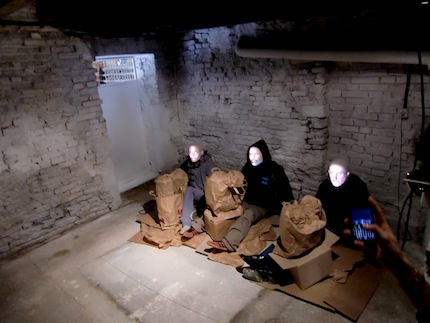
But one of the surprises was a small room inside the Palazzo Malipiera, which enticed me with something so different from what I had seen before. Up until that moment I was convinced that it was the Iranian section of the pavilion. All indications pointed to this. Yet now, as I try to specify the names of the artists, I find that that the part of the exposition has mysteriously vanished from any information resources. Perhaps somebody can help me figure out who the authors were? At the exhibit, I found myself lingering for a long time, shuffling from one part of the room to the other and back again, my eyes glued to the work. Bums who looked like they came from the streets of New York were sitting and talking by brown paper bags on strips of cardboard, their faces hidden inside hoods. Their faces were made of plaster, yet they moved as if they were living. Videos of faces were projected onto the plaster casts. The eyes shifted, the mouths moved, and the gestures attested to the unmistakable presence of a living person. But nonetheless this wasn’t true. The impression was so strange that I got pleasant rush of goosebumps.
You don’t understand it fully, but later it won’t let you go. Convoluted art doesn’t speak to me. Yet if I can’t understand it, that doesn’t mean it belongs in this category. You don’t always have to understand everything immediately. If a work really is too tedious, then you quickly forget about it. But there are works of art that later won’t let you go; once in a while you think, What was that, what did it mean? It’s possible that this confusion of the soul sometimes suits conceptual art. Here I’d like to mention the Russian national pavilion, curated by the cultural theoretician, philosopher, and conceptual art specialist Boris Groys, who is renowned in Russia and elsewhere in the world. The exposition Empty Zones was created by the pioneer of Russian conceptualism Andrey Monastyrsky (1949) and the group Collective Actions.

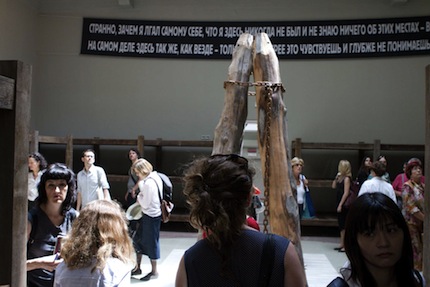
Of the Russian Pavilion, Giardini di Castello
The pavilion has lots of free space. The exhibit was created as an archive made available to the viewer, with videos from the group’s projects and other materials. Wooden logs have been erected vertically in the center of the hall on the second floor. After you have walked through the rooms, you are left with a feeling of incomprehension: Why this archive of works by artists? Why this emptiness? And why logs? Impatient visitors are even known to snort something below their breath.
Yet the atmosphere and message of the exposition soaks in only gradually. On the night after I visited the exhibit, I leafed through the Russian pavilion’s catalogue and read about what the Empty Zones are. Boris Groys writes that Andrey Monastyrsky and the group Collective Actions have incited people to “empty action” since the 1970s. This is an activity that is neither active nor passive; it gives you a chance to enter the “empty zones,” in which society can reflect upon itself without being disturbed. This is contemplation. The next day I started to notice these very same vertical logs in the waters of Venice, which have been marking the paths of ships and boats for centuries.
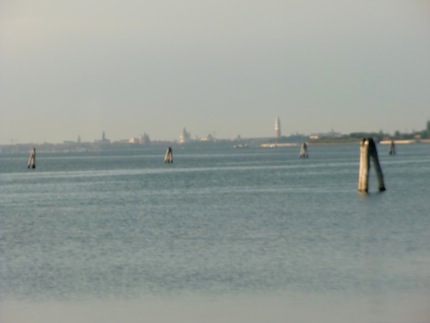
View from the Venetian coast
Returning to the long queues: No matter how tiring they could be, they still shrewdly conjured up an atmosphere of commotion and importance. But no matter how much this forming of queues is or is not an artificial trick (for instance, keeping to a minimum the number of people who are let it at one time), none of the pavilions was able to accidentally achieve an advertisement as good as Iceland’s. You could read everywhere that Iceland would be represented at the Venice Biennale by a pair of artists, Libia Castro (1969) and Ólafur Ólafsson (1973). Now read this again, and carefully. No, that’s not the Danish/Icelandic artist Ólafur Eliasson, who everyone knows :) It’s Ólafsson.
I know a whole bunch of people who misread the news during the bustle of the festival, and went to the pavilion just like the others who were bewitched by the commotion of the long queues. I realized what was what just days before the Biennale.
No matter how big the swarm is around large contemporary art exhibits, art itself reminds us of the trivial main thing: to awake from our slumber, to find some time for reflection, and once in a while to find refuge in the “empty zones.” I like art that knows how to remind us of this in a very beautiful way, one that always comes as a surprise to our sense organs.
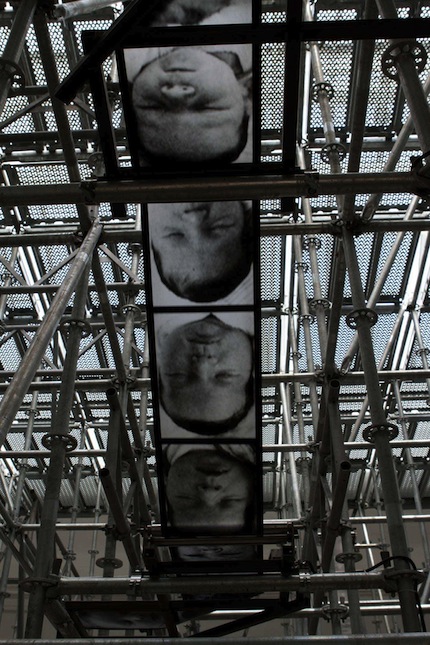
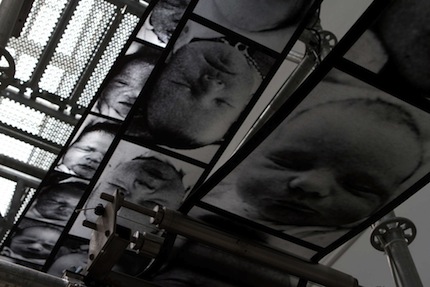
Of the French Pavilion, Giardini di Castello. Christian Boltanski, "Chance"
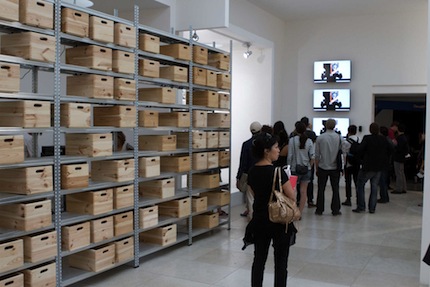
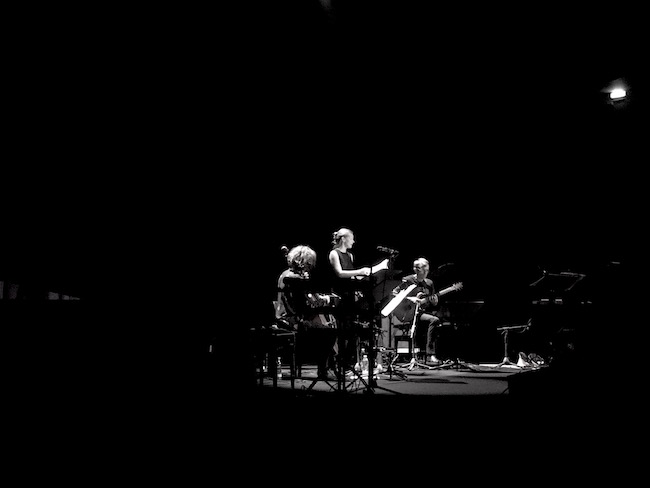
Of the Danish Pavilion, Giardini di Castello. Several artists united under the theme - freedom of speech - "Speech Matters". Curator - Katherine Gregos

At the entrance of the Canadian Pavilion. Artist - Steven Shearer, 1968. The inscription on the 9m high wall compiled from lyrics of the Heavy Metal music.
