


“It should have been made decades earlier”
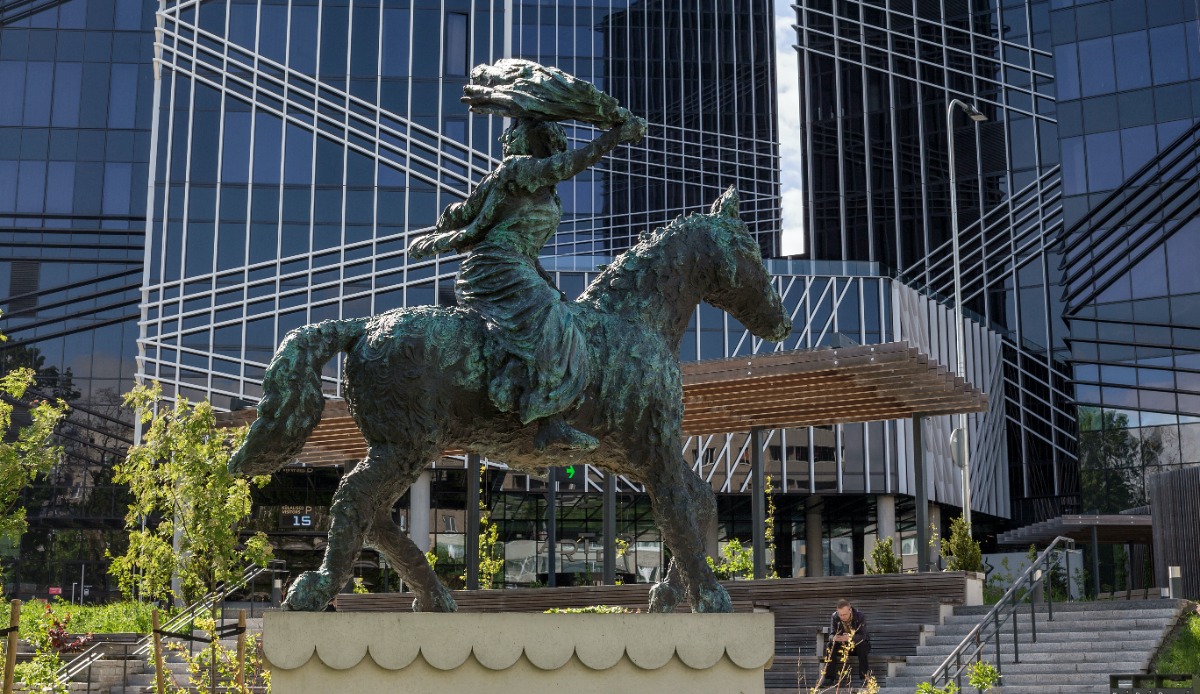
A life-size bronze equestrian statue of women’s rights advocate Alma Ostra-Oinas has been installed in central Tallinn and has sparked intense public debate. The conceptual work was created by artist Flo Kasearu, who agreed to answer our questions.
Alma Ostra-Oinas was a political figure and activist in the women's movement during the pre-war era of the Republic of Estonia. The monument represents a character from Kasearu's sculpture series “Monumental Abandonment.” Flo Kasearu (b.1985) is an artist based in Tallinn who works directly with various social processes, often using her characteristic irony. Her works include videos, drawings, paintings, installations and performances, with the approach chosen to suit a given theme. The equestrian statue series originated in the 2023 Vabamu Museum exhibition "Out from Behind the Stove!", curated by Piret Karro. "It was a historic show, built on the realization that the history of the Estonian women's movement and feminism had been fairly underwritten. We didn't know very much about it – perhaps something about recent history, but certainly not, for example, that there was a very active women's movement in pre-war Republic of Estonia," said curator Piret Karro to journalists of ERR.
"Out from Behind the Stove!". Exhibition view. Vabamu Museum. 2023. Photo: Kristi Sits
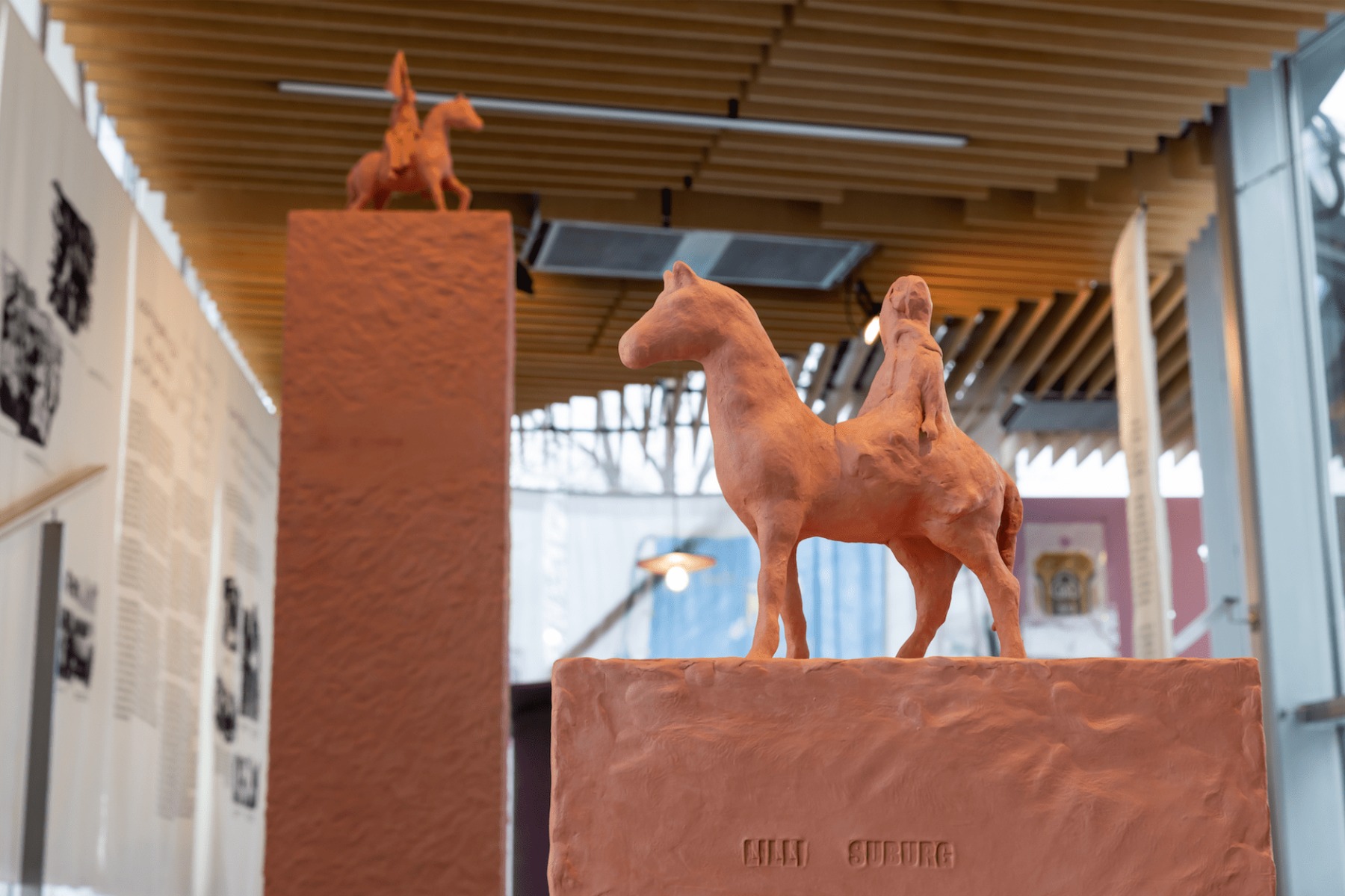
A selection of seven women from different periods of Estonian history was made, ranging from the writer and feminist Lilli Suburg to the social scientist Marju Lauristin and the curator and art historian Eha Komissarov. While the exhibition was still on display, the idea gradually emerged that the sculptures (originally relatively small-scale figures) might eventually be placed in public urban space, becoming part of the city’s everyday environment. In May, this concept was realized when a life-size bronze monument was installed on a green area behind the Arter office building in Tallinn. The sculpture portrays Alma Ostra-Oinas, a Social Democratic politician and women’s rights activist from the era of the interwar Republic of Estonia, depicted in motion as she urges her horse forward, as if driving it onward through space and time. "It looks as if it might have been erected decades ago – perhaps even during Alma's lifetime. It's all conceptual, and the idea is for the monument to appear as if it has stood here for a very, very long time," said Flo Kasearu to journalists about the “timeworn appearance” of the sculpture.
At the same time, some sharply negative reactions appeared in public discussions. The criticism can be broadly summarized as objections both to the historical figure herself and her left-wing views, as well as to the aesthetics of the monument and the anatomical plausibility of the horse’s depiction. Thus, one review points out that “the muscles of the hind legs would only allow the poor creature to move by pulling itself forward with its forelimbs, like a seal.”
This is one of the rare cases in which contemporary art does not operate within its usual designated preserves – museums and galleries – but instead enters the public urban space itself. For that reason, we felt it was important to take part in the discussion and reach out to the artist. Flo kindly agreed to answer our questions.
Photo: Mari-Leen Kiipli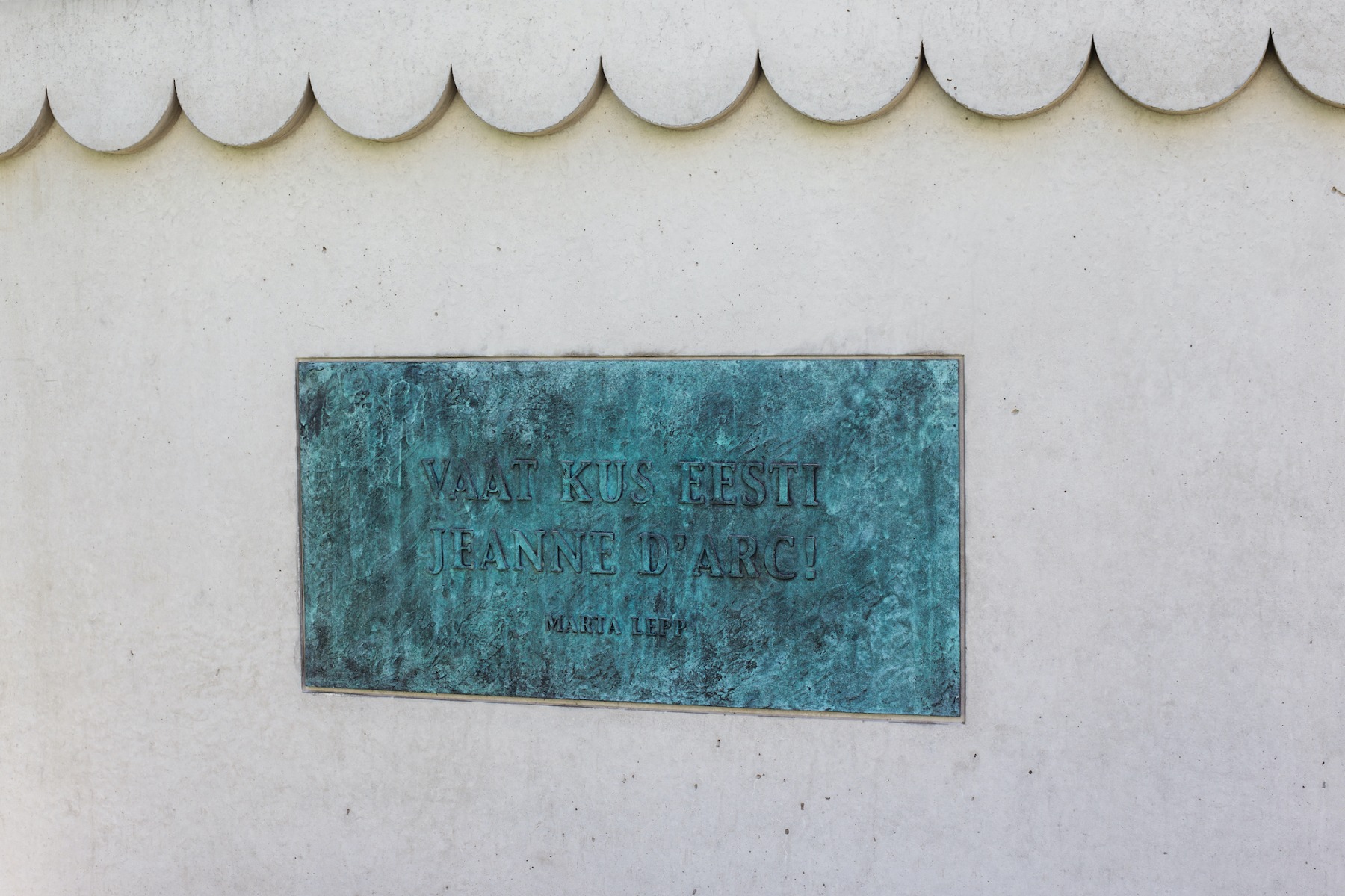
How do you perceive the legacy and historical significance of Alma Ostra-Oinas? Why did you choose her specifically as the subject of this monument?
The sculpture series “Monumental Abandonment” contributes to the creation of a more equal society by opening up the diversity of the story of Estonia’s democratic development. The series erects equestrian monuments to historically significant women. While such monuments have traditionally been dedicated to men, this series highlights women who have remained invisible in Estonia’s mental and urban space, despite deserving recognition.
The series originated from the 2023 exhibition “Out from Behind the Stove!” at Vabamu, which explored the history of the Estonian women’s movement over the past 150 years (curated by Piret Karro). Women such as Lilli Suburg and Alma Ostra-Oinas operated in the same political and social spaces as well-known male figures, but their roles are often not emphasized. Yet women’s freedom and independence have been essential to the formation of Estonian democracy since the era of national awakening. None of us knows how women’s lives in Estonia might have developed if there had not been such a courageous woman as Alma Ostra-Oinas. Estonian history is full of influential women who helped shape democracy, but who seem to have been forgotten by history.
“Monumental Abandonment” in the Arter courtyard gives these women an equal place alongside men.
The selection process for deciding who would receive a life-size monument was carried out together with the commissioner and took quite a long time. During the discussions, we weighed different possibilities. In the end, Alma Ostra-Oinas was chosen.
Photo: Mari-Leen Kiipli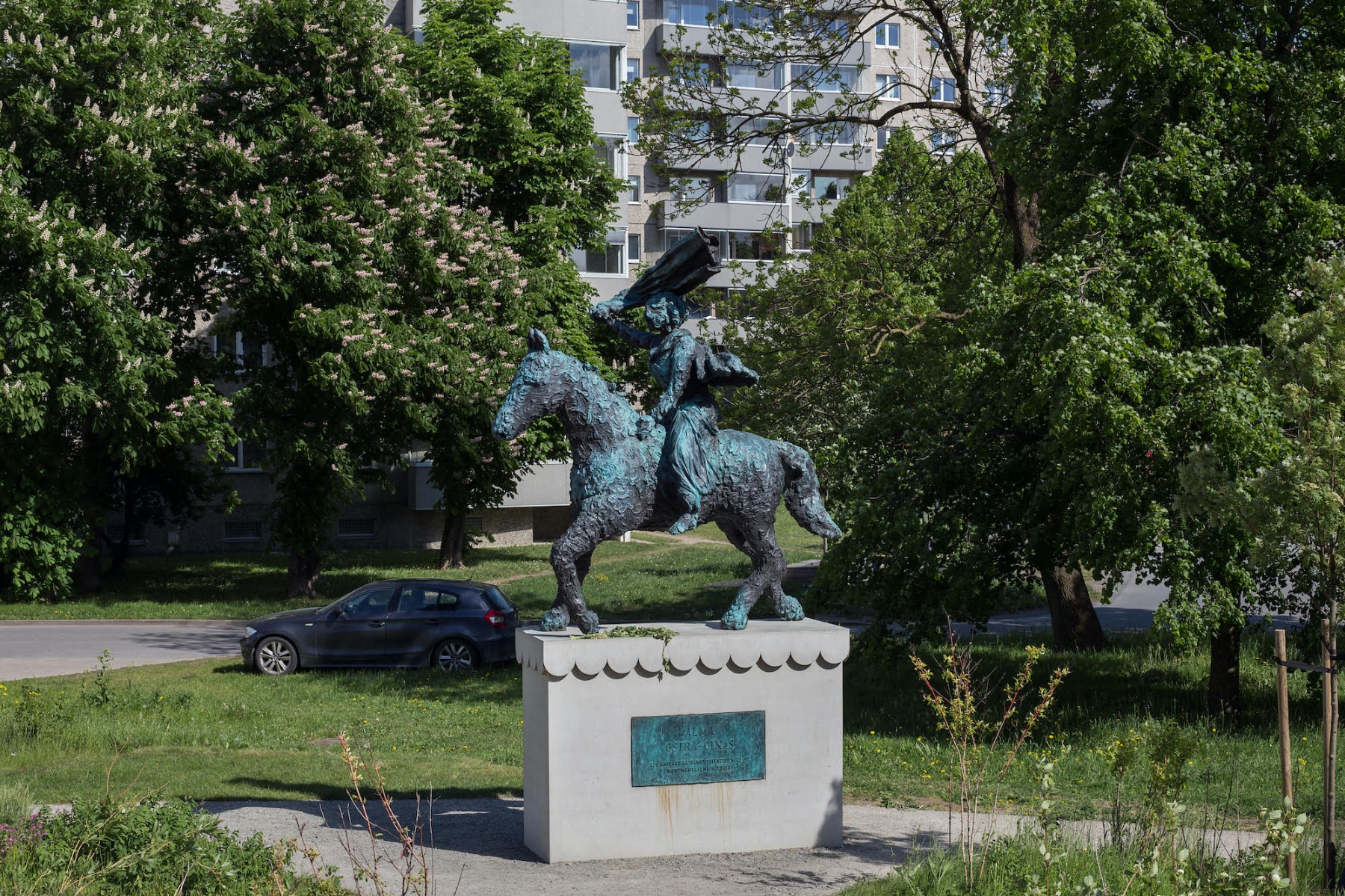
Why did you decide to make it an equestrian monument?
As the Estonian member of the European Parliament Urmas Paet wrote: “An equestrian monument has to be earned in order to dominate the cityscape for centuries. Lord Leopold II became worthy of an equestrian monument only after appropriating part of Africa – the Congo – and organizing the mass killing of locals there, alongside the extensive extraction of every conceivable natural and other resource. Unfortunately, here in Estonia we probably do not have figures on that scale to present, and therefore we must settle, in the case of our domestic equestrian monuments, for whatever merits our heroes have managed to achieve in life.”
A vivid debate has emerged in Estonian society – almost like a battlefield – where on one side stand experts in their field, and on the other those who judge purely on the basis of “beautiful versus ugly” and immediate comprehensibility. Masculine force is also very much present, because the monument’s most active verbal attackers have primarily been men. At times it is almost frightening to sense how the appearance of a visible woman on horseback in public space reveals Estonians’ values and their understanding of gender equality.
Photo: Mari-Leen Kiipli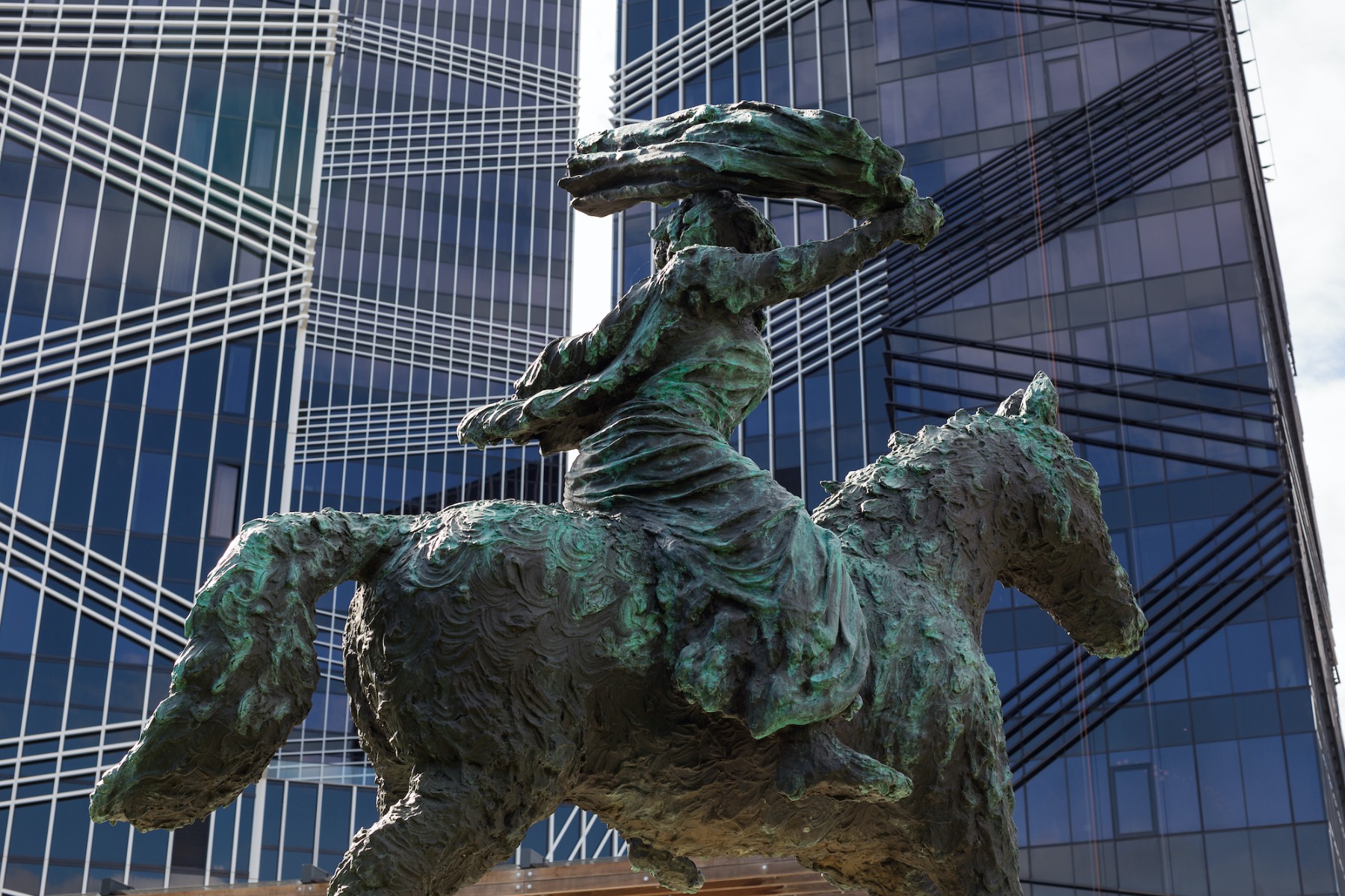
Part of the public reaction has been sharply negative. Did that surprise you, disappoint you, or confirm that the work achieved its purpose?
As a contemporary artist, I wanted to play with the intersection between the format of the classical equestrian monument and contemporary art. At first glance, beneath the green patina, it may appear like a monument that has oxidized there for centuries and was erected long ago, while the expressive edge of the pedestal pattern and the painterly treatment of the figure do not really refer to the classical representation of an equestrian monument. I made the monument to Alma in 2026, but at the same time I am hinting at the idea that it could – and should – have been made decades earlier.
Photo: Mari-Leen Kiipli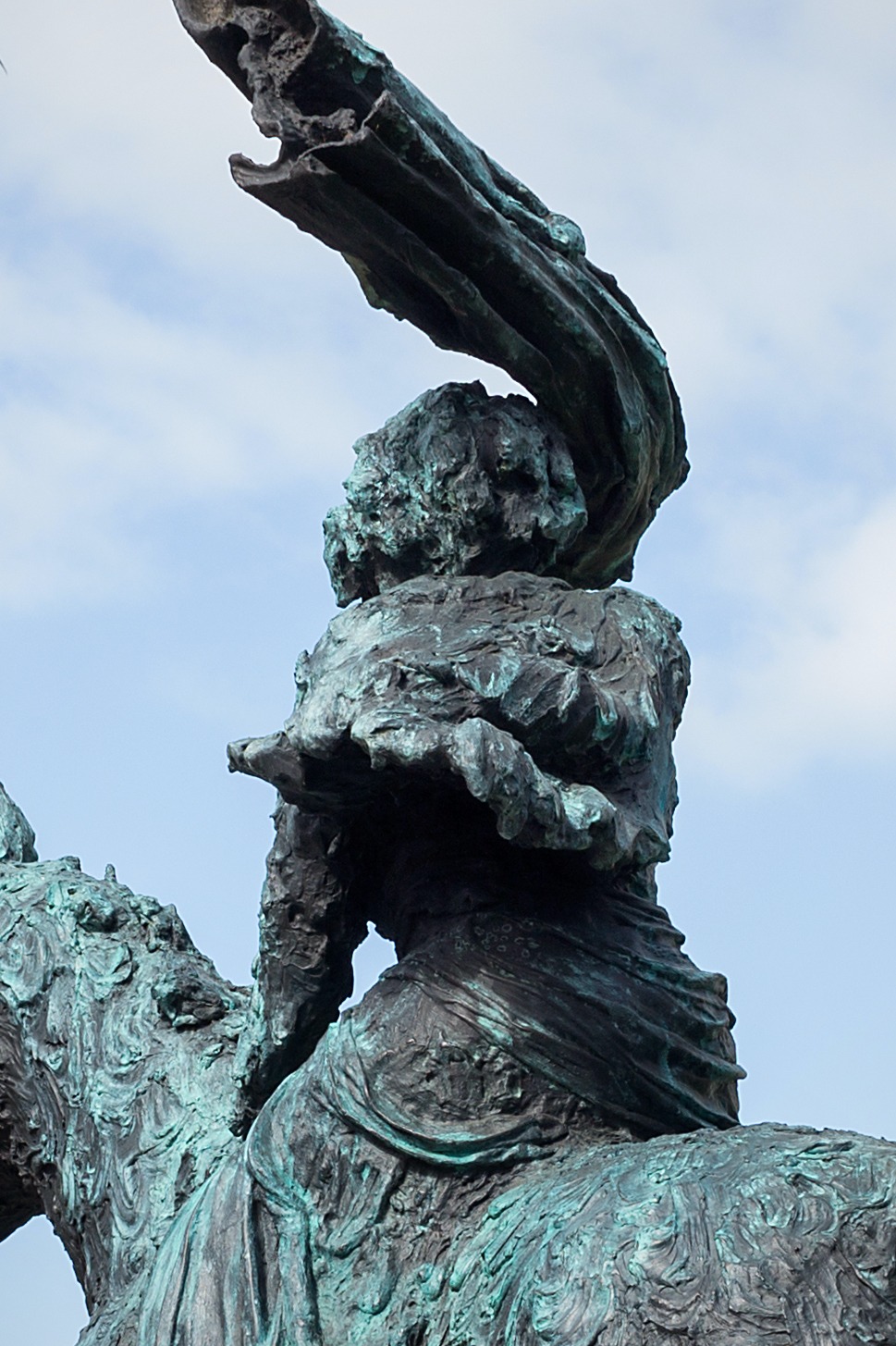
Some people say the issue is not Alma Ostra-Oinas herself, but the artistic language of the monument – its ghostly quality, deliberate strangeness, and almost unsettling atmosphere. Do you think this reflects an expectation that monuments should still adhere to a traditional heroic mode of representation – in which even the horse is expected to look as if it might leap off its pedestal and not stop until it reaches Tartu?
I am very pleased that contemporary art is attracting interest and being discussed publicly. What surprised me, of course, was that despite Estonia’s rapidly developing society, a large number of people still remain centuries behind in their understanding of art. But art does not stand still.
The “ghostly nature” and “deliberate strangeness” have been projected onto the monument. As an artist, I had entirely different aims. Alma’s character and her courage in standing up for equality and participating in the governance of the state should indeed be expressed boldly, contemporarily, and dynamically. If this generates discussion and debate, then that is of great value. We need to speak more in the media about public space and the nature of contemporary art.
Yes, my goal was not to sculpt a realistic horse. The former rector of the Estonian Academy of Arts commented: “To expect a realistic horse in the 21st century is sheer naïveté and a rather art-distant understanding. This monument deliberately contains a comic interpretation and an allusion, because women generally are not military commanders, which is the classical iconography of the equestrian monument.”
Flo Kasearu. Photo: Mark Raidere 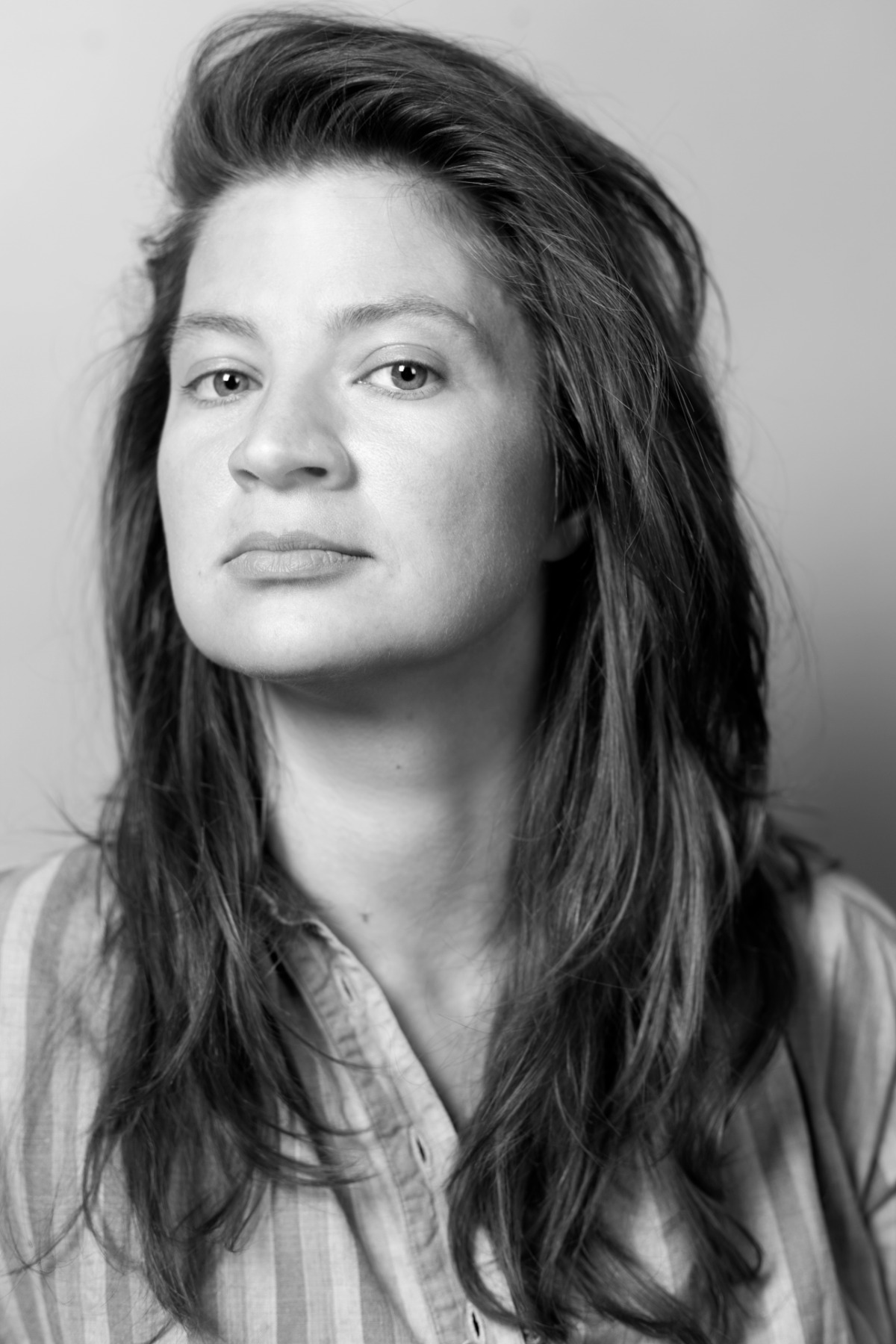
Estonia is currently going through intense debates about monuments, symbols, and historical memory in general. Can this monument be seen as an attempt to rewrite Estonia’s national pantheon – or rather as an attempt to show that it may have been somewhat incomplete?
Returning to the beginning, this series points toward the creation of a more equal society and urban space. I still believe that women should not remain “behind the stove.” Women also have a place in history, on the pedestal, and on horseback – even if some people think otherwise. Clearly, with this sculpture I have, figuratively speaking, grabbed hold of society’s “brown skirt.” Whether this reshapes the national pantheon will be for art history to judge.
