


To feel the weight of it
An interview with Augustas Serapinas about Physical Culture
In summer 2026, Nottingham Contemporary, One of the largest contemporary art galleries in the UK, presents the first institutional solo exhibition in England by Lithuanian artist Augustas Serapinas featuring his large-scale sculptural installation, Physical Culture. Serapinas (b. 1990, Vilnius) is one of Lithuania’s most internationally active contemporary artists. By assigning new characteristics to everyday objects and spaces, he shifts how we perceive and experience them. Often collaborating with local communities and involving them in the creative process, Serapinas incorporates subtle humour in his work to refer to Lithuania’s geography, history, and culture.
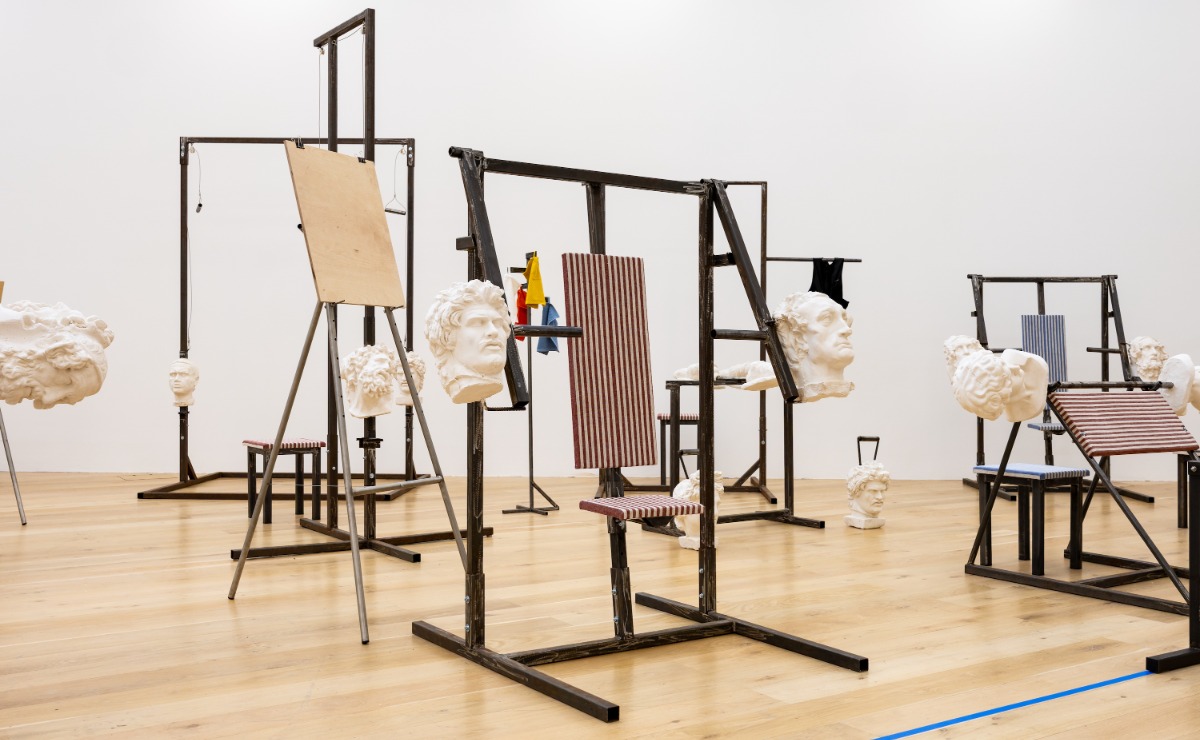
Augustas Serapinas, Physical Culture Installation view, Nottingham Contemporary, 2026. Photo: Jules Lister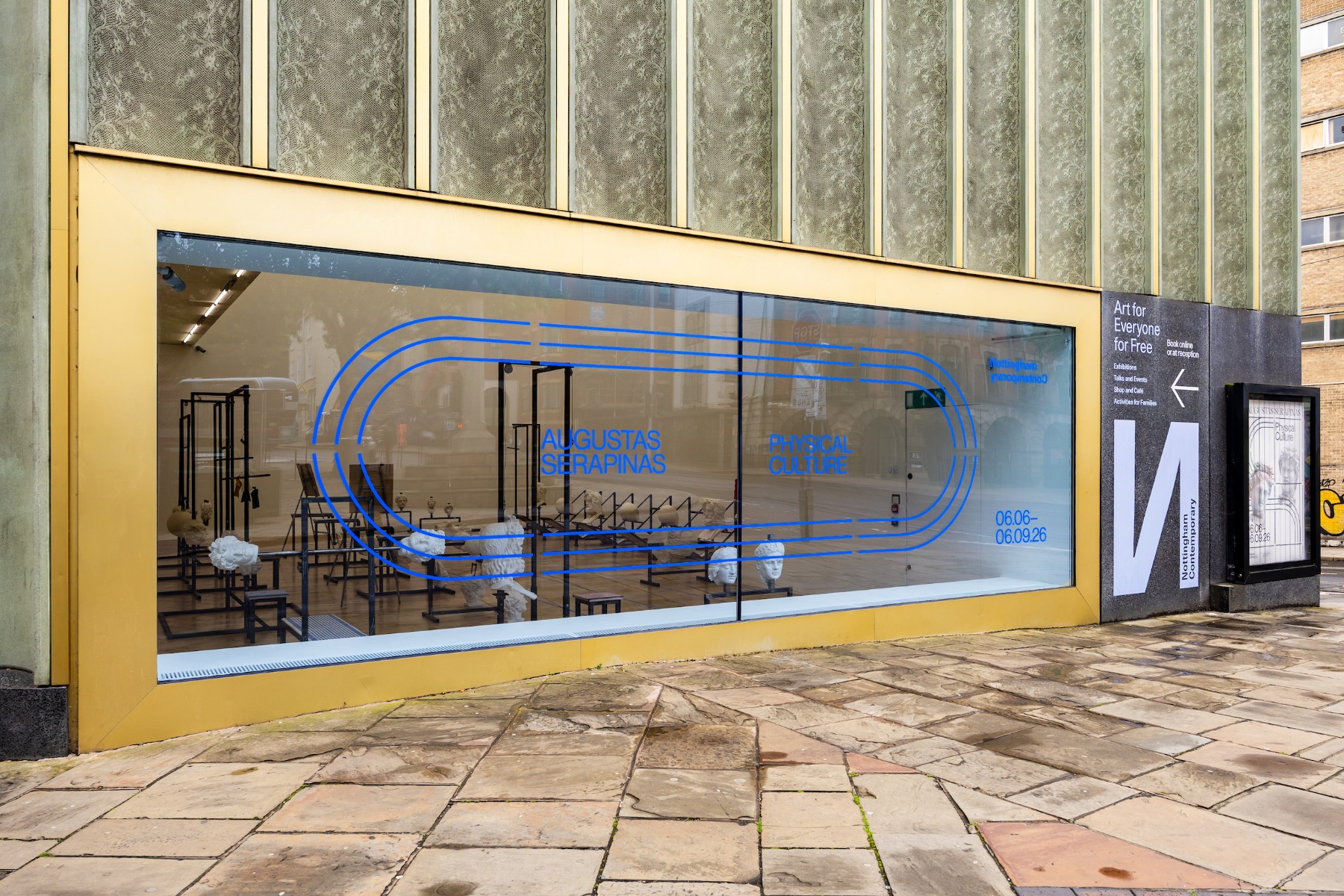
The first iteration of Physical Culture was created in 2012 while Serapinas was a third-year student at the Vilnius Academy of Arts’ Sculpture Department. Since then, various versions of the installation have been exhibited internationally. Following Contemporary Art Centre, Vilnius’s 2025 expansive edition of this work, Nottingham Contemporary presents a new reconfiguration spanning across two of our largest gallery spaces. The exhibition invites audiences into a hybrid space of activity – performance space; drawing studio; and gym – featuring fully operational metal fitness machines with jesmonite sculptures replacing conventional weights. The work is activated through a dynamic live programme that punctuates the exhibition season. Local fitness groups are invited to participate in exercise classes in the galleries; students from local universities take part in life drawing classes; and community wellbeing groups host mixed-ability sessions and holistic workshops.
Augustas Serapinas, Physical Culture Installation view, Nottingham Contemporary, 2026. Photo: Jules Lister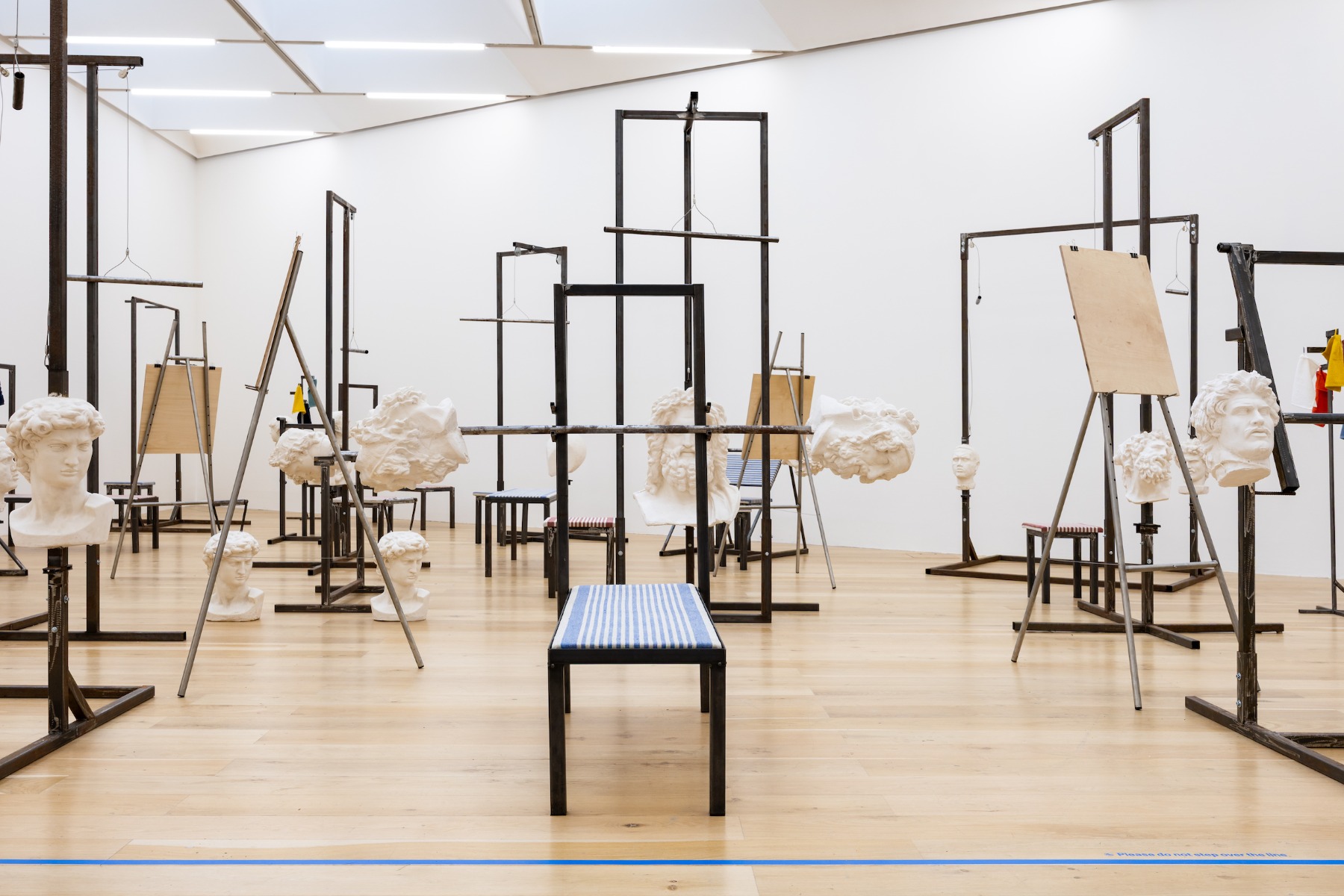
The installation is inspired by Serapinas’ experience as a student at the National M. K. Čiurlionis School of Art in Vilnius, where art education follows a classical methodology emphasising the importance of life drawing and the mastery of painting and sculpture techniques. In this vein, the work looks at crossovers between the repetitive and diligent skills required to create classical forms in Western art history and the discipline required to sculpt the body in the gym. Revisiting the art school’s archives, Serapinas has reconstructed copies of his own student work, such as portraits of his classmates, an earthworm, and an alien, as well as plaster models once used for drawing classes and replicas of well-known sculptures, such as Michelangelo’s David (16th century) and Apollo Belvedere (2nd century), long considered exemplars of classical antiquity.
We contacted Augustinas to find out more about this project and its new realisation at Nottingham Contemporary, on view until 6 September.
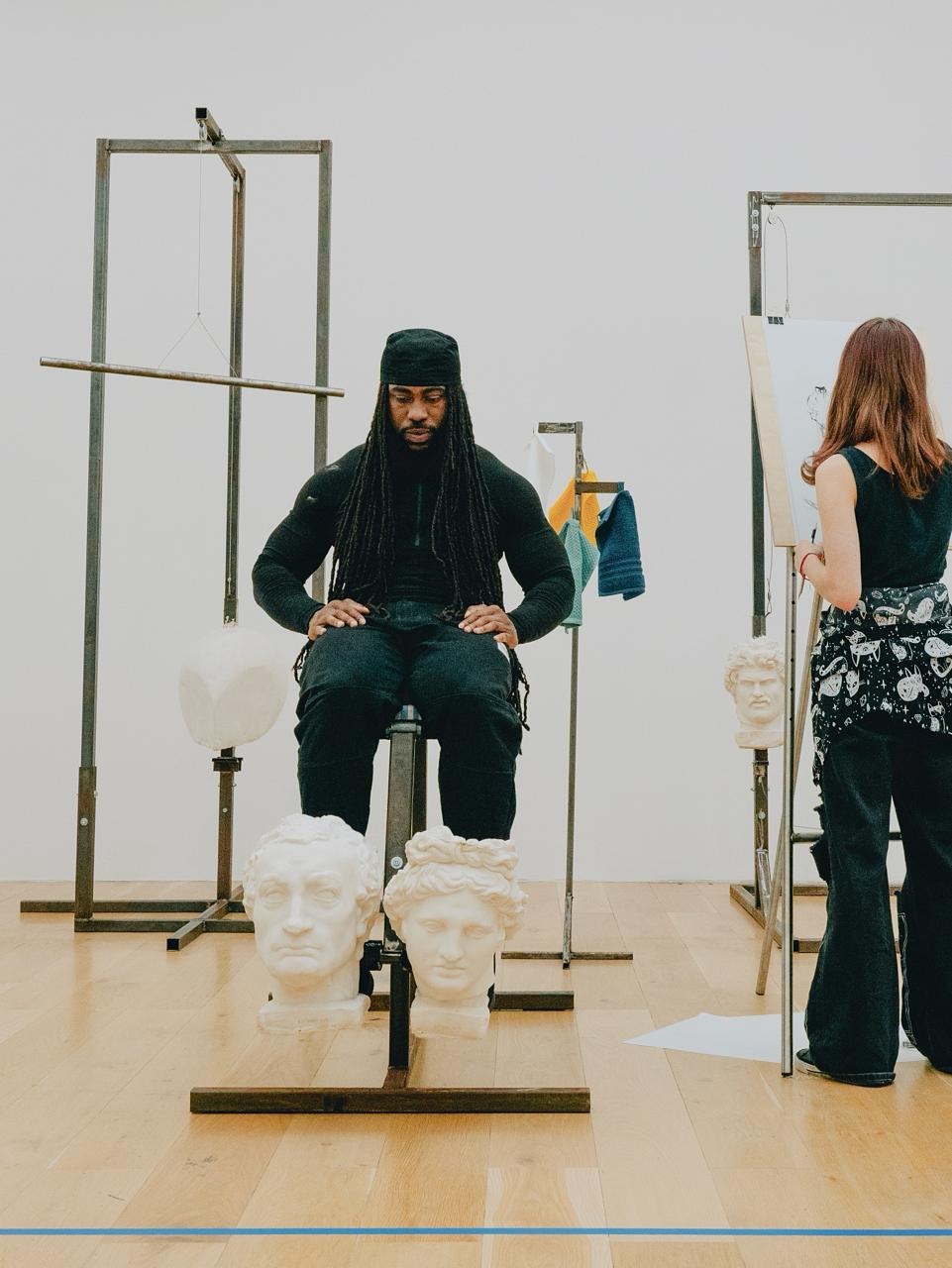
Augustas Serapinas, Physical Culture, activated installation view, Nottingham Contemporary, 2026. Photo: Jade Vowles
The title Physical Culture refers to a historical movement that connected exercise with ideas of morality, discipline, and the creation of the “ideal citizen.” What does the modern gym reveal about our values and anxieties as a society?
The exhibition Physical Culture is exactly pointing to the origin of ideal beauty and how it has changed compared to nowadays. I would say the notion of “ideal beauty” is still very persistent in modern times and often takes on an almost toxic role. While it has been increasingly fashionable to exercise, speak on topics of longevity and wellbeing, in fact it has a newly consumeristic touch to it. It is equally important to have certain clothes or equipment for when you’re exercising. Additionally, there is a larger variety of activities offered, next to the ordinary gym you have hyrox, crossfit, yoga sculpt and many more. So, there is this almost sacralised and ritualistic aspect in how you participate in the modern gym and what you make of it.
Augustas Serapinas, Physical Culture Installation view, Nottingham Contemporary, 2026. Photo: Jules Lister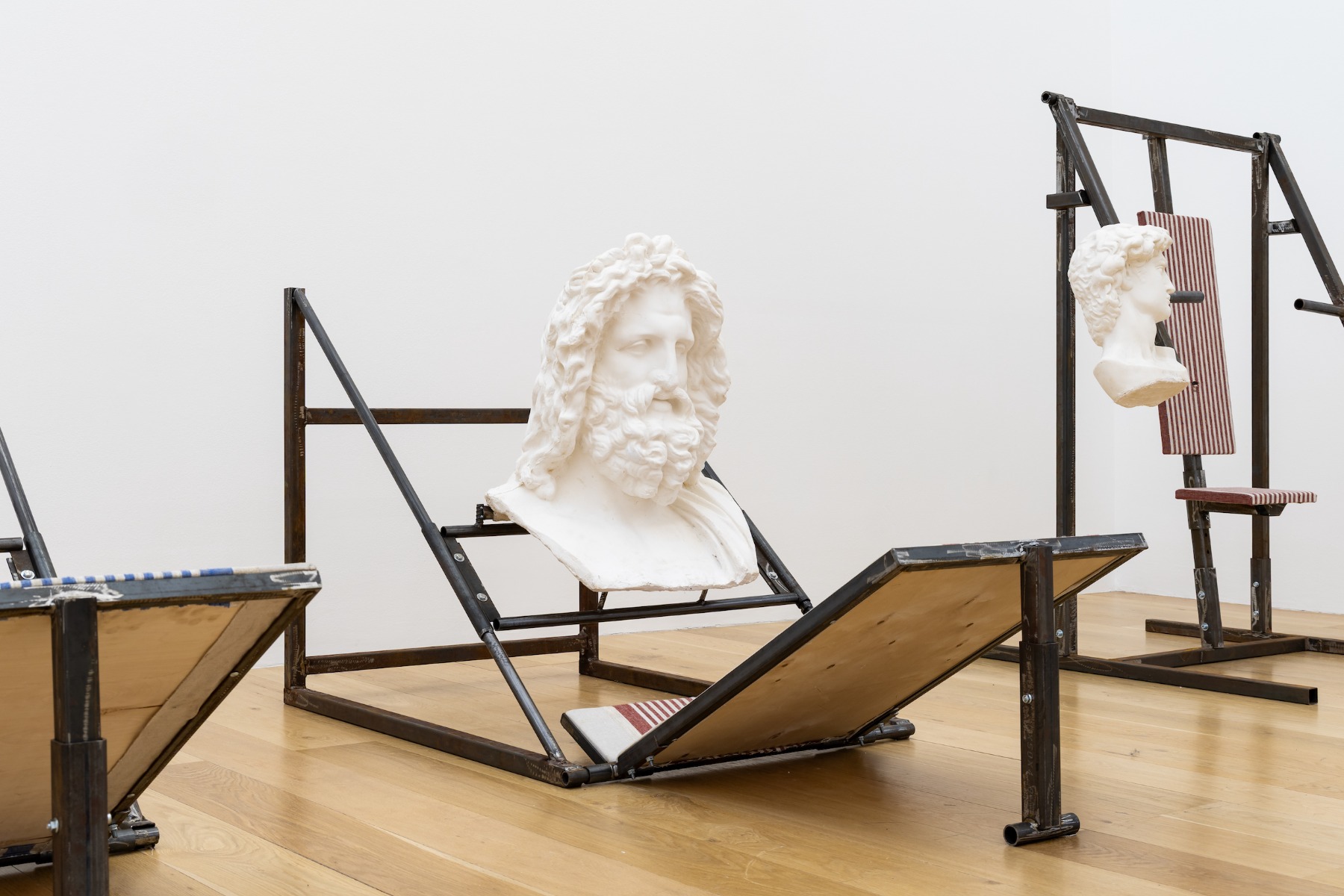
Your installation brings together gym equipment and copies of classical sculptures such as the Apollo Belvedere and Michelangelo’s David. What does the historical ideal of the perfect body mean in an era that increasingly questions universal standards of beauty and strength?
Even if today the ideal beauty is questioned with body positivity movement, the notion of it still governs the way people look at themselves. Gyms have never been so popular before. It became a product of mass culture. My work first of all refers to this phenomenon. If you are a gym goer – doesn’t really matter if you question it or not, you are still part of the body culture. Since my installation is a fully functional gym, you can face these ideals and feel the weight of it.
Augustas Serapinas, Physical Culture, activated installation view, Nottingham Contemporary, 2026. Photo: Jade Vowles
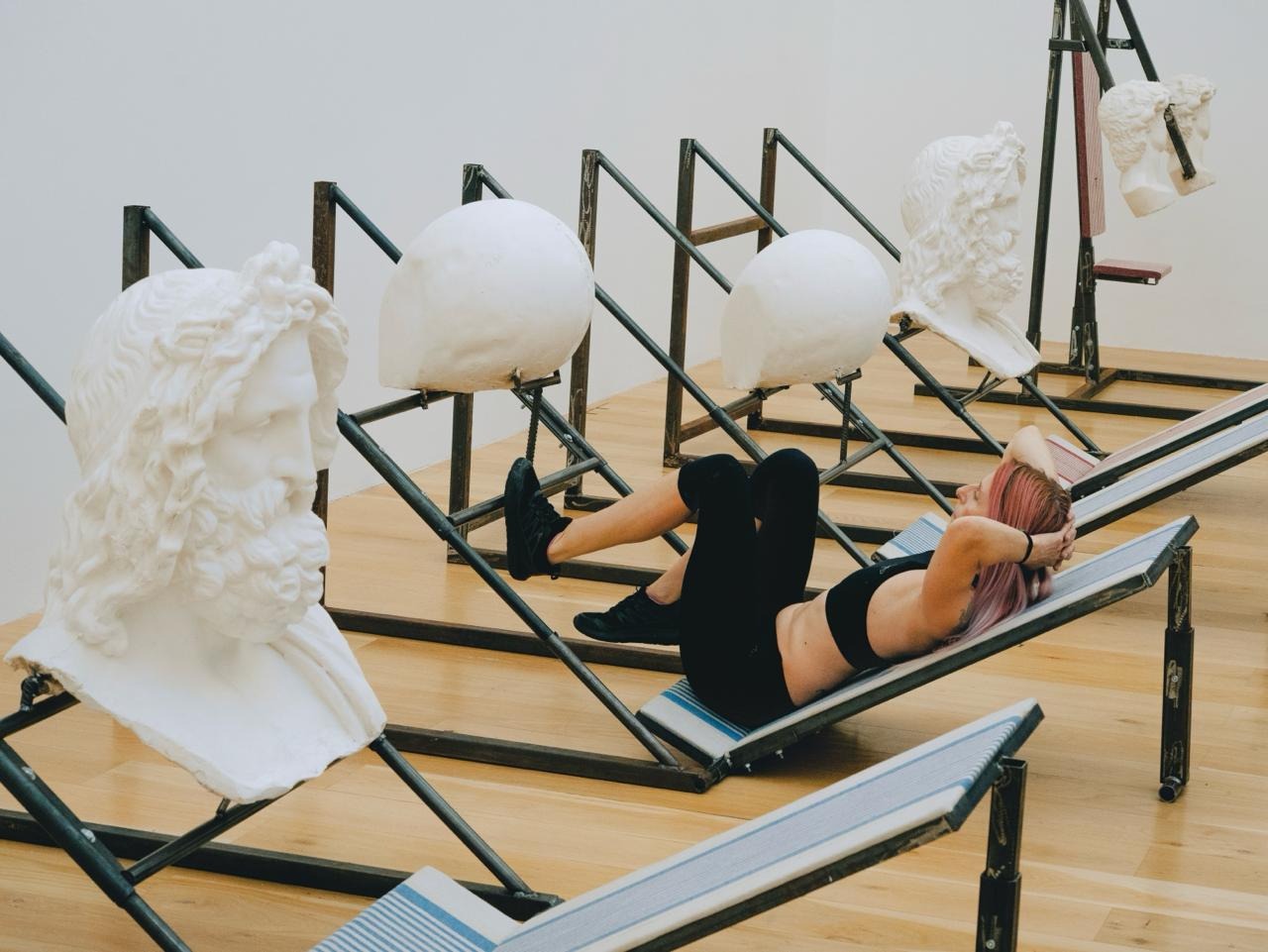
Physical culture was also used by many political systems – from nineteenth-century nationalism to Soviet ideology– to shape disciplined and productive bodies. Did your experience growing up in post-Soviet Lithuania influence your view of the body as something socially and politically constructed?
I don’t think it must’ve been totally different from the rest of Europe where strict gender stereotypes were considered the norm. I think I have been liberal and always seen sports or working out as separate leisure activities with no beliefs around what the body should be.
Augustas Serapinas, Physical Culture Installation view, Nottingham Contemporary, 2026. Photo: Jules Lister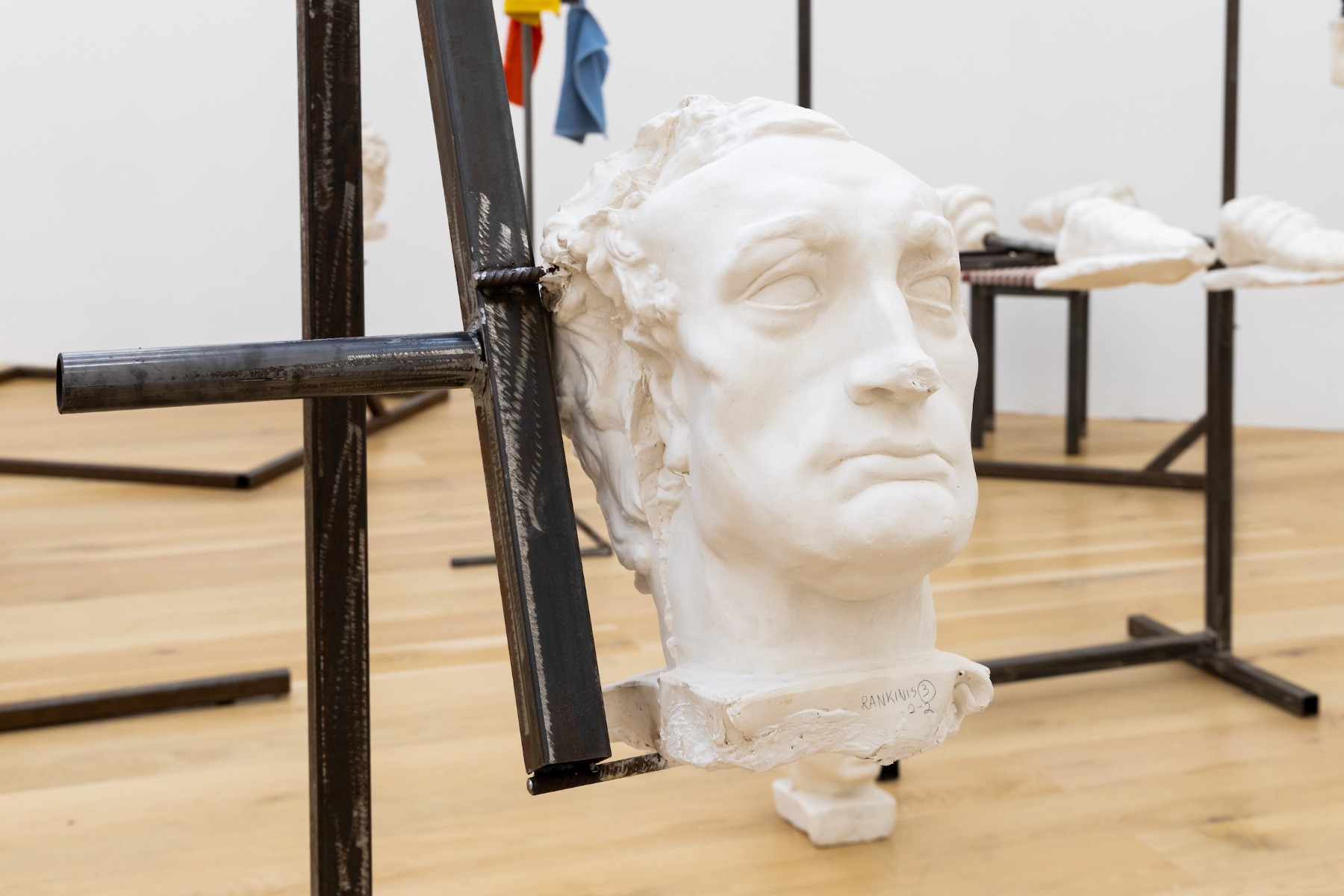
In a time when our bodies are constantly measured, optimized, and displayed – especially through digital culture – what does “physical culture” mean to you today?
Our digital presence has become part of our social life. For some a work out is incomplete without a photo taken and put on display on social media. Some go even further and direct their habits and lifestyle according to what is media-desirable. It is getting harder to understand where the actual reality is. It all comes down to our conscious decisions. We have a choice of how much and what we mediate. For me, training the physique was never about the digital. I see it as a great tool for mental and physical well-being. It is the time for yourself. The fit body is just a by-product.
Augustas Serapinas, Physical Culture, activated installation view, Nottingham Contemporary, 2026. Photo: Jade Vowles
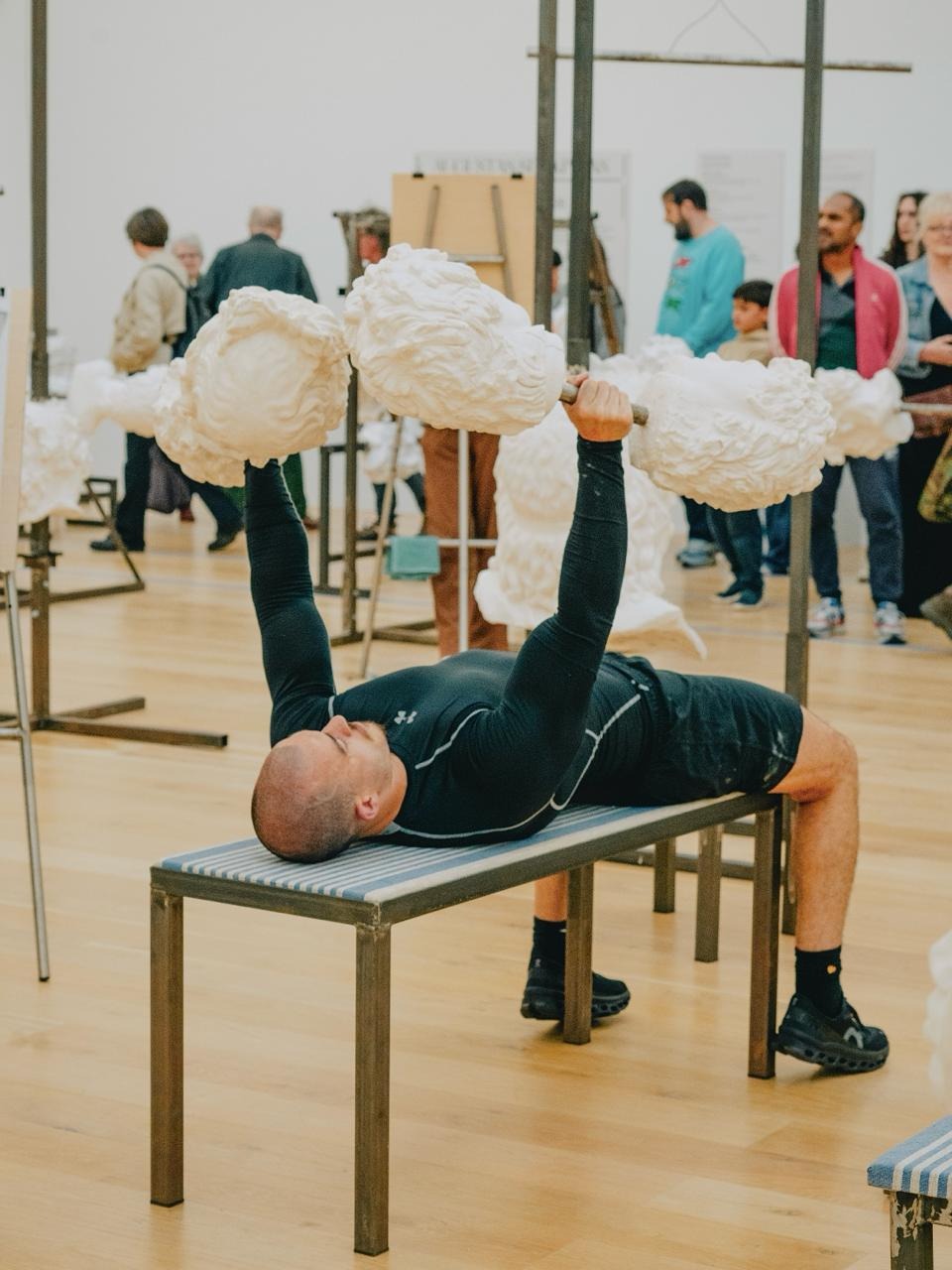
Your installation draws a parallel between training the body in the gym and training the hand and eye in classical art education. Do you see these two forms of discipline as similar, or is there a hidden conflict between them?
Till I was 19 years old I was studying in a specialised art school, where copying from nature was a fundamental method of education. Mostly a questionable approach unless the art school includes a space for reflection. I could see a parallel between repetitive labour of drawing antique sculptures and training at the gym. Both are based on discipline, precision and will to improve. In my work, I am bringing the two activities into the art institution, making it a platform that combines these two interests and audiences. When “Physical Culture” is displayed, local gym trainers and drawing groups are invited into the installation. In this setting, one can train their body muscles or the drawing skills while confronting the origins of Western art and beauty.
Augustas Serapinas, Physical Culture, activated installation view, Nottingham Contemporary, 2026. Photo: Jade Vowles
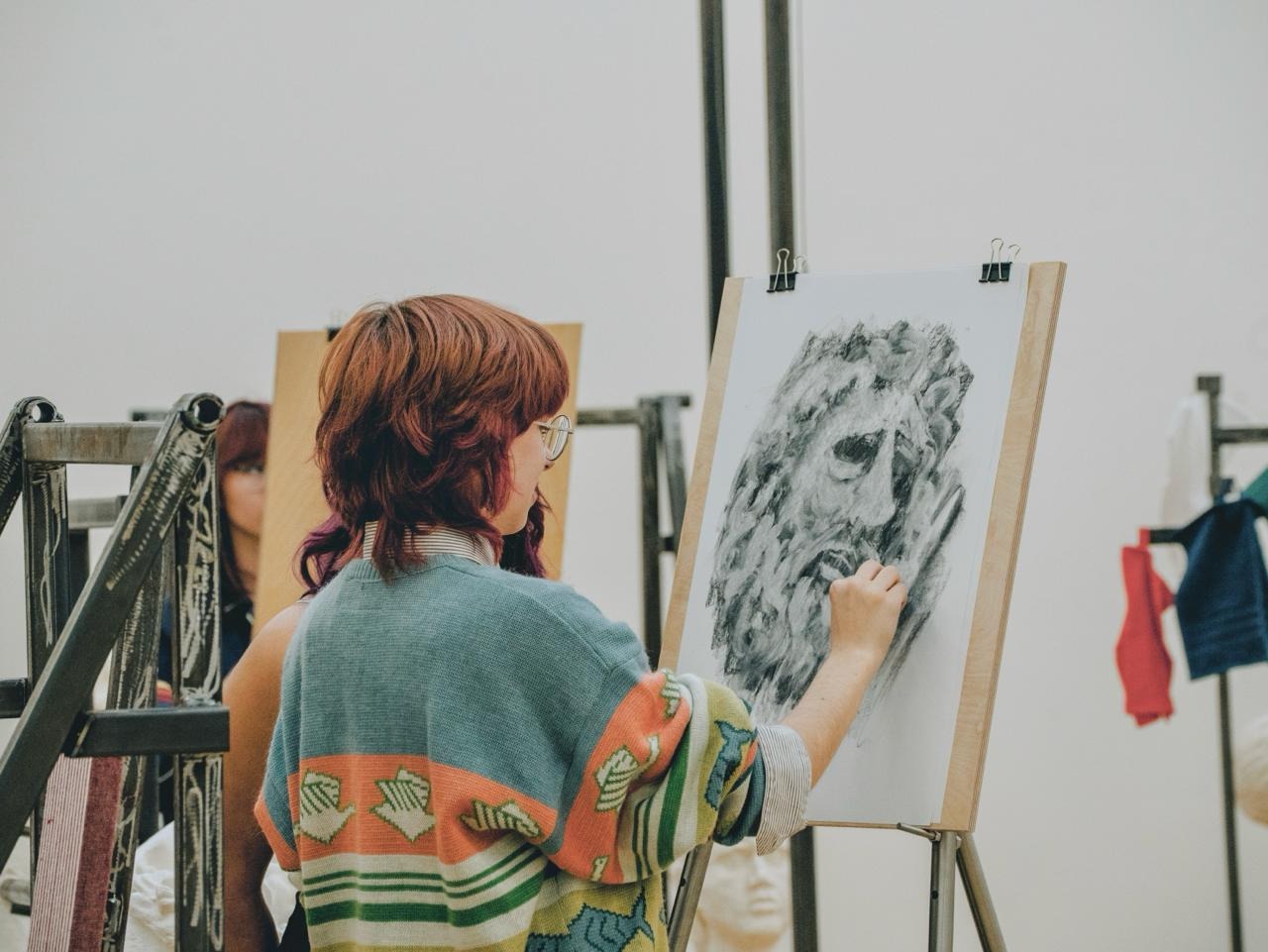
Many artists have rebelled against academic drawing, yet they were often trained through it first. Do you think it is necessary to learn the rules of representation before breaking them?
By drawing you don’t really learn the rules. Not anymore. It is an outdated notion. It can be useful among other disciplines, but it can’t be the main art education subject. I would recommend learning art history and trying different mediums, see if there is anything you are driven by. Experimentation is much more important than learning the actual skill. Skill can always be obtained later on.
Augustas Serapinas, Physical Culture Installation view, Nottingham Contemporary, 2026. Photo: Jules Lister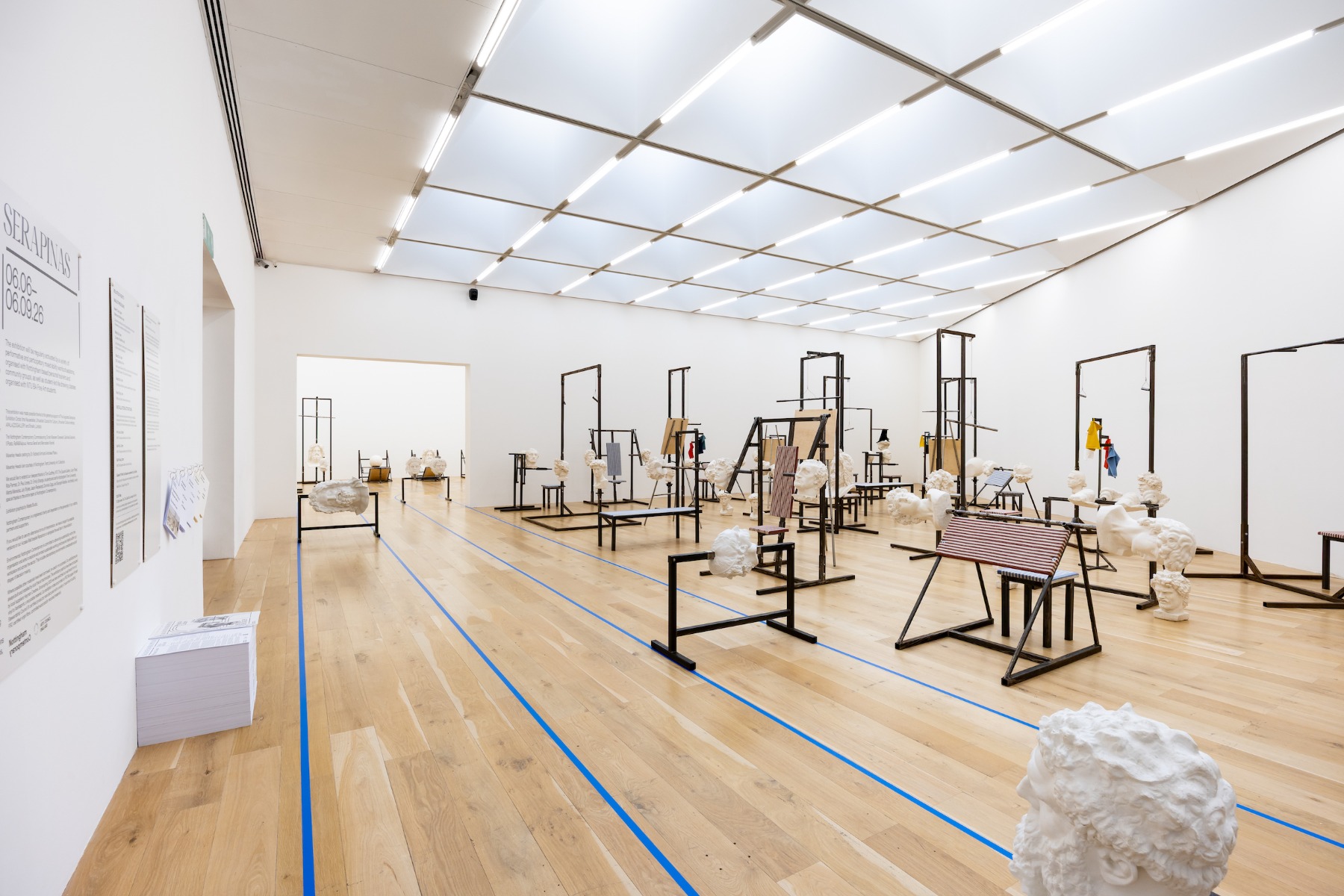
Physical Culture was first created in 2012, when you were still a student. How has your vision of this work changed over more than a decade of revisiting and reconfiguring it?
The 2012 gym made for the Raja Gallery of Tallin Art Academy is quite different from the one we see now. The first one was made out of artworks that were left by students and older artists. The current version of the gym is based on my experience at the National M. K. Čiurlionis School of Art. There my everyday consisted of copying and drawing Greek and Roman plaster sculptures and it became an inspiration for the further development of this body of work. The newer version of the gym had more thoughtful equipment, increasing its functionality and including more diverse exercises.
With each new showcase I like to adapt it to the context and see how it can be made more relevant for the local community. For example, the running hurdles in Nottingham Contemporary we have incorporated copies of 16-18th century artists - Raphael, Benvenuto Cellini, William Hogarth - whose heads are on the façade of Nottingham University’s Waverly building. Something that was present in the local architecture and regarded as examples can be reevaluated in the gym.
Augustas Serapinas, Physical Culture, activated installation view, Nottingham Contemporary, 2026. Photo: Jade Vowles
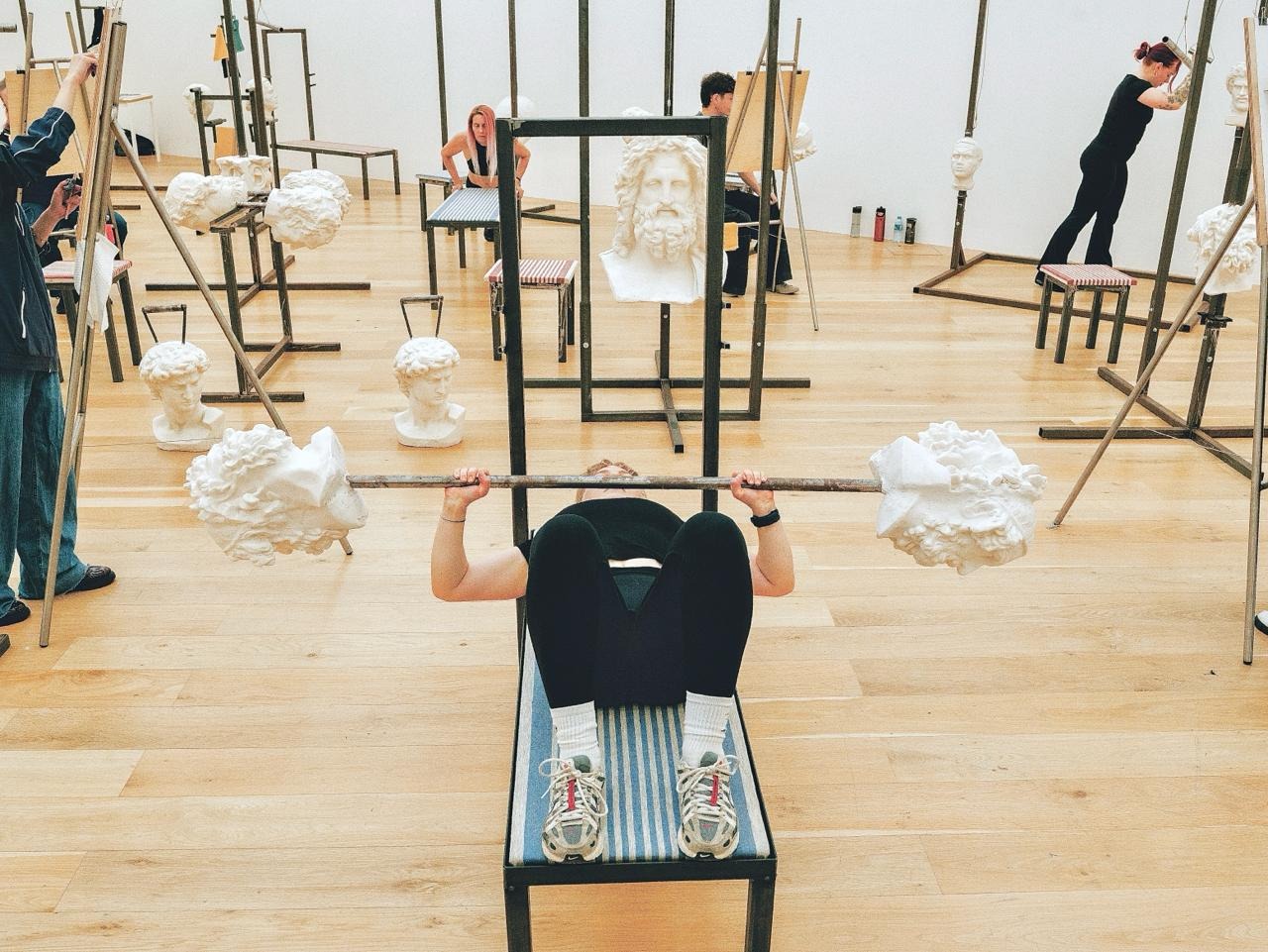
This new version includes collaboration with local communities and performers in Nottingham. How do you see the relationship between authorship and collective participation in your work?
I give the framework – a fully functional gym for collective participation. The functionality of my machines defines the choreography and outcome of such an interaction. I don't see my version of the gym as being much different from any other gym. Only in terms of weights, mine has much heavier symbolic weight. But functionally it works exactly the same; people are invited to sign up, either to work out physically or to freely exercise their drawing skills. I am grateful to curators Katie Simpson and Klara Szafrańska for their dedication and enthusiasm on creating collaborations with the Nottingham community that open up the artwork.
