


About the time being
Arta Raituma
Notes on the sixth edition of the Kochi-Muziris Biennale
The sixth edition of the Kochi-Muziris Biennale, curated by Indian artist and curator Nikhil Chopra, opened on December 12, 2025. The Biennale takes place in the city of Kochi (Cochin) in the Kerala region of South India. The historic part of the city, Fort Kochi, serves as the main venue for India’s first international contemporary art biennial, which is also Asia’s largest contemporary art event. The theme of this edition is For the Time Being.
Title, logos and curatorial credentials hand-painted on the wall, Aspinwall House venue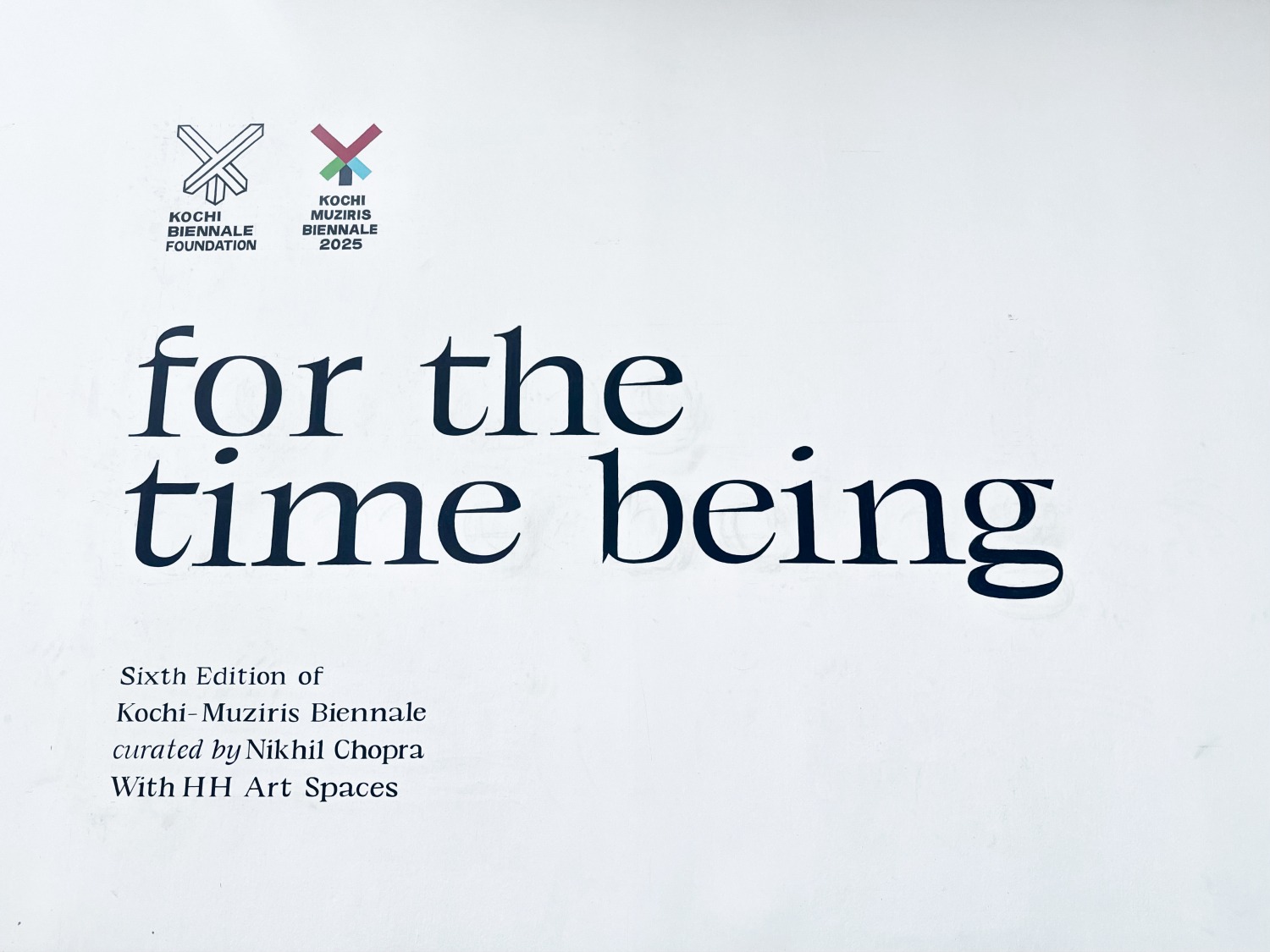
Before I dive into the multifaceted and vibrant impressions of attending the main opening, collateral exhibitions, workshops, and parallel events, here is a peek at the overall statistics of this edition. Sixty-six artists and collectives are taking part in the main biennale exhibition within Nikhil Chopra’s curatorial frame, representing 25 countries: about half of the participants are either Indian nationals or artists based in India, around 16 from Europe (none from the Baltics in this edition), 6 from the USA, around 6 from Africa, and a few from South America and other parts of Asia. Given the numbers, a big emphasis is put on cultural contexts and topics that are especially significant to India, this year looking even deeper into specifics, history, and traditions of the Kerala region.
The Biennale is running for 110 days, until March 31, 2026, giving time to experience the events even long after the initial opening. However, it is like a morphing, evolving organism, and there lies a high possibility that the end of this biennale will take a vastly different shape. Apart from its core – the main exhibition – this fluctuating art hub anchors around seven official collateral exhibition sites and even more distinct institutional projects, educational and workshop programs such as ABC Art Room, performance and screening programs, special events, and concerts. The structure is fluid rather than rigid, which corresponds well to its location – Kochi, a port city, a historic trade gateway, influenced by Portuguese and Dutch settlements. Just like Venice and its Biennale, Kochi is the harbour point of cultures merging and lively waters flowing through countless canals. For the Time Being does justice to the city and its abiding layers by making it an active co-creator.
Fort Kochi area near the main venues of the Biennale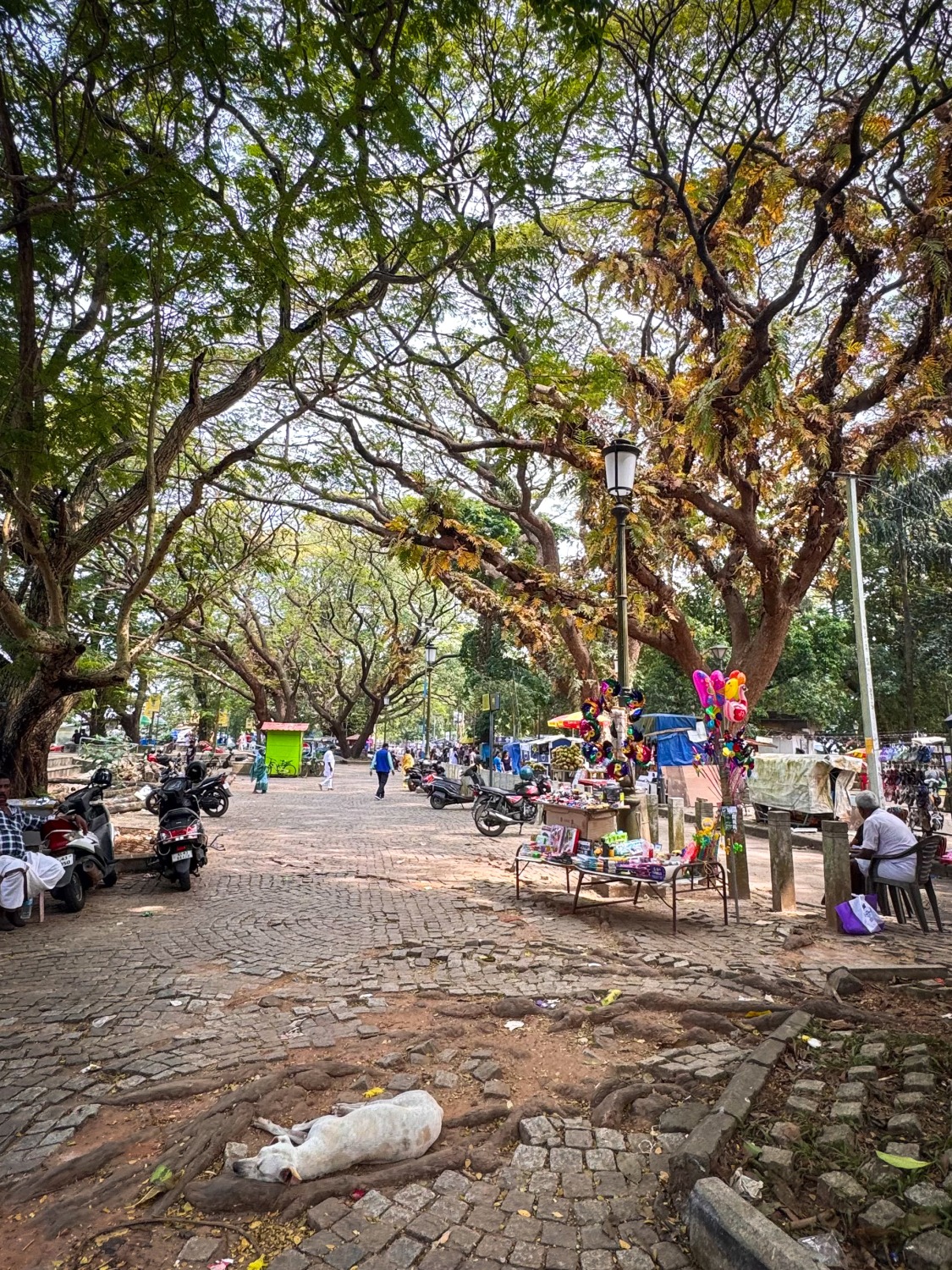
OPENING TIME
The city is swarming when the opening day begins around 11:30 am at Aspinwall House, a large colonial heritage building facing the waterfront; it has been used as the main venue since the beginning of the Biennale. The crowd gathers in the wide courtyard, hiding in the shadows of the majestic old trees, as the weather in Kochi remains sunny and the temperature hits 30 degrees Celsius (this is considered to be wintertime here). First, the flag hoisting ceremony is held – the official flag with the Biennale’s visual identity is rolled up by the curator Nikhil Chopra and Bose Krishnamachari, the co-founder and president of the Kochi-Muziris Biennale. The symbolic act is followed by Chopra’s speech, thanking the team and everybody who has been involved in the making of this edition. He refers to Mario D’Souza, the director of programs at the Kochi Biennale Foundation, as the driving force who helped to make a dream come true. The farewell to the visitors:
“This Biennale is a gift from the Foundation, and I want you to just enjoy this. Read all the signs and interventions, and things that don’t even look like art – yet they are.”
The flag hoisting ceremony on the opening day of the Biennale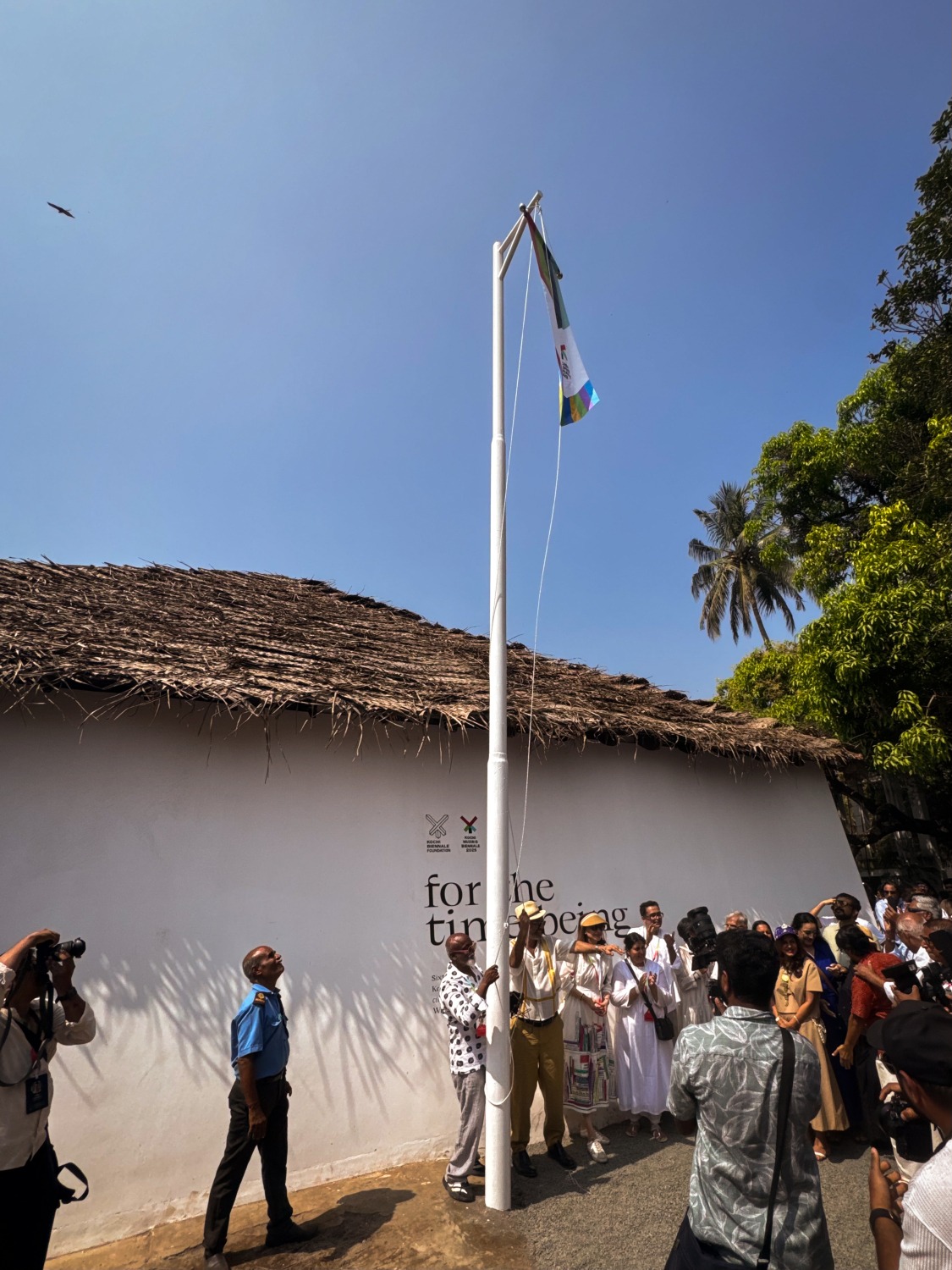
It is time for the first guests of For the Time Being to start discovering what Aspinwall House holds. In parallel, the first performance, Witnessing a New Alphabet by Monica de Miranda, takes place in the courtyard, at a space designated for performances, built as a clay platform and serpentine-shaped walls. This performance roots in decolonial thought, using voice and body to develop new sounds for each letter of the alphabet. The humming of this new language-in-the-making accompanies visitors in the exploration of the main venue.
Performance Witnessing a New Alphabet by Monica de Miranda on the opening day at Aspinwall House venue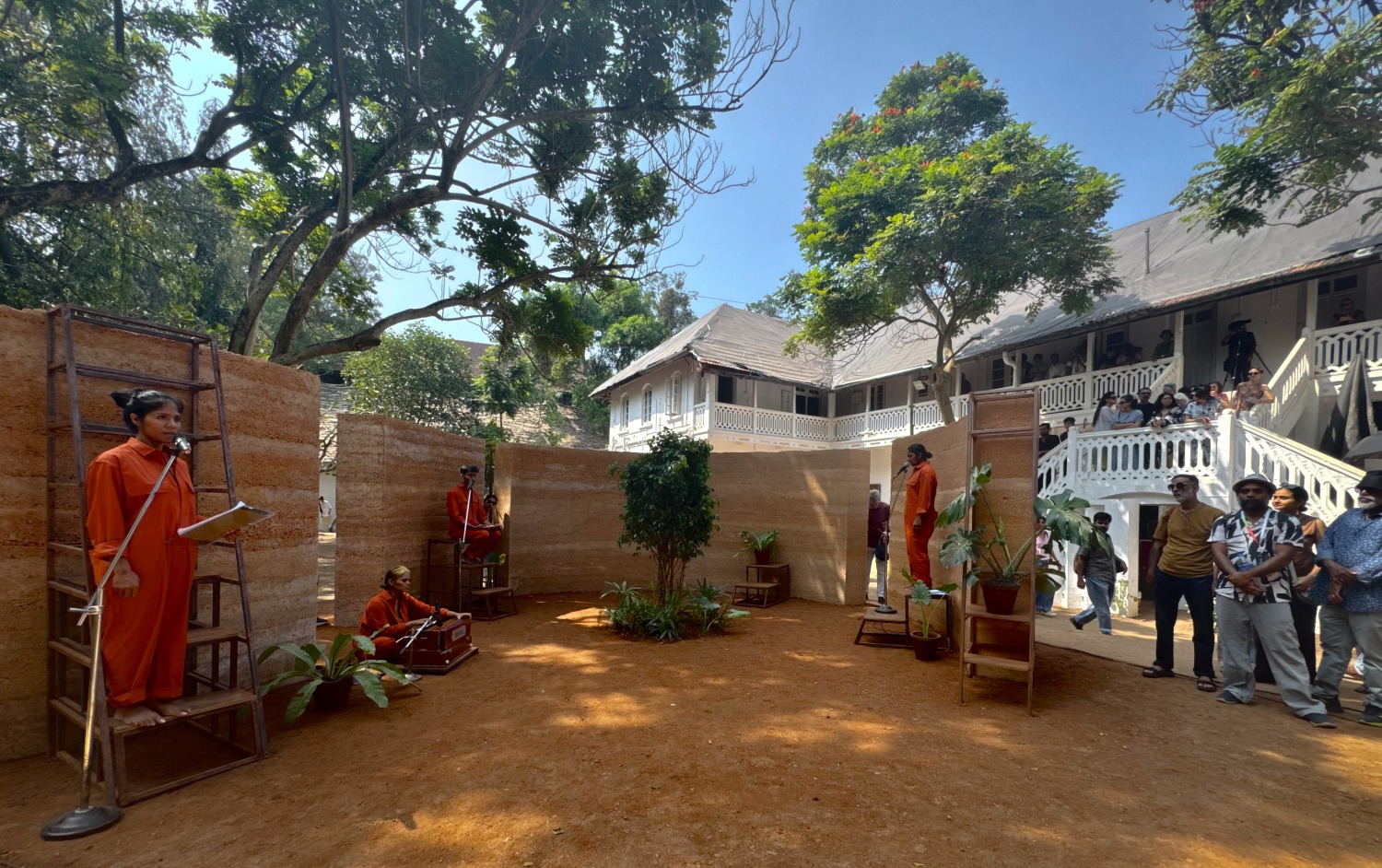
The route to other exhibition spaces is walkable; it leads through the areas of Fort Kochi and Mattancherry. Additionally, there is a newcomer – another large venue located on Willingdon Island, which actually is India’s largest artificial island. Therefore, for the first time, the visitors of the Biennale are invited to cross over with a ferry-water metro and, therefore, perhaps plunge deeper into the understanding of Kochi’s unique biosphere.
This Biennale is like a collection of intimate spaces interwoven, spaces that hold their own historical stories and worlds yet are unfolding together over time, blending past and present, including the street noises, antique museums, spice markets with dazzling aromas of cinnamon and cumin, patios revealing unexpected river views. Nobody is left out. Henceforth, the extraction of separate events and the act of shining the spotlight on particular artists and their works is apologetically subjective.
HIGHLIGHTS IN TIME
Aspinwall House itself is a breathtaking architectural piece, becoming a supportive and interactive stage for the artworks. A definite highlight on the first floor of the building is Pakkalam, a series by Indian artist Smitha M. Babu. She is from Kollam, a city in Kerala, and the work is also rooted in the lived experiences of this place, making close observations of working-class daily life. It is a tender documentation of the communities, traditions, and micro-heritage. Technically splendid, these watercolour works break the conventional transparency of the medium. They are not just representations; each work acts as a character in a play, enchanting with peculiar shapes and earth-toned colours. Alongside these 30 paintings exhibited, the artist and her team are set to perform during the Biennale using natural materials like coconut husk from Kollam city.
Pakkalam, exhibited series by Indian artist Smitha M. Babu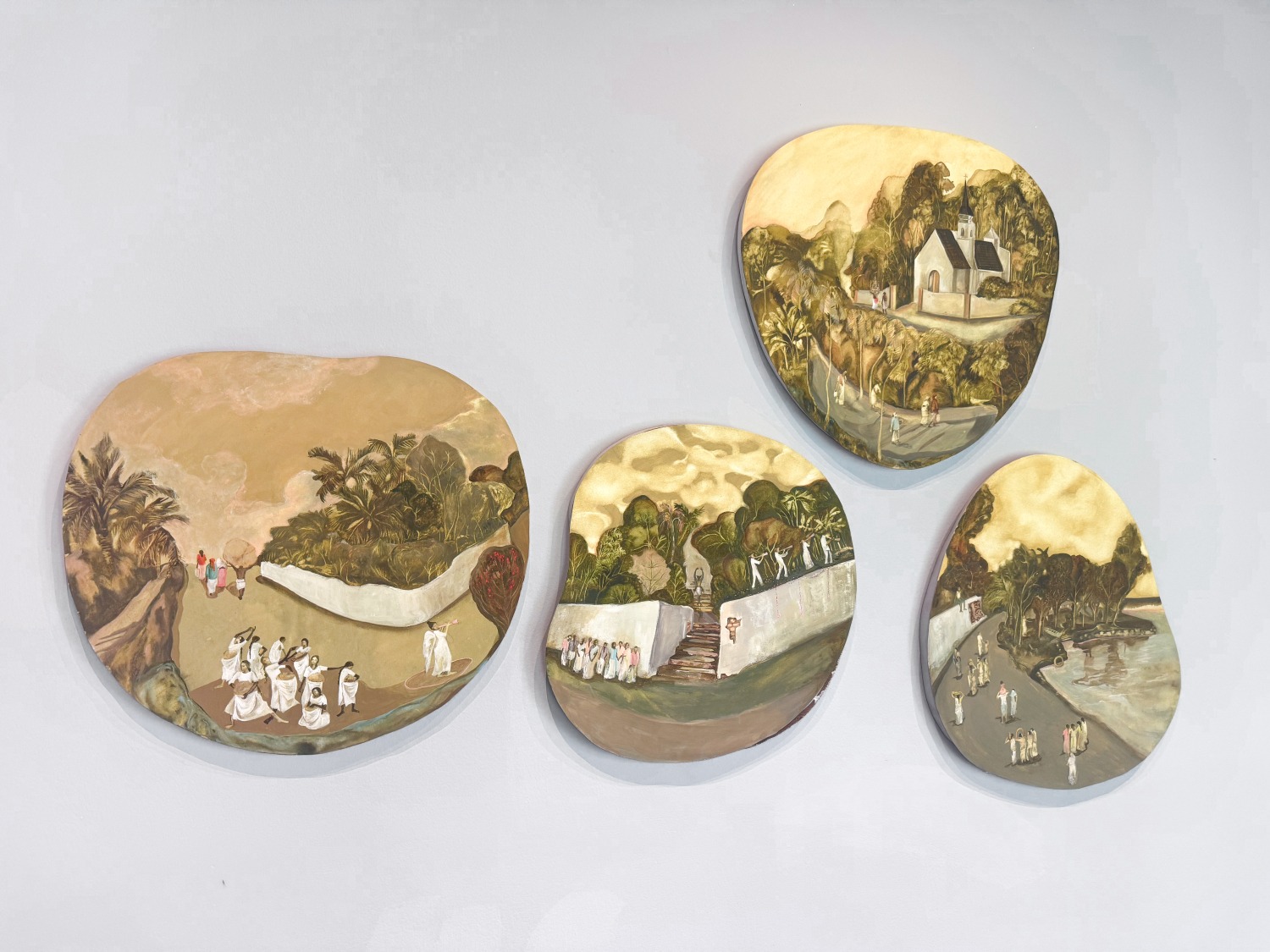
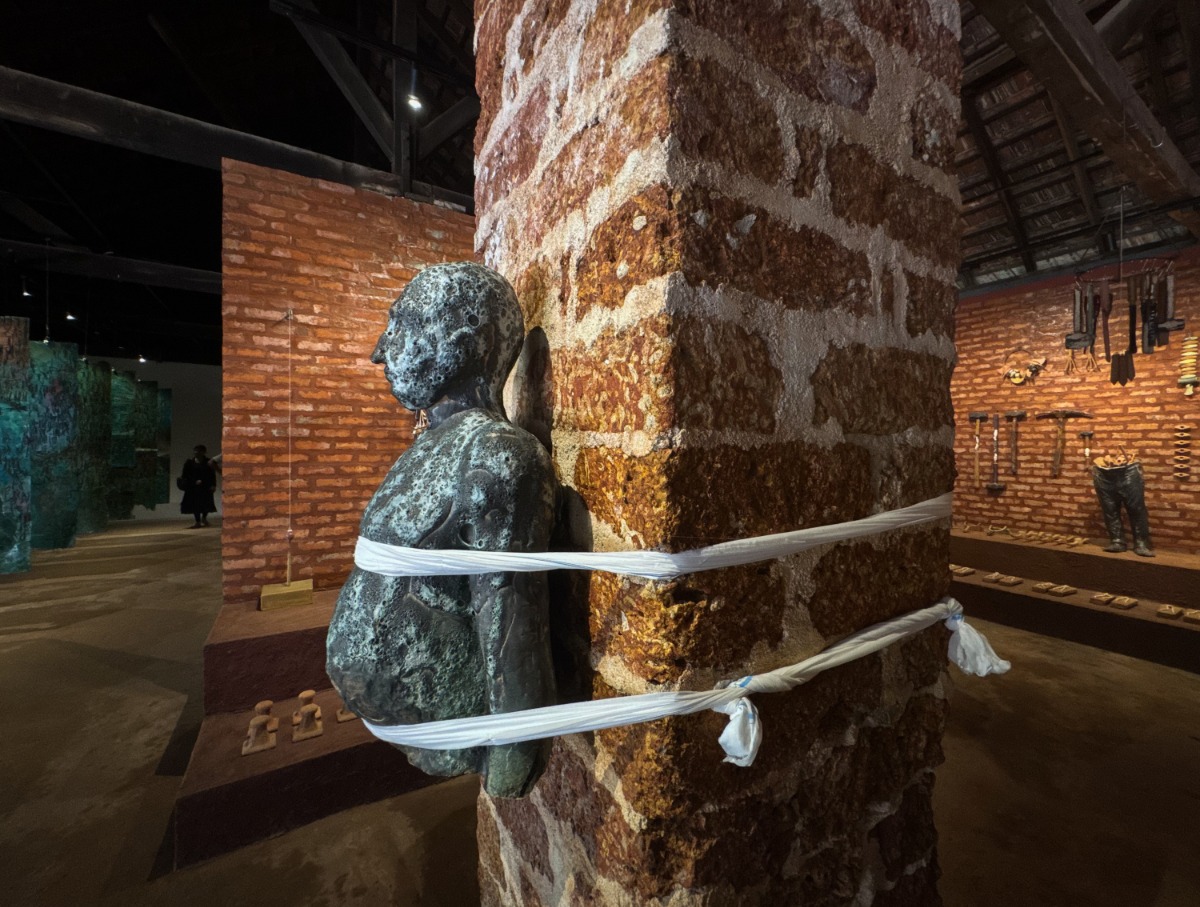
“Earthiness” curls through the venue right beside Aspinwall House; its brick structure almost merges with the works of Birender Yadav, an artist from Ballia, India. The project Only the Earth Knows Their Labour creates the arrangement of a kiln. The uniformity and volume of bricks signify the labour of landless kiln labourers, who are usually seasonal workers. The terracotta casts represent the belongings they often leave behind at temporary homes, and the overall installation evokes the textures of memory and a touch of struggle.
The theme of the capitalistic relationship between land and people is addressed further in the practice of Zarina Muhammad, an artist from Singapore. As a counterstatement to oppressive work, her Omens Drawn by Lightning takes shape as a dimly lit room that serves as a sanctuary – visitors are invited to take off their shoes, rest, and play the musical instruments made by local artisans. On-site ritualistic performances are conducted by Muhammad.
Artist Zarina Muhammad and visitors at her project Omens Drawn by Lightning space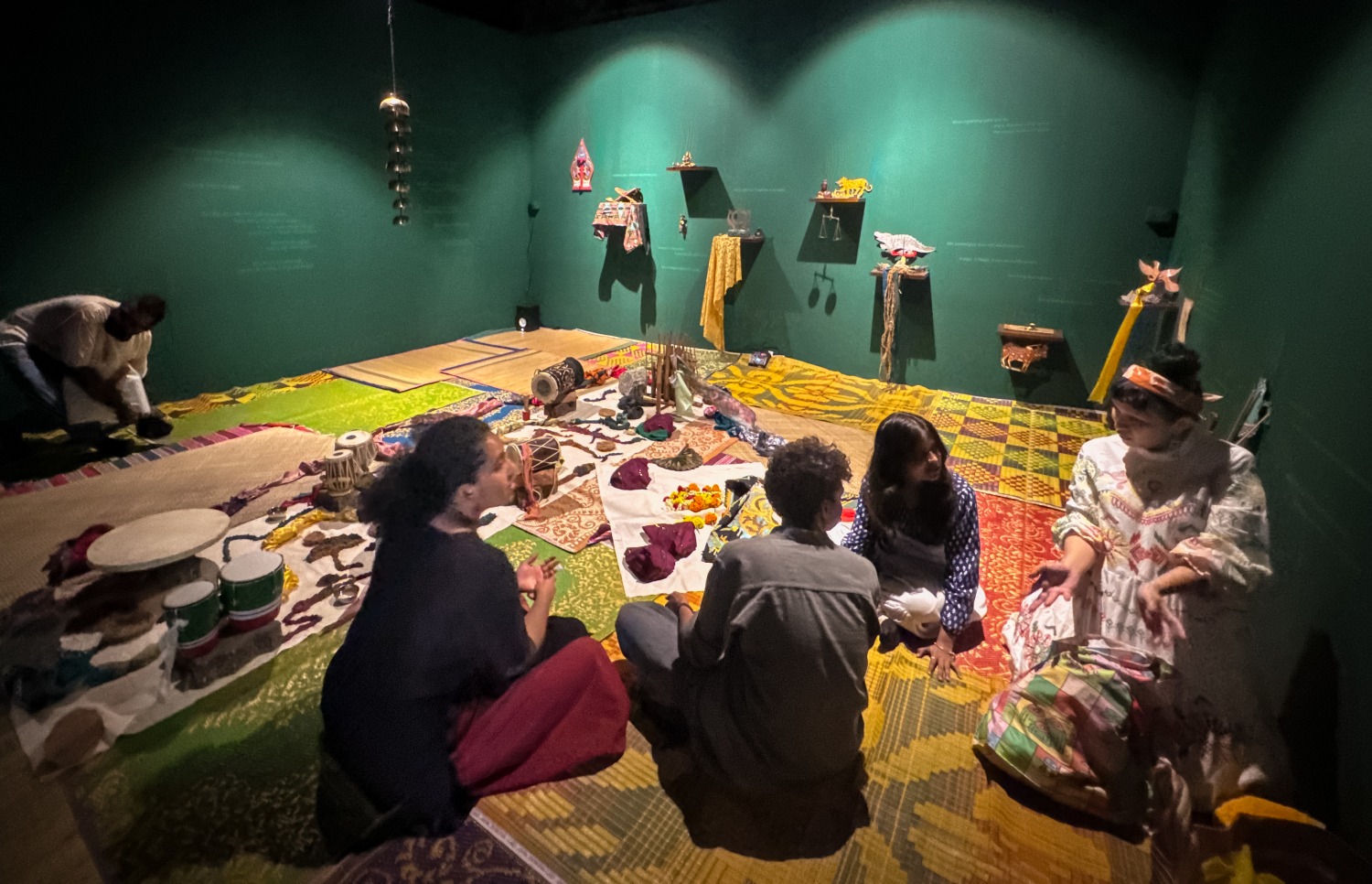
Time is stretched “the Biennale way,” with live performances happening almost every day throughout all the venues. In general, the inclusion of video works is minimal; the materiality of artworks, often made from local, organic materials, tackles all sensorial stimuli. This approach truly shifts visitors’ attention to the present moment and the physicality of a conscious art experience.
Continuing the route of highlights, another important venue, further down the road towards Mattancherry, is Anand Warehouse. In contrast to Aspinwall House’s majestic silhouette, this certainly is a space-in-the-making, and, aware of that, its central passage opens with the work Lifespan by British artist Mark Prime, which is an installation made of industrial metal frames. This bridge structure symbolically links Kochi’s geographies as a warehouse connecting docks with markets.
Work Lifespan by artist Mark Prime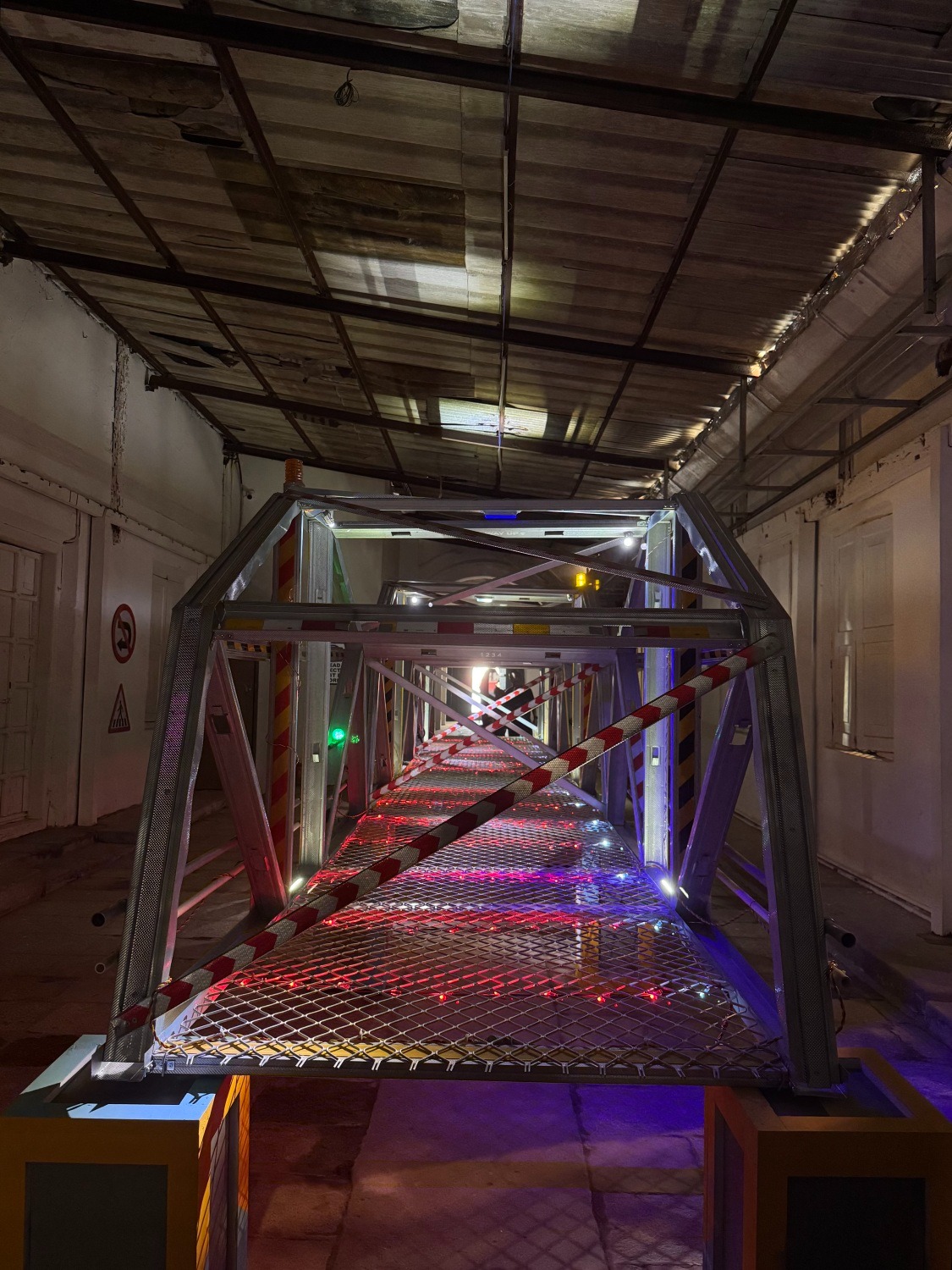
On each side of this entrée are rooms hosting works that I would describe as among the most sublime of this Biennale.
First, the works of Indian artist Kulpreet Singh. His practice explores the perspectives of land, its cultivators and their resilience. His project Indelible Black Marks contains one of the rare video mediums of the Biennale, still connected deeply to nature and physical labour. In this film, the artist and his team run across torched paddy fields, holding trails of long canvases that become marked by the residues of chemical fertilisers and scorched by stubble. This work echoes the state of climate emergency, sprouting as a form of disturbing distance between farming communities and political power.
A shot from artist Kulpreet Singh’s film as part of his project Indelible Black Marks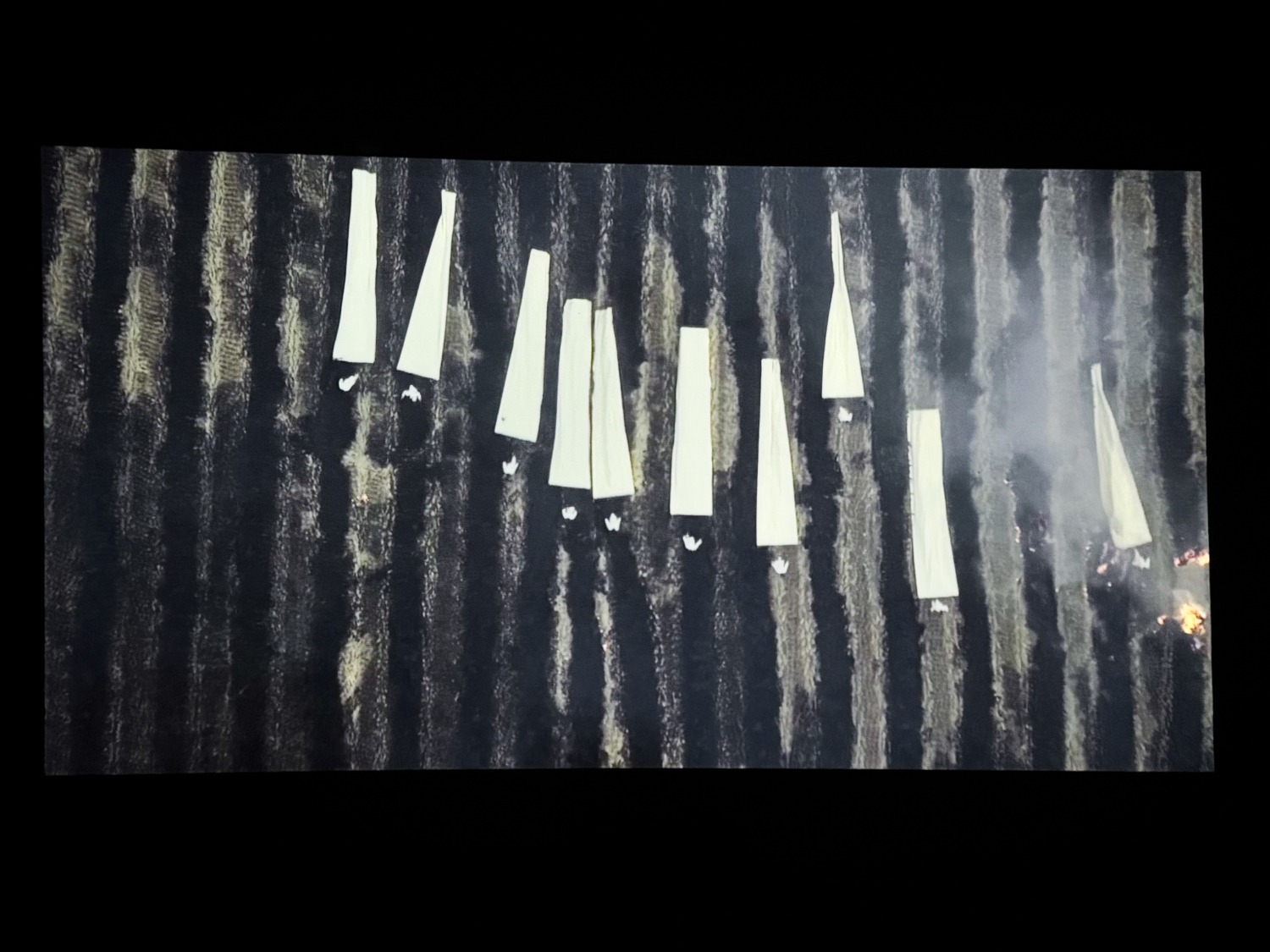
Parallelly, a vast hall within Anand Warehouse is dedicated to Parliament of Ghosts which is a project by Ghana-based artist Ibrahim Mahama, whose practice examines colonial legacies by transforming public buildings and everyday object displays into arenas of enquiry and commentary. With walls covered in used jute sacks, the space is “furnished” with rows of discarded chairs. Mahama rewrites parliamentary spatialities, activating the space with public programmes during the Biennale. Significantly, Mahama has been named number one in ArtReview’s 2025 Power 100 annual ranking of the influential people in the contemporary art world, becoming the first African artist to top this list.
Project Parliament of Ghosts by artist Ibrahim Mahama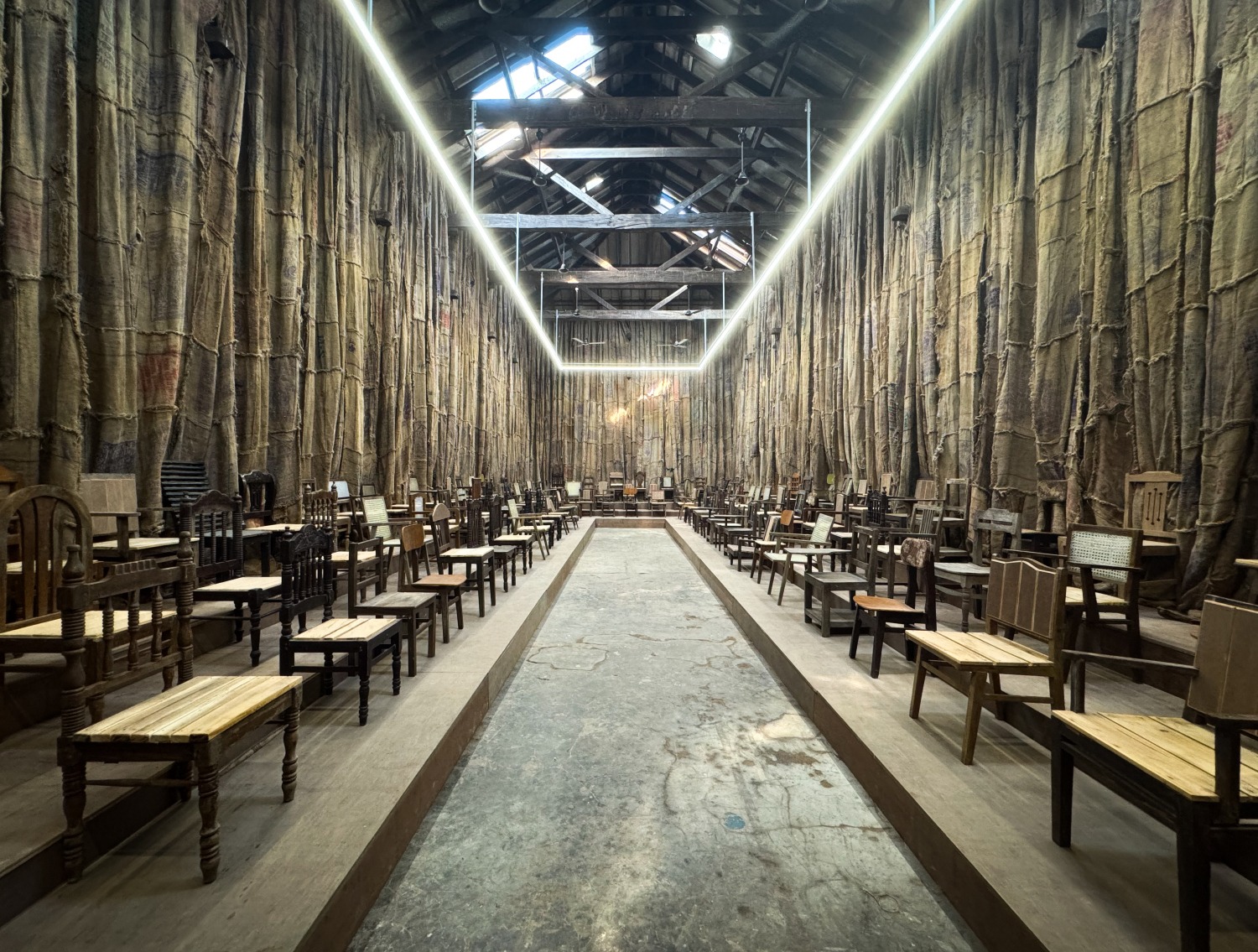
DURATIONAL TIME
The Biennale certainly has a selection of “big international names,” and according to the theme of a body placed within a flow of time, performance artists are a crucial part of this edition. Therefore, the artist is present – Marina Abramović, one of the most significant performance artists of all time. Her iconic work Waterfall, a video installation featuring Tibetan monks chanting (first created in 2003), is exhibited at the Island Warehouse on Willingdon Island. However, the biggest emphasis is on the continuation of her legacy – the Marina Abramović Institute (MAI). Numerous works from the MAI archive are presented at the Biennale. Moreover, to truly enliven the process of performance, the Abramović Method workshop was held before the official opening of the Biennale.
Participants of the Abramović Method workshop and facilitator Billy Zhao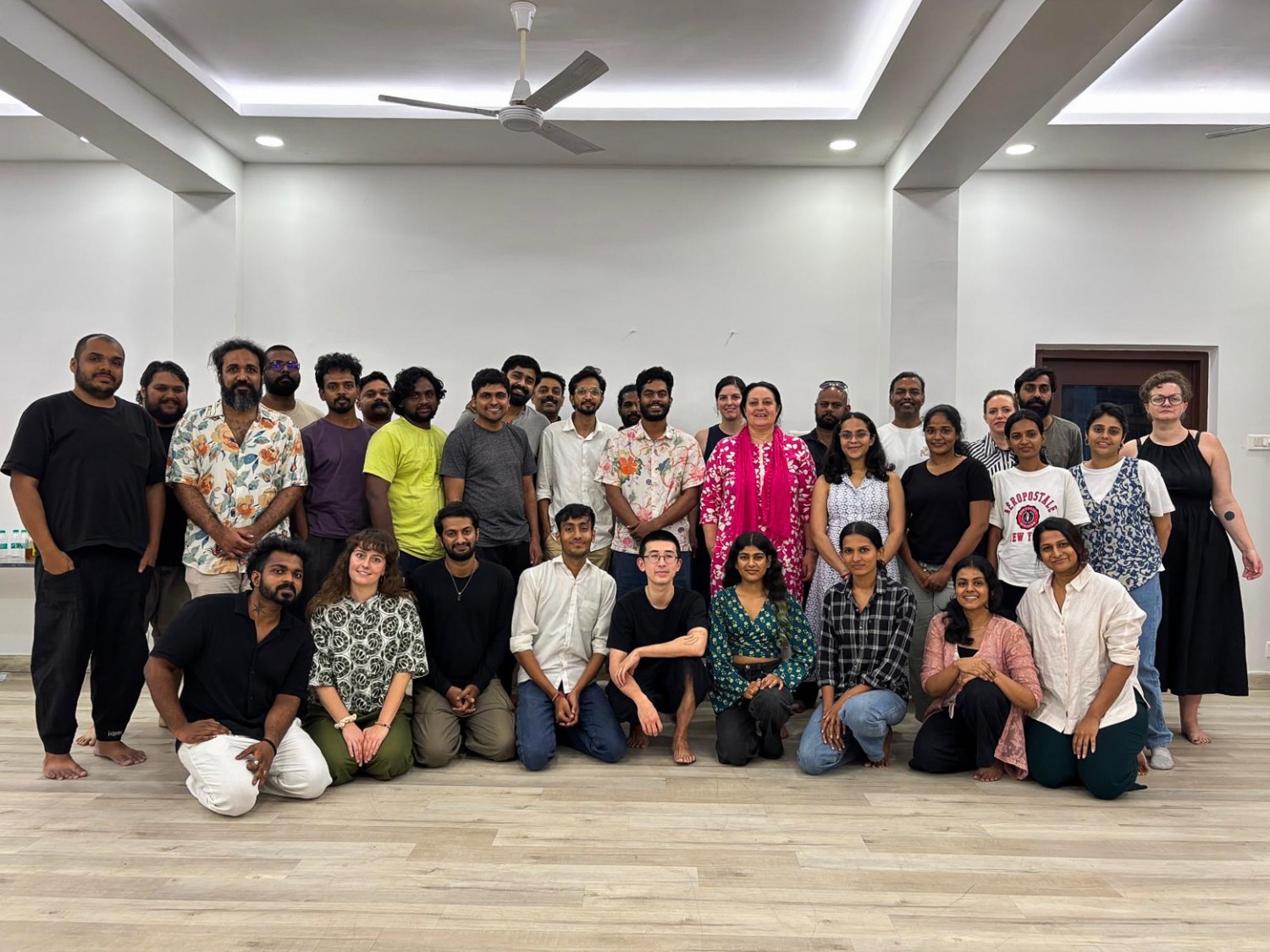
I had the honour of personally attending the workshop, led by Billy Zhao – a researcher and performance curator based in New York, former teaching assistant to Marina Abramović. A condensed one-day version of Abramović’s workshop Cleaning the House was held, giving a unique chance to encounter the original methods. Initially, during the workshop, participants take part in a series of long-durational exercises to improve focus, stamina, concentration, resistance to pain, and the ability to break through physical and mental boundaries. All of us, the participants who had never met before, had to accomplish certain tasks, for instance, separating rice grains from lentils and counting them, gazing into each other’s eyes, walking in slow motion. Simple by their nature, these exercises become challenging after a while, and the duration of each one was never told prior. Considering that nobody was allowed to use mobile phones or watches, “not knowing the time” inevitably becomes the state of momentary existence.
Consequently, this is the way I would suggest attending the Biennale – with undivided attention, letting go of the conventional concept of time.
PARALLEL TIMELINES
Outside of Nikhil Chopra’s curatorial framework, yet crucial to the ecosystem of the Biennale, are the collateral and invitation exhibitions, and the students’ biennale, which gathers a selection of works by art students from all over India. Plus, the local spirit of culture breathes through Edam, a showcase platform designated to artists from Kerala and its diaspora, this year consisting of three venues and 36 participating artists and collectives.
Artist Tom Vattakuzhy’s work Death of Gandhi as part of Edam exhibition platform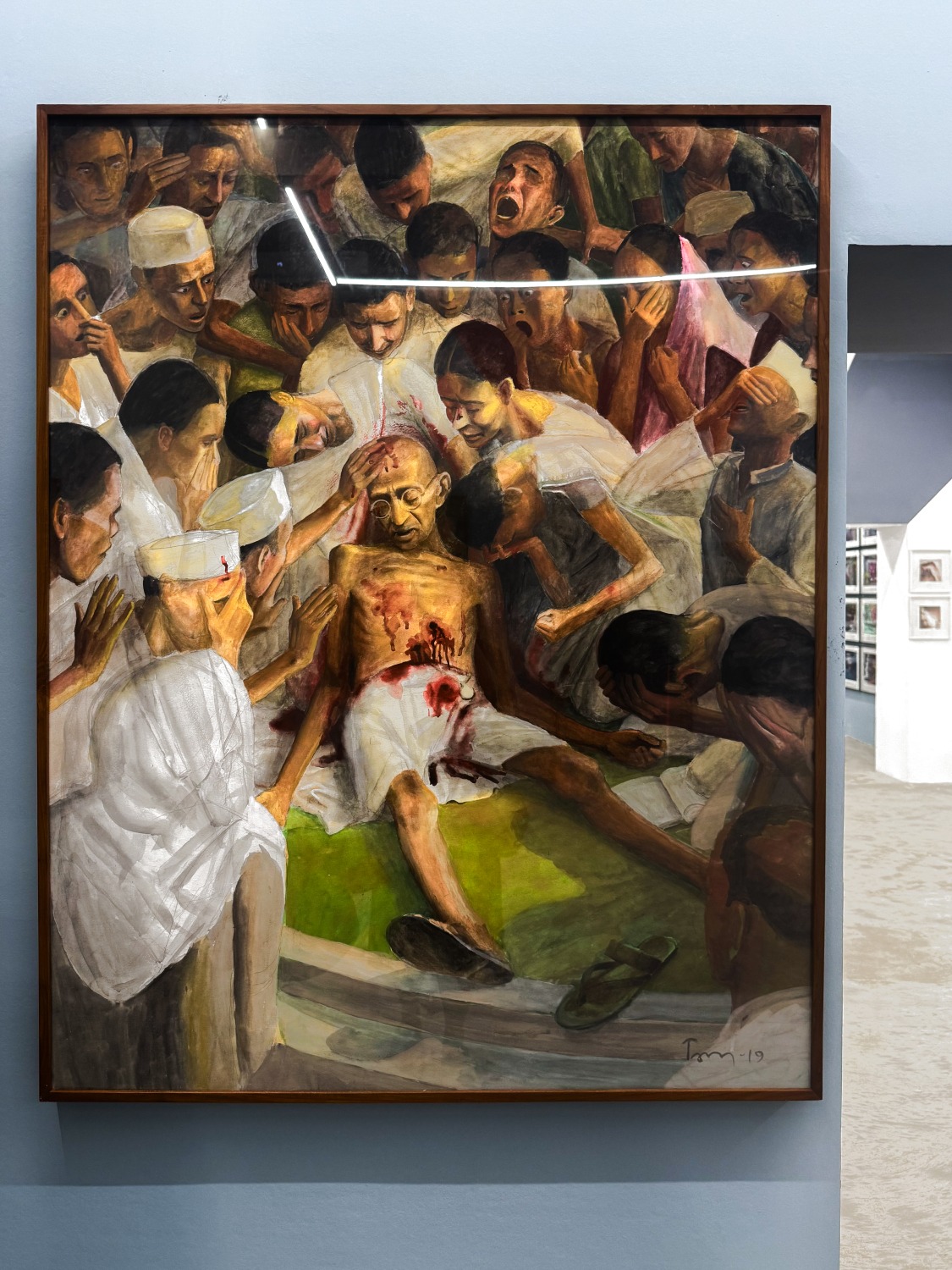
One of the significant qualities of the collateral exhibitions is giving voice to perspectives that have been historically muted, oppressed, and hidden behind a curtain.
For instance, creative collective Monsoon Culture’s group exhibition The Emperor’s New Clothes remorselessly exposes the inherited trauma of the caste system and colonial wrongdoings through archive photos and their reenactments, handwritten letters and delicate drawings.
Group exhibition The Emperor’s New Clothes by creative collective Monsoon Culture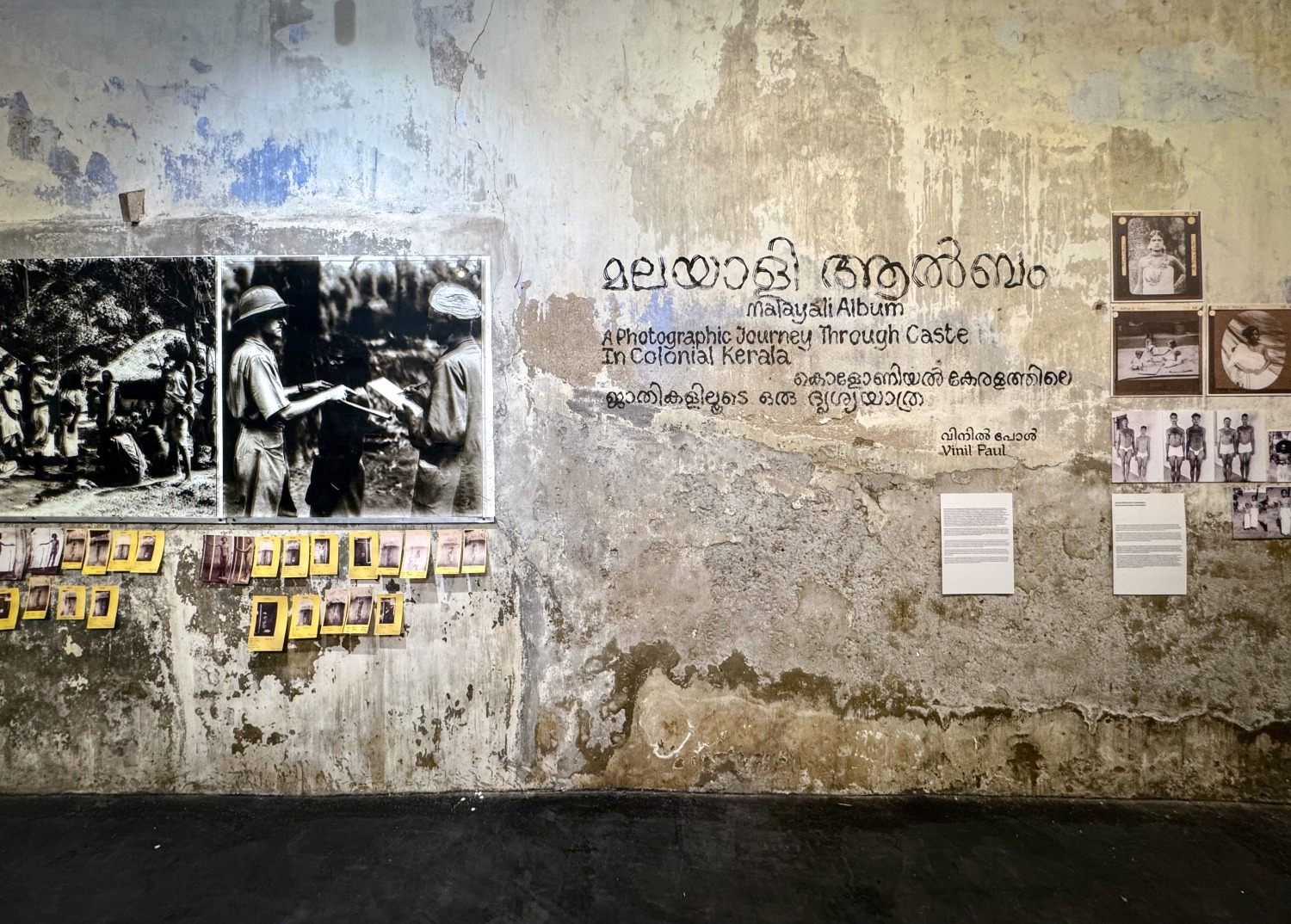
In like manner, artist Sarah Chandy’s solo show Lilies in the Garden of Tomorrow interprets the life story of a resilient woman during India’s transition to Independence in the 1930s. Chandy uses a mix of performative studio photography, newspaper archives, and personal diary entries to create the tense narrative between a maltreated individual and society.
Work by artist Sarah Chandy as part of her solo show Lilies in the Garden of Tomorrow 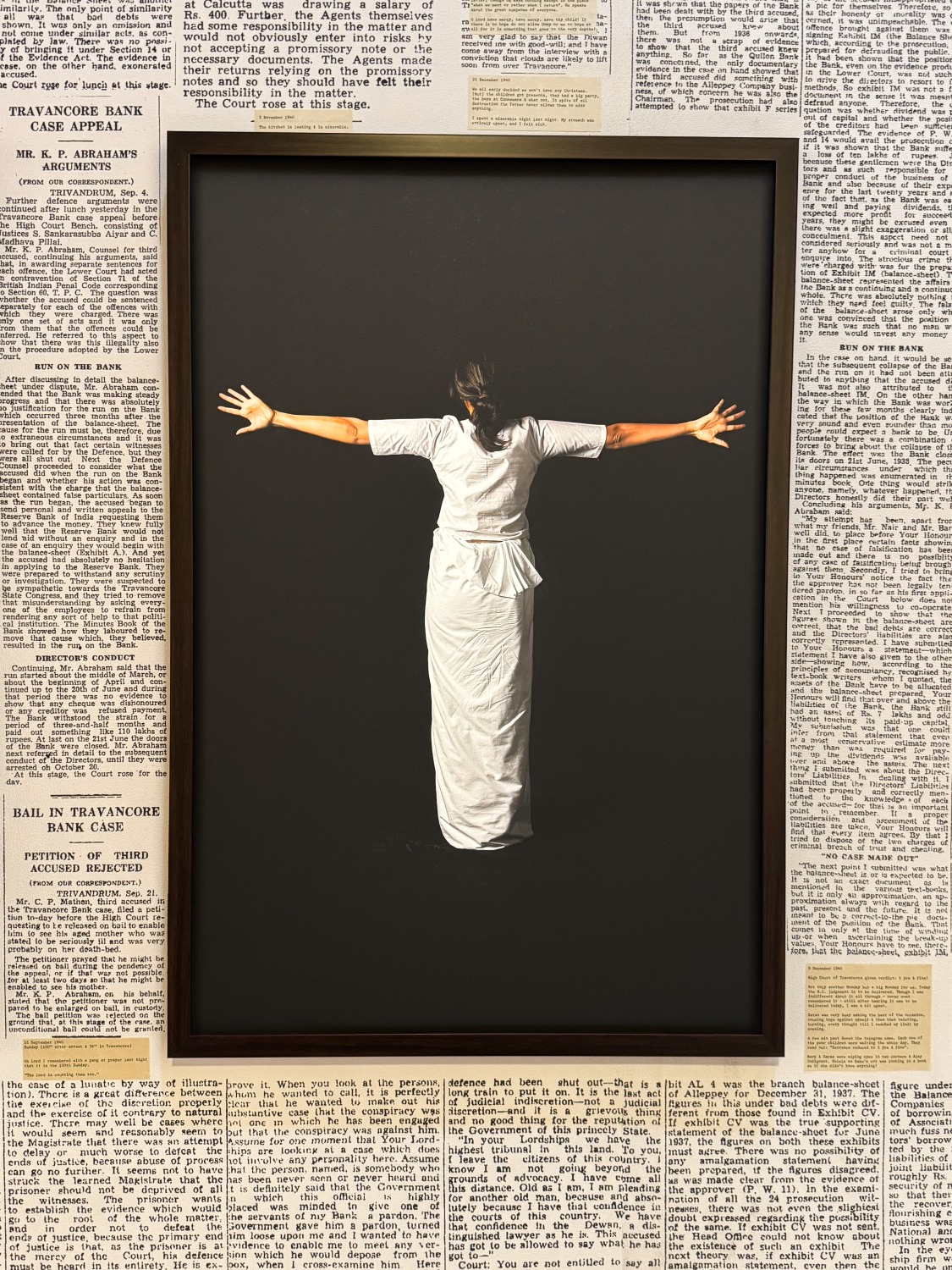
As all these exhibitions unfold across multiple venues, visitors can orient themselves through a digital map or by pausing at the large-scale wall map by the entrance to Aspinwall House.
Large-scale wall map displaying all the locations of the Biennale’s venues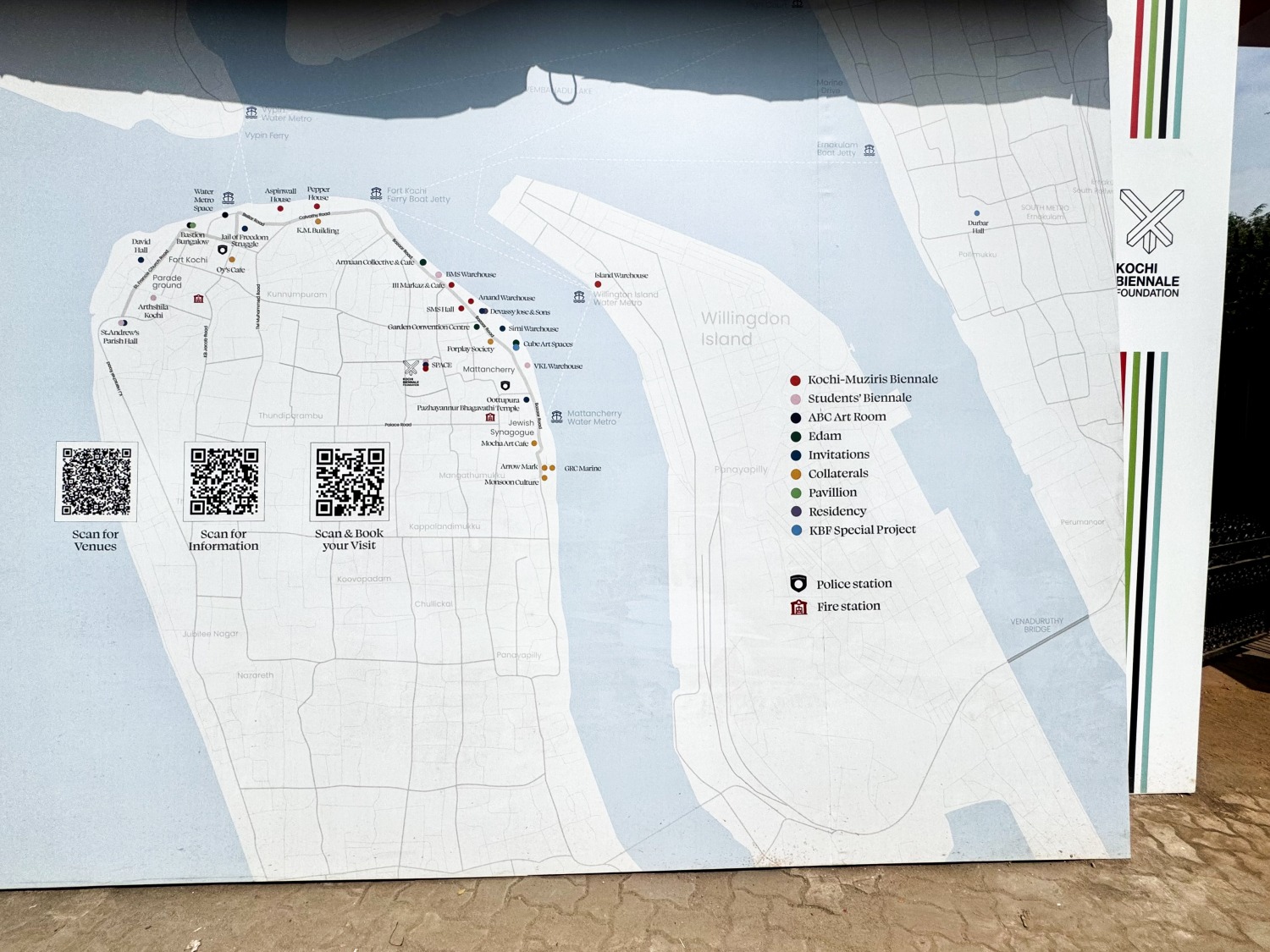
LAST MINUTE
I am glad to remain in Kochi until the very last minute of the Biennale to experience its unfolding. Additionally, I have the chance to be a part of the official ABC Art Room Programme, hosting a two-day workshop on fire techniques. For any updates on workshops (which are free of charge and open to the public), performances, concerts, etc., my recommendation would be to follow the Kochi-Muziris Biennale’s Instagram @kochibiennale, because this is the online platform used for everyday news, last-minute changes, and announcements. Every week’s program has special events, so even if attending only for a few days, it is guaranteed to be a vibrant, unforgettable experience.
After all, For the Time Being is a reminder that it is not the time we are running out of. It is presence.
Title image: Artist Birender Yadav’s project Only the Earth Knows Their Labour
