


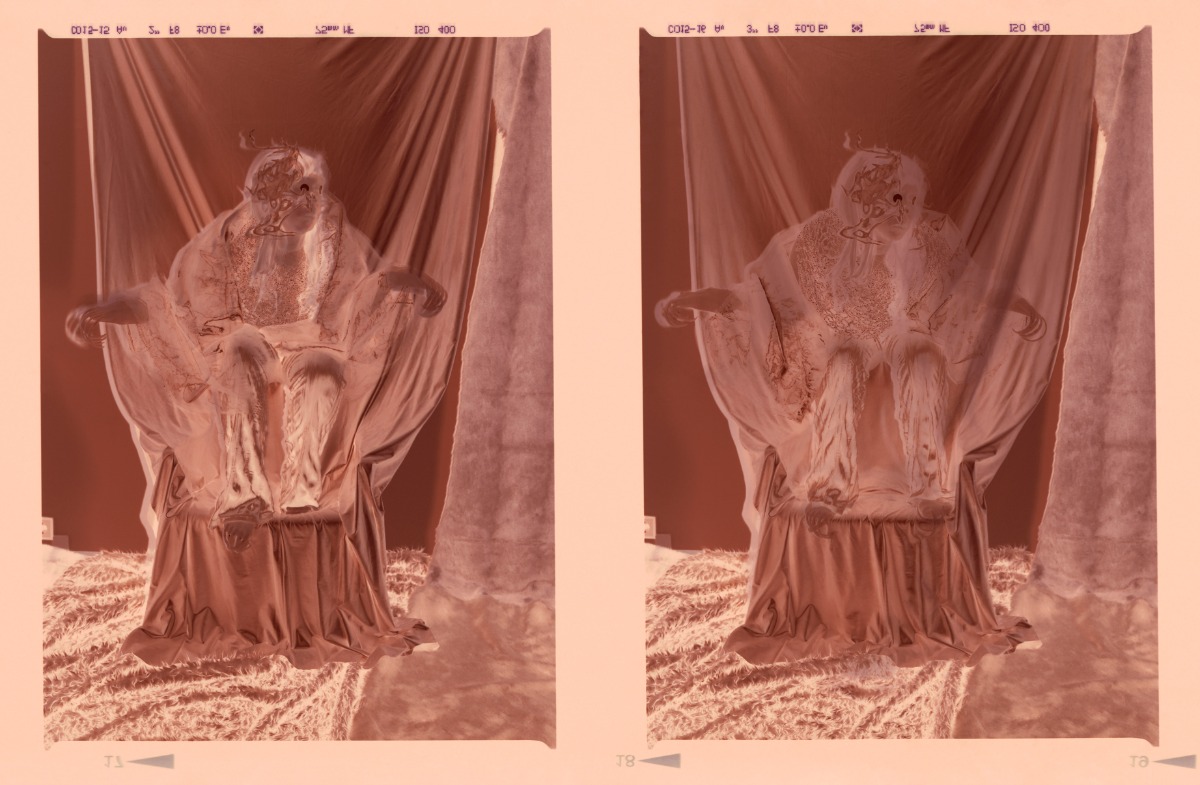
Two sisters and the familiar spirits
A conversation with Agate Tūna, who was recently nominated for the Annual Art Award of Latvia as Artist of the Year / Her new exhibition “Familiar / Līdzbūtne” has just concluded in Riga at Gallery 427
Agate Tūna works with analogue photography, experimental video, and sound art. Her works explore the interaction between spirituality and technology from a female perspective, linking family heritage, hauntology, and “techno-ghosts.” Process lies at the center of Agate’s practice: the material is examined, transformed, and manipulated – through reflections, image shifts, and chemigram processes the film is restructured and acquires new spatial and material forms. Her work challenges the feminine aspects of technology and supports the principles of spiritual feminism, emphasizing intuition, energy, and alternative forms of knowledge.
Agate Tūna. “Volentity” at ASNI Gallery. 2025. Foto: Kristīne Madjare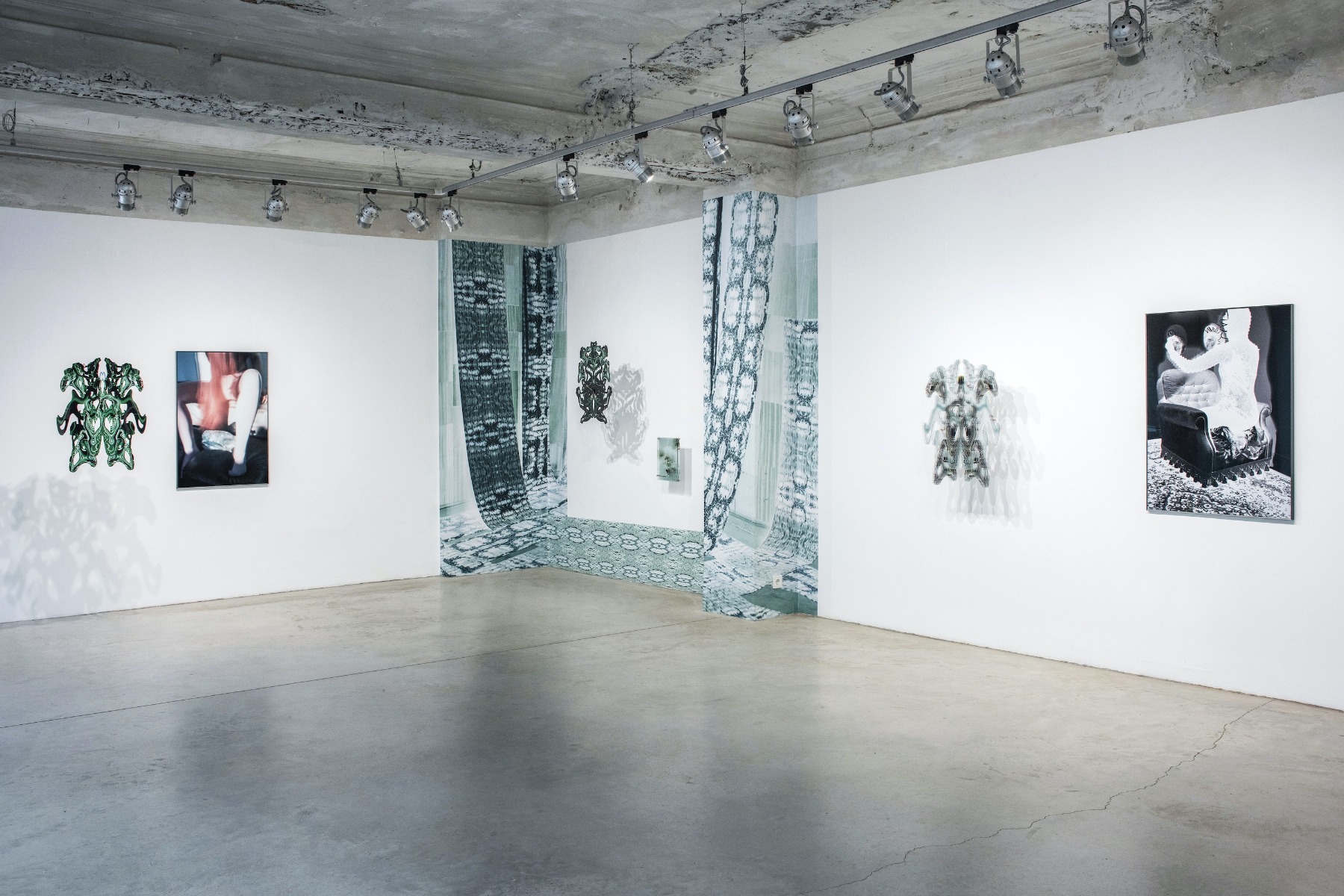
Her new exhibition “Familiar / Līdzbūtne” at Gallery 427 (5.01 – 21.02) was based on the journey of an analogue negative: from inserting the film into the camera to developing, scanning, and printing it – at each stage the image accumulates traces, scars, and transformations. The concept of the familiar here symbolizes a spiritual companion, a presence that changes together with its bearer. The exhibition proposed viewing photography as such a presence and as a living archive, where the analogue interacts with the digital, becoming part of collective visual memory.
Agate Tūna. “Familiar”, 427 Gallery. 2026. Photo: Līva Priedīte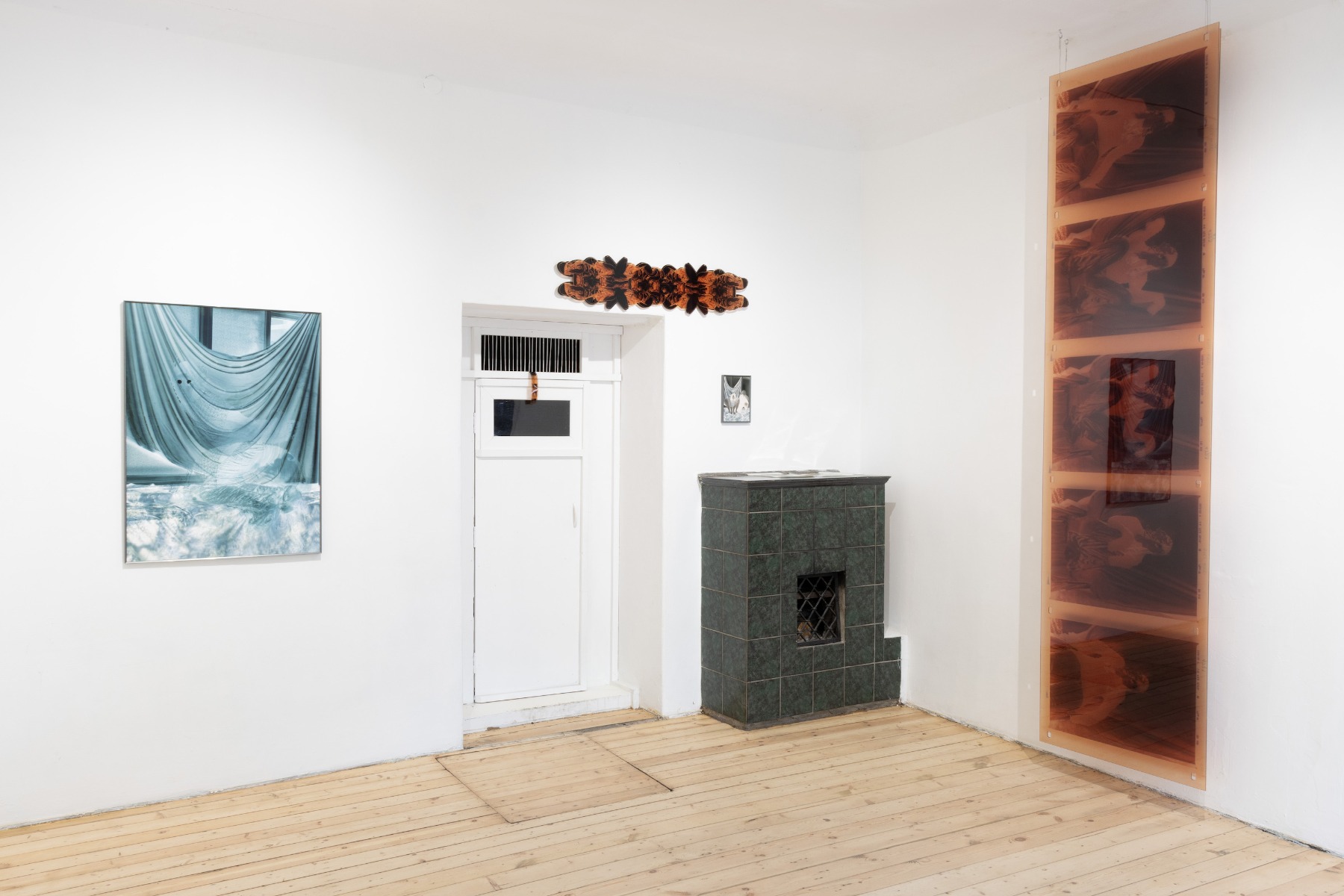
I visited this exhibition one February day during gallery hours – under rather mystical circumstances. The lights were on, the doors were open, but no one was there. I walked for a long time from wall to wall, observing entire groups of negatives on which mysterious beings partially resembled young girls, partially mythic characters; they lay, sat, and looked into my eyes, in which nothing was reflected except the flash of the camera. Sometimes cats’ eyes shine like that. In the door leading to the inner gallery space there was a glass “window,” but it was dark, no light was on inside. And to this day I do not know whether I was there alone, or whether someone (something?) was watching me through that glass.
I came to the gallery again a few days later to speak with Agate herself, and this time there was light behind that door. We settled in the small back room, holding cups of tea in our hands. Outside it was minus fifteen again.
Agate Tūna. Photo: Līva Veigura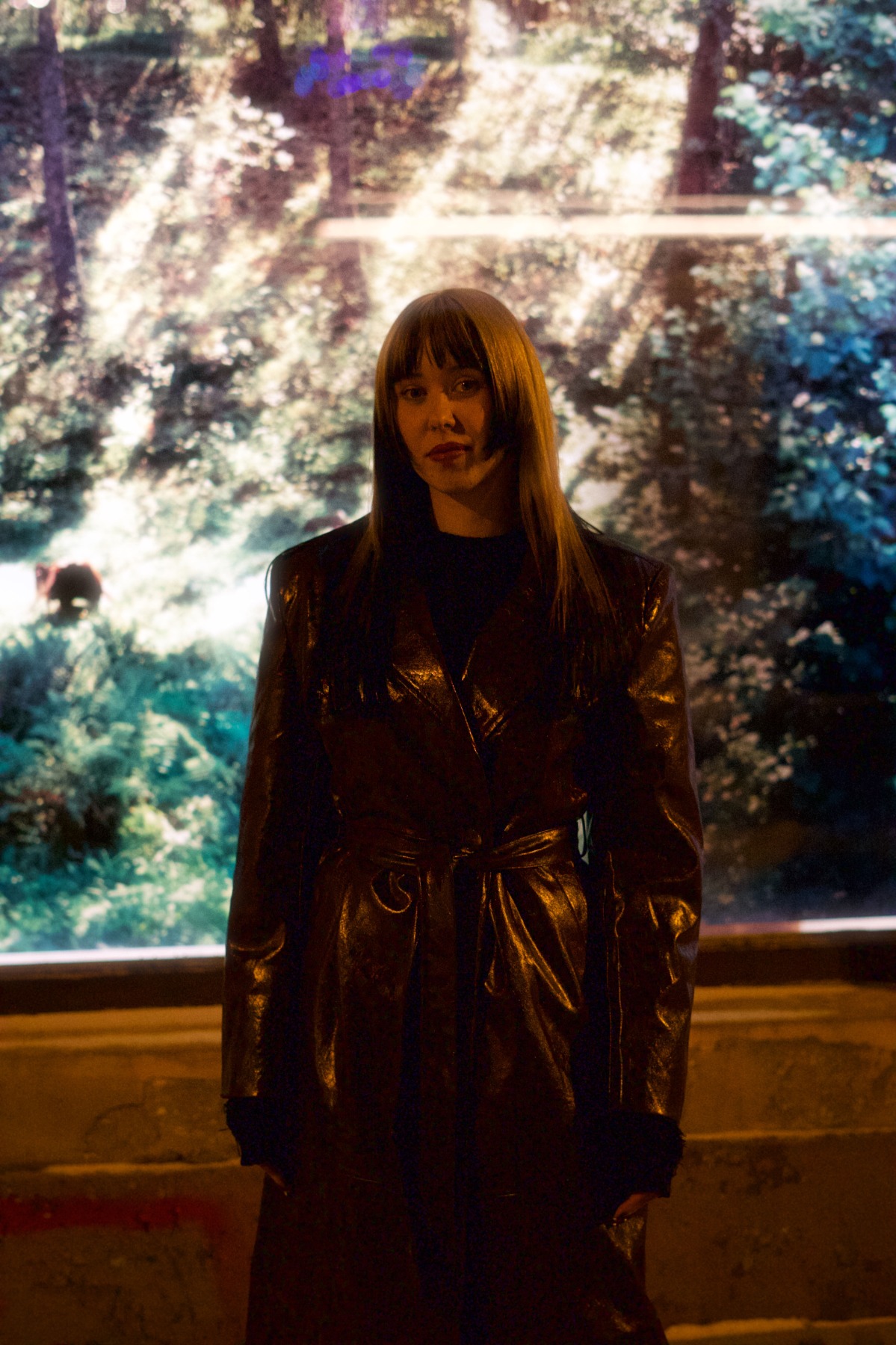
I want to ask you – you are interested in spiritual matters: is that connected to your personal life story, or is it simply an interesting and powerful subject?
In the final year of my BA in painting, I went to Lisbon on Erasmus. There we had a photography lecturer who taught experimental photography techniques such as chemigrams, photograms, and film soups – which I had known nothing about before. I was surprised that photography could exist without a camera. Working with chemigrams, I realized that painting with developer and fixer on photosensitive paper produces an extremely painterly result. Through the interaction of light, touch, and chemicals, contrasting drawings emerge in pinkish, bluish, or sepia tones.
That was my introduction to photography. After that I enrolled at ISSP School, and we began our first photo projects. At that time my grandmother began to show the first signs of dementia. We understood that the illness was progressing quite quickly and that it was important to listen to and record her stories as soon as possible – about her home, about our family line. From these stories and memories my first photo project “Pond House” (2022) was created. Then it emerged that in Latgale our family had included healers and herbal women who, according to stories, also knew how to cast spells. In the Western European historical context such women were often labeled as witches. We too, in the Baltics, have had witch trials, yet it seems that here witchcraft was more often associated with knowledge of plants, healing, and incantation traditions. It was more connected to practical and inherited knowledge. My great-grandmother also had a small notebook of spells that was passed down from generation to generation. My mother remembers that if, for example, a tooth began to ache, they would chant “What crawls by day and by night…” while simultaneously invoking “Jesus Christ and the Virgin Mary.” It was like a double effect – Catholicism and folklore at once, the religious and the folk spiritual layer.
Agate Tūna. “Familiar”, 427 Gallery. 2026. Photo: Līva Priedīte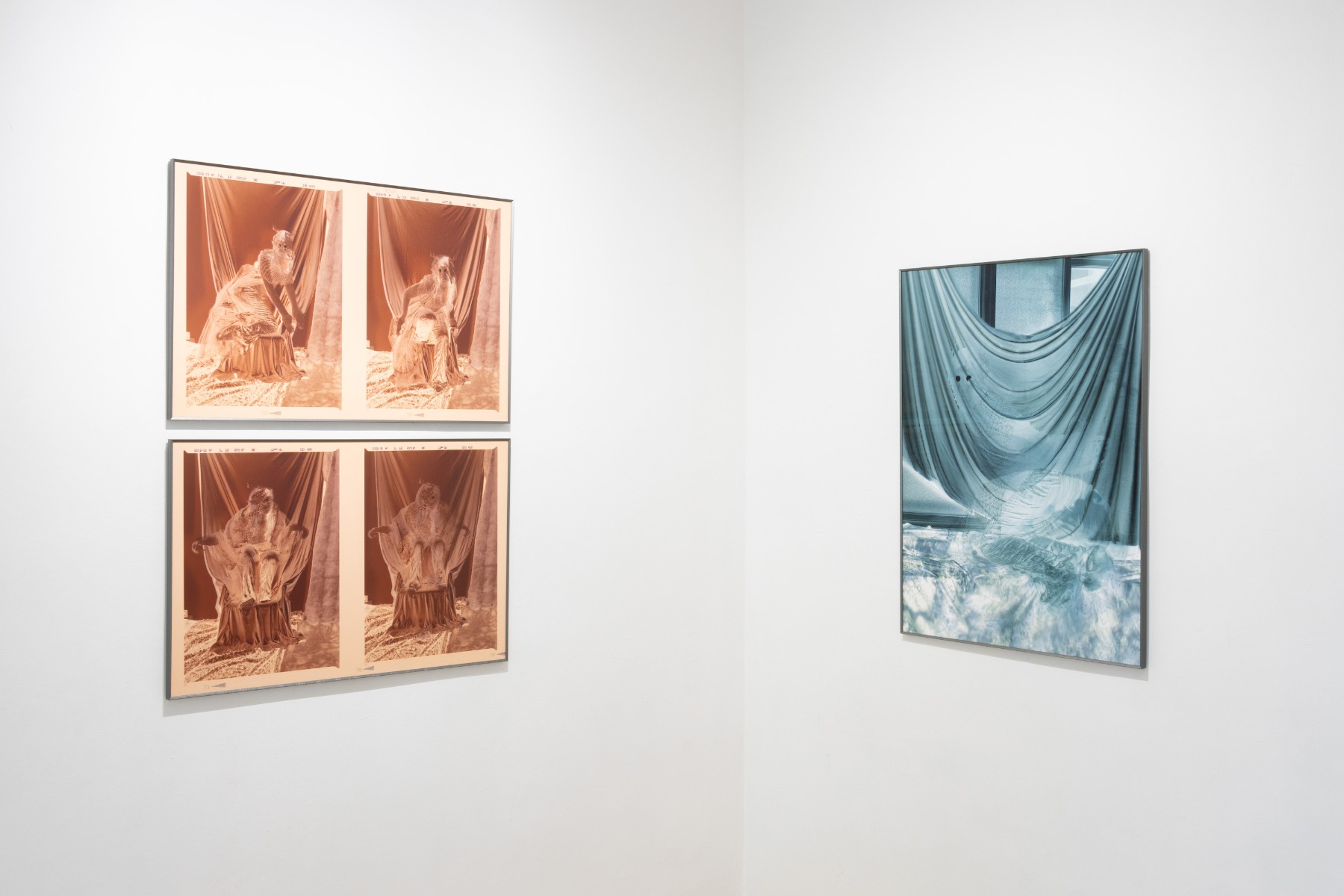
But what were those little books like? Could you say they were like “recipe books” describing what to do if something specific happens – what actions to take in such situations?
Yes, mostly. For example, if your stomach or head hurt… how to act in order to relieve the pain. Of course, there were also recipes for love, how to “cast an eye” on someone, but I don’t really know about those things. Unfortunately, my great-grandmother did not pass this little book on. So there is speculation – either it was burned, or it was hidden somewhere in the house between the boards.
I have always been interested in these topics. And then I understood why… My sister and I used to go to this country house in different seasons, when it was already uninhabited. Looking through the house albums, I realized that not many photographic testimonies of the everyday life of its inhabitants had survived. A camera was not available on a daily basis. Photo documentation happened through neighbors’ or guests’ cameras. In the house there were still my grandmother’s headscarves, her woven blankets, and everything else that preserved the feeling of her stories. Our family has lived in this place for seven generations.
Agate Tūna. “Familiar”, 427 Gallery. 2026. Photo: Līva Priedīte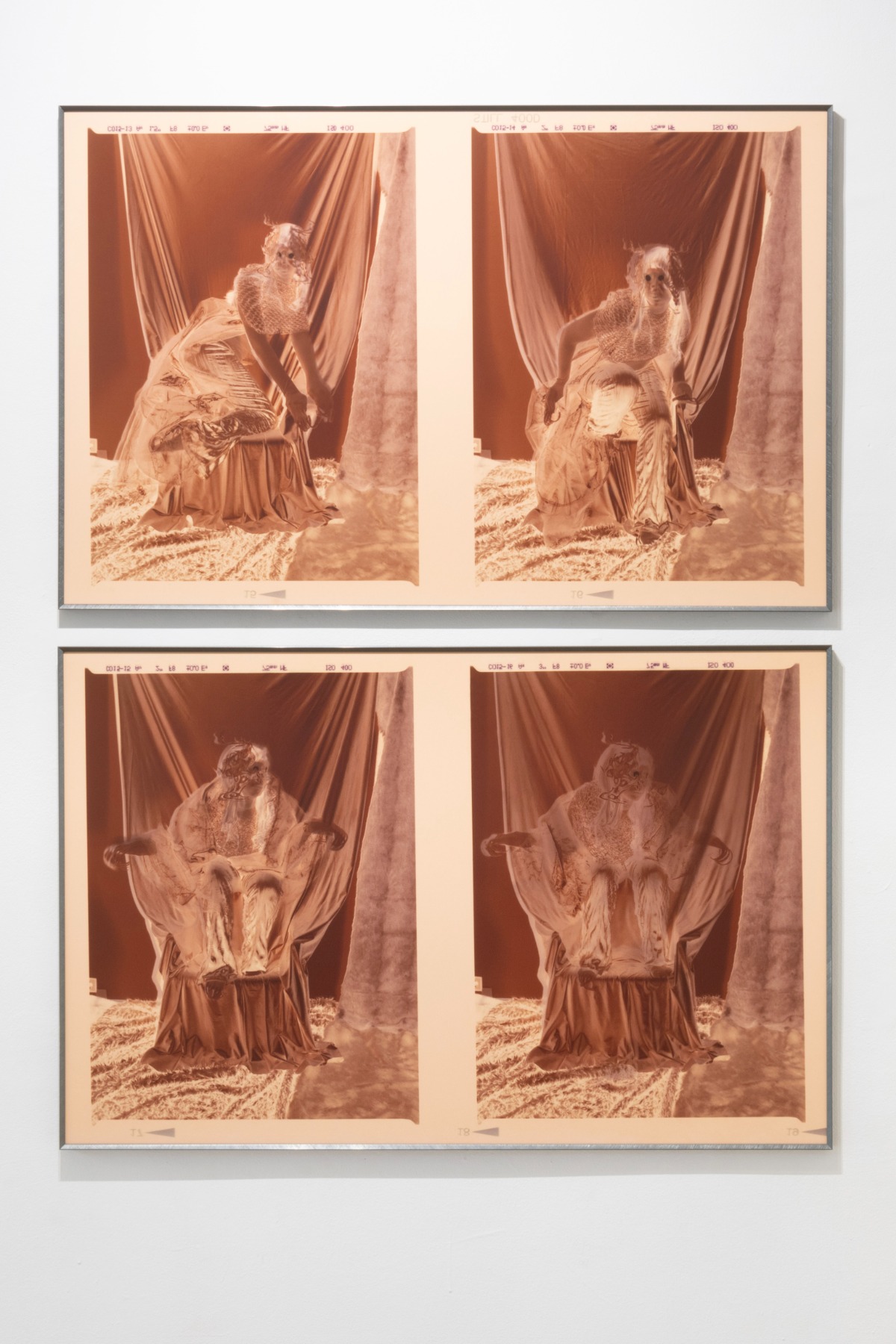
In general, things that we might call the “paranormal world,” and their photo documentation, are a very interesting subject…
I was very interested in spirit photography, for example ectoplasm (a white, semi-transparent mass that during séances was released from the medium’s body and formed humanoid shapes). I began to wonder whether something similar existed here as well. Then I went to the Photography Museum and searched the archival materials to see whether anything like that existed there. Unfortunately, I found nothing. Although written testimonies about the documentation of séances have existed. Later I became acquainted with illusionists Dace and Enriko Pecolli and learned more about magic photography. Then I understood how much power a photographer actually has. Essentially, a séance takes place, but the photographer, depending on the chosen film or exposure method, for example long or double exposure, can make viewers believe or disbelieve what they see in the photograph.
That is precisely what fascinated me – how to create effects and “ghosts” without digital manipulation – when everything happens directly on the film. And then you actually overcome several fear factors as well. At first you photograph on film and already wonder – what will even turn out, will anything visible turn out at all. Then you develop the film and also think: “Well, will there be something there or not?” This interplay captivated me greatly. The interior is also important – levitating tables, velvet curtains, soft carpets, as well as various constructions that concealed tricks.
Historically, illusionists, especially Houdini, attended spiritualist séances. He recorded the techniques used by mediums and then reproduced them on stage, step by step showing audiences how table levitation or other “spirit” effects were achieved. In this sense, a photographer can also play in a similar way. Whether to document and expose, or to participate in sustaining the illusion. And then I feel that there are moments when you yourself go so far that you no longer realize – did “I do this,” or not? Your own psyche also influences all of it.
At the same time I began to turn toward the technological side and the aspect of hauntology. For example, all our text messages, correspondence, or draugiem.lv profile pictures, or other images – all of this becomes our digital photographic “plates” that simply follow us and will haunt us forever. [Laughs]
I realized that I want to continue this theme, because there are so many aspects to discuss. One can speak from an ecological perspective, a feminist one, from memory and history, from technology and algorithms, and so on. Of course, it is not only about ghosts – there are also aliens, fairies, and all that paranormal photography. What particularly interested me was mask-making, dressing up, and the whole preparatory stage that happens even before the image is fixed.
Agate Tūna. “Familiar”, 427 Gallery. 2026. Photo: Līva Priedīte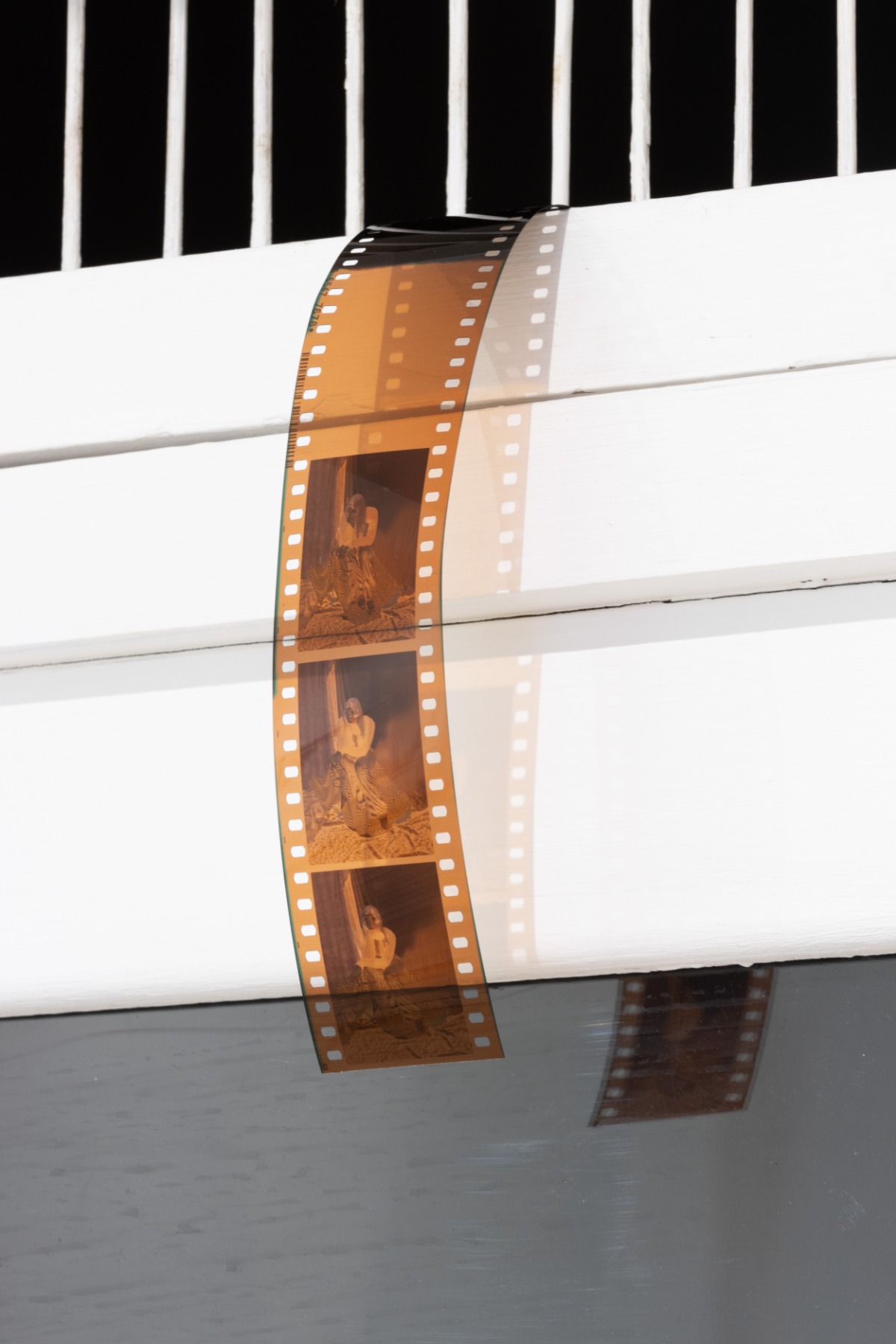
In early December I was in Milan, where the large-scale exhibition “Fata Morgana: The Unseen Memory,” prepared by Fondazione Nicola Trussardi and curated by Massimiliano Gioni, Daniel Birnbaum, and Marta Papini, was on view. There were quite a lot of photographs related to spiritualist séances of the early twentieth century. In some of them, as you mentioned, ectoplasm was visible.
Pecolli says about that: “Well, it’s like this – just as they swallowed swords, they also swallowed that gauze, and then comes the purification process.” [Laughs] They explained everything very technically, how it happened and how these methods worked.
Last May and June I was in Paris, in residence at Cité. I went to the Institut Métapsychique International, and they showed me four boxes of photographs in which ectoplasm and photographs of Eva Carrière were also visible. [Eva Carrière (1886–1943), also known as Eva C., was an early twentieth-century medium. She became widely known for demonstrating fake ectoplasm made of chewed paper and cut-out faces from magazines and newspapers. – aut.] It was the first time I had seen these photographs in such quantity. Usually we see only a single image, but there were entire series. For example, one woman with cotton behind her back, and inside the cotton a portrait… And there were twelve photographs in which she changes her pose, clothing, shoes, and is photographed with this “cotton ghost.” I found it extremely fascinating – usually only one picture is exhibited, but here you could see movement and the behind-the-scenes process.
In your exhibition there was also a kind of serial approach.
Yes, I had already selected all the images and even brought them to be printed. But then I looked at my pile of negatives and noticed that the movement forming within them was actually extremely interesting. And how bodily the negative becomes, because it passes through so many hands and processes that it acquires scars, burns, bruises, dust… Then it seemed interesting to me that the negative becomes like a piece of skin that, like our body, ages over time. It then becomes a symbol of birth and life processes. And then – what happens next? Well, they can disappear over time, or someone preserves them – it all continues like a life cycle.
That is why it seemed extremely interesting to show the source of the image I created, the sequence of frames, the exposure time, and which film was used. Each film has its own tint – whether sepia, bluish, reddish, or yellowish – and is given a specific tone. And if the film’s expiration date has passed, various effects and visual surprises begin to form.
Agate Tūna. “Familiar”, 427 Gallery. 2026. Photo: Līva Priedīte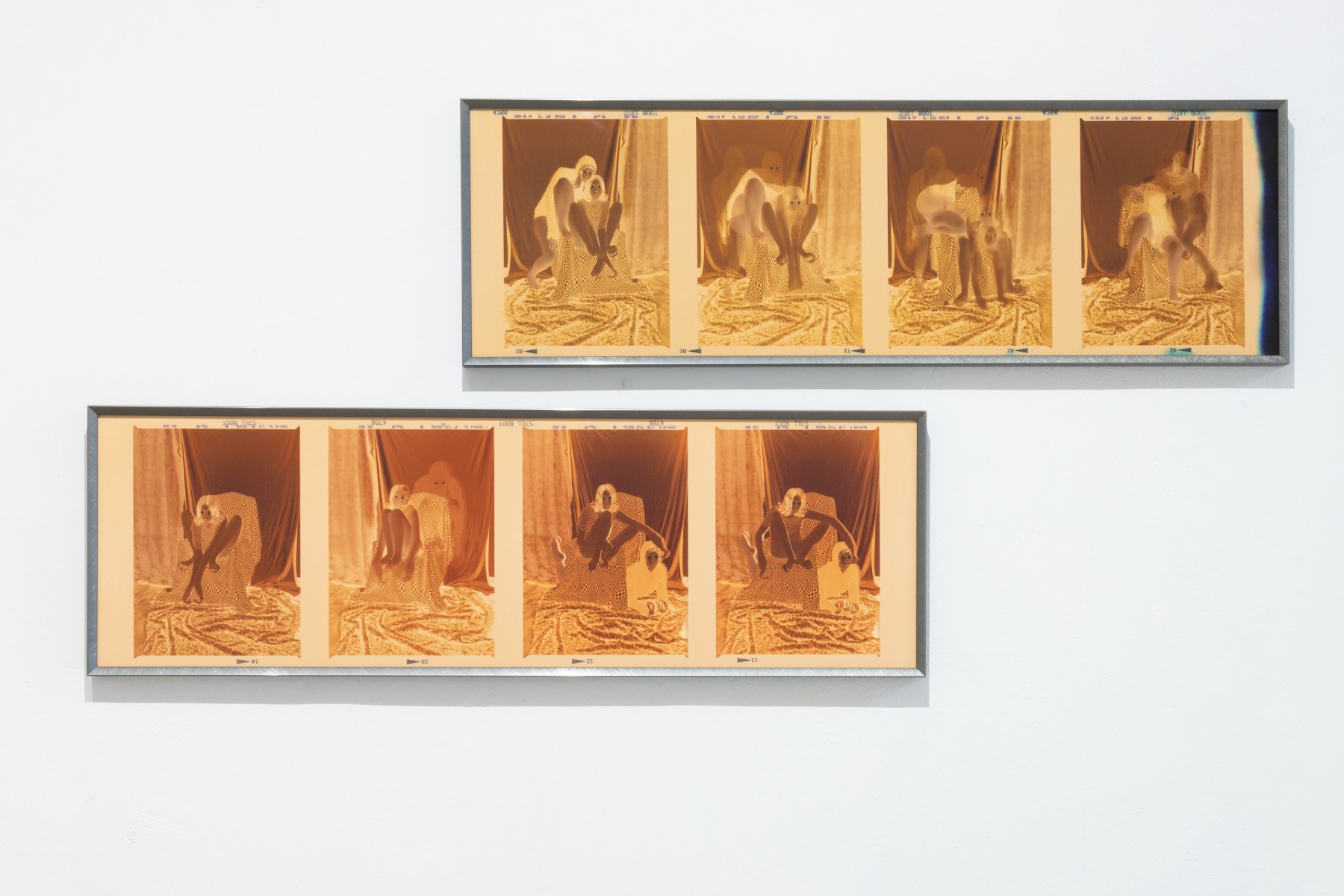
In general, a negative is a very interesting object in itself, also some kind of “ghost.” A message from the “other side.”
It is in itself like a parallel reality. It shows the world inverted, light becomes darkness and darkness becomes light. And the fact that a negative is transparent, almost invisible – you have to hold it up to the light to see it. Then you enlarge it, scan it, and it passes through all processes – through grain, through film, then it turns into pixels, is stored on a hard drive or sent by email. A negative survives so many different forms, and this transformation seems extremely interesting.
The stylistics or structure of the photo negative also allows you to mystify the characters a little. What kind of world is forming there? Where does such a phenomenon as familiar spirits exist?
A familiar spirit is a companion to a witch or some supernatural being that can appear as a toad, a black cat, a raven, or another living form, and that helps in everyday tasks. In Western European witch trials it is often mentioned that these beings had supposedly malevolent gazes.
I think that in the Baltic context it is healthier – here the companion is more connected to the home, for example to the bathhouse, to objects, clothes, or everyday items. Like a house spirit, connected to our ancestors.
In about ninety percent of these images it is either me or my sister. For example, I have chemigrams glued to my ears – sketches from my other exhibitions. From fake nails I have made something like hands. It turns out that I create quite a lot of these objects myself, and then they appear in the photographs. Like remnants or continuations of previous work.
The process itself is also interesting, because I photograph either with a remote or with a timer. Then I dress up, glue reflective fabrics over my eyes, for example, so that they shine. I glue chemigrams to my head, attach nails and everything else. Movement becomes interesting too, because it is difficult – everything collapses and falls, and I cannot see the process one hundred percent myself. In a way it is an embodiment process into that character. I think about how, just as mediums embody a spirit through themselves, I also embody these familiars or figures and speak through them about themes that interest me. At that moment the boundary between me and the character becomes blurred. I am no longer only the author or the model, but rather an in-between state – a place where an idea acquires a body.
Agate Tūna. “Familiar”, 427 Gallery. 2026. Photo: Līva Priedīte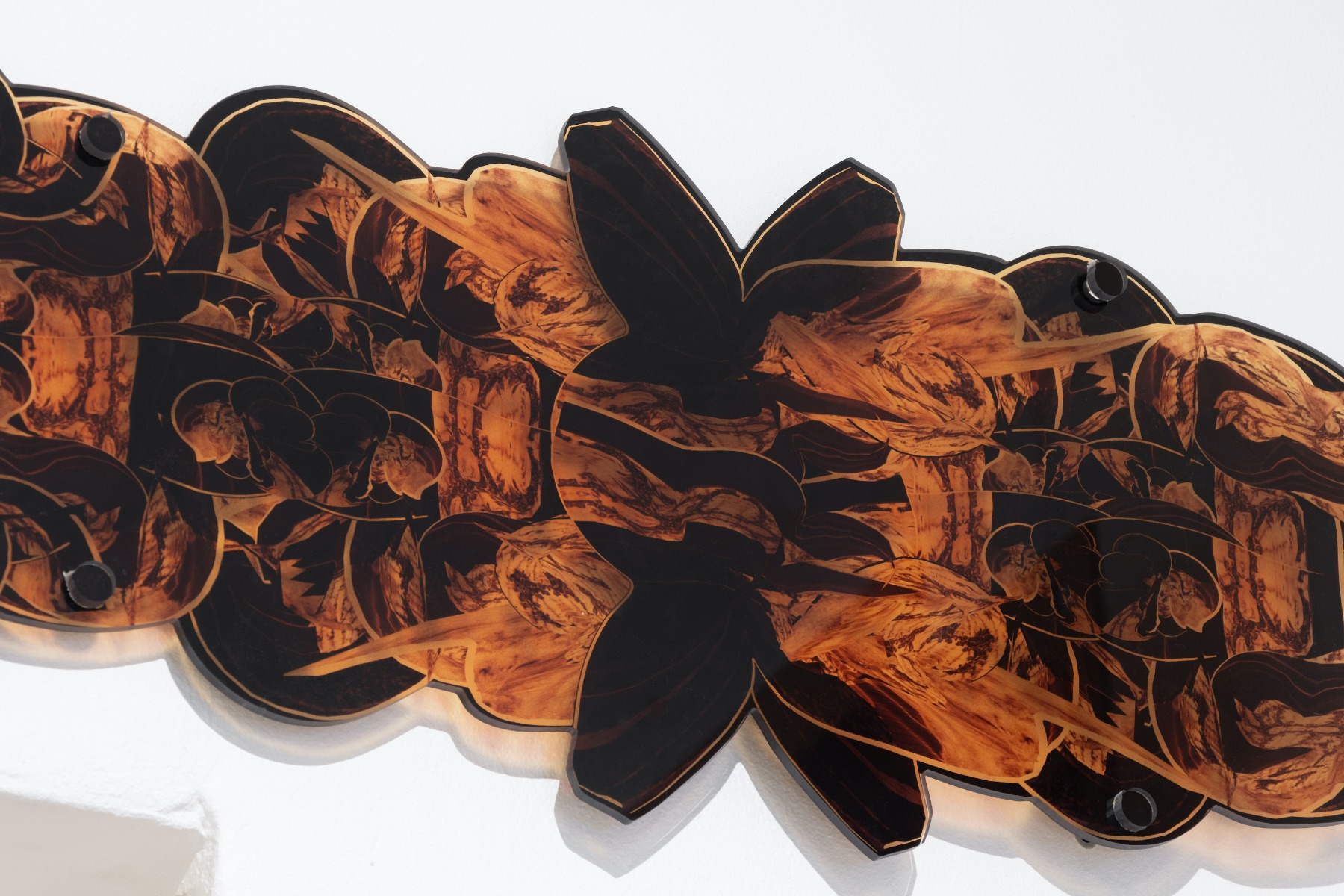
You mentioned hauntology. It seems that for the Baltics this is an important concept. The space is filled with ghosts of the past and with future possibilities that never arrived.
In one landscape different regimes, belief systems, and unresolved historical traumas overlap.
In my opinion it is also connected to the fact that we still have a close connection with the pagan world and its rituals. The body follows these conditional mystical laws. If you comb your hair, you must not throw it on the ground. You must not sit at the corner of a table. You must get out of bed with the correct foot. You notice that you live according to a certain rhythm in order to avoid misfortune. And at some point that creates paranoia.
At one time I perceived photographing as a search for proof. I thought: well then, I will try. I will go into that forest, I will go into the darkness, into those corners, and then I will photograph. And I thought – come toward me, prove what I should be afraid of! But I realized that nothing really comes toward me. Then I thought: well, maybe if I literally embody that character and that being, maybe then my fear will disappear. I look at the image and no longer understand that it is me at all. It is a very interesting feeling – it is a self-portrait, yet at the same time something completely different.
I also think about the haunting. About what I was speaking of – our photographs, data, and fingerprints… We become like a walking portal when our face, our fingers, and everything else becomes digitized. I begin to develop quite a large paranoia about all of this. [Laughs] But through this exhibition I realized that I want to change this awareness – from proving and haunting toward something more co-existing, something like cohabitation in essence. And how one can simply transform with it – not to reconcile, but simply to somehow respect one another.
Agate Tūna. “Familiar”, 427 Gallery. 2026. Photo: Līva Priedīte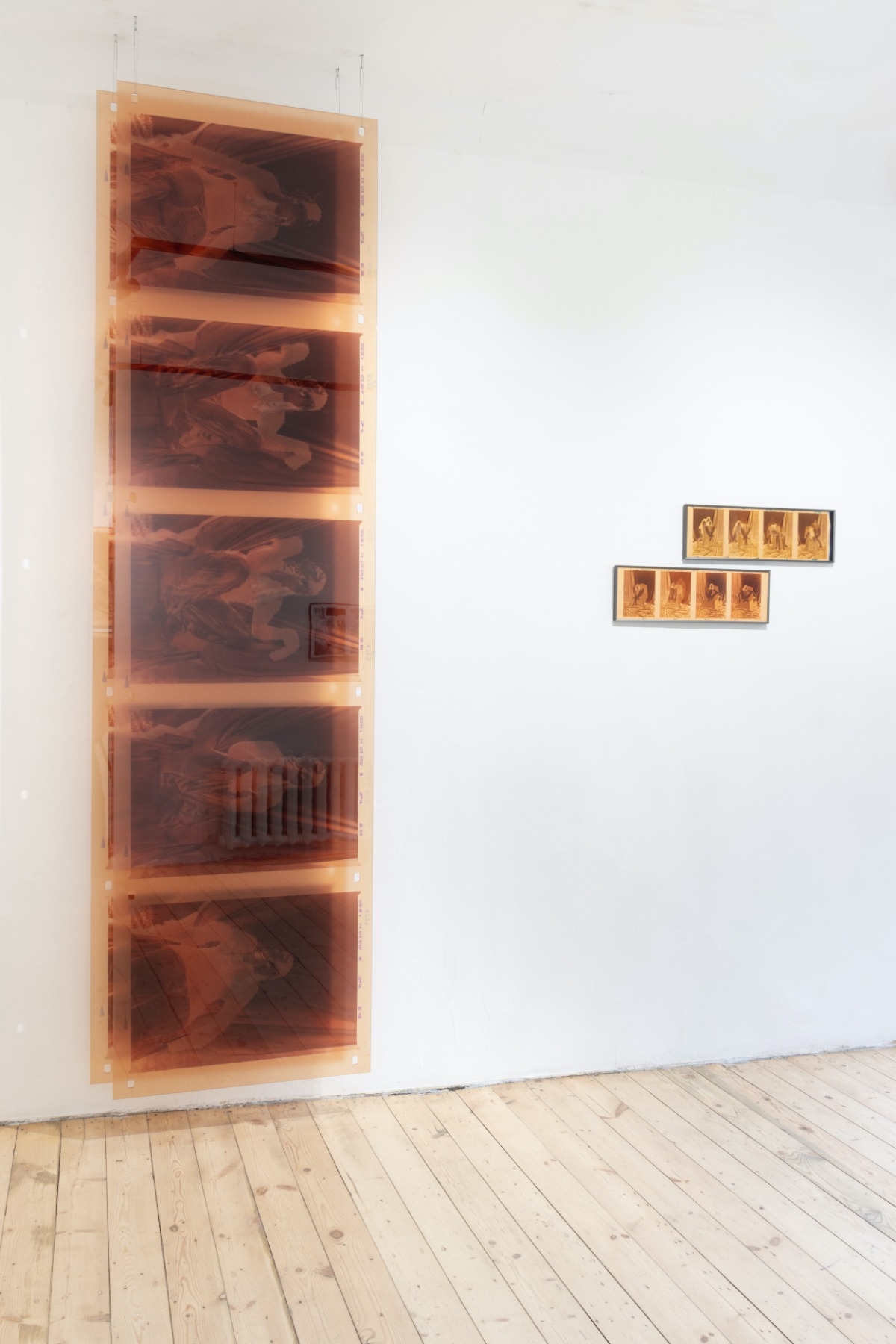
But thinking about the historical context… Radical shifts of power, such different eras… And sometimes all that remains are some photographs without narrative, like mute figures in sepia.
Yes, and then what is called the zombie archive forms: what continues to exist without context becomes living dead… We see faces and places, but they are already separated from their political, social, and emotional circumstances. In this sense the zombie archive is not only about missing context, but about recoding. Each new era rereads these images anew.
Even during the Soviet period, alongside the official ideology, religion, healing, and quiet rituals continued to live. My grandmother was deeply Catholic, and in the countryside these worlds existed simultaneously, alongside official reality – everything happened in parallel.
A mixture.
Yes, an absolute one. Religion and folklore together, and this all-controlling power as well. It is interesting how information circulated. Much was transmitted in half-words, through stories and rumors, without visual proof.
Agate Tūna. “Familiar”, 427 Gallery. 2026. Photo: Līva Priedīte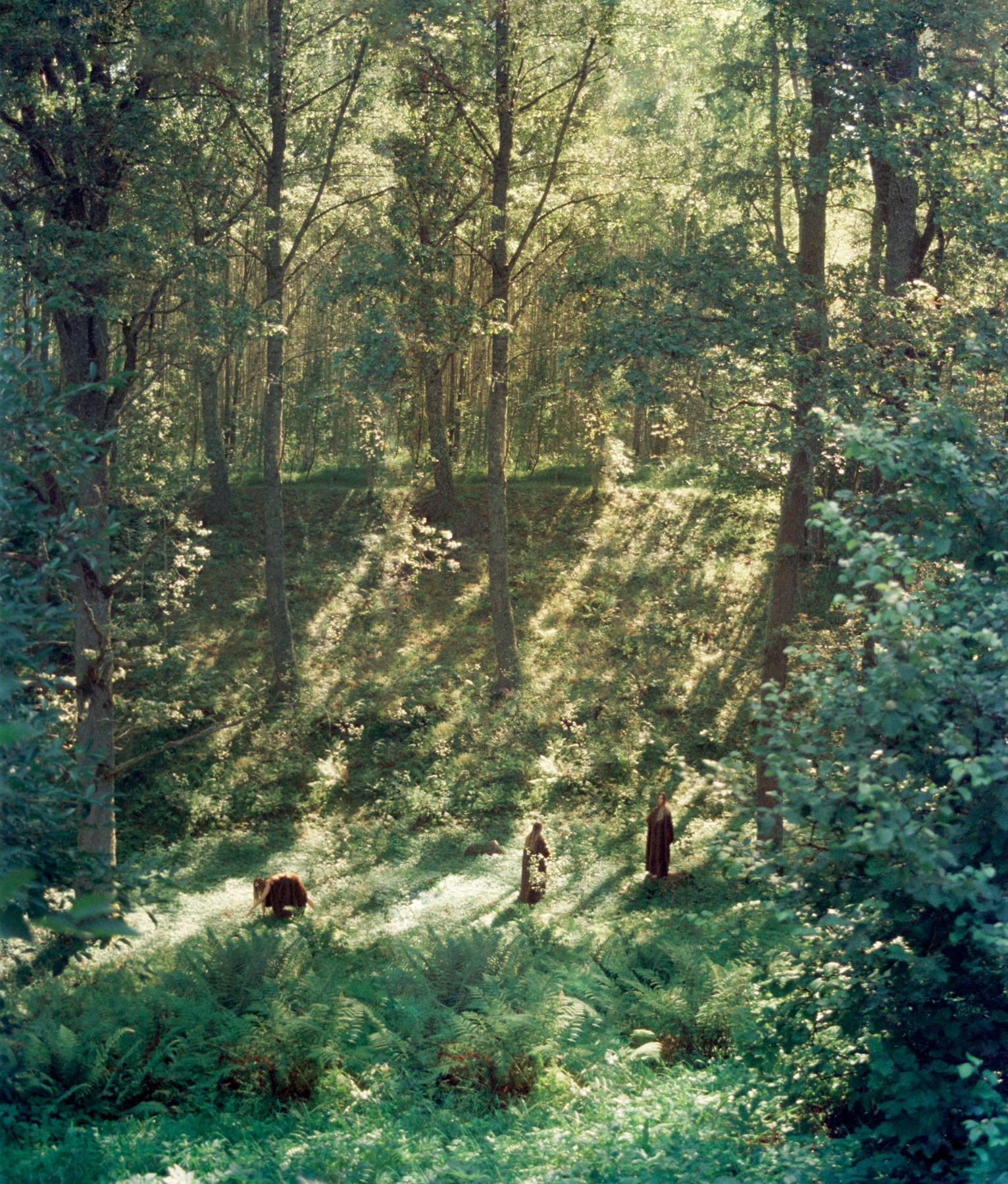
Here, in the exhibition, the forest also appears – one could say it is the largest image, placed in the large window of the space, and it can be seen both from inside and outside.
At night, when light flows from within, it can be seen from outside; whereas when there is light outside, it enters the space. That transformation happens around four or five o’clock – it disappears on one side and appears on the other. And it is the only positive image in the exhibition. All the others are negatives.
That photograph is actually film from my first solo exhibition “The Order of Invisible Things” (2022) at Dom Gallery. While preparing for it, I also reviewed my archive. And I found these three images. It is a collage. I placed the tripod on a hill, ran down the slope, and using a timer and remote photographed myself at three different points. But the landscape is the same.
Oh, I see! Because I thought those were three people.
Yes, three of me. [Laughs] There a kind of interesting conversation forms…
A ritual.
Yes.
Agate Tūna. “Familiar”, 427 Gallery. 2026. Photo: Līva Priedīte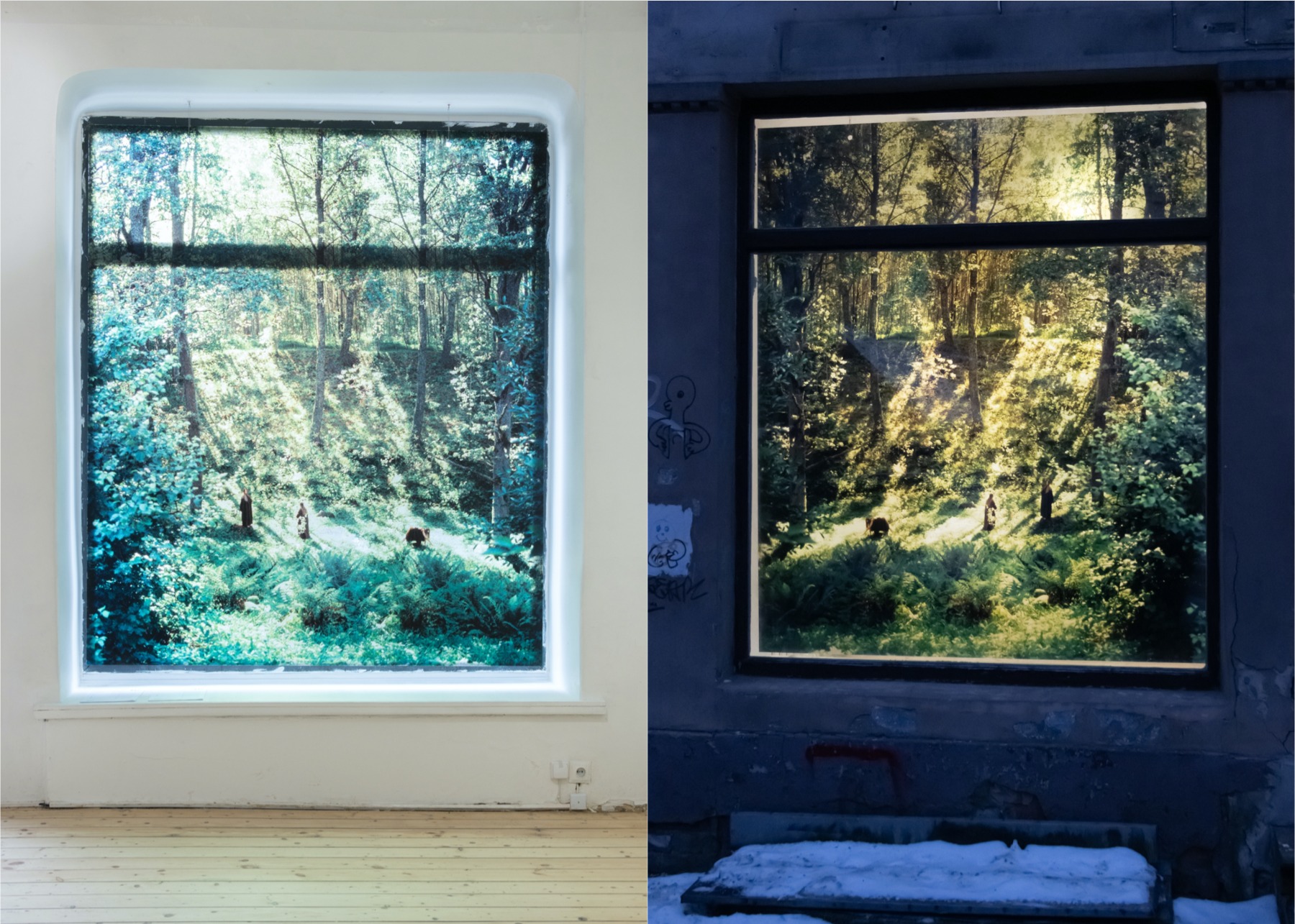
The forest looks so natural, yet with the help of technology it becomes a field for a complex game. It seems that technology plays an essential role in your work. For almost each exhibition you choose a different approach.
Usually it is a continuation of the previous one. Each approach organically grows out of the previous work and material. Sometimes they are chemigrams on aluminum as flexible objects, other times scanned chemigrams become video, or the image materializes in plexiglass objects and becomes spatial.
For example, for the exhibition “Under the Sun” at TUR space I took one 35mm negative from my previous exhibition “Volentity” at Asni Gallery and in Photoshop divided it into about two and a half thousand small fragments. Later I printed these fragments and physically cut them out with scissors and scanned them again. The image went through several transformations until from this one small negative four works were created. Two of them were 2 × 3 meters, and two were 2 × 2 meter plexiglass works that grew out of this small photo negative.
Over time a responsibility appears toward how many images you consume. I used to photograph thirty-six frames, but now I have switched to medium format, where there are about fifteen or sixteen frames. I realized that in fact I do not need ten films – just a few are enough, then the result can be endlessly varied.
Agate Tūna’s works in the exhibition “Under the Sun” at TUR art space in collaboration with 1646, The Hague. 2025. Photo: Bob Demper.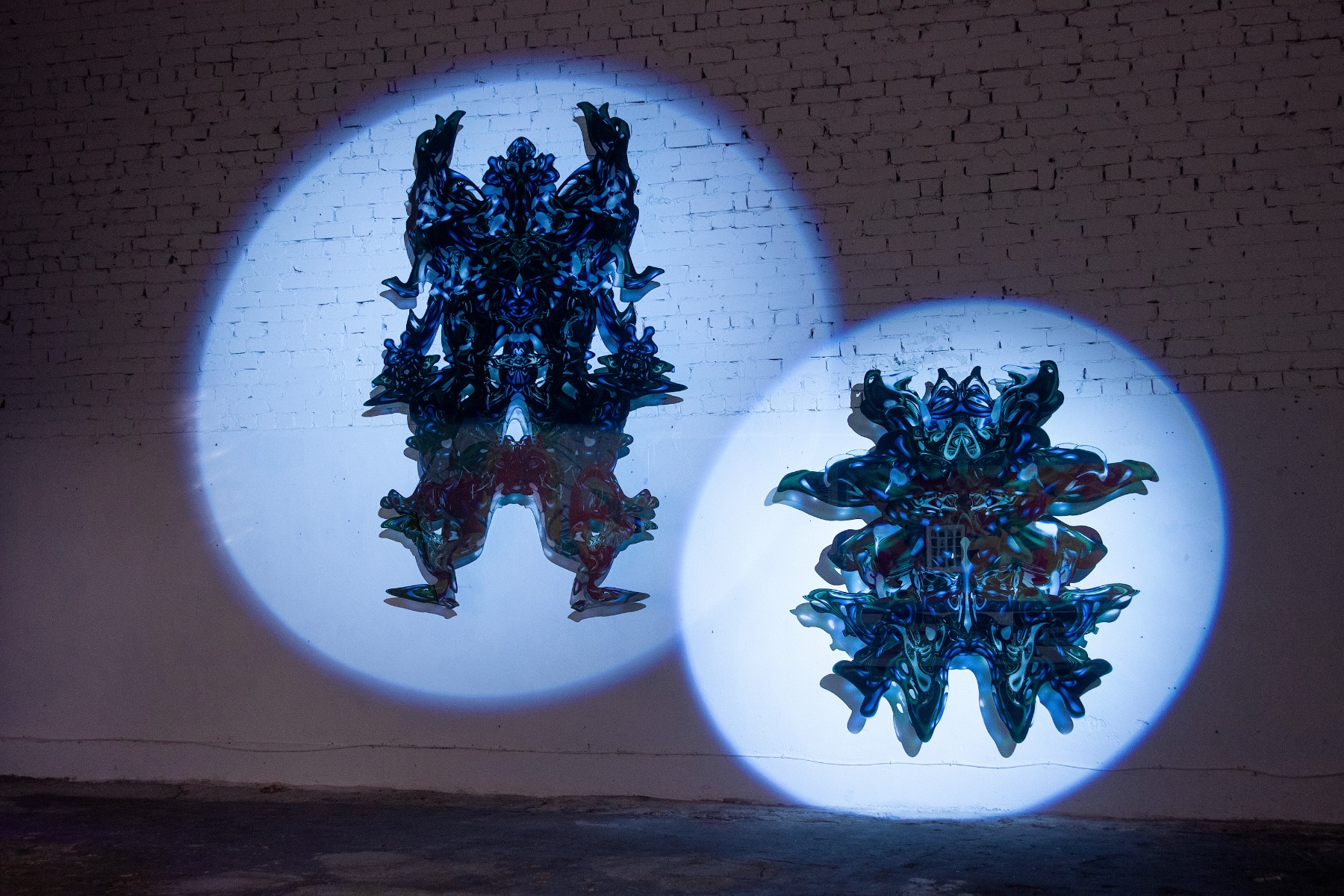
Honoré de Balzac believed that the camera is a soul thief, because in each photograph something is lost from the depicted person. This idea was also mentioned in the description of the exhibition “Volentity.”
I feel that I no longer sense that I myself am in those images. It seems that I do not disappear, but create a new personality there. Then I also feel a responsibility – if I do not continue, it will fade and disappear, it will no longer live. Somehow it feels necessary to keep it alive. It seems to me that in this way I create my alter ego.
But do you already have a sense of the next stage with this alter ego?
At the moment I am actually interested in UFO videos from Latvia. On YouTube there are various documentations from the 2000s that are incredibly interesting. Because, let’s say, there you can find filmed flying saucers, but the camera quality is so pixelated that essentially you only see little blocks that change, and only in that way can you understand that something is flying there. [Laughs] Using zoom, the image collapses into pixels and turns into an abstract structure – a kind of ornament forms.
It is interesting to hear there: “Those are not stars!” in Latvian. At the moment I am collaborating with environmental aesthetics researcher Kamilla Kūna, gradually beginning this research. But there is already a lot of material. I would also like to work more deeply with those incantations.
Usually I find a person with whom I want to collaborate, and through dialogue the process itself forms. In the case of this exhibition it was a conversation with myself. [Laughs] At the same time it was also a collaboration with photography researcher and art historian Katrīna Teivāne, who wrote a wonderful text for the exhibition and proposed the familiar/companion motif, which eventually became the exhibition title. I am also grateful to my sister for these years of being together and for our shared process – for sisterhood, trust, and time spent together. This is the first exhibition in which we both appear together in the photographs, because until now it was usually either her or me in the frame. It is also a reference to the Fox Sisters [three sisters, Leah, Maggie, and Kate, nineteenth-century American mediums who initiated the global spiritualist movement – aut.] or to the Cottingley cousins [in 1917 two cousins (Elsie Wright and Frances Griffiths) from Cottingley photographed “fairies,” whose authenticity was believed by Arthur Conan Doyle – aut.], to this motif of sisters, to sisterhood, and also to the game – only we ourselves are aware of and know how it was achieved.
Agate Tūna. “Familiar”, 427 Gallery. 2026. Photo: Līva Priedīte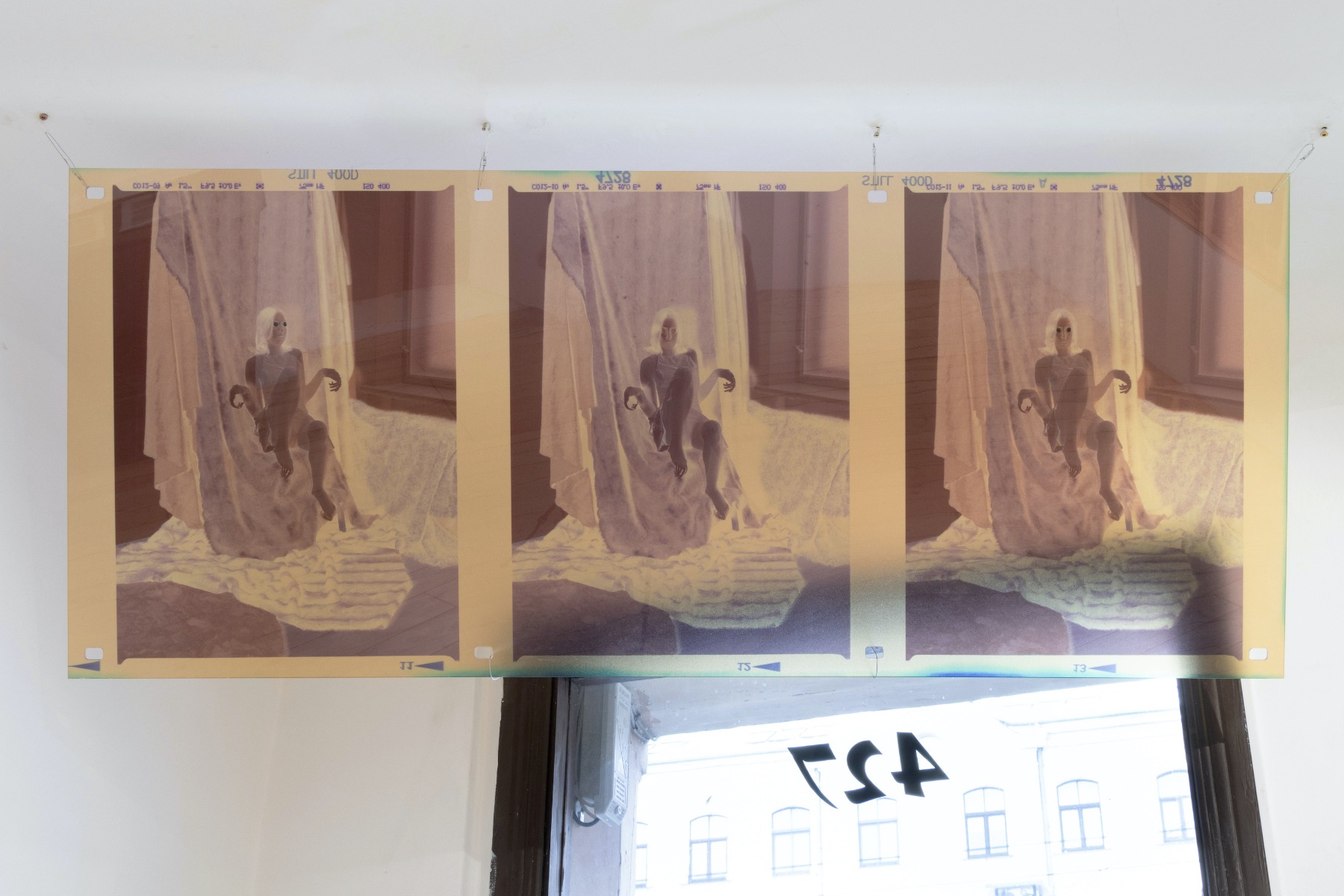
Only you and the familiar spirits.
Yes, [laughs].
