


Real painting in a real Venice
An interview with Estonian artist Merike Estna, who will represent her country at the 61st Venice Biennale
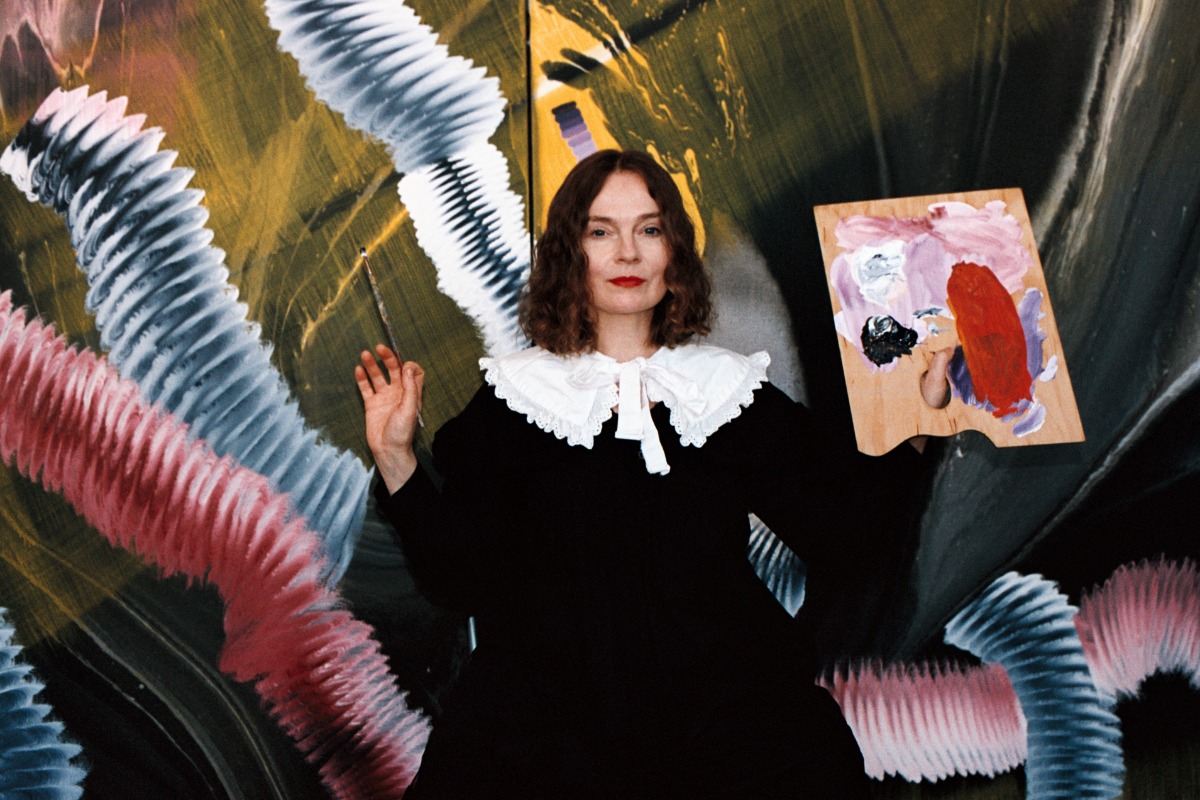
For the 61st International Art Exhibition – La Biennale di Venezia 2026, Estonia will showcase the work of artist Merike Estna (1980) through her ambitious, process-driven project called The House of Leaking Sky. Developed in collaboration with art historian and curator Natalia Sielewicz, the project transforms the conventional pavilion into a dynamic, evolving space rather than a static display. Merike’s artistic approach, grounded in the expanded possibilities of painting, blurs the lines between canvas, environment, and daily life, encouraging painting to be experienced as a communal, performative activity instead of a solitary object.
Patronato Salesiano Leone XIII in Venice where the Estonian Pavilion will be open in May, 2026. Photo: Estonian Centre for Contemporary Art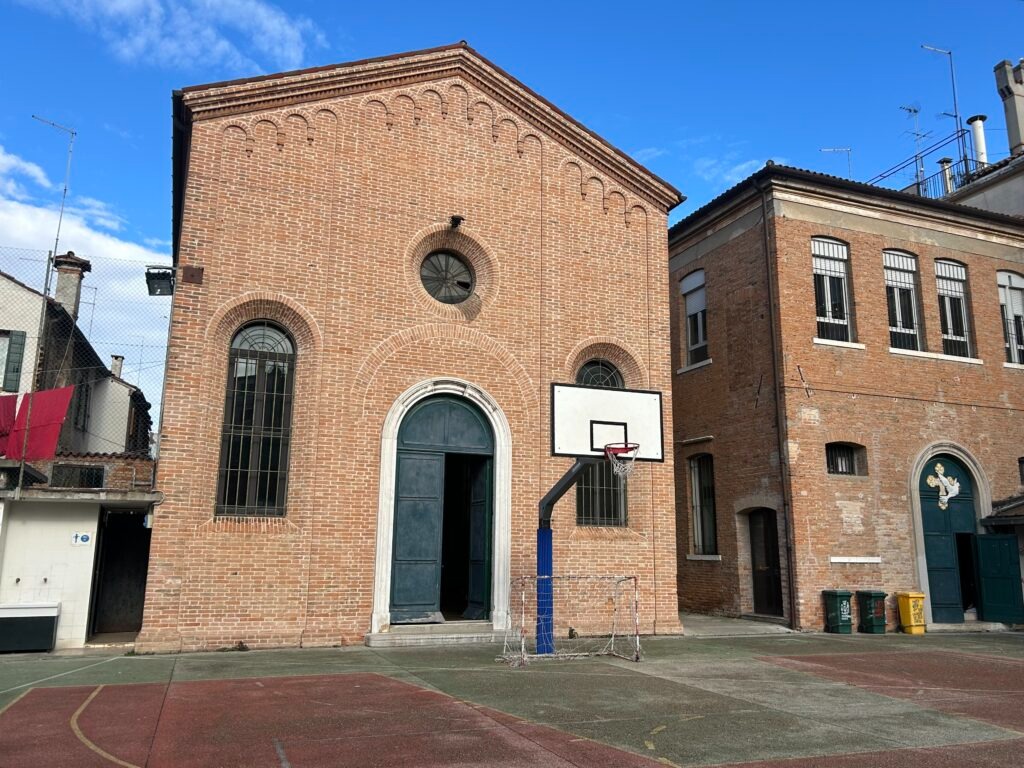
Housed in a former church converted into a community centre near the Biennale’s Giardini, the exhibition turns the space into both a working studio and a site of continuous creation. Estna will live and work in Venice throughout the Biennale, producing and adjusting her work in real time – a deliberate approach that links artistic practice with everyday life, while exploring questions of authorship, temporality, and the often unseen labour of care. In this setting, painting flows, spreads, and moves through the space, reflecting both the exhibition’s title and Estna’s focus on fluidity, circulation, and shared experience.
We spoke with Merike online while I was in Riga and she was in her studio in Tallinn – a lively place, with preparations constantly underway and people coming and going with boxes. Despite the bustle, our conversation was a wonderful opportunity to learn more about one of the Baltic Pavilion exhibitions and to get in contact with such a generous and friendly person as Merike is. If you happen to be in Venice during the Biennale and see her at work, imagine having this exact conversation with her. I believe I used my chance to ask all the questions that might come to the mind of an average visitor.
I was reading about your work, and as I understand it, there are two central questions that run through your practice: how painting can be integrated into daily life, and how elements of everyday life can be incorporated into painting. It seems to me that this Venice project is, in a way, a response to both of those questions.
To some extent, yes. One of my main intentions in trying to destabilize the way we exhibit or approach painting is to reflect the fact that everything in the contemporary world is constantly in motion – nothing is truly stable. In response to that, I’ve been interested in making painting more responsive and more open to its surroundings. In a way, I’m aiming for something like a living organism, or a living painting. So, I’ve created different works using a variety of approaches.
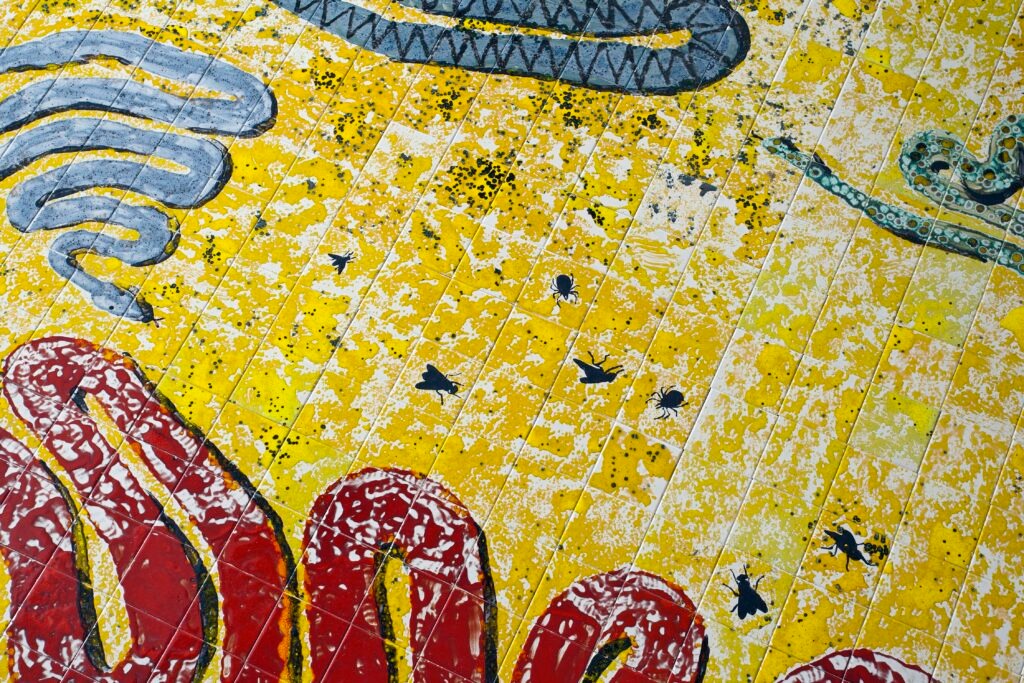
For example, one approach is painting as a floor, either as an actual floor, as a stage, or as painting on tiles. When painting becomes a floor, as we walk across it, there are infinite ways of seeing it. In that sense, it remains responsive and open, because there is no fixed point of view. Each time we enter the space, we encounter it differently. It could also take the form of a picnic on a painting, suggesting painting as a place to meet, to exchange ideas, or as a kind of social space. With this project for Venice, however, I approached it from a slightly different angle.
In recent years, I have been working more and more on canvas again, trying to solve this question through it. Then, about a year and a half ago, I realised that the canvas feels most responsive, most alive to me when it is still in the process of being born. So, I suggested showing this process rather than a finished painting.
We are also showing two monumental pieces, and we have been making another floor painting on tiles. In this way, we are covering the entire floor of the pavilion with the painting.
Merike Estna. Photo: Ana Hop/ Estonian Centre for Contemporary Art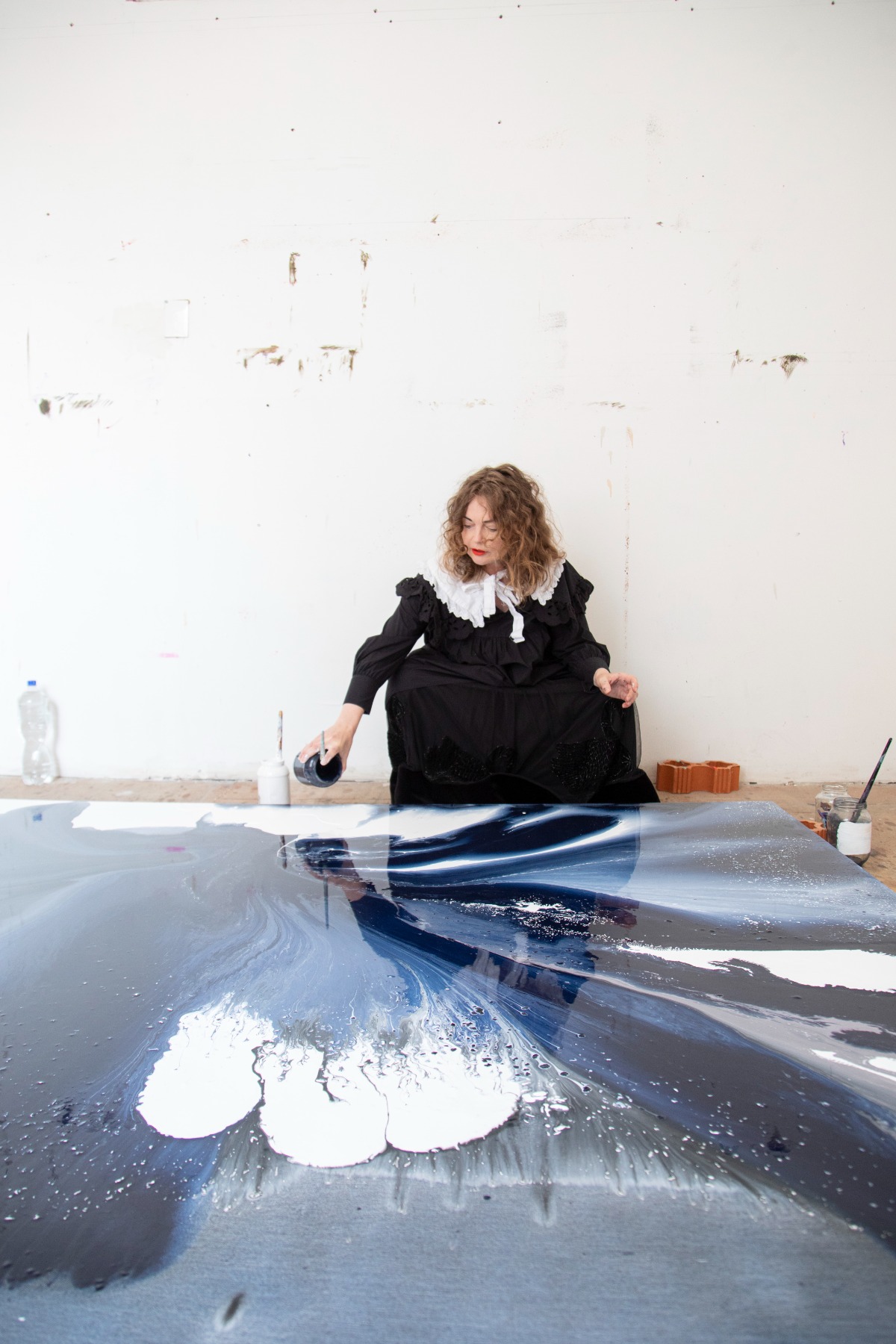
And the space itself is a former church?
Yes, it's a former church, but it has been transformed into a children's basketball court. I really loved these layers that almost don’t fit together at all. In the space, it’s very visible as a kind of collage. The basketball court has been built inside the church, and on top of that, there will be my exhibition.
I think this kind of layering is very similar to the way I approach a canvas. I always pile different patterns on top of each other and try to make them appear technically separate, almost like a collage, even though it’s all painting.
So I think the space is really ideal for me. It’s part of a community centre, which I also really like, because it’s part of the “real Venice”. When you enter the courtyard in front of the pavilion, you step into this “real Venice”, even though it’s very close to the Giardini and Via Garibaldi, areas that are crowded and full of exhibitions.
Merike Estna, an egg, a larva, a nymph. 2018. Mural, a floor of 4,260 hand-painted glazed tiles, nine vases with beeswax candles, and a performative element. View to exhibition "Give Up The Ghost", 13th Baltic Triennial, Tallinn Art Hall, curated by Vincent Honoré. Photo courtesy of CCA, Estonia and Anu Vahtra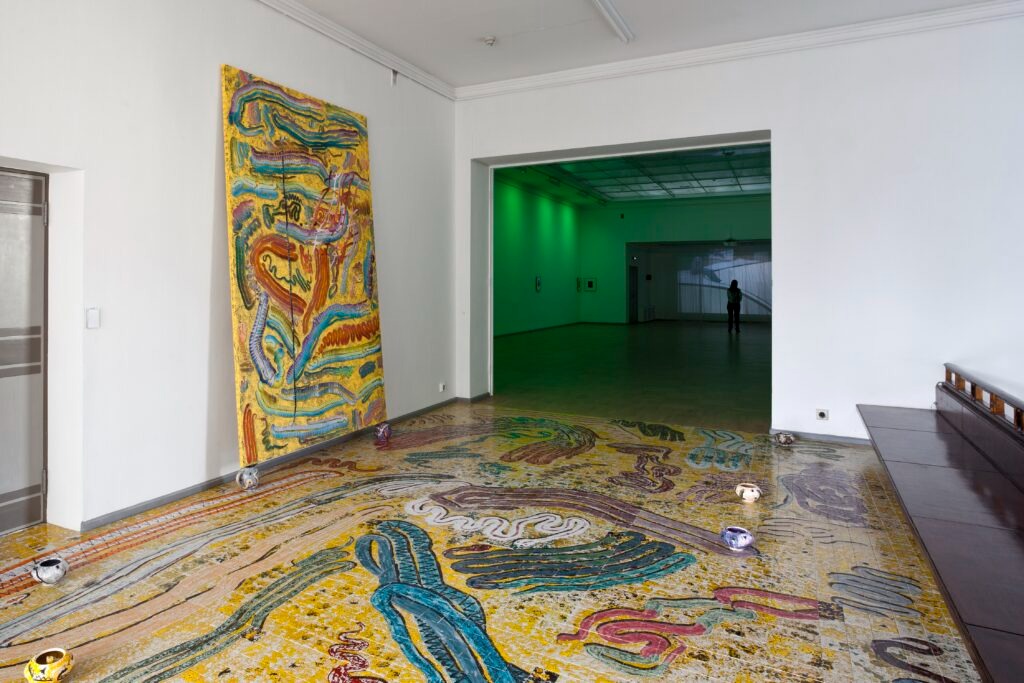
And at the opening of the Biennale, for people coming to the Estonian Pavilion, what will they see? Will the process of creating only start once the Biennale opens?
We are already installing a floor made out of tiles. We’ve been painting and firing the tiles since the beginning of January. The floor is made up of around 25,000 tiles, and the entire surface is covered with a painting.
As part of this floor piece, there is also a long bench, quite monumental in scale, roughly 26 metres long. It’s for visitors, but also for me and for the exhibition’s mediators. It’s covered with painted tiles as well. So, visitors will see the floor painting already in place, but there will also be additions during the Biennale. The way I work with canvases is that the first layer is poured onto the floor; I put the canvas on the floor, and some paint always leaks over the edges. The tile floor will receive another layer in a similar way during the Biennale.
And then there will be a monumental canvas made up of 22 modules. Altogether, it’s 22 metres long and 6 metres high. The idea is that I’ll be creating it as a single painting, one monumental piece. But afterwards, it can function like a transformer. The modules can be exhibited together or separately.
I’ve tried this approach before, when I made a painting for Malmö Moderna Museet. I had a solo show there some years ago, and I created a piece 6 metres high and 4 metres wide, made of four modules, which could be arranged in different orders or shown separately. So this new work also has the aim of keeping it open and responsive.
I’m going to start painting on the morning of 6th May at 10 o’clock, when the Biennale opens for the preview days. So I’ll begin then, and that will mark the start of the painting. I’m aiming to finish it sometime in the autumn, leaving the exact timing open, depending on how the process unfolds.
The idea is to make the painting as I would in my studio. The final stage isn’t fixed, but I’m probably aiming to complete it around the beginning of October. In this way, the finished painting will also have its own time in the pavilion.
Merike Estna, view to exhibition "Soil will not contain our love" curated by Karin Laansoo, at Kai Art Centre, 2022. Photo: Anu Vahtra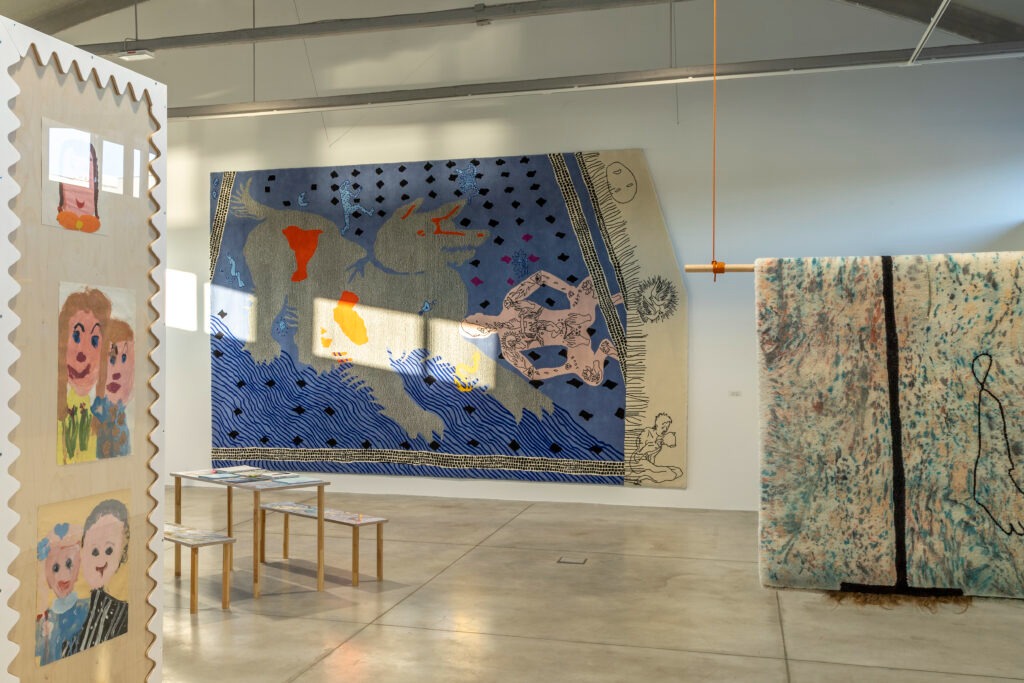
Will you move to Venice with your family for the whole period?
Yes, I’ll be going a week before, and they’ll join me a week later. So yes, we’ll all be going together. I mean, it’s a long period, and I have two small children, so it’s very much a team effort.
Will the kids also be present in the exhibition space?
I mean, in reality, we don’t know how everything will turn out. One thing is to imagine it, another is how it actually goes. Normally, my kids don’t come to the studio very often – sometimes the older one, who’s four and a half. But in Venice, as it’s a really large space and there’s also a courtyard in front with basketball, football, table tennis and other games, I think they might hang out there and I may see them more than usual.
We’ll see how it goes. I’ll also need time to focus, but it will be more of an organic process to see how things unfold.
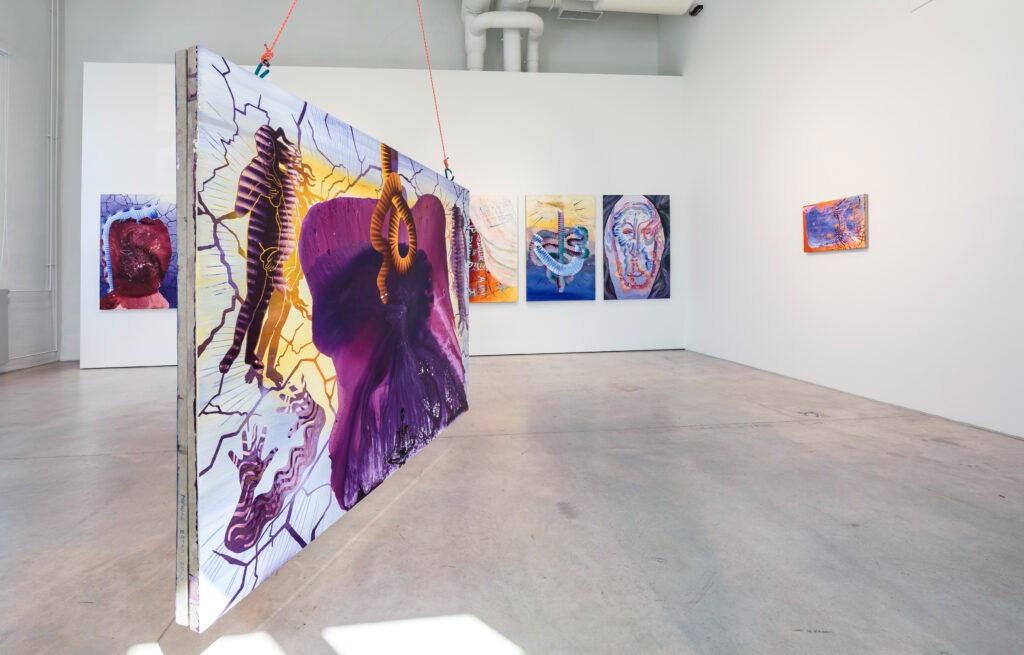
Merike Estna, view to exhibition "Peradam" at Temnikova & Kasela gallery, 2024. Photo: Stanislav Stepaško
Merike Estna. Prehistoric origin.
Acrylic, oil, canvas, 150×200 cm. 2023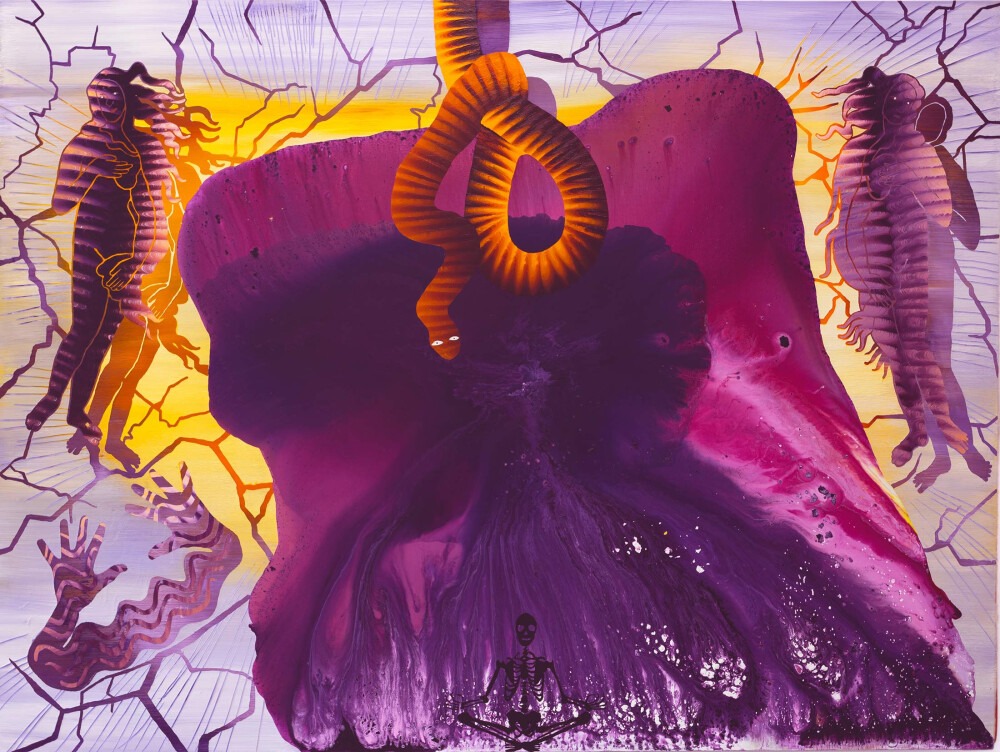
But how do you imagine communicating with the viewers? Of course, there will be quite a lot of people coming and going… Will you interact with them somehow, or just focus on your work?
The preview days are a little different, I think – especially the opening of the Estonian Pavilion. There will be a lot of people I know, and we’re aiming for something more organic, so that I can enjoy the opening while still being engaged with the work.
Normally, though, I think the idea is to ask people not to talk to me too much – or actually, not to talk to me at all – so I can really work. Venice can attract so many people, and while I think I can work with viewers around, if too many start talking to me, it becomes more difficult. Most likely, I’ll also listen to music through my headphones, as I usually do when I paint, to be able to focus on my work and switch off from the gazing eyes.
What kind of music could it be?
Well, it really depends on my mood, but I do listen to a lot of classical music and sometimes techno as well. It really helps me focus and channel my energy. Mostly, I choose pieces without words.
Merike Estna, The House of the Tragic Poet, 2021, exhibition view, Bosse & Baum, London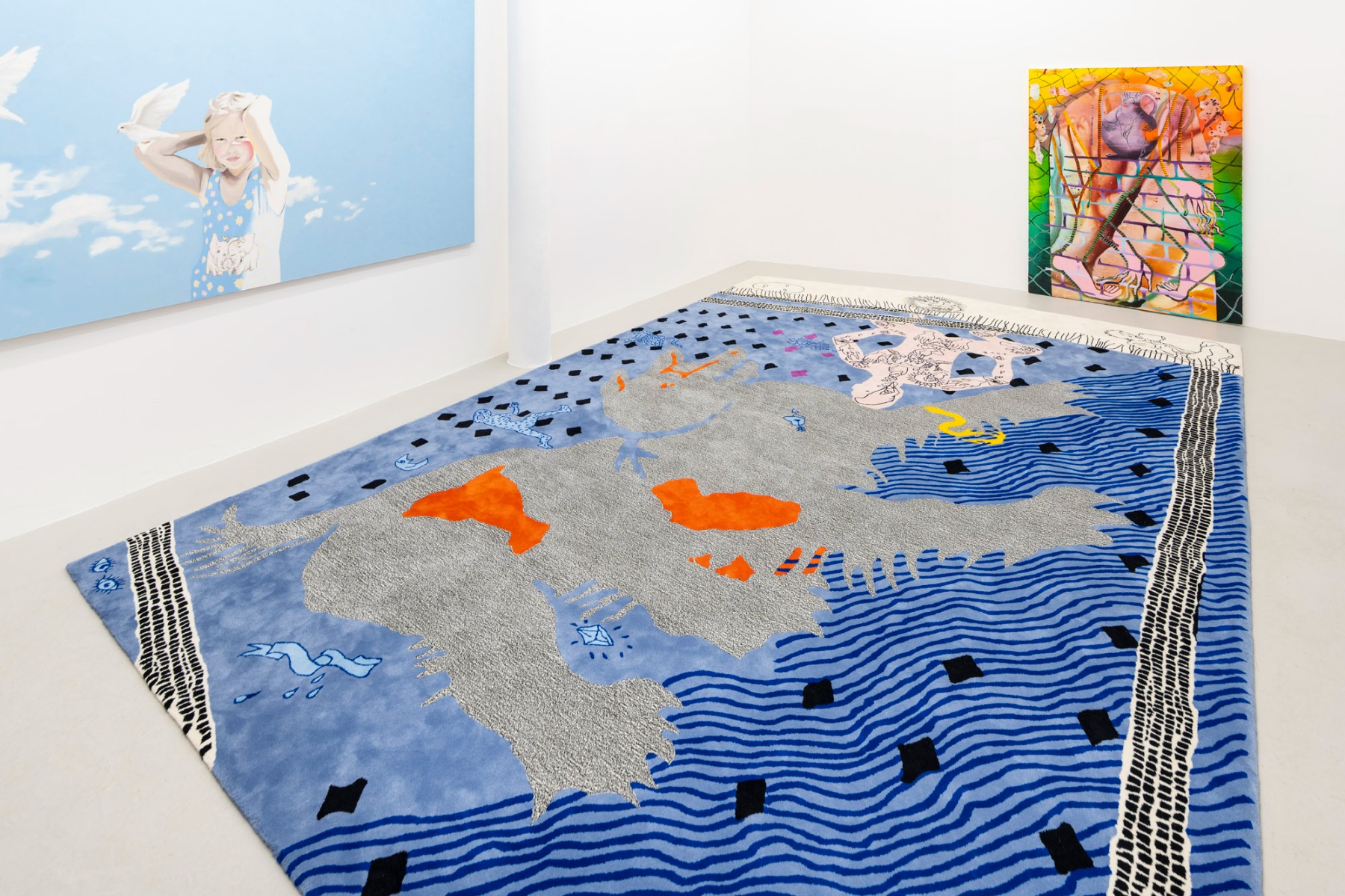
Merike Estna. Peace? Oil on canvas, 200×300cm. 2005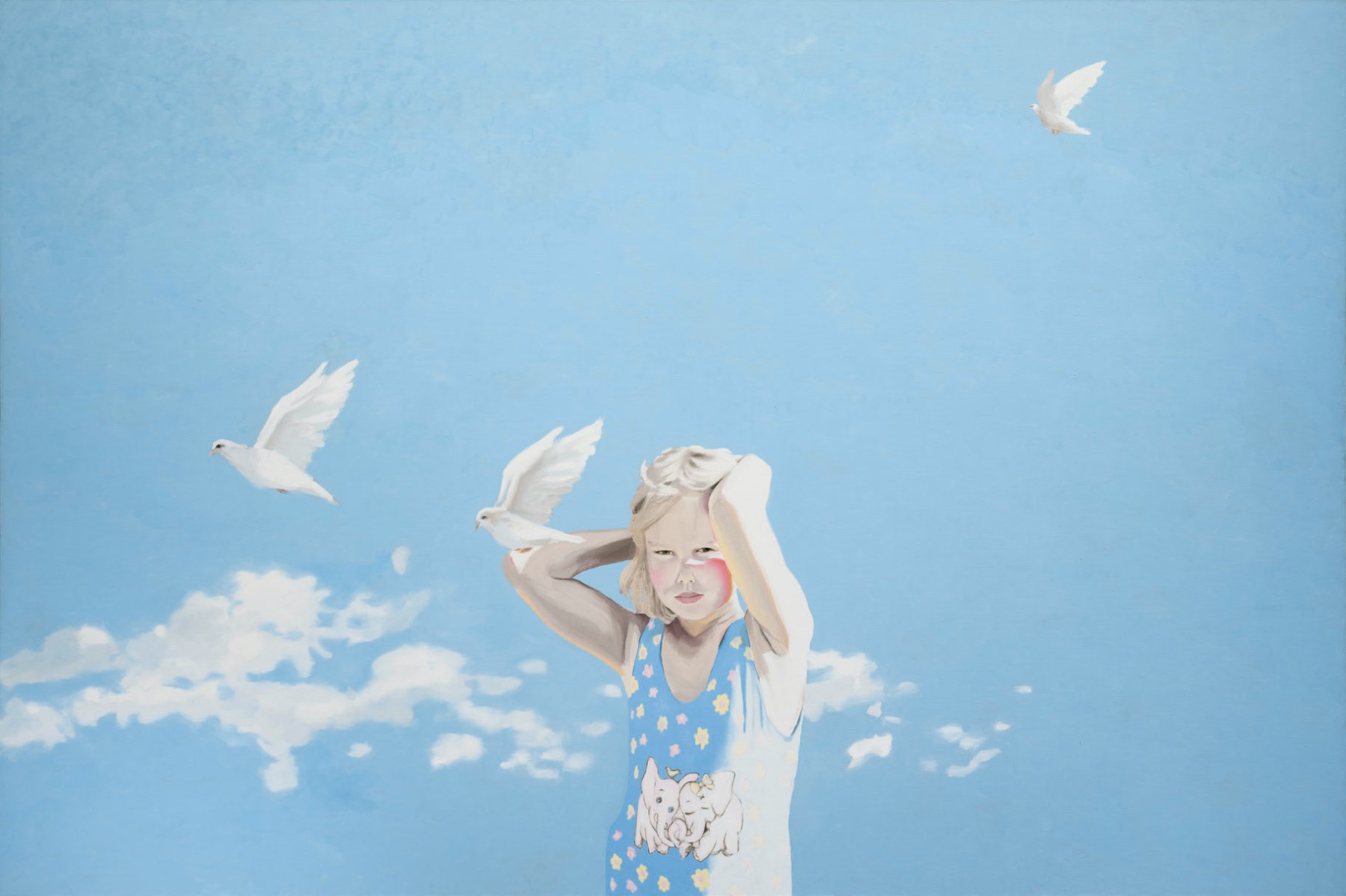
Talking about words… could you also comment on the title of the exhibition, The House of Leaking Sky?
Actually, the title was chosen by my curator, Natalia Sielewicz. Of course, we discussed it and there were several options, but the pavilion has a painting on the ceiling, which is the first time I’ve shown work in a space like that.
My original idea, for both the floor and the ceiling, was not only to keep the painting alive, but also to play with the traditional positioning of historic paintings. Often they are placed high on ceilings, in a kind of overwhelming, powerful, isolated position, as precious objects far from reach. I wanted to turn that around. So, I think the title is a mixture of several ideas coming together with The House of Leaking Sky.
We also have a side project within the main project, which will take place in August, from the 11th to the 16th – a week in the life of the pavilion. It’s called The School of Strange Weather. During that week, I won’t be painting, but I’m offering the pavilion as a platform, or a stage, for students from the contemporary art master’s course at the Estonian Academy of Arts, where I currently teach. I’ve invited them to create performative projects, so it will add another layer of experimentation and being alive, but in a different sense.
Merike Estna, Ocean. View to exhibition at Tartu Art House, curated by Maria Arusoo, 2025. Photo: Nele Tammeaid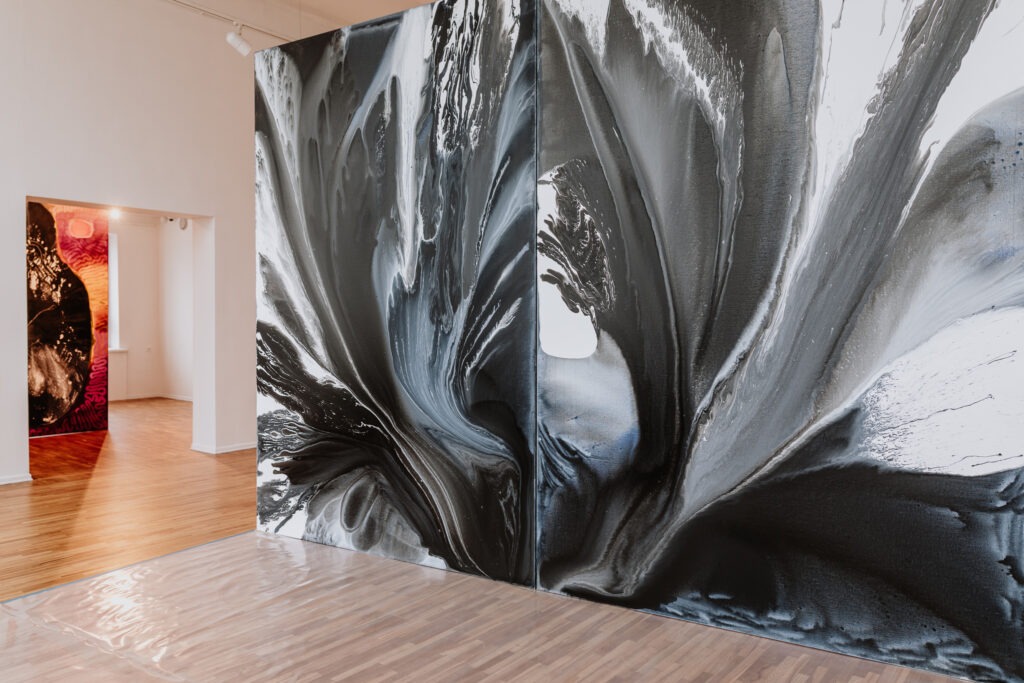
Do you feel a sense of responsibility as an artist, representing Estonia at such a major international art event? Are you thinking about integrating elements of Estonian culture into the project, or are you mainly focused on doing your best as an artist?
Mainly, it’s about doing my best as an artist. But my work does have some links to traditional crafts in general, in the way objects are made. Some aspects are very closely connected to my practice – for example, my interest in bringing patterns or methods of applying paint from craft or decorative traditions into painting.
Also, my initial interest in a more feminist perspective on painting comes from my childhood. My grandmother used to say it was a sin to sit and do nothing, so whenever she had a free moment, she would do crafts.
When I started studying painting, I began to connect the different ways of expressing oneself through traditional crafts with how these practices were often undervalued or dismissed in the world of painting – at least in Estonia. For example, textile crafts were mostly carried out by women in between doing housework.
I’ve been interested in this from the beginning. More recently, with Natalia, we visited the Literature Museum in Tartu and found some fascinating connections in the runic songs of Estonia. So there are links to this tradition, but more in a general sense, loosely connected to my work. This interest has been with me for quite a while.
There are also some quite concrete visual links in The House of Leaking Sky. On the floor, there’s a sketch of an Estonian wedding blanket. Traditionally, this blanket was embroidered, and the newlyweds would sleep under it on their first night.
Merike Estna with her children in her studio in Mexico City in 2025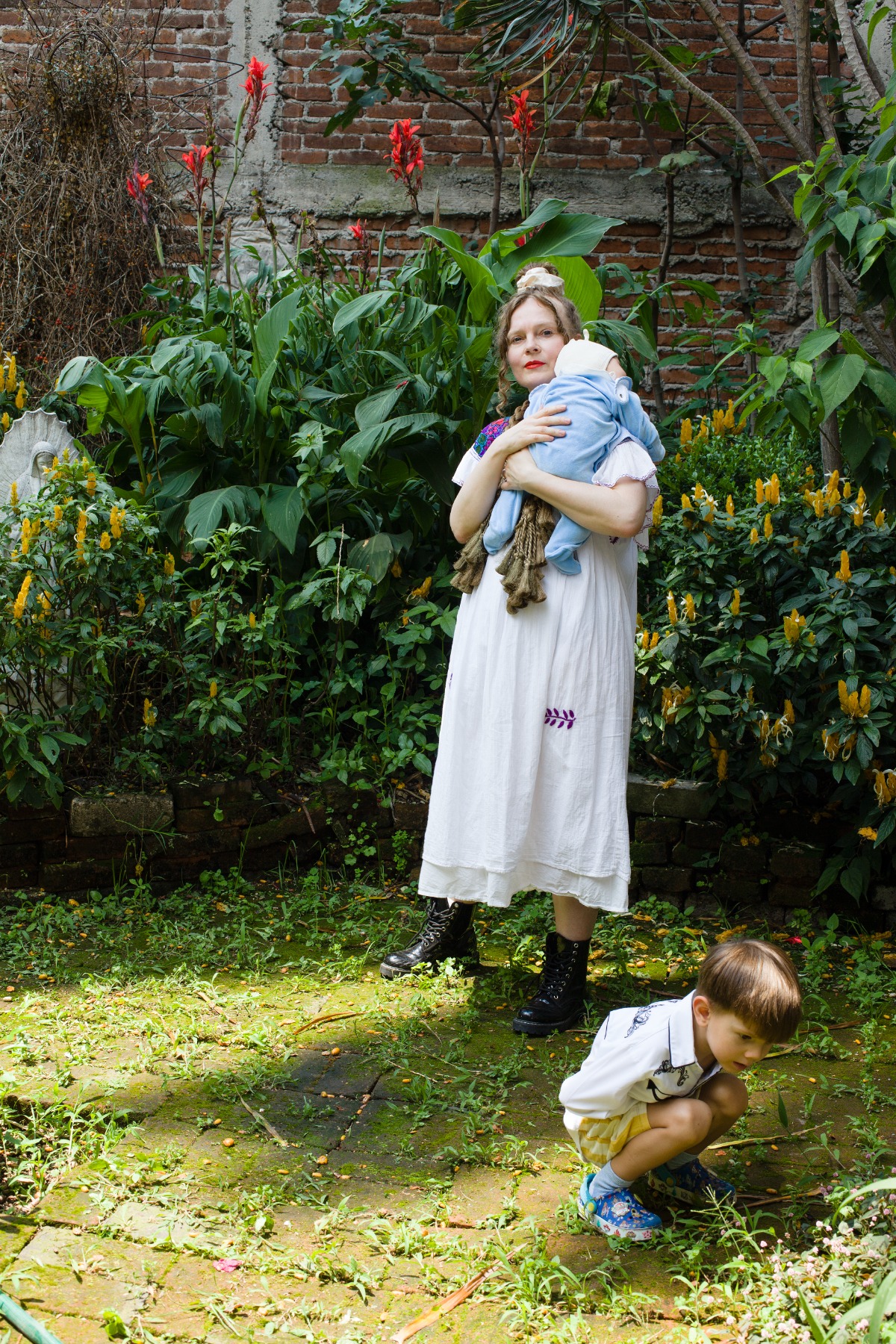
As I understand, for a long time you divided your time between Tallinn and Mexico City. These are two very different cultures – does their mix somehow influence what you are doing now? And if so, in what way?
Yes, definitely. We’ve been here in Tallinn since August, but over the past three years we also spent quite a lot of time in Mexico. I think the whole project has been influenced by that experience.
I was thinking about this just this morning while giving another interview. Perhaps my focus on process rather than result comes from two things in my life: becoming a mother, and my time in Mexico. At least for me, as an outsider, it felt like people there really live in the moment and appreciate it. Quite the opposite, I think, from Estonia, where we often live in the future – always aiming for something to happen and sometimes forgetting to enjoy the simple things every day.
Motherhood has naturally influenced me as well, because it’s not something that can ever be finished or ever complete. It is a constant process. This has changed how I want to show my work, what I want to show, and what I consider important.
Merike Estna and Natalia Sielewicz. Photo: Silver Mikiver/ Estonian Centre for Contemporary Art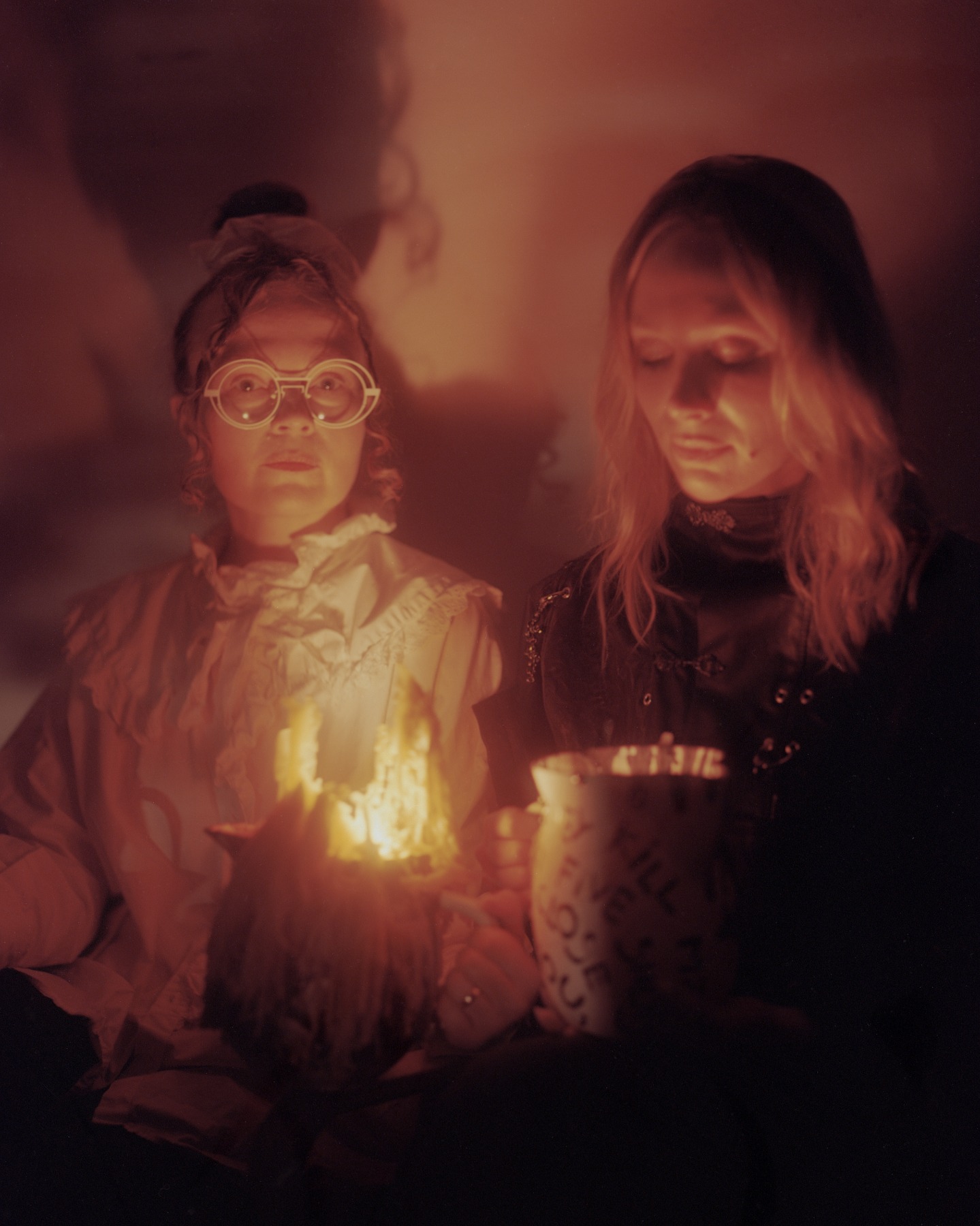
Maybe a few words about your curator – why did you choose Natalia to work with, and what does she bring to the project?
It’s been an amazing collaboration. I came with the idea of showing the process of painting, and also highlighting some links to historic female artists who are important references for me in this project. Over the last couple of years, I’ve become increasingly interested in a female history of art, and in recognising the people who historically changed things – those who were first in some way.
For example, Lavinia Fontana, who is probably considered the first European female painter to have a professional career. She ran her own studio and signed her own works. Or Paula Modersohn-Becker, from a later period, who is considered the first European female painter to create a nude self-portrait. She was also one of the first to paint very domestic scenes – nursing women and themes tied to motherhood and home.
And our conversations with Natalia have been very fluid and organic. The final result really emerged from these discussions. In fact, the final setup – the size of the canvas and the way the pavilion is presented – was shaped through our collaboration.
We discussed everything together with Natalia and Diogo Passarihno, the architect of the pavilion. In the autumn, we had a meeting in the pavilion where we went deeply into the conceptual aims and chose this massive format. It emphasises me as a female painter creating a monumental canvas, a field traditionally dominated by male painters.
Thematically, I’m aiming for something quite different from the typical monumental subjects, which historically would have been political, religious, or war scenes. I think the final phase of the pavilion is very much the result of this collaboration.
But what will be the subject of your canvases?
Well, we have these references to motherhood and everyday labour. I don’t have a sketch for the painting, because the aim is really to make it on site. Normally, when I paint, I also sketch while I’m working – layer by layer. The first layer, I pour the paint, and then I start sketching as I go in between the layers. I’m aiming for a similar process this time.
