


The bear and a song
Thomas Houseago, the British-American sculptor, speaks in Madrid, at the Banca March gardens, about vulnerability and energy, trauma and recovery, sculptures and flowers
In southern cities, the idea of the garden carries a particular resonance. It is always a distinct kind of space – with its own atmosphere, symbolism, and emotional charge. One such place in Madrid is the Banca March gardens, located on Calle Castelló: a verdant oasis set in the shadow of an iconic early twentieth-century building in the Salamanca district of Madrid. Spanning more than 1,600 square metres, the garden’s landscape design is shaped by the close integration of art and nature.
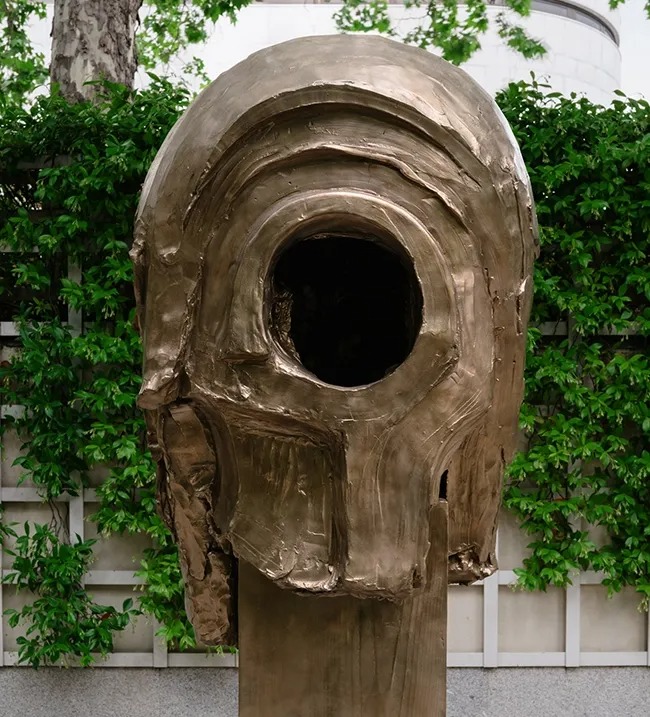
Classical Head I. Courtesy of the Artist and Xavier Hufkens, Brussels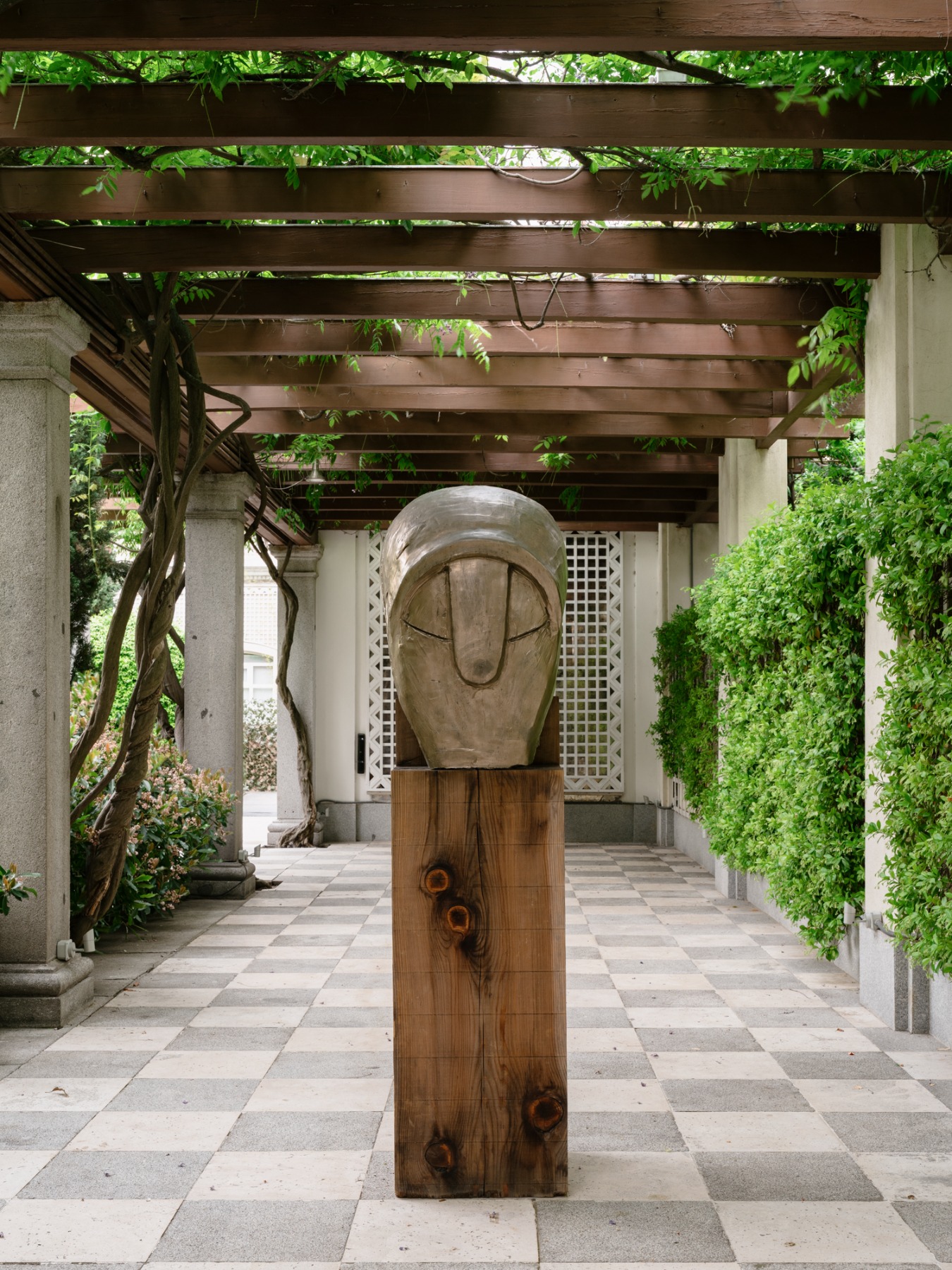
Usually closed to the general public, the garden opened its doors on selected days from the start of May to October to mark Banca March’s centenary. To celebrate the occasion, this family-owned financial institution – now run by the fourth generation of the founding family – invited one of the most prominent contemporary sculptors, Thomas Houseago, to stage his first exhibition in Spain. The exhibition features seven monumental sculptures combining traditional materials – plaster, bronze and aluminium – with industrial and organic elements such as iron rods and hemp. Among the works on view are the monumental Large Walking Figure I (Leeds) (2013), nearly five metres tall, and the recent Janus (Mirror Figure) (2025).
Thomas Houseago was born in Leeds, UK, in 1972. He studied at Central Saint Martins in London in the early 1990s, and later at De Ateliers in Amsterdam. After spending several years in Brussels, he moved to Los Angeles, where he has lived and worked since 2004. His work has been exhibited internationally at major institutions, including TANK Shanghai, China (2023); the Centre Pompidou-Metz, France (2022); the Musée d'Art Moderne de la Ville de Paris (2019); and the Royal Academy of Arts, London (2019).
Janus (Mirror figure). Courtesy of the Artist and Xavier Hufkens, Brussels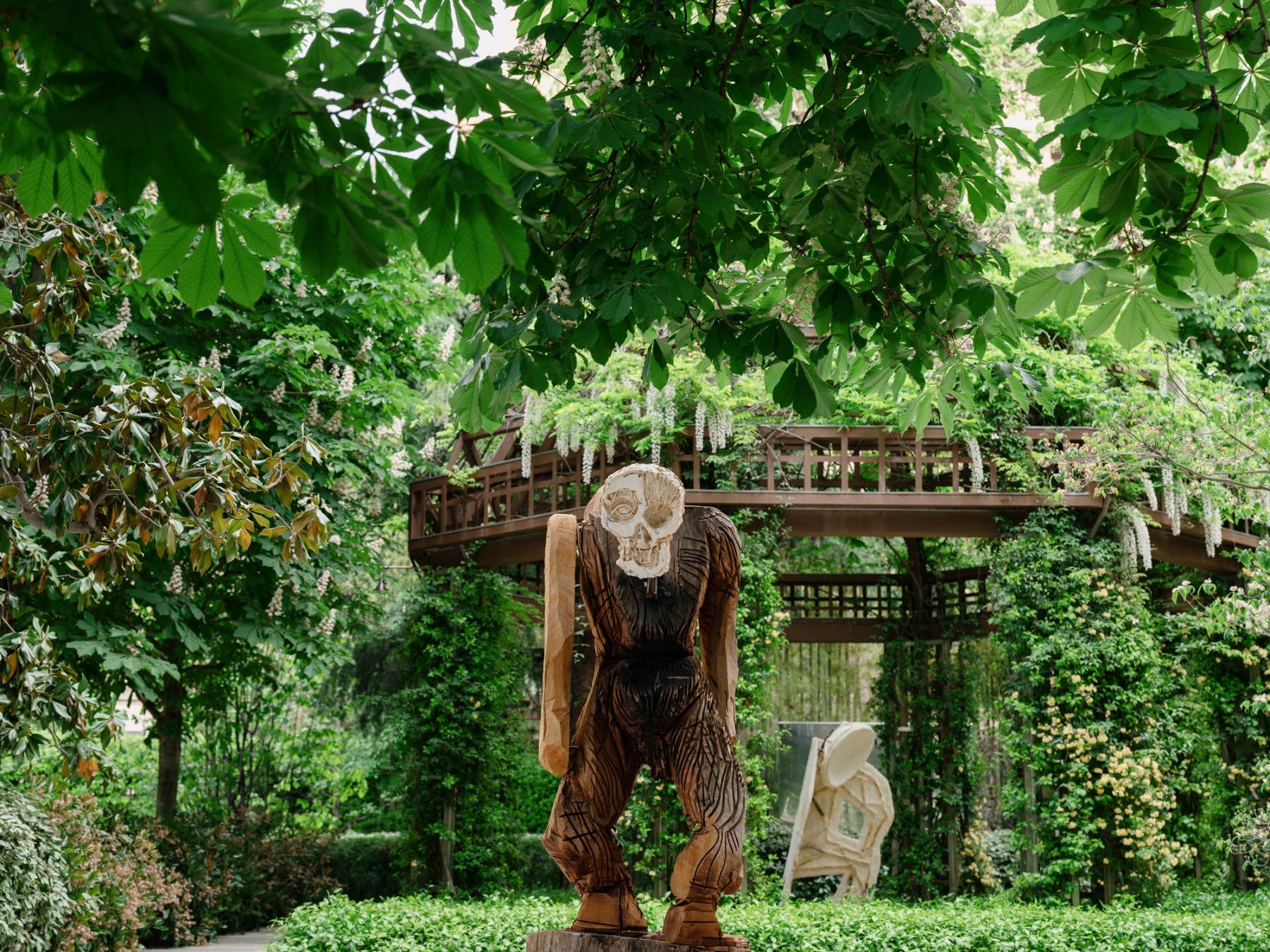
He is an extraordinarily charismatic person who has undergone profound experiences throughout his life, and that experience allows him to speak about many things openly and with genuine understanding. Dressed in jeans, a T-shirt and a denim jacket, he appeared at the press conference in the Banca March gardens and immediately won over both the local and international press. I also had the opportunity to ask him several questions – both during the press conference and later while walking through the exhibition and the garden itself. For ease of reading, I have arranged his answers to my questions and those of others thematically.
What Thomas says struck me as deeply important – not only for understanding his sculptures, which are at once monumental and astonishingly fragile, porous, and open to the gaze and to the world, but also for understanding the way he thinks about perception itself, and the human condition that underlies his work. As he put it: “Seeing requires presence, and seeing requires being receptive and porous. And porosity is, you know, your ears, your eyes, your mouth...” This comes from an artist who even imagined a wall as something porous – open to passage and inhabitation. But let’s not get ahead of ourselves and give the floor to Thomas Houseago himself.
We’re all in a body
We all inhabit bodies, right? We’re all in a body. You can come from any culture, any gender, any race – we inhabit a body. And we’re taught to ignore our bodies, or to treat them as vehicles for some projection of perfection or style… and that’s fine. But at the end of the day, our bodies are complicated. Being in a body is a very complicated experience, and sometimes it betrays us, right? We can think our way through things, but we still have to deal with the reality of being in a body, and everything that comes with that.
We’re born and we die. We all go through that journey. I think I’m very interested in the parts of it we often don’t talk about… or represent – the vulnerabilities, the animal qualities in us, our darker sides, our lighter sides, the elemental energy that runs through the body.
Aluminium Construction No. 1 (Giant). Courtesy of the Artist and Xavier Hufkens, Brussels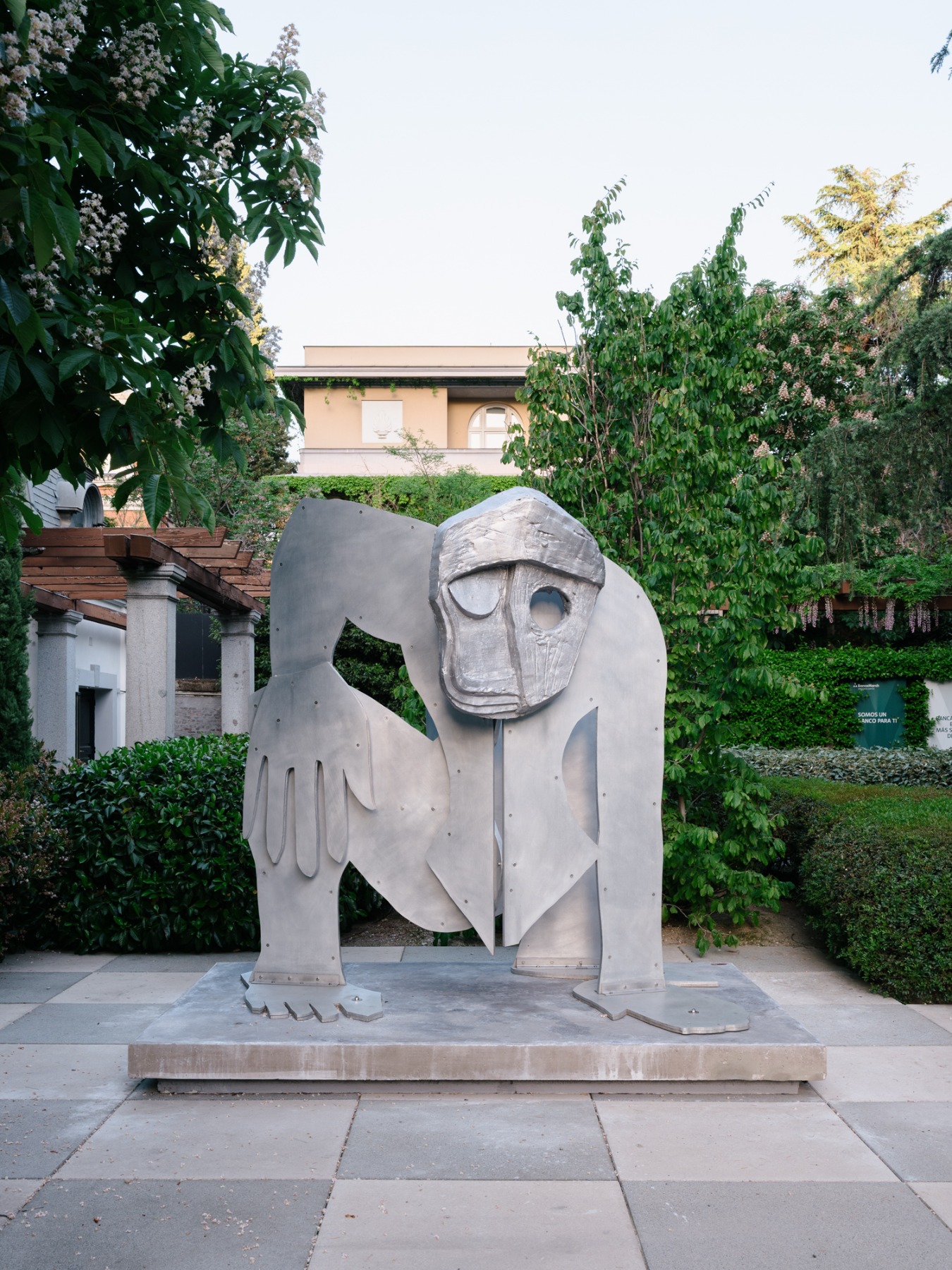
Art is a place for exploring humanity
The world is shifting again. The world is going through tremendous shifts, and there’s a lot of danger in that. And I think art – culture – is a very unique space. You don’t find that in entertainment. You don’t find it in shopping. But we also have to make room for this discussion about who we really are. How do we really feel? Not some image of how we should feel, but really, how do we feel?
And I feel like the more vulnerable I get, and the more open I am about my own struggles, the more connection becomes possible.
My sculptures don’t show off, you know? [laughs] They’re not images where you think, “Oh wow!” There’s something else going on. I think our humanity will save us from the technological danger we’re creating for ourselves. It’ll be our humanity that saves us, every time. It won’t be going to Mars, or our iPhones being this big, or implanted in my eye. That won’t save us. It’ll be our humanity that saves us over and over again.
And art is a place for exploring humanity. Sculpture is a particularly extreme version of that because of what it demands of you. It’s an object. It takes up space. In a way, it’s stupid. I mean, I say that with all the love in the world – I’m a sculptor. But sometimes I can feel people thinking, “Can’t you just make a photo of this?” or “Can’t you put it on your phone or something?” You know? It’s so silly. So against the norm. And yet I think that’s important.
But the art world can also become its own island and start assuming that art is only for this small group of people who go to biennials and art fairs, and that that’s what art is. Well, actually, no. Art should be as accessible to people as music, as movies…
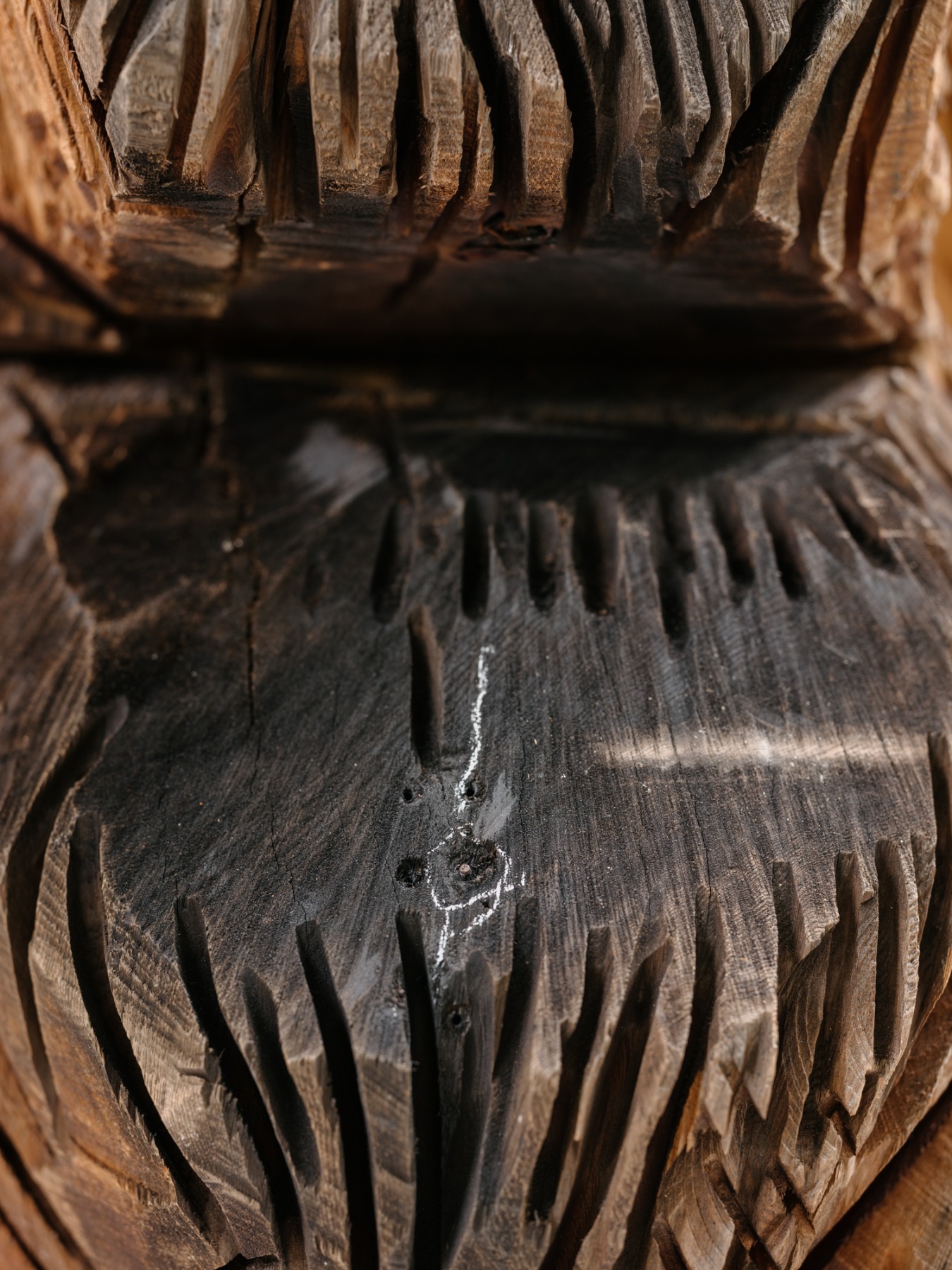
Trauma and recovery
I was a victim of abuse as an infant, as a young child. It’s very common – more common than we realize. There was a very big scandal around this in the north of England. And I ran away from it. I just kept running until I sort of reached the west coast of America.
Recently I was obliged to go through recovery. I had my breakdown at the end of 2019. The art world was kind of curious, like, “Oh well, he’s gone crazy.” But my friends who were writers and performers were like, “We can see you disappearing. Come back.” And they found an interventionist for me. That’s what they’re called – interventionists. There was a guy named Danny Smith who was very well known in that world, though I didn’t know anything about it at the time. He took me on and basically put me in a house in Malibu, brought in nurses, and started this very radical form of treatment. Part of it was about opening up the senses. Smell, for example. I love sage, but I’d never really thought about that before. Again, I come from this macho culture where you’re not supposed to say, “I love the smell of that.” But he was very much like: “Let’s talk about what you like. Did you like the smell?” “Yeah, I really loved the sage.” “Okay, then let’s plant sage.” It sounds silly, right? But when you’re freaking out, smell goes straight in. So, I started learning about touch, about safe touch, and about things like water – oceans, rivers. Those things are very important for traumatised people.
And then there’s the spiritual component. Whether you believe in God or not, there’s this understanding that we are spiritual beings. We have souls, if you like. Underneath all the thoughts and ego and noise, deep down, you can access a kind of soul experience. And obviously there are practices – yoga, mantra practices – that can take you there.
I was very blessed in California that so many great resources are now available that didn’t even exist ten years ago. There would have been a time when someone like me would have died tragically, and that would have been the story: “Oh, artists, you know… they’re doomed.” But I didn’t. I came back. I went through six years of quite intensive recovery. I was going through it with scientists who also had trauma. There were social workers. There were business people. I mean, we were all there, all these people going, "What happened to us? Why have we repeated this or not?" Or "Why have we blown up our lives?"
In my own private recovery work, there’s a phrase they use a lot: when you’ve been traumatized, you’ll never simply not be traumatized. It’s not like there’s an end to it. It’s not like, “Oh, if I take this pill, then I’ll…” You want it to end. You want it to be gone. And so it’s a complicated thing. But one of the things I learned in recovery, from some amazing people, is this: you learn to live with it, not in it.
Cave/Rock Head III. Courtesy of the Artist and Xavier Hufkens, Brussels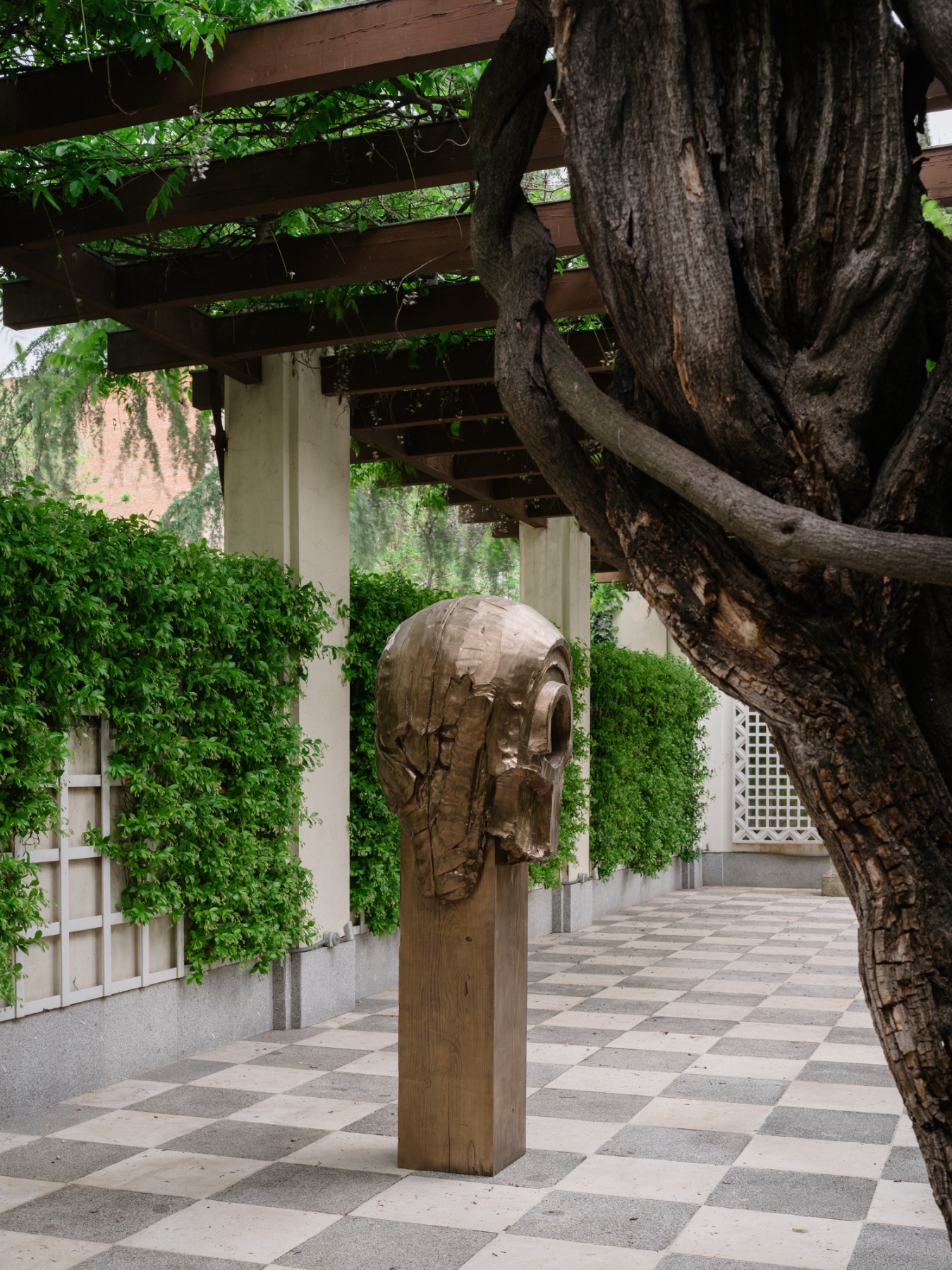
Sculptures and the garden
Number one, I mean, I think the fact that this garden exists – and it’s existed a long time: I heard it was planted by the founders. So, there’s this kind of cosmic quality here. It’s like an oasis, right? There’s a tree over there, a pine tree. I can’t stop looking at it. I just look at it every day and I marvel as I watch the sun catch it.
My curator and friend Anne Pontégnie has always done this with my work. She’s always felt like, “Hey, your work can go outdoors. It should be outdoors. It should be in relationship to architecture and nature – this dialogue.” It’ll end up in a museum sometimes, or an institution, or a gallery. But my dream is that it would end up in a garden, in a way like this.
So, you know, Anne installed a sculpture that has quite a scary history for me, and a strange personal history. It’s kind of a monument to… I made it for Leeds, the city I’m from, and at the time it was pretty catastrophic, in 2013. And Anne has placed it in water, surrounded by these trees. And you see the city, you see some of the buildings. And yes, it’s a troubling sculpture, and yes, in a way, when you look at it you might think, “Whoa,” you know. But there’s also this magnificence to it, for me.
The first thing I thought, once I got used to it, was: man, I would love to make a sculpture park myself. And I would love to place that in a lake.
Large Walking Figure I (Leeds). Courtesy of the Artist and Xavier Hufkens, Brussels. Residents and visitors of Riga can see a version of this sculpture in the courtyard of the contemporary art museum Zuzeum, where it has been on display for several years.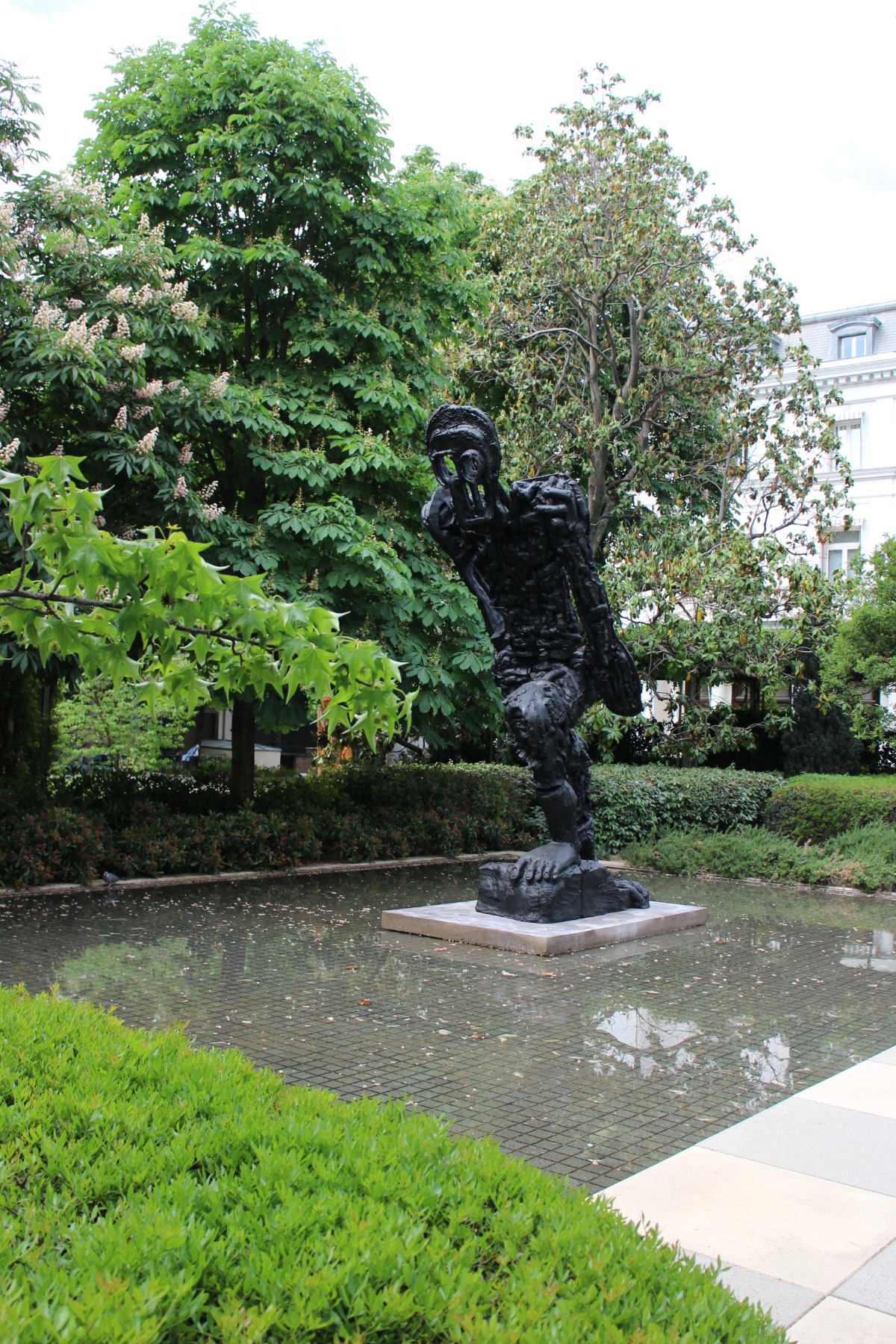
Europe and USA
Because I came from this very catastrophic personal and familial situation in Leeds, I became stateless in a way. You know, you become itinerant as an artist, like me. You’re actually moving through the world. I’ve lived all over the place, and when I went to LA it felt like I was welcomed by LA and the energy of LA. It was very receptive at that time, very open. There was a fantastic energy.
And it’s been extremely sad over the last 10 years. You know, you stay hopeful and you think, “Okay, maybe in two years, maybe in three years.” Now I have two teenage children, and they’re like, “We’re done with this. We don’t want to be part of this. We don’t want to pay taxes to this…” And at first I was like, “No, no, no – I brought you here, and I escaped England…” And it’s taken a while. So, quite literally, tomorrow I’m going to go look at properties, I want to come back to Europe. And you’d be surprised how many of my friends – actors, musicians, et cetera – are saying the same thing now. I mean, I’m not against America. I love America. I have an American passport. My children are American. But I think there’s only so much fighting you can do, and at a certain point you have to take care of yourself.
And I do think one of the strange byproducts of what’s happening in the States is that Europe is being reminded of what it is. I think there’s a kind of moral, ethical, and cultural power in Europe that you see more clearly now. In any case, it feels like a real alternative.
And now I’m really looking at Spain. When you’re an artist, you’re like a truffle dog, right? You can smell it – this has got energy, this place. So yes, I’m going to go and look.
Janus (Mirror figure). Courtesy of the Artist and Xavier Hufkens, Brussels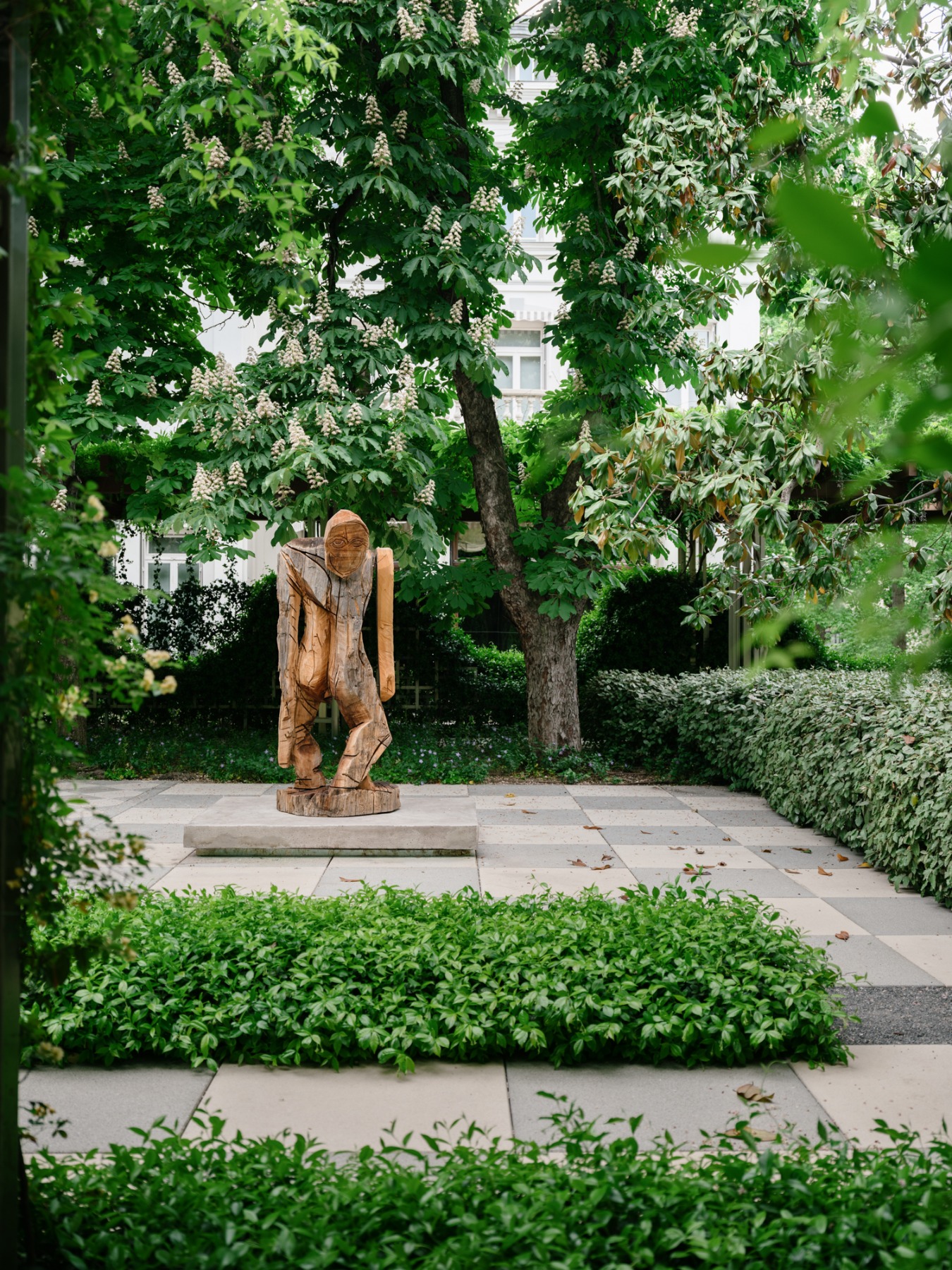
Censorship and the beautiful wall
I just don’t think artists do a very good job of saying, “I am this,” you know, “I know this, and here’s…” What I will always do is be on the side of love, compassion, creativity, and I will always talk about that. When Donald Trump came into power the first time, or was on his way – I was working on a sculpture I wasn’t quite sure what it could be. It should be an abstract work, architectural work. And he talked about building a “beautiful wall” between the US and Mexico. He used that phrase – “beautiful wall.” He wasn’t president yet. This was a long time ago. And it struck me as such a perverse concept, and such a deep… and also clever. That’s what was so twisted about it – it was kind of smart. He always says it: “the beautiful wall.”
And I thought, well, I’m a sculptor. I’m going to make a beautiful wall! So that became the mission. My wall would be porous. People would play in it. Kids would play in it. People would meet in it. You could sit in it, write in it – it was this huge thing.
And then Trump came into power. Trump won. Everyone told me, “Don’t worry, he’ll be gone soon.” And, you know, whatever your politics, the idea was that this division would stop, because that’s really the illness in America right now – this sense that no one is listening, everyone is so polarized, so angry.
So anyway, I thought this sculpture would become this kind of topic of conversation. And as Trump came in, and as LACMA (Los Angeles County Museum of Art – ed.) is now opening, I’ve noticed a lot of emphasis on Jeff Koons’ sculpture – a flower dog, right? [laughs] (Thomas is mentioning Jeff Koons’s ”Split-Rocker”, installed on LACMA’s campus – auth.) And everyone said to me, “Yeah, we’ll install yours in a couple of years, because we’ve had all these problems.” And I began to wonder: “Are you guys scared?” And then someone did say, “Yeah, maybe don’t mention the title.” And I thought, “Wow.”
And I think I will never be censored in any shape or form when it comes to the things I truly believe. I don’t believe in being provocative for the sake of it – because that just cuts people off. I’ve seen that. I’ve lived that. But the most radical thing I’ve ever seen is when you really talk about your experience, and you keep arguing for art, for culture, for thinking, for elegance, for love, for holding things – you know? But yes, I think there is censorship out there. I just don’t live in it.
Because who controls me? No one controls me. That’s the upside of being an artist. The downside is you’re on your own, and you’re a bit of a weirdo and you’re always trying to survive. The upside is: who’s my boss? No one’s my boss. My galleries aren’t my boss. My curators aren’t my boss. My work is the boss. Work is the boss.
Moon Figure I. Courtesy of the Artist and Xavier Hufkens, Brussels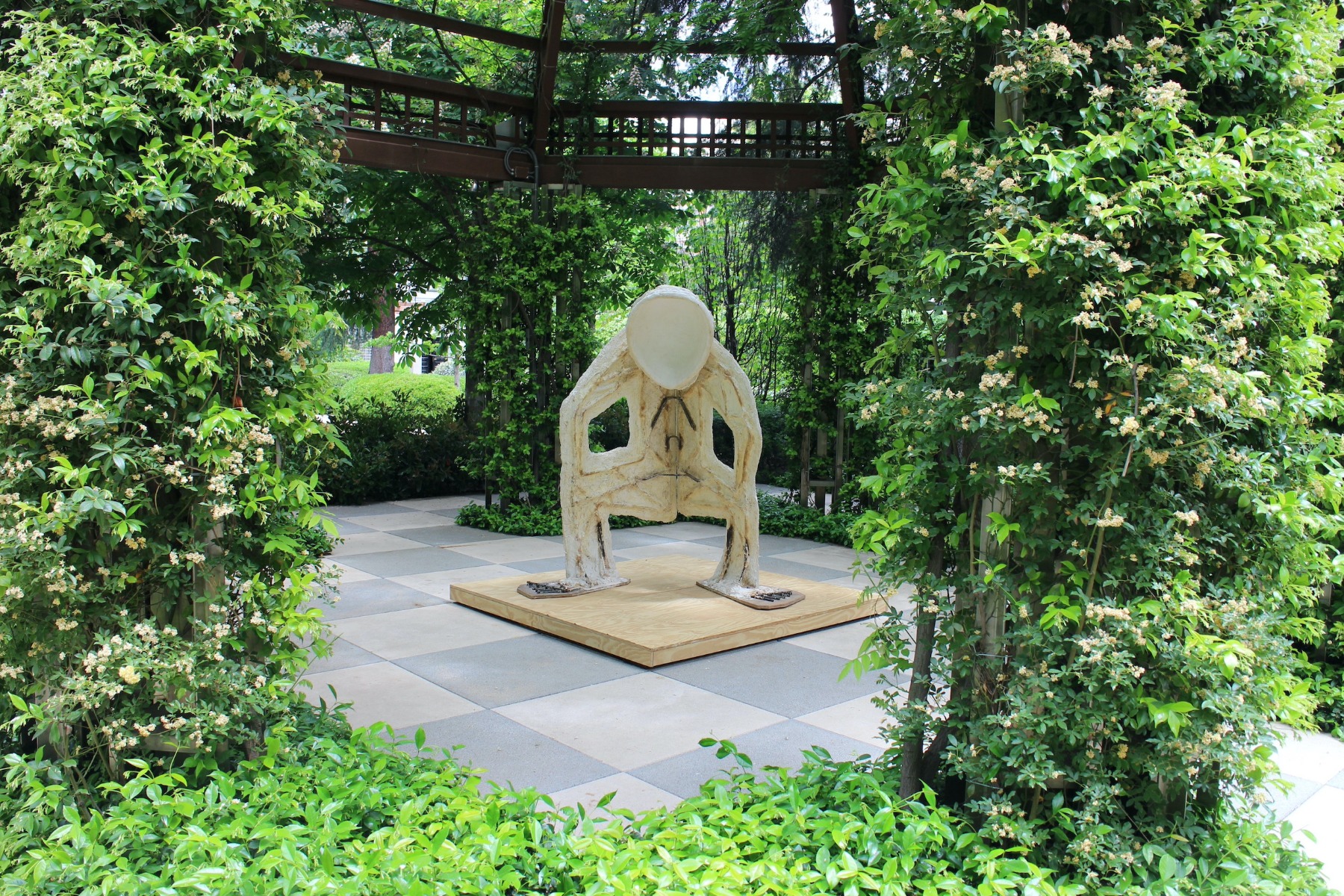
War and Goya
If I look at war right now... It's all Goya. And again, Goya never says, “I’m right, you’re wrong,” or “the French were right and the Spanish were wrong,” or any of that. In The Procession of Folly, he deliberately takes the uniforms off so you don’t know who is French, who is Spanish, who is who. It’s bodies, right? He wants you to feel: I’m not on one side or the other. It's all the same stuff. Trauma loops.
Trauma loops and getting caught in that – and I think art is saying: be careful about these trauma loops. There is no one enemy. You know, as soon as you’ve enemised someone, as soon as you’ve said they’re the bad one, you’re in it. Anything becomes possible then. You have to stop and say: “We’re all humans here.” We can all relate. We all love… Someone loves someone. Someone has a relationship with their parents – maybe difficult, maybe beautiful, maybe complicated. But that’s the stuff I want to get into. And that has enormous radical consequences.
Believe me, I’ve felt this in Spain this week – in conversations I’ve had with journalists, with professionals, but also just with people. That’s what I’m really excited by now. It’s that real human connection that I think is the most radical thing, and it blows away censorship. You can’t stop it. It’s like once the genie is out of the bottle. And I say: you’re human, I’m human, and this is where we can actually discuss and talk things through – and then the genie’s out. No one can control that anymore.
Cave/Rock Head III. Courtesy of the Artist and Xavier Hufkens, Brussels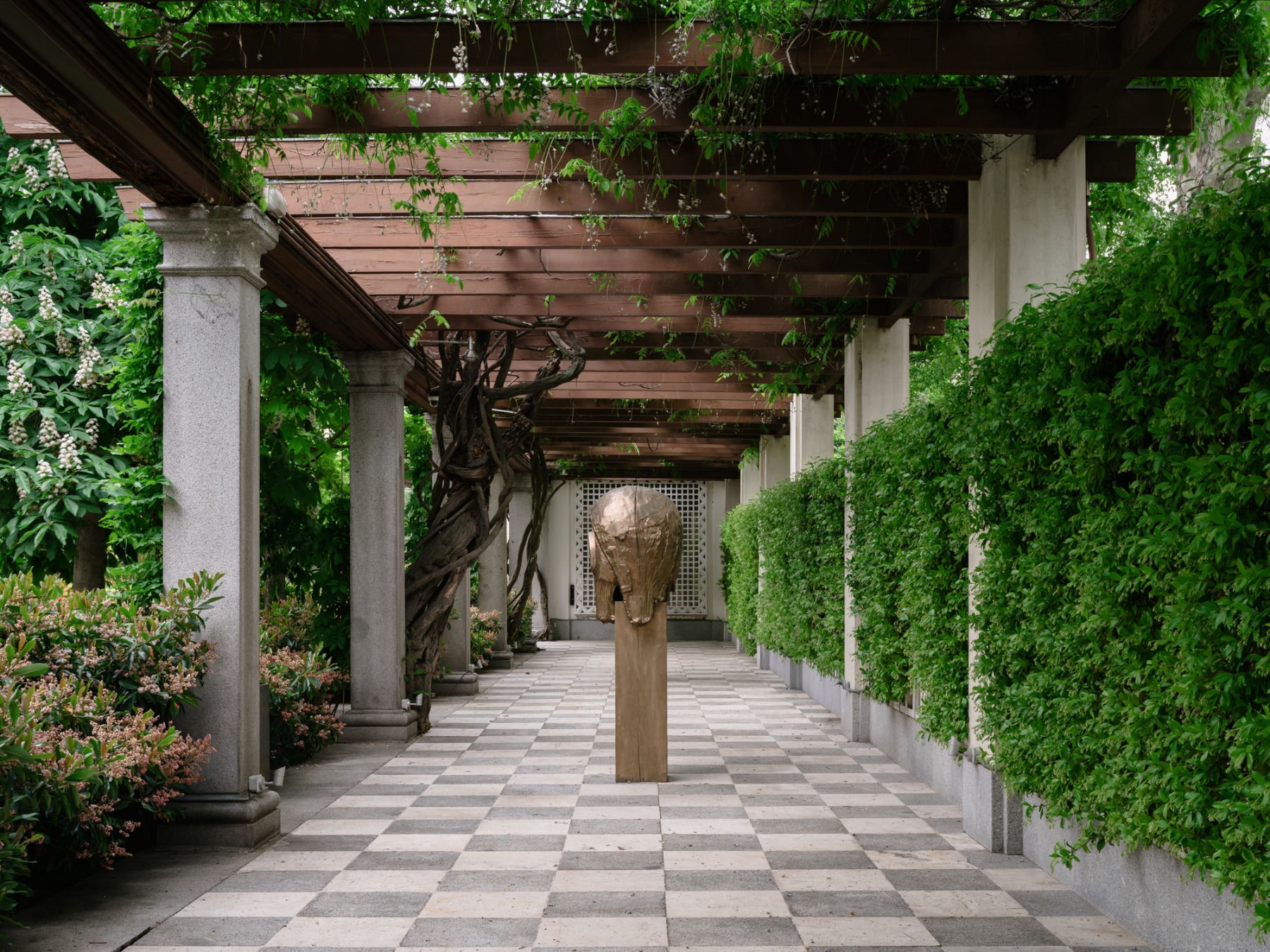
Our duty as humans
Whenever I go back to Leeds and I do a talk, there’s always a militant Leeds person in the audience. I don’t do it often, but when I do it, you know: “You’ve sold out, blah, blah, blah, and we’re here, blah, blah, blah.” And I always say that’s nonsense. Such nonsense! Our duty as humans is to live as fully as we humanly can, and to use whatever resources we can to create connection.
That’s it. That’s our job as humans, I think. And the reason I like to talk about that is it has political implications. If you want to talk about someone who’s trying to find an external solution to an internal problem, that’s Donald Trump. Somewhere he feels lesser than, or like a vulnerable guy, or whatever it is, and he needs to go out there to prove something. That’s one of our worst patterns… and we all do it. I do it all the time. I’m uncomfortable, so I think, “You know what? I’m really angry about this,” or “I’m going to go buy this because I’ll feel…” Right? We all do it. They call it an external solution to an internal problem.
And I was just with a group of tech leaders – billionaires, basically – and they were all talking about Mars, and about offshoring this and that. And I told them: the only journey I’m interested in talking about is the internal journey.
Your internal journey. Because you’re going to wake up on Mars and you’re going to ask yourself: “Am I a good person?” [laughs] “Was I a good dad? Was I a good sister or brother? Have I been good to my friends? Did I add to the beauty of the world, or not? Did I make the world an uglier place, or a more beautiful place?” That’s really the question. Whether you’re on Mars, or you’ve become a robot, or whatever – I don’t really care. Are you in the business of making the world more beautiful, even in a tiny way?
This is a discussion that doesn’t really happen in our society. We think kids need to learn science, technical skills, ba-ba-ba, da-da-da. But actually, I think we need to start somewhere else: how do you become a good human being? How do you become a good custodian of your feelings? How do you stay regulated?
Janus (Mirror figure). Courtesy of the Artist and Xavier Hufkens, Brussels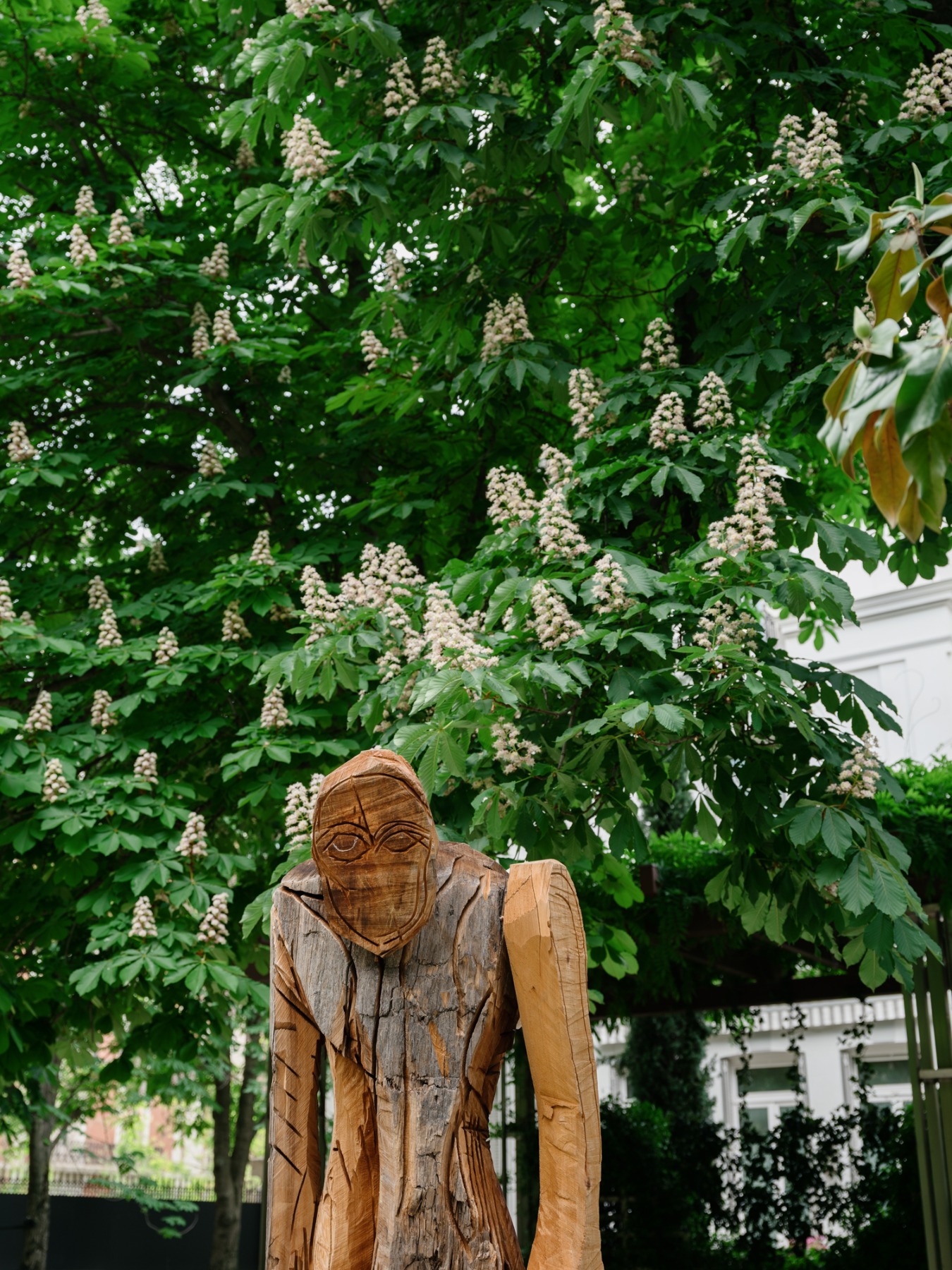
Art and violence
I’ve done very direct works about war and violence. I might be wrong, but I think war and violence come from an inability to connect to our humanity. I think that’s all it is. Once that connection is cut off, war becomes possible. Violence becomes possible. If I make a sculpture, or I talk about it, I’m not going to stop war. I understand that. But I can highlight that – this is just my maybe naive theory – that if I can take some of the ideas I’ve learned, and some of the things that have saved me from being a violent person, which I could have been easily, very easily, maybe I can spread that energy. We all know violence never leads anywhere. It’s the same old story. And art always forces you back into human connection. My work is about connection. And I think through connection – and through talking about connection, and reminding people of connection, and the history of connection – hopefully we can create a shift so people don’t need to re-enact these traumas.
I feel like a lot of my works are monuments – anti-violence monuments, believe it or not. A lot of my sculptures are victims of violence. You can feel it: there’s a pathos in that, a sadness in that. I’m a victim of violence. I was shaped by violence. So, I think my duty is to begin in the personal, and then move into the universal.
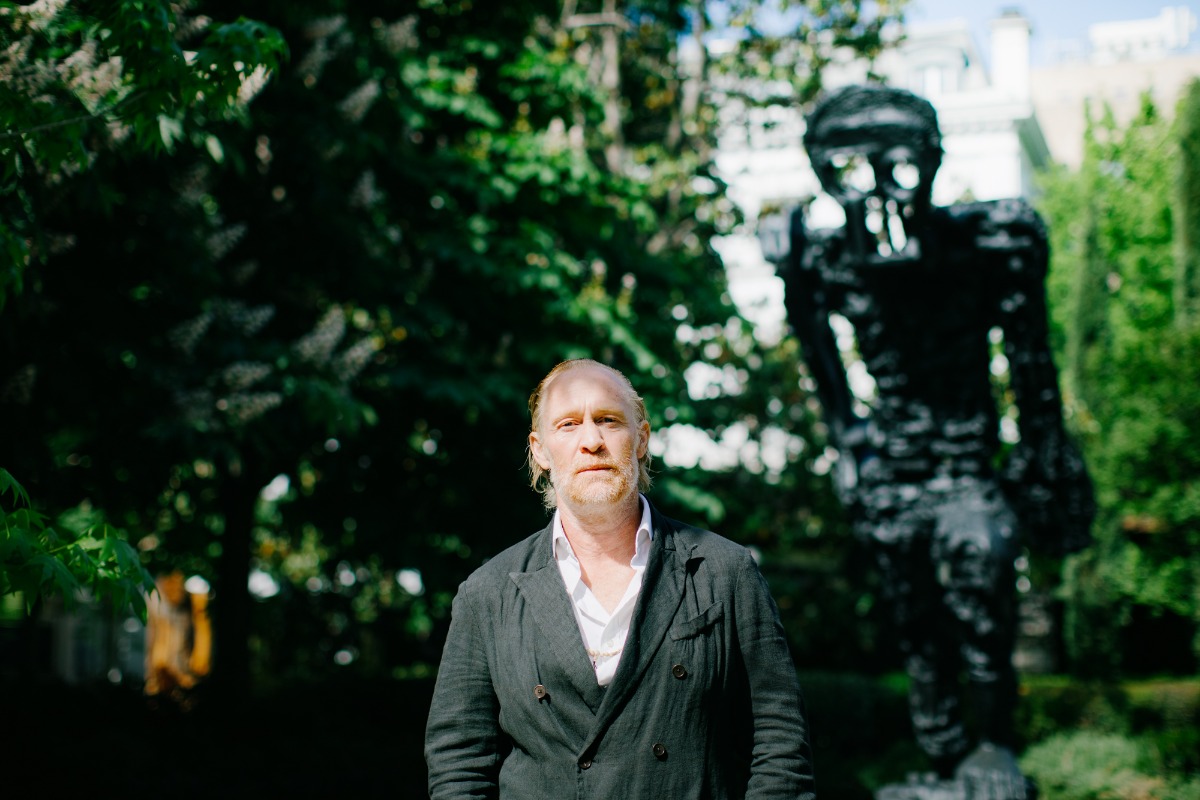
Thomas Houseago. Photography: © Pablo Gómez-Ogando, courtesy of the artist, Banca March and Xavier Hufkens Gallery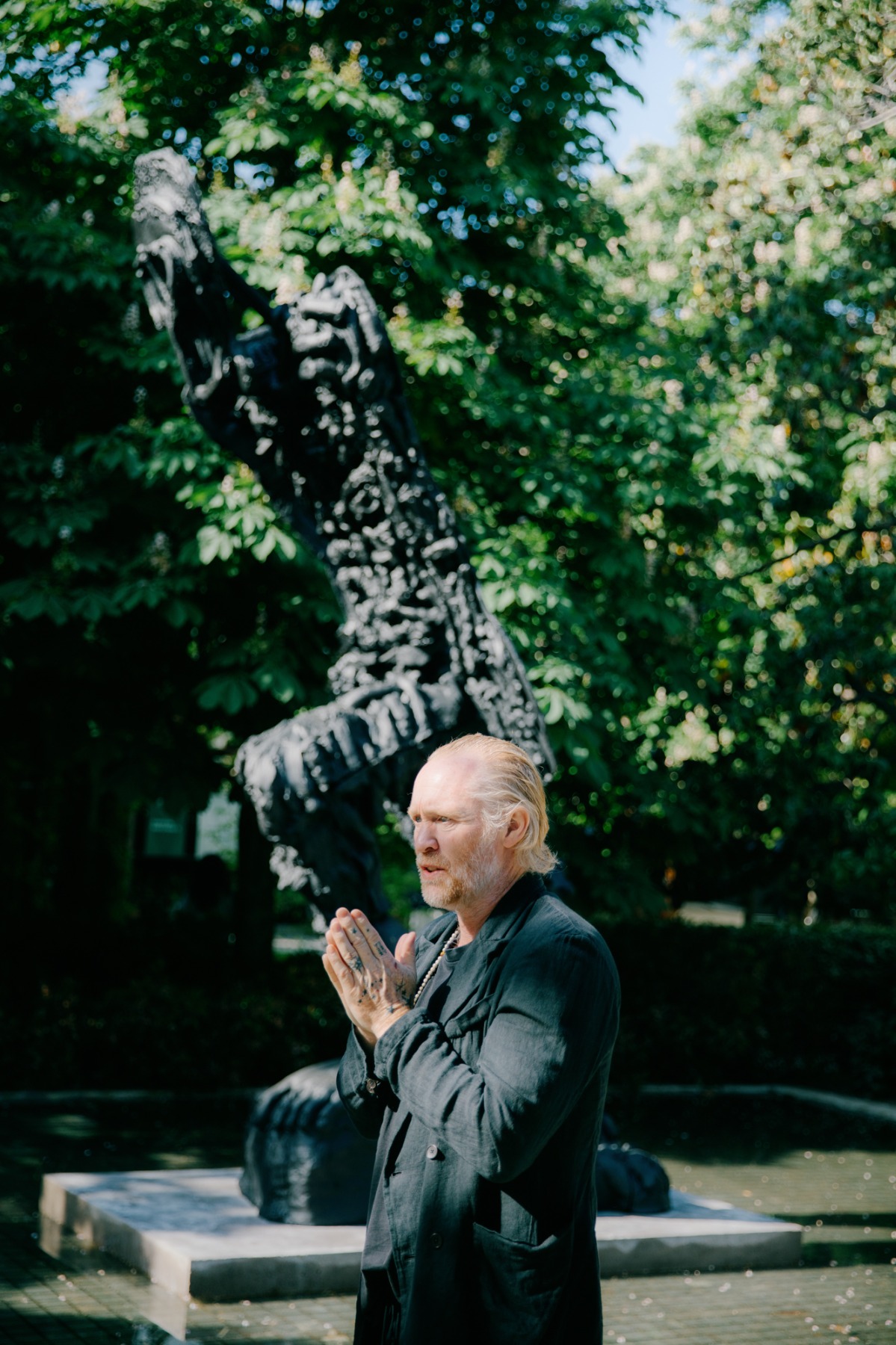
Sculptures and flowers
Paul, who works with me, got me these trees. I’d never carved directly into a tree before. I’d always carved wood as a block, or worked in clay, you know… But these were trees that had been struck by lightning and fallen down. They had these ruptures running through them. And I just went into this group of trees – probably four or five trunks – on this ranch in Malibu, which is not really a place to be an artist. It’s weird, you know? It’s surfers and Kim Kardashian. But Paul and I found this strange ranch, and I just went into the work.
This was actually the first piece I started on, and it led to a whole series of sculptures. Two or three of them are in Miami right now. Another one is in Washington at the Hirshhorn Museum. But there was something about those sculptures… I don’t know if it was some kind of personal victory, or if it was that I was returning from the void in a strange way, but they created so much dialogue.
And I thought about one of these new works (Janus (Mirror Figure) – auth.): "This is for Madrid…" And I didn’t realise how perfect it actually was, because the whole show is about the mask, and the face, and the body – the disconnect between the mind and the body. What is the body doing? Your subconscious, your conscious, your dreams… all of these things. So somehow it all connected.
And one of the things I’ve loved is that flowers fall onto it. It’s almost like it receives this blessing of flowers, or leaves, or whatever. It feels… I was just in China, and there’s a tradition there of placing flowers on sculptures, or fruit on sculptures. You know, people offer bananas and things like that to them.
Sculpture as a political act
I realized sculpture is a political act, just to take space. You'd be amazed at what people think is absolutely normal to take space in our culture, and I'm always the one who's too big. Yeah, why are your works so big? Oh, really? I'm gonna walk into an opera and go, "Gosh, a lot of musicians. This opera's huge. What are you doing here?" Everyone would be like, "What an asshole." But no one has a problem coming to a studio. "Whoa, lot, it's very big. Why so big?" I'm like, "I'm tiny." [laughs] I'm a fucking tiny ant in this system. You know what I mean? And that's still very common. "Oh, you're the guy who makes those big things, huh?" Meanwhile, they own the biggest fashion company on the planet. They've put it everywhere, and I'm, apparently, I'm the big guy [laughs] ... taking up space, right? So, I fight for that too.
Cave/Rock Head III. Courtesy of the Artist and Xavier Hufkens, Brussels
Sculpture as vibration
There’s a musician called Kamasi Washington. He’s a jazz musician based in Los Angeles, and we became friends. He loves sculpture. He would literally come to that sculpture, take out his saxophone, and play into it. I’ve got footage of him playing into my sculptures, and they amplify the sound. His music is very cosmic – he’s a very, very deeply spiritual human being. He has this theory that sculpture is about vibration.
And I thought about this when I was in Florence with a friend of mine, Flea, the bass player (Australian-American musician and actor, founding member and bassist of the rock band Red Hot Chili Peppers – auth.). He’s super fascinated by art. I mean, he just kept asking: “What should I see? Where should I go? What, what, what?” He doesn’t just want to live in the world of rock ’n’ roll. So I said, “Well, you should go and see the Galleria dell'Accademia.” (The Galleria dell’Accademia di Firenze is an art museum in Florence, Italy, best known as the home of Michelangelo’s David – auth.)
And Europe being Europe, they said to me, “Yes, we know your work. We’ll let you in, no problem. You come in the morning.” I took Flea and my other friends and my girlfriend. And you walk into the Galleria dell'Accademia – you’ve got the David there, and it’s kind of like, “Fuck!” you know? But then you’ve also got the “Dying Slaves,” the unfinished version. And it’s really interesting to see how people react to that.
I have a photo of Flea, and I’ll never forget this – and his wife was with us. There was one of these Michelangelo’s Slaves and he just stopped in front of it, and he went into this kind of fugue state. And at first, I thought, “Oh, he’s being funny.” Like, “That’s really funny,” because we were all moving around. And we kept looking, and he hadn’t moved. He was just standing there, staring like… but almost like a child. Almost sad.
So, his wife said to me, “Is Flea okay? What’s going on?” And I said, “I don’t know, I’ll check.” I went over and said, “Hey, you okay?” And he said, “I’m in a vibration relationship to this thing. I don’t really know how to explain it, but I’m in a vibration thing.” I immediately understood. I just gave him space. I said, “Do you need space?” And he said, “Yeah, just give me some time.”
And then they opened the museum to the public, so of course it became, “Oh, it’s Flea!” you know? And we had to kind of drag him away.
And it’s never happened to me with him before, because normally when the public arrives, it’s like, “No, let’s get out of here.” But he just stayed in it. He said all his hair was standing on end, and he just felt something in the vibration of the energy of the material, and he wasn’t totally sure what it was. We got home, and he cried that night after dinner. It brought up a lot of things for him – friends he’d lost, experiences he’d been through. He was like, “Something with that sculpture, man… I was just caught in it.” He didn’t really look at the David. At no point did he go, “Oh, it’s the David.” He didn’t care. He was kind of like, “What is that?”
And I realise that if you tune into sculpture – and I think musicians have a very easy time with that – it’s vibration. It’s material. It kind of goes “woo, woo, woo”… and it echoes.
Thomas Houseago. Photography: © Sergej Timofejev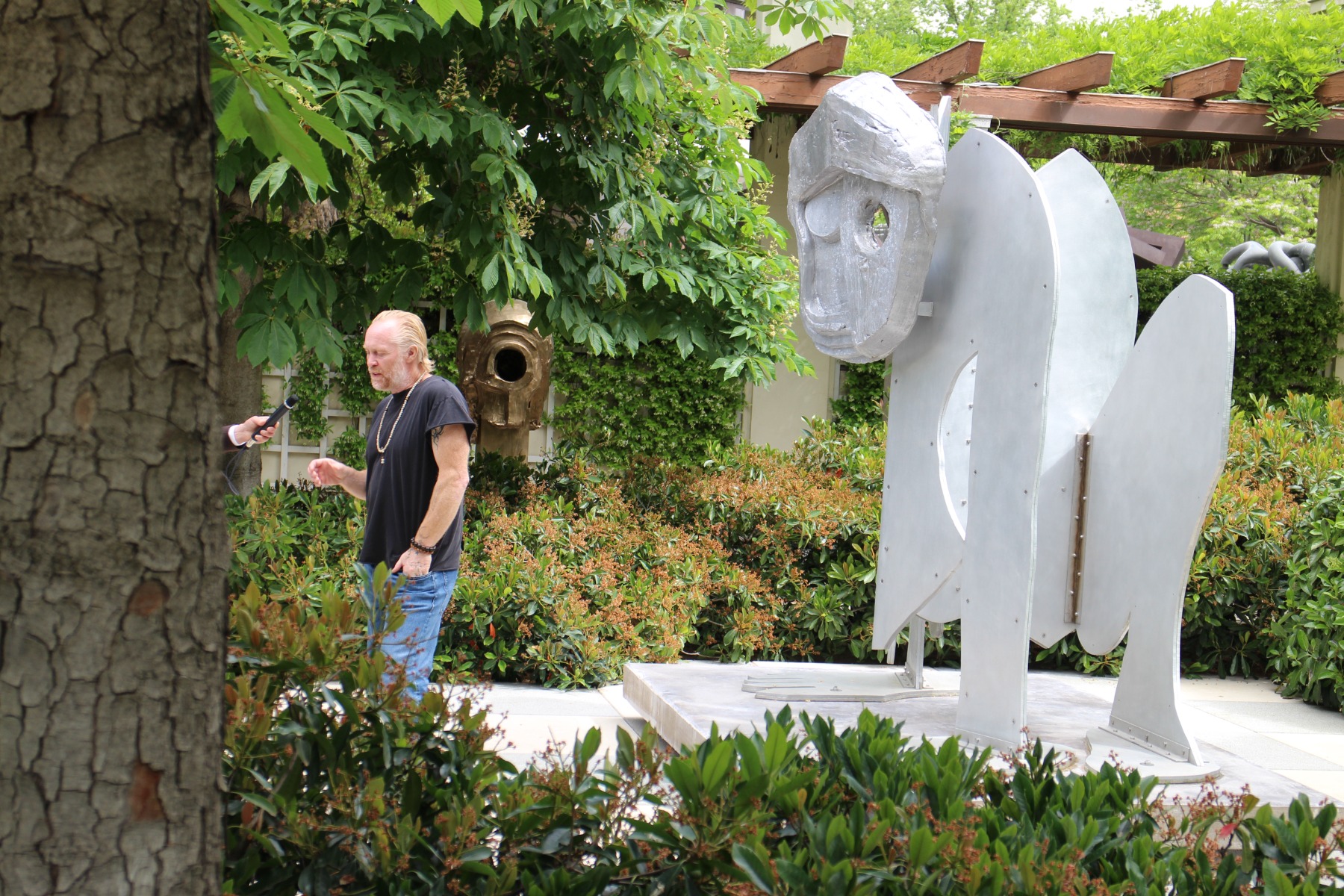
The final story – about a giant bear and a song
Listen, do you see this bear, right? (This part of the talk went on after almost all the journalists and guests had left; it was just Thomas, me, and Martin Sexton, the British artist and journalist. Thomas lifted his T-shirt slightly and showed the large bear tattoo on his chest – auth.) I’m going to tell you a quick story about this bear. I was with Flea, the musician, and he’s really, really into hiking – like proper deep hiking in Yosemite. Not like, “Oh, let’s go and have a look…” but six-day, deep-in-it hikes.
And we went on a hike together. I love him, and he’s really good at it. He’s a survival guy, right? But he’s tiny. And we’d been walking for three or four days, and your cellphone’s gone, your food is basically gone, and you’re getting into that rationing state. You’re deep in there. And you know you’ll get out – you know you can get out – but you’re also at that moment where you think, “If I get injured… if I slip… this could get weird.”
I remember saying to his friend, who’s a real mountain man: “What happens if one of us falls?” And he just looked at me and said, “We’re fucked.” That was his answer. “We’re sort of fucked.” I was like, “Okay. Got it.” Anyway, I knew there were bears – I knew there were grizzlies, I knew there were black bears, I knew it was a whole range.
I said to Flea, “What happens if we come on a bear?” And he said, “Don’t worry, I’ll sing to it.” And we laughed! Anyway, about four hours later we go around this bend and there’s this giant fucking grizzly bear, no bullshit. It’s so big and so intimidating, and we were on such a tight path through the forest that it was like, “Oh shit.” Flea was ahead of me, so I got my sticks and thought, “Right, we’re about to fight a bear. I guess that’s what’s happening.” You know what I mean? Because I’m traumatised. So it’s like I’m either going to run, or me and this bear are going to fight to the death and I’m going to lose, 100%. It was absolutely clear to me I was going to lose. That was all I had. I’ll either be eaten by the grizzly… but maybe I’ll protect Flea and my other friend.
And Flea sang to this fucking bear. He actually sang – he didn’t pause, he got down and he sang to it. And I watched a bear that was this close kind of look at him, look at me, and kind of listen to the song. And Flea was singing it like a prayer – “a beautiful bear,” kind of crazy shit, like a druid prayer.
I was looking at Flea thinking, “Dude, I hope this works, but in a weird way I think it’s going to work.” It was strange. And then at the end of his song he said, “Do we move, or do you want to move back?” And I’m not joking – the bear sort of moved to the side. We’ve got a photo of it like this, moving into the forest, and then it sat down and watched us pass.
Banca March Gardens
Calle Castelló, 75, Madrid, Spain
Thursday: 7:00 – 11:00 pm
Friday: 12:00 – 7:00 pm
Saturday: 12:00 – 7:00 pm
