


What moves us?
A review of Crystal Pite’s Alchimia, created for Collezione Maramotti, with insights from the Canadian choreographer
In early October, I witnessed a miracle. All that remains of it now is a dozen or so striking photographs and a handful of very positive reviews, mostly in the Italian press. I’ll also try to capture it in words, especially since I’ve received written responses to several of my questions from Crystal Pite, the Canadian choreographer and creator of Alchimia. Over the course of her 35-year choreographic career, Pite has created more than sixty works for companies such as The Royal Ballet, Nederlands Dans Theater, the Paris Opera Ballet, and the National Ballet of Canada. In 2002, she founded Kidd Pivot in Vancouver, “a company that strives to distill and translate universal questions into artworks that connect us to essential parts of humanity.”
Crystal Pite – NDT 1 & Kidd Pivot. Alchimia ©Andrea Mazzoni – I Teatri Reggio Emilia. Courtesy Collezione Maramotti, Fondazione I Teatri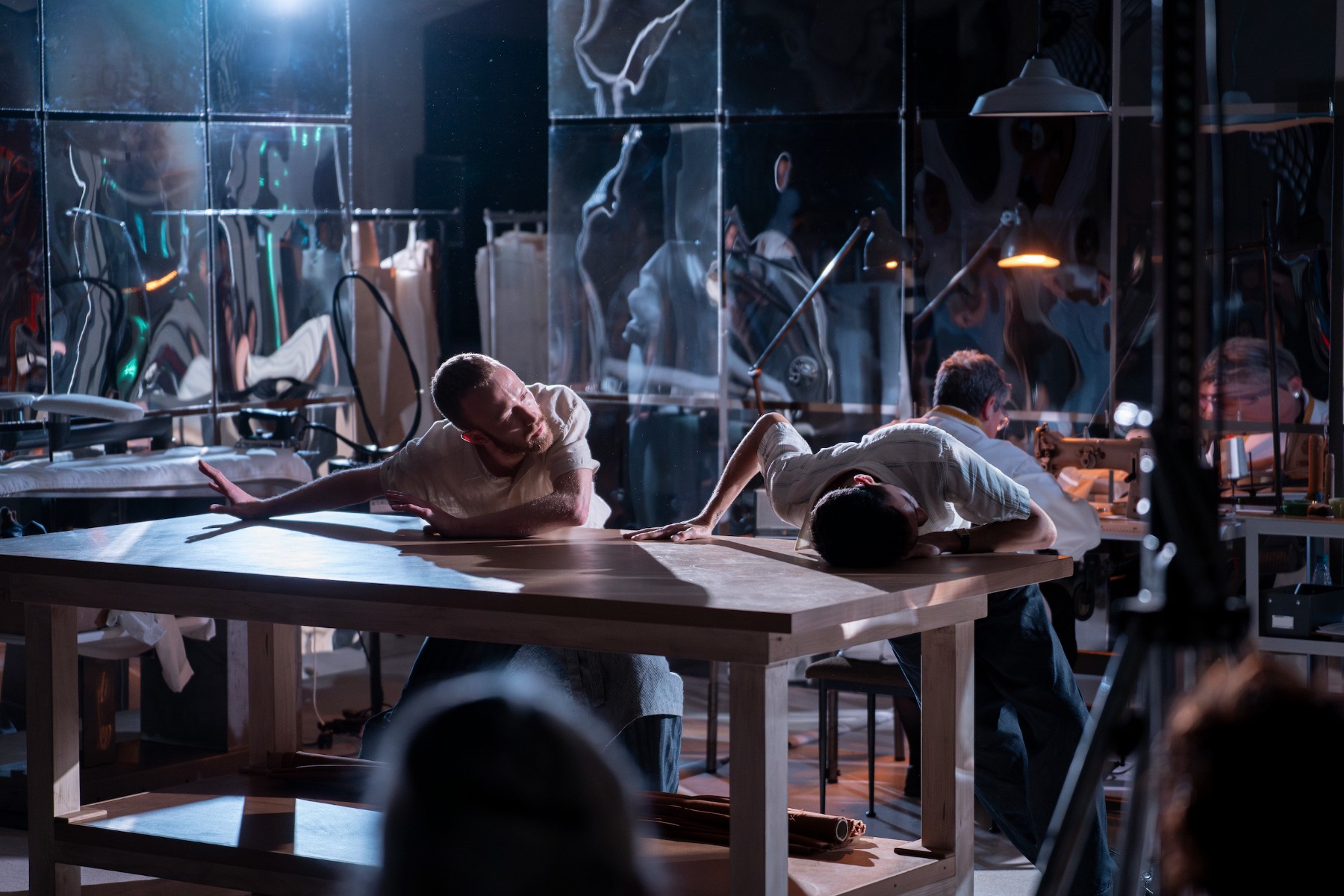
“We have followed Crystal Pite for years... Her choreographic works – at once utterly original and deeply archetypal, rigorous and overwhelming – are intimately bound to the imaginaries of contemporary art,” says Sara Piccinini, director of Collezione Maramotti, a private contemporary art collection that opened to visitors in 2007 in the historic former headquarters of the Max Mara company in Reggio Emilia.
A notable example of Brutalist architecture in Italy, the former Max Mara building was originally designed in 1957 by architects Antonio Pastorini and Eugenio Salvarani. In 2003, Max Mara moved to a new site on the outskirts of Reggio Emilia, and the former plant was turned into a home for the collection of contemporary art acquired by the company’s founder, Achille Maramotti. Alongside its permanent collection of over 200 artworks created between 1950 and 2019, Collezione Maramotti regularly commissions new projects and presents works by emerging and mid-career international artists. Since 2009, it has also collaborated with Fondazione I Teatri di Reggio Emilia and Festival Aperto, inviting leading contemporary choreographers and dance companies to create site-specific performances for the space. Among the artists who were invited to reinterpret the Collezione Maramotti through movement were Trisha Brown, Shen Wei, Wayne McGregor, Hofesh Shechter, Dimitris Papaioannou, Peeping Tom, and Anne Teresa De Keersmaeker.
The dialogue between contemporary dance and visual art has taken many forms in recent years. Dance, movement and the living human body bring a new dimension to the stillness of artworks, however magnificent and inspiring they may be. But Alchimia, performed in Reggio Emilia, also explores another fundamental theme: craftsmanship as a path of choreographic art and artistic creation more broadly. Crystal Pite sees herself as an artisan, approaching choreography as a hands-on process of building, assembling, adjusting and refining, in which every detail can reveal something essential. This approach finds a rhyme with the history of Collezione Maramotti, housed in a former Max Mara factory, where the footsteps and gestures of the artisans who worked there for decades still seem to echo in the air.
Crystal Pite – NDT 1 & Kidd Pivot. Alchimia ©Andrea Mazzoni – I Teatri Reggio Emilia. Courtesy Collezione Maramotti, Fondazione I Teatri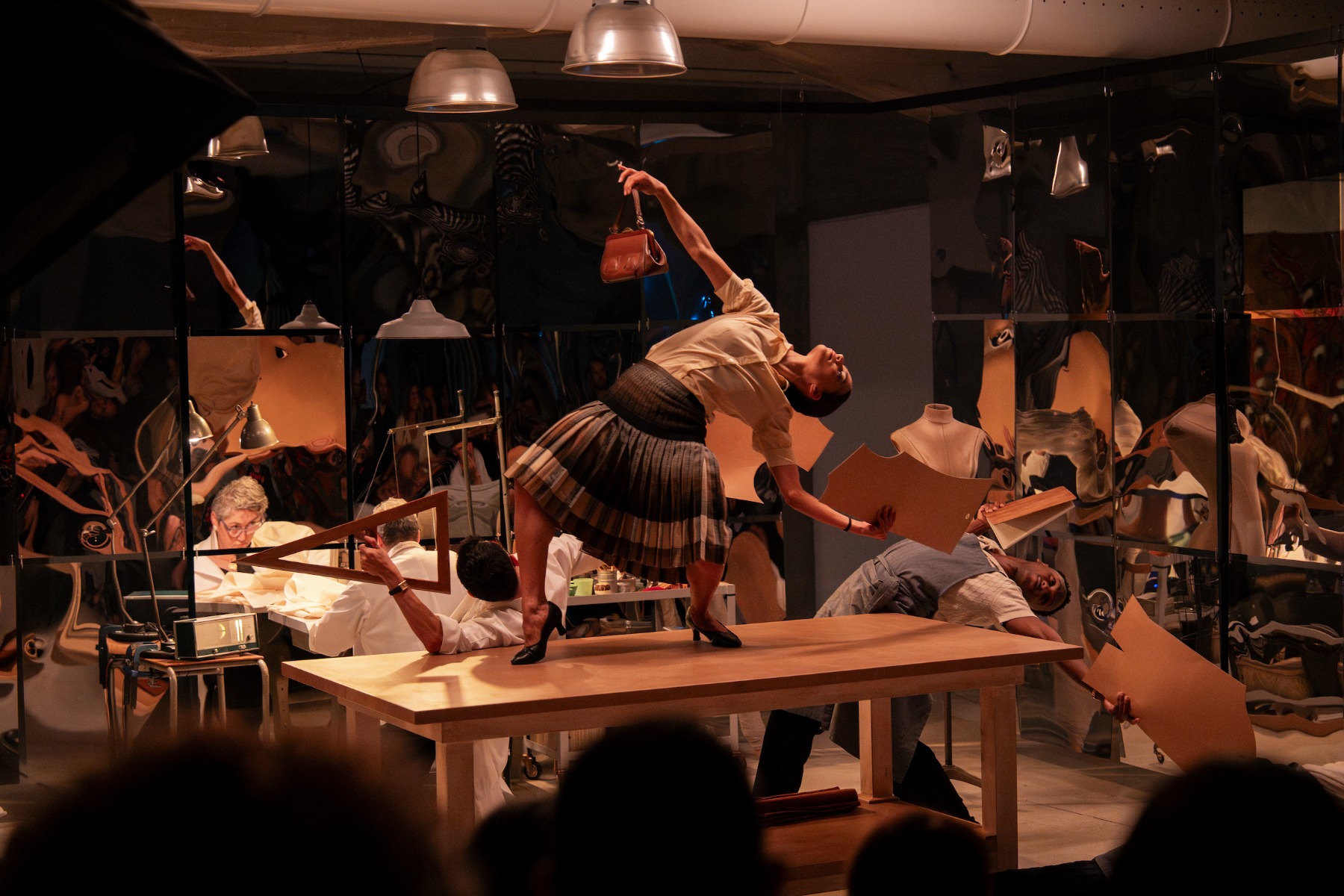
“The tailors and seamstresses who made their living there, whose hands produced the garments that made the brand famous: theirs was the craft of making clothing for the moving, breathing human body. My own craft is not dissimilar: I like to think of dance as a force that wears a human body,” notes Crystal Pite.
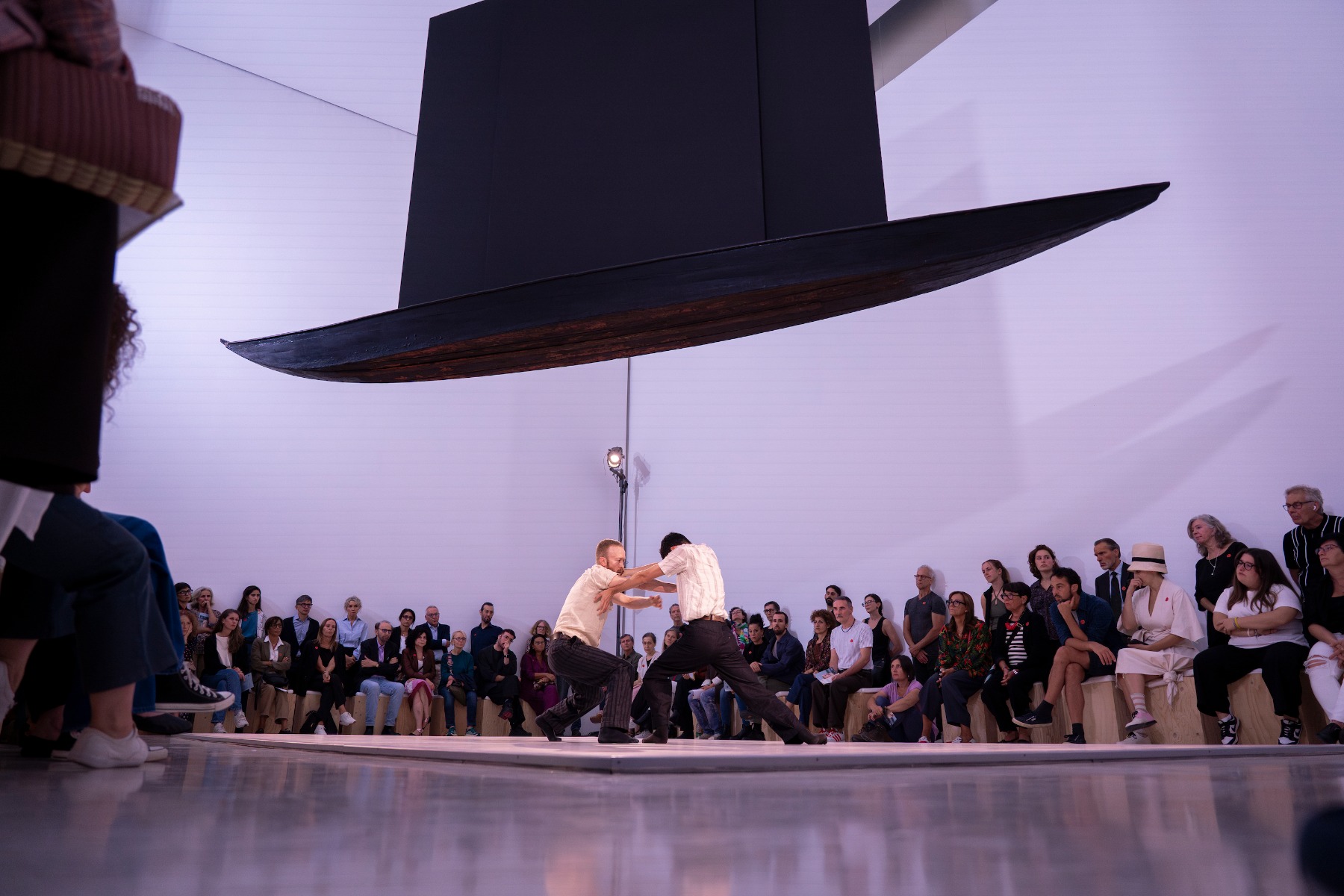
The performance she devised, Alchimia, opens in a second-floor room featuring Claudio Parmiggiani’s Caspar David Friedrich (1989), a striking, almost otherworldly installation of a wooden boat with three large black canvases raised like sails. Suspended in space, the boat seems to drift across an invisible sea, with no clear destination or horizon. Beneath it, the story of two dancers – a man and a woman – begins. Dressed in uniforms resembling those of the institution’s staff, they seem to guard an invisible field of energy radiating from the artwork. At one point, a female spectator, apparently a colleague of the dancers, drops her smartphone into this forbidden zone. The man steps in to retrieve it, and suddenly his body is caught in a powerful stream of energy pouring down from above. The scene establishes one of Pite’s central concerns: the mysterious relationship between the body, the forces that animate it, and the possibility that something invisible can make it move.
Crystal Pite – NDT 1 & Kidd Pivot. Alchimia /Artwork by Claudio Parmiggiani, Caspar David Friedrich, 1989 ©Andrea Mazzoni – I Teatri Reggio Emilia. Courtesy Collezione Maramotti, Fondazione I Teatri
That’s how Crystal Pite responded to my question about why she had chosen this particular work from the collection for her choreographic interaction: “If you were to look at the pages of my notebook over the past year you would see over and over again, variations of "BUT WHAT ABOUT THE BOAT?!" Like many of the choreographers that have created works for the Collezione Maramotti, I was drawn to the room where Caspar David Friedrich hangs. The room itself feels potent, and Parmiggiani's work has a beautiful, indomitable presence. You can't just dance underneath it without contending with it - dramaturgically, energetically, spatially, spiritually. For me, initially, the "BOAT" connected to the word "craft" and its many meanings in English: skilled handwork, vessel, magic and deception; all of which connected to the content I was interested in exploring. However, hanging the content on what is basically a pun, and an English pun at that, felt like a bit of a stretch. It wasn't until I looked more deeply into Parmiggiani, and particularl his Delocazione, that I was able to connect his creation with what I was chasing in my own way. It was Parmiggiani himself that I felt moved by; his lifelong inquiry into the generative properties of absence and mystery, the poetry of his questions and responses. This is where I felt alignment and motivation. This is how I contended with the space beneath that boat”.
Crystal Pite – NDT 1 & Kidd Pivot. Alchimia ©Andrea Mazzoni – I Teatri Reggio Emilia. Courtesy Collezione Maramotti, Fondazione I Teatri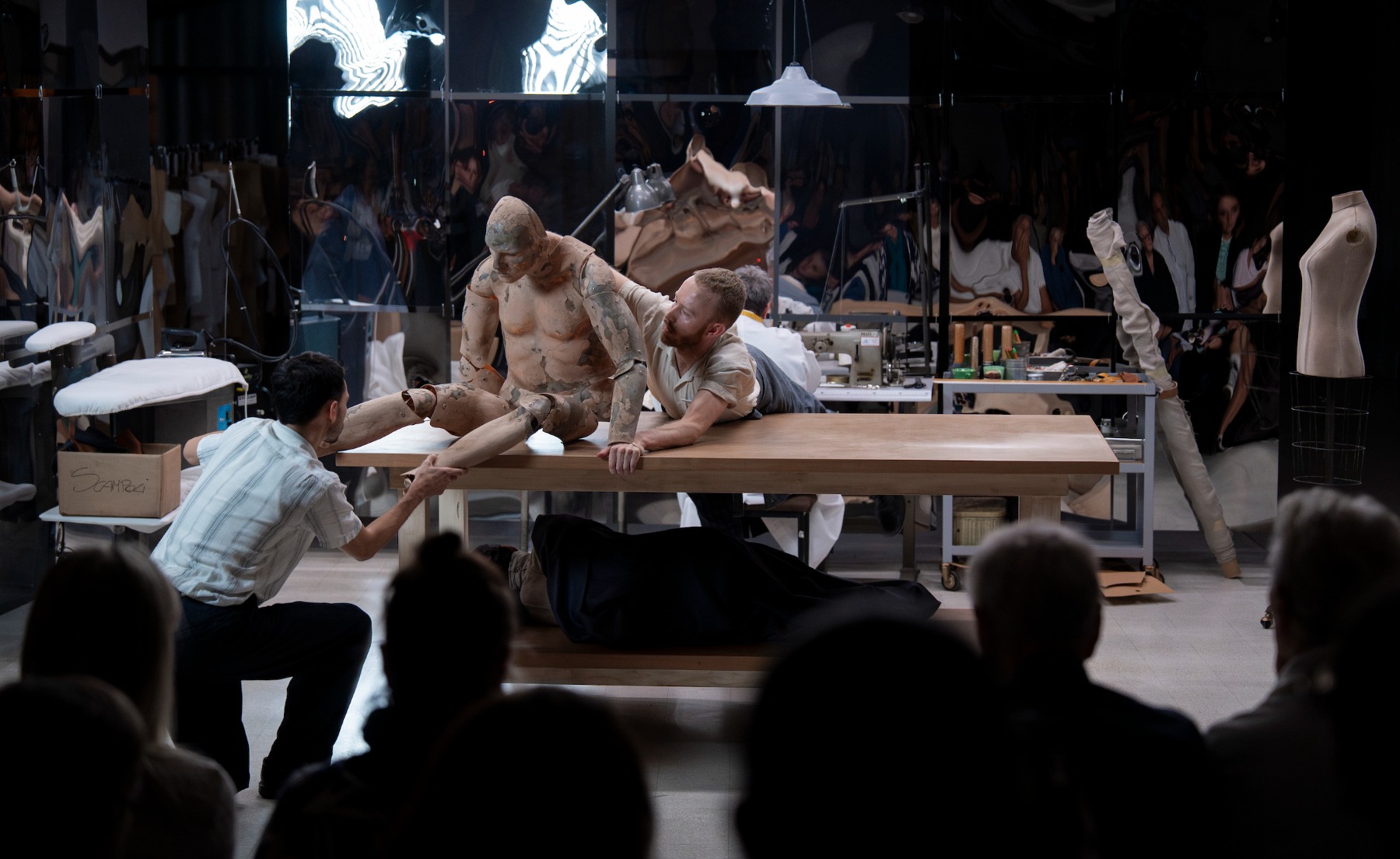
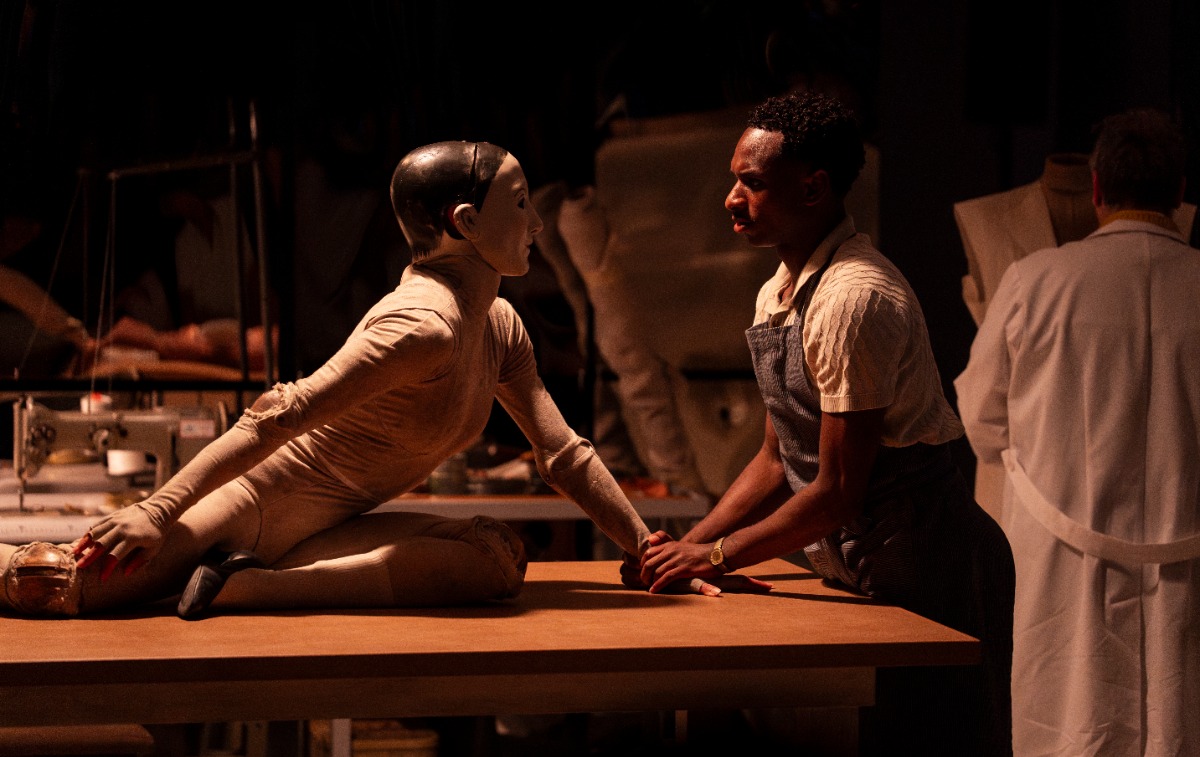
The second tableau shifts the focus to the building’s industrial past. In the large hall on the second floor, a reconstructed sewing atelier evokes the everyday world of the seamstresses who once worked there. At its centre stands a large wooden cutting table, surrounded by a Singer sewing machine, spools of thread, an ironing board and racks of paper patterns. These are not merely theatrical props, but details that recreate the atmosphere of a working environment where garments were carefully cut, assembled and finished by hand. The reconstructed space takes on an unexpected sense of reality with the presence of Monica Salsi, who once worked as a seamstress at the Max Mara factory and now works as a costume maker at the I Teatri Foundation in Reggio Emilia. Rather than playing a fictional character, she performs familiar tasks: handling fabric, arranging patterns and taking measurements. Her gestures retain the natural precision of someone who has practised the same craft for years.
In response to my question about when, during the creative process, she decided to she decided to bring Monica Salsi into Alchimia, Crystal Pite replied: “The idea to invite Monica to perform with us was hatched in the same moment as deciding to recreate a work station from the garment factory. The industrial sewing machine and all the equipment and tools we collected were authentic and I wanted our craftsperson to be authentic too. We wanted someone with mastery and long experience, a local person who was woven into all the elements, including Reggio Emilia itself, its theatre, factory and community. Monica exemplified all that. She was absolutely perfect. She brought our show to life with such humanity, professionalism and grace”.
Crystal Pite – NDT 1 & Kidd Pivot. Alchimia ©Andrea Mazzoni – I Teatri Reggio Emilia. Courtesy Collezione Maramotti, Fondazione I Teatri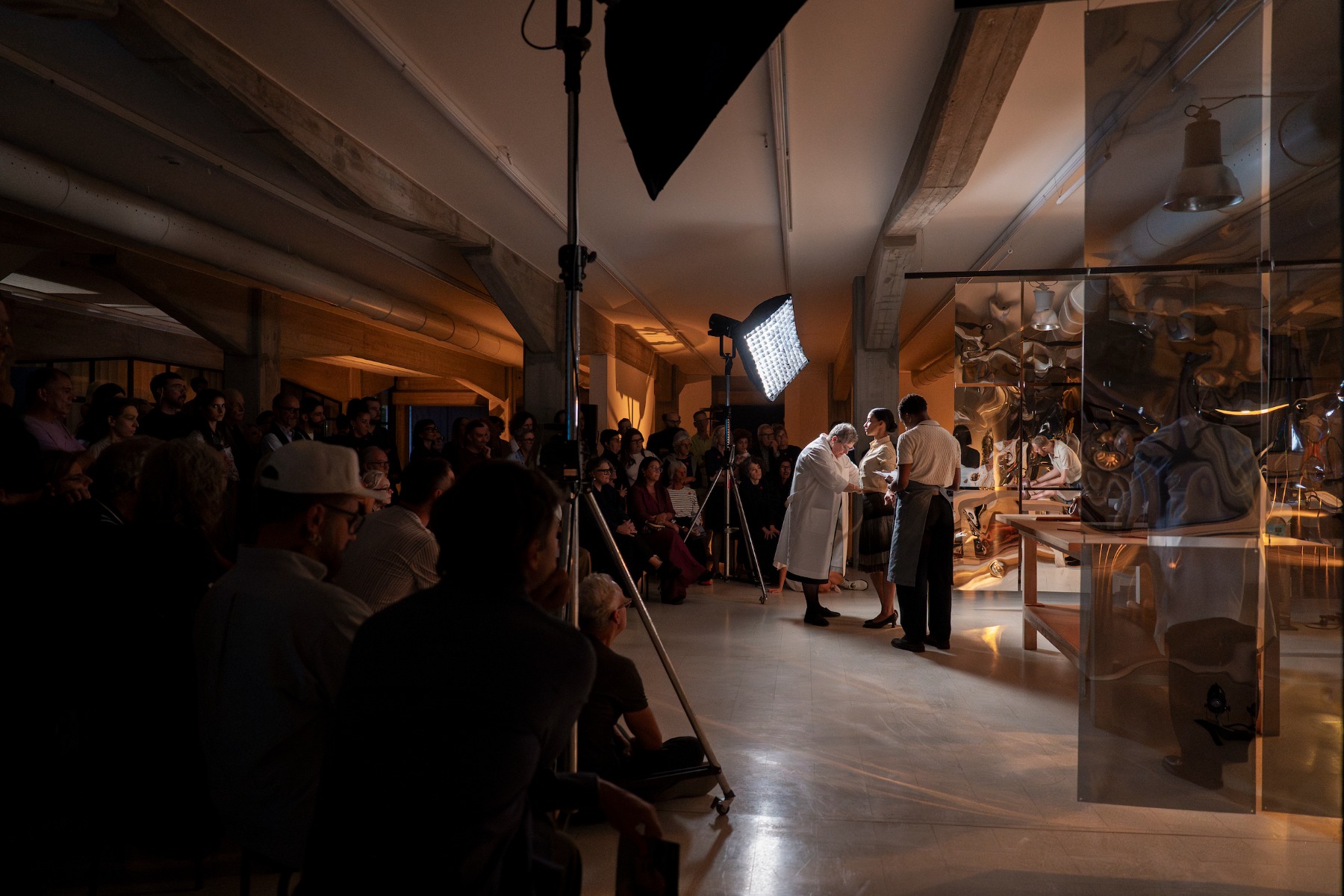
And it is here that the magic, until now playing with invisible currents of energy, begins to assume a tangible form. In the atelier, as football commentary drifts from a small radio, two dancers dressed as tailors measure the live model. Then they begin working with a mannequin resembling an exoskeleton. Before our eyes, the process of creation unfolds, finding a compelling, everyday expression in the work of tailors and designers. At one point, a life-size fabric figure lies on the cutting table, with a dancer hidden inside it. When the seamstress finishes her work and leaves, the figure begins to stir and slowly rises, as though they had all breathed life into what they had created together. The boundary between the animate and the inanimate begins to blur or to glitch, evoking the very essence of the performance’s title: Alchimia.
“Running through all of my work is the question of what moves us. I've always been interested in animation and puppeteering – the way movement is essential to the illusion of aliveness in an inanimate thing. Puppeteering can be a beautiful deception, at the heart of which is the question of consciousness. Working with the mannequins in our show does feel like a kind of alchemy. What I love most about it is the collaboration between puppet, puppeteer and viewer. You need all three elements for transformation to happen. I suppose you could say the same thing about art, artists and audiences,” Crystal Pite commented on the nature of this “alchemy.”.
Crystal Pite – NDT 1 & Kidd Pivot. Alchimia ©Andrea Mazzoni – I Teatri Reggio Emilia. Courtesy Collezione Maramotti, Fondazione I Teatri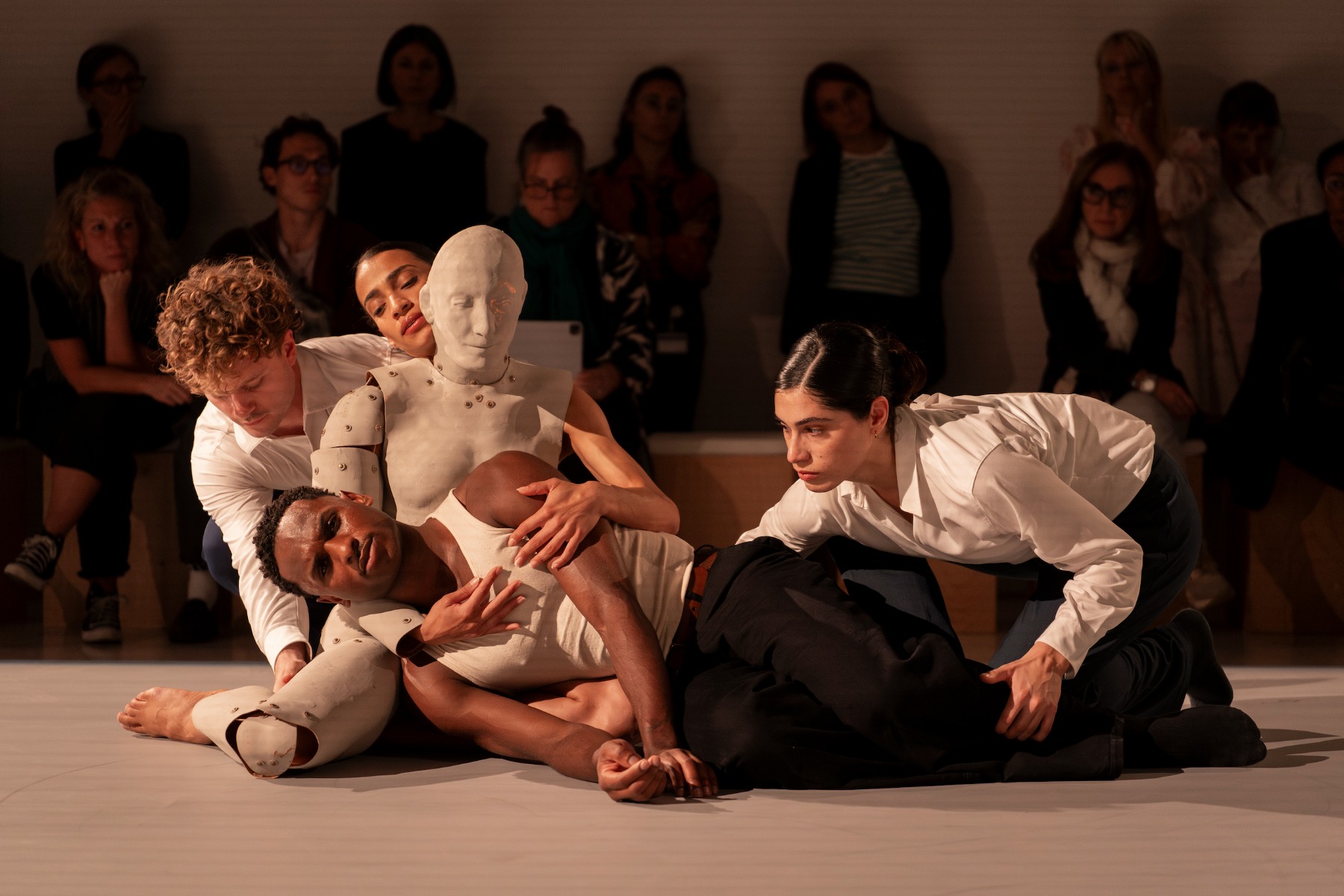
In the final tableau, the dancers return to Claudio Parmiggiani’s Caspar David Friedrich. Beneath the striking presence of the suspended boat and its enormous black sails, their bodies, through carefully composed movements, shifting formations and moments of stillness, create a kind of story about relationships. Here, the animate – represented by the three dancers – and the inanimate – embodied by a female dancer partially concealed within a mannequin-like puppet, whose face seems to “peel away” from her own – ultimately enter into a kind of symbiosis. This profoundly tender dance, founded on gestures of care, brings Alchimia to its close.
What is truly astonishing about this project is the dancers’ exquisitely precise work. Four of them are from Nederlands Dans Theater, with which Crystal Pite has a longstanding artistic relationship, while the other two are members of her Vancouver-based company, Kidd Pivot. Every movement, every gesture feels both free and flawless – as though it could not possibly be any other way. I was particularly surprised to find out, in conversation with one of the dancers, that the rehearsal period had been only a couple of weeks: one week without Crystal and one week with her. The atelier set is beautifully conceived, too, as is the sound design, with its subtle and evocative choices by Owen Belton.
Crystal Pite – NDT 1 & Kidd Pivot. Alchimia ©Andrea Mazzoni – I Teatri Reggio Emilia. Courtesy Collezione Maramotti, Fondazione I Teatri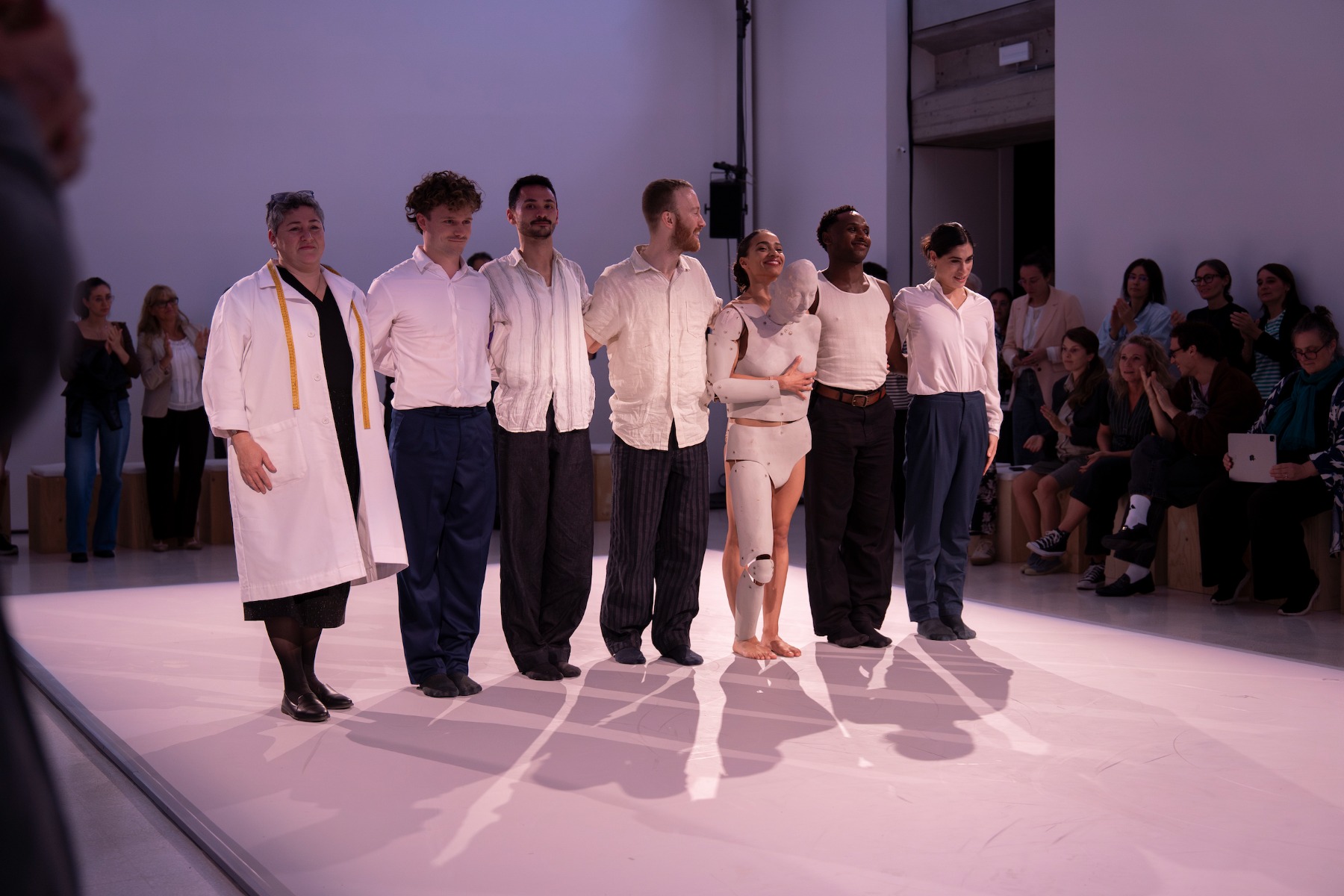
Alchimia ran for just four consecutive evenings, from 1 to 4 October, yet it has left an indelible memory in those who witnessed it: an illusory, multifaceted source of light suspended in space. When I asked Crystal Pite how she felt about the fact that such a remarkable work, the product of so much effort and so many ideas, would exist only for those few evenings in October 2026, she replied: “As a dance artist, I am rarely troubled by impermanence. I'm used to it. Dance's ephemerality is actually part of its appeal for me; its heightened states, its ever-vanishing traces of beauty in the present moment. But presenting live choreography in the Collezione Maramotti, surrounded by the 'permanent' work of great artists across time, certainly throws the impermanence of our offerings into stark relief. Sometimes I envy the solidity of other media. And of course I wish more people could see what we make”.
