The world is everything
An express interview with Estonian sculptor Edith Karlson, whose solo exhibition is on view at Kiasma (Helsinki) until 27 September
Edith Karlson represented Estonia at the Venice Biennale in 2024. In 2025, her mythological creatures were exhibited at Vilnius’s Sapieha Palace – a new art institution affiliated with the local contemporary art centre (CAC Vilnius) – and in Riga, where her mermaids surfaced in the exhibition of the Survival Kit festival, curated this time by Slavs & Tatars. Karlson’s mythical and, in their own way, archetypal creatures are clearly in demand, perhaps because they are at once distant and fairy-tale-like, yet also thematically relevant and current.
“I am desperately trying to understand the world, but its current state is so absurdly horrific that it goes beyond all comprehension,” says Karlson. “I love fairy tales, but when I look at my works collectively, they feel – despite their strangeness – more like reality than fairy tales, though perhaps not quite as brutal.”
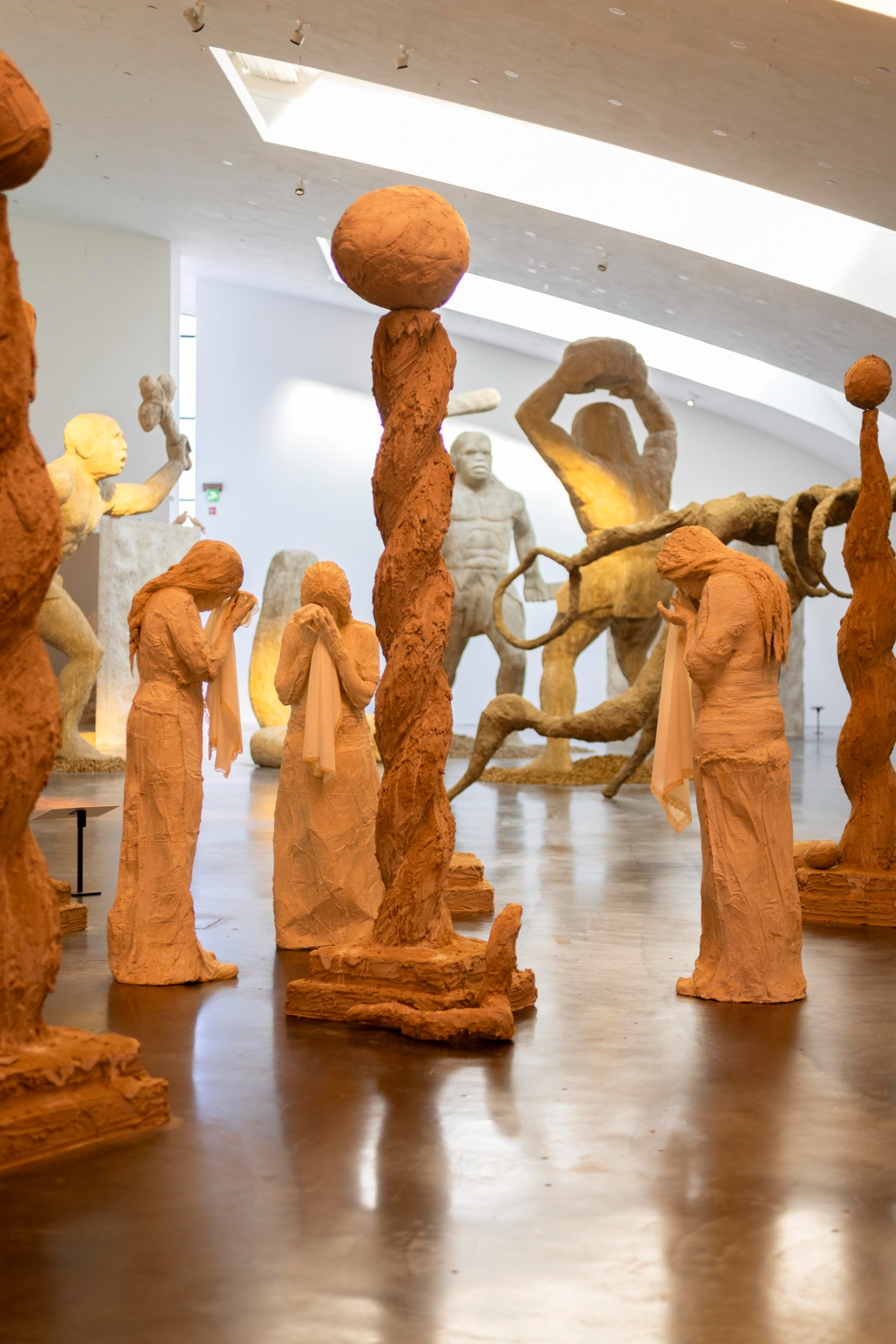
Edith Karlson. March: Army, 2025–2026. Photo: Finnish National Gallery / Pirje Mykkänen
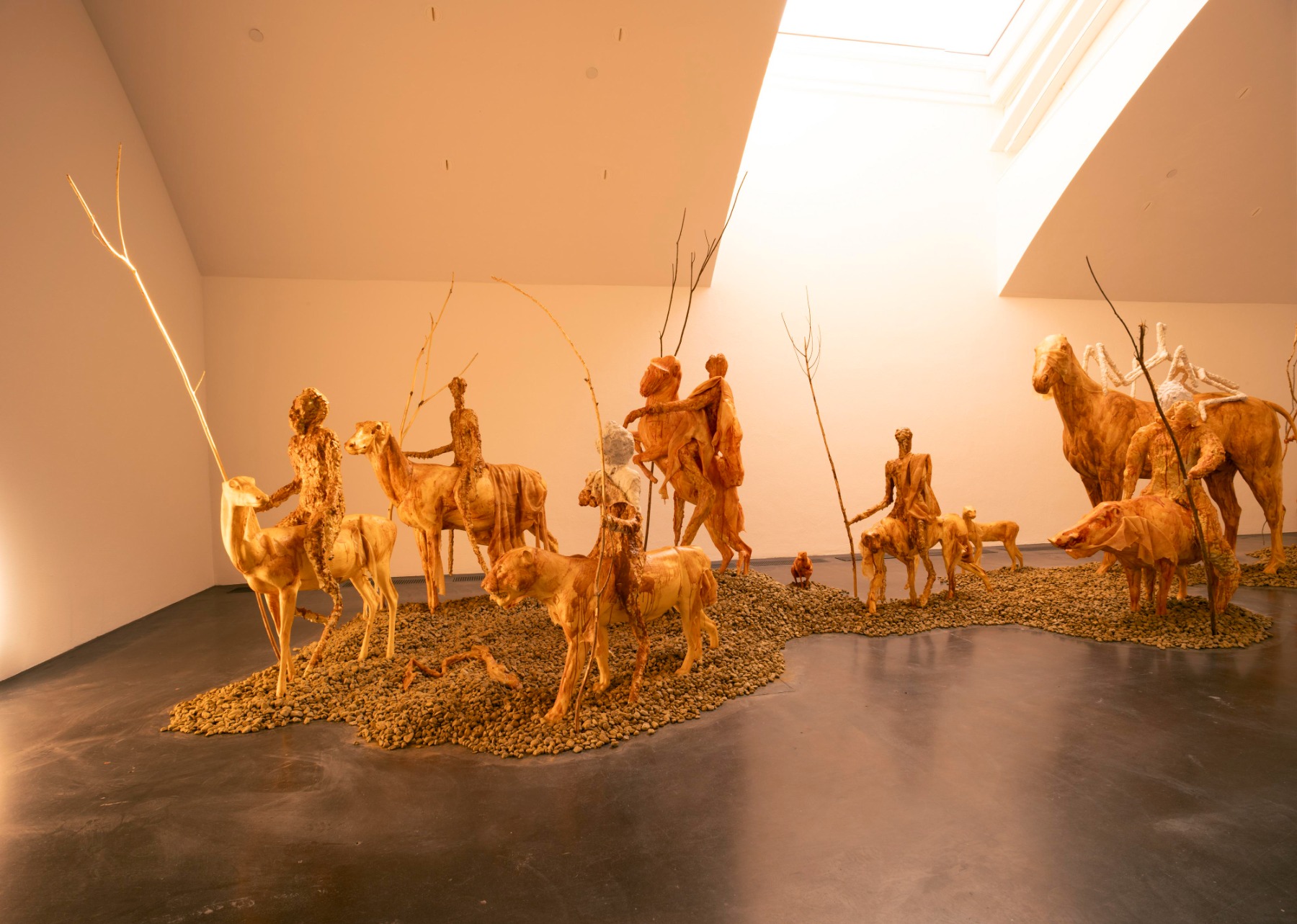
Recently, a major solo exhibition of her work opened in Helsinki at Kiasma under the title Dawn till Dawn. Here, Karlson presents an entire world inhabited by humans, animals, and mythical creatures. Visitors weave through sculptural groups as the lighting shifts from warm artificial yellow to natural daylight. “Mythical characters, for Karlson, are a vehicle for exploring questions that reason alone cannot answer. Prehistory, fossils, and archaeology also provide enduring inspiration. Humans and animals are united by instinct, a tenacious will to survive, and the ability to adapt – themes she consistently examines in her practice. Karlson employs a diverse array of materials, including clay, concrete, and silicone, creating works that often retain a raw, unfinished quality. Many pieces are left unglazed, their surfaces rough, evoking processes of transformation and transition,” notes the exhibition text for the show, curated by Piia Oksanen, a member of the Kiasma team.
“Nothing in this world ever ends or is ever finished,” Karlson reflects. “Every day is a struggle from the moment I wake, but I have learned to find joy in small, ordinary things: birds going about their avian business, or even when someone extends a courtesy by giving way in traffic.” So we, too, asked for a small favour – we got in touch with Edith to ask her a few questions for a short interview, and she kindly found the time to answer them.
Edith Karlson. The Past and the Future, 2024. Photo: Finnish National Gallery / Pirje Mykkänen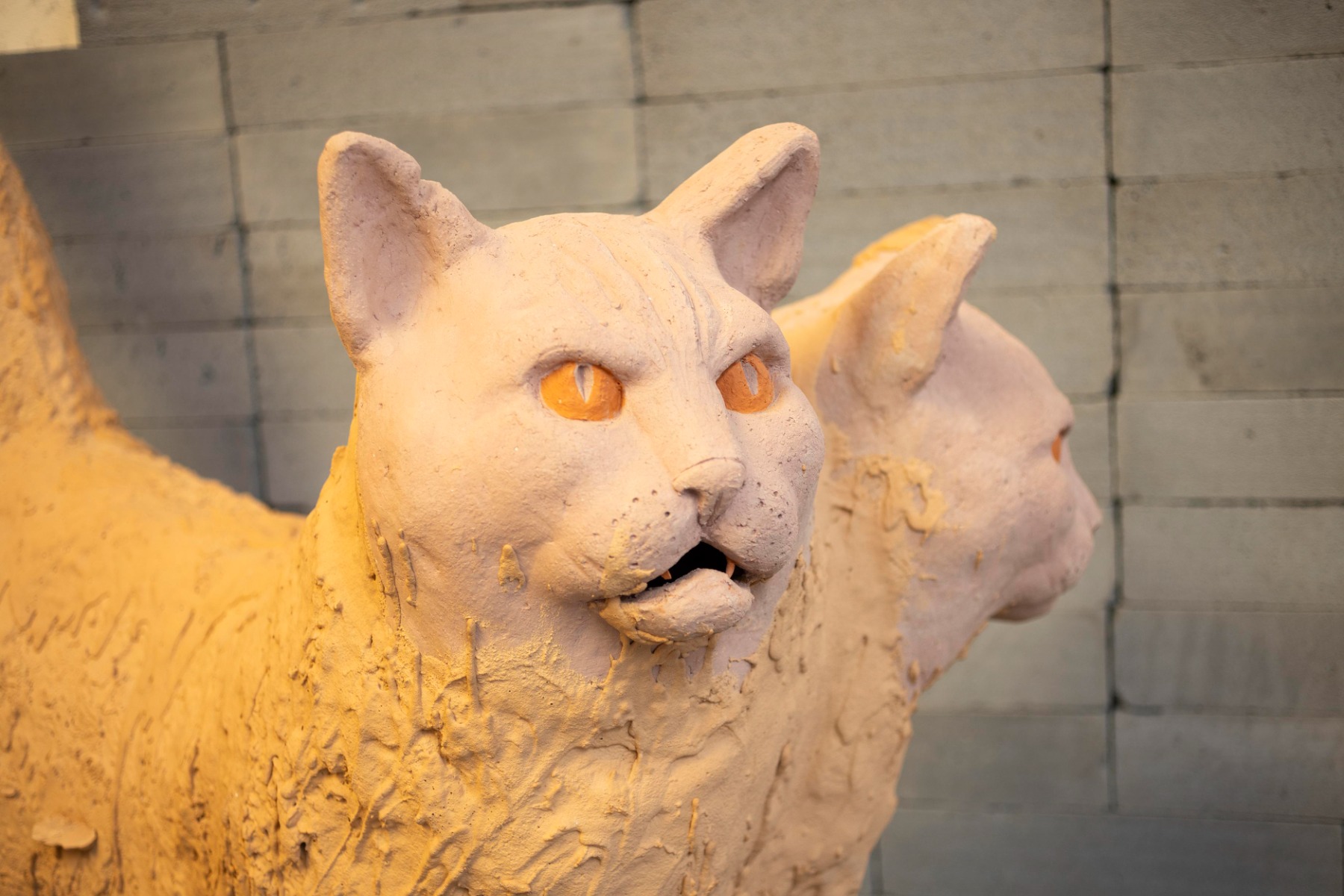
Your sculptures often blur the line between nature, myth, and the human body. Why are these themes important to you?
I can never give an exact answer, but I think it probably has to do with the feelings I have toward nature, animals, people, mystery, and the mystical. I’ve always felt that there are very simple answers to everything, and I’m drawn to simplicity, but at the same time I know how terribly complicated simplicity can be.
If I try to answer more specifically, I think these themes contain so much intrigue and so many interesting moments for me that they inevitably become important.
Edith Karlson. Installation view: Dawn till Dawn. Photo: Finnish National Gallery / Pirje Mykkänen
Do you think the world is inherently magical, or is it something we need to actively make more magical – also through art?
I think the world is everything. It is harsh, cruel, evil, beautiful, and also magical. The question is simply: what kind of world do you want to live in, and what do you do to make it so?
I don’t think anyone has to do anything they don’t want to do. If life becomes easier for me when I watch grass growing or a bird jumping from branch to branch, and if those things feel magical to me, then for someone else they may remain completely incomprehensible – and that’s fine.
What I modestly hope for is curiosity, an open heart, and flexibility. Then perhaps these magical moments can enter through doors and windows – through art, and maybe even, if we are lucky, while reading the news. Although that still feels rather hopeless. But one can dream.
Edith Karlson. Hora Lupi / Hour of the Wolf: Sad Women, 2024. Photo: Finnish National Gallery / Pirje Mykkänen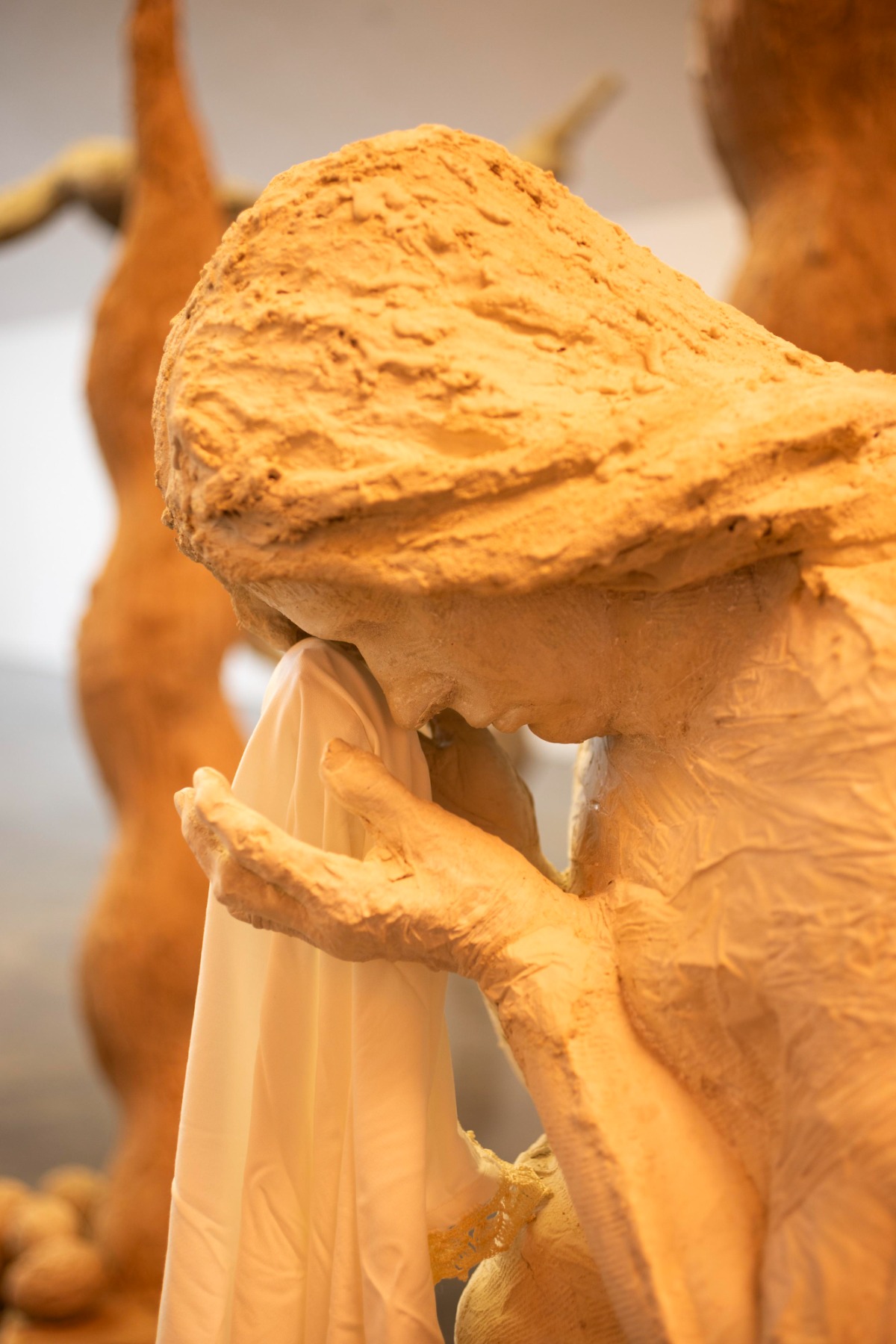
Why did you choose the title Dawn till Dawn? Is it about repetition, survival, or the feeling that history keeps circling back?
It was chosen precisely because that is how we live: from dawn to dawn, over and over again. Every day you wake up and begin again, and it continues like that until the end of your days.
It also speaks about how tragic – and “interesting,” if I may put that word in quotation marks – it is that history keeps repeating itself. Even during moments when it feels impossible that certain things could happen again, when humanity seems to have learned, developed, and perhaps even become better.
Edith Karlson. Hora Lupi / Hour of the Wolf: The Giants and the Snake, 2024. . Photo: Finnish National Gallery / Pirje Mykkänen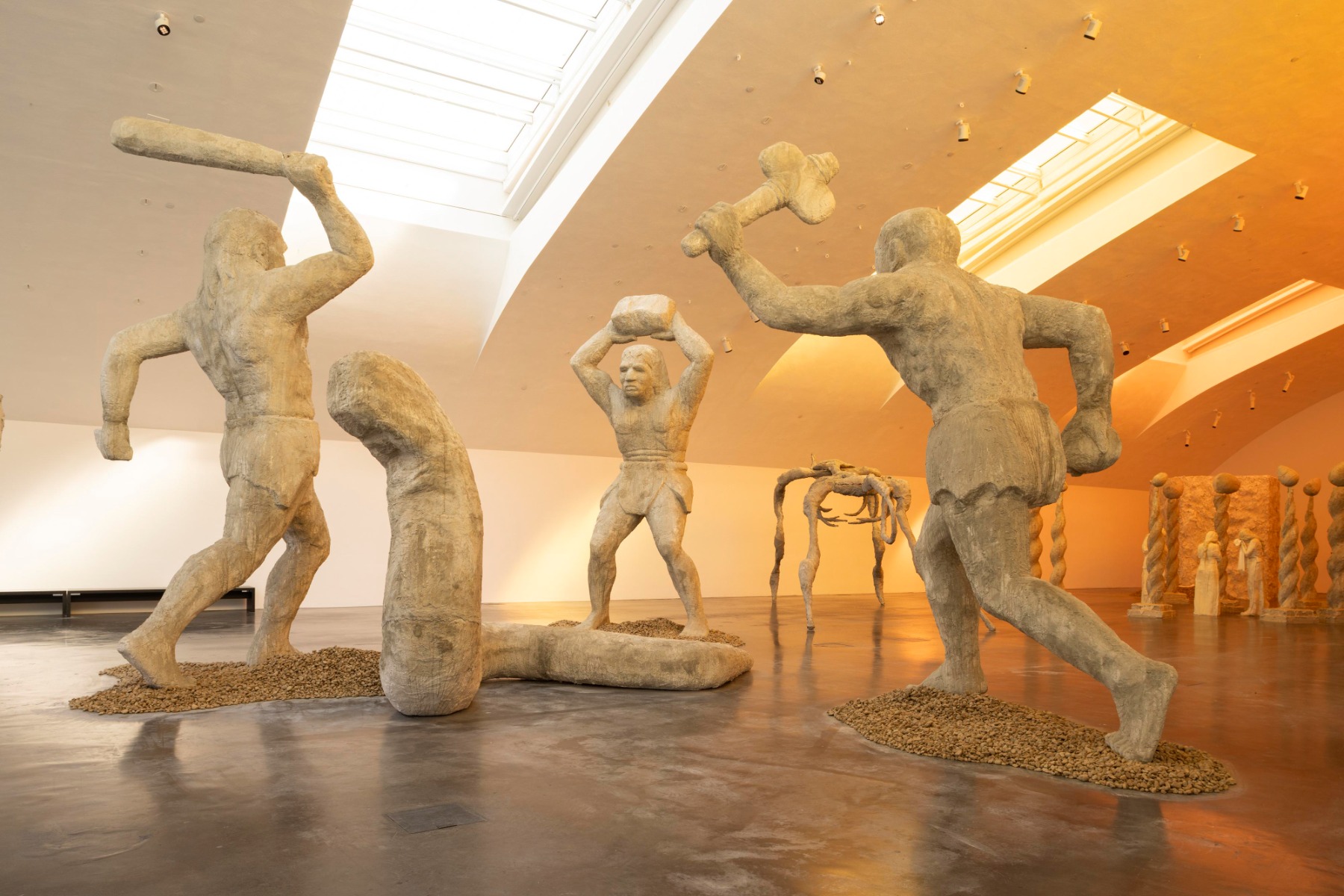
Did the architecture or atmosphere of Kiasma influence the way you installed the exhibition?
One hundred percent. The spaces where I make exhibitions are extremely important to me. I like adapting myself to a space, but I also like creating works specifically for it. It’s an exciting game, and I enjoy it very much.
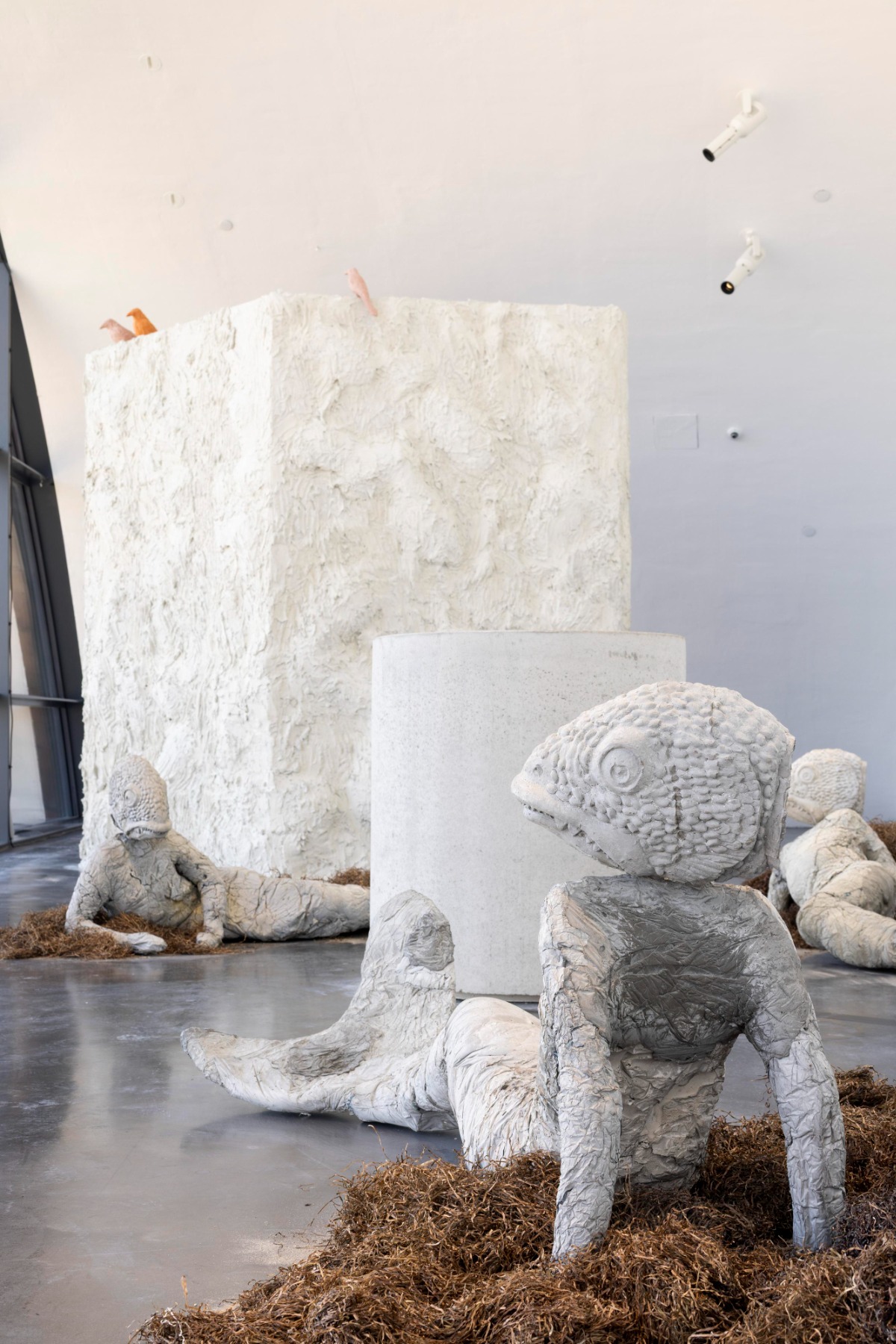
Edith Karlson. Hora Lupi / Hour of the Wolf: Can't See, 2023, 2026. Photo: Finnish National Gallery / Pirje Mykkänen
The way the sculptures are arranged creates a strong sense of tension and procession. Did you approach the installation more like choreography than a traditional sculpture display?
I work from a dramaturgy that I create for the exhibition. I suppose you could call it choreography, but I tend to think of it more as dramaturgy.
Perhaps that comes from having worked on theatre stage design and from collaborating with a curator who is actually a dramaturg. I like creating a movement through the exhibition that feels logical and understandable – at least to me. Sometimes the abundance of elements and works can even confuse me, and when I begin installing them, I need to establish some kind of backbone or structure.
Edith Karlson. Hora Lupi / Hour of the Wolf: Blue Series I–II and Wooden Relief, 2024.
Photo: Finnish National Gallery / Pirje Mykkänen
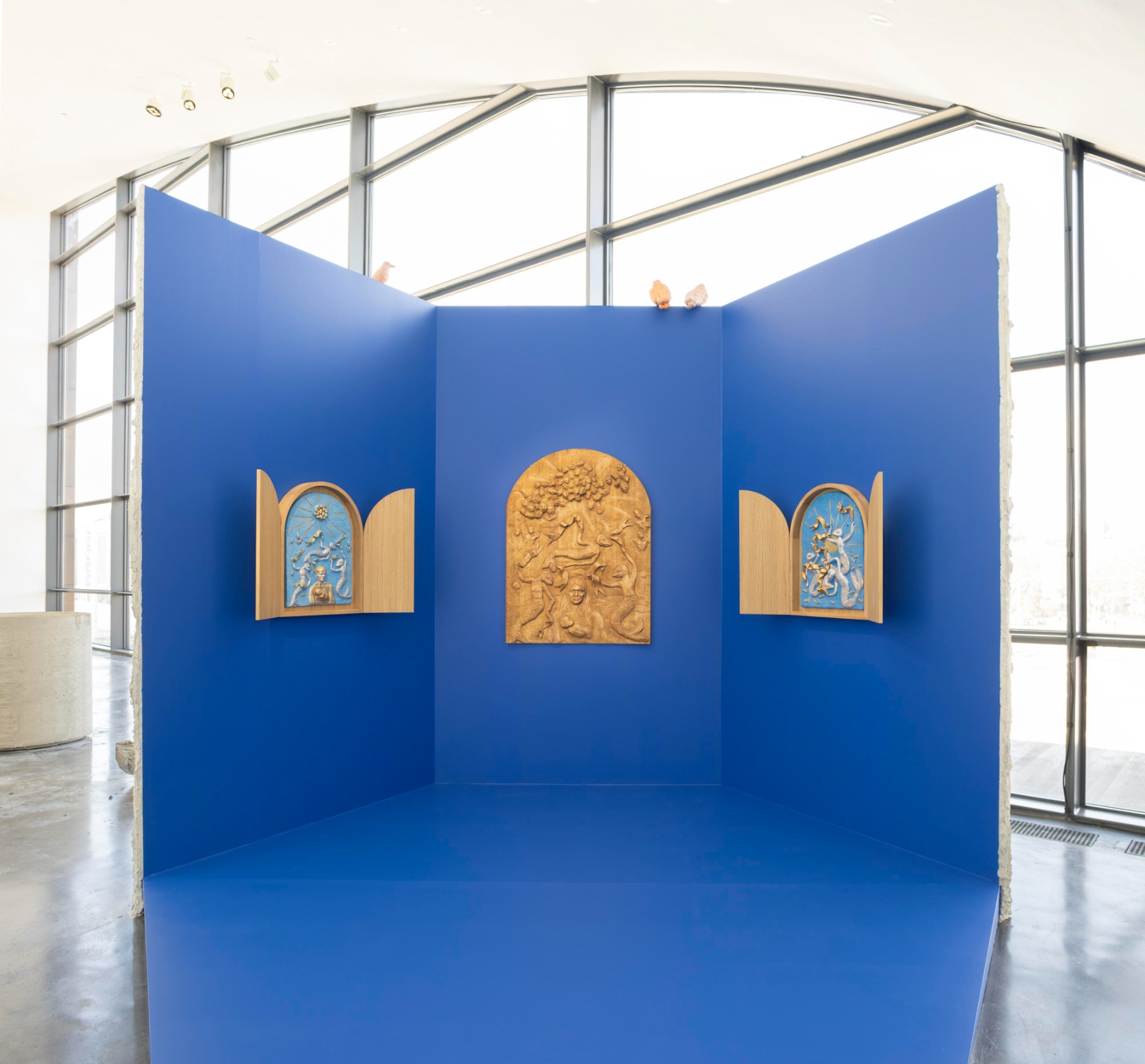
In the section of the exhibition featuring Hour of the Wolf: Blue Lines and Wooden Relief, the installation feels almost theatrical, as if viewers are entering a separate, carefully constructed space held together by the blue-toned walls. Why was it important for you to create this kind of “spiritual corner” within the exhibition?
Here we must again speak about the architecture of Kiasma itself and the logic of the space. When I first visited these rooms knowing I would have a solo exhibition there, I immediately knew I wanted to use the spaces as they were – especially their linearity and monumentality.
I wanted the large rooms themselves to function as large installations, and I didn’t want to place works directly on the walls. But then an interesting challenge emerged, because the curator, Piia Oksanen, had selected certain works that absolutely needed to be included in the exhibition, and some of them could only really exist on walls.
So I began thinking about how to create a situation where the large works could still be experienced from a distance as part of an installation, while the smaller works would not disappear or become overwhelmed by them. That’s when the idea emerged to create separate “chapels” for the smaller works – spaces that from the outside resemble cave walls and remain part of the larger installation, but inside contain their own intimate world where the works can be viewed more closely.
Edith Karlson. Hora Lupi / Hour of the Wolf: Blue Series II, 2024. Photo: Finnish National Gallery / Pirje Mykkänen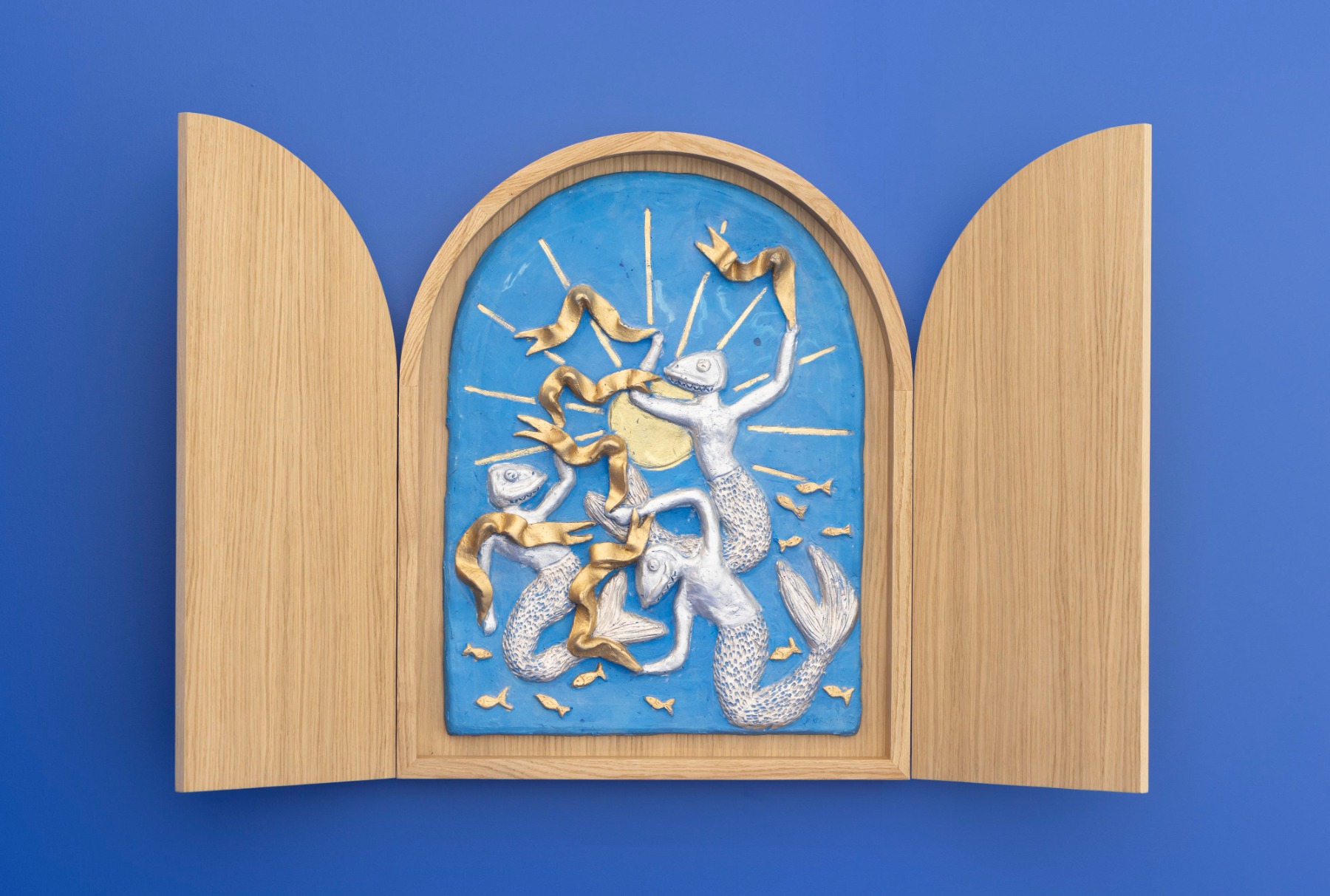
How do you see contemporary sculpture changing in the Baltic and Nordic art scene today?
I’m afraid I’m not the best person to answer that, because I’m the kind of artist who only barely manages to keep up with what’s happening in the art world.
It’s not because of egotism, arrogance, or lack of interest – it’s simply that there are not enough hours in a day. I do my work, and then I go home and try to be a mother to a wonderful boy. The reality is that most of what I know comes through my artist friends and acquaintances.
But perhaps that is also enough to form some kind of impression, and from where I stand, it seems that everything is exactly as it should be. People are making strong work. Everyone is talented, and I admire them very much.
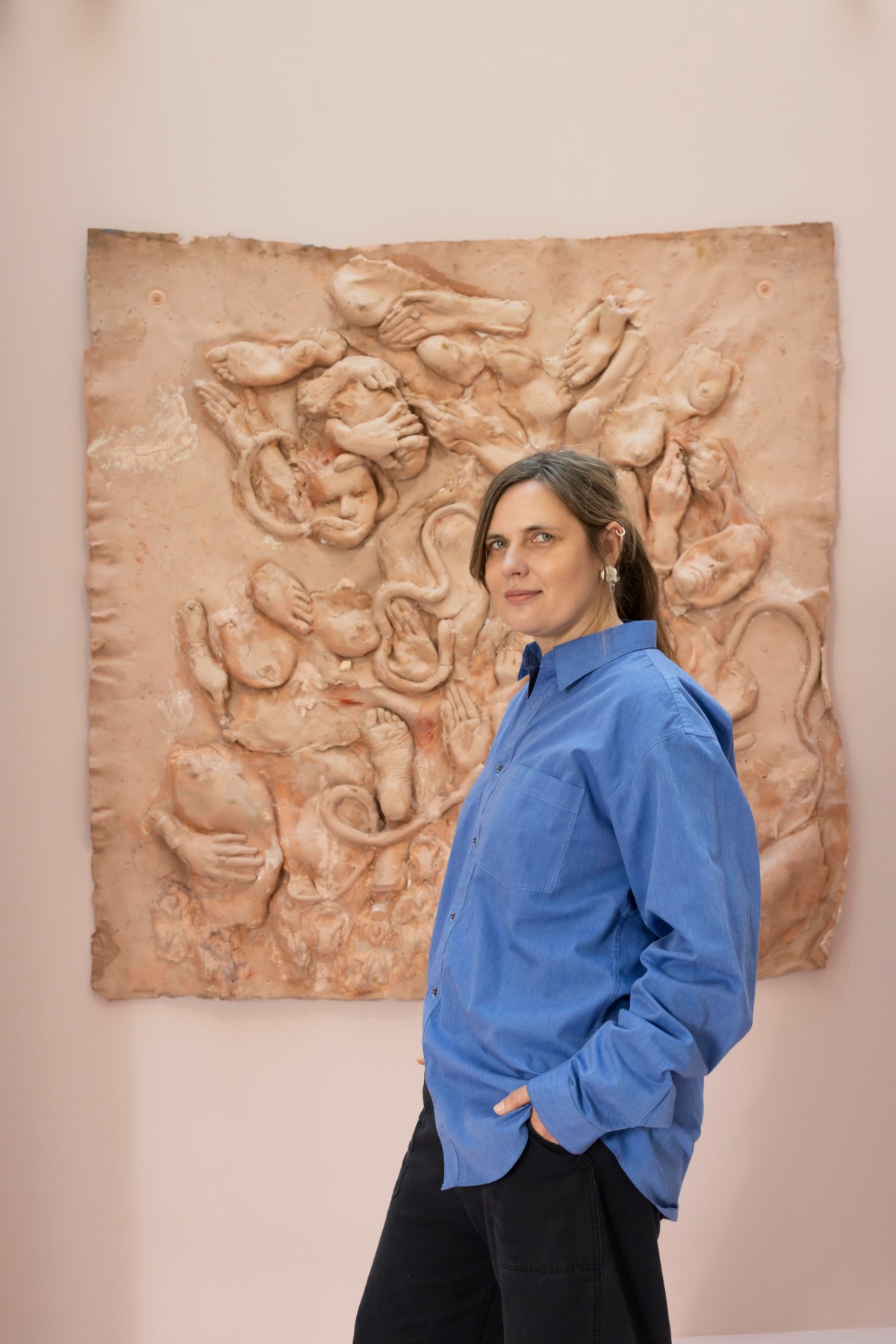
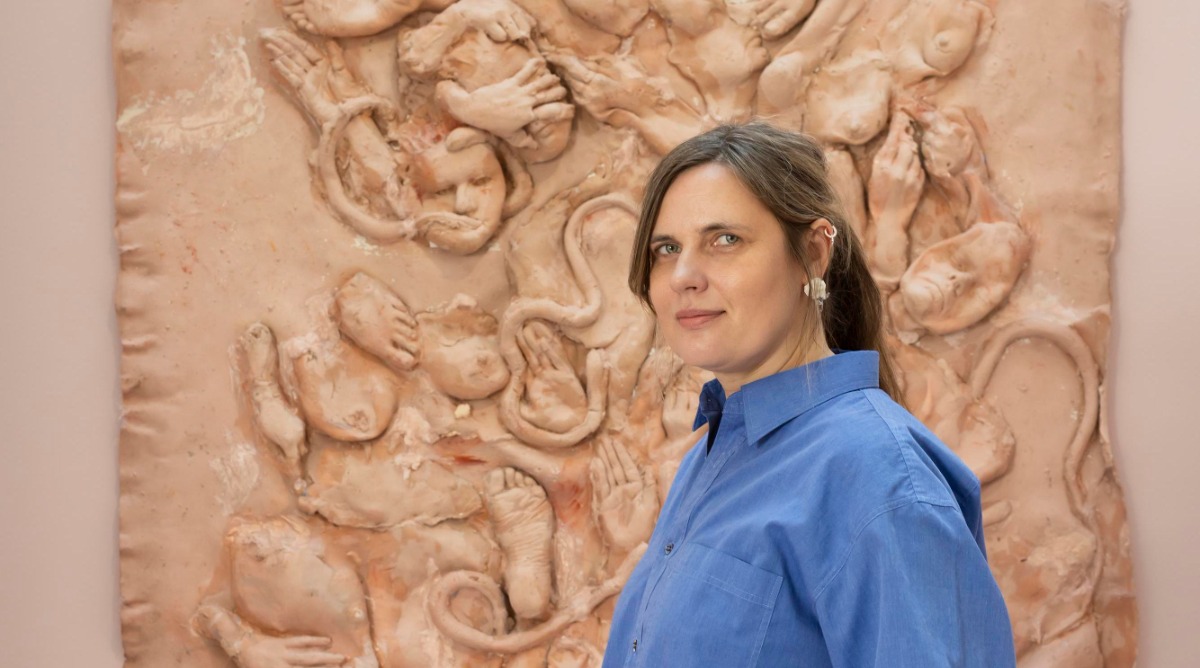
Edith Karlson. Photo: Finnish National Gallery / Pirje Mykkänen