


You can touch it, place a cup on it
Interview with Latvian artist Aleksandrs Breže about his exhibition Threshold, on view at the ASNI gallery until February 21
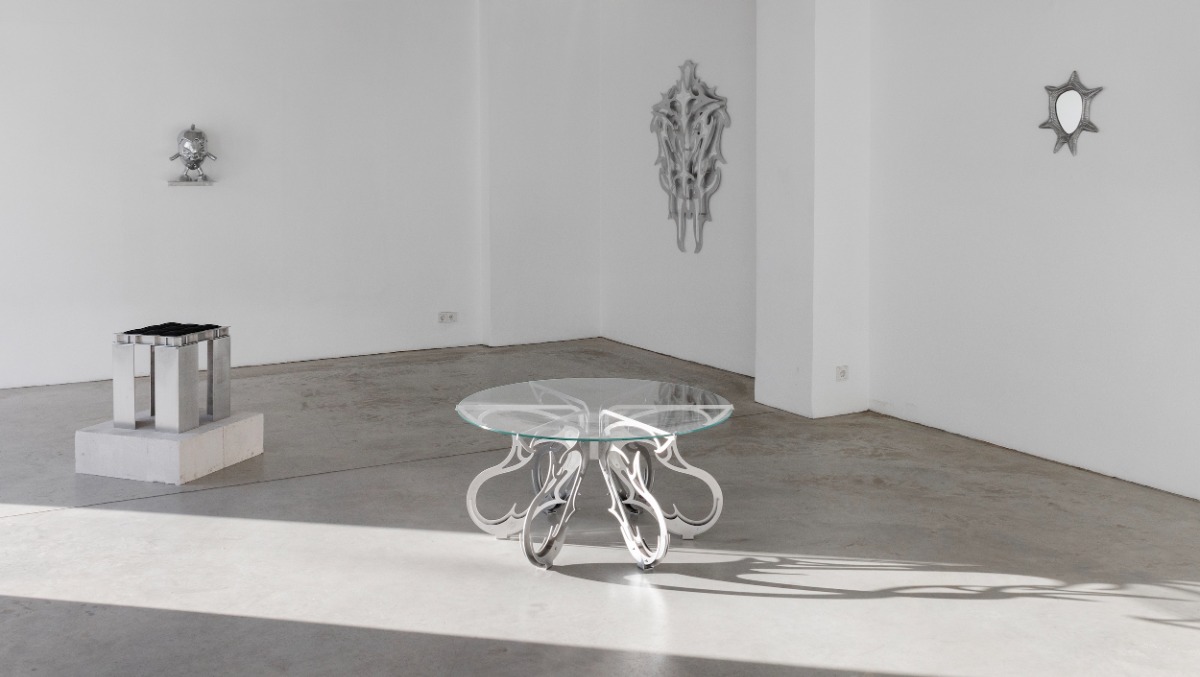
“Aleksandrs Breže’s artistic practice to date is closely connected with the exploration of digital environments and the creation of three‑dimensional abstractions, in which references to the visual aesthetics of the 1990s and the utopias of virtual space can be felt. The artist’s latest series of works marks a threshold state between art and usability: the works visually resemble design objects, yet refuse to fully submit to the logic of functionality,” reads the exhibition text on the gallery’s website. “The exhibition title Threshold symbolically marks this point of transition — the space between the digital and the material, between sculpture and design, between aesthetic experience and potential use.”
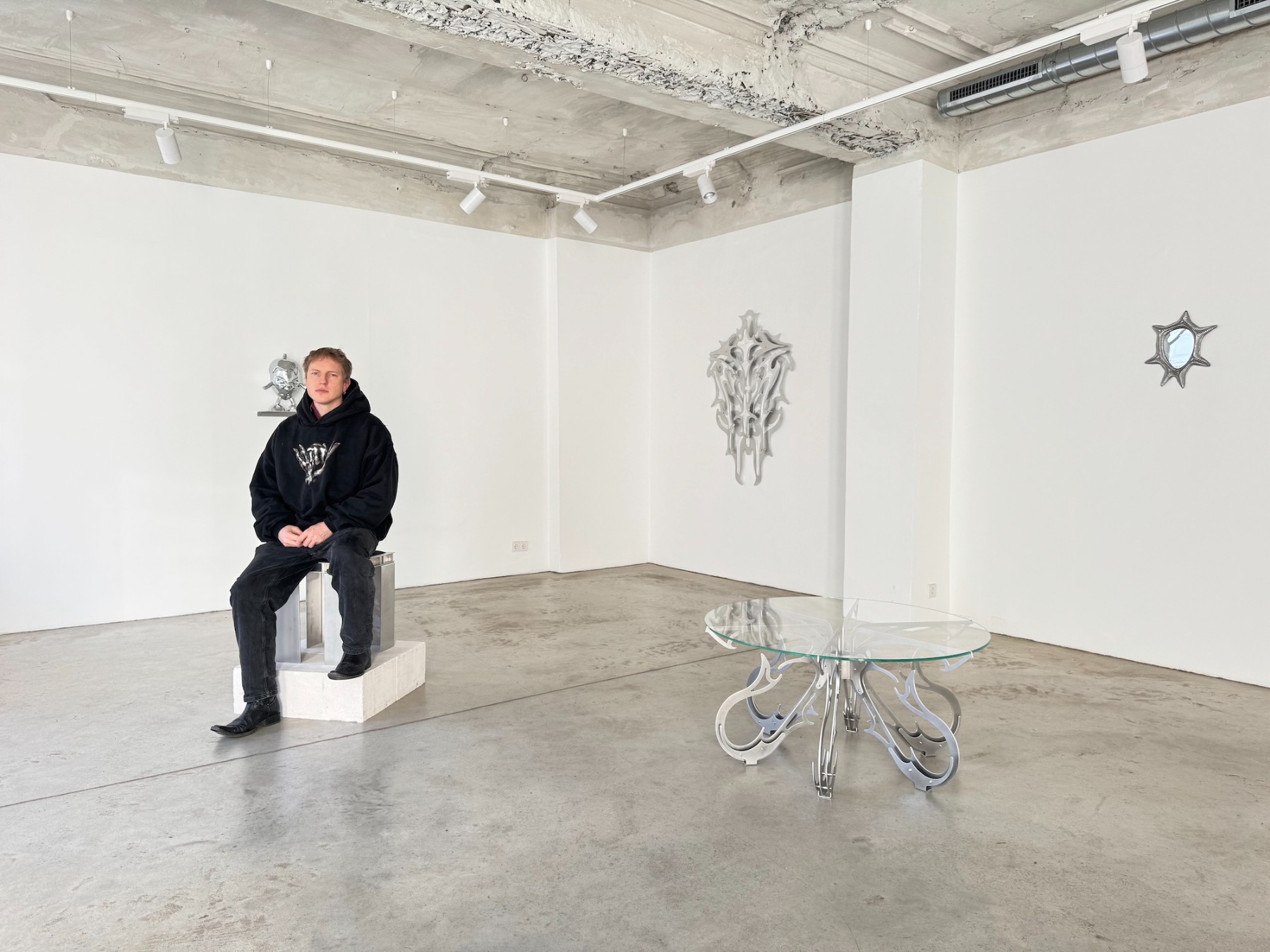
Aleksandrs Breže (1994) graduated from the Gerrit Rietveld Academie in Amsterdam. Over the past couple of years he has had two significant solo exhibitions — Optimism, Confidence, Charity (2023) at LOOK! Gallery in Riga and Succumbing to Temptation (2024) at the Kogo Gallery in Tartu, Estonia, which has hosted a number of exhibitions by Latvian artists in the last few years. Here his authorial style gradually took shape — a world with shadows of Art Nouveau and Northern fairy tales, saturated with sharp forms and various metallic tones, which at times can also find completely practical application. Breže is generally characterized by this fascination with “the narrow distinction between contemporary art and object design,” as curator Šelda Puķīte wrote two years ago in a text about his exhibition in Tartu. “Breže enlivens pieces of furniture and interior elements by playing with associations and blending boundaries between traditional and futuristic aesthetics… Through abstract spatial installations, he explores the clash between written laws, religious values and the harsh reality of institutional control. His art delves into the struggle for individuality amidst enforced conformity.”
But, as he himself notes, those ideas and subtexts discussed by Šelda are less present in his latest exhibition. Still, this tension between tightly welded metallic forms is strongly felt. At the same time, you can sit on some of these things — or use them to look at yourself. There is glass, stone, mirror surfaces, but above all — metal. It was precisely this material that Aleksandrs and I talked about at ASNI gallery, where we met an hour before the regular opening time.
I would like to ask you: why is metal so important to you, especially polished metal?
Can I answer at length?
Of course.
It started quite accidentally. I studied graphic design in both my bachelor’s and master’s programs. During my studies in Amsterdam at the Rietveld Academy, once there was an assignment to bring homework and present it. I hadn’t done it, presentations had already started, and I was just thinking what I could quickly make so that it would look like I had been working on it for a long time. It occurred to me that I should make something out of metal.
I watched a YouTube video about welding while others were presenting their work, ran to the metal workshop, took a welding gun and welded a few rods together. And I was really surprised by the feeling — you take two heavy, monolithic things, join them, and suddenly they can no longer be separated or bent. That stuck with me.
After several years I realized I was tired of working with graphic design. When I finished my master’s, I couldn’t sit at the computer all the time anymore. I wanted to work more with my hands. I started with wood. But wood is complicated — it expands, shrinks, cracks, changes with the seasons. You make a table and if you glue something wrong, after a year it can be warped or cracked. With metal, in a way, it’s simpler — harder to work with, but afterwards much simpler. I have no formal education in metalworking, so I just kind of poke my way forward.
Foto: Kristīne Madjare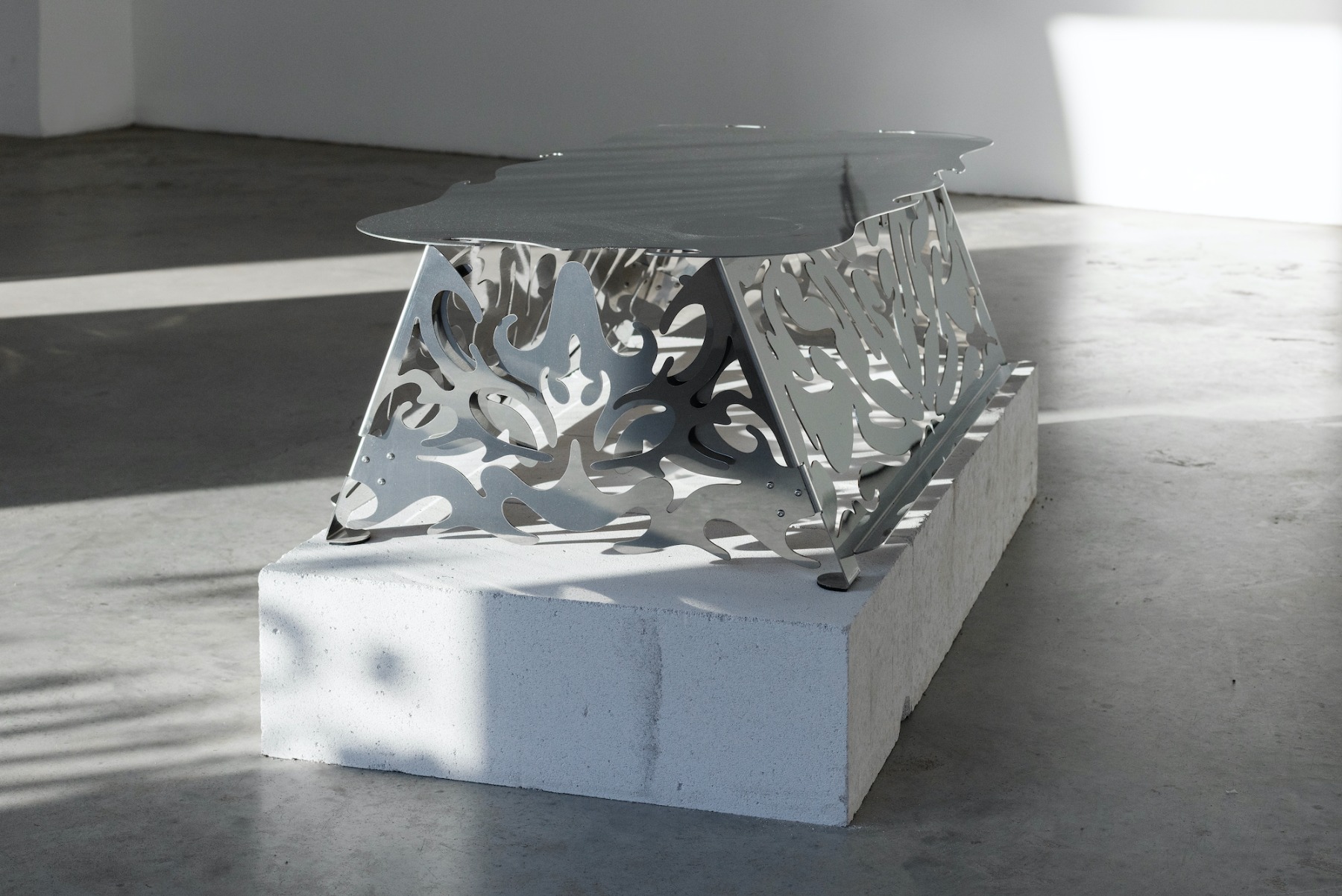
Do you like metal visually as well?
Yes. It feels aesthetically cold and self‑sufficient. My design used to be quite minimal too. I’m simply very bad with colors — I don’t really see warm and cool nuances. Everything related to color has always caused me problems. So metal makes life easier for me in the sense that I only have to worry about tonalities.
Sometimes you polish the surface, sometimes you leave it unpolished. How do you decide?
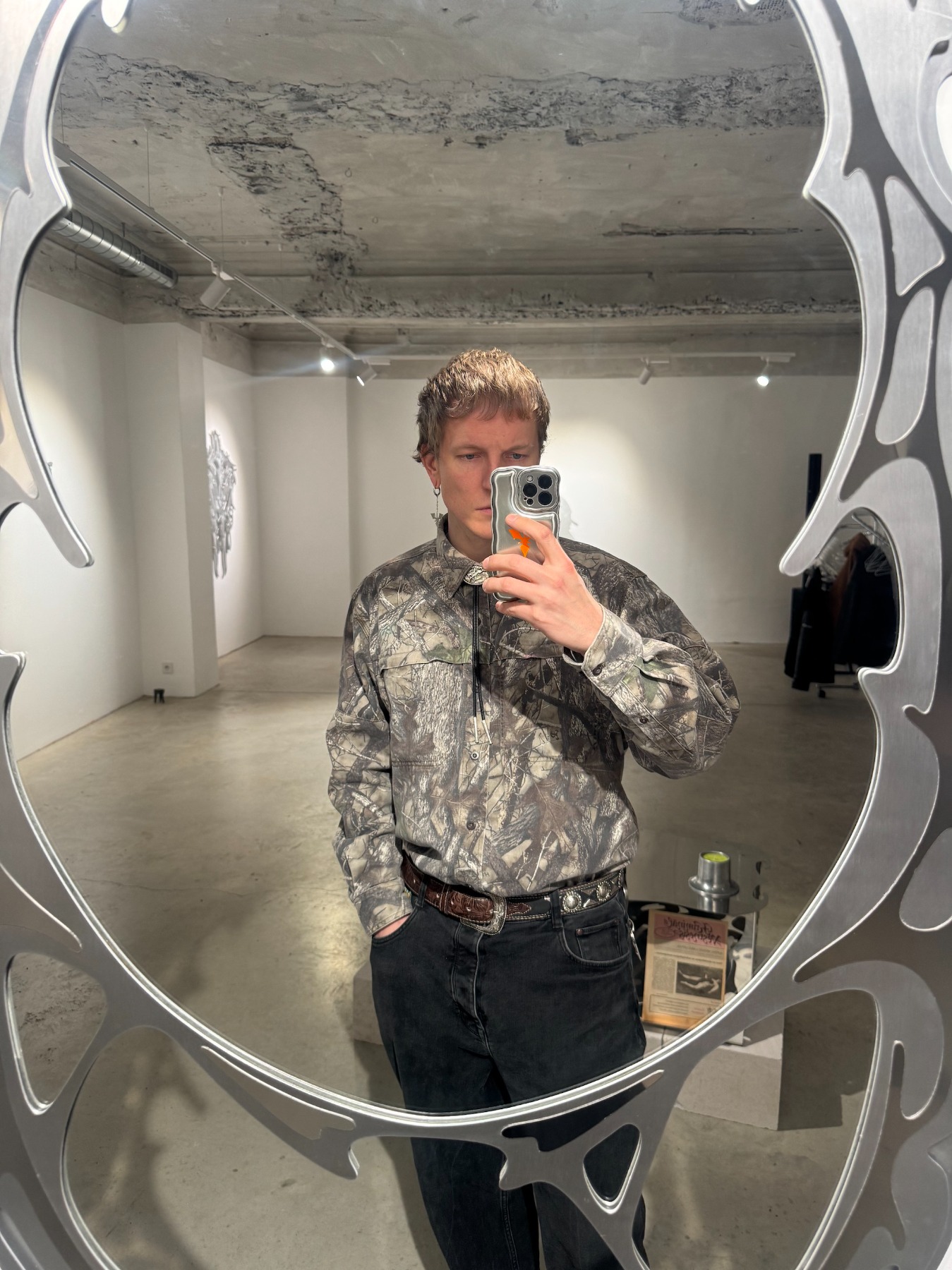
Intuitively. First of all, a lot depends on the material. Aluminum, for example, loses its polish very quickly. Stainless steel can be industrially polished, but I like to mix. For example, in this mirror — the frame is aluminum, but the small details are polished steel, and they reflect like a mirror but slightly differently. Then an interesting interaction forms between the surfaces.
Foto: Kristīne Madjare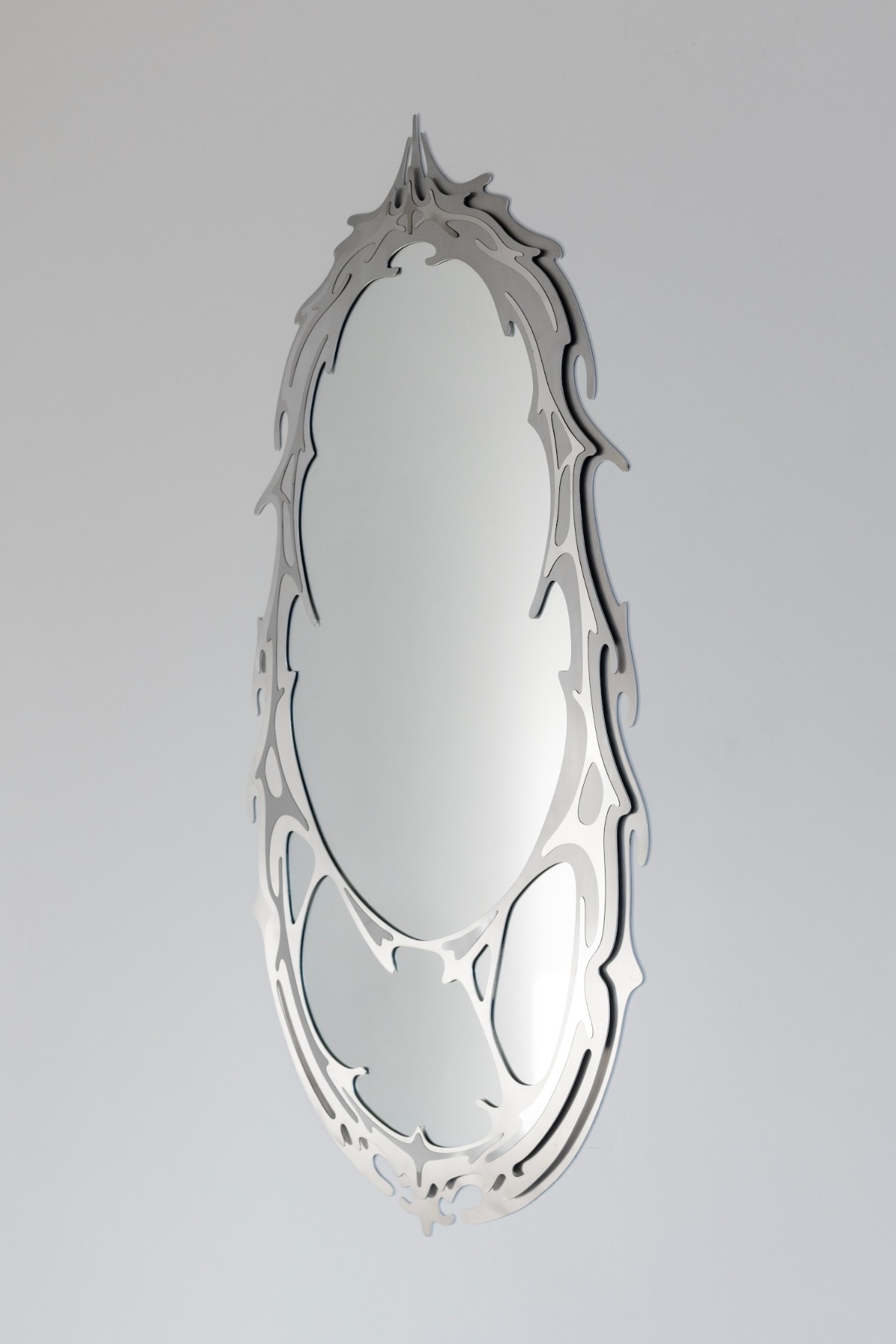
Mirrors and metal strongly echo each other in your work.
The mirror is more about function for me. There’s nothing very deep under it. I simply like things that can also be used functionally. I know I won’t sell all the works from the exhibition, so some will end up in my apartment or basement. But at least the ones that go into the apartment I can sit on, put something on, or look at myself in.
There are also other “domestic objects” in the exhibition — a table, a chair.
Yes, I like when an object has a use beyond “decorative art.” In the previous exhibition at Kogo Gallery in Tartu the objects had no function, but now I wanted to move a bit away from art, more toward design. In general, Elīna Drāke and I also talk — why does everyone search so hard for the boundary between art and design? For me personally that boundary isn’t that important.
Foto: Kristīne Madjare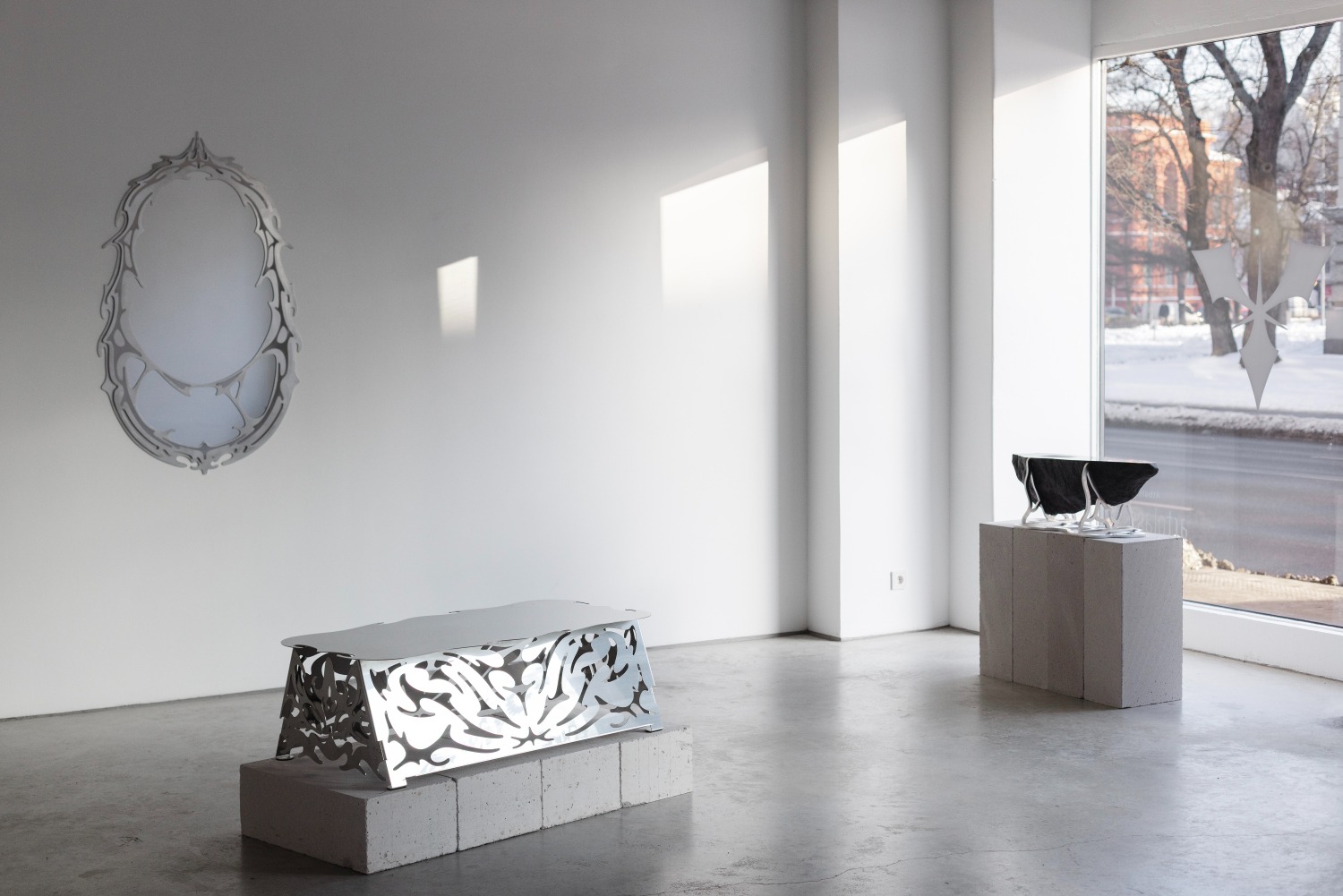
Do these objects form some kind of message in the exhibition? What was your intention?
I don’t know. And I don’t want to assign heavy symbolism to a small table. What’s more interesting to me are technical details — how something is developed, what kinds of joints, nuances. And I’m always trying to get away from sharp forms, but it doesn’t work. They naturally come out. It’s interesting to see how they change over the years.
You also call the exhibition “Threshold” — from one stage to another?
That’s the idea. I’d like to focus much more on interior objects than on purely visual ones… But I needed Zīļuks to gently bring the whole space to life. (Zīļuks – a character from the children's book Zīļuks, written and illustrated by Margarita Stāraste‑Bordevīka – ed.).
Foto: Kristīne Madjare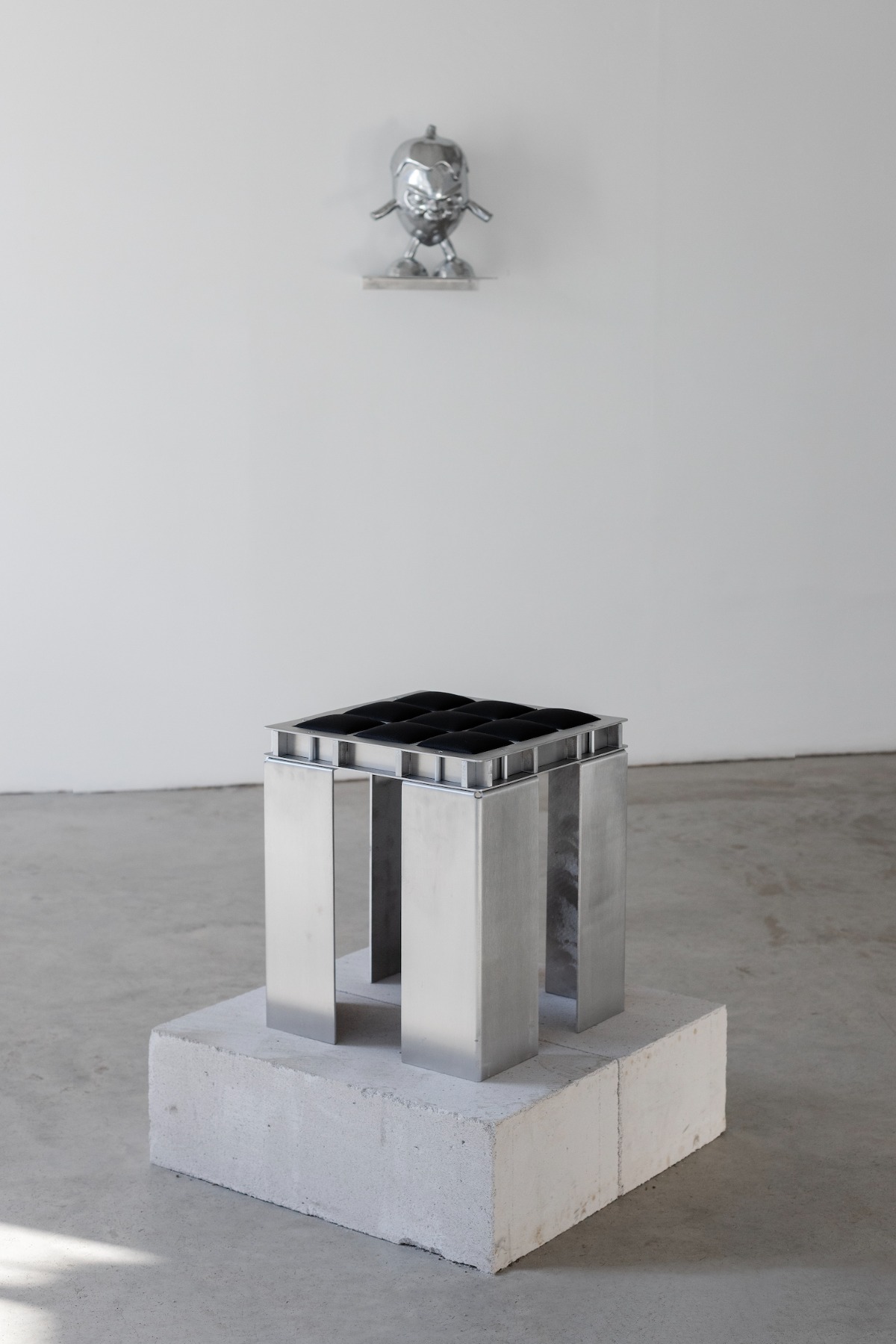
Why was Zīļuks important to you?
Those slightly nostalgic, coming-of-age-related figures and objects had already surfaced in my work before. In fact, I created Zīļuks a long time ago in a 3D program, but I never felt the moment was right for him. In the end it turned out to be a kind of self-portrait, in a way. And a lot of people at the opening said he even looks a bit like me. (Laughs.)
Foto: Kristīne Madjare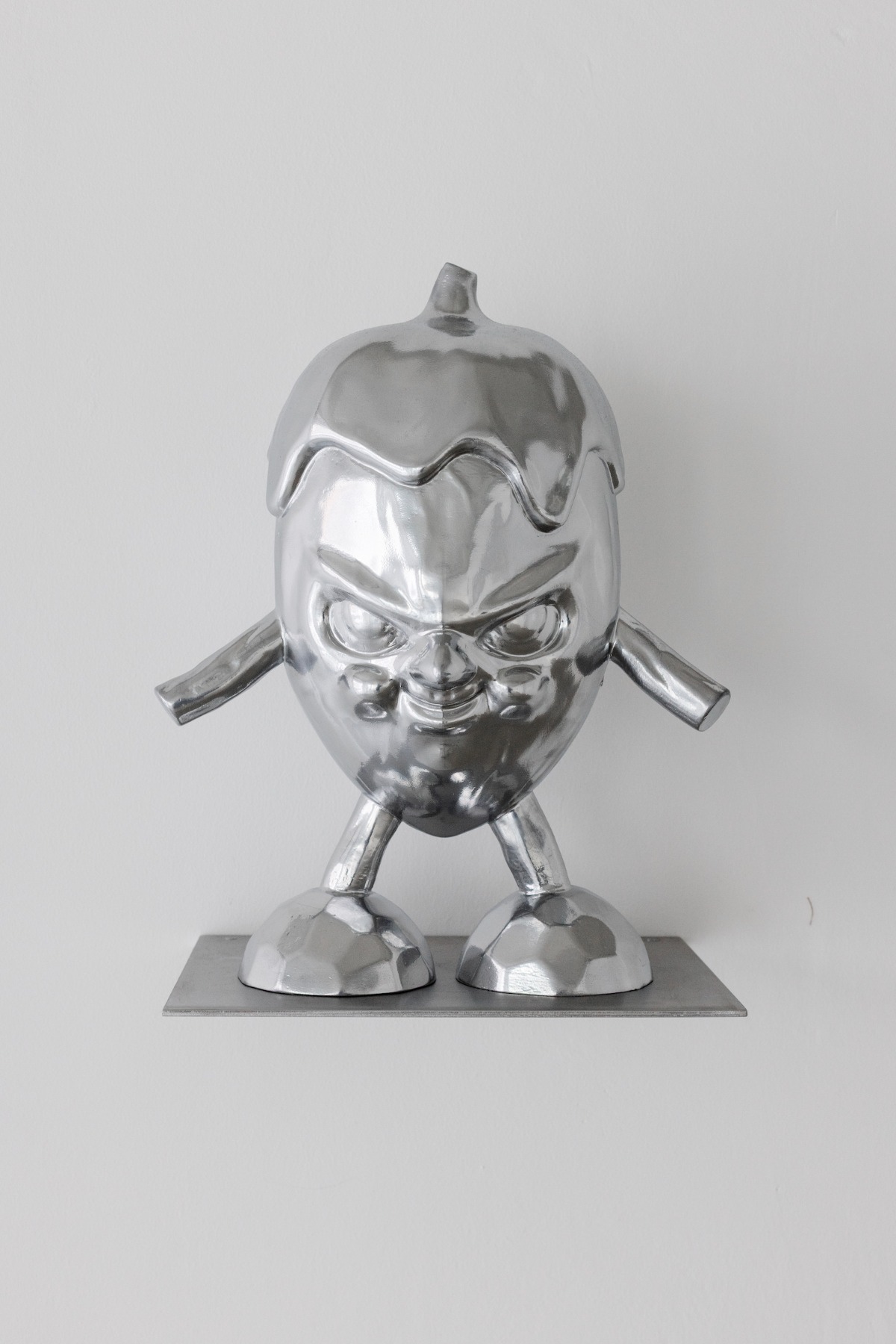
And you’re moving away from the digital environment toward materiality.
As much as possible. I worked for years in graphic design — branding, posters, book design. It went quite well, but I didn’t have satisfaction at the end when receiving the printed book or poster after weeks of work. I always felt I wanted to do more with my hands. With a physical object it’s different — you can touch it, put a mug on it, sit on it.
The process still starts on the computer, but in the end there’s a lot of hand work — sanding, screwing, surface treatment. That stone, for example, I carved myself. I found a huge stone by the sea. A sculptor asked for 2000 EUR to cut and polish it, so I decided to learn myself. After a week of carving and sanding, I understood why he asked for that money.
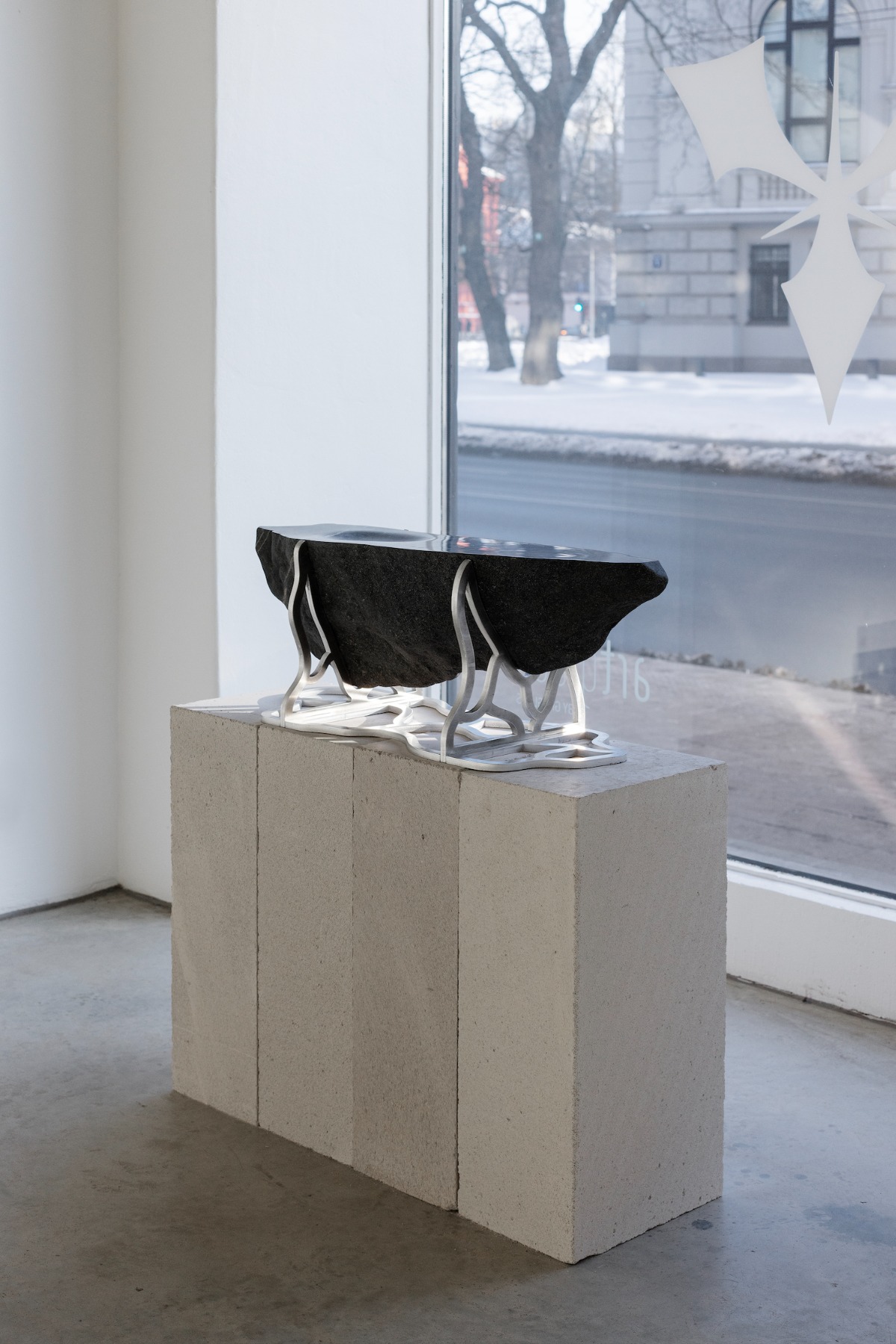
I recently spoke with Edd Schouten, the artistic director and curator of the art space TUR. He said that, in his opinion, many Latvian artists are handy.
However, I’ve noticed that many can accomplish a lot, but they all have these artistic, technical shortcomings. They don’t delve deeply into the technique and understand it only superficially, just enough to quickly complete their specific work. And that is very noticeable. Of course, there are exceptions, such as Uģis Albiņš, who really goes in-depth into technical details and execution.
Foto: Kristīne Madjare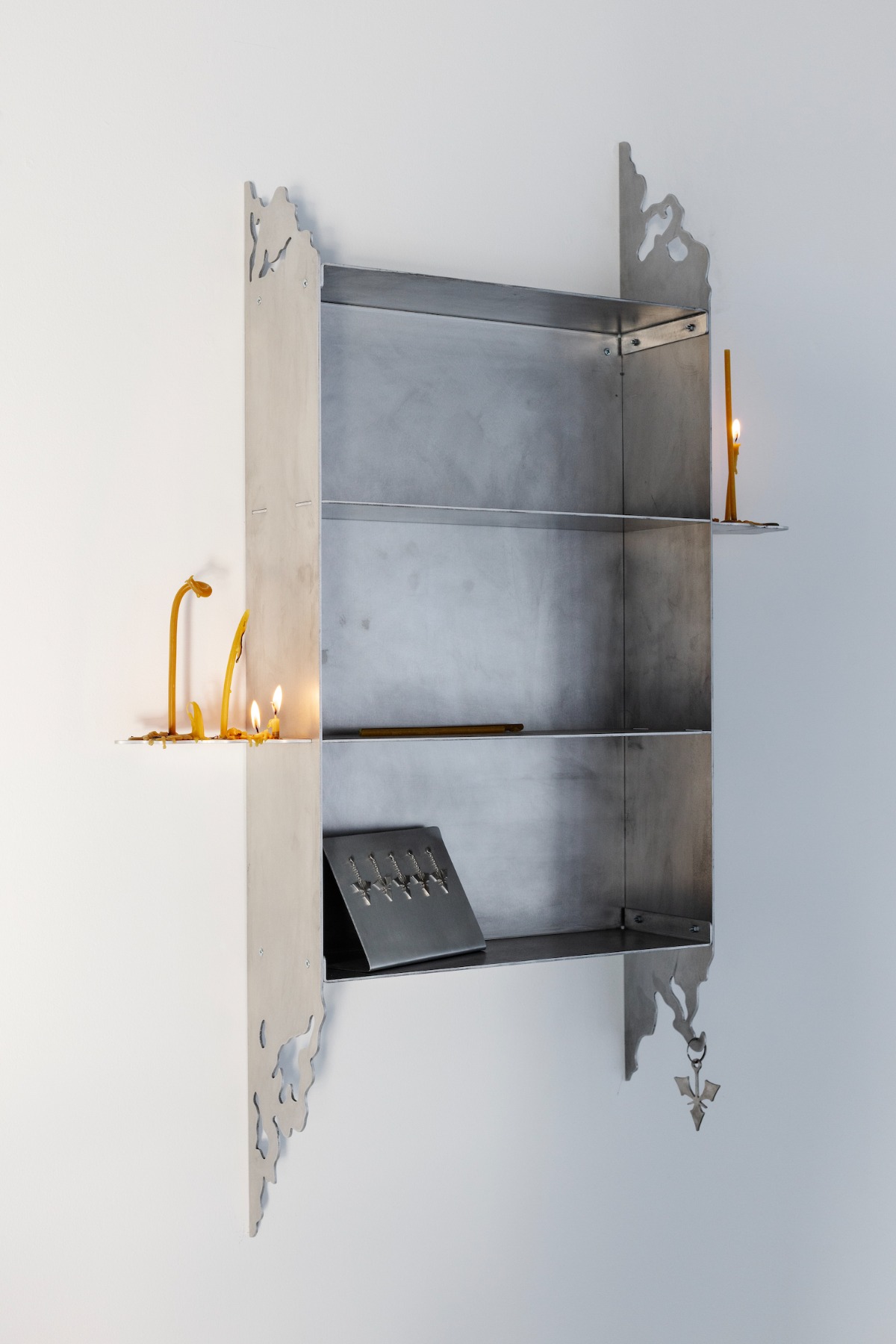
But here, in the exhibition, there’s also a somewhat mystical element, in my opinion. There are candles on a shelf…
In all those previous exhibitions I’ve done, there was always incense in the corner. It’s like in a church… that smell. Many of the forms come from the time when I spent three years at a Christian boarding school in England. My mother sent me there when I was about 15, and it was a very strictly religious environment. The shapes from the school and the church stuck with me. And somehow, they travel with me.
I also told Elīna that it’s not purely a ‘90s tribal aesthetic – I personally see connections with Art Nouveau forms. Something in between has been mixed together.
Foto: Kristīne Madjare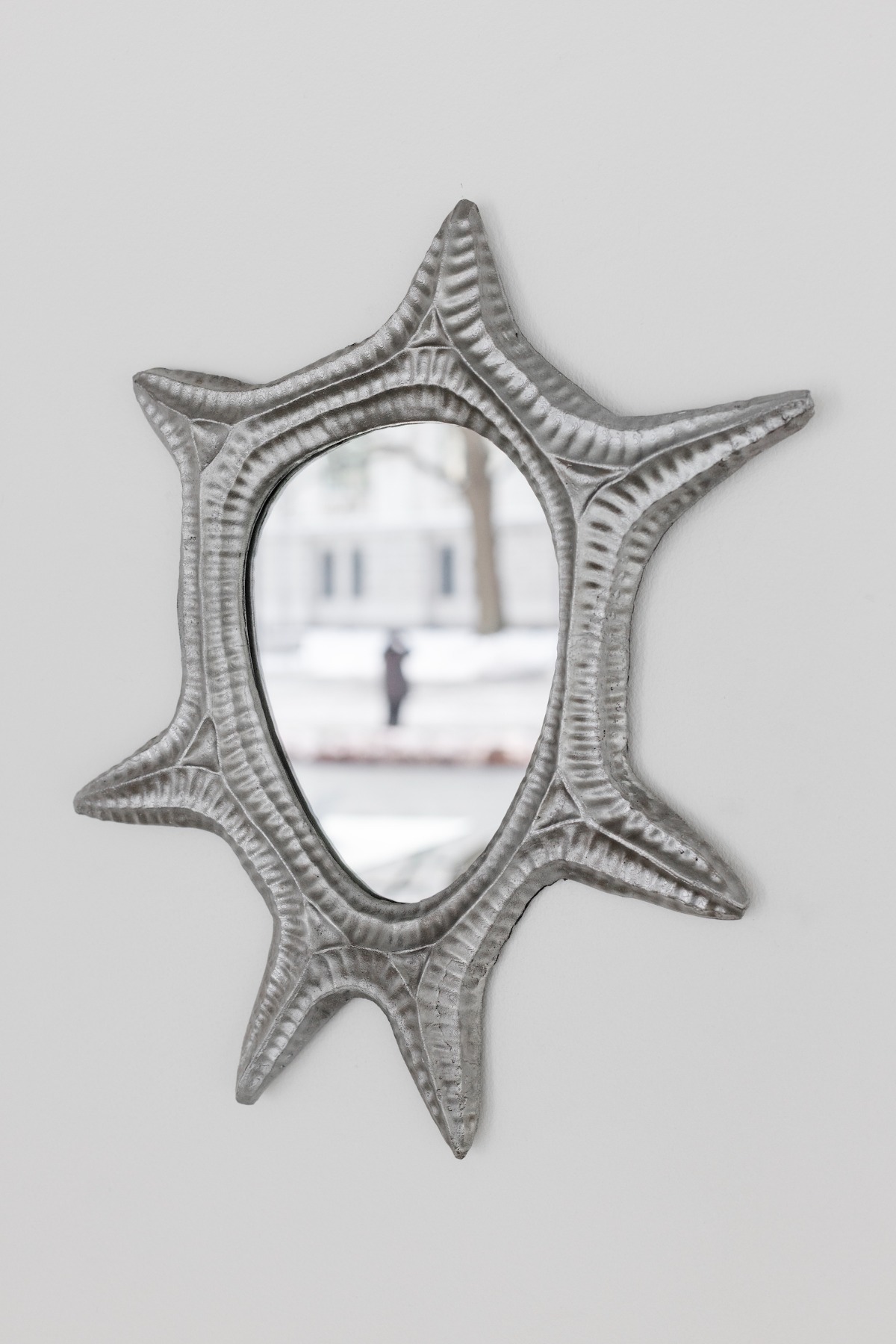
Or even the Middle Ages…
My first exhibition at LOOK was purely about that. I even had a large wooden prayer chair there. Nowadays, I’m not really interested in religious themes, but those forms still sit somewhere inside me. And those candles somehow popped out anyway. (Laughs.) Something had to be placed on that shelf, otherwise it would have felt too empty. But overall, there’s some kind of… mystical tale here. Narnia.
Something between The Snow Queen and Narnia.
The nightmare zone of The Snow Queen…
But there are books on that little table?
Books? Yes. I just wanted to show the function at the opening – that the coffee table has that edge where you can place books. So I took a few from my own bookshelf.
There’s an interesting combination of books there.
One of the books is Kriminālais Vēstnesis. In my opinion, it’s an amazing publication that, back in the 1990s, printed photos of mafia corpses with absolutely no censorship. In Mexico there was a magazine called Alarma that also published all the cartel killings. Pretty wild.
And the other one is a photo album from Belgium about cocaine smuggling. And then the one in the middle is the best. English football clubs had these business-card-style cards (they called each other “firms”) with quite witty texts. When someone got hit over the head, they’d put the card in their pocket. Someone had collected quite a lot of these “business cards” and made a publication out of them.
But there’s no subtext to look for there. They’re just the first books I grabbed from my shelf — and I didn’t want to take anything boring either.
The day before yesterday I watched your 2015 film about inspiration on YouTube.
Oh God! I’ve written to the Jānis Rozentāls Art School asking them to delete it. It’s absolute madness! But it’s my diploma project.
Why madness? I’d say it’s a very cool little film.
I was a complete nutcase back then. I really hoped they might take it down, but the film belongs to them. So… (Laughs.)
Foto: Kristīne Madjare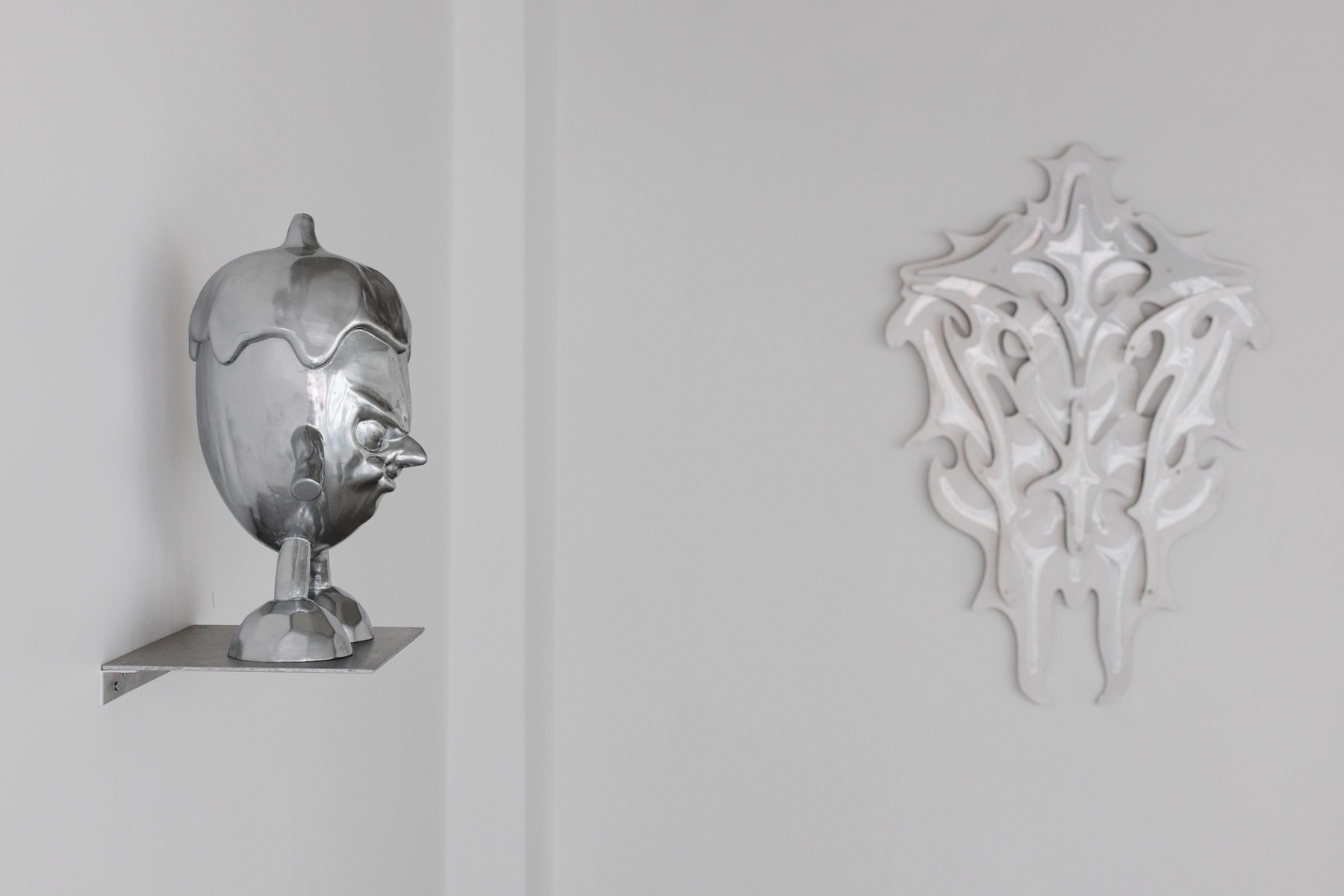
Back then you went to different places where people usually find inspiration and didn’t feel anything. But what inspires you now?
When traveling, things soak in. Very often I wake up with a very specific image in my head — what I want to make. I wake up and the idea is already mature. That happened with at least three objects in this exhibition. Often, I solve technical problems in the moment of waking up. It’s strange.
I also get inspired by technical, engineering things in everyday objects. And I’m very inspired by tools. I love tools. I have many that I might never use — I just like having them. Often the idea comes from thinking what to make with a new tool, not the other way around. I recently bought a lathe and made my own screw from scratch — pure pleasure.
Foto: Kristīne Madjare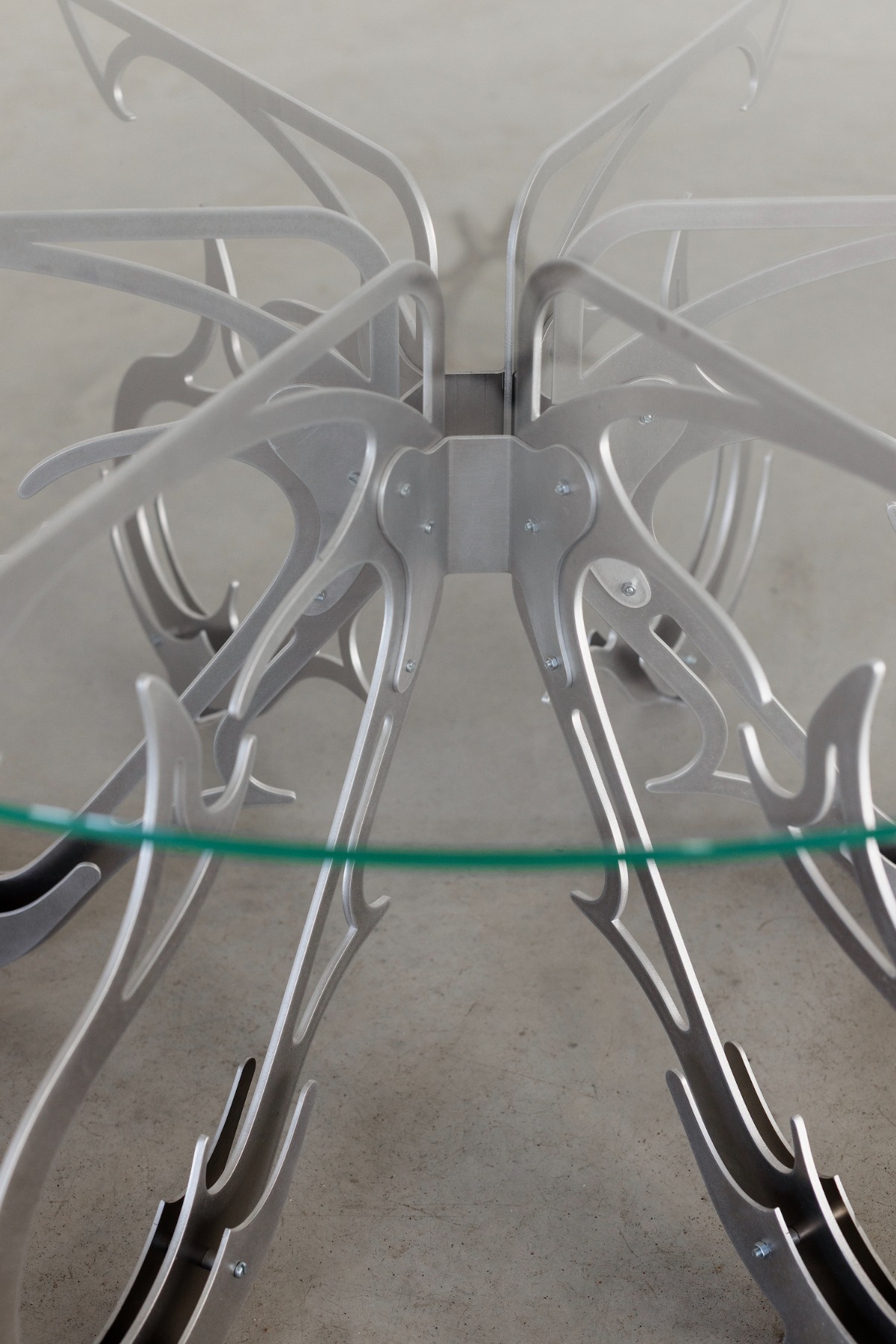
I saw that your objects are also used, say, in clubs, music festivals… Is this environment important to you?
My friends hang out there… I’m also somehow a part of that culture, even though I’m not much of a dancer myself. But it’s a way for me to get involved. And I’m happy that afterwards everyone posts pictures from the events where my pieces are visible and have added to the atmosphere of the event.
Foto: Kristīne Madjare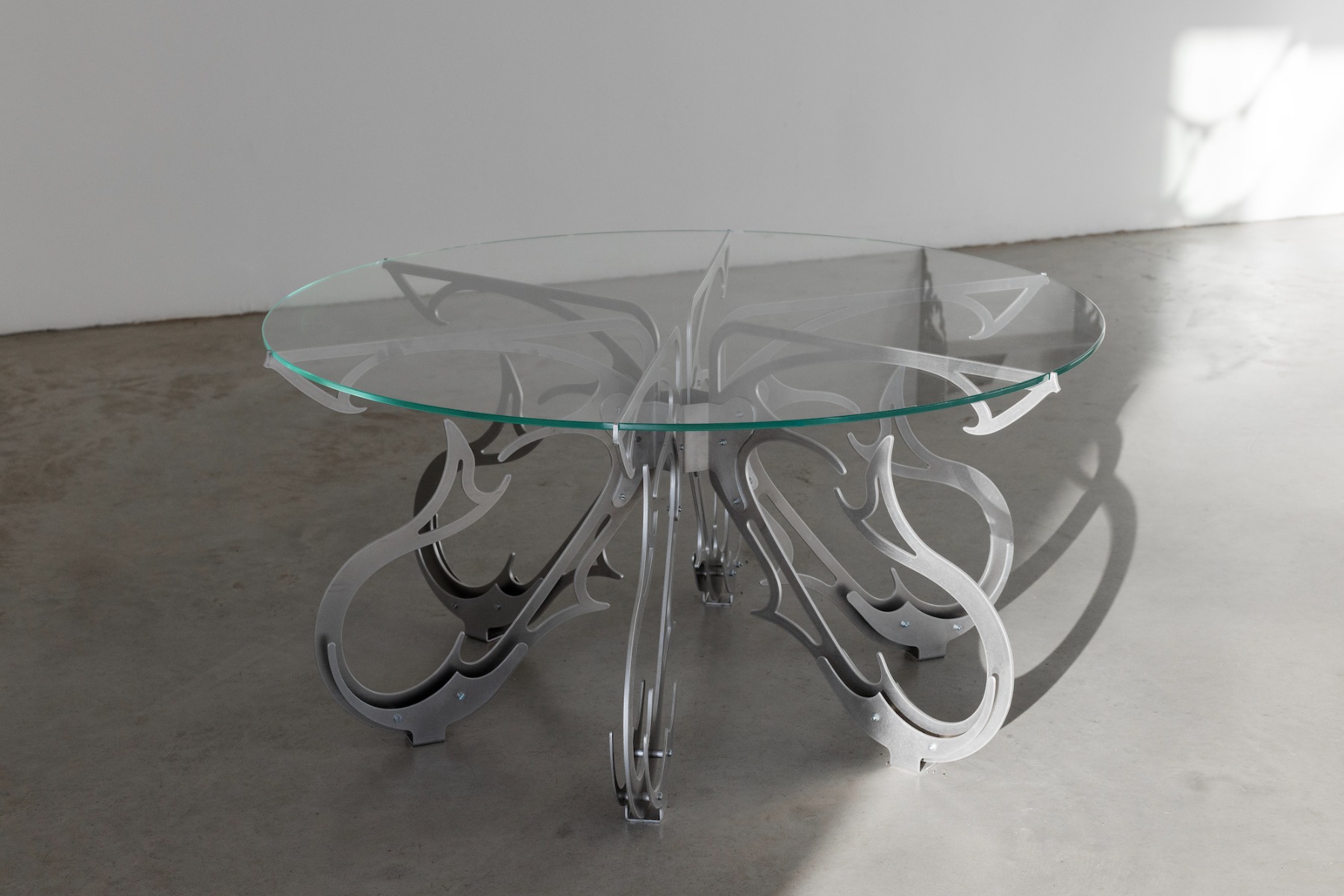
Do you feel that there is a generation of artists you can relate to? Perhaps those who work with both digital and material media?
Yes, but not here. I mostly have friends online who come from abroad and make somewhat similar pieces – somewhere between art and design. I haven’t really gotten to know those who do something like that here. Most of the people here who do it have a background in design or architecture, which I don’t, so I feel a little different. From that design crowd, I definitely feel a bit excluded. And also from those who work with metal, I feel separated, because the guys there have completely different skills and expertise – skills I can only dream of.
Although one acquaintance like that actually came to the opening and said it was really good – that made me genuinely happy. But I don’t feel like I have a kind of ‘generation’ of my own in art here in Riga or anywhere. I know that my father (Latvian artist Andris Breže – ed.) had that very clearly – a real artists’ community.
I also noticed that my father’s generation… they don’t really understand what I do. Well, this exhibition he likes, but before, he used to call everything I made ‘Chinese knick-knacks.’ For his generation, cleverness was very important; everything had to have some kind of joke or trick. Now I’ve somewhat gotten him used to my work.
But what kind of emotions actually are in your works?
There’s a kind of joke too. I don’t want to be completely serious. But I try not to look at my works too much as art – like they need to carry some big, serious message.
Do you just enjoy it?
Yes, I just enjoy it. I’m interested in something completely different – the technical things we were talking about. I don’t want to burden myself with thoughts about why or what I’m saying to anyone through it. So I just make what interests me. If someone likes it – good. If not – also fine.
