


Modern hell is pink
An interview with Latvian artist Jānis Mitrēvics
Until May 24, the personal exhibition Dollhell by artist Jānis Mitrēvics is on view at the Art Station Dubulti, where the image of an industrially produced doll lives in paintings and porcelain sculptures. “Doll. Hell of dolls. Dolls are usually played with. Games can be different, but the doll is a very grateful model,” he says himself.
In a spacious and bright space, large-scale works are displayed, created by combining various techniques. They seem to lightly levitate and resemble wall paintings in some modernist temple. They tell about the lives, passions, and experiences of dolls, yet behind their seemingly naive and slightly empty eyes, a deeper layer is revealed. The world of dolls is our own world – contradictory, full of irreconcilable views, where agreement is often impossible. Porcelain dolls are placed on the upper floor. Altogether, it somewhat resembles the phantasmagorias of Hieronymus Bosch, only without monsters and the flames of hell.
“I think modern hell is pink and perfectly packaged in many wrappers,” says Jānis during our conversation. We sit in a small room above the stairs to the second floor and observe various visitors – young and older, alone or with partners or children – looking at his works.
“In the solo exhibition Dollhell, Mitrēvics speaks both about the world and about art as such. In stories about the world, the artist is interested in figurative generalizations. For example, how society manifests itself and in what generalizations it can be shown. How an era manifests itself and how to show it. How politics manifests itself and in what symbolic images, colors, and relationships it can be shown. Social and political ‘bubbles’ are important sources of metaphor for Mitrēvics’ imagery. The titles of the paintings and sculptures succinctly name the state, symbol, or insight that guided their creation – ‘Choice’, ‘Gain’, ‘Stairs’, ‘Back’, ‘Instruction’, ‘Babel’,” writes curator Inga Šteimane.
Babel. Oil on canvas, digital print, 360 x 400 cm. 2025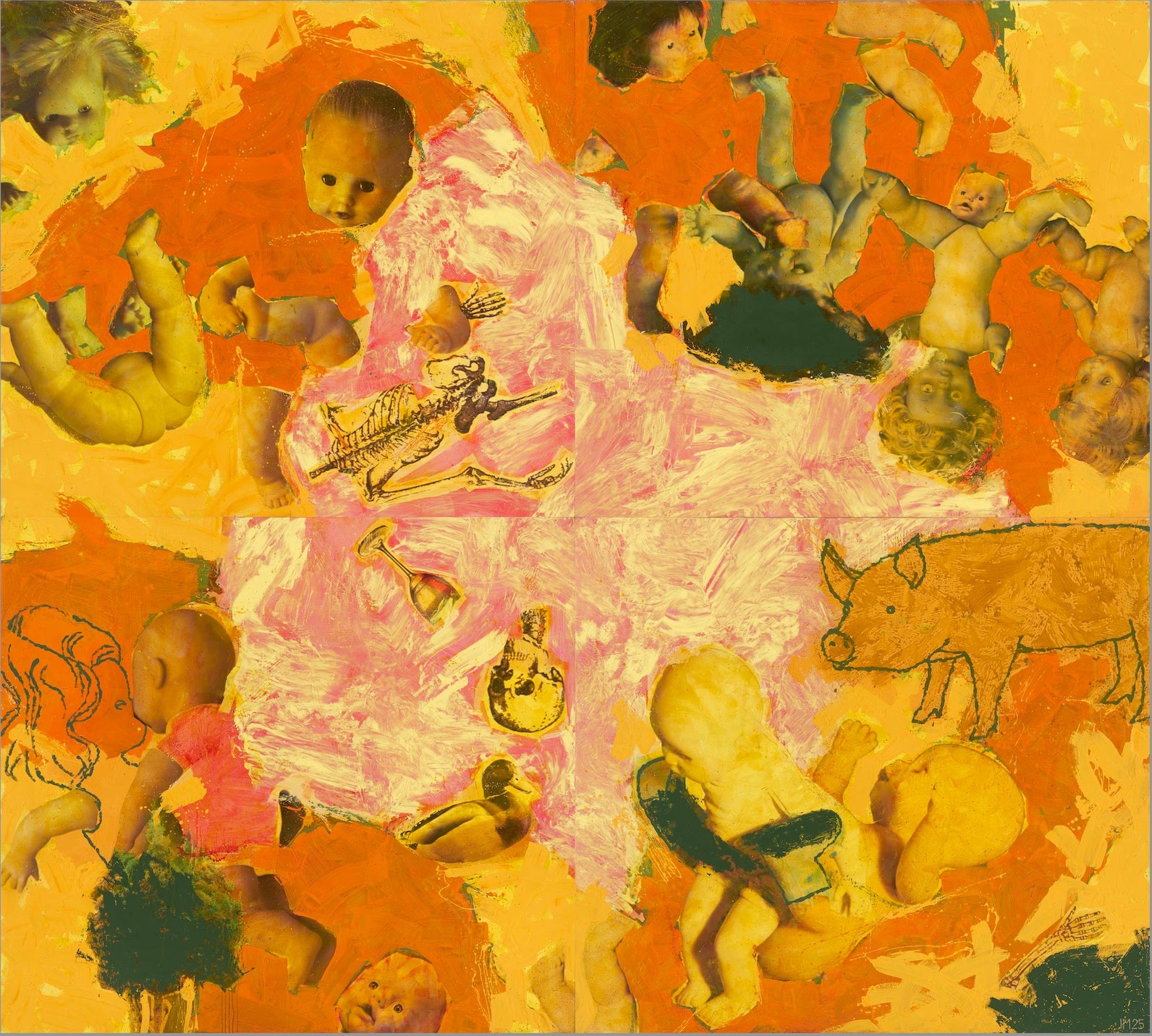
Jānis Mitrēvics is one of the members of a group of painters who in 1990 organized the legendary exhibition “Gentle Fluctuations”, where both the importance of process and the presence of the author were essential. It was called a “theatre of painters”, because the works were created in front of the viewers. He was also close to the group’s shared style – vivid neo-expressionist painting coexisted with environmental objects and postmodern practices of citation and appropriation. Later, in the second half of the 1990s, his solo exhibitions featured digitally processed photographs transferred onto canvas with silkscreen and then painted over, merging documentary and fiction. Since the 2000s, after founding “Dd studio”, Mitrēvics has focused on museum exhibitions and digital solutions, implementing dozens of projects in Latvia and abroad.
“When in the 1990s the usefulness of painting was being questioned, Jānis Mitrēvics emphasized painting as a universal language of art and a basis of artistic expression, even when using alders, ropes, leather, plastic, Soviet high-rises, ducks, text, and video cameras,” writes Šteimane.
After about 20 years, he returns again to the materiality and energy of painting, creating a whole world titled Dollhell.
Jānis Mitrēvics. Photo: Jānis Deinats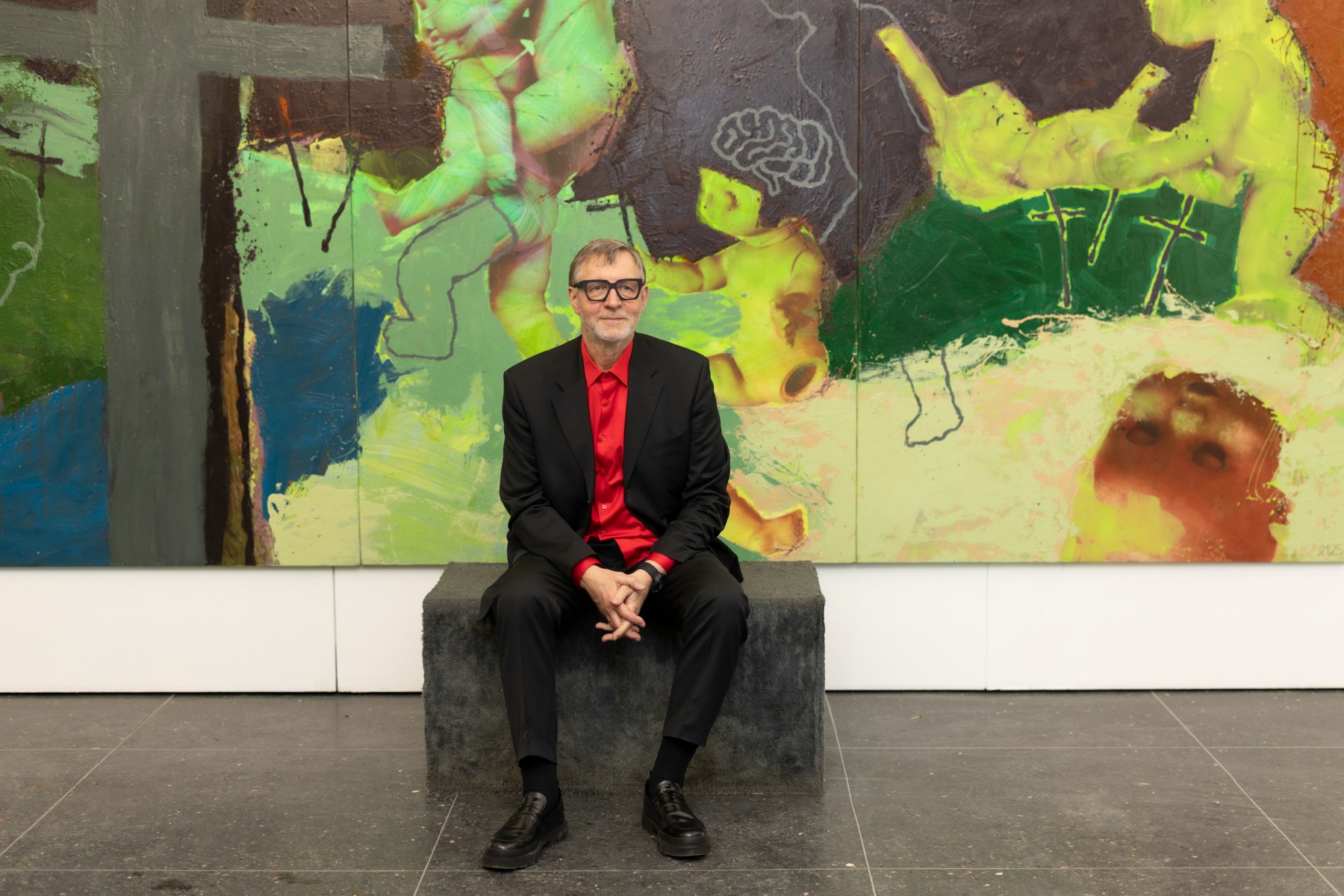
There are many large-scale works in the exhibition. Where and under what conditions did you paint them?
In my workshop in a barn in the countryside, in Zosēni. It’s an interesting place – actually one of the highest points in Latvia. Zosēni is about 200 meters above sea level, and there is also a meteorological station there. Gaiziņš is higher, of course, but there is no observation station there, so in a way Zosēni “rules”. My studio is in an old farm building – a barn built around 1936 or 1937.
That house itself has an interesting story. In the 1990s, friends and I brought video cameras from New York, sold them, and used the money to buy country houses. Almost everyone in our group got one. I was the last – I just got tired of going to others’ work bees. But no one came to mine anymore, because everyone already had their own.
Does this “statistical height” of Zosēni influence your thinking?
Probably. From there you can really look far into the distance. But this exhibition is not only about Latvia. I think it is more about civilization as a whole – about its current condition.
Gain. Oil on canvas, digital print, 180 x 150 cm. 2026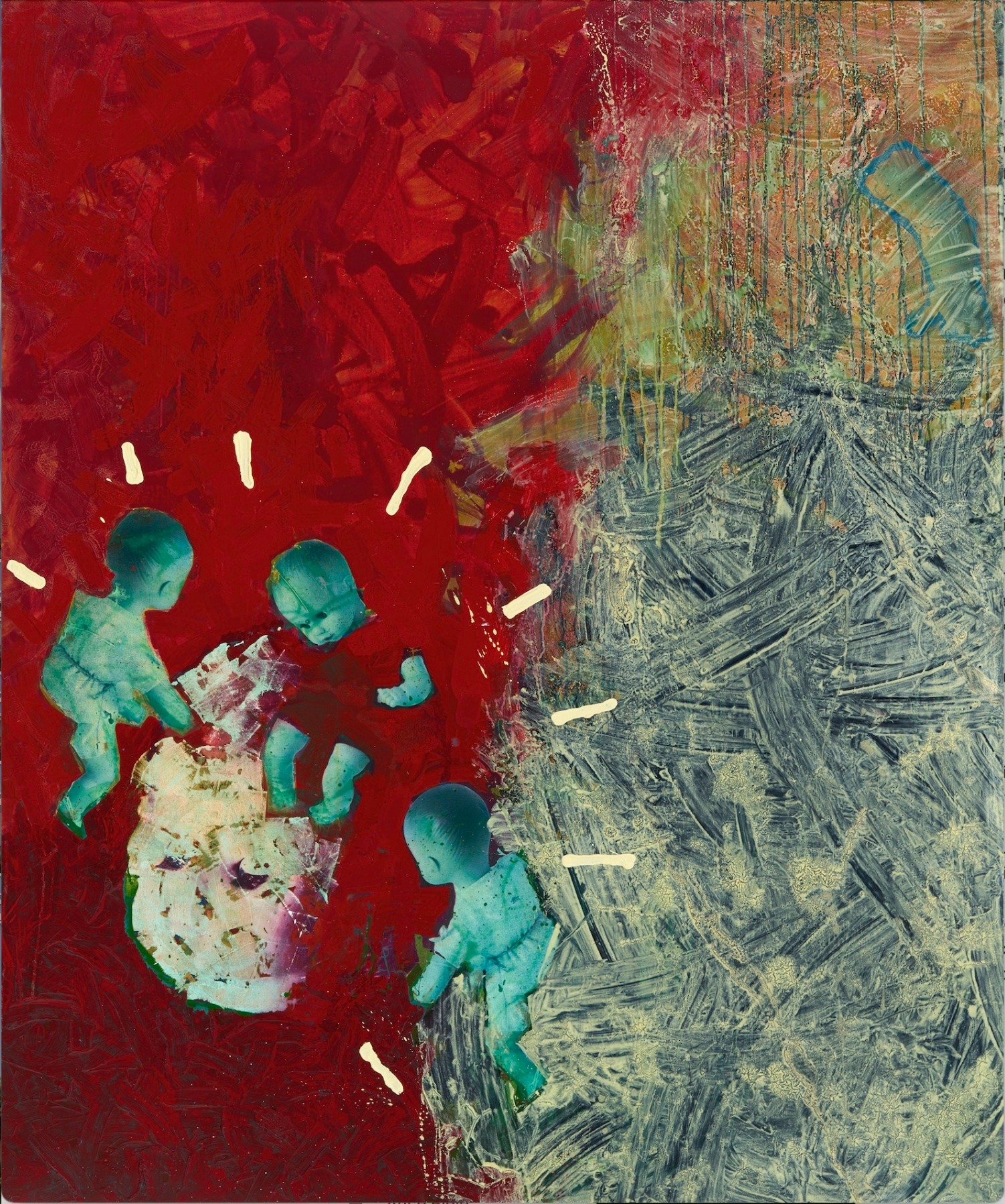
Here in Dubulti, your works feature dolls in many situations. Isn’t this metaphor – that we are merely just dolls in this big strange world – a little bit too straight?
You know, a doll can be interpreted in many different ways. The image of the doll is, of course, nothing new. It started for me a long time ago as well. My last exhibition before the long break was “Sin. The New Revelation”, part of the cycle “The New Reality”, which took place in 2001 in the Chapter Hall of Riga Cathedral. That was the first time dolls appeared in my paintings.
When I resumed working many years later, I realized that I was essentially continuing from the same point where I had stopped. I thought that over those twenty years I had gone very far in my thinking, but looking at the works I see – it is a continuation.
But still – why exactly dolls?
Because documentary imagery is everywhere today. We are constantly surrounded by photographs, images, pictures. There is so much of it that we no longer really see. A doll is a model one can work with more freely. It allows one to abstract oneself from documentary realism and speak about the human being on a more general level. Of course, there is also another meaning – in a sense, a human being is already a doll as well. In God’s hands…
Photo: Didzis Grodzs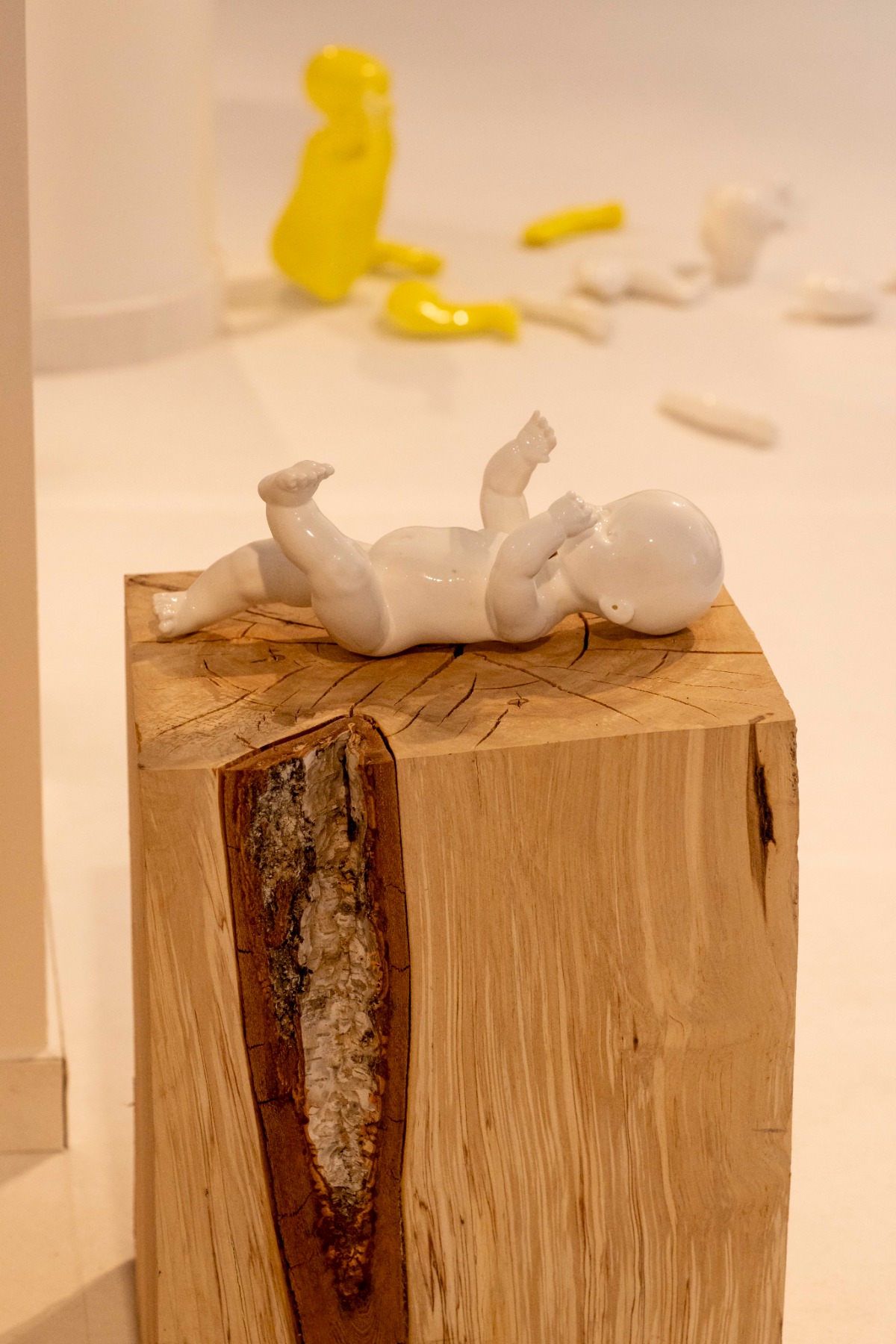
In God’s hands or in the circumstances of a situation?
We simply need to define what God is and what a situation is. We can define that God exists, and we can define that God does not exist. But in the world there is a certain order. And it is not really important how we, so to speak, name it. But by naming it God, we associate it with some kind of system, some principles.
So that order simply exists, and there is nothing that can be done about it?
It is objective. It is just that humans constantly try to ignore it, so to speak. Why the reference to Babel? Because it is the best story about human vanity, human ambition and short-sightedness. And then we arrive at what is described as God’s anger, and how he reacts. He gives them different languages. People can no longer understand one another, and everything falls apart, all that lofty thinking. And thinking about the current situation, in my view, the same thing is happening. It is not about language; it is about the inability to agree on anything anymore, in order to do something meaningful.
Choice. Oil on canvas, digital print, 200 x 250 cm. 2025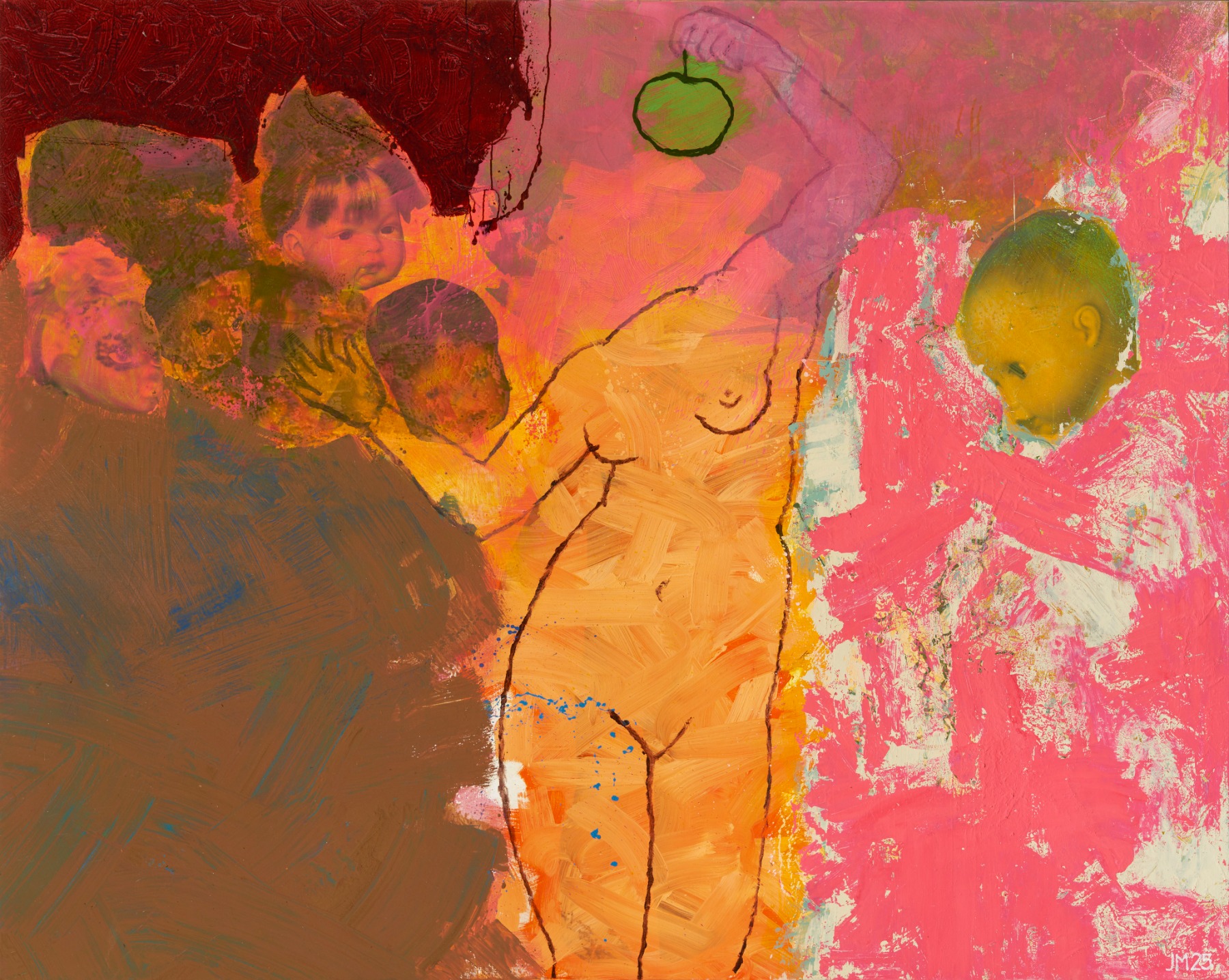
Do your dolls have a gender?
A doll is good precisely because it does not have a gender issue at all. Although in fact there are also dolls with a clearly expressed gender, but fundamentally it is more about the general essence of the human being. In the content of the images, gender does appear in some way, but it is not a primary thing.
In your works there also appear animals.
Yes, pigs, crows and others. But they are the most human-like attributes in the image.
That’s quite a critical view…
I am neither negative nor critical. That is one of the fundamental ideas – a human being is also neither positive nor negative. At the moment we are strongly divided into “the good” and… But within each of us there is both good and bad. The question is one of proportion and priority.
Good and evil constantly run in parallel, and that wordplay – doll / hell (in Latvian – lelle / elle – auth.) – is also about that. If we speak about hell, the stereotype is that it is darkness, fire, and something happening there. The contemporary hell, it seems to me, is pink. And perfectly packaged in many layers of wrapping paper.
In general, when you go somewhere abroad and observe things, it starts to feel that art is silent right now. The cannons are working, and art is essentially assigned the role of a kind of pink plaster. It does not touch anything. And I, too, try to distance myself in my awareness from that insane flood of negativity that is coming from all sides. And yet I cannot relate to it in such a detached way.
I am trying to understand what the cause is. I think the biggest problem of our time is that we are terribly fragmenting the world. We also talk about “bubbles” and how there are more and more of them. Any field is developed in such a narrow perspective, detached from everything else. As a result, there is no major outcome. Even in education we talk about the need to specialize as early as possible in order to achieve something. That is complete nonsense – if you do not see the world as a whole, you are only able to develop some small thread, but nothing more.
Photo: Didzis Grodzs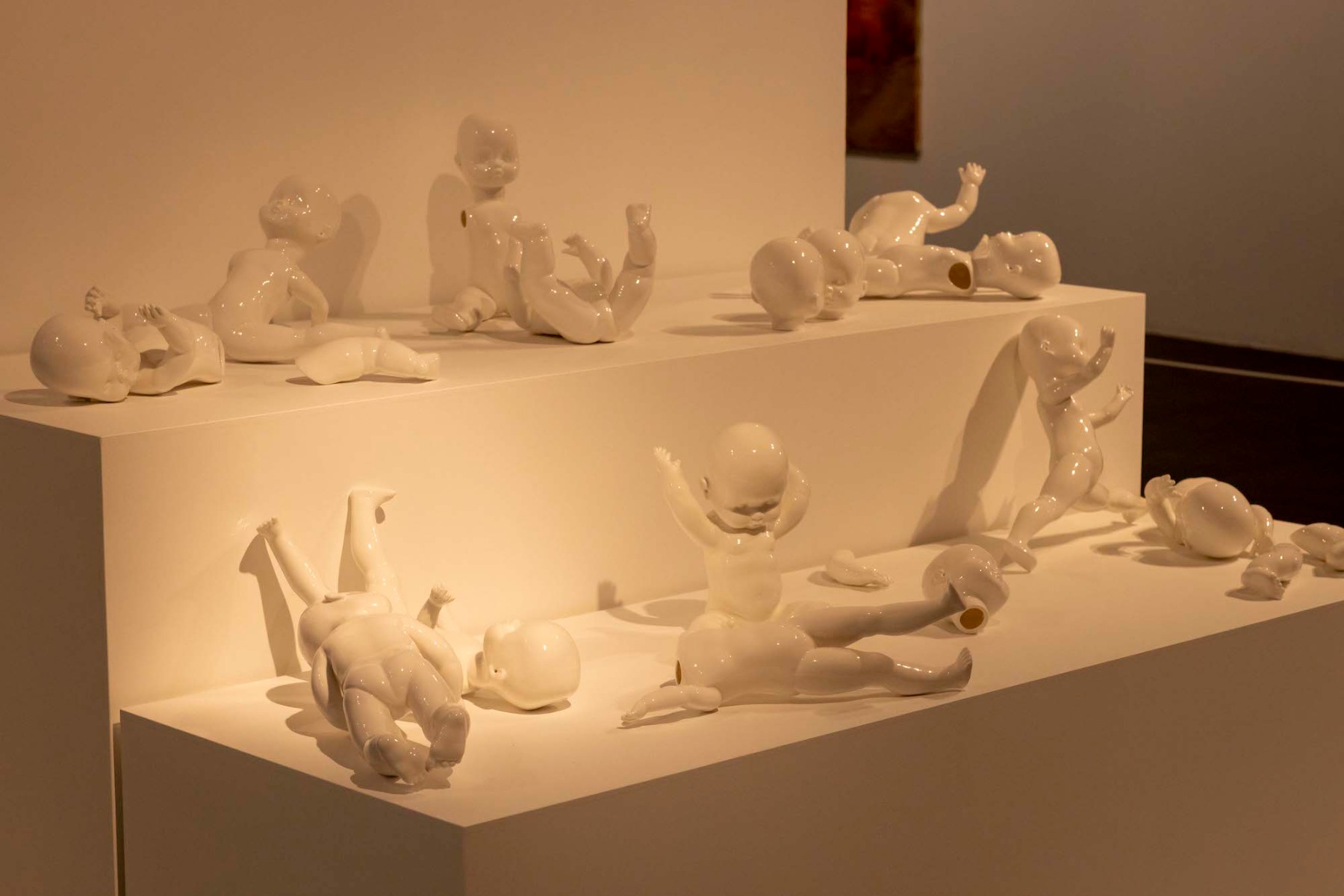
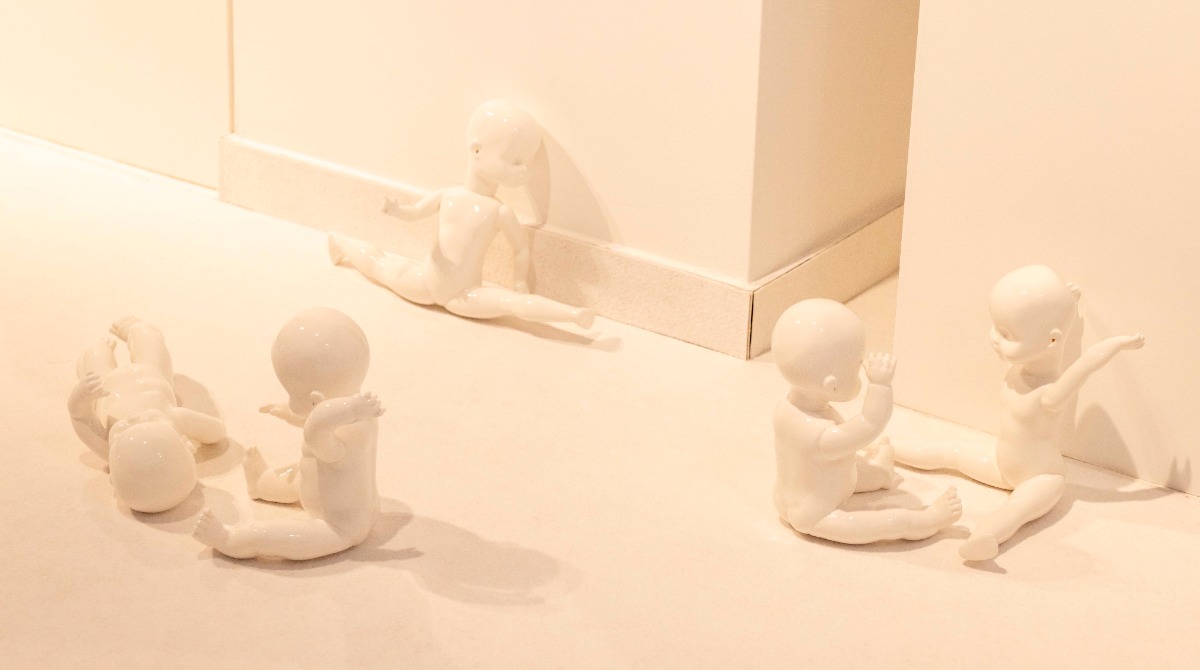
In this exhibition, your dolls appear both in paintings and as porcelain figures.
It happened quite by chance. The exhibition curator, Inga Šteimane, said that in the upstairs space there could also be something three-dimensional. And then I arrived at porcelain. In essence, it is the same story, only the material is different. If you recall anything from my earlier work, I have never really had a strict framework – I can work with any material in order to express my idea. In this case, it is porcelain.
Who became the models for those porcelain figures?
My grandchildren and relatives lent me a whole box of dolls. The forms were taken from them. Hands, legs, heads – everything is made separately. Then the porcelain is fired. The most interesting thing is that during firing it shrinks by about twenty percent. So in the kiln the figure actually moves. It was a kind of technological challenge – to produce what you want.
Photo: Didzis Grodzs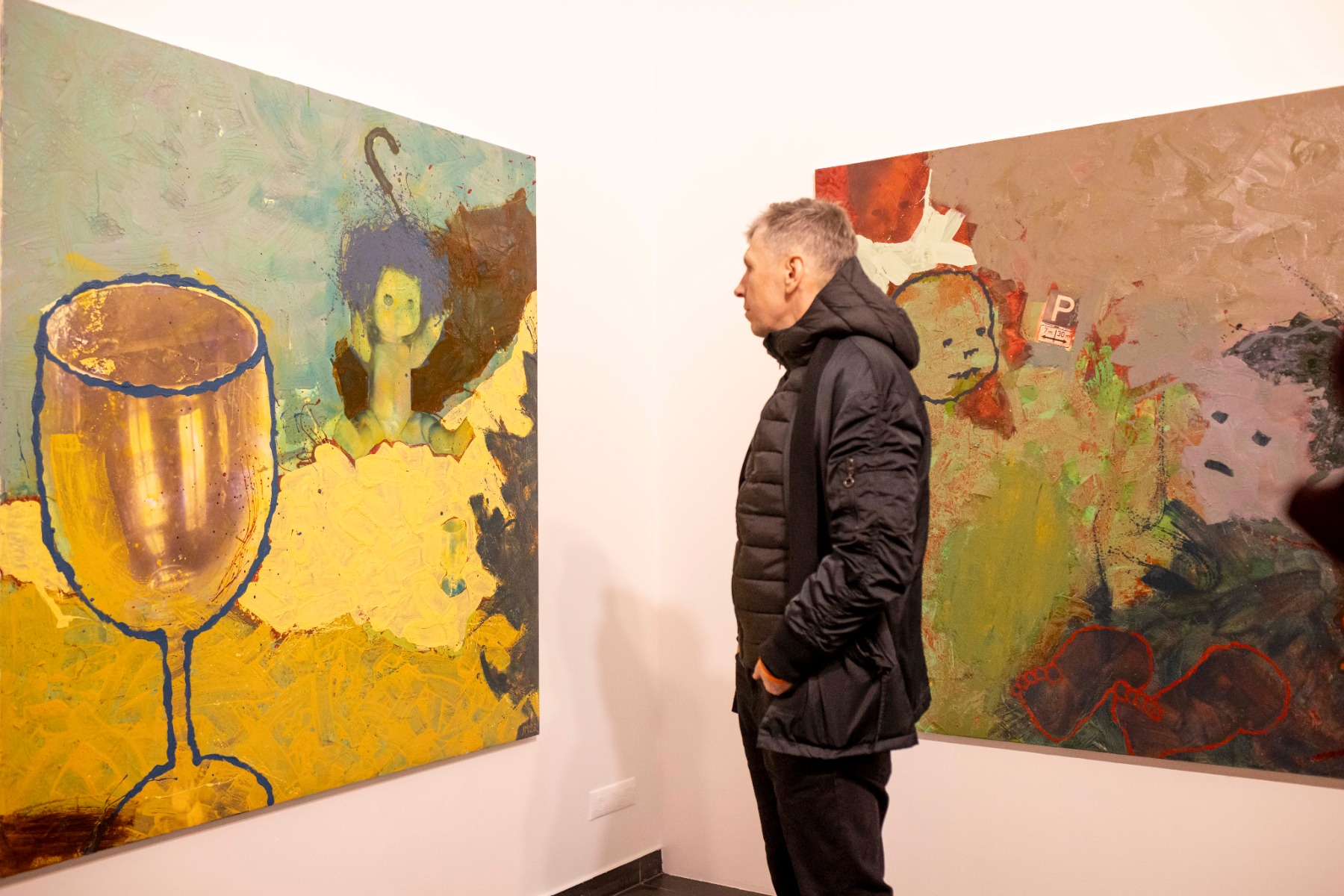
But a doll is still somehow associated with childhood and innocence. They are not mannequins – they are something completely different. Perhaps dolls are a little closer to hope, because they still contain some potential and are in a more direct contact with people?
And a doll does not age in the sense that it becomes wrinkled like a human, but it does wear out. In childhood, the most beloved ones are often precisely those – without an arm, without a leg, dirty, or missing some detail. And yet it is the most beloved doll. Yes, I can agree with you – a doll is human. In that sense, it is a human model.
But at the same time it remains a figure without consciousness, without the ability to act independently.
At first glance you see the doll, but I think that in the next moment you already forget about it. It was the same for me while working. In fact, I was thinking about the human being, not about the doll.
Photo: Didzis Grodzs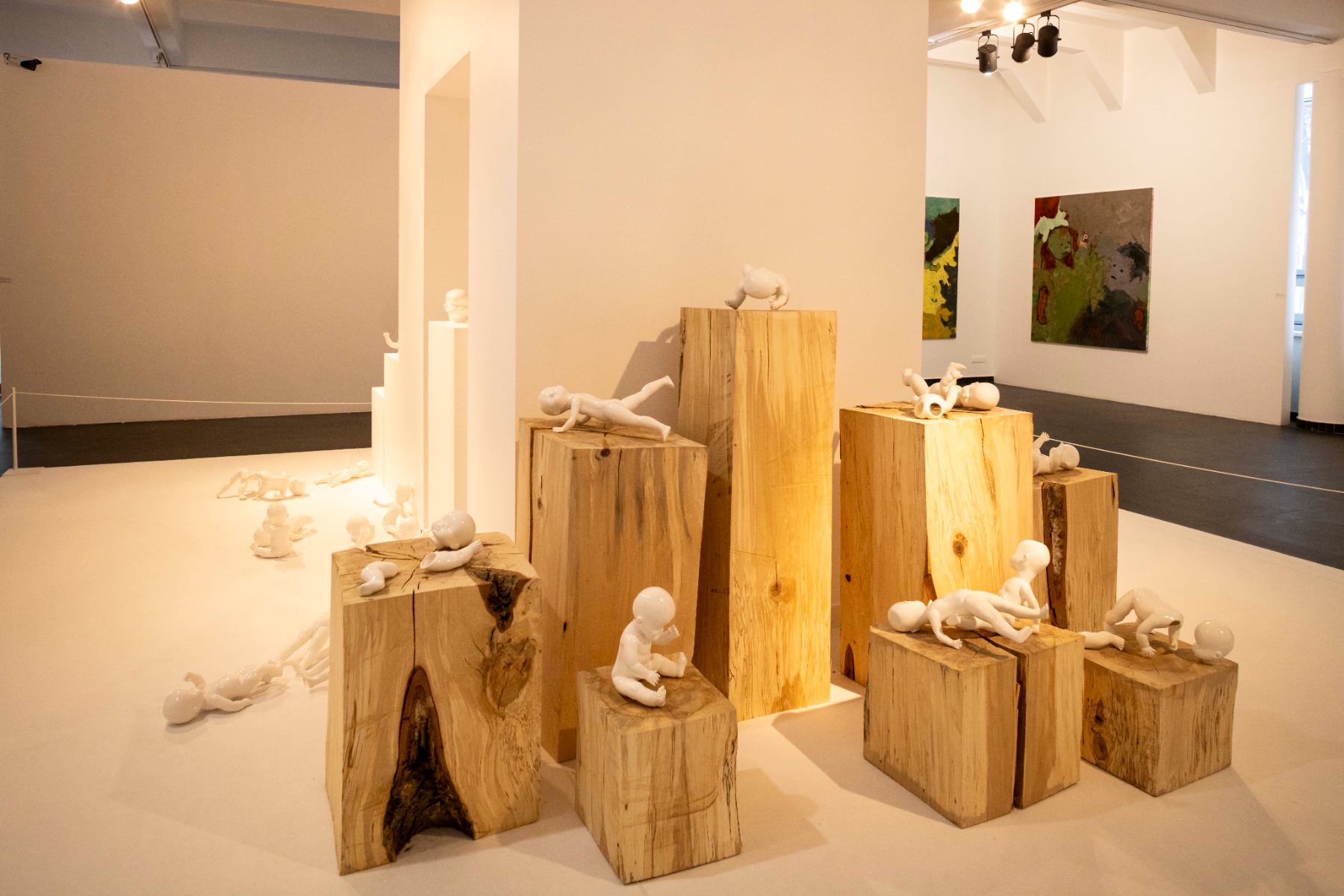
In our conversation you mentioned the Tower of Babel, but here, in my opinion, other biblical motifs also appear. For example, that figure with the apple.
When trying to think about certain things – where something comes from and why something happens the way it does – you simply end up, almost by chance, at religion, where these things are already defined. Not that I am, for example, making illustrations for the Bible, but rather I arrive at the realization that my way of thinking coincides with ideas that were already formulated before me.
I am not a practising churchgoer, but I am not an atheist either. We spoke about how everything is becoming narrower and more specialized. And if you do not know where to go next, then you start from the beginning.
Do you think that art and culture are silent, operating in a subdued mode. But where, then, is there any kind of hope?
You see, I am not a pessimist. Of course, I am concerned about the current situation, but at the same time I realize that it has always been like this and, unfortunately, it will remain so. Civilizations have arisen and disappeared, and we constantly forget that. Nothing began with us, and nothing will end with us.
And if we talk about environmental protection, in my opinion the very concept, the wording, is misleading – as if nature needed to be protected. It is human beings who need to be protected. In reality, nature will be fine. Humanity may even disappear, but since humans are part of nature, in some way it can regenerate itself as well. Even if the worst-case scenario comes true, life as a whole will continue to exist, because at least during certain periods of time conditions will be suitable for it – for example, those provided by the Earth’s atmosphere.
Photo: Didzis Grodzs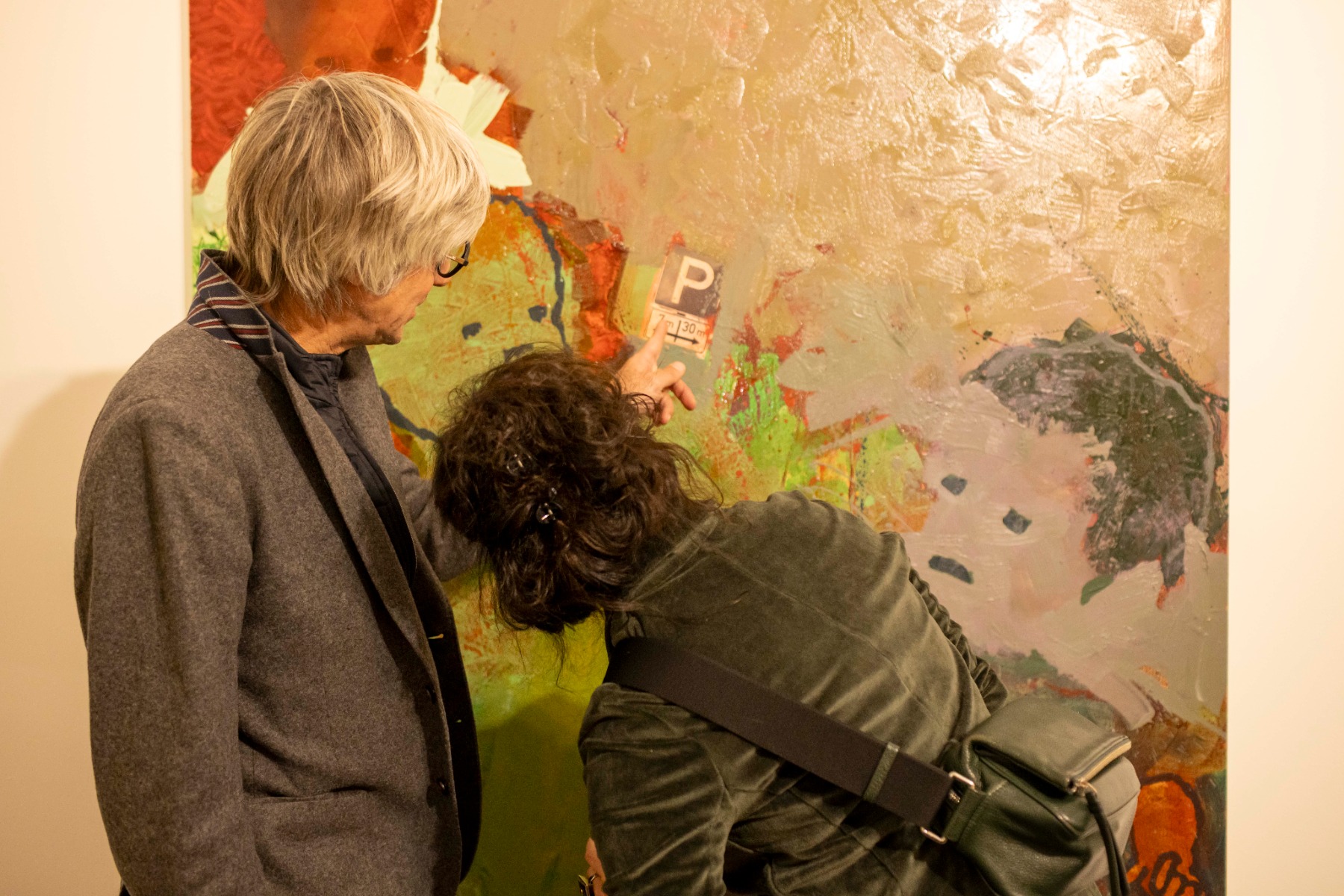
Yes, say after some catastrophe… I don’t know – a thousand years will pass, and some new archaeologists will find these paintings. What would they even understand about our world from them?
I think – it’s unlikely that those paintings would survive that long at all… [laughs] I very much doubt it. In fact, in the history of art, what survives is a matter of complete chance, and our judgments are based only on what has accidentally endured. There are so many circumstances that determine what remains and what disappears.
Of course, we can imagine that we are capable of selecting and preserving the “best,” but that is human vanity. In reality, it is not within human power to take on a kind of God-like role and decide what will remain for eternity. As a result, what survives is usually what is most durable – for example, sculpture or other materials that can withstand the effects of time. Paintings, however, are by no means eternal.
Although… I worked in that shed, and the paintings were standing there all the time, and when I brought them from Zosēni, I realized that they had gone from minus twenty degrees to plus twenty degrees… so in fact a forty-degree difference. Then I understood that oil painting is actually quite a resilient material. Churches, after all, have no heating either, yet many things there have survived for a very long time.
But how would you yourself describe your world, the one those “imaginary archaeologists” would see after a thousand years?
I would probably say that it is tragicomic. It contains both tragedy and absurdity, and joy. But again – how will we interpret it?
Let’s say in Azerbaijan, in the desert, we created a petroglyph or rock drawing museum. There are ancient images carved into the rocks there. We look at them and see what is there, but that is my interpretation of what I see. I do not know what the artist was thinking at that moment. The drawings have been preserved, and we see them – there are, for example, hunting scenes, spears, various objects.
From these works it will also be possible to see what, so to speak, has been. What kinds of animals and people there were. Perhaps someone will even find it surprising that those people look a bit strange.
Small.
Yes, small. [laughs]
Instruction. Oil on canvas, digital print, 200 x 250 cm. 2025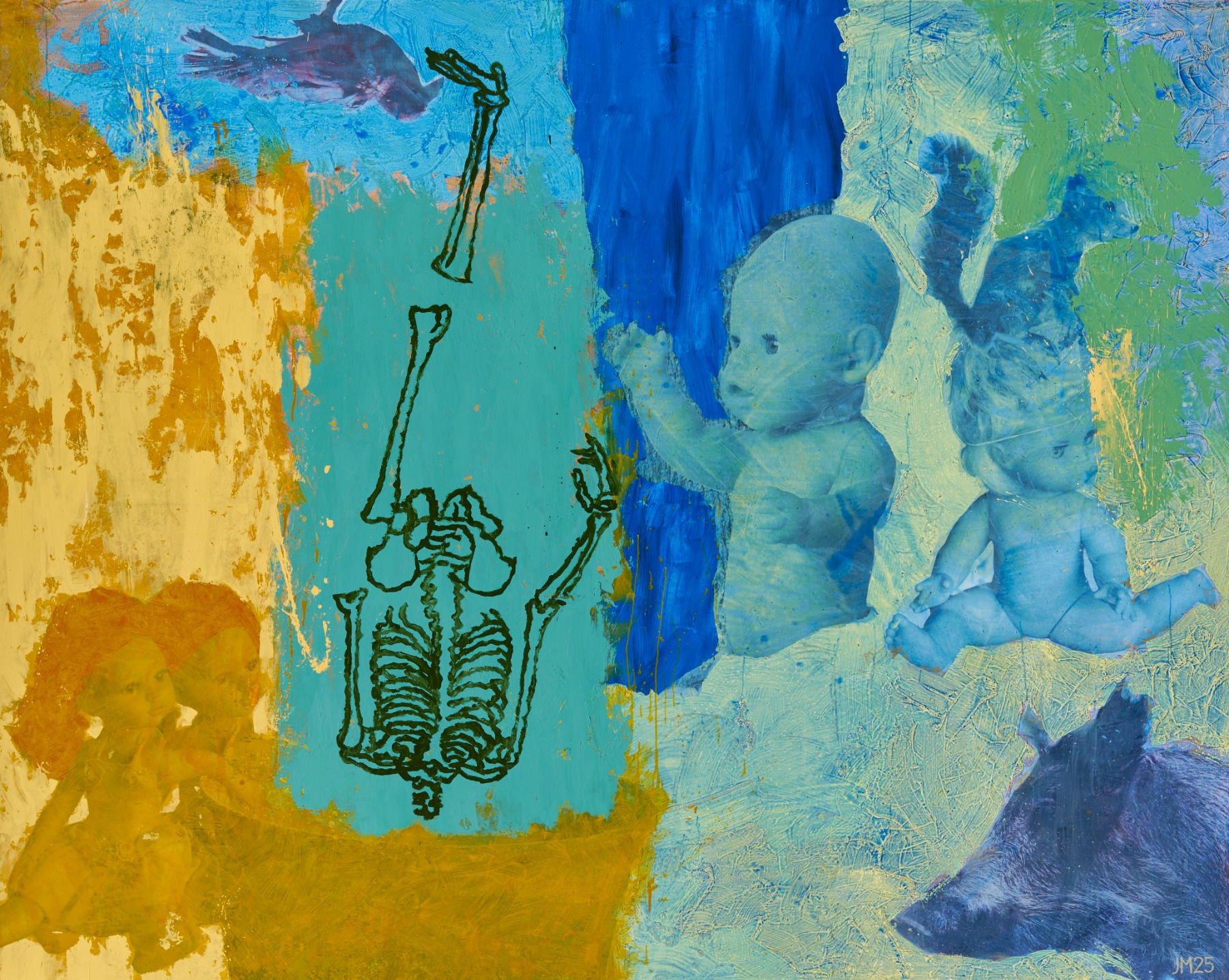
You are often described as a postmodern artist. Do you agree with that? Has your understanding of postmodernism changed in any way since the 1990s?
I do not really try to formulate it in any particular way. Just as I do not try to claim that “this was made exactly the way I intended it, and you must understand it exactly like this.” Definitions are not really my task either, and it always depends on the context. What we understand by a given concept changes over time. I do not have a fixed position on whether I am one thing or another. And, in fact, it is not particularly important to define oneself in such a way.
But if you were described that way, you wouldn’t object?
Call me John or call me Peter – it doesn’t really change anything. [laughs] I want that freedom. I also want that freedom for the viewer, because when I am asked – what exactly is your story – I usually answer: what you see and perceive is also what is there.
These paintings themselves operate on several levels – there is underpainting, print, painting, drawing. It all layers and forms over time. While working, I myself have a clear underlying idea – I know what I have intended and what I will do. But each layer adds its own nuance of meaning, and the viewer can perceive the level that speaks to them at that particular moment.
What was the process behind creating these large works?
I mainly paint on the floor, because with oil paints and textures it is easier. I simply need the work to remain in that position for at least a day so that the paint does not run. If I keep it horizontal, I can control the process, and the drips do not interfere.
Of course, one can also deliberately use drips as an expressive device, but in this case that was not the aim.
So, in practice, you view the works from above.
I have two approaches. I either lift them up and fix them to the wall. Or I climb a free-standing ladder and look at them from above.
Photo: Didzis Grodzs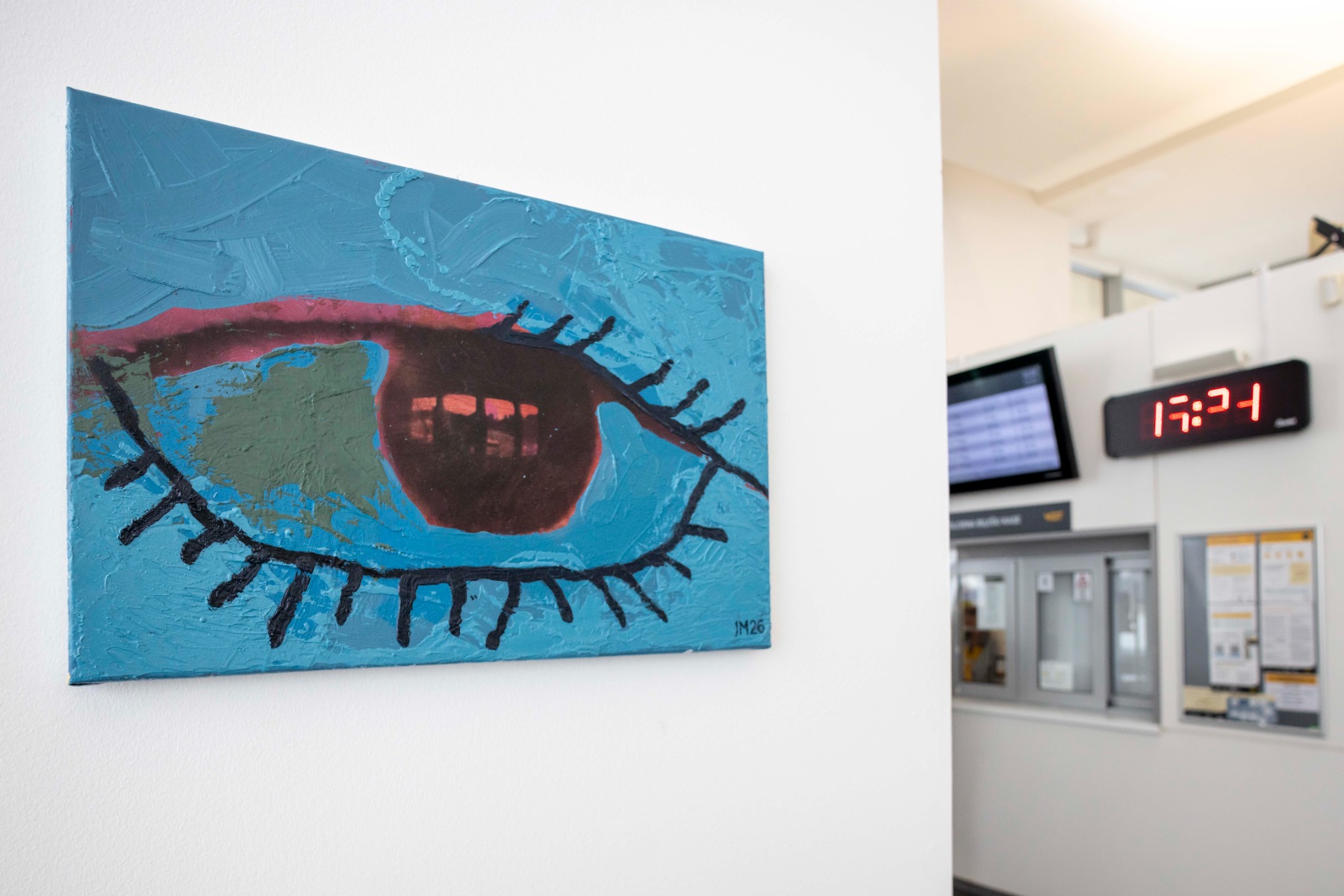
Here, at Dubulti Station, there are always people.
Yes, just ordinary people from the street who do not know what they will see. They can only imagine what it might be.
That is a major advantage of the Art Station Dubulti – people also come in who would otherwise never come into contact with contemporary art.
I completely agree. In my opinion, this is a unique place, because passers-by are constantly flowing through. Something similar was once achieved by actions in the railway station tunnel in Riga, but those were one-day events. Here, however, there are people who are waiting for a train or who come in simply to warm up. Some come in and immediately leave, but there are also those who do stop and look around.
Photo: Didzis Grodzs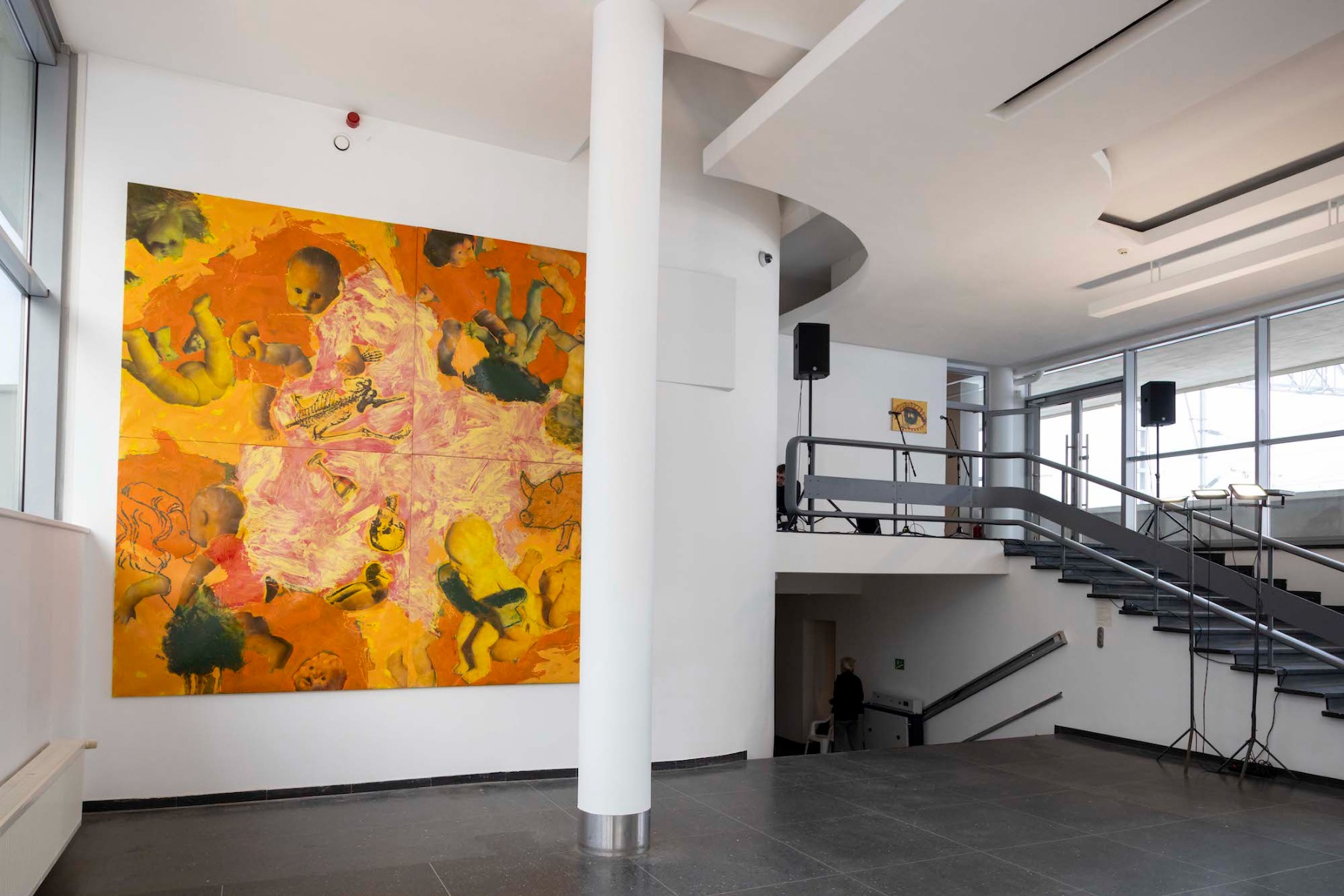
While waiting for you, I was watching people, groups. No one said: “Oh, no, no, no, I’m not going to look at that.” Many were taking photos.
There is nothing here that could really frighten anyone – the art is not aggressive. Quite the opposite.
You mean – calming?!
No, rather… I would feel satisfied if this exhibition made people think.
But what could they take away with them?
Each person something of their own.
In any case, I think that what I do stands in opposition to the speed at which we scroll through reality on our phones in everyday life – you glance, a second, a second and a half, and you’re already moving on. Here, on the other hand, you can stop and look longer, immerse yourself in the image.
About scrolling. I had an observation – one day I went to the zoo with my grandchildren. We were walking slowly, but they were constantly running. “Come, look at this!” and then back again. And I realized – in their own way, they were “scrolling” the zoo. They are used to speed – they look, scan, and move on.
You think they don’t really look closely?
They don’t stop, they don’t examine what those deer are doing there. It’s as if they just film it – here’s a deer, here’s a pig, here’s a giraffe – and then they run on.
Do you think they perceive the world as images?
As images that no one really delves into, but immediately moves on to the next one – like on a screen, where the next clip is already playing.
But how do they look at your works?
Well, because they are mine… I have even asked them: “Do you like anything?” And each of them liked something different in those pictures. I haven’t really spoken with them about it in detail, but I think they probably also recognize their own dolls. Which one belongs to whom.
Photo: Jānis Deinats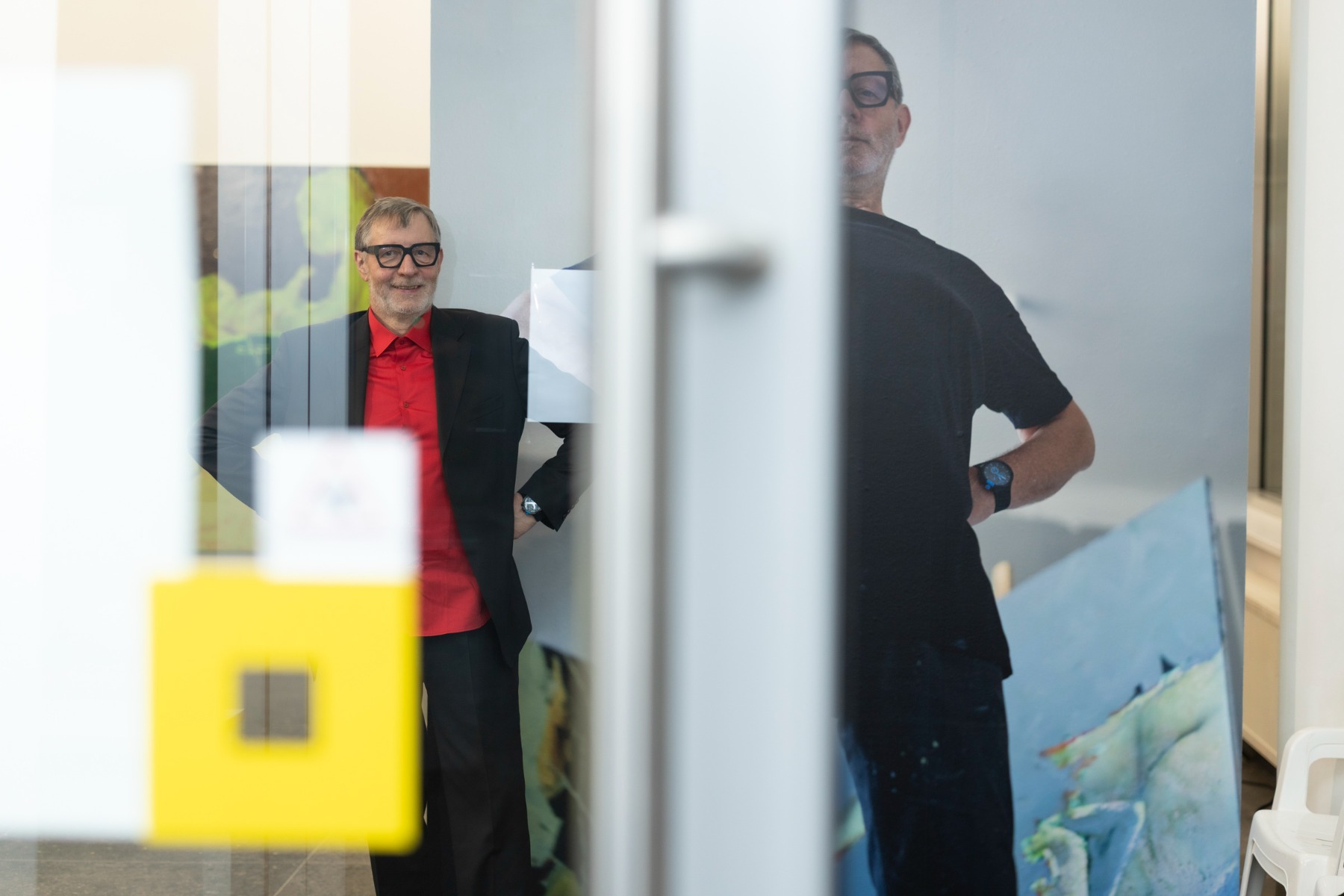
It is actually interesting how they will look at it after some time… A doll is definitely an object with many layers. Isn’t there a risk of getting a bit lost within those layers?
There is, of course, but in any work you can lose yourself if you do not keep the main idea in mind – what is most important to you. Still, I consciously allowed myself that freedom. Because when you are painting, you are not dependent on anyone – from start to finish everything is in your hands. If you compare it, for example, with the porcelain works, where I am tied to a factory, to people – that means a different process. Here there is more freedom.
And if such freedom is given, then it should be used.
