


The Space in Between
An interview with Greek artist Nefeli Papadimouli on the occasion of the opening of Always the Sun at the Riga Contemporary Art Space
The first time I encountered the work of Greek artist Nefeli Papadimouli was in Athens in the summer of 2025. Her magnificent, almost meditative 30-minute performance Dream Coat unfolded in the lobby of the Benaki Museum as part of In a Bright Green Field, an exhibition presented by the DESTE Foundation and the New Museum. At moments reminiscent of a mystical Sufi dance, the performance seemed to dissolve the boundaries between the individual and the collective, between body and space. Dancers moved together inside and through Papadimouli’s sculptural costumes, their movements gradually blurring the boundaries between individual bodies. The performance seemed to reach beyond the self, time and space – a pattern whose beauty, for me, lay in the synchronicity of its diverse elements.
A little more than a year later, Dream Coat is coming to Riga. On 1 October, Papadimouli’s performance will mark the opening of Always the Sun at the Riga Contemporary Art Space, an exhibition of contemporary Greek art curated by Marina Fokidis. The context could hardly be more fitting. The performance revolves around the solar cycle, while Always the Sun looks at the sun not simply as a source of light but as something that shapes perception, bodies, rhythms, landscapes and ways of living.
Born in Athens in 1988 and now living between Athens and Paris, Papadimouli came to art through architecture. She studied at the School of Architecture of the National Technical University of Athens before continuing her studies in visual arts at the École Nationale Supérieure des Beaux-Arts de Paris. That architectural background remains palpable in a practice that moves between performance, sculpture, installation, drawing, photography, moving image and costume. Yet rather than constructing fixed spaces, Papadimouli is interested in what happens between bodies: how distance can become proximity, how boundaries can become permeable, and how an individual body can temporarily become part of something larger.
Textiles play a central role in this exploration. Her sculptural costumes can become what she calls “adoptive skins” – forms that simultaneously shelter the body and connect it to its surroundings. Activated through performance, they can bind several bodies together, alter the way they move, and create temporary architectures of encounter. Questions of touch, movement and collectivity run through her work, alongside another, perhaps more fundamental question: where does the individual end and the collective begin?
Soon after Riga, another chapter will open. On 19 November, M Leuven in Belgium will present ANAMESA, Papadimouli’s solo exhibition bringing together recent works and a new production. The Greek word anamesa means “in between” – a fitting title for an artist whose work repeatedly returns to the space between body and architecture, human and nature, individual and collective.
Perhaps it is also the most appropriate place from which to enter this conversation: the space in between.
Nefeli Papadimouli. Sails. Photo: Paul Thévenet © ADAGP, Paris, 2026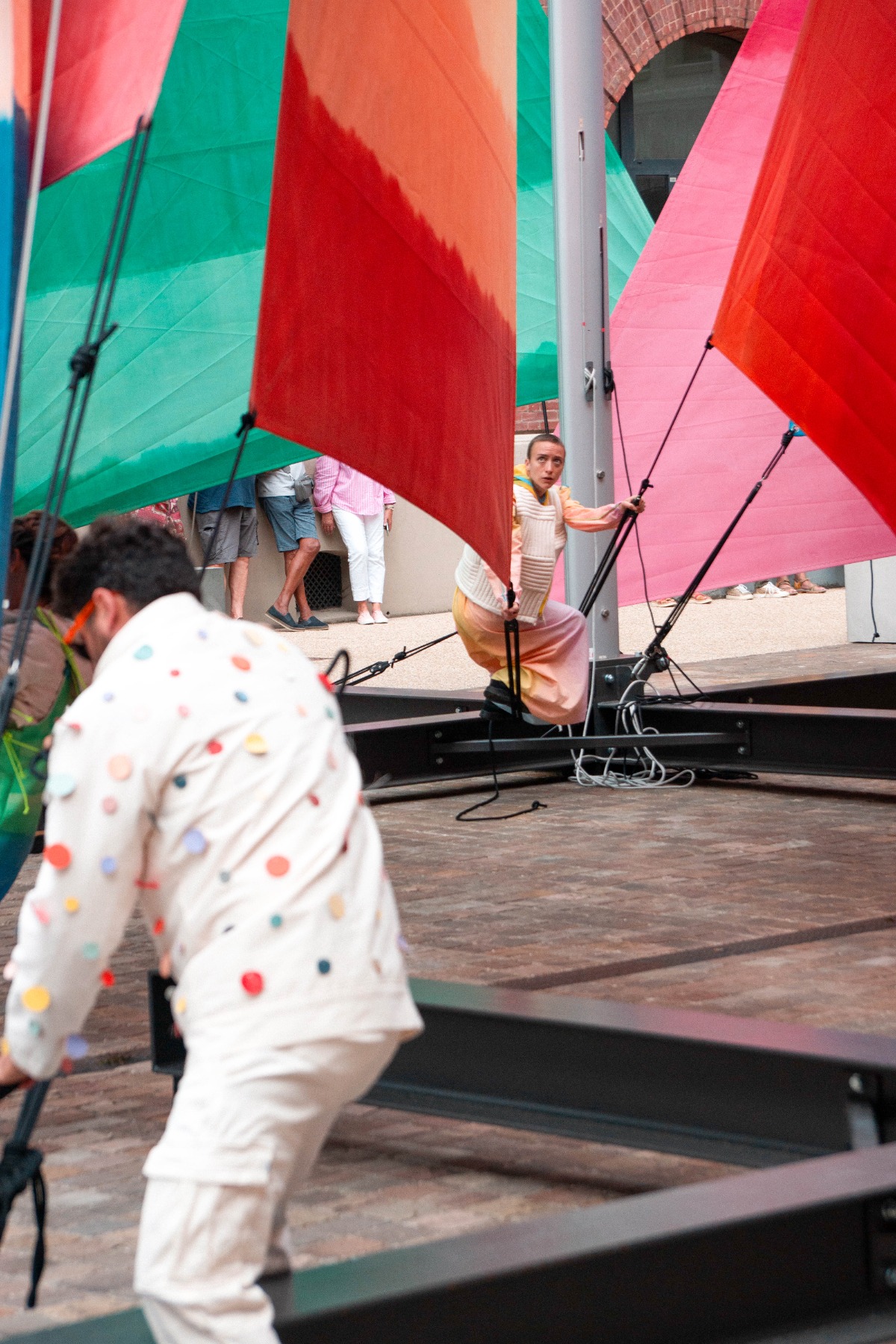
When looking at your work and your performances, I’m curious: what interests you about the human body?
I think the way my work is presented now is the result of a profound curiosity I’ve had since I was younger around the formation of identity. The main question is how identity is constructed. In my first works, I used to explore this idea of identity through the reflection that it is something dialectical, something that is formed in the space between.
I used to make sculptural forms, and I was trying to understand how objects have the tendency to have their identity transformed when they are around other objects. Then I realised that what really interests me is humans – how we can be transformed and then create a better world to live in.
That’s why I transitioned towards performative practices. And within those practices, I started becoming extremely interested in the skin. The skin as a surface that has a lot of qualities. It can be a border, it can be a passage, it can be a bridge. It can be something that, on the one hand, separates us from the world, but on the other hand connects us. It’s really permeable. So my work, I think, is around this idea of how our identity can be transformed when we are in connection with others through our skin, in a way.
But why is performance as a medium so important to you? Is it because it really happens here and now?
Yes. I think performance is an event, and the particularity of an event is that it is inscribed in a precise moment in time. It’s something actual, something that happens at a precise time and in a precise space, and it brings people together.
This is something you can see in my work – this desire to bring together people who don’t always know each other, to create an ephemeral community within the work. And then, in the public presentation of the work, in order to see a performance, people have to be there to know what actually happened. This creates a larger community.
I mean, watching a performance means that we have to go somewhere. And when we go there, we see the performance, but we also see the other people who are there, and something bigger emerges. I think performance has this capacity to create communities.
I think community is something we have partly lost in our very individualistic society. For most of our history, we have lived in communities, but now we seem to be struggling to find our way back to them. There is competition, we are sometimes afraid of each other, and we don’t always know how to communicate because we live in our own bubbles. Was this sense of community something you felt was missing in your own life as well?
Definitely. I think all artists, in a way, work with subjects and desires that are at once something we see in society and something we experience within our own bodies. I think it has a lot to do with my background in architecture – reflecting on society, not thinking so much about how the individual functions, but about how we can create spaces for society to exist in a more optimal, better way.
And I think the fact that I am Greek and part of the generation that became young adults during the crisis also affected the way I think as an adult. At that moment, when institutions collapsed and everything we believed in collapsed, we realised the importance of creating communities and, through creating communities, creating an autonomous way of life.
Being around others, working with others and thinking collectively helped me a lot to overcome the crisis and all the different kinds of crises that existed during this period in Greece. I realised the importance of that. And I think I’m a little influenced by Brecht as well - this idea that many people together can transform the world in a much more efficient way than each one of us alone.
I think communities exist nowadays, but they are mainly virtual. The communities we find on the internet are based on common interests, and they can be extremely strong and really important for some people. But I still believe that the physicality of the body, the feeling of being around others, is much more powerful. It can affect us to the core because it doesn’t pass only through the intellect. It’s not an intellectual community. It’s an actual, physical one. It’s one in which you feel accompanied, part of something.
There is also this sense of physicality and touch, which we have partly lost with virtual communities and the virtual world. I wonder if this is also why so many artists are returning to physical materials – ceramics, for example, or textiles.
Yes, I think with the integration of new technologies and the place that artificial intelligence is taking in our everyday lives and in the social sphere as well, artists need to find ways to respond. And it’s not only that. At the same time, there is an ecological crisis, which is extremely important. So we have to respond to that. We have to take a clear position on what the world is and what the world can be.
You mentioned the skin, but in a way you work a lot with a second skin. What is the role of this second skin in your work? Could we also compare it to architecture – to walls and boundaries?
Yes. I think the sculptures I make – which function as sculptures when they are exhibited and as accessories in performances – are, for me, adoptive skins. They are skins that we choose to put on, to wear, as a kind of representation of ourselves.
These adoptive skins also function as shelters. We can be protected inside these skins, inside these works. For me, clothing –these shelters – is a kind of minimum architecture. It’s an architecture for one body, something that protects us and connects us to the environment at the same time. So it is a shelter, a primary architecture, a minimum architecture.
Nefeli Papadimouli. Dream coat. Photo: E.Ponsaud © ADAGP, Paris, 2026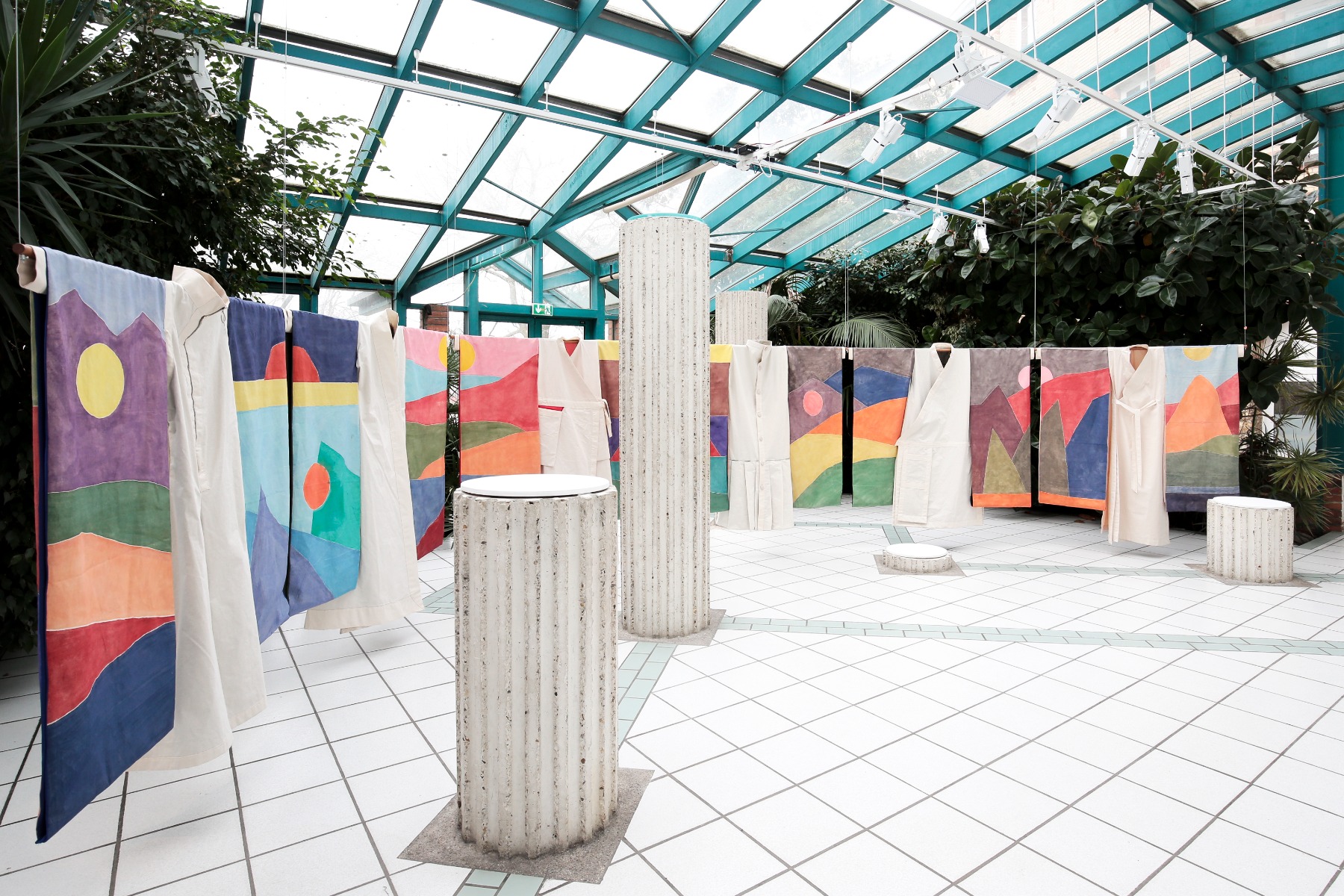
Looking at your performance, I had the feeling that what the performers are wearing is not really a dress or a costume, but almost a landscape.
In a way, yes, I agree. And thank you so much for this question, because this is where my work is going right now as well. It’s a direction my work is taking more and more – this idea of the human body being part of a much larger system, which is the world, the landscape. The human body is part of that. We come from the landscape, we come from the earth, the water and the sky, and then we go back there. So there is this kind of cyclical movement between being landscape and being body.
This is becoming more and more present in my work, and especially in Dream Coat, the performance we are going to see in Riga. The costumes depict the solar cycle, and this is actually the first time I’ve moved in this direction, trying to get away from the geometrical approach I used to have and towards something almost figurative, or more poetic. I wanted this community wearing the costumes to feel connected to this larger system, this celestial system.
Nefeli Papadimouli. Dream coat. Photo: Yei Wei-Chen © ADAGP, Paris, 2026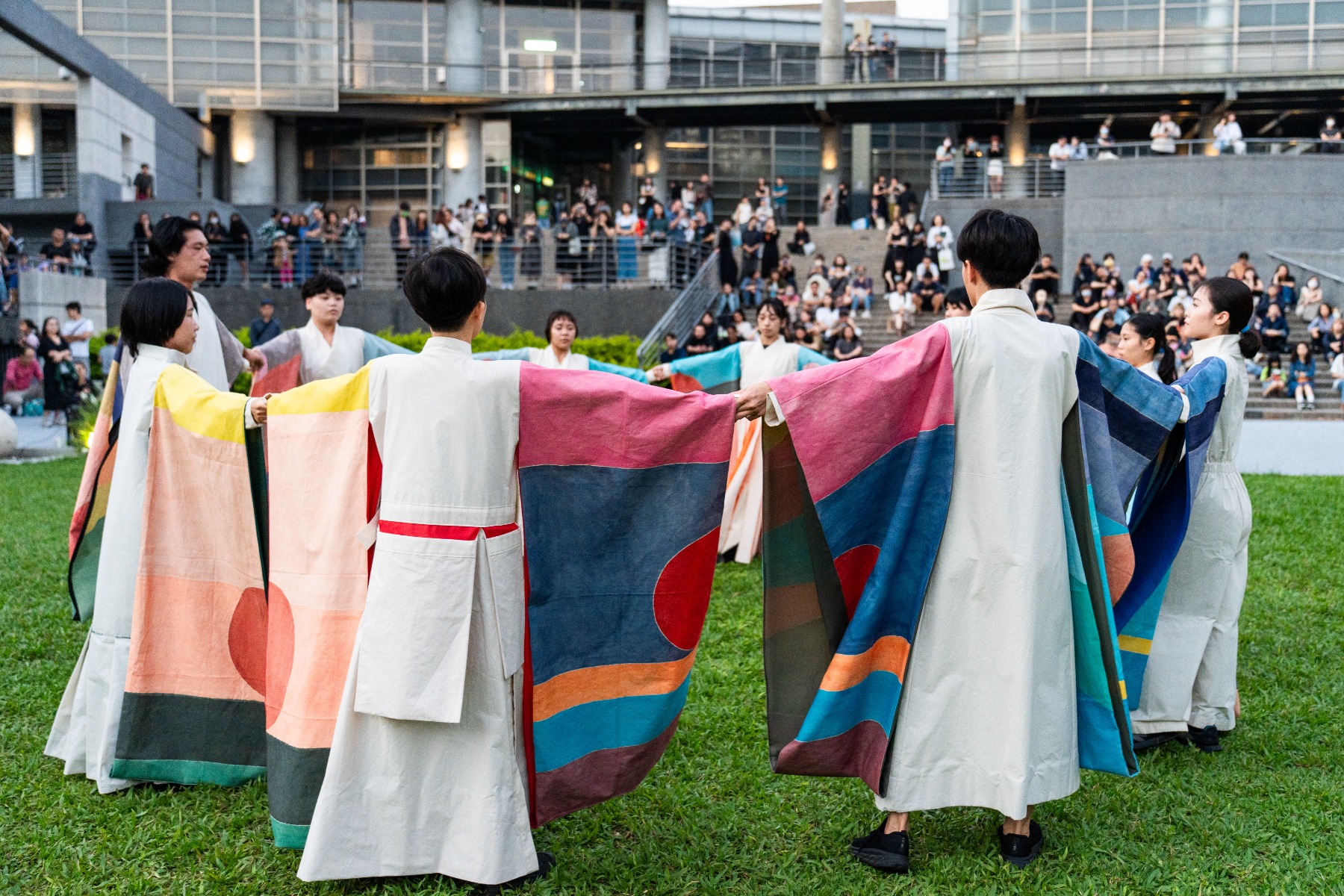
Watching the performance, I was reminded a little of Sufi dancing and of ritual dances in different cultures. There is something ritualistic about the movement and about what happens between the performers.
Yes, that’s really well seen. I’m very interested in that. Actually, I have a lot of interests, and I’m trying to bring everything together in the work. Sometimes it works, sometimes it doesn’t.
One of the other things that interests me a lot is vernacular dance – traditions that are passed from generation to generation. These dances have always been a way to create a community and to reach a kind of collective ecstasy. And ecstasy is where we connect with something bigger than ourselves. We connect with other humans, with the community, or with this bigger community – we connect with the world.
So in Dream Coat, the main gesture, the main human gesture, is this kind of meditation through movement, which comes from the movement of Sufi dance. It is a way to connect with the divine, and at the same time it is something vernacular, something that has also become folkloric as a gesture. So yes, it’s an active meditation. It’s an active body meditation.
Nefeli Papadimouli. Dream coat. Photo: Владимира Яроцкого © ADAGP, Paris, 2026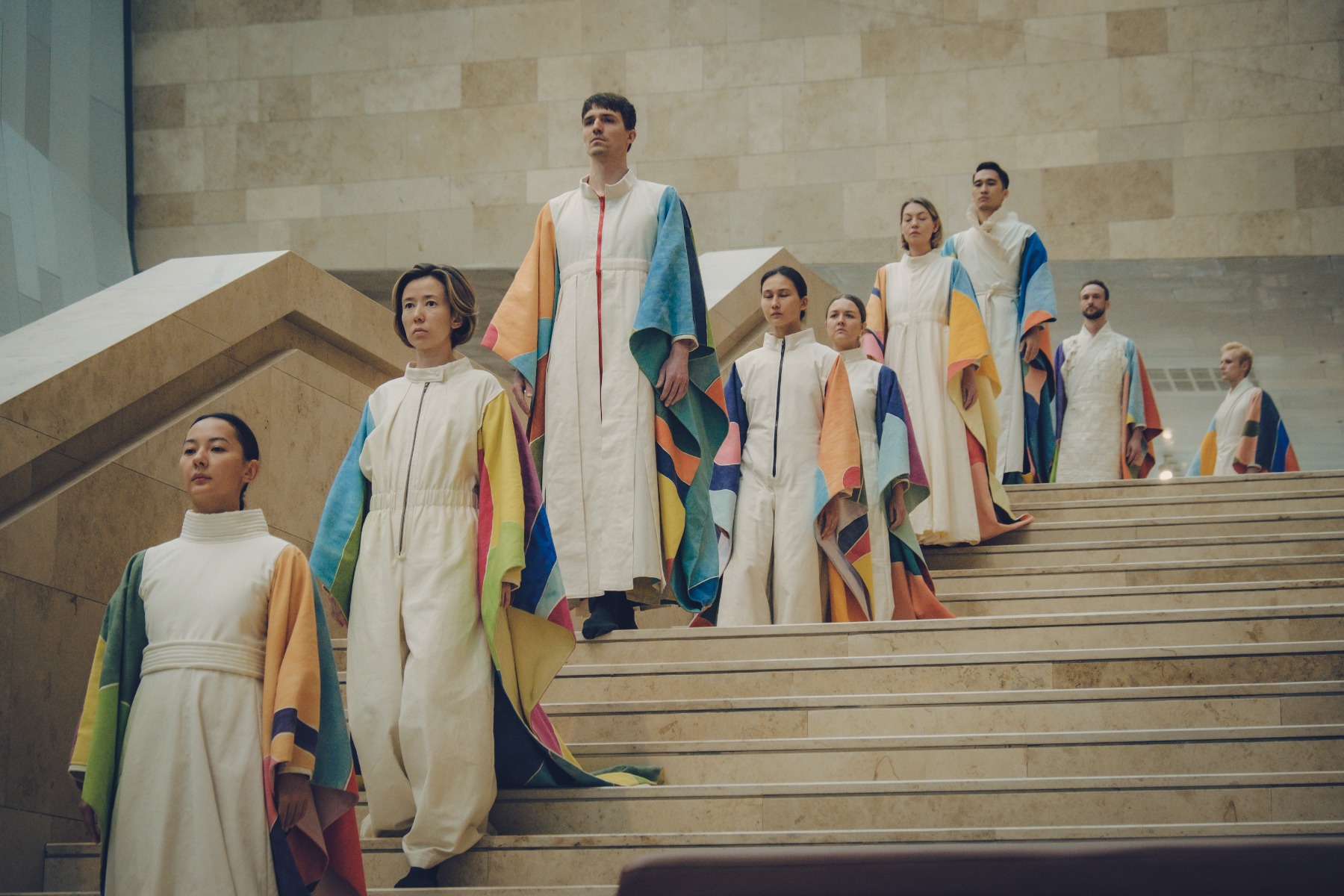
Do you also practise some form of meditation yourself?
Yes, a little bit of meditation every day. I have a ten-minute ritual every day, which is really important because I’m a mother of a young child.
And when I started dancing myself, I started through an experimental approach, which was an exchange between meditation and dance. I think this is something I also try to bring into my practice. The techniques that I used to follow as a student, I now try to transform and use in the way I work collectively with others.
But it’s interesting what happens to our sense of individuality when several bodies, as in your performance, inhabit one space, one surface.
I don’t know. For me, this is a question. I have also performed this myself, and I think there is a kind of dissolution of limits. Our body dissolves – or actually, mainly our consciousness dissolves, in a way. When we turn without stopping, the limits of our body dissolve, and we become much more open to connecting with others.
Working on this performance, spinning so much, turning around so much, allows us to connect to something else, to something bigger. We lose the limits. We get dissolved, in a way.
And then, in the performance, there are these moments when we stop and touch another body. There is a kind of recentering. I like this idea of being recentered in reality, in everyday reality, and then going back to where we come from.
Nefeli Papadimouli. Idiopolis (I-X) © Jair Lanes © ADAGP, Paris, 2026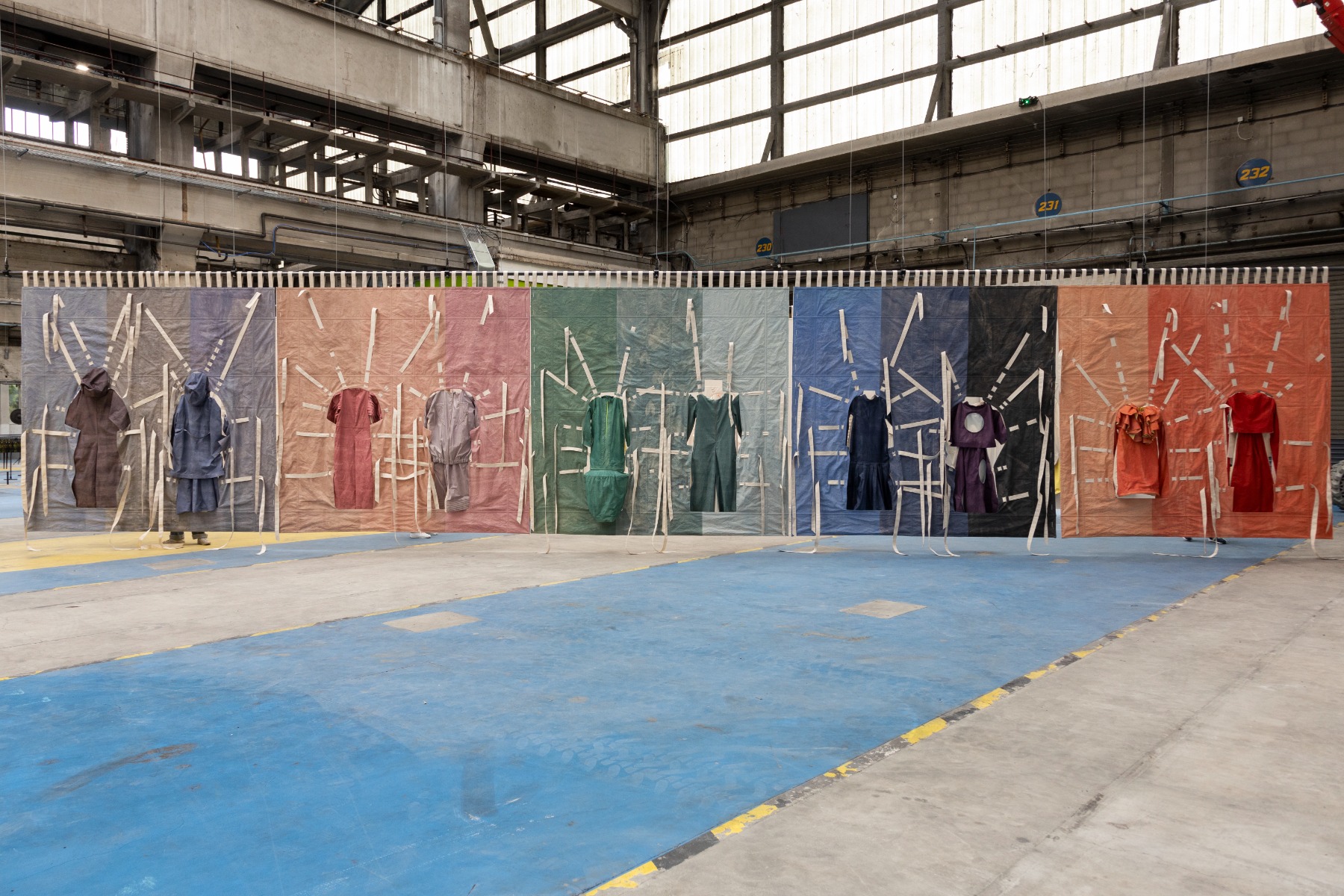
I once had a conversation with a Sufi dancer who had been practising for many years, and I asked him about trance and altered states – whether he enters such a state while turning. He said, in a way, yes, but also no, because it also requires concentration. If you go completely into a trance, you lose your balance. I find this connection between the brain and the body while turning very interesting. Do you distinguish between physical and mental boundaries, or are they much more interconnected than we tend to imagine in our daily lives?
I really believe they are interconnected. I don’t believe in a separation of body and mind at all. I believe they are one, that they are deeply connected.
That’s why performance, and especially its physicality, is extremely important to me. I believe that putting the body in movement – inviting my own body and other bodies to move – is also a way of creating movement spiritually and intellectually.
That’s also why I don’t feel so connected to virtual communities, because I always feel this barrier of never really being inside.
Nefeli Papadimouli. Être Forêts. Photo: Nacása & Partners Inc. Courtesy of Fondation d'entreprise Hermès © ADAGP, Paris, 2026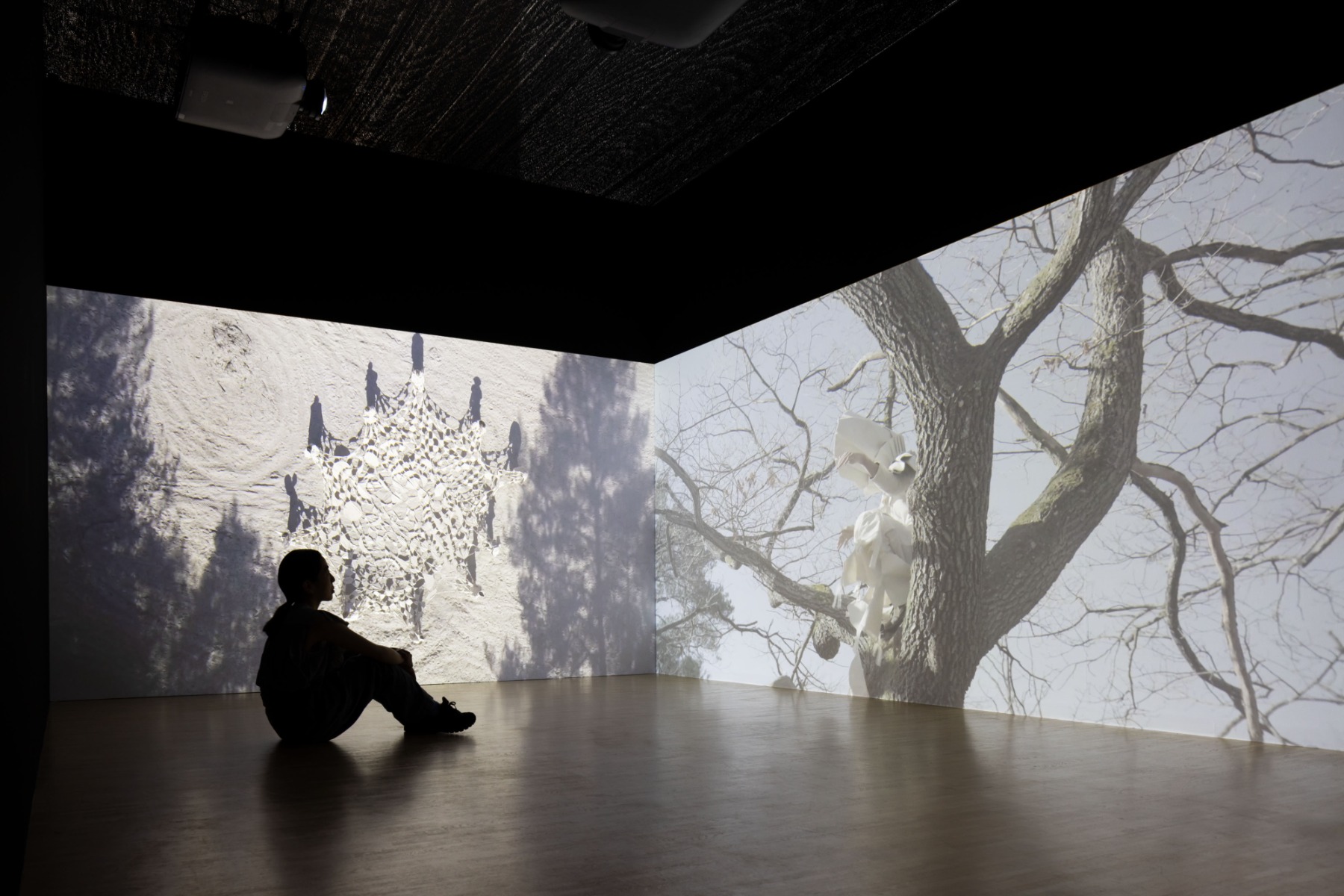
The barrier of the screen.
Yes, the screen. It’s not a skin, it’s a screen.
Both the textiles you work with and dance are very connected to physical touch. I remember an interview with an American social psychologist who spoke about an experiment involving a warm or cold drink, and how this physical sensation affected people’s perception of interpersonal warmth. Something as simple as being given a cup of hot tea when you are alone in a hospital can create a completely different emotional experience. How important is the sense of touch in your work?
I think this is where I came from, actually – from this idea that touch can be comforting. It gives us access to the feeling of being touched, in a way. I think textile is a really interesting technology because it has a lot of capacities. But I chose textile mainly because it can be extremely soothing when we wear it, and it can be really comforting. It’s like a blanket that we wrap around ourselves.
That’s also why, when I create my sculptures, the best textiles are always the ones you don’t see – they are on the inside. So when the performers wear the costumes, which are actually quite heavy, they feel something like a caress. It’s like softly touching somebody, comforting someone. It’s tenderness. It’s an act of tenderness.
And usually my sculptures can be touched in the exhibition space. There are works that can also be manipulated by the public, and others that are only used for performances. But still, I always say that you can touch them, because I think it’s a kind of recognition that comes from something other than the eyes. I’m really interested in this kind of accessibility – giving access to other ways of recognising an object, a situation or an image through another sense.
Nefeli Papadimouli. Capsules, Models 1_1. Photo: Manuel Abella © ADAGP, Paris, 2026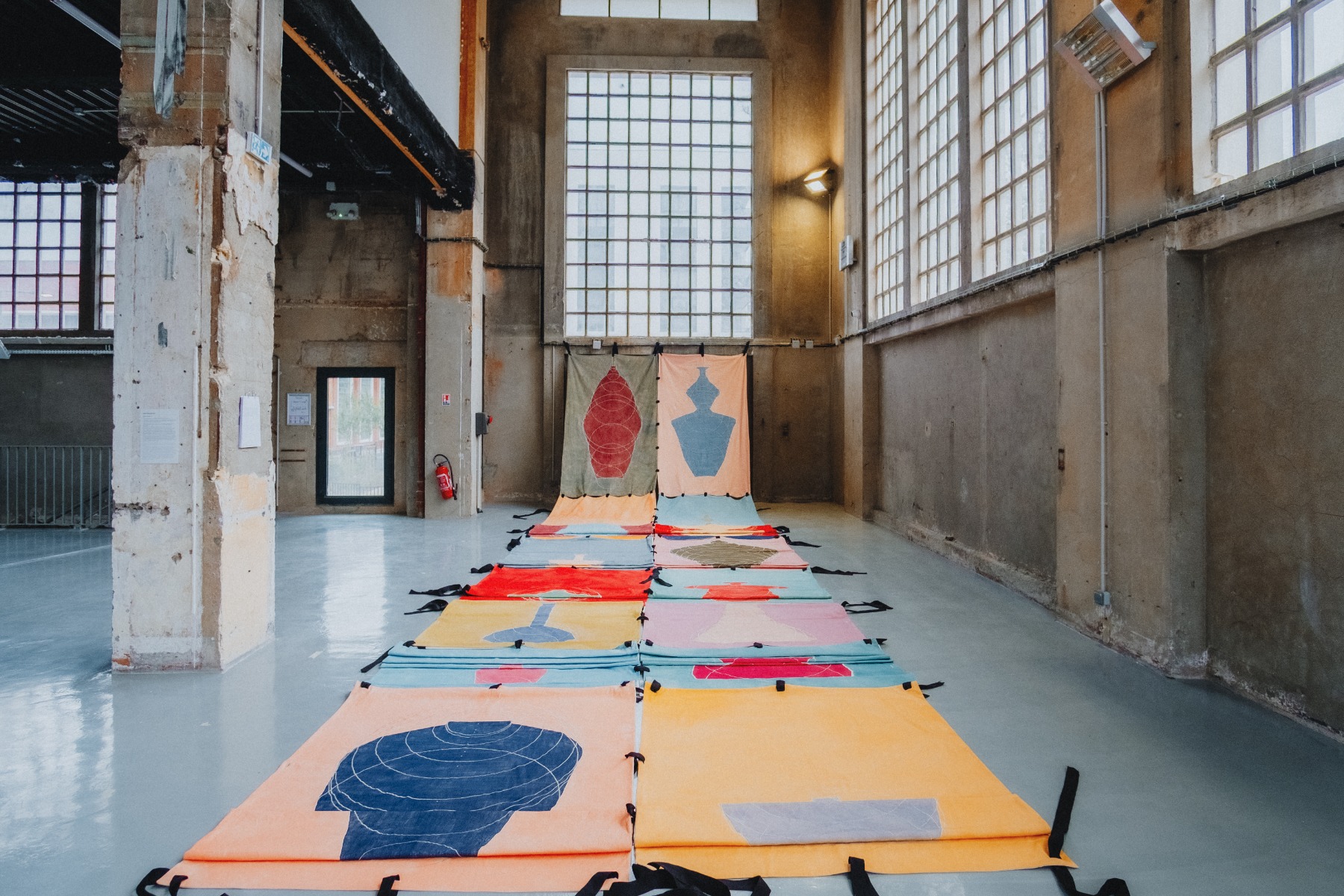
It’s a really interesting aspect of your work. I greatly admire the Brazilian artist Ernesto Neto and the way his works invite physical engagement, dissolving the conventional distance between the viewer and the artwork. Touch changes the way we perceive and experience an artwork – it directs our attention differently. We are so used to art being untouchable. Was this accessibility something you intended from the beginning, or did you arrive at it gradually?
I think I came to it gradually. When I was a student, like many students, I had a much more conceptual approach to my work. I was working with ideas and making things that were, I think, less accessible. Then I started questioning myself about who the public is, who I want the public to be, and how inclusive I want the works I create to be.
And my body was also going through something at that time. After my studies in fine arts, I was passing through a difficult period. I don’t know how much I can talk about it, but my body had a reaction. I was coming out of a trauma, and I started having acne. So the skin became extremely important. Having acne at 30 is not so common, and the skin became a really important question for me.
At that point, I discovered Lygia Clark. So when you talk about Ernesto Neto - he is Brazilian as well – I feel very connected to the philosophy of those Neo-Concrete Brazilian artists. I think getting to know their practices and studying them influenced me, but also liberated some of the questions I had, or some of the limits I had in my own practice.
I think my practice nowadays has been shaped by a series of important decisions I had to make. I wanted to create performances, so people could come and join. I wanted to create objects that we could touch, so we could also recognise them through this movement. And I wanted to create forms that are accessible – forms that can be attractive and technically very precise, so that a public that is not used to seeing contemporary art can become interested through the technical aspect of the work.
In this way, the technical aspect can introduce them to the sensibility and the concepts within the work. There is a form, there is a context, and inside there is a concept.
But did you ever work as an architect?
A little bit, yes. I had to, because as an artist you don’t have an income immediately. So for the first two years after my studies, I worked as an architect. I mainly worked on renovations and interior architecture.
Would you agree that architecture is perhaps one of our most fundamental art forms, because it is always about the relationship between the human body and space?
Yes, there is all that, but there is also movement. Actually, creating architecture is a way of choreographing movement on a larger scale – the movement of society - while also protecting the body from the weather, from the outside, from natural forces. I really do believe that architecture can be a form of art. The reason I left architecture is that, in contemporary society, it’s very difficult to practise. It’s even more difficult than art, to be honest. You are much more dependent on the political situation.
But you live between Athens and Paris now, right?
Yes.
These are two very different cities, each with its own strong cultural heritage. Does living between them affect your awareness of the body and public space? The way people move through Paris, for instance, seems very different from Athens.
Yes. And I’m really excited to discover Riga. I live between these two cities, and I never feel completely at home in either of them. I think I’m always kind of floating in a space between these cities and these cultures, which are both mine now. Even French culture has become mine.
I think whichever city I’m in, I’m searching for the rhythm of the other one. When I’m in Athens, I’m searching for the faster, more dynamic rhythm of Paris. And when I’m in Paris, I’m searching for the open time and open space that we can experience in Athens. I think this conflict, or this little balance between those rhythms, is actually the space where I create, in a way.
Paris is not exactly a northern city, but it is still considerably further north than Athens. Do you ever think about the impact of light and sun on you, both as an artist and as a person?
Yes, absolutely. In Greece, there is this sun that burns everything. There is this light - the sun creates a light that is completely white. You can hardly open your eyes. Everything feels burned. Even when we take photographs, there is something very particular about the way the light is captured.
In Paris, the light changes much more. We can see many more colours, in a way. And thank you for this question, because I had never realised this before, but now I do. I think this might be the reason why, now that I’m mainly in Paris and less in Athens, I’m starting to use more colour in my work.
When I was in Greece, what I was creating was almost completely white, because everything was burned by the light. That was how I was thinking, how I was seeing the city. And now we can see much more colour appearing in my recent work, perhaps because my main studio is in Paris.
Nefeli Papadimouli. In the Folds of the World, Endlessly.The Pill.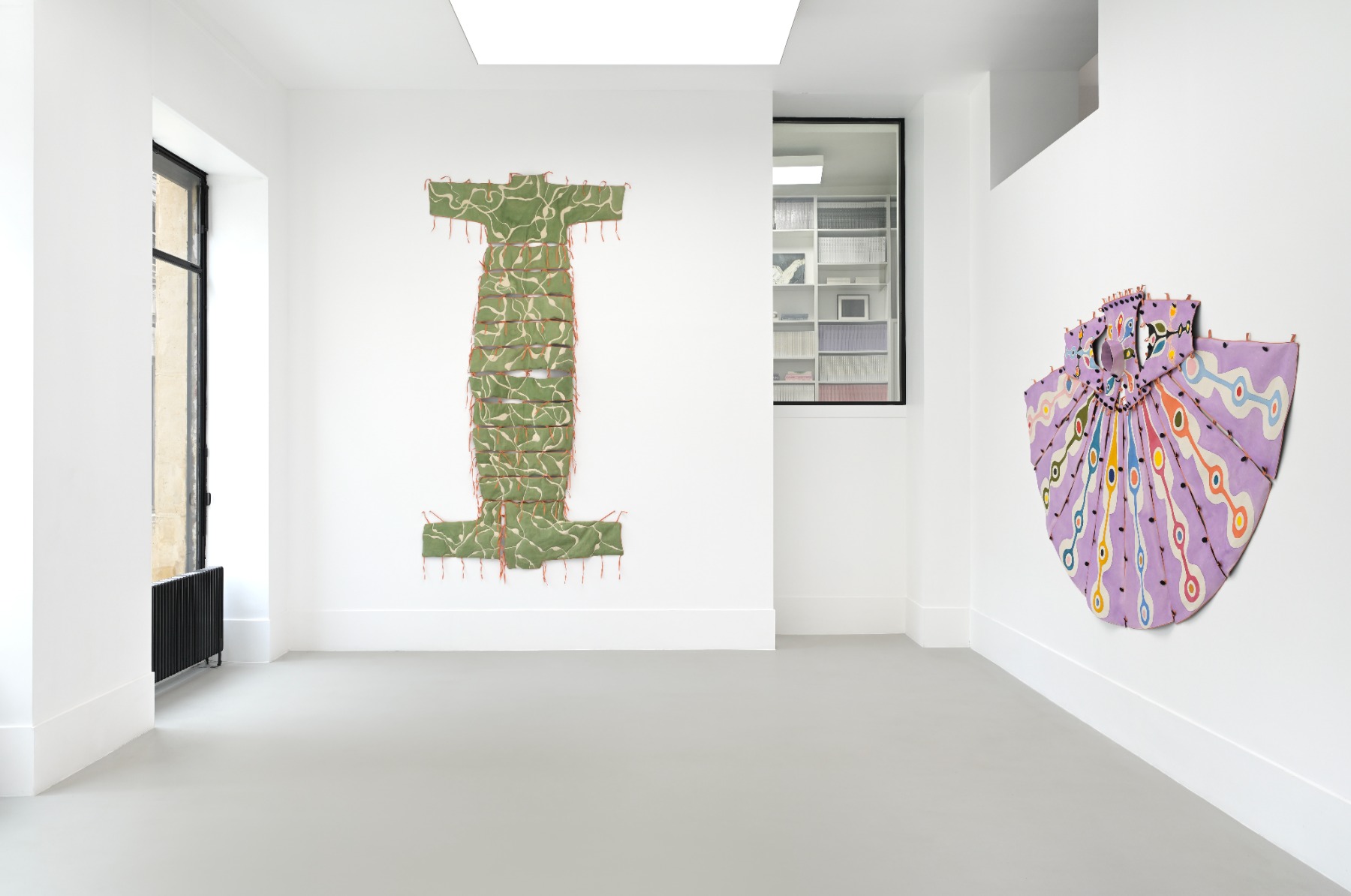
It’s interesting in relation to the exhibition as well. Riga and Athens are almost on the same longitude and share the same time zone, but Athens is much further south. Here in Riga, we lack sunlight, and the exhibition opens just as the darkest time of the year begins. So, in a way, we are bringing the Greek sun to Riga. But the sun also has a darker side. Too much of it can be destructive – as you said, it burns everything.
Yes. The sun can be life, or it can be destructive. It’s necessary for us to be alive, and for nature – we are part of nature. But if you fly too close, if you want too much of it, then it burns everything.
It’s all about balance – or distance, actually. And in this case, as in many cases, balance comes from distance.
Art today is very global, and many of us live almost as global nomads – you yourself live between Athens and Paris. But do you think there is still something we could call “Greekness” in art? Do you feel your Greek roots in the way you work or in the way you look at the world?
I think it has something to do with language. Greek is a very complex language, with a lot of words, a lot of possibilities and nuances. The vocabulary is extremely rich, and I think that thinking in Greek affects the way artists work.
And then I think there is the light as well, and the fact that it’s really warm. I’m not sure there is a “Greekness”, but still, I think Greek artists are amazing. I’m not talking about myself, I’m talking about my colleagues.
I know that my generation of artists has been through a lot of difficult things. And I can see something of that in the work, sometimes directly and sometimes in a more subtle way. It is something I recognise across the work of many Greek artists today, including the artists who are part of this exhibition. I’m not sure. I’m asking myself as well. I don’t really have an answer. But I think, yes, there is a trauma somewhere, and this trauma finds expression through very different and interesting approaches in contemporary art.
You can now look at Greece both from a certain distance and as an insider. We already spoke about the crisis – you were very young when it began, just at the start of your career. I’ve heard people in Greece speak about the crisis as having had a paradoxically generative effect on the art scene, arguing that without it Athens might not have developed the vibrant contemporary art scene it has today. How do you see this? And what do you find most interesting about what is happening in the Greek art scene now?
I wouldn’t really know what it was like before, because I was very young and I was studying architecture at the time. But personally, I would never call the crisis a blessing because of the effects it had on society as a whole. I cannot isolate what happened in contemporary art from the wider context of what was happening in the country.
But it is true that one of the most interesting things about the Athenian art scene – and this is probably connected to the crisis – is how vibrant it is because people know how to work with almost nothing, with very little funding. There is a very strong sense of community. Communities form very quickly in Athens. We know how to work collectively, how to work with others, and how to create something out of almost nothing.
This is what happened during the crisis, and it is still happening today. Artists and young curators are creating exhibitions and really interesting works with almost no public funding and very little private funding. There is this energy, and there is a knowledge of how to create an economy based on exchange. I think this is also why there are so many great initiatives in Athens. They create the conditions for extremely interesting practices to emerge.
So, in a way, the crisis changed how your generation thinks about community and also about public space.
Yes. Community, public space, and sharing. Because public space is a space that we share. We started to learn how to share, actually, and this is really crucial to what is happening today.
But in a way, performance itself can also teach us how to share. The people involved in a performance are sharing something - the performance itself becomes a gesture of sharing.
Yes, completely. Everyone participating in a performance becomes part of something they have in common. Everyone shares the performance. It creates a common space, a common time, and also the idea of the common. This is what is amazing about performance.
Is this also why it is important for you not to bring your own team of dancers, but to work with local performers?
Yes, this is part of my practice. Otherwise, I think it would become more like contemporary dance or theatre. I really believe that the work becomes actual when it comes into contact with the place.
And by place, I mean the context in a larger sense – not just the physical space, but also the people who inhabit it. Working with local dancers means working with different bodies, with a different way of moving. This is what makes it interesting for me, and I hope it makes it interesting for other people as well.
So you think that the way we move and the way we dance are also deeply embedded in our culture?
I think so. I think we can do everything, but I also think that each of us is rooted somewhere, in a way, and that is beautiful. I believe it’s much more interesting to try to understand those roots, to try to find them, rather than to be completely nomadic and create a spectacle. For me, then it would become a spectacle rather than a performance, rather than an event.
So even though you now live partly in Paris, you are still rooted in Greece - in the way you think, move and work as an artist.
Yes, definitely. In my rhythms, in my inner rhythms as well. I think there is a kind of resistance there. Most of my performances are quite slow, very contemplative in a way, and I think this is part of my personal resistance to following the Northern European rhythm.
It is a way of keeping something of how we understand time in Greece, which is a completely different way of understanding time.
Really?
I think so, yes. I’m not sure if this is interesting, but I think Greece has a particularity. The sea is the centre of the country. It’s a place where space is exploded, in a way – the land is divided into many different parts, and to get from one to another, you have to travel a lot.
And I think this changes the way we understand time. The fact that space is exploded creates a time that is exploded as well. I really believe that, unconsciously, the geographical situation of the country affects us a lot.
I think it’s because of the sun, and I think it’s because of the archipelago – the archipelago situation. I think the slowness comes from that. At least, this is how I dream of it.
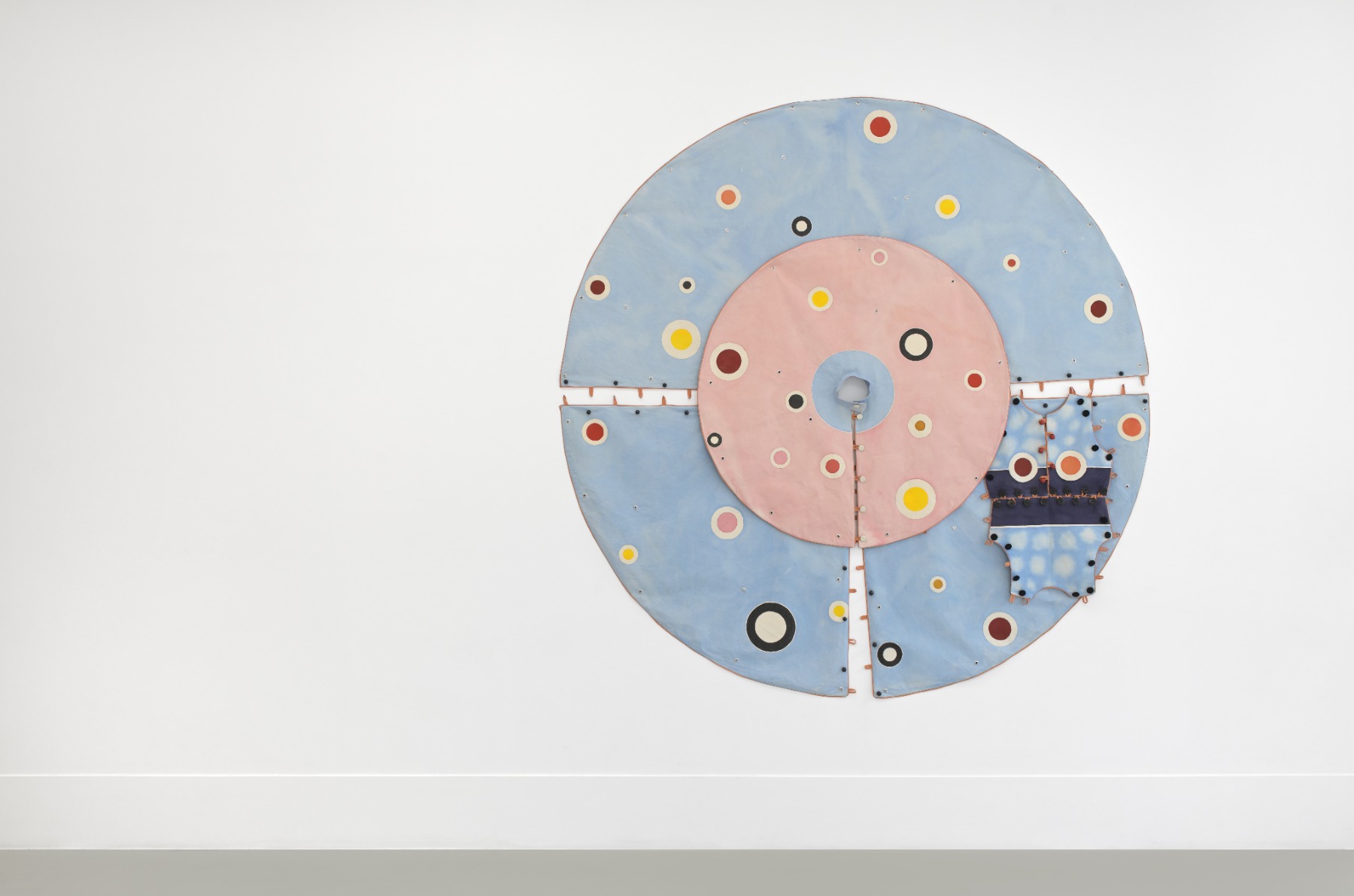
Nefeli Papadimouli. In the Folds of the World, Endlessly. The Pill. © Rebecca Fanuele © ADAGP, Paris, 2026
How do you see the role of art today, at a time of such turbulence and uncertainty? We often speak about art as a healing tool and about the power of art. Our previous exhibition here in Riga was dedicated to emotions, and what struck me was how people seemed to use the exhibition almost as a safe space. Some returned four or five times, including people who would not normally visit exhibitions, and they spent real time with the artworks. It made me wonder whether, in times like these, people instinctively begin to search for something in art, just as they might turn to nature.
I think we both believe, as art workers, that art can be a transformative experience. And not just healing. Yes, it has healing powers, but I think the possibility of coming into contact with beautiful forms and with fiction – with fiction as the possibility of new realities - is essential.
It is extremely important for us to be able to survive the times that are coming, which are extremely difficult for all of humanity. And I think it is essential for art to exist because art is a space where we can experiment with possible solutions. We don’t try to find answers, but through all the questions we put into art, we can experiment with possible alternatives.
And I think people need that. They need to see hope. They need to see forms of utopia – new ways out, new possibilities.
And finally, tell me a little about your upcoming exhibition at M Leuven in Belgium this November.
Yes. I’m working on an exhibition called Anamesa. It has a Greek title which means “in between,” and it will bring together some of my recent works as well as a new production.
The exhibition explores this idea of the space in between. I’ve spoken a lot about that – the in-between as an interface, as a balance, or as a space of formation.
Each room of the exhibition will explore a different in-between space: between body and architecture, between human and nature, between the individual and the collective. So there is a kind of progression through the exhibition.
Thank you!
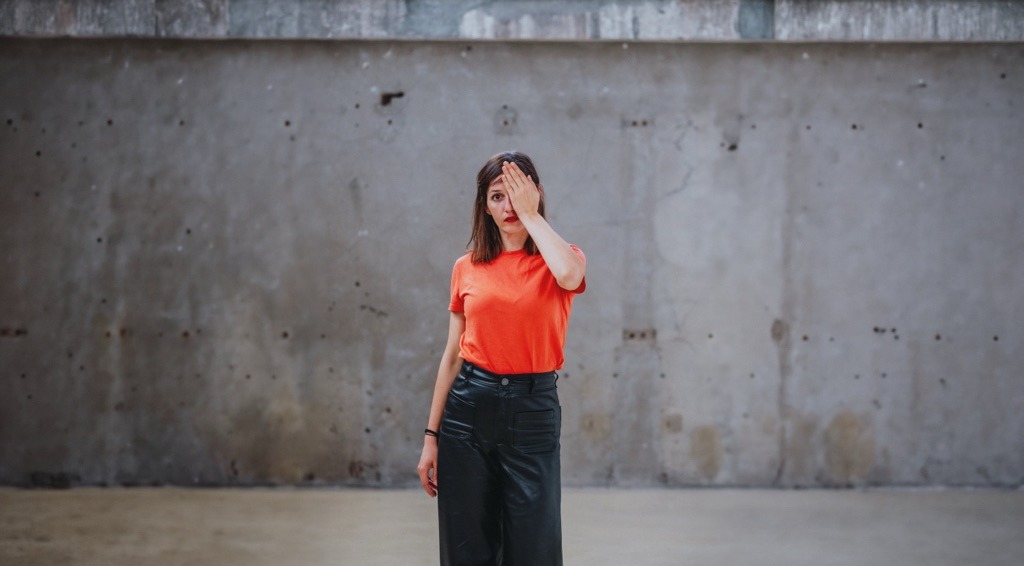
Title image: Nefeli Papadimouli. © Manuel Abella
