


A Greek polis beneath Riga
An interview with Marina Fokidis, curator of the exhibition Always the Sun
Always the Sun is the first large-scale presentation of contemporary Greek art in the Baltic region. On view at the Riga Contemporary Art Space (RCAS) until January 10, 2027, it brings together a constellation of 27 Greek artists whose practices are shaped by the interplay of geography, light, climate, and cultural legacy. “Drawing inspiration from the song by The Stranglers, the exhibition approaches the sun not as a motif, but as a medium of thought, perception, and lived experience. It explores how the brightness, heat, and exposure of the Mediterranean have influenced aesthetic languages and fostered strategies of survival, intimacy, and adaptation. For Riga, a northern city where sunlight is often fleeting, this exhibition offers an encounter with a southern sensibility: not exotic, but grounded, material, and spiritual.”
Always the Sun. Riga Contemporary Art Space. Exhibition view. Photo by Līga Spunde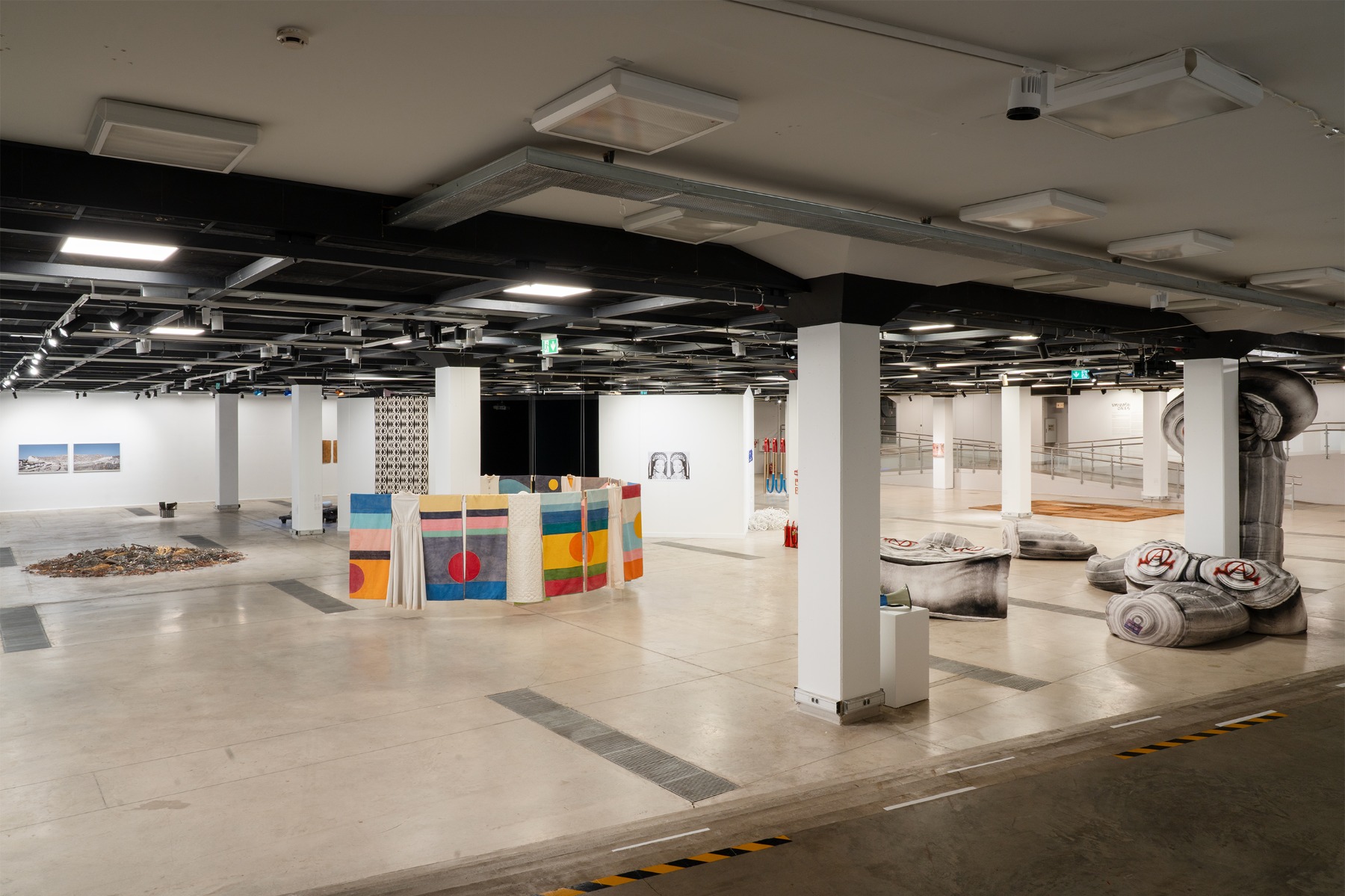
This quote from the exhibition’s statement captures its spirit, its “vibe,” very precisely: its unhurried pace, diverse forms of materiality, and precise, succinct artistic metaphors. And all of this is not an attempt to “sell” us a culture that is, in many ways, quite distant, but rather an invitation to get acquainted, to find common concerns, and to linger over a conversation. The exhibition “proposes light not only as a symbol, but also as a form of knowledge. In ancient Greek thought, light illuminated truth, but the southern sun, unlike the colder light of the Northern Enlightenment, is contradictory. It dazzles, reveals, and blinds. It asks us not to observe from a distance, but to feel, inhabit, and listen.”
The curator Marina Fokidis is not afraid to look directly into the light: “The sun. Not the picturesque Mediterranean sun of tourist brochures, nor the luminous ideal inherited from modernist painting, but the sun as both a metaphor and a lived reality: a force that regulates daily rhythms, shapes public space, and influences the ways people meet, rest, work, and inhabit their cities. What does it mean to live under a particular light? How might weather influence artistic production as profoundly as history, politics, or language?”
Bill Balaskas. Culture. Neon, electrical cables, variable dimensions, edition 2/3, 2013. Courtesy of Irene Y. Panagopoulos Collection and the artist. Photo by Līga Spunde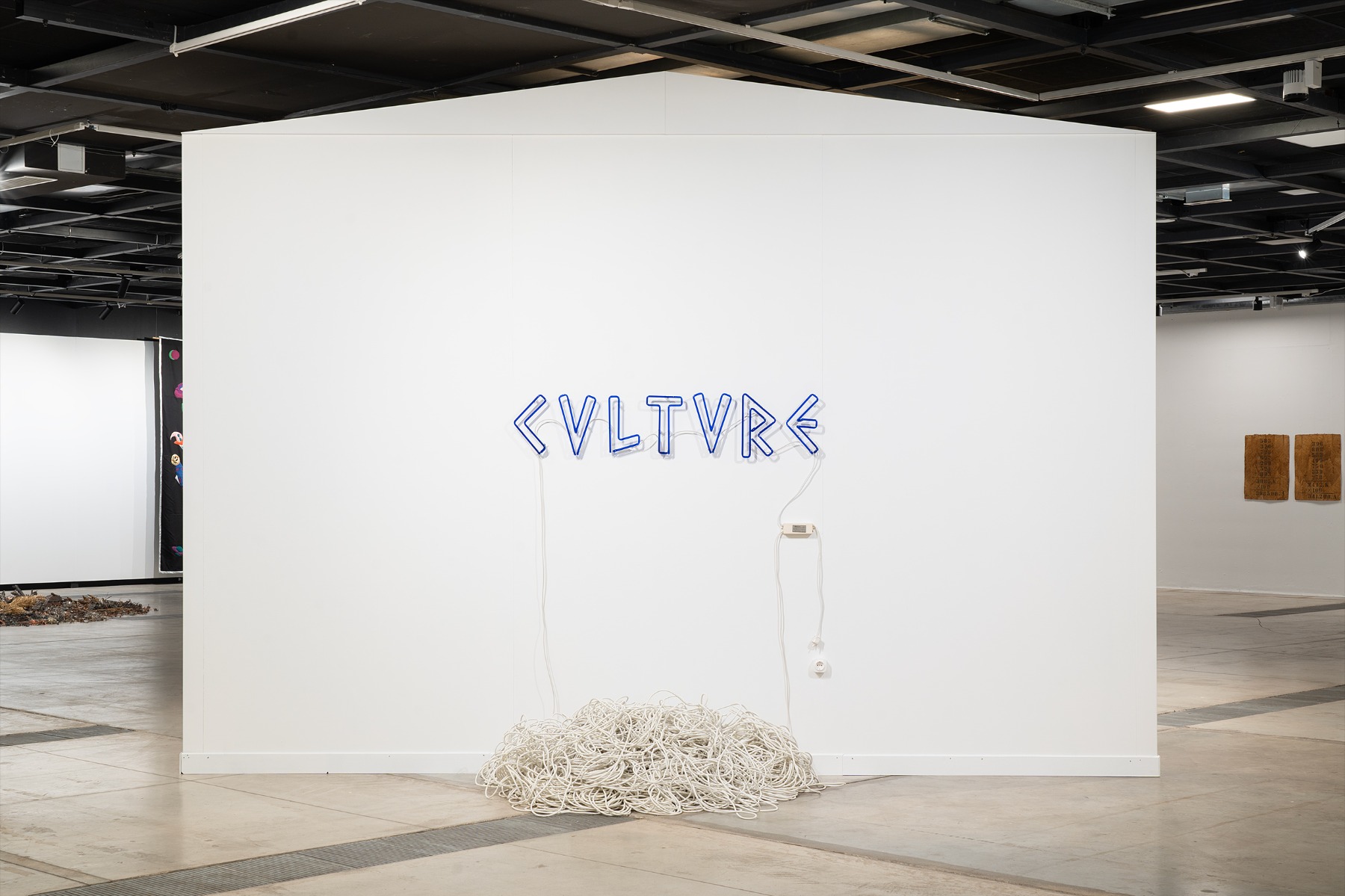
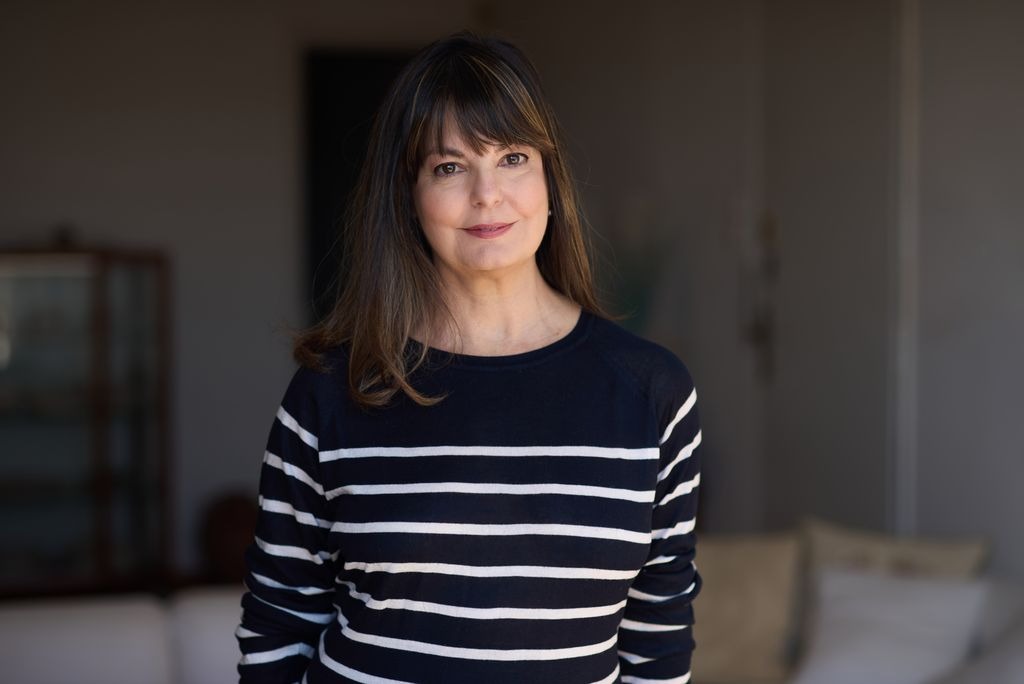
Marina Fokidis is a curator and writer based in Athens Greece. In 2010, amidst the Greek economic crisis, she founded the independent space Kunsthalle Athena to reflect on the “social role of art institutions in the 21st century,” beyond mounting exhibitions and towards co-producing culture; while in 2012, she founded South as a State of Mind magazine, a biannual arts and culture journal that creates unexpected dialogues between distinct neighborhoods, cities, regions and approaches. In 2014, she was appointed Head of the Artistic Office, Athens and curatorial advisor for documenta 14.
I meet her a day before the exhibition opening at the Riga Contemporary Art Space, in a vast hall located one level below ground. Marina and Martins Vizbulis, the regular exhibition setup specialist at RCAS, are moving from one corner of the space to another, checking the details, slightly raising or lowering works that have already been installed. Finally, Marina finds some time for me, too, and we sit down on huge, remarkably soft columns reminiscent of those of the Parthenon. I will find out what they are a little later.
Angelo Plessas. The Quilt of All Beings. Handmade quilt, 300 x 190 cm, 2022. Courtesy of the artist. Photo by Līgas Spunde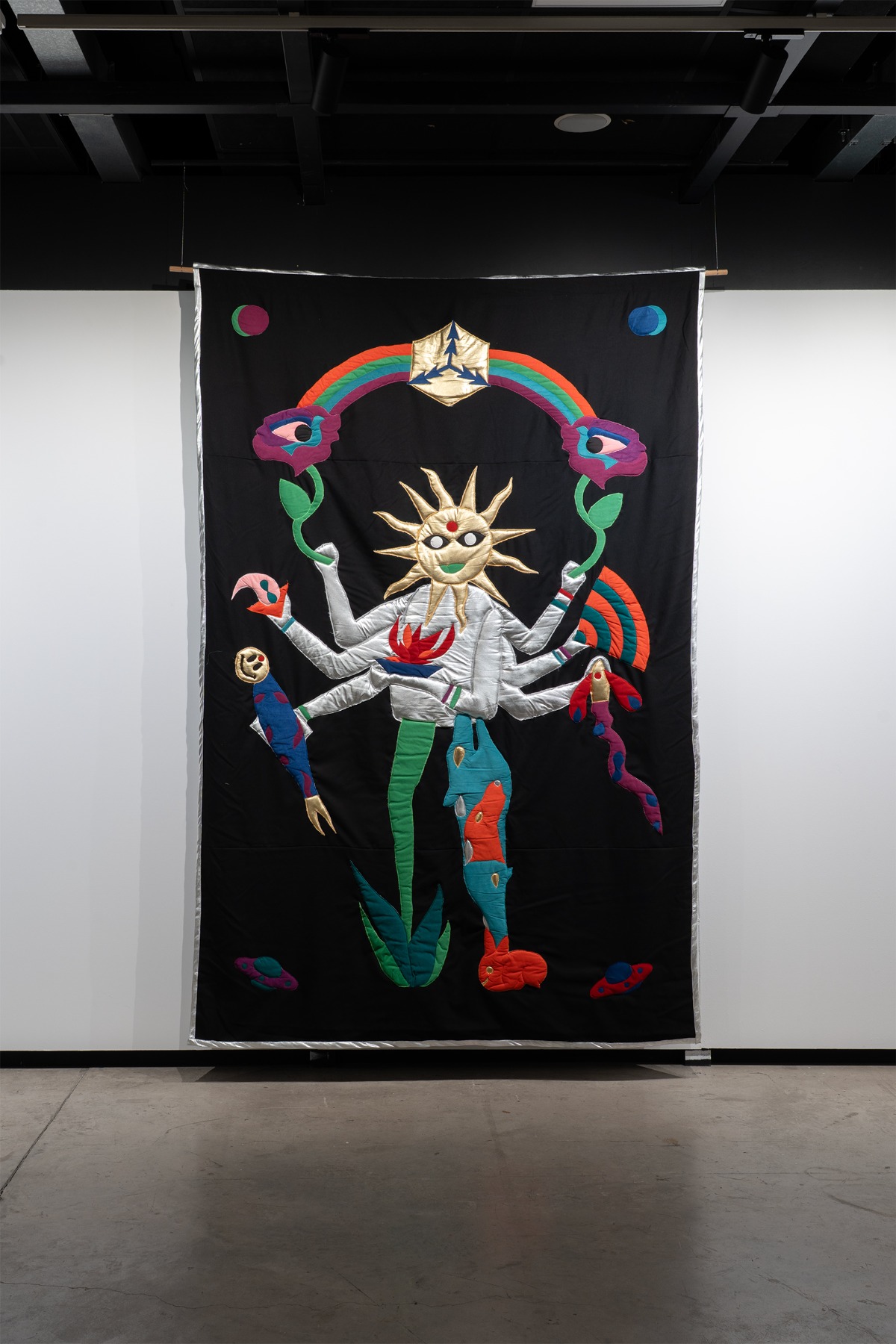
So, Always the Sun. This phrase doesn’t come from Greek mythology, literature, or pop culture, but from a song by The Stranglers, the British punk and new wave band. Why was it meaningful for you to start with this title, with this song?
When I was invited to curate an exhibition of Greek artists, my first reaction was to question the premise itself. National exhibitions are not something I usually undertake, and the idea of presenting artists through a shared nationality belongs, to some extent, to an earlier moment in contemporary art. In the 1990s, we spoke frequently about British, German, or Balkan art scenes, often as though geography could provide a coherent artistic identity. But what exactly constitutes a national art scene, and how much can nationality really tell us about an artist's work? These are questions I have been addressing for years, also through South as a State of Mind – the magazine I was publishing – as my interest has always been in the complexities and contradictions of geographical and cultural identities.
So I began by considering the images through which Greece is internationally recognised. The sun was almost unavoidable. It belongs to the vocabulary of tourism, leisure, antiquity, and a certain idealisation of Mediterranean life. But the same sun shines upon radically different social realities. It illuminates privilege and precarity, abundance and deprivation, freedom and constraint.
This brought me back to Always the Sun by The Stranglers, a song popular when I was in high school in the late 80s. What interests me in this pop song is precisely the tension between its seemingly optimistic title and the political disquiet of its lyrics, which question the unequal distribution of power and privilege.The title allowed me to work with a familiar stereotype while simultaneously destabilising it. I wanted the sun to become a way of approaching a much more complicated contemporary Greece, without resorting to another familiar construction of Greek identity: mythology and classical antiquity.
The exhibition begins with this contradiction, and perhaps with a question: who has the privilege of living under the sun, and under what conditions?
Always the Sun. Riga Contemporary Art Space. Exhibition view. Photo by Līga Spunde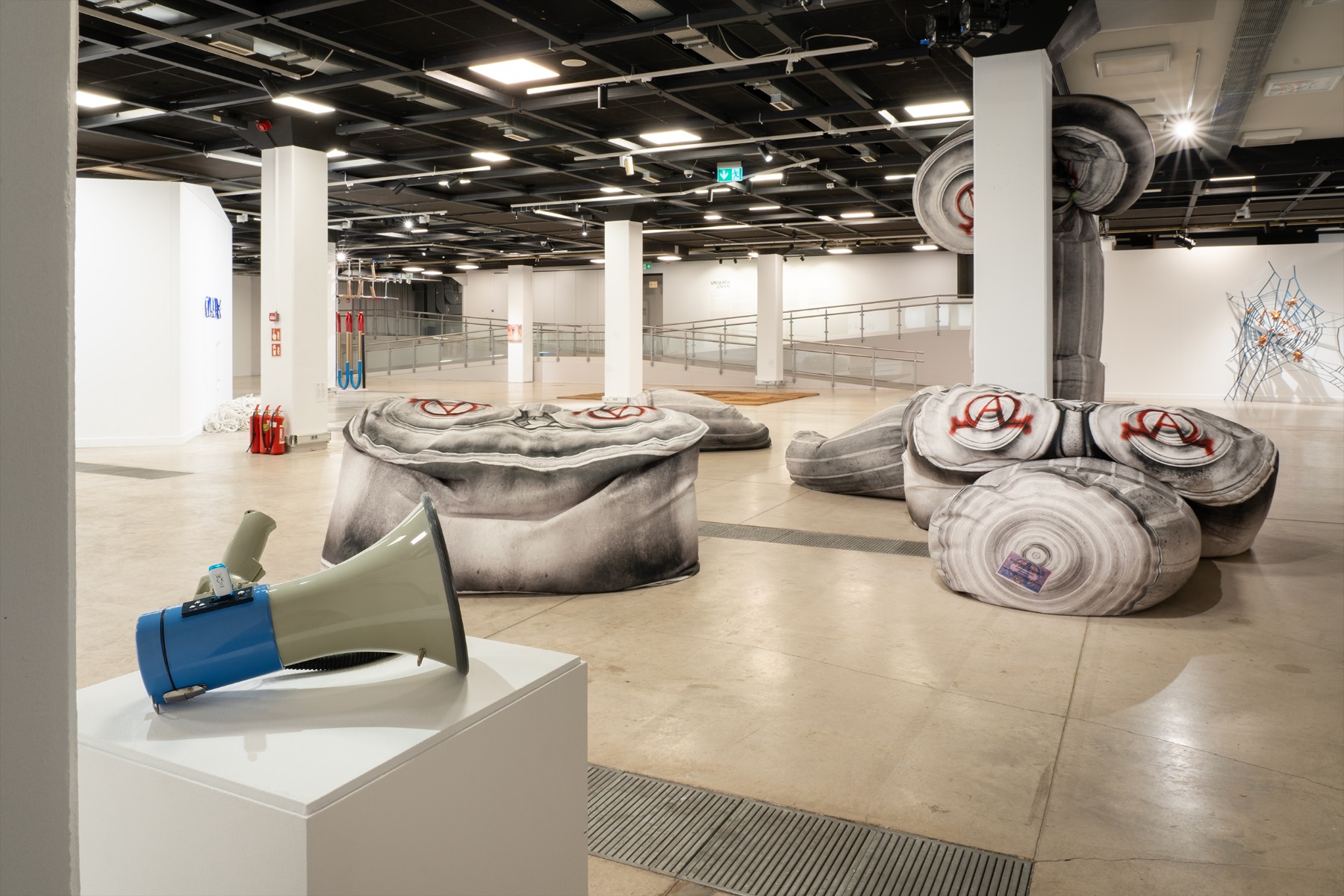
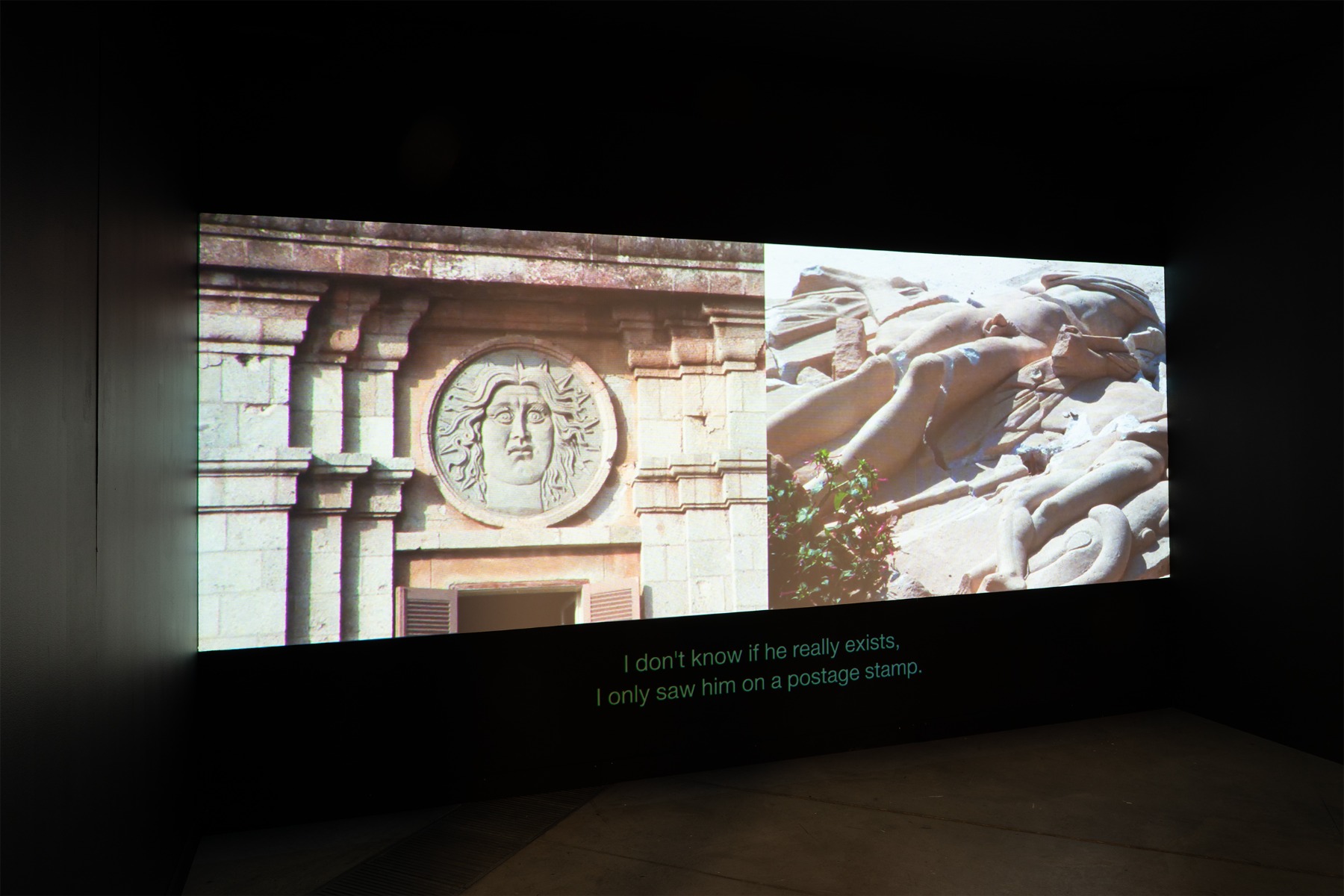
Menelaos Karamaghiolis...Mrs Dankbar Speaks Through Me...
16 mm film transferred to digital video, 7’, 2 channels, 1986–2026. Photo by Līga Spunde
A few works in the exhibition also have the word “sun” in their titles.
Interestingly, very few works represent the sun directly, and this was deliberate. I was interested in what the sun produces, materially, socially, and symbolically, beyond its immediate visual representation. Greece continues to be imagined internationally through its extraordinary climate and landscape, but this image coexists with the realities of economic crisis, environmental pressure, and increasingly aggressive touristification.
One example is the work of Menelaos Karamaghiolis, ...Mrs Dankbar Speaks Through Me..., which addresses the mythology surrounding the Colossus of Rhodes, the ancient monument dedicated to Helios to Helios, the Greek sun god. The Colossus disappeared many centuries ago, yet its imaginary presence remains extraordinarily powerful. It has become part of the island's tourist identity, endlessly reproduced through images, souvenirs, and popular narratives. Here, an absent monument continues to generate a very tangible economy of cultural representation. Karamaghiolis questions precisely how such narratives are constructed, circulated, and eventually accepted as historical truth. Dimitra Charamandas's Sun Burn another example approaches the subject differently. Here, sunlight carries the traces of exposure, exhaustion, and environmental transformation. The image itself seems affected by the conditions it records, while the landscape bears the consequences of increasing heat and dryness.
So the sun operates throughout the exhibition as a presence, a pressure, and sometimes a contradiction. It does not necessarily need to appear as an image to influence the conditions under which these works were conceived.
Panos Tsagaris. Golden Newspaper series. September 6 2015. Gold leaf on archival inkjet print, 150 x 90 cm, 2016. August 26 2015. Gold leaf on archival inkjet print, 150 x 90 cm, 2016. April 9 2024. Gold leaf on archival inkjet print, 150 x 80 cm, 2024. Courtesy of Kalfayan Galleries and the artist. Photo by Līga Spunde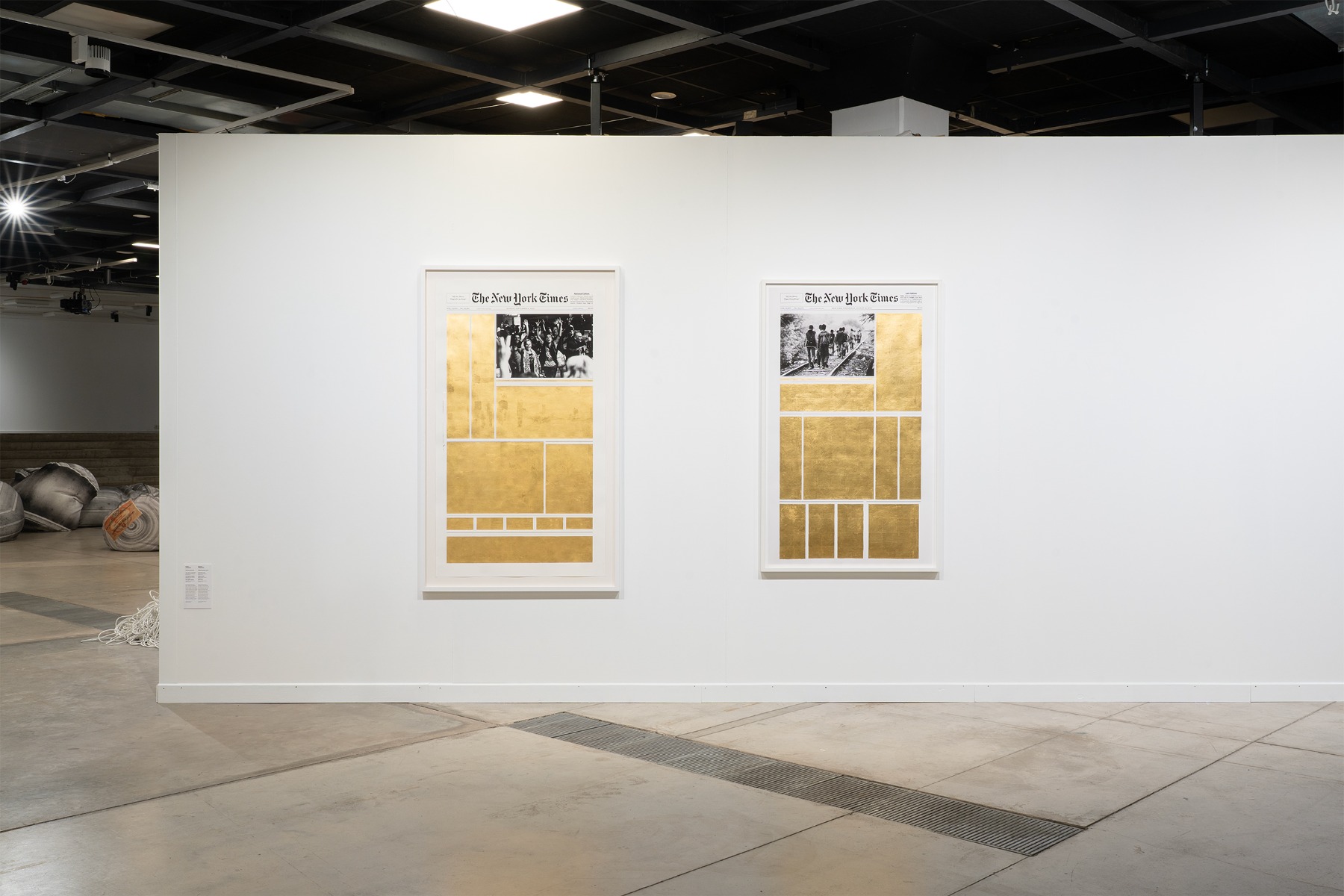
How does this particular quality of light, which you mentioned, affect artists and their practices? It must be rather important to the way they see reality and the way they work.
I would hesitate to make a direct connection between a particular climate and a particular artistic language. That would risk reproducing precisely the geographical essentialism that the exhibition is trying to question.
Historically, light was often discussed in relation to painting, representation, and perception. But contemporary artistic practices operate across many different media, and I am interested in a broader understanding of what climate might influence. In Greece, the intensity of sunlight and heat has consequences for the organisation of everyday life, the use of public space, and the rhythms of social interaction. Streets, balconies, squares, and outdoor gatherings become important extensions of collective life. Climate is never simply a backdrop; it participates in shaping the ways people inhabit a place and negotiate their proximity to one another.
Of course, this does not mean that Greek artists share a particular temperament or aesthetic. But perhaps the density of social encounters, the exposure of public life, its noise, contradictions, and sometimes extraordinary intimacy, enter artistic production in less immediately visible ways.
I am interested in this indirect relationship between atmosphere and artistic practice, in how the conditions of living somewhere may enter a work without necessarily becoming its subject.This is also what interested me about bringing these works to Riga, where the relationship between climate, public life, and the seasonal experience of light is so different.
Photo by Līga Spunde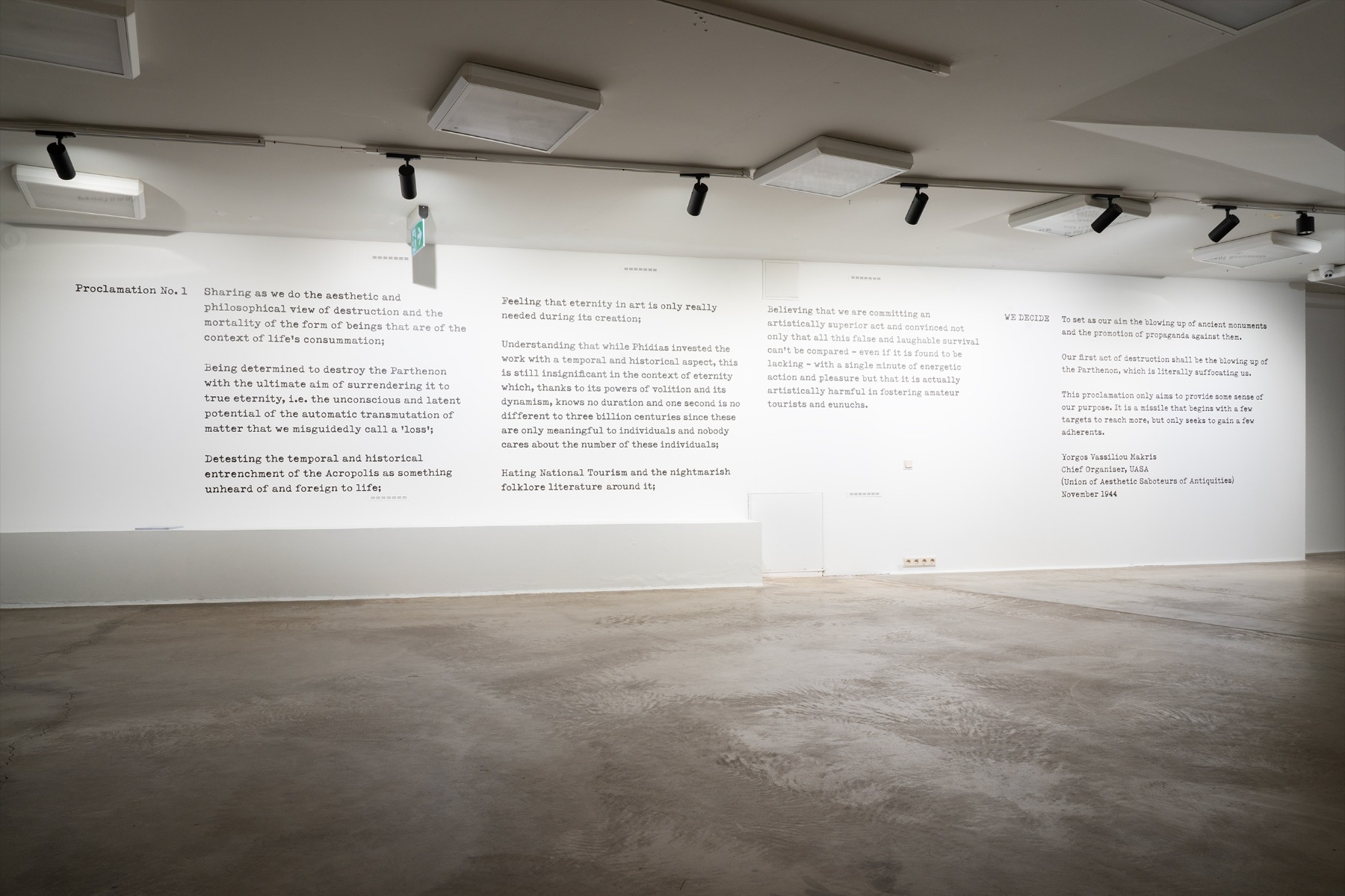
I see. And another, I think, meaningful subject here is this historical and cultural heritage, and the many different ways of looking at it. One of them is this manifesto on the wall, which seems to invite us to “explode” it in way.
Yorgos Makris belongs to a fascinating, relatively marginal history of Greek intellectual life, the anarchic and uncompromising circles that challenged the cultural and political conventions of their time. His manifesto proposing the destruction of the Parthenon should not, of course, be understood as a literal architectural proposal. It is a provocation directed against the authority of a symbol, and particularly against the ways in which classical antiquity has been instrumentalised in constructing modern Greek identity.
The Parthenon occupies a remarkable position in Athens, both physically and ideologically. It presides over a city whose contemporary realities are often far less monumental: social inequalities, precarious lives, political struggles, and all the contradictions of an inhabited metropolis. There is something profoundly interesting in this coexistence between the permanence of an idealised past and the instability of the present.
Of course, I strongly support the return of the Parthenon Marbles. Their restitution concerns historical justice, cultural responsibility, and the consequences of imperial appropriation. But this legitimate demand also exists within a broader political discourse in which antiquity is repeatedly mobilised as an emblem of national prestige. I think it is important to be able to distinguish these questions.
Makris's manifesto has accompanied my thinking for many years. We published it in South as a State of Mind and subsequently revisited it when the magazine became the journal of documenta 14, Learning from Athens, for which I headed the Artistic Office in Athens.Here, the manifesto assumes an almost architectural presence, forming a backdrop to the exhibition and in close proximity to Andreas Angelidakis's Anarchaeological Anaparastasis, where a set of soft, unstable columns transform the supposed solidity of classical architecture into something provisional, bodily, and even humorous. They can be moved, inhabited, and sat upon. Their institutional markings, including the wonderfully subversive “Ministry of Paganism,” further complicate the relationship between cultural heritage, state authority, and public funding.
Together, the manifesto and the sculpture question what happens when an inherited monument becomes so authoritative that it begins to overshadow the living culture around it. And there is a beautiful irony here: we are discussing the symbolic weight of the Parthenon while sitting comfortably on its collapsed, soft reincarnation.
Andreas Angelidakis. Anarchaeological Anaparastasis. Sculptural installation, variable dimensions, 2025. Courtesy of Onassis Collection and the artist. Photo by Līga Spunde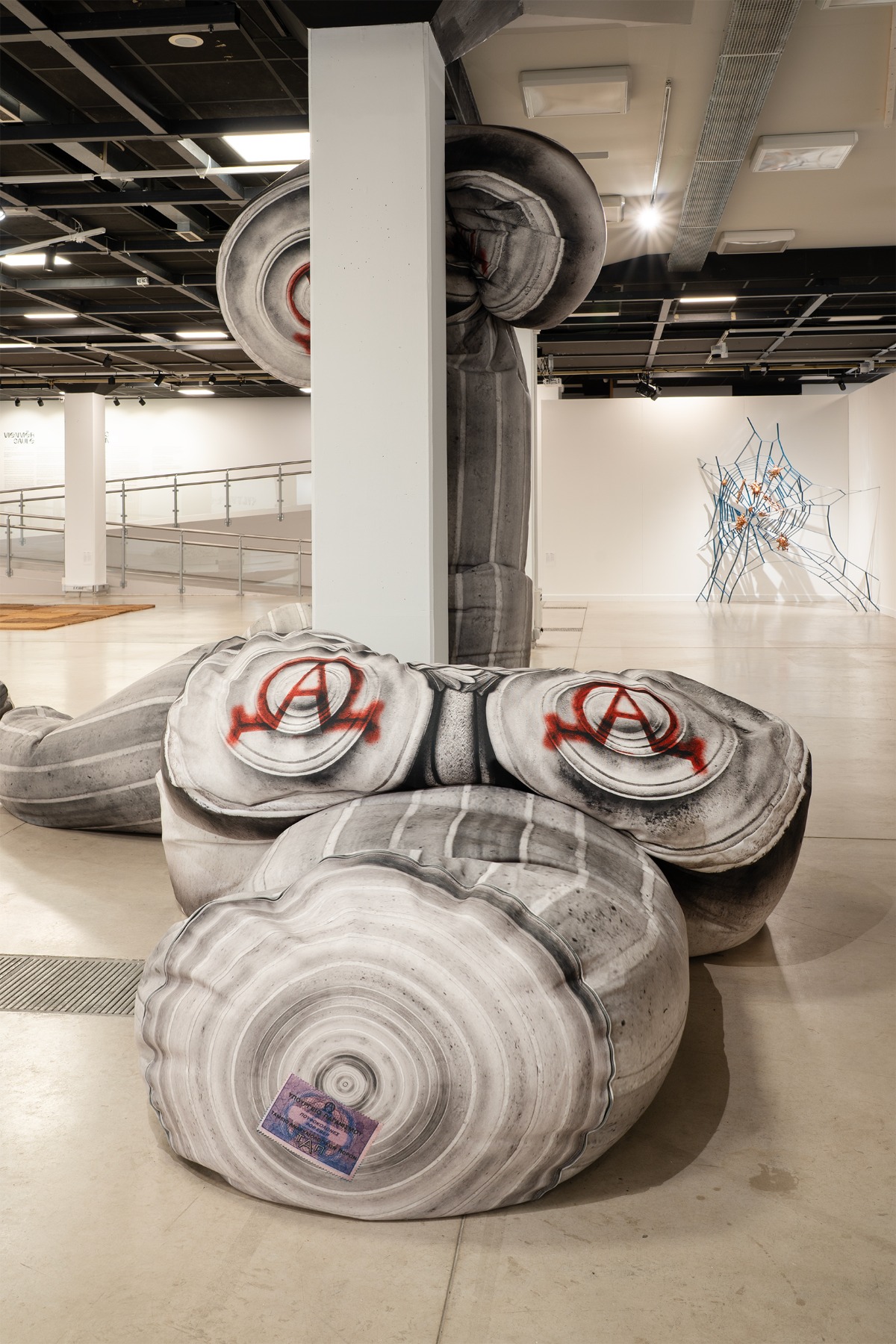
So, in a way, this cultural heritage of ancient Greece is conceptualized as something strictly connected to national state.
Ancient Greek heritage is obviously of immense importance, and its preservation is essential. But I am interested in the disproportionate attention that has historically been given to archaeology in relation to contemporary cultural production. For a long time, Greece was expected to represent its glorious past almost at the expense of acknowledging its complicated present.
There is also an important historical construction behind this. The idea of Greece as the cradle of Western civilisation was developed extensively through European Enlightenment thought, German philhellenism, and the ideological formation of the modern Greek state. This narrative established a privileged continuity between classical antiquity and modern Western identity, often overlooking the many other cultural histories that constitute Greece: Byzantine, Ottoman, Balkan, Mediterranean, and Eastern.
Even the famous whiteness of classical antiquity is largely a modern projection. Ancient sculptures and architectural monuments were richly coloured, something that seriously complicates the aesthetic ideals subsequently associated with them. The image of a pure, white classical world became an extraordinarily powerful European fantasy, carrying ideological implications far beyond archaeology.
The foundation of the modern Greek state was similarly marked by contradictions. Following independence, the arrival of the Bavarian monarchy under Otto brought a particular model of European statehood and modernisation. This was a complicated process of constructing national coherence across a territory with diverse cultural, religious, and linguistic histories. Of course, modernisation brought important institutional developments, but it also involved the suppression or marginalisation of other identities. I am interested in these tensions because Greek identity has never been as homogeneous as its official representations suggest.
Socratis Socratous's Stolen Goods introduces another layer to this history. The work takes as its point of departure the National Garden in Athens, originally the Royal Garden created under Queen Amalia, whose botanical collection included plants brought from different parts of the world. By casting leaves and branches from this garden in metal, Socratous creates objects that are both beautiful and politically charged. The garden itself can be understood as a nineteenth-century attempt to cultivate and domesticate nature within a new European capital. The title Stolen Goods introduces questions of ownership, displacement, appropriation, and historical entitlement.
Made during the Greek economic crisis, the work also resonates with the deeply unequal political and economic relations that became so visible during that period, particularly between Greece and Germany. The public discourse surrounding debt often reproduced familiar hierarchies between a supposedly disciplined European centre and an irresponsible southern periphery, while obscuring the complexities of financial power and historical responsibility. What interests me is how a work made from something as modest as a leaf can carry such an accumulation of histories: botanical, colonial, national, and economic.
This also connects to an important curatorial decision in Always the Sun. Many works were made during the Greek economic crisis, particularly around 2012–2015. I did not want to present them as historical documents of a difficult period, however. I wanted to see what happens when works conceived under the sun of the crisis are encountered again under the sun of the present. It is striking how contemporary they remain, how their questions persist and sometimes acquire new meanings. Artistic production continued throughout those years, often under extremely difficult circumstances. I think of the myth of Icarus here, not simply as a warning against approaching the sun, but as an image of ambition, exposure, vulnerability, and the possibility of continuing even after a fall.
Perhaps the exhibition is also about this persistence: the capacity of art to remain alive beyond the immediate historical conditions of its production.
Anastasia Douka. Anger Organizes. Anodized aluminum, car spray paint, polyethylene, dimensions variable, 2021. Courtesy of the artist, commissioned by NEON. Photo by Christina Dimitriadis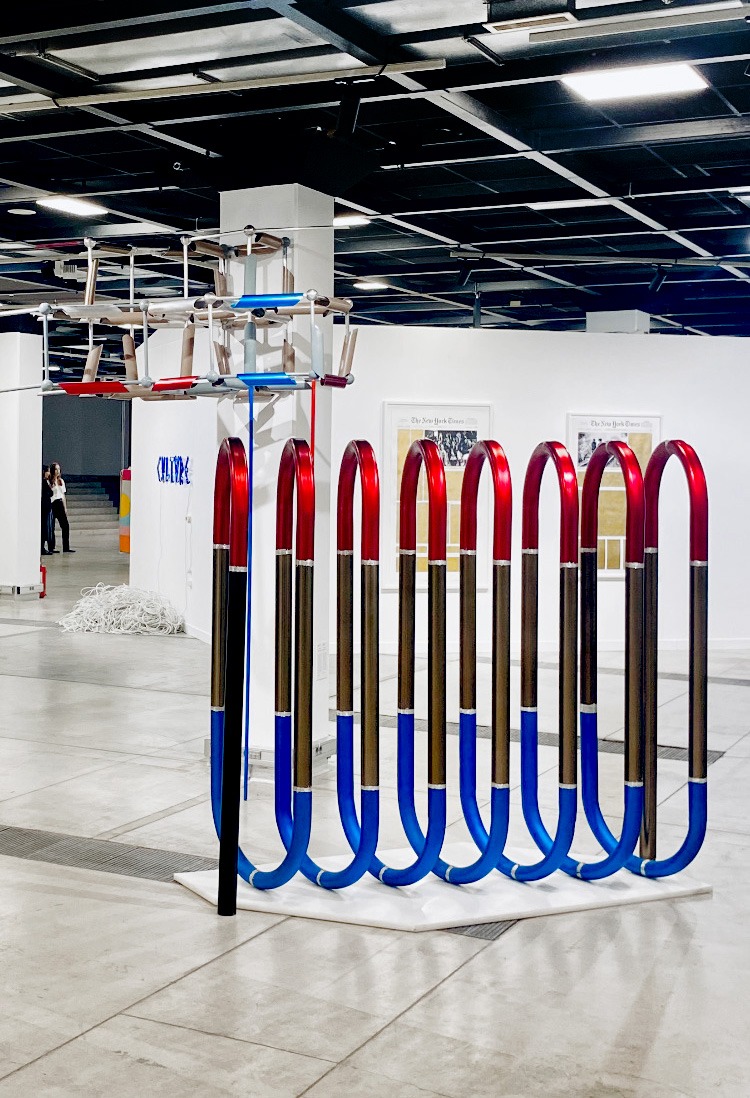
Definitely, the crisis was a crucial event for Greek society and also for the art scene.
The crisis was profoundly traumatic, not only economically but socially and psychologically. It transformed our understanding of stability, collective responsibility, and the relationship between citizens and institutions. But what continues to interest me is how artistic production persisted under these conditions, without necessarily providing direct illustrations of the crisis itself.
Anastasia Douka's Anger Organizes is particularly interesting in this respect. The work takes the form of a machine that generates intense heat, usually used in the tobacco industry. It approaches anger as something that can accumulate, be organised, and potentially transformed into action. There is a very particular tension between its industrial appearance and the emotional forces it suggests. Anger here is neither simply destructive nor necessarily emancipatory. It is a form of energy whose political potential remains unresolved.
Nearby, Panos Charalambous's Tobacco Archives: Accounts brings another history of tobacco into the exhibition. His work draws upon the agricultural economy of Greece, particularly the cultivation of tobacco, and the memories of labour embedded within it.The calculations written directly onto tobacco leaves are especially moving. They record the quantities harvested and the money expected in return, but behind these numbers lie entire lives organised around agricultural labour. The leaf becomes both an economic document and a fragile repository of social memory.
I wanted these works to enter into conversation. They belong to different generations and historical experiences, yet both approach tobacco through the relationship between labour, value, and the human body. In one, energy accumulates almost to the point of combustion; in the other, the traces of labour remain inscribed on something extraordinarily delicate. These connections interest me much more than constructing a linear narrative about the crisis. They allow different historical moments to speak to one another through the materials themselves.
Panos Charalambous. Tobacco Archives: Accounts tobacco leaves, mixed media, 78 x 57 cm each, 1994. Fragment. Courtesy of CITRONNE Gallery and the artist. Photo by Līga Spunde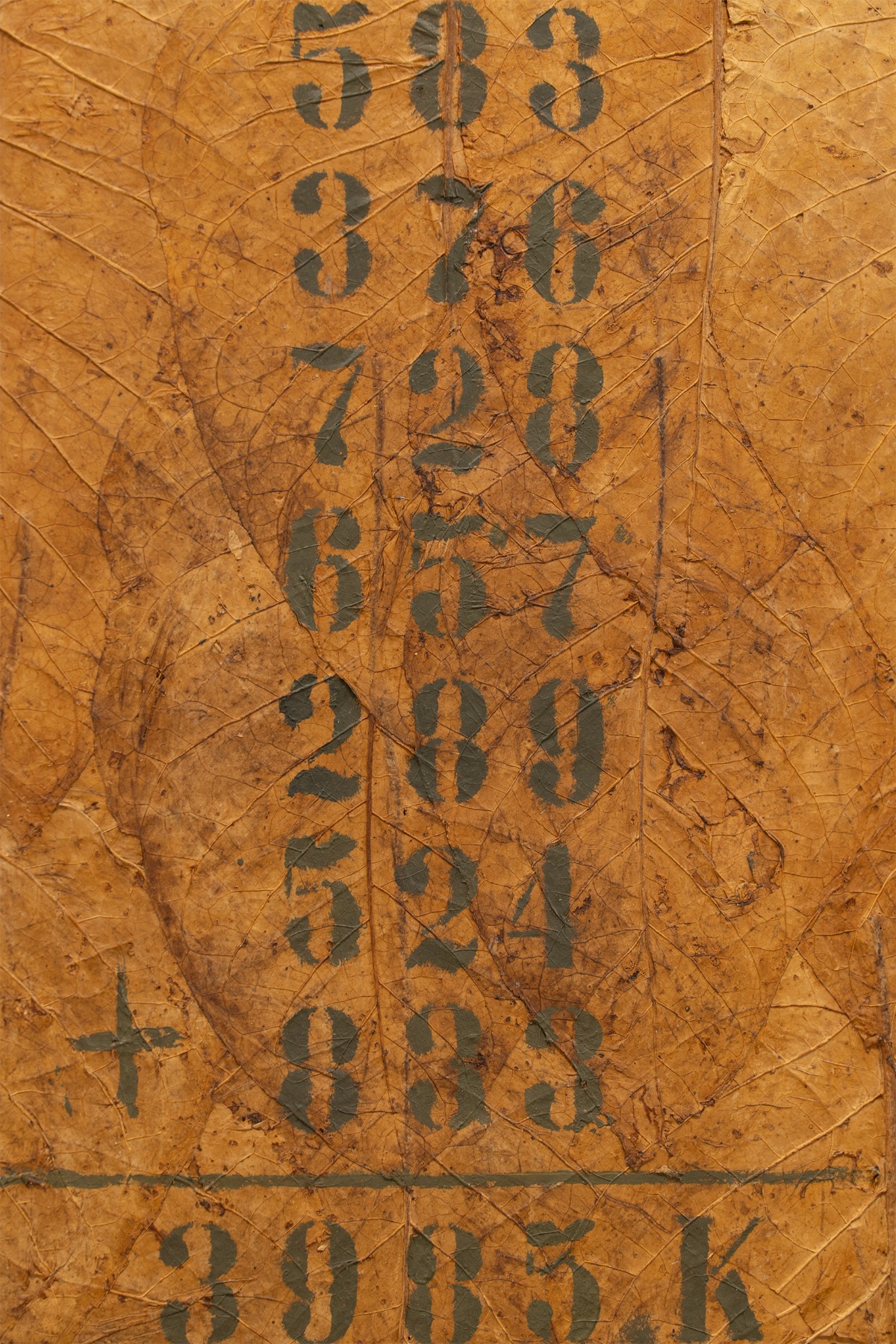
Yes, these calculations are written directly on the tobacco leaves… There are actually so many different forms of materiality, so many different approaches. But all this diversity tells a story that is somehow interconnected. Maybe this connection also comes from the way you organized the exhibition, using the model of the Greek polis.
The architecture of Riga Contemporary Art Space was very important in developing the exhibition. I was particularly struck by the staircase, which immediately suggested an amphitheatre. This offered an opportunity to work spatially with the idea of the ancient Greek polis, while also questioning the idealised political and cultural imagery traditionally associated with it.
I imagined the principal exhibition space as a kind of agora, a place of encounters, negotiations, and sometimes conflicting voices. The staircase introduces another position: that of the spectator, someone who observes the activity below while remaining physically separate from it. The distinction between participation and spectatorship became central to the exhibition's spatial dramaturgy. Of course, these positions are never entirely fixed. A visitor can move between them, choosing when to participate, when to observe, and when to withdraw.At the centre, we constructed a space resembling a temenos, a sacred precinct, which accommodates the video works. It introduces a different rhythm, a more intimate and contemplative experience within the public character of the agora.
What interested me was the possibility of giving these different spatial positions a contemporary political resonance. Today, we experience an extraordinary amount of public life through screens. We witness conflicts, demonstrations, collective struggles, and political events, often from the relative comfort of our homes. We can be informed spectators of almost everything while remaining physically absent from much of what we observe. Of course, spectatorship itself is not necessarily passive, and political participation can assume many forms. But the distinction remains worth questioning.
I wanted the exhibition to create a situation in which visitors become aware of their changing positions within a shared space. The polis is therefore not reconstructed as an archaeological model, but proposed as an open question about public life, visibility, and the responsibilities of participation.
Always the Sun. Riga Contemporary Art Space. Exhibition view. Photo by Līga Spunde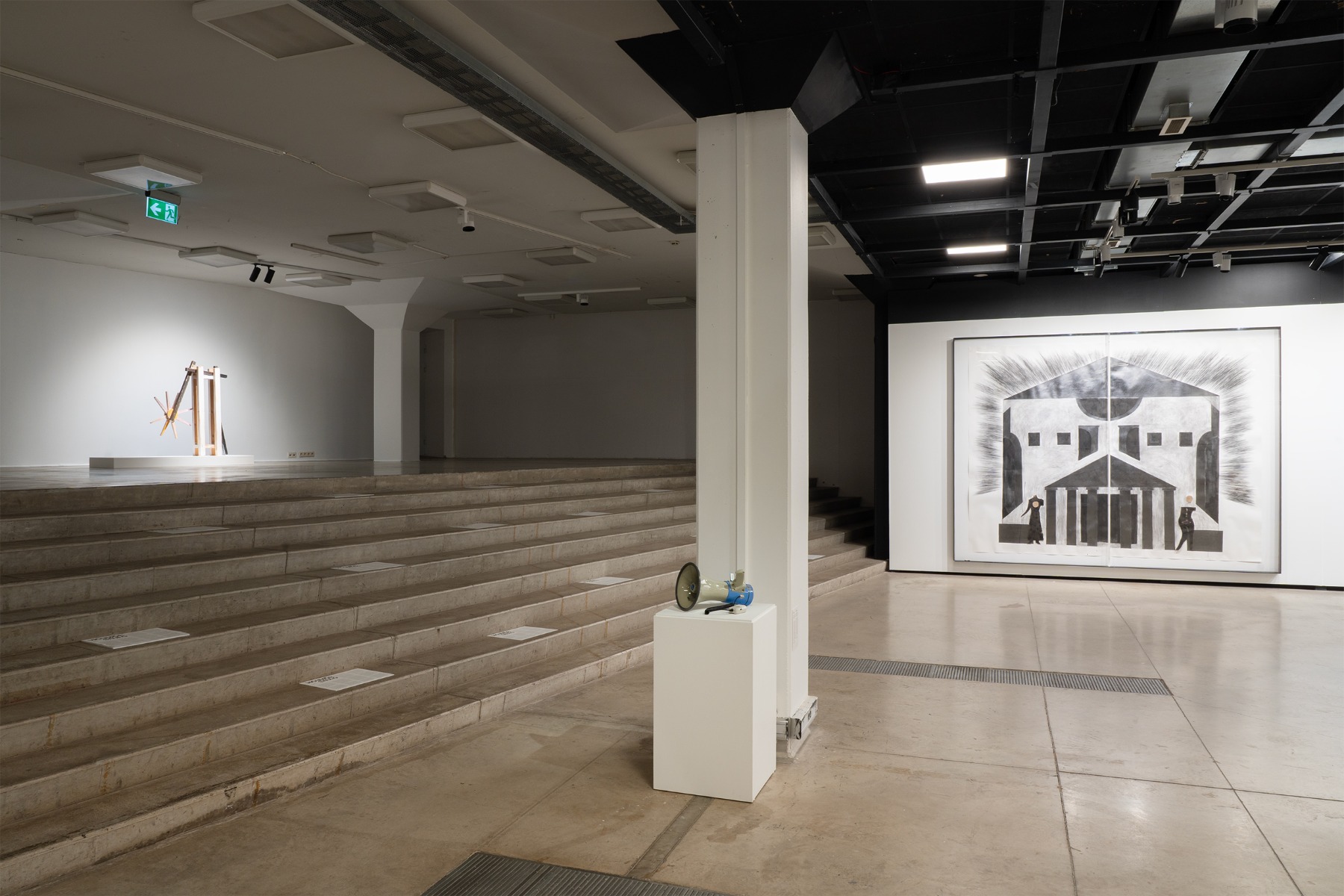
In a way, there is also a mirroring effect in the structure of the exhibition.
Yes, and some of these connections emerged through the installation itself. I was interested in creating relationships between works that belong to different artistic languages but share certain underlying concerns. For example, Marina Gioti's As to Posterity and Dimitra Charamandas's Sun Burn occupy opposite corners of the exhibition, that face each other from afar. Both present images of Athens, yet they approach the city through very different temporal and atmospheric conditions.
Gioti filmed Athens during the crisis, in the early hours of the morning, when the streets appear almost deserted. This absence is particularly striking in a city usually associated with intense public activity. Accompanied by birdsong, the images suggest a city whose human inhabitants have somehow withdrawn. There is something almost post-human about this vision, as though the city were being observed from an imagined future.
Charamandas, on the other hand, films under the intense midday sun, when heat itself can empty public space. Here, the city appears exposed to a different kind of pressure.
One city, two moments of the day, two different forms of absence. And yet, in both works, the familiar urban landscape becomes strangely unfamiliar. I am interested in these subtle correspondences. They create an exhibition that can be experienced through associations and tensions, without prescribing a single narrative or interpretation.
Nefeli Papadimouli. Dream Coat. Cotton and wooden structure, 150 x 160 cm (each), 2023–2025. Courtesy of T H E P I L L ® and the artist. Photo by Līga Spunde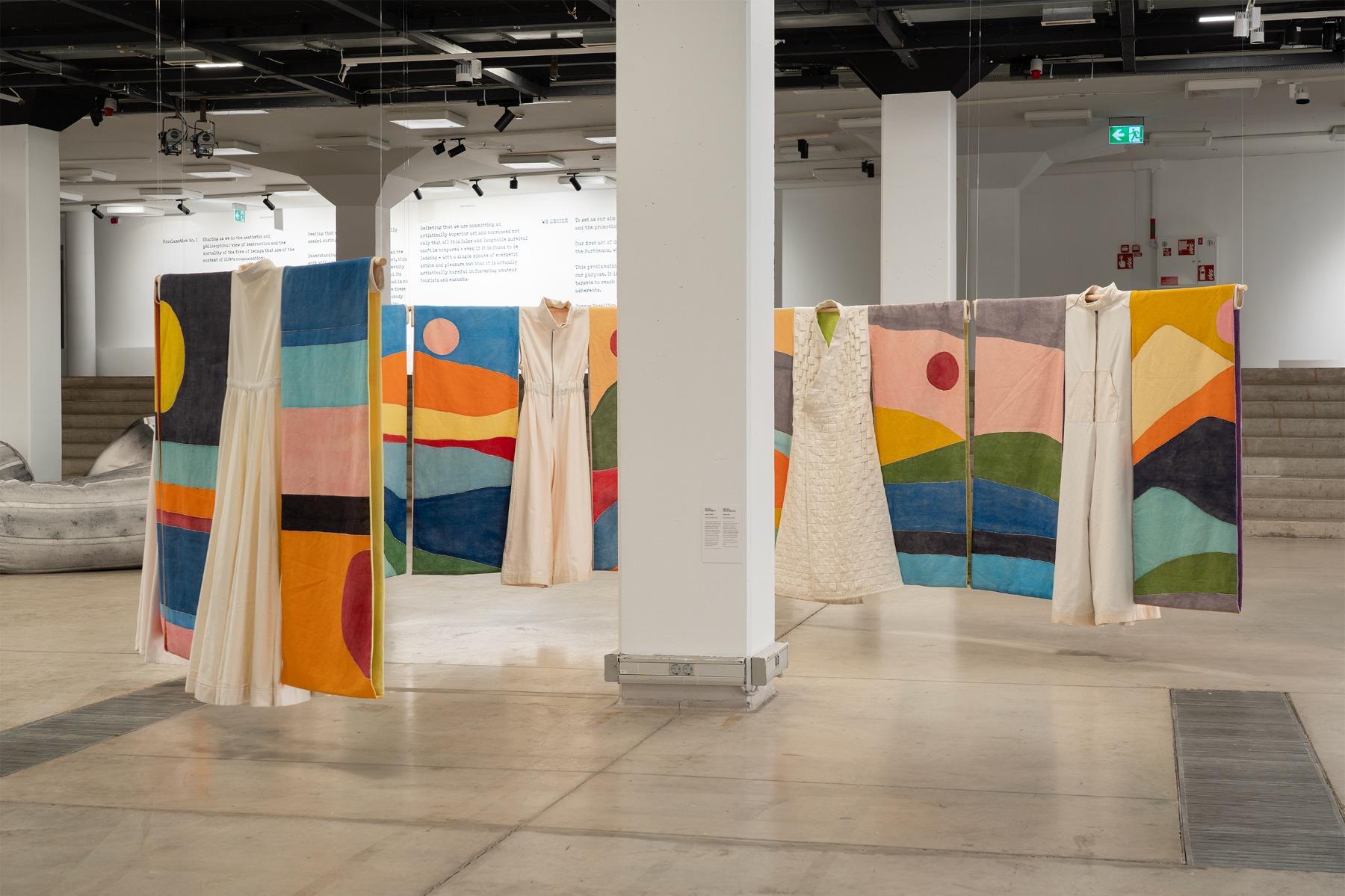
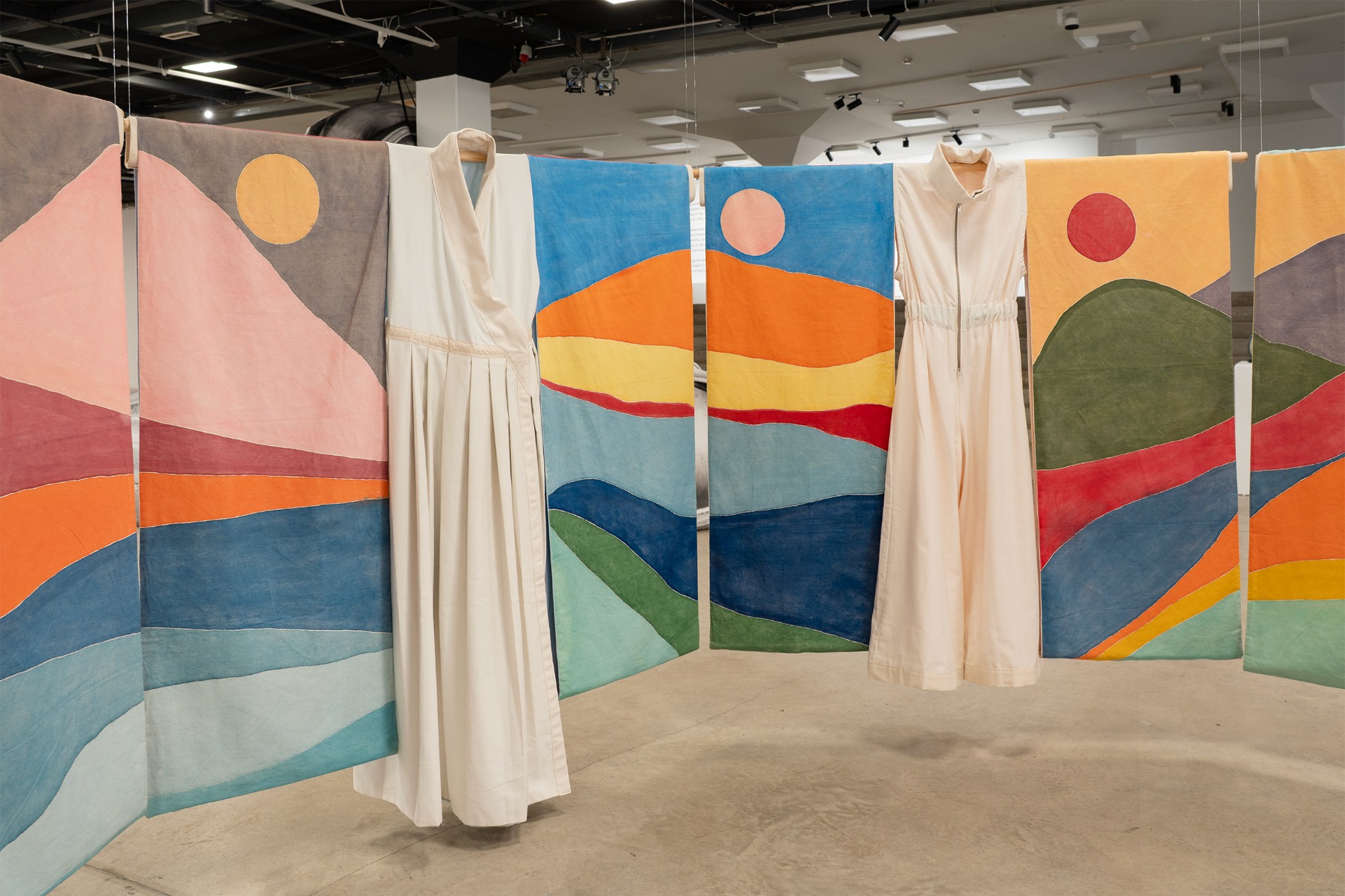
And there are also two works with clothes. SERAPIS Maritime exhibits Piraeus Golden Hour Series (and Collection). This work captures a fleeting condition of light at Greece’s largest harbour and transfers it onto garments. And there is Nefeli Papadimouli with her Dream Coat, which is not only a material work but also a part of the performance at the opening of the exhibition.
Nefeli Papadimouli's Dream Coat interests me because it moves between sculpture, costume, architecture, and collective performance. The garments become extensions of the body, while their movement produces changing relationships between individuals and the space around them.There is also something significant in the multiplication of the suns. Instead of a single, central celestial authority, we encounter a constellation of bodies, each carrying its own sun. The choreography, with its circular movements recalling planetary orbits and Sufi whirling, introduces questions of collective movement, interdependence, and the relationship between individual and shared rhythms.
SERAPIS maritime approaches clothing from another direction. Its Piraeus Golden Hour Series (and Collection) operates between contemporary art, fashion, and the everyday visual culture of the port. Images associated with a particular place and moment of light are transferred onto garments that can circulate far beyond their original context.What connects these works is the possibility of wearing an image, of allowing an artwork to leave the conventional space of display and enter the world through the body. Both also complicate the distinction between artistic object, collective experience, and everyday life.
Always the Sun. Riga Contemporary Art Space. Exhibition view. Photo by Līga Spunde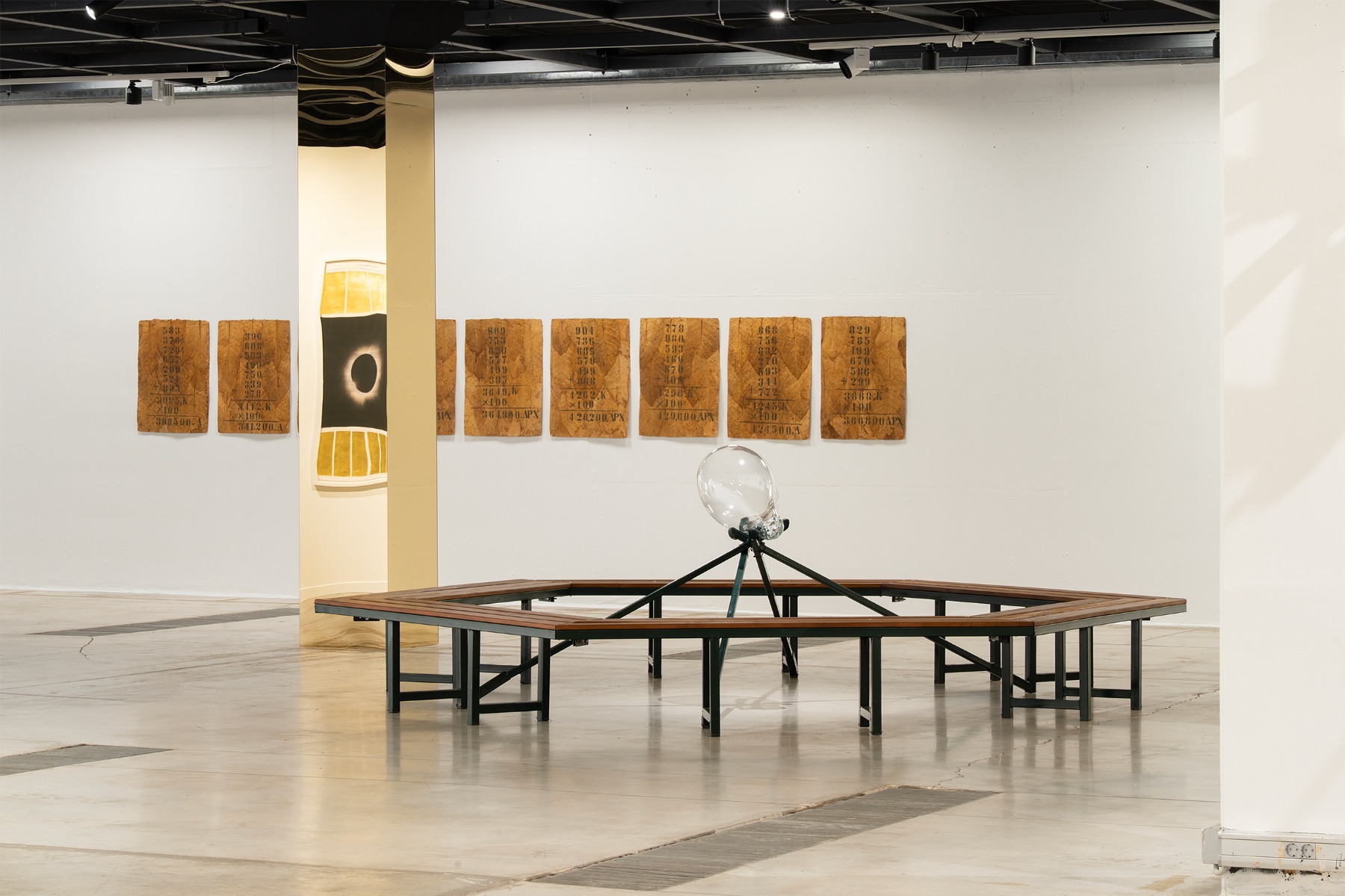
Kostis Velonis. The Gravity of the Sun. Wood, metal, acrylic, oil, 130x110x29 cm, 2023–2024. Courtesy of The Breeder and the artist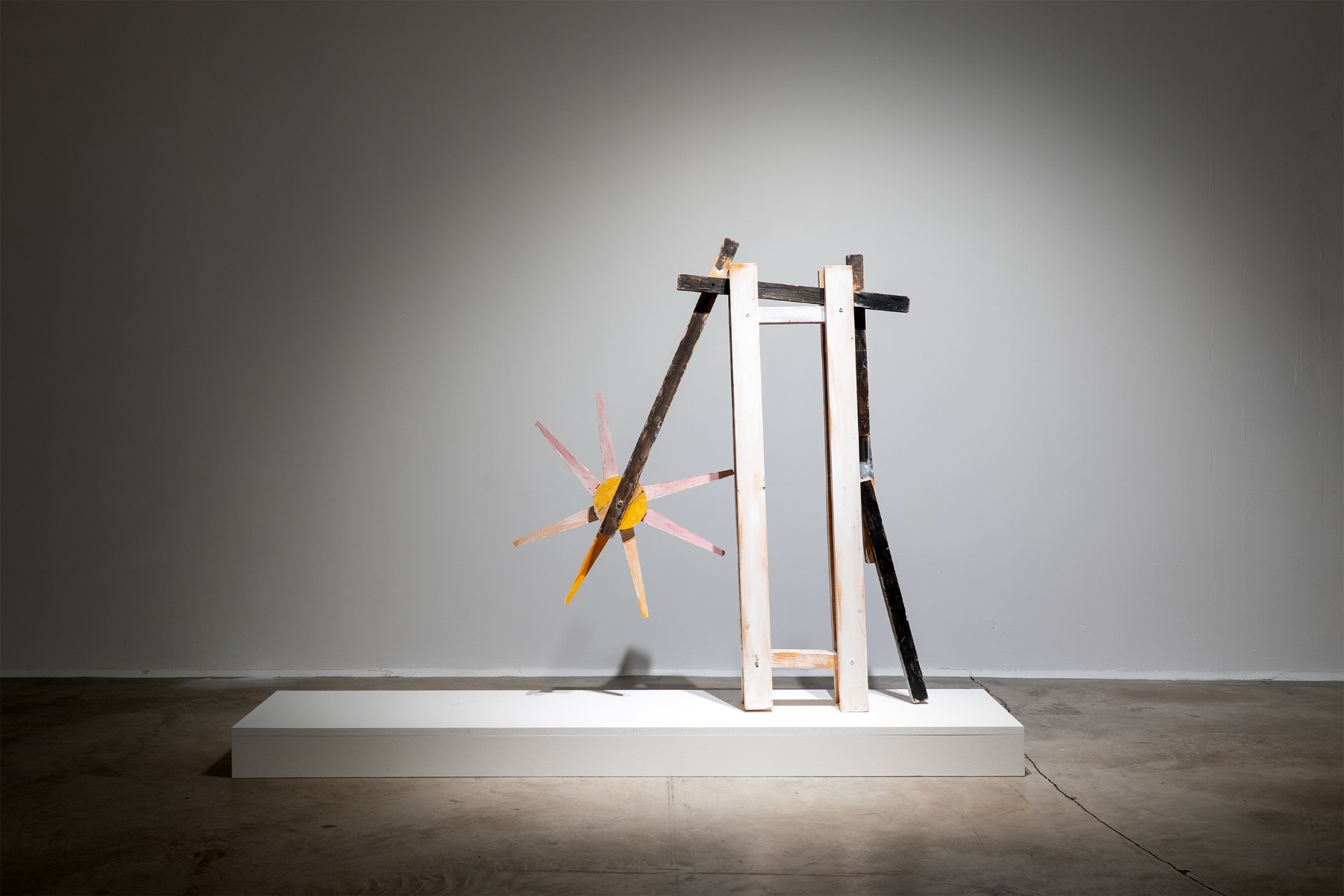
Malvina Panagiotidi. The Mornings Grow Silent I. Copper, steel, electrostatic paint, magnet, 271 x 308 x 15 cm, 2023. Courtesy of The Breeder and the artist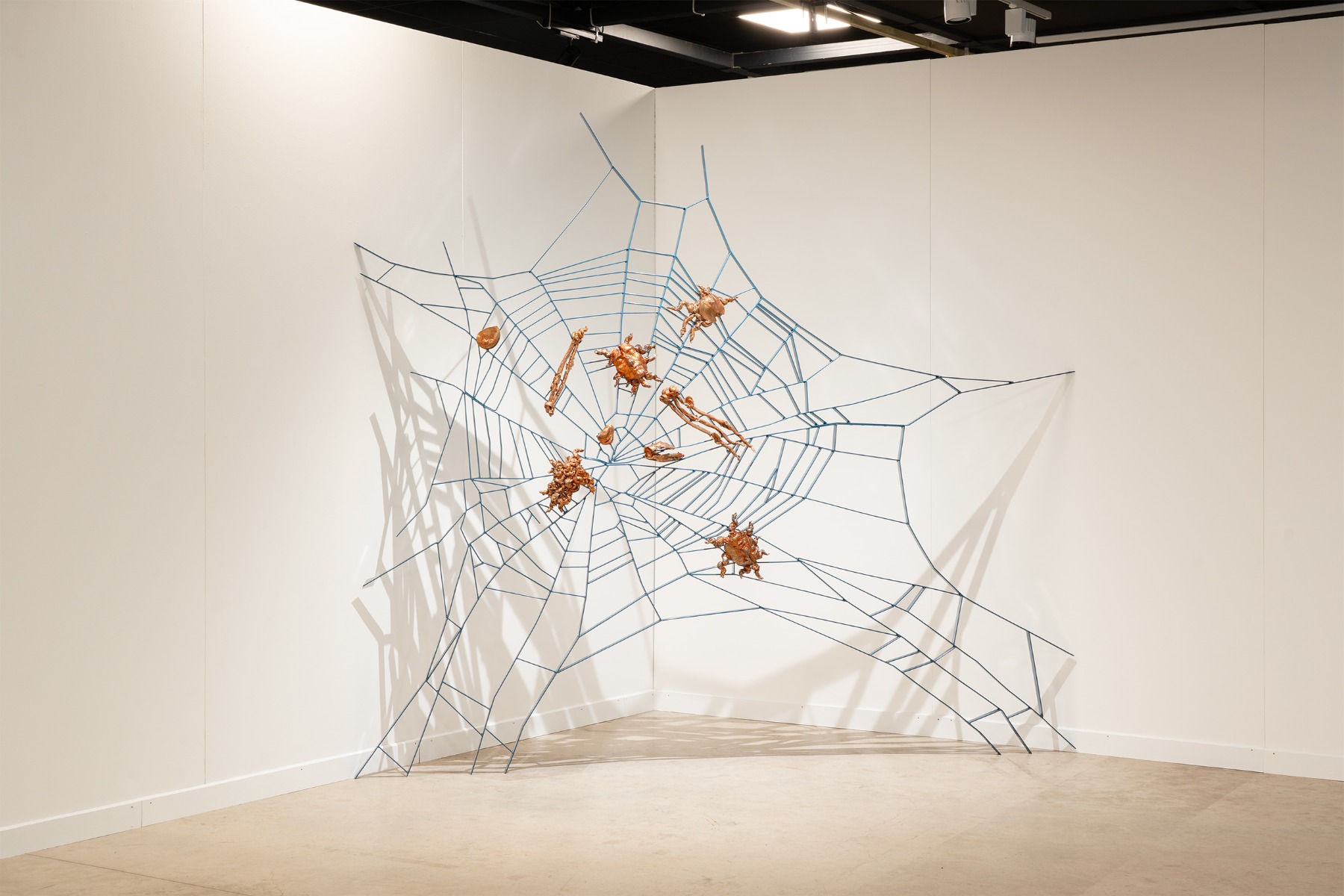
So, at the end, what do you think? Do we get some kind of Greekness from this exhibition? Maybe an imaginable Greekness, maybe Greekness with a question mark, but something which – like, some common feeling, some unifying concept?
I think this is ultimately a question for the audience. Being Greek myself, I am perhaps less interested in defining Greekness than in questioning how it is constructed, represented, and perceived. I don't believe there is a single Greekness that these 27 artists could collectively represent, nor would I want there to be. What interests me is precisely the coexistence of different generations, experiences, artistic languages, and relationships to the place they come from.
Of course, there are recognisable references: the ancient column, the city of Athens, the sun itself. But none of these appears entirely as we might expect. The column has lost its monumentality, the city can appear deserted, and the sun is not always a promise of happiness or abundance.
Perhaps what emerges is not an image of national identity, but a series of tensions between the inherited and the lived, the monumental and the precarious, the familiar and the contradictory. And I think there is something important about presenting these works in Riga. They enter a different climate, geography, and cultural imagination, where their meanings can shift again.
If the exhibition succeeds in complicating the familiar image of Greece, while allowing the works to speak beyond their national origins, I would consider that a meaningful achievement. After all, the sun belongs to no single geography, even if we experience it under very different conditions.
