Everything is about soft connection
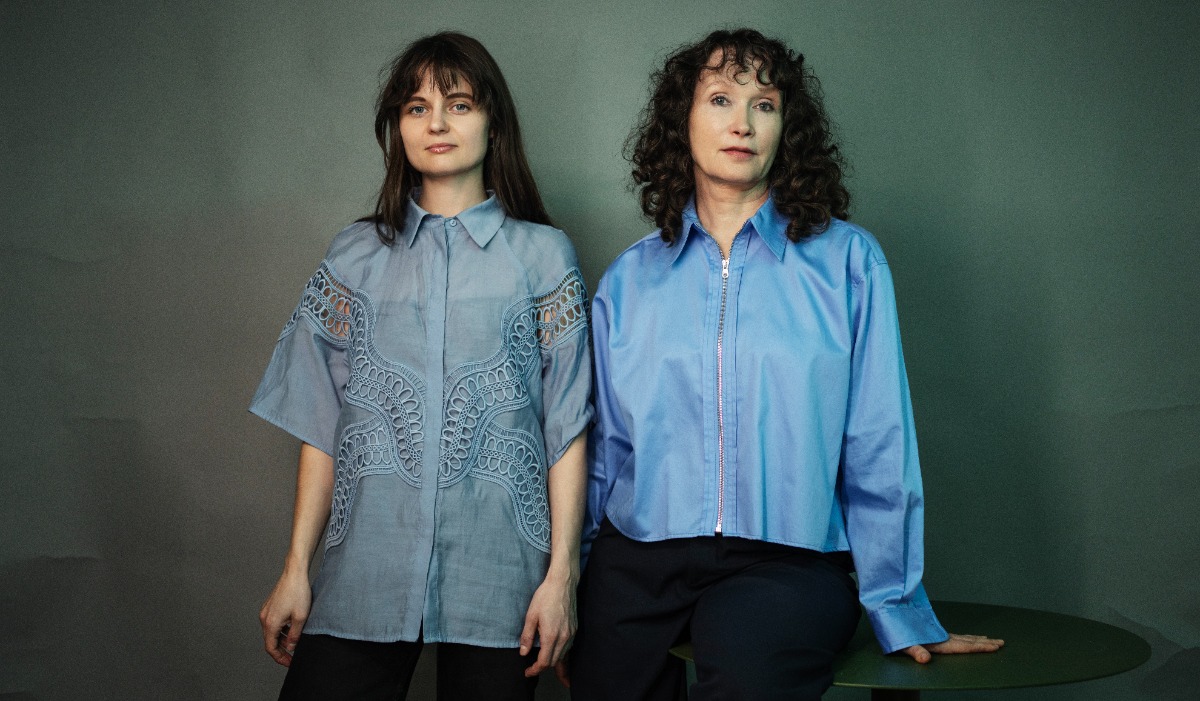
An Interview with Elena Sorokina and Simona Markel Dvorák, Curators of Survival Kit 17
From August 28 to September 27, 2026, the Riga Congress Hall is hosting the annual international contemporary art festival Survival Kit, organised by the Latvian Centre for Contemporary Art (LCCA). Titled “Arrow of the Wind: On Artists and Healers,” Survival Kit 17 presents an exhibition and a programme of performances, bringing together more than 25 artists from Latvia and abroad. Survival Kit 17 is curated by Elena Sorokina and Simona Markel Dvorák, in collaboration with the Initiative for Practices and Visions of Radical Care.
Daina Dagnija. Waiting. Penelope. 2007. Daina Dagnija
Midsummer Night Bonfire
2007. Photo: Kristīne Madjare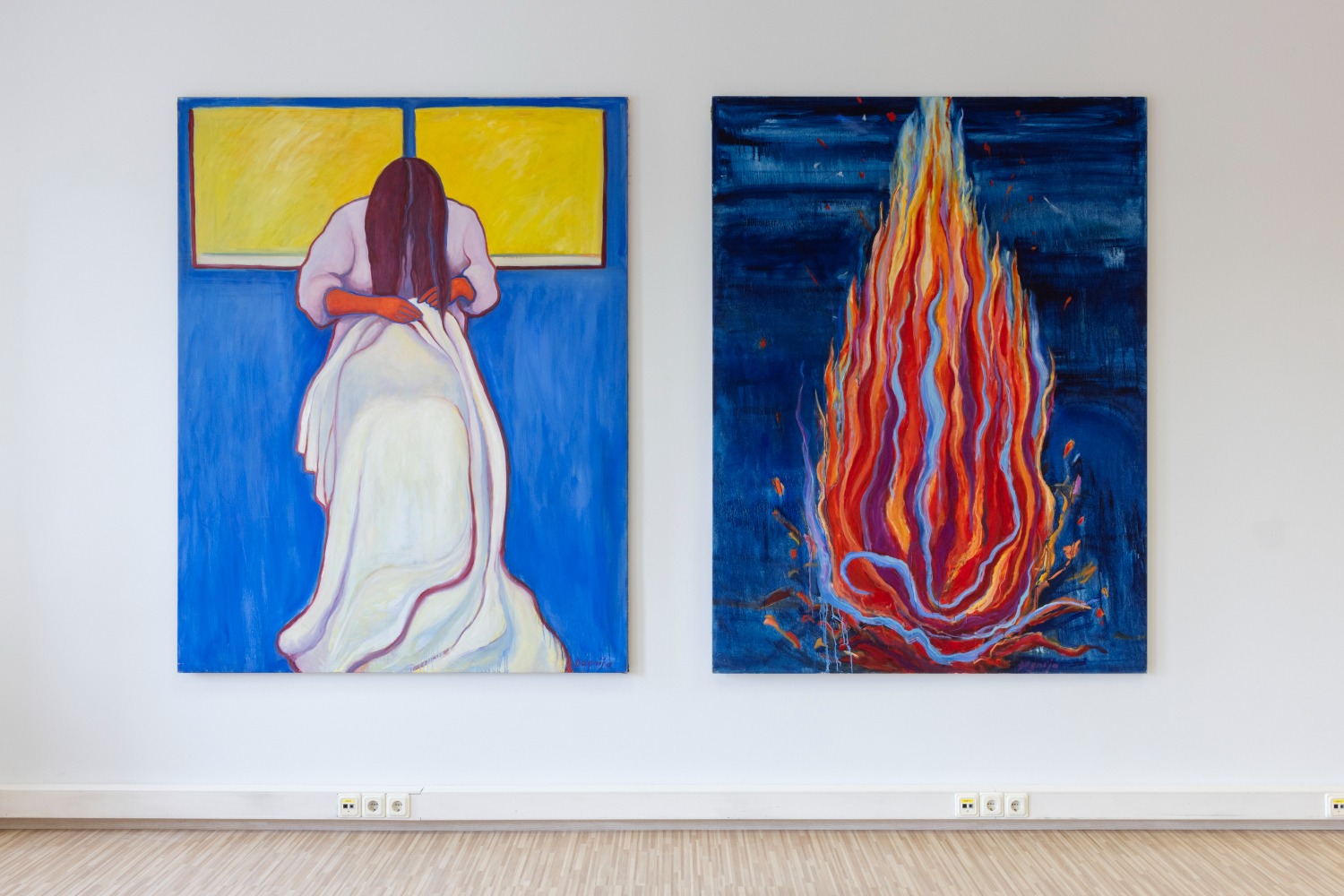
The curatorial text for Survival Kit 17 starts like this: “Arrow of the Wind takes its title from an ancient Latvian healing spell that calls upon the powers of the wind to heal humans and animals and ward off the illness that was believed to enter houses via draughts, slipping in through open windows. Such spells combined words with rhythm, chant, movement, drumming, and song. They were never merely words to be spoken; they were embodied practices that organised attention, movement, sensation, or breath”.
On the left: Anna Hulačová. Dolomite lovers. 2026. Photo: Kristīne Madjare. On the right: Imants Tillers. Nature Speaks: FQ. 2016. Photo: Kristīne Madjare
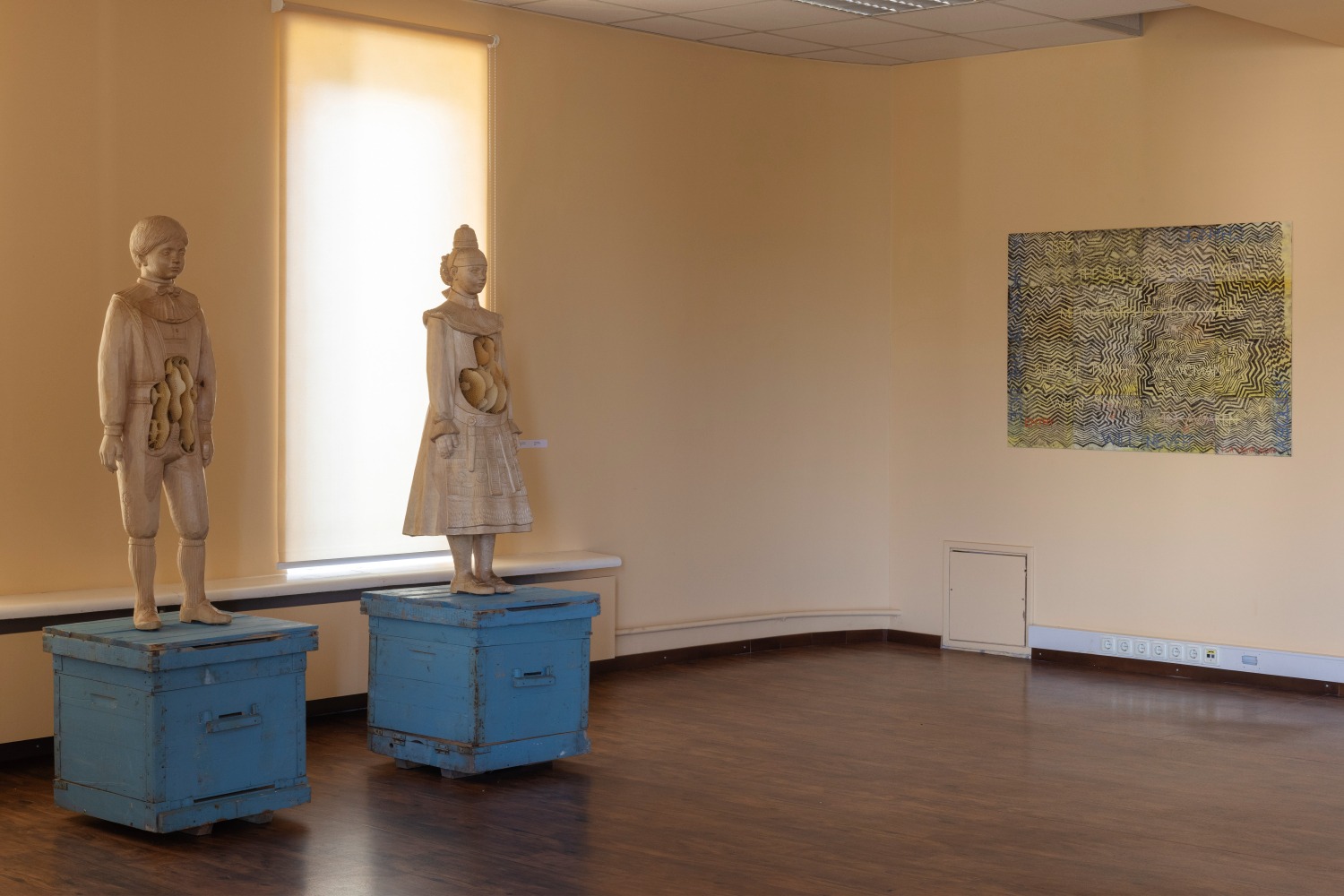
Anna Hulačová, Hydro Hybrids, 2023. Pierre-Alexandre Savriacouty, Invisible Migrations (L-1B), 2026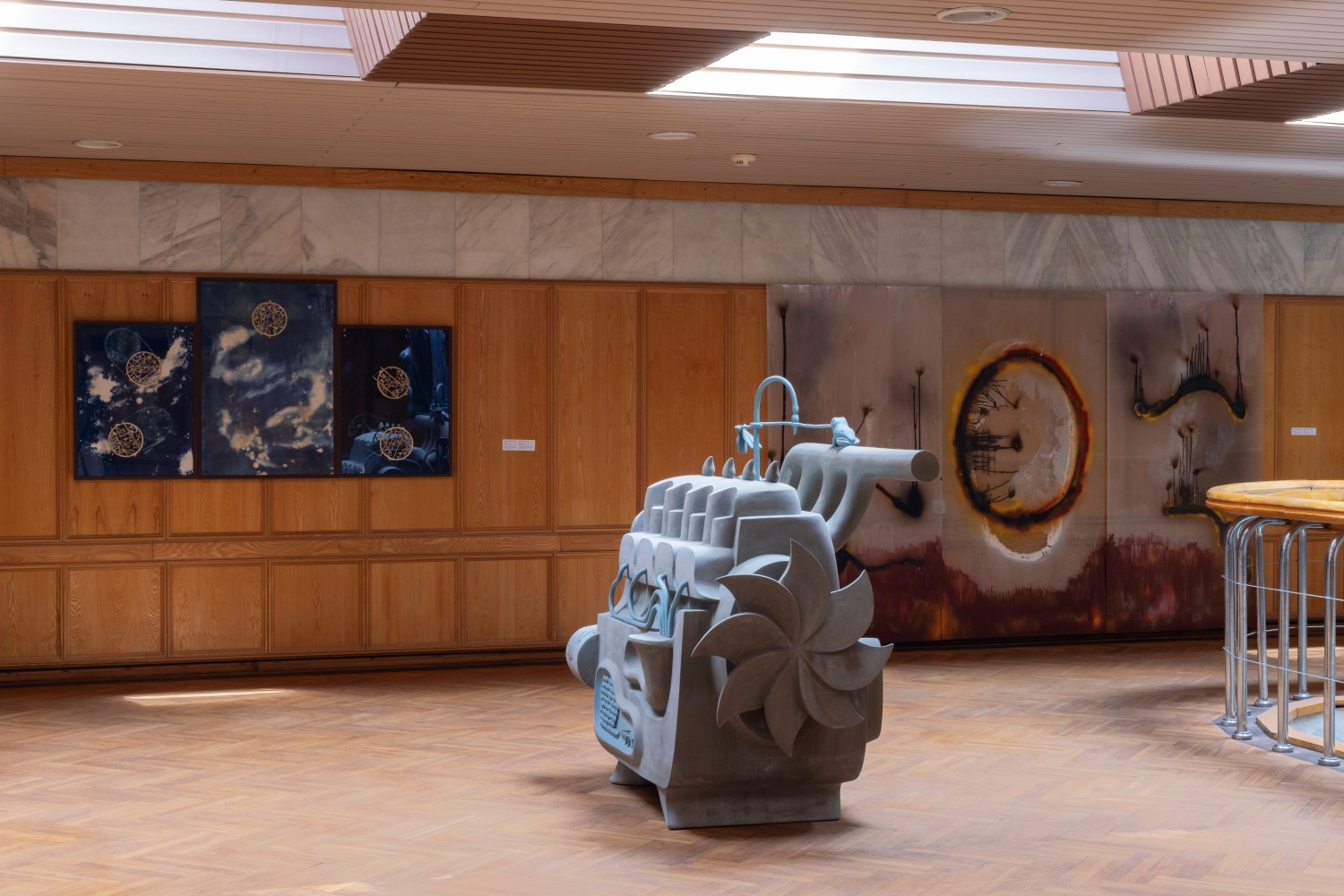
The exhibition Arrow of the Wind: On Artists and Healers invites us to look at the world through artistic and healing practices. Taking its title from a healing spell, the exhibition understands healing as something relational – something that emerges through sensory pluralism, attunement, and re-story-ation: the process of recovering, renewing, and creating stories that reconnect people with one another, with places, nature, other species, and art.
We talked the curators of Survival Kit 17, Elena Sorokina and Simona Markel Dvorák, about how the exhibition’s message was formed, what practices lie behind it, how COVID influenced the initial idea, and what kinds of feelings and sensations can be activated in the space of the exhibition. We met in one of the backstage rooms of the Congress Hall, still filled with all kinds of things after the opening that had taken place literally the day before. We arranged the chairs, smiled at each other, and began.
You were invited to curate Survival Kit 2026, and I think your activities in the project Initiative for Practices and Visions of Radical Care played a crucial role in that invitation. Could you tell us a little more about the project – how did it come about, and what does it focus on?
Elena Sorokina: Well, The Initiative was launched by Nataša Petrešin-Bachelez and myself. Nataša is a close friend and colleague who used to run the public programme at the Cité internationale des arts in Paris. She’s also based in Paris, and we’ve known each other for literally 20 years.
During COVID, we felt we had to do something. We’re not really the type to just sit, meditate, and complain, so we started thinking about how we could support artists. After all, that’s part of our job as curators – creating conditions in which artists can continue to work. So the initial question was very simple: what can we actually do in this situation?
We started reaching out to artists and curators and listening to what they needed. Quite quickly, we realised that the artists drawn to the Initiative tended to have practices that were, in one way or another, directed towards others. Some were already working collectively or had a strong social dimension to their practice; some worked with refugees, for example, while others were exploring healing and different therapeutic approaches.
Our first project was No Straight Line, during COVID. We wanted to create something in public space that could happen safely within the French restrictions at the time – the one-metre distance, the one-kilometre limit from home, and so on. Participants left temporary markers in public spaces along a pre-designed map connecting Aubervilliers, on the outskirts of Paris, with the Comédie-Française, right in the centre of the city. It was a very simple gesture, but it allowed to create a connection at a moment when connections had become very difficult. And from there, the Initiative somehow grew quite organically.
INLAND. Think of a Forest — Regeneration System 3. 2026. Photo: Kristīne Madjare
How did you join, Simona?
Simona Markel Dvorák: I joined at the very beginning via Nataša's invitation, with who I worked on numbers project first as an assistant, then as a colleague and a friend. Now it’s been six years. I was working a lot on the structure and infrastructure of the project, helping it become an association. I’m very interested in reinventing institutional practices. As someone who worked primarily in public museums in Paris, as a curator and art historian, I was researching inclusivity, thinking about what the museum of the future could or should be. So I was really interested in how we could think about this collective as a "utopian institution" that isn’t a physical space, only moments of togetherness.
And what does collectivity mean in this sense? We often call it a collective because it’s easier, but I don’t think it’s quite the right word. I think ecosystem might be better, as a web of different practitioners who don’t necessarily meet regularly, but that always meet in solidarity. Someone might disappear for a while and then come back. It’s an organic process.
E.S.: And there were shared values, of course. But also a shared understanding of art as something that goes beyond the discrete object. From the beginning, we were interested in what art can actually do: what kinds of relationships it can create, what forms of knowledge or experience it can produce, and how it can intervene in a situation or become part of people’s lives. We always thought of art less as an autonomous object and more as a situated practice – something that acts in the world, creates connections, and can sometimes become a form of infrastructure for thinking, gathering, or imagining things differently.
There are, of course, many histories behind this. You can think of Mierle Laderman Ukeles and her Maintenance Art, but equally of Lygia Clark, who moved from the art object towards bodily and therapeutic practices. I’ve always been very drawn to these histories. My own thinking was also shaped by my time in New York, and practices centred on action, performance, participation and embodied experience have remained an important part of my thinking and curatorial work ever since.
S.M.D.: I think Paris is also a very specific context. It’s a major cultural capital, incredibly diverse, with many private galleries and foundations, but also a great deal of competition. So solidarity and collectivity can sometimes be difficult to find.
What’s also important about the Initiative is that the collective is largely made up of people from diasporic backgrounds. There are French artists, but also many people who have experienced exile or forced migration – from Palestine, Sudan, Afghanistan, and many other very different contexts. Thus, the Initiative – this ecosystem – carries within it memories of displacement or exile; of practitioners that are guardians of stories, songs, recipes, and oral traditions.
E.S.: Absolutely, and they’re incredibly diverse. At some point, we realised that our collective reflects Paris remarkably well, because Paris itself is such a layered and diasporic city. So we’re very Parisian in that sense: there’s a whole world of different histories, geographies, and experiences within the collective.
Ágústa Oddsdóttir, Mosi Kristjáns, Egill Sæbjörnsson. Pain & Other Recyclables. 2026. Photo: Kristīne Madjare 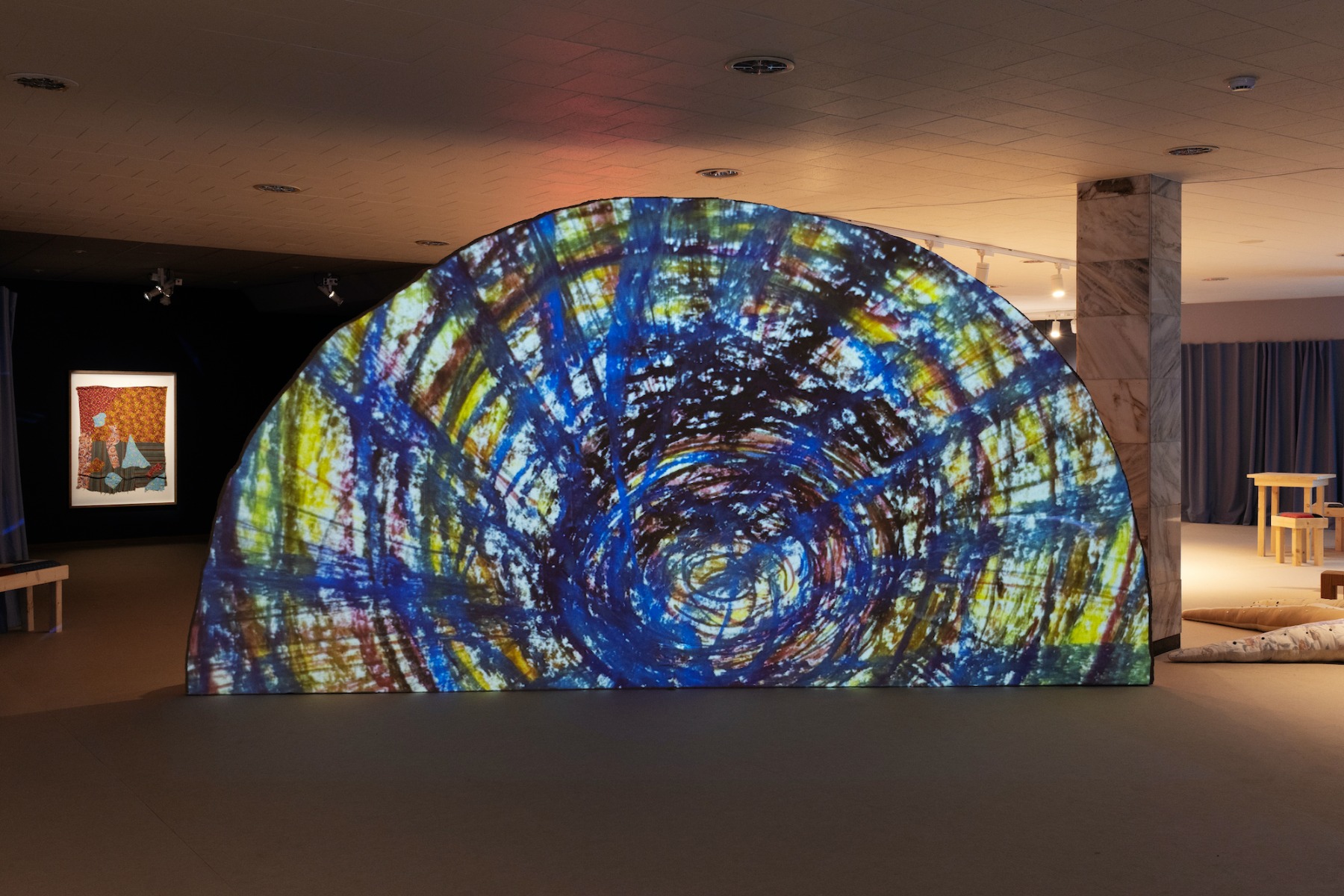
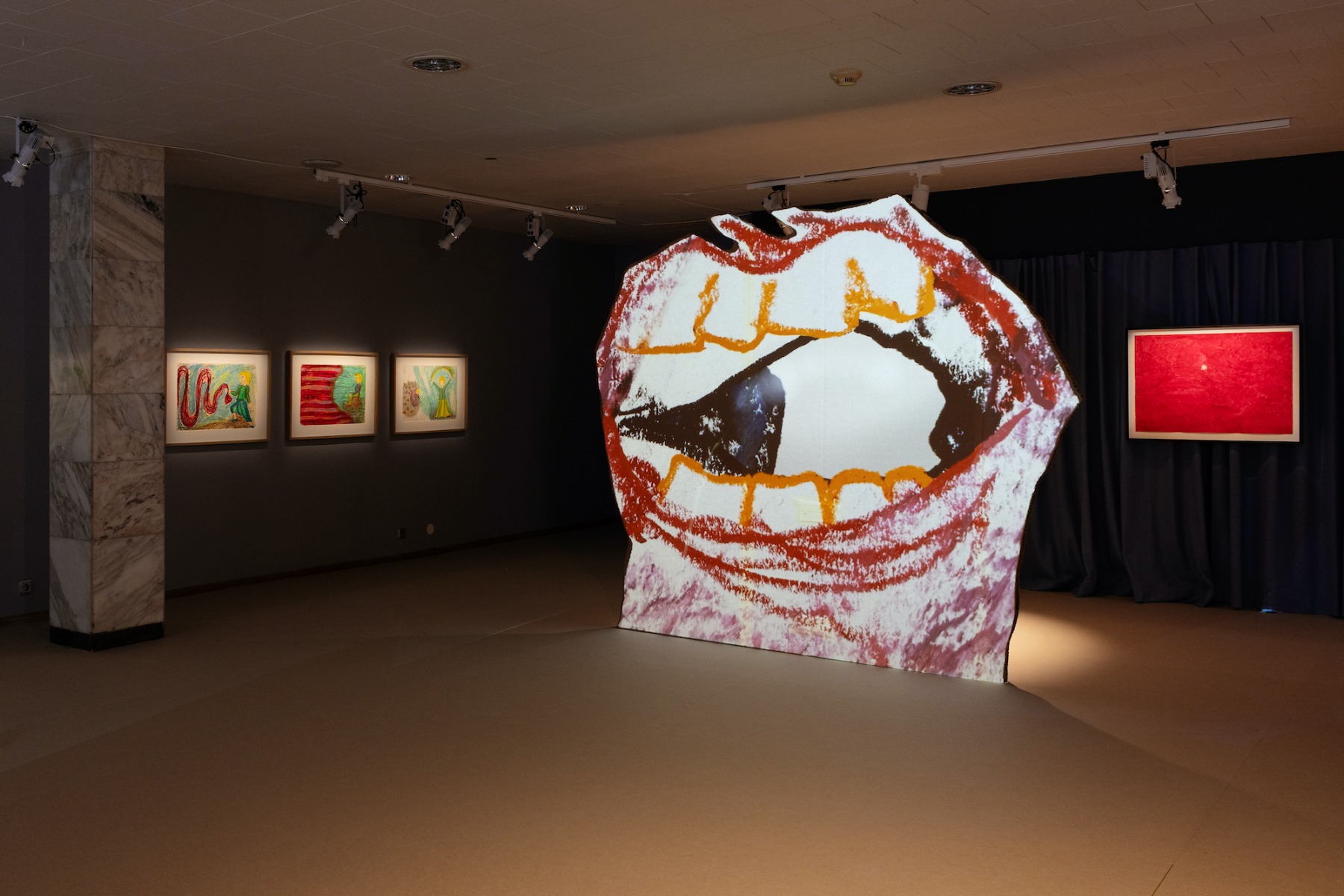
You were invited to curate the Survival Kit festival, and you came here with your own plans and ideas. Did you feel that you were able to realise them fully, or did you have to make some compromises, for example, because of the space?
S.M.D.: It’s always a process of negotiation and adjustment, but I think that’s also very much part of the nature of the project. We came with quite an ambitious exhibition and a very extensive public programme to create many different opportunities for dialogue around the works.
At the same time, Survival Kit has a very particular way of working, which requires a great deal of adaptability and flexibility. As you know very well, you don’t necessarily begin with a fixed exhibition space. So rather than starting from, “This is my room, this is what I can do here,” you might spend six or eight months developing a project without knowing exactly what kind of space it will eventually inhabit.
You develop relationships with the artists, think through the works and their connections, and then, once the space becomes concrete, everything enters another phase of conversation and adjustment. A work may need to become smaller, larger, or simply different. So adaptability isn’t really a limitation – it becomes part of the curatorial process itself.
E.S.: We had to scale back the public programme because we didn’t receive all the funding we had hoped for, so there was quite a lot of fundraising along the way. It was, as we say in French, rather sportif – you’re constantly adapting to what becomes possible and making decisions about what you can realistically do. But actually, in the end, I think we managed to realise about 80 or 90 percent of what we had imagined. Perhaps we were a little overambitious at the beginning, simply because we loved the concept and wanted to explore it in all its dimensions.
And, of course, these questions around healing grew quite naturally out of our practice and almost six years of thinking together about care – what it actually means, and what happens when you take it seriously rather than simply using it as a catchword.
A lot of this goes back to COVID. At the very beginning, there was this strange, almost utopian moment when everything suddenly stopped. And for a brief period, people seemed to be asking very fundamental questions: What could we do differently when all of this is over?
Bruno Latour, for example, circulated a questionnaire asking people to think about what they wanted to see return after the crisis, what they would leave behind. Of course, once COVID was over, many of those hopes disappeared remarkably quickly. We more or less went back to business as usual – even to more difficult conditions than before. But for us, something had been launched. We had created the collective in response to that particular moment, and then it took on a life of its own and simply continued.
S.M.D.: We actually knew quite early on what we wanted to do with the exhibition. The immersive installation at the entrance of the exhibition – Pain & Other Recyclables by Egill Sæbjörnsson his mother and his cousin – grew out of a project we had done with them in Paris about a year before we were invited to curate Survival Kit. It was an incredibly beautiful collaboration because it brought us to Sigríður Björnsdóttir, a forerunner in art therapy who influenced Egill's entire family, and who, above all, pioneered the therapeutic dimension and healing to the field of art in the Western context. We created a programme that connected this historical figure with contemporary art therapist and artist Tamara Singh, who is part of the Initiative.
Through this project, we realised how little attention had been paid to these historical figures – women who were both artists and therapists. Another exemple is Elsa Wolliaston, dancer, choreographer from the same period who inspired generations of dancers and students. Her work was brought to light by performance curator Linus Gratte with who we were collaborating. We were interested in her artistic endeavours, but also, less known, her therapeutic and somatic approches in the dance workshops she gave for over four decades in Paris. They tend to be remembered either as therapists or as artists, but rarely as both. And that became a real starting point for our research. We thought: we would love to make an exhibition that would allow us to go deeper into these stories, to look at these different women’s practices and bring them into transgenerational dialogue with contemporary art. So, the exhibition was already there as an idea. And when Solvita wrote to us and asked whether we would like to curate the next Survival Kit, we said “Well, yes – actually, we already have an exhibition!”
E.S.: Art and healing came up immediately. And this brings us to something quite fundamental in the exhibition. We wanted to reconsider some of the canonic categories we have inherited for thinking about art. In particular, the idea of art as an autonomous field, separate from other forms of knowledge and experience. Knowledge systems rooted in long relationships with land and community, embodied knowledge, are obviously very important within this conversation. They can challenge precisely these separations – between art and healing, the material and the spiritual, human and more-than-human worlds.
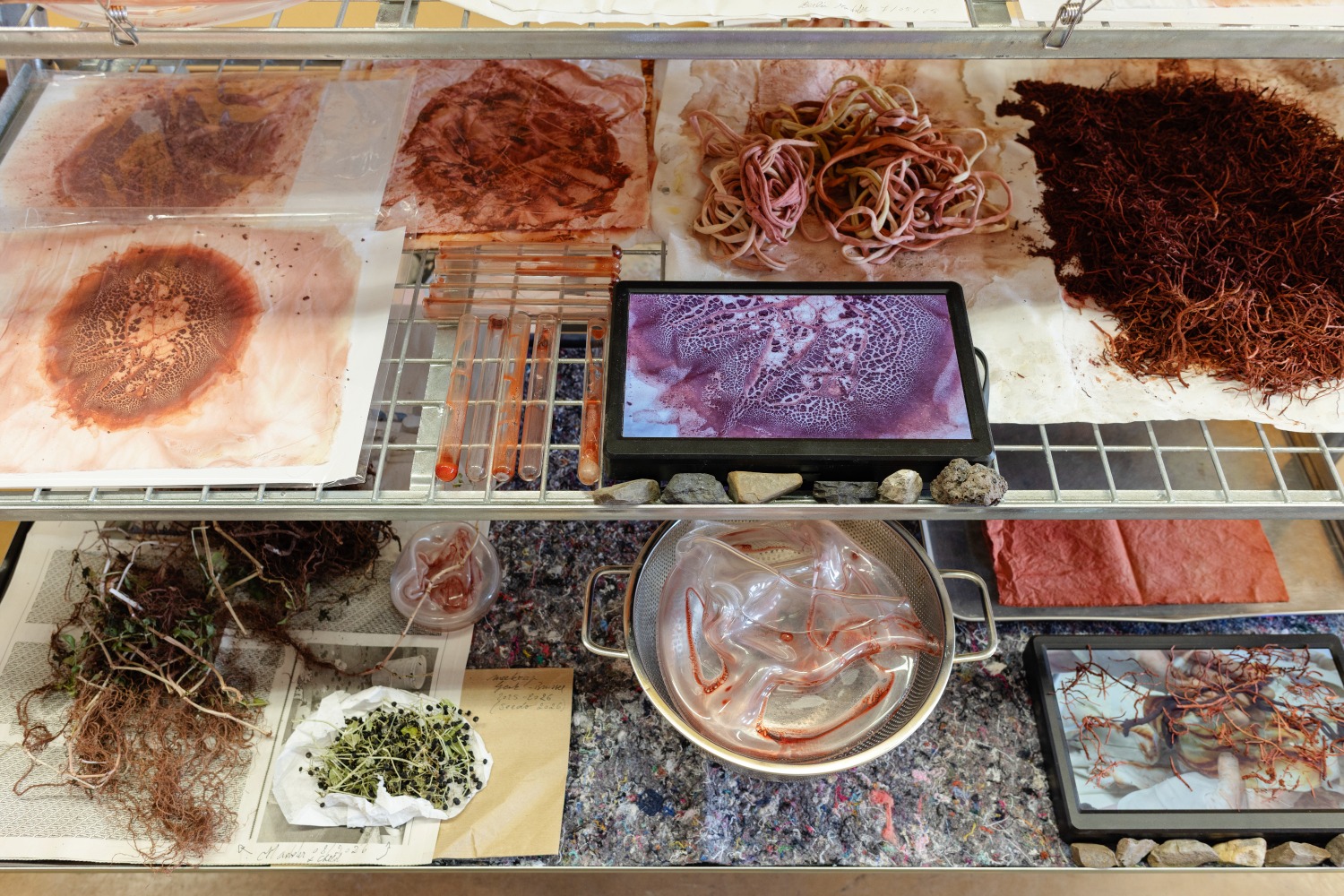
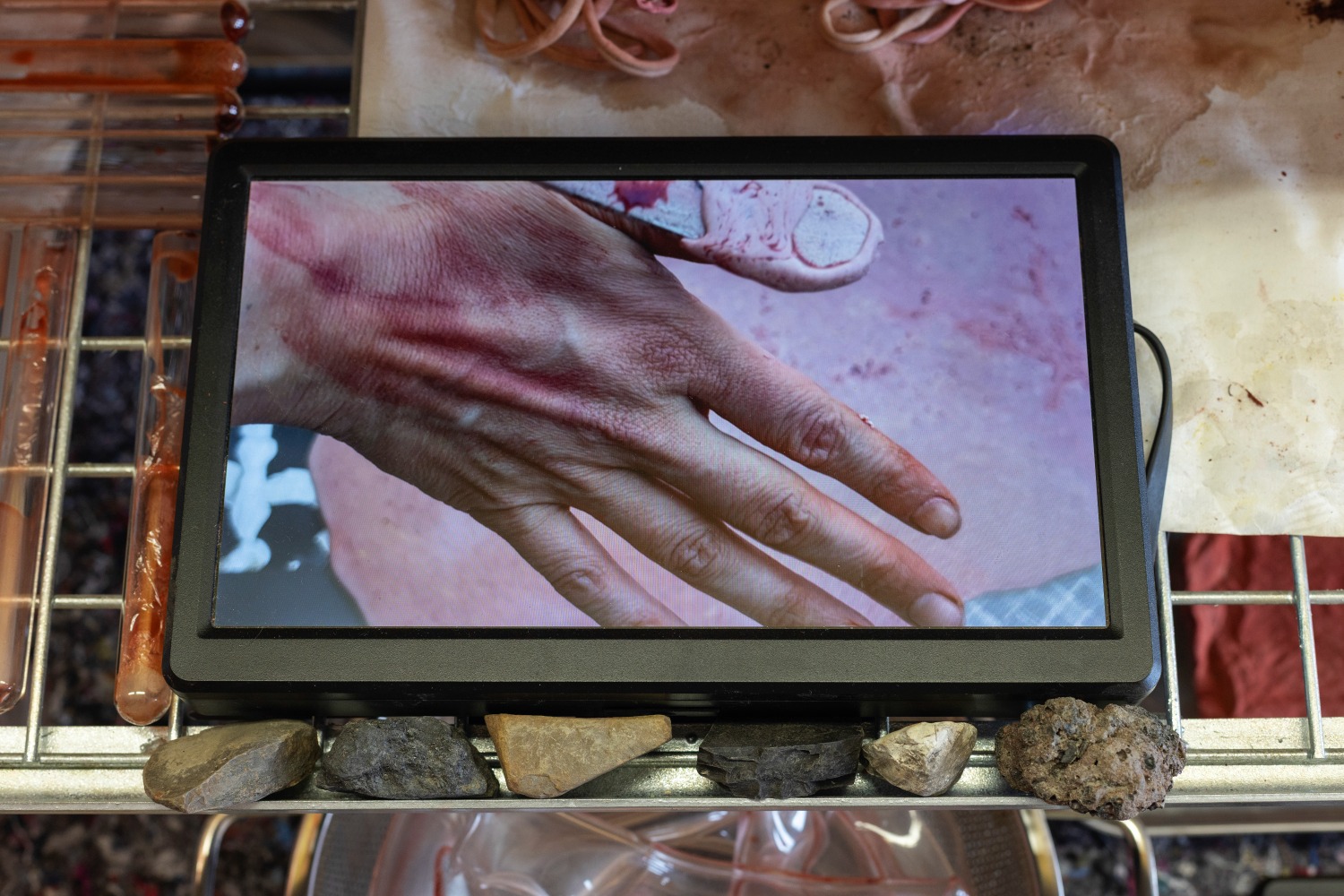
Ada Van Hoorebeke. Madder Routines. 2025-2026. Photo: Kristīne Madjare
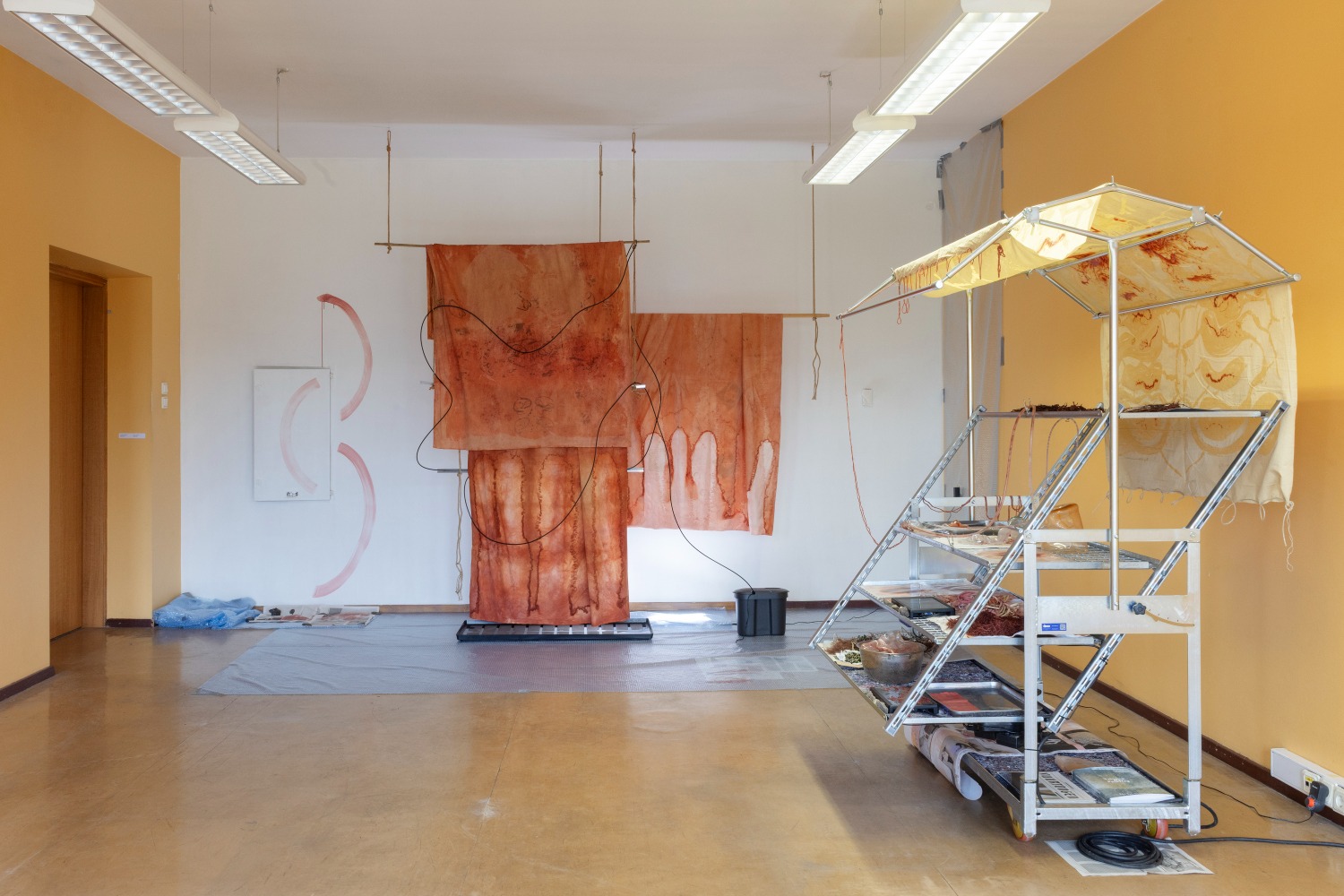
What kinds of Indigenous ideas and concepts can we find in the Survival Kit exhibition?
E.S.: We already had a strong connection to Australia because we had worked with Brook Andrew, whose practice is informed by his Wiradjuri and Ngunnawal heritage. We had also worked with d harding, an artist of Bidjara, Ghungalu and Garingbal heritage who is now based in Paris. Then, through our research, we encountered the work of Betty Muffler, whom we hadn’t known before. Betty is an artist and a highly respected ngangkari, or traditional healer. She became an incredibly important figure for us precisely because, in her practice, these two roles are not separate.
When we speak about art and healing, we’re questioning some of the categories through which art history has traditionally organised artistic practice. The separation between art, healing, spirituality, and everyday life is not universal; it belongs to particular histories and systems of thought. Other knowledge traditions organise these relationships very differently.
Think about ritual, for example. Today, we might describe it as an interdisciplinary practice bringing together sound, movement, performance, objects, colour, rhythm, touch, and collective participation. So part of what interested us was not simply bringing healing into the category of art, but asking how the category of art itself might need to continue becoming more porous.
S.M.D.: We also wanted the exhibition to be very sensorial. Multiple forms of knowledge traditions we encountered throughout the artists, for example, are deeply rooted in bodily experience – knowledge is not simply something you observe or understand intellectually, but something you feel, experience, practise, and carry through the body.
So as you move through the space, you encounter aromas, sounds, textures, vibrations... It’s about moving beyond the dominance of the visual and allowing the body to participate in how you encounter the works on the sensual level. But ultimately, of course, it’s the artworks themselves that carry and tell the stories.
E.S.: For example: what is a human body? Modern biomedicine has often approached it through specialised systems – the heart, the brain, the nervous system. But Ayurveda, Chinese medicine, and many ancestral healing traditions tend to understand health more relationally. Through connections between different bodily processes, environment, mind, community, and spiritual life. What fascinates us is that some contemporary scientific research is also complicating the idea of the body as a self-contained unit. Neuroscience, microbiome research, for example, are revealing forms of interdependence that can resonate with much older knowledge traditions.
The exhibition becomes a meeting point for these different ways of knowing. Betty Muffler’s practice, for example, brings painting, Country, dreaming, and her work as a ngangkari healer into relation. So ultimately, the exhibition is about creating connections – between bodies, knowledge systems, and environments. We want people to leave with their perception slightly shifted.
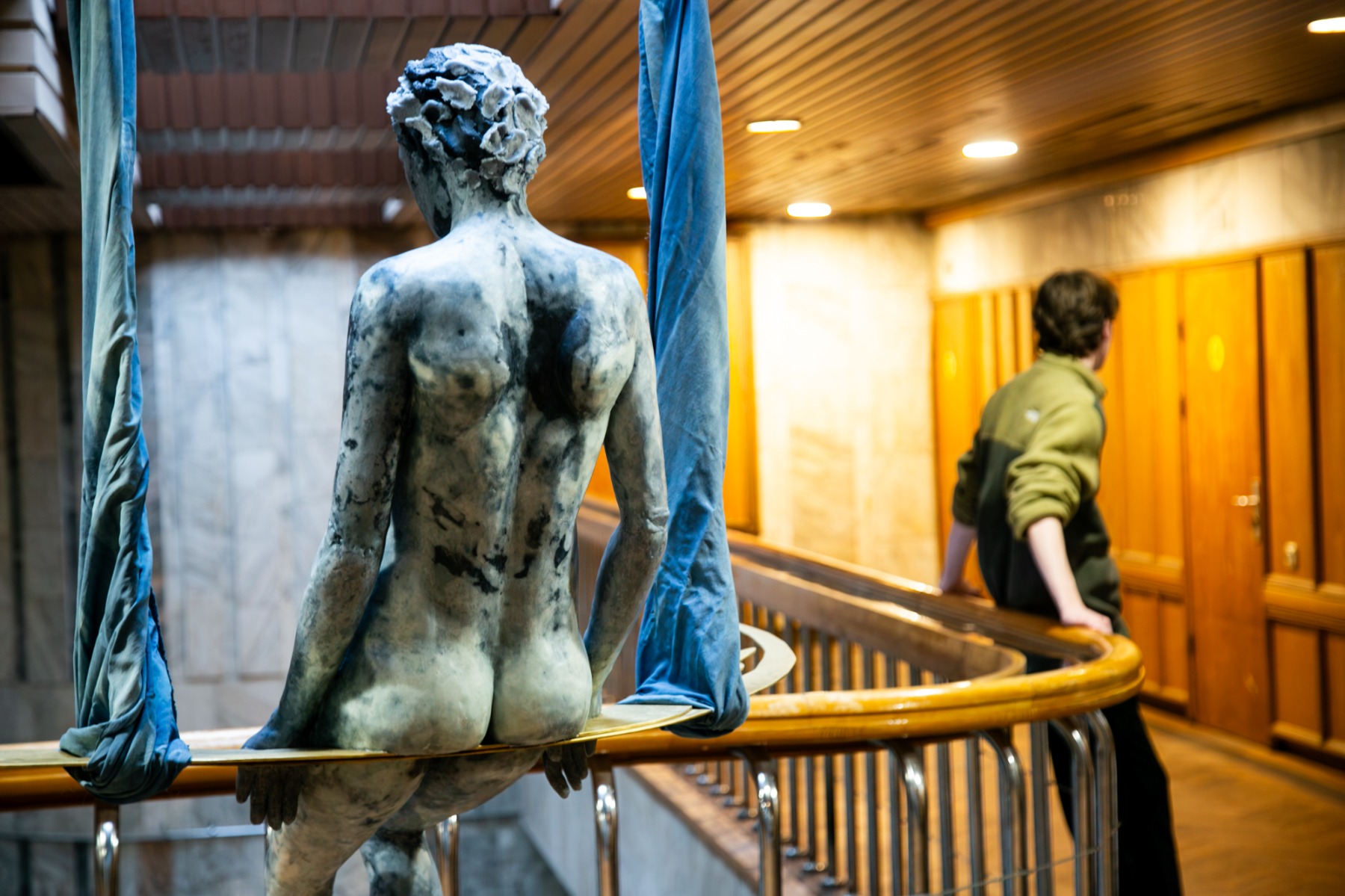
S.M.D.: It’s very much about the processes and the materiality of the work. For example, it’s not always obvious how the works were created. Many of the artists make their own pigments, using clay and other natural materials. Virginie Ittah, for example, is making her sculptures from wax that she mixes with a unique indigo pigment produced by microorganisms. Or d harding, who uses handwoven linen painted with earth pigment from a former quarry in Latvia, historically mined for industrial purposes, including during the Soviet era. In harding's work, this history and materiality are shifted toward an Indigenous understanding of land as a shared ground of relation between beings, species, and generations. Soil is here as living material that carries memory and sustains life.
There’s a lot of research into what the materiality of art can be, and how it can become more ethical or ecological. Facing the climate crisis, we can learn many things from Indigenous practices and vernacular knowledge, particularly their understanding of coexistence with nature and other species. It’s about seeing the body, animals, insects, water, and other elements as interconnected – as one planetary organism.
This is something we wanted the exhibition itself to evoke: as an invitation to listen the movement of the planet, to follow the stars or the moon, and to become more aware of our connection to it. Angelica Mesiti’s large-scale video installation The Rites of When, for example, draws inspiration from ancestral practices rooted in communities living in harmony with seasonal rhythms and the natural world.
Meanwhile, some of the works address these questions from more direct political perspective. Anna Hulačová, looks at the monoculture agriculture and its socio-political conditions, considering mutation as a survival strategy. There is also the collective INLAND Campo Adentro based on a farm in Spain, where the artists are also farmers and shepherds. Their work looks at eucalyptus monoculture in Spain and Portugal – how these plantations consume water and affect everything around them, while also serving the paper industry.
Inevitably, conflict, destruction and pain are present in these accounts – the exhibition is also about addressing trauma. But we didn’t want to show violent images, because they are present everywhere. You only need to open a newspaper or look at the media. So we wanted to make an exhibition that is gentle, that brings kindness. Yet, it carries within it a call to reflect and to act: art should be an invitation to imagine how we could live differently – how we could create a better world.
E.S.: And there is hope in this, because artists, even on a very small scale, can imagine other possibilities – other ways of living, healing, and relating to the world. Sometimes they simply draw our attention to something that is already happening, like the extraordinary capacity of natural systems to resist human control and find their own course.
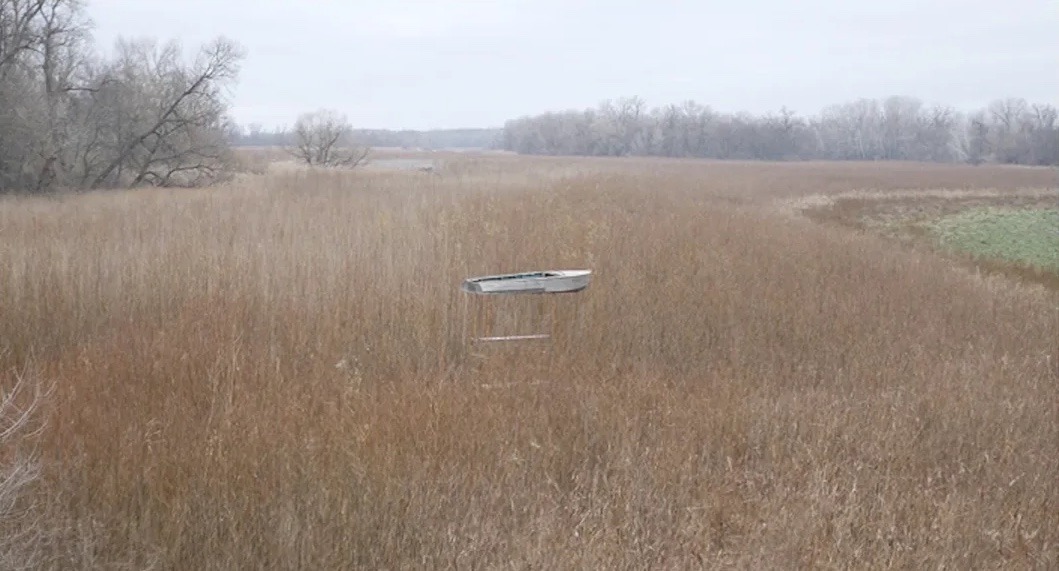
Zhanna Kadyrova, for example, made a video in response to the war destruction of the Kakhovka Dam in Ukraine. The dam itself evokes a particular logic of modernity: the ambition to control and reshape nature on an enormous scale. In the Soviet Union, this reached extraordinary extremes, including plans to reverse the flow of rivers. But the underlying idea was much broader than the Soviet project – the assumption that nature could be mastered and brutally reorganised.
Many land-based knowledge traditions offer a radically different understanding, based not on domination but on reciprocity, responsibility, and the recognition that humans exist within ecological systems rather than outside them. You cannot simply control nature because you are part of it. Many of the artists in the exhibition are working precisely within this shift in perspective. And Latvia is a particularly resonant place for these conversations because relationships with landscape, seasonal cycles, folk traditions, and pre-Christian forms of knowledge remain remarkably present in the culture.
Zhanna Kadyrova. The forest. 2026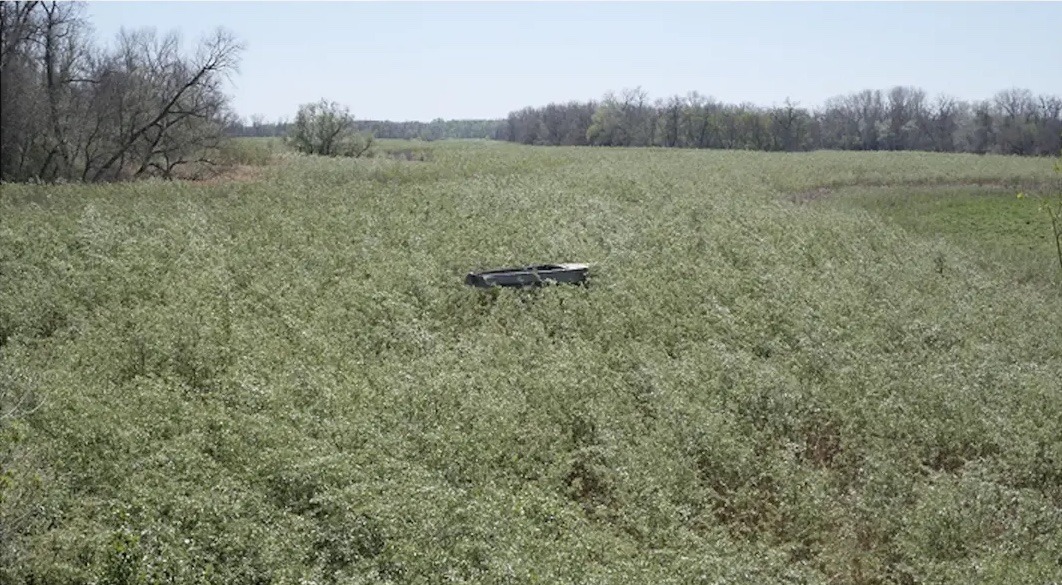
But what was the most interesting or inspiring thing you discovered in the Latvian traditions you mentioned?
S.M.D.: One things that fascinated me is the amount of herbal knowledge here that is still very present in everyday life. People would say, “This is what my grandmother used to make as tea, and now I’m doing the same.”. It is vernacular knowledge in a way: knowing what grows around you, which herbs, mushrooms, and berries to use, and when to collect them. All of these are very specific forms of knowledge that have become increasingly rare.
E.S.: We got fascinated by many forms of Latvian place-based ancestral knowledge. Knowledge accumulated through living on this land over generations. Much of this knowledge was transmitted orally, through stories, rituals, songs, and spells. That was something we recognised very early on and thought, “This is extraordinary. We really want to make space for this in the exhibition.”
Shivay La Multiple. Ancestralidagua, third version. 2025. Photo: Kristīne Madjare 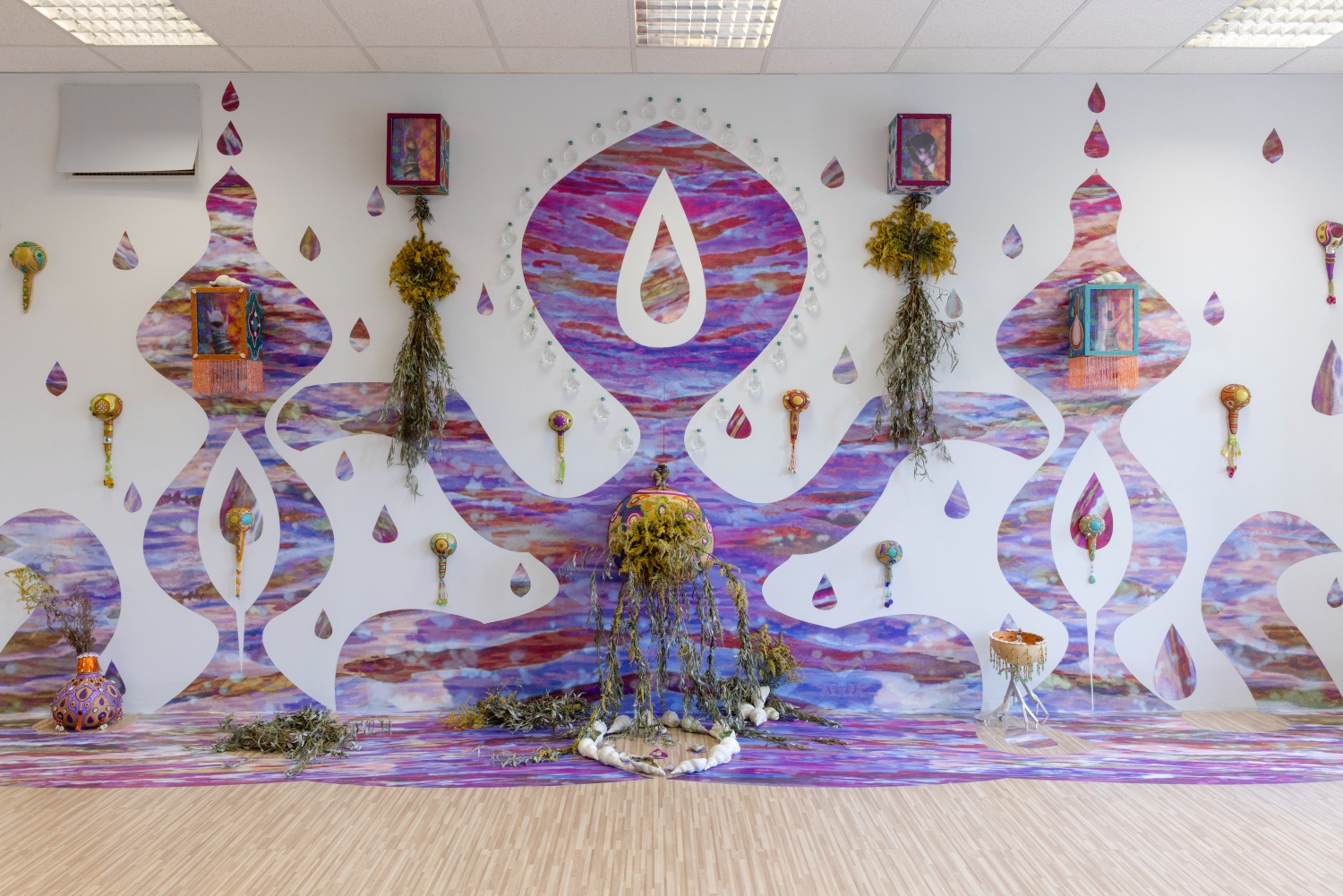
You were speaking about this herbal knowings, and I immediately started to think about the work of Shivay La Multiple, using local herbs.
S.M.D.: Like most of the artists in the exhibition, she didn't just want to come for a few days, make a work, and leave. That was actually part of how we selected the artists: they all have a very relational practice, so they really need to connect with the place. From the beginning, we were discussing that Shivay would come for a much longer period because she was very interested in connecting with this knowledge. She’s from New Caledonia and is a Francophone artist, and she has a deep respect for spirituality and for knowledge that belongs to local communities. She didn’t want to extract it for her own artistic practice. She really wanted to meet people who could share their stories and knowledge.
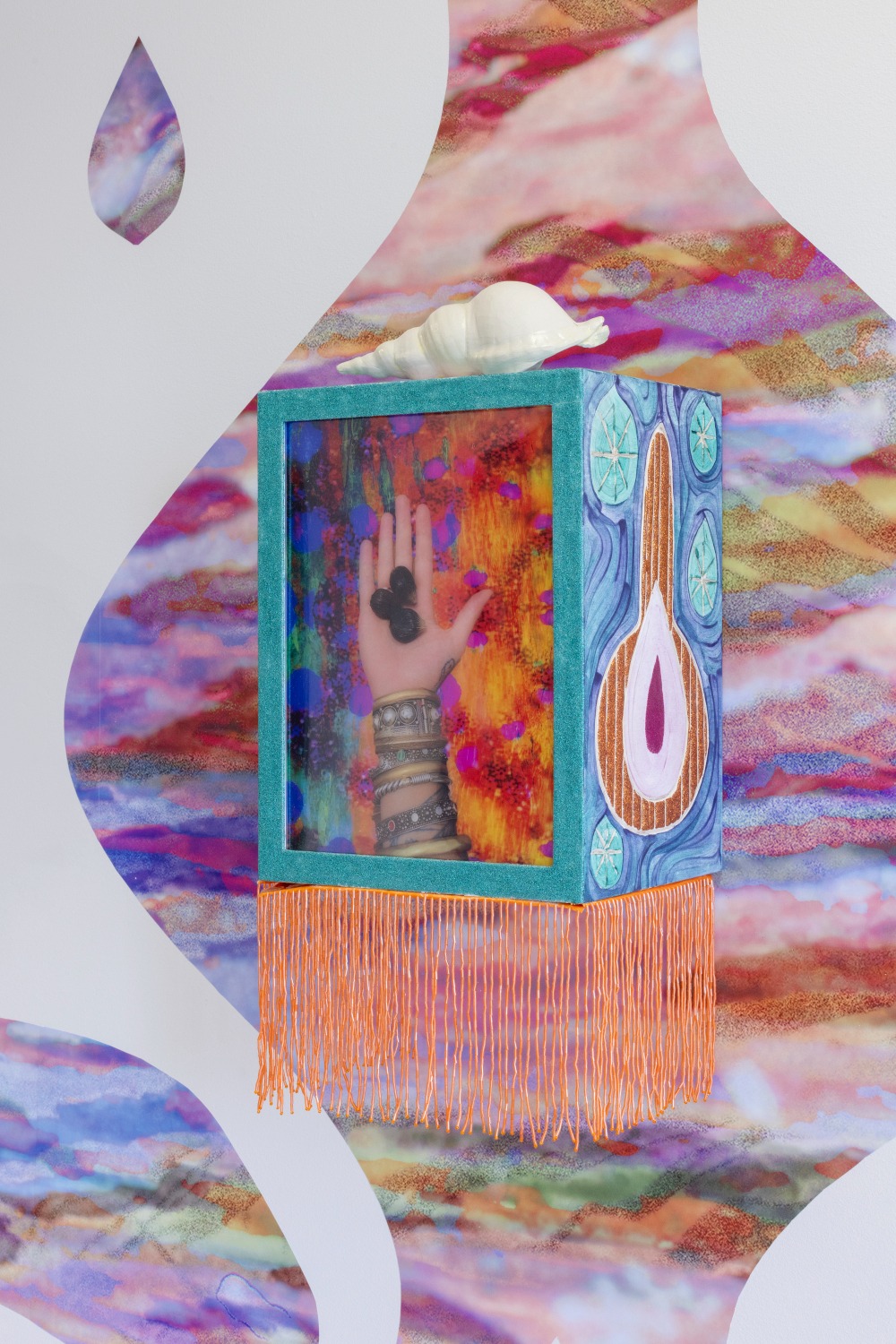
E.S.: Shivay always uses local herbs. And what’s interesting about her installation is that it’s always changing – every time she makes it, it responds to the land, not only the “site”. She goes out into the place where the installation is happening and collects plants that speak to her, adding them to the work. So the constellation on the wall keeps adapting as the story develops. She also adds these small bottles that form a kind of archive of different rivers she has encountered.
Photo: Mersedes Margoit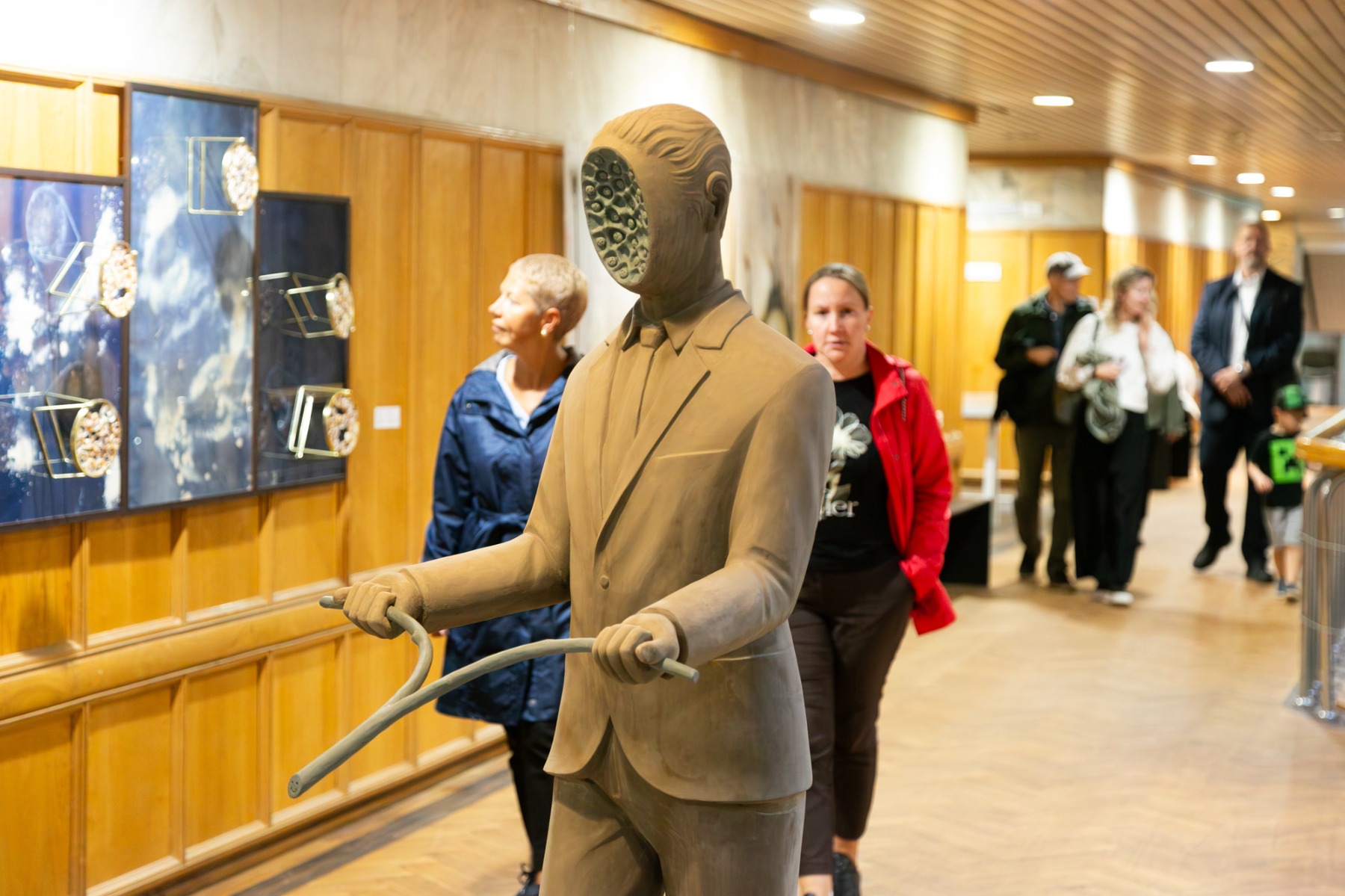
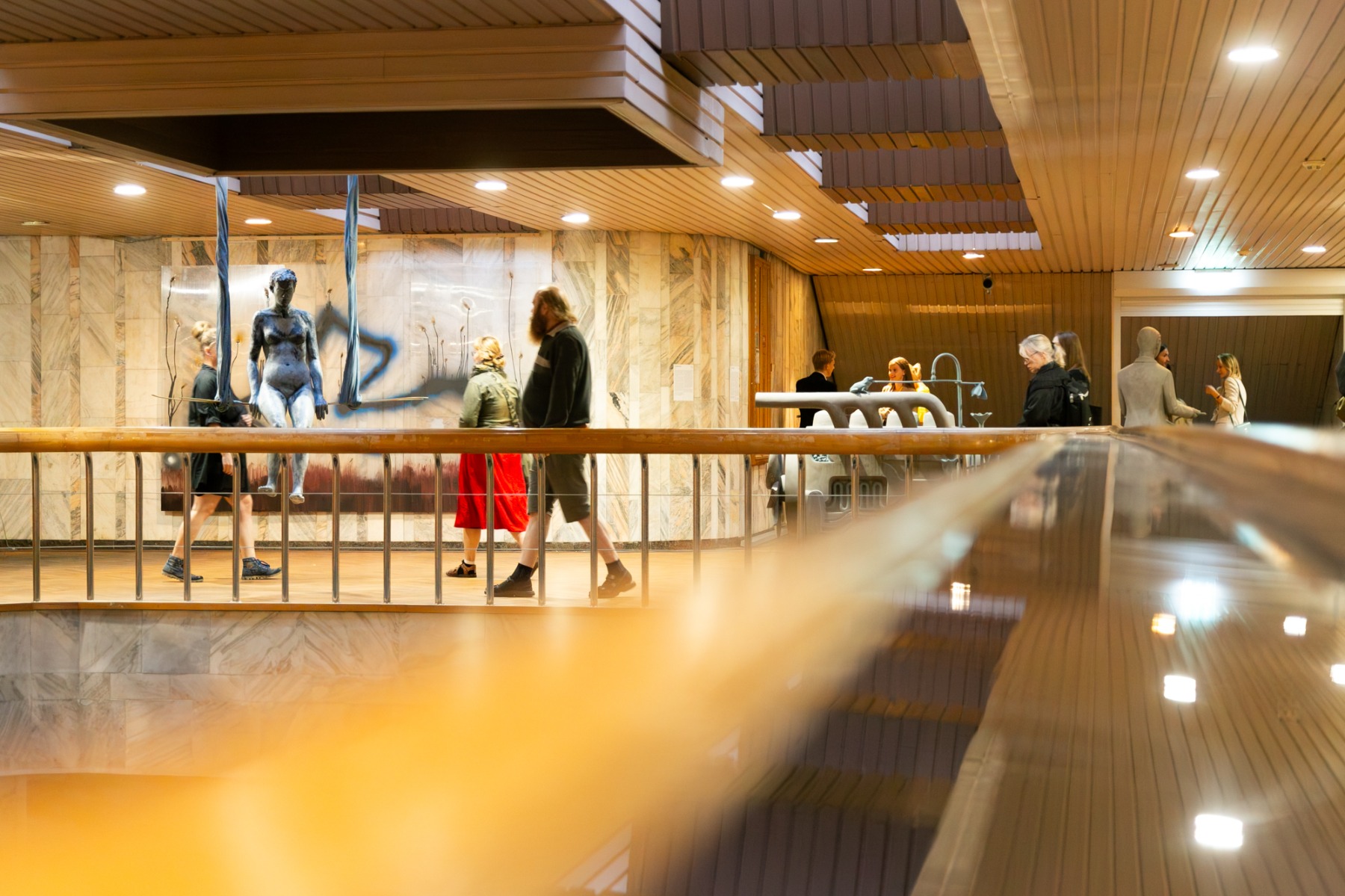
I really love that this piece also has such a distinct smell. It smells like a mixture of these local plants… The smell is unexpected in this seemingly brutalist massive building, which is actually rather elegant inside – the Riga Congress Hall.
S.M.D.: But we also really like this building because of the location. You have the canal right next to you, and it’s in the middle of the park. All the artists were quite excited about the location. And personally, I like this kind of brutalist architecture. I know what these buildings represent, and of course they carry a very charged history. But at the same time, they’re also monuments to the past, and I think it’s important to preserve them as part of history.
For example, in my home country of Czech Republic, a lot of these buildings are being destroyed because they’re associated with the Soviet period. But I think we should also be able to look at them differently. There are many beautiful elements in this building, in the way it was designed and constructed.
For me, this building also represents a certain idea of power and power structures. And I see your ideas and practices bringing a completely different context into this space.
E.S.: This is why we bring in witchcraft and spells. (Laughing)
S.M.D.: Yesterday's opening performances with Zora Snake, Naima Nefertari and Maya Minder, brought together artists that come from very different, often diasporic contexts, and with strong spiritual practices. So we knew that, in a way, they would kind of exorcise the building. That happened yesterday, actually. And it was a full moon, so everything was very nicely aligned with the performances.
Zora Snake. A Rite for Elsa. 2026. Photo: Kristīne Madjare 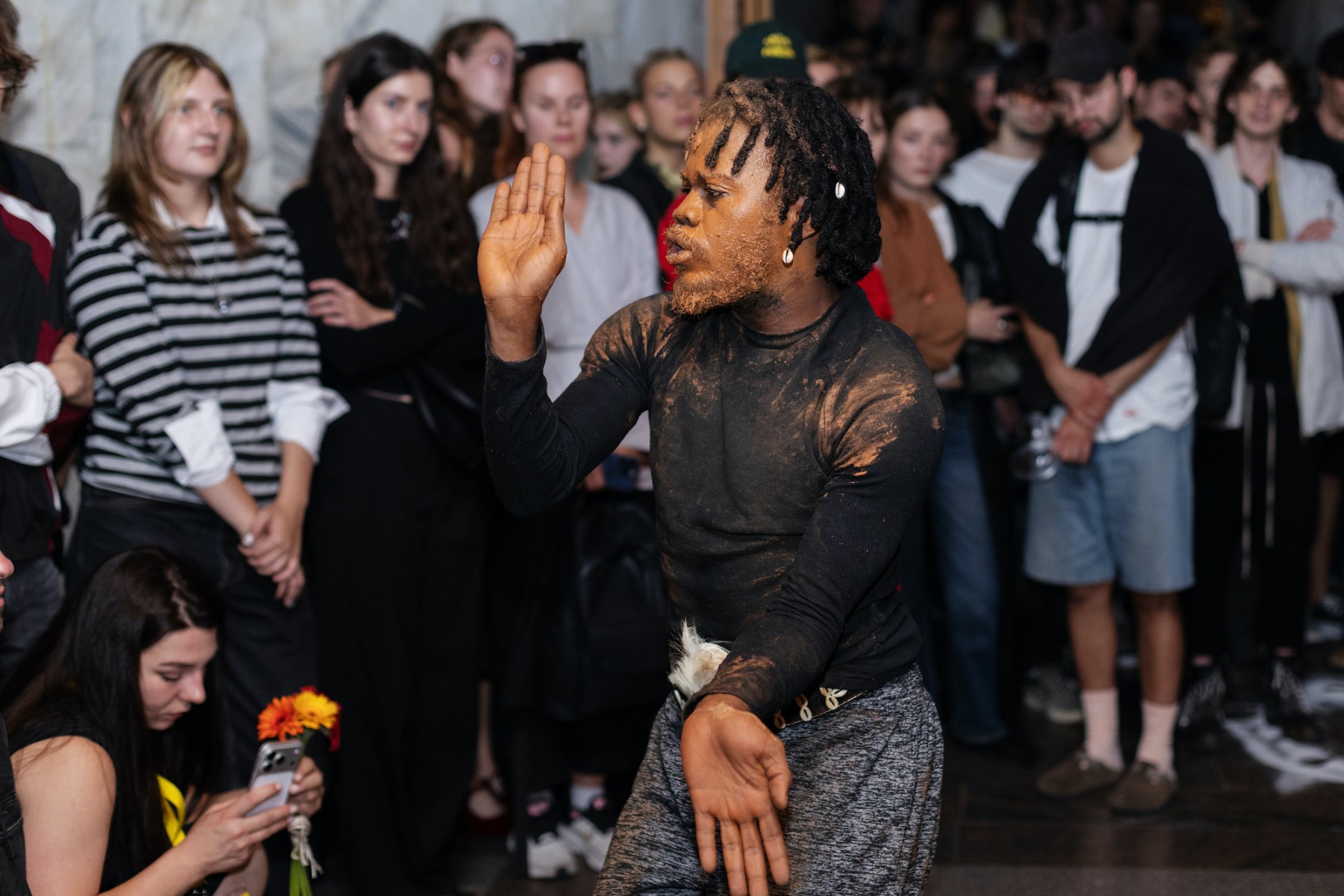
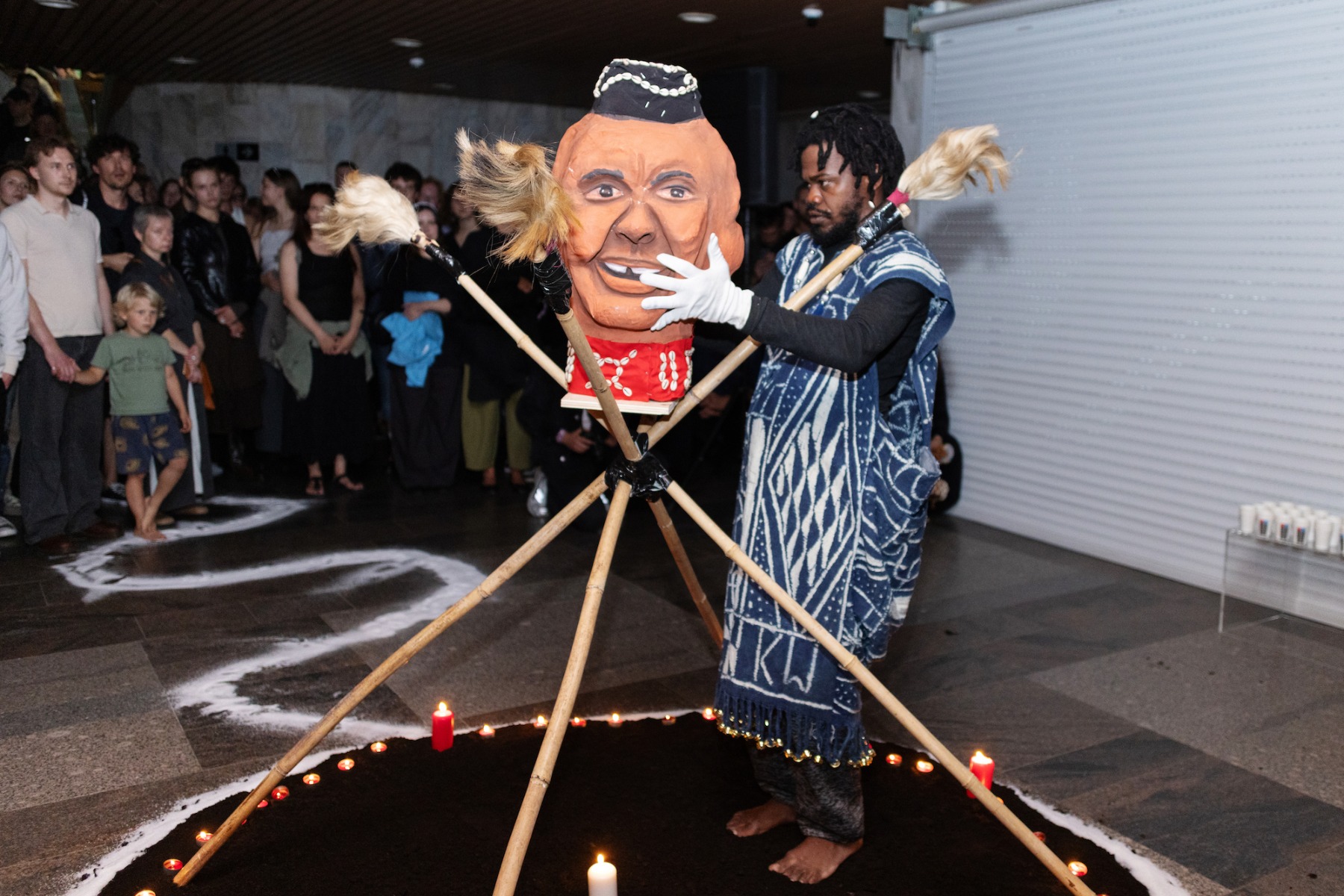
Yes. As Solvita Krese mentioned in her opening speech, it was also about kind of healing the building – bringing fresh air into it. And you also gave the exhibition a title that connects to this idea of wind: Arrow of the Wind: On Artists and Healers.
E.S.: Wind was a perfect element for us because wind exists somewhere between the material and the immaterial. Since we were working with different epistemologies, we wanted to move beyond vision – towards processes, sensations, and other ways of experiencing. Wind has this beautiful duality: it’s invisible, but at the same time very material and perceptible, we feel its effects with our bodies.
S.M.D.: And what’s interesting is that, in some traditions – for example, Inuit traditions that Jessie Kleemann's work calls upon in the exhibition – the word for wind also means breath and spirit.
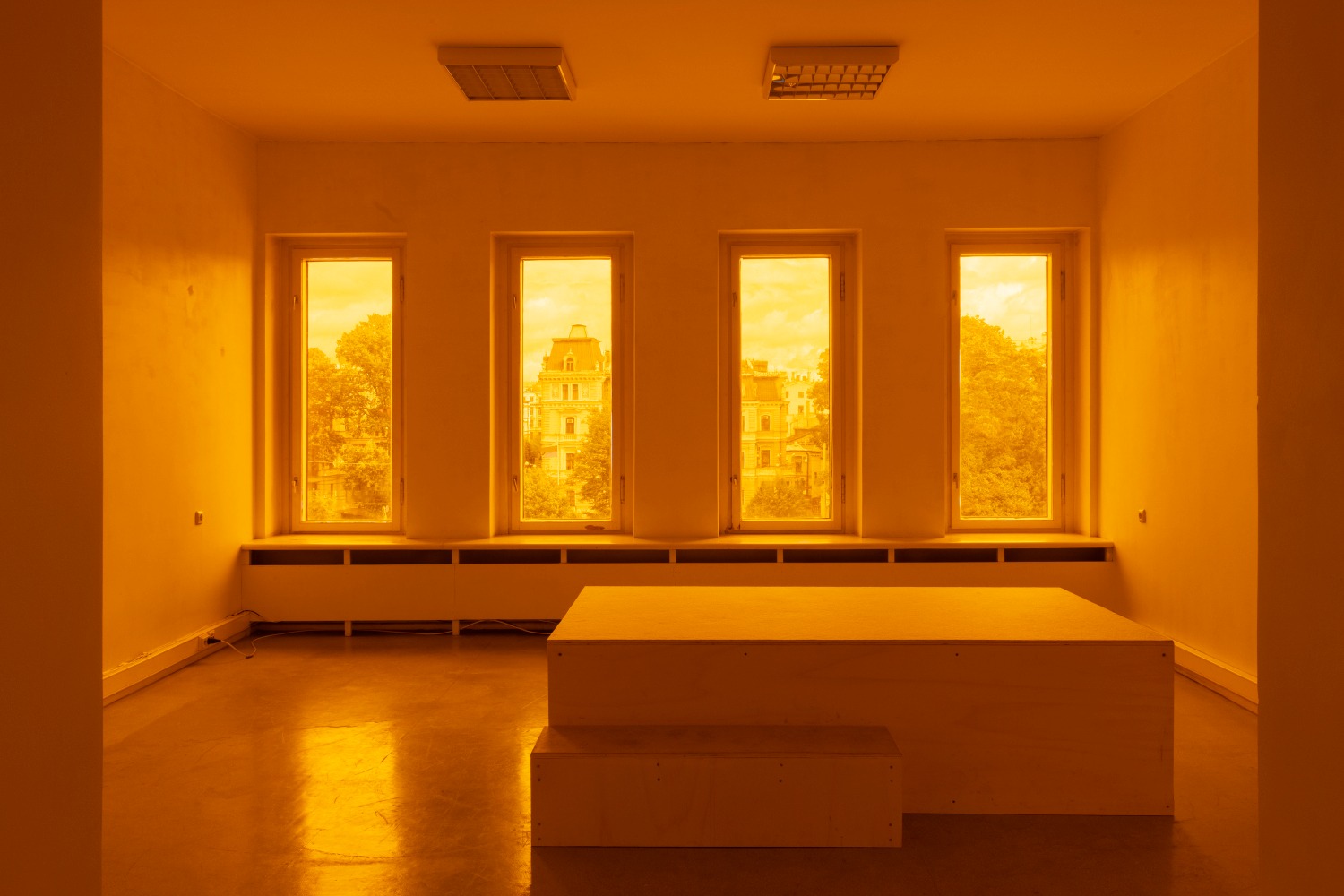
Estelle Labes. SUN SET. 2026. Photo: Kristīne Madjare 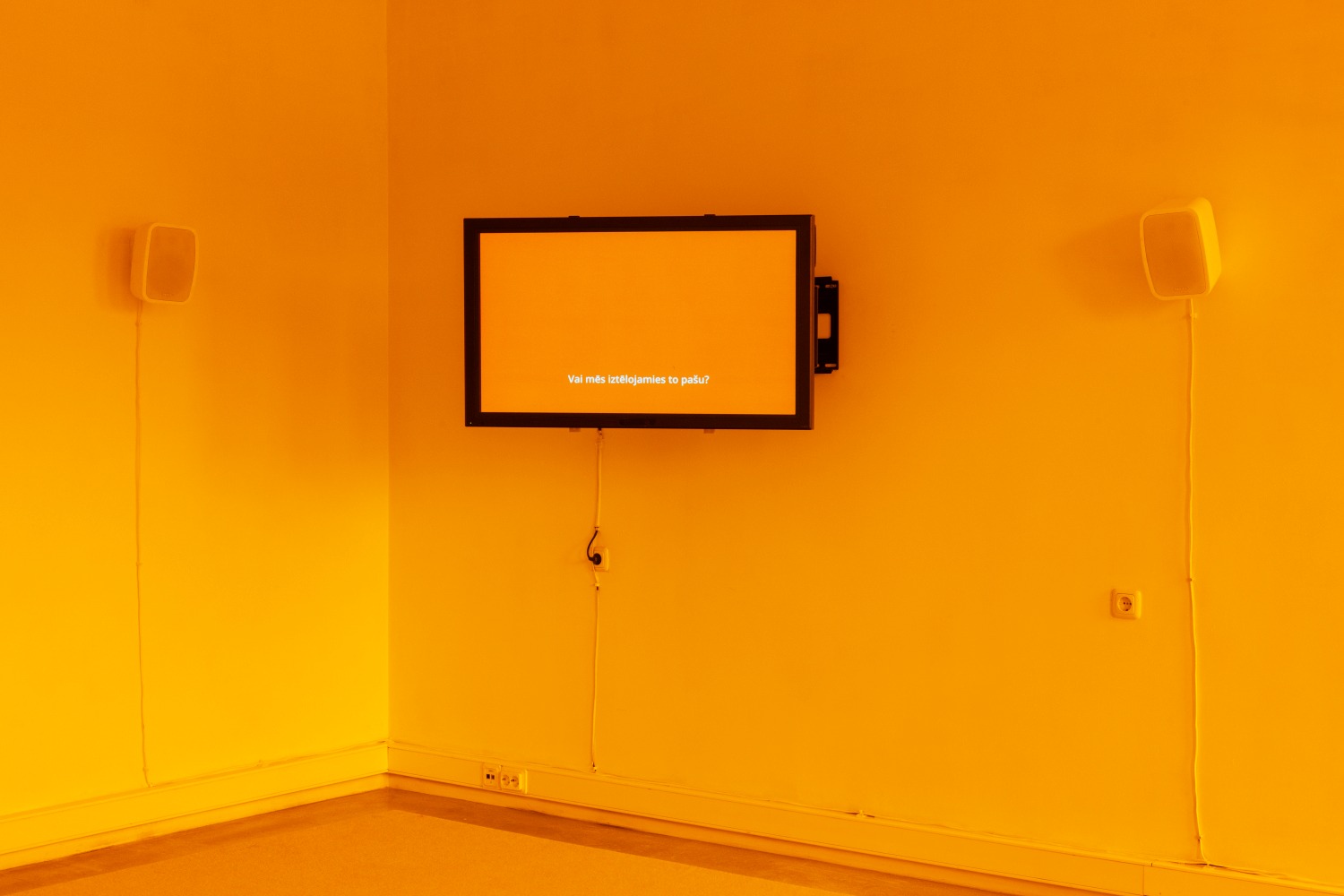
Wind also bring smells. And you mentioned smell as well one of cruical elements. But there also many others, in your text you are mentioning this “sensory pluralism”.
S.M.D.: It’s based on contemporary cognitive research, involving neuroscience, psychology and other fields. They were researching how we experience five senses and found we may possess as many as thirty-three distinct sensory systems. Which means we never experience something through only one sense. For example, when you’re in a cinema, you’re not only seeing the film. There are emotions, sounds, physical sensations, memories – joy, fear, and so on – all happening together. So there is this kind of multisensory neural activation. We can’t really say it’s simply about vision; it’s many things happening at once.
E.S.: And yet we still tend to think of the five senses as a basic fact, when in reality our sensory experience is far more complex than that.
S.M.D.: Estelle Labes, one of the artists in the exhibition, could explain this much better than we can. She comes from a deaf family and is very close to both the deaf and blind communities. This is what she explores in her installation SUN SET: that there are many more senses than we usually think about. And sometimes we become much more aware of these other senses precisely when we can’t rely on sight.
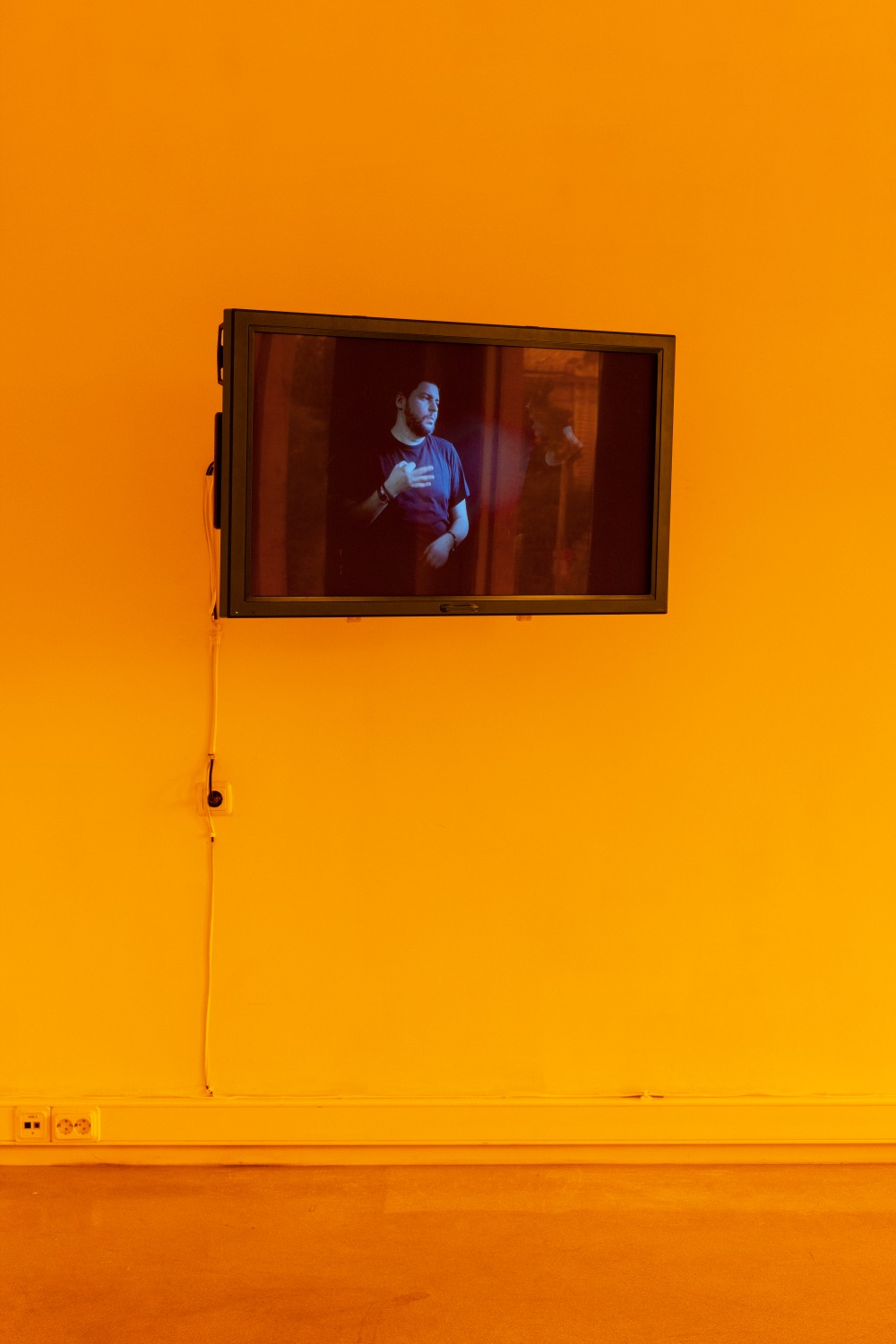
E.S.: She transforms the light in a room using filters and creating a very specific atmosphere. And you’re invited to lie down on a platform which produces vibrations. The installation is really multisensory. Her video records a conversation in tactile language used by DeafBlind people, in which communication happens through touch, movement, pressure, and gestures perceived directly through the body.
And what I find so beautiful is the way Estelle’s interlocutor speaks about touch. At one point, he describes the joy he feels when his fingers encounter a smile in relief. It’s an extraordinarily generous conversation because it shifts the perspective entirely. Rather than defining his experience through what might be perceived as an absence, he describes the extraordinary richness of what is there, a highly sophisticated sensory relationship with the world.
On the left: Virginie Ittah Learning to Fly. 2025. On the right: work by Pierre-Alexandre Savriacouty. Photo: Kristīne Madjare 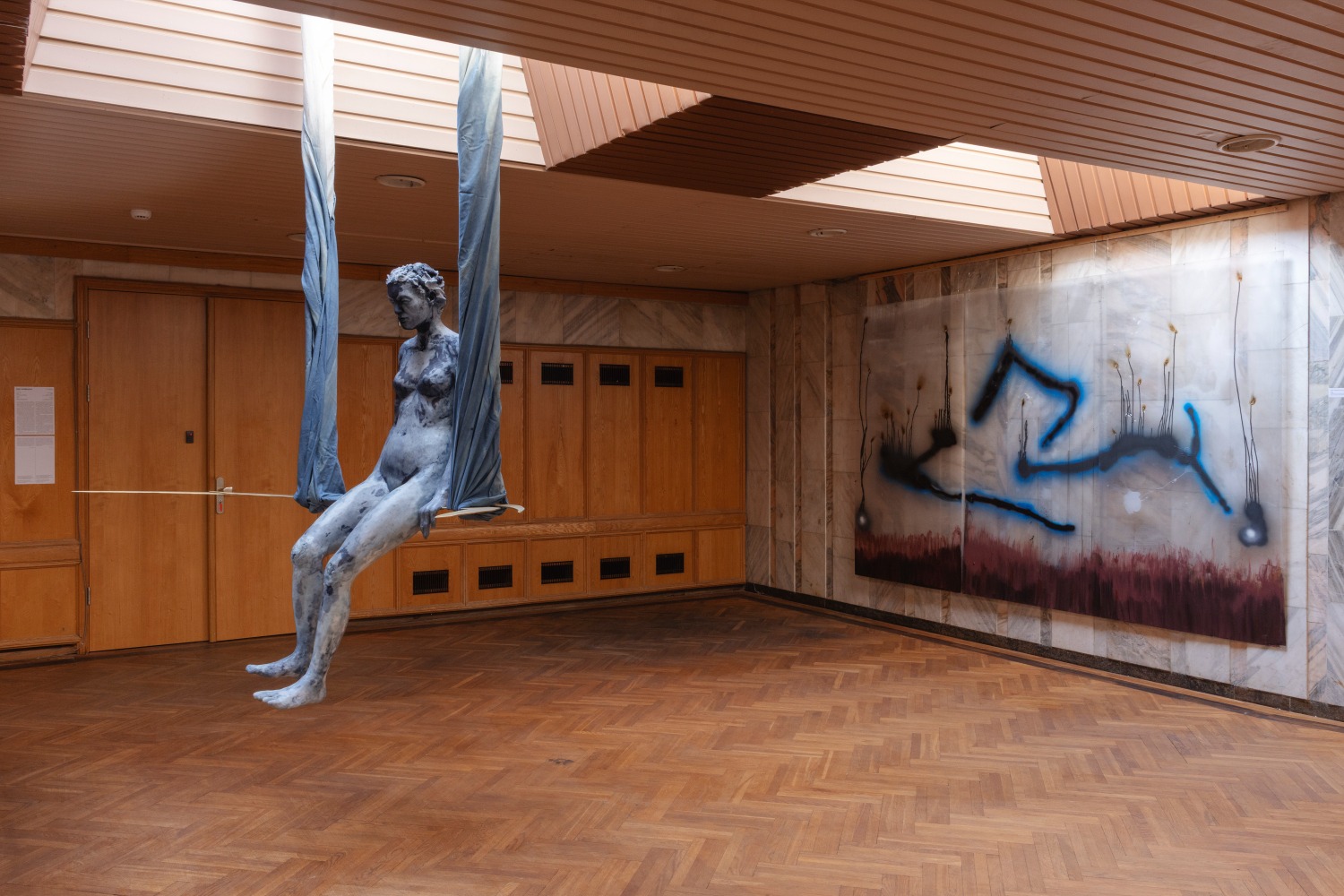
I talked yesterday with one of the artists, Pierre-Alexandre Savriacouty, and he mentioned that he really appreciates the way you work with artists – that you’re open to accepting things that perhaps other curators wouldn’t.
S.M.D.: In general, all the practices in this exhibition are very relational. The artists create relationships with the place, and that’s really important to us. Pierre-Alexandre Savriacouty, for example, had never been to this part of Europe – the Baltics or Scandinavia. He said, “I can’t just take a plane from Paris to Riga and make something. I wouldn’t understand what I’m doing. I need to feel the place.”
So we created the infrastructure to make that possible, through partnerships with three different residencies. He walked from Poland through Sweden to Latvia, following birds, particularly cranes. And the walk became a kind of therapy for him, a way of being in nature and connecting with the place.
E.S.: This is a really important dimension for us. Nothing is ever simple, of course, but as much as we can, we try to create a supportive environment for the artists we work with. Being an artist can be incredibly precarious, and the pressures are not only financial or professional – they can also be emotional and psychological. So care for us is very much part of the working relationship, not something separate from it.
With Pierre-Alexandre, that dimension was quite present, but at the same time, the project itself was so inspiring. From the very beginning, he said, “This is what I want to do. I want to walk. I want to follow the migration of the birds.” And we just thought, “ This is so wonderful! How can we make it happen?”
S.M.D.: Pierre-Alexandre said to us, “I’ll produce something, and I’ll see what comes out of the experience.” He didn’t want photographic documentation of his journey. And that was actually a beautiful part of it, because you can see that the whole experience of the walk found its way into the work. All these plants and colours he encountered, the pigments – they all came from the journey. In an embodied and performative sense, the walk made its way into the work.
Photo: Mersedes Margoit