


Worryingly happy or happily worried
Express interview with Latvian artist Kaspars Groševs about his exhibition “Feedback,” on view at Medūza gallery (Vilnius) until 11 April
When you enter the Medūza gallery, located in the center of Vilnius, for Kaspars Groševs’ exhibition, you immediately begin to both see and hear. The space is quite open: large empty areas alternate with hanging paintings. As you move from one image to another, you also move from one room to the next, winding around walls (some of which were specially built for the exhibition), gradually drawing closer to the source of the sound – in the largest room, in the corner by the window, there is a compact black console, with a pair of black speakers nearby.
Photo: Laurynas Skeisgiela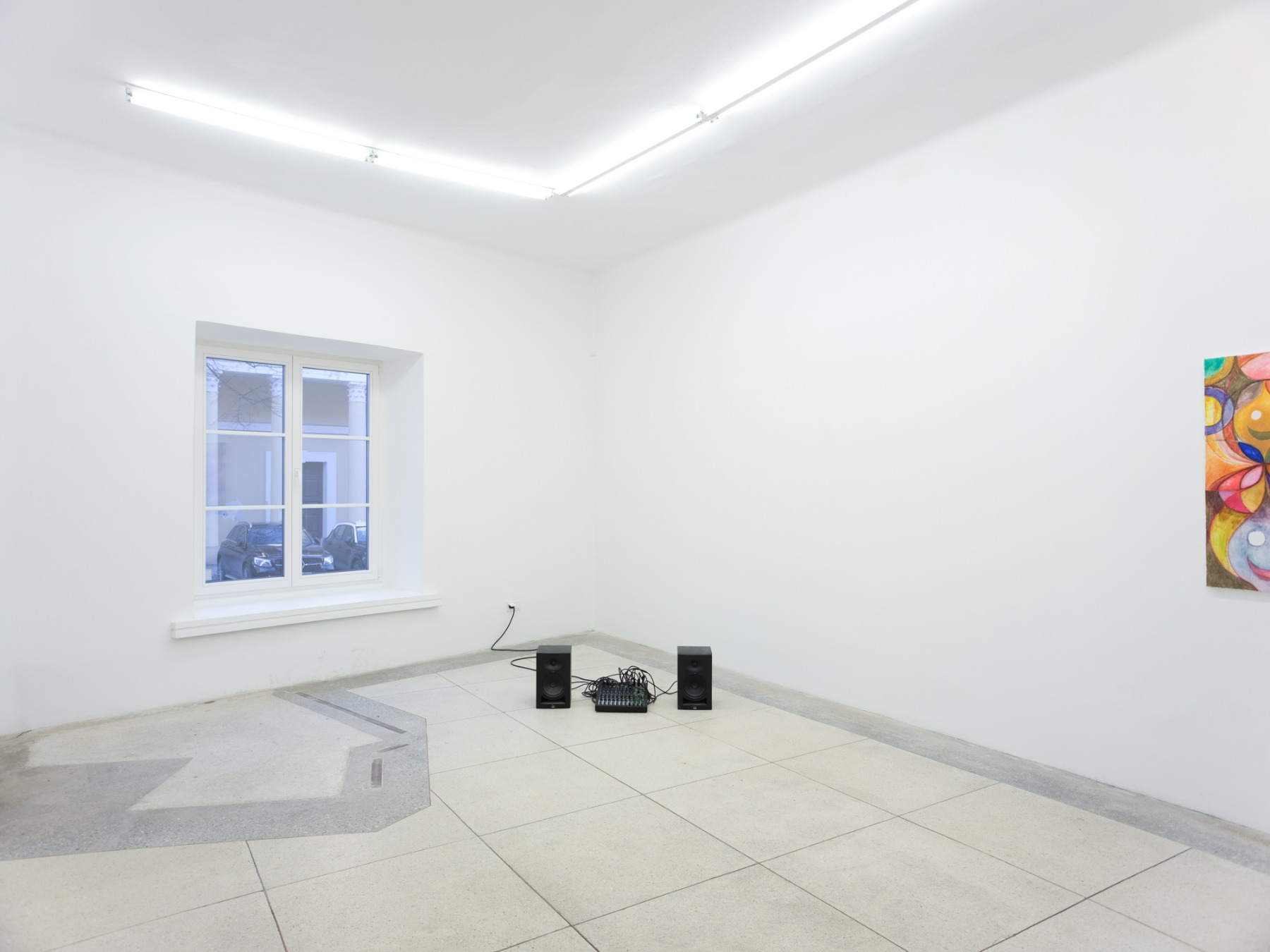
“The sound installation No Input Just Output encompassing the space is an acoustic feedback loop that occurs when a system begins to hear itself and amplifies that signal until distortion replaces clarity. In Feedback, Groševs stages a cultural equivalent”,” tells us the text of the exhibition (curator – young, ambitious, and insightful Žanete Liekīte).
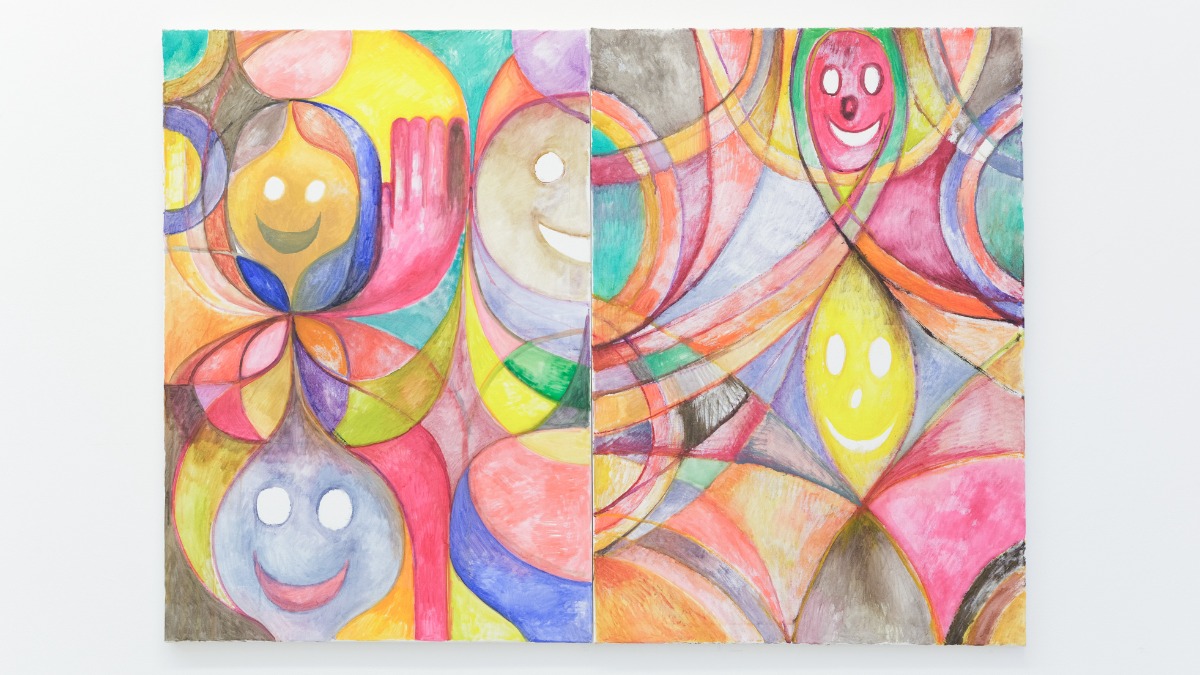
The images themselves are extremely colorful, reduced to graphic forms of smiling faces, slightly reminiscent of iconic emojis on psychedelic pills from the 2000s. “Groševs’ paintings wave back to those early twentieth-century attempts to invent spiritual grammars through distortion, chromatic excess, and rhythmic patterning. If abstraction once promised transcendence through formal coherence, Groševs stages coherence tipping into apophenia: the compulsion to perceive structure where there might be none”. Another important detail: “Groševs was born in 1983. For several years, however, his Facebook profile listed his birth year as 1913. The joke persisted until it became biologically implausible. Yet this gesture still lingers. Kaspars Groševs’ solo show Feedback treats time as a signal looping back on itself. The works in the show carry the charge of something belated and anticipatory at once”.
Photo: Laurynas Skeisgiela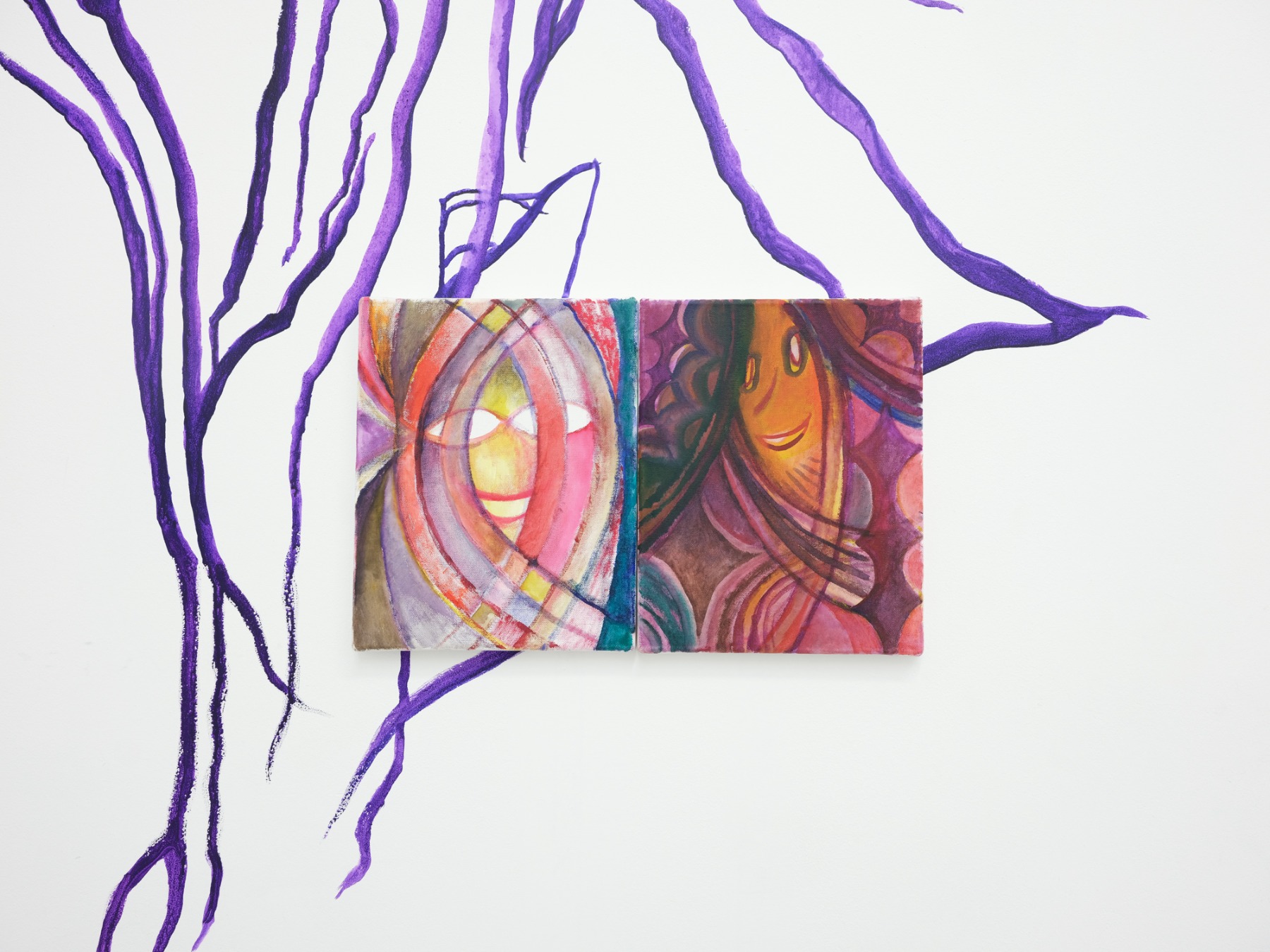
We met Kaspars in Vilnius just a couple of days after the exhibition opened. It was clear that he felt completely at home in the city. Kaspars took me for a bite at Viet.inė, knew which DJs were playing where that day, and enthusiastically told me about the local music and culture platform Radio Vilnius, which broadcasts online and frequently collaborates with DJs from Latvia. Our exchange of questions and answers about his new project happened in the same relaxed, friendly spirit.
What inspired the joke about your birth year, and how did it shape the show’s concept of time? Do you sometimes feel like you really are 110 years old?
Sometimes I feel both timeless and instant like coffee. I think the joke about me being born in 1913 came from “The Art of Noises” manifesto written by Luigi Russolo that year. Sometimes I have a feeling that was the year the upside-down urinal was invented, even though officially it’s 1917. Anyhow, in the show, the time also feels somewhere between 110 years ago and now, at least for me. When I was rubbing that aquarelle into the canvas, I felt like I was sharing a studio with Sonia Delaunay, even though it was mostly my friend Irma working alongside.
The figures in your paintings seem playful but slightly eerie, and together they have a mildly hypnotic effect. Did you intend to give viewers a subtle psychedelic experience?
While making the paintings, I felt puzzled and also amused by what came out. The paintings totally lured me in as if they were drawing me instead of the other way around. To be honest, the period of making the works indeed felt a bit like a psychedelic tunnel or K-Hole, and as in those kinds of experiences, it's hard to say if it's a good trip or a bad one. But it certainly was a memorable trip where I hope I came out slightly better than before. I usually don't intend to give viewers anything, just propose a situation where they can take away whatever it is that captures their attention. I hope there are enough details and gestures to build different kinds of experiences, including a psychedelic one.
Photo: Medūza gallery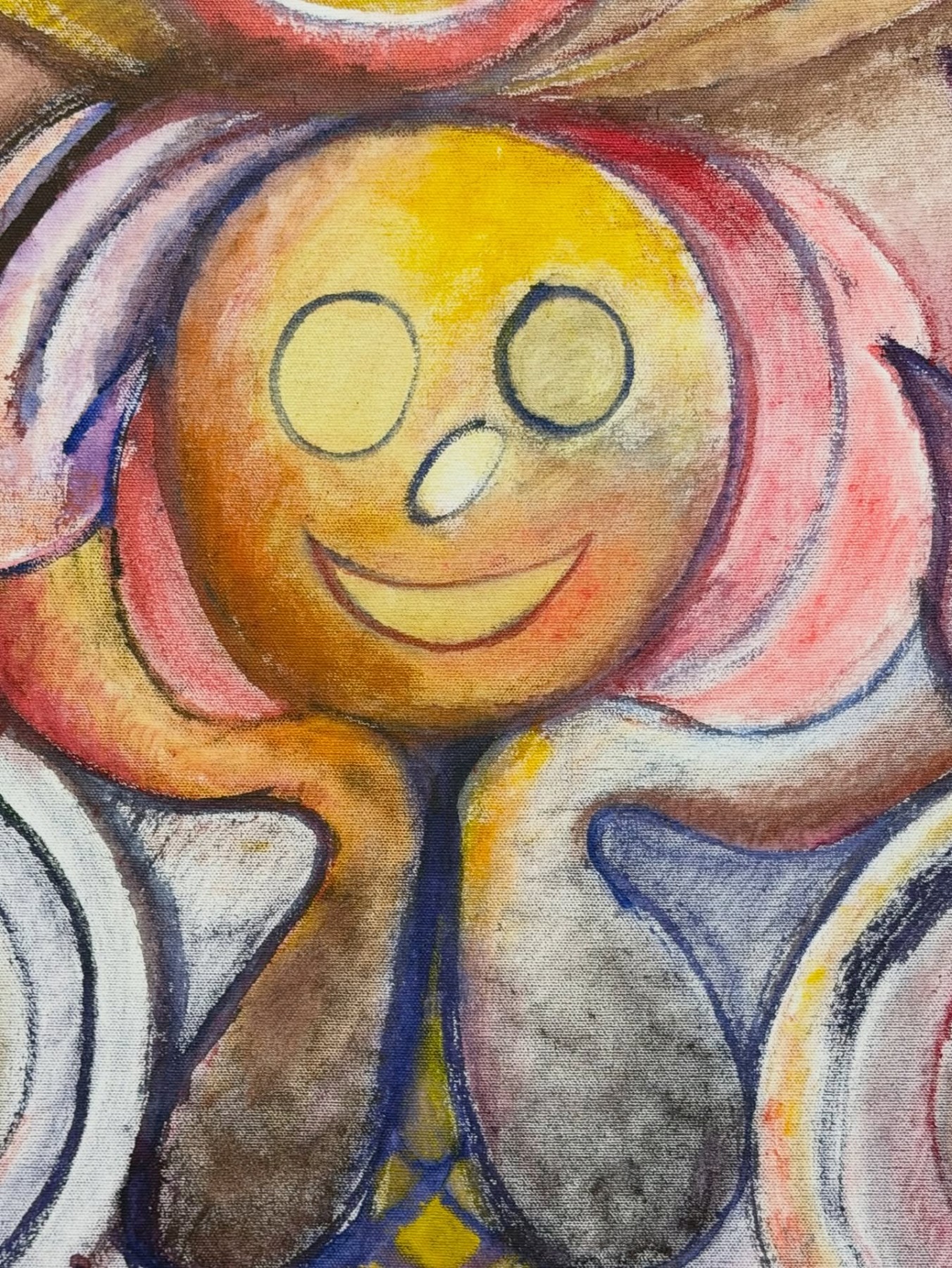
Those smiles in your work… should we feel happy or worried when looking at them?
I really don't know. Perhaps worryingly happy or happily worried?
The sound installation loops and distorts – it’s like a feedback loop on steroids. How does it relate to the paintings? Should we listen first and then watch, or does the order not matter?
Once you enter Medūza, the labyrinth of walls keeps the sound in distance as if there's a railroad or sea waves somewhere in the far. At first, it's almost like a room tone or ventilation, like the everyday traffic drone that surrounds us in a city and that we maybe don't even notice. But once you reach the source of the noise, you might get captured by it, at least I am. Somehow it's like watching a car crash happening and you can't turn away, maybe the same can be said about the paintings? I think in the exhibition, the sound gives the paintings an extra layer of coating so that the paint doesn't fall off the canvases.
“Many of the drawings you first created while sitting in bars and cafes, together with friends amid conversation, allowed the hand to move ahead of the mind.” Have the style and forms of these drawings changed over time? What are you drawing now?
I feel like my drawings change constantly. Somehow, the words of Charles Demuth resonate in my head frequently: "For some there is no stopping. Most stop or get a style. When they stop they make a convention. That is their end. For the going every thing has an idea." (From the second issue of 1917's The Blindman magazine) To be honest, I'm not drawing currently, at least not with my hand. My friends were an important part in the creation of these works and my dear friend Labais Dāma's sudden passing has left a massive black hole in me. What I'm drawing currently is rather a timeline of upcoming events - several tributes to the memory of Labais, including a screening within the "Feedback" exhibition.
Photo: Laurynas Skeisgiela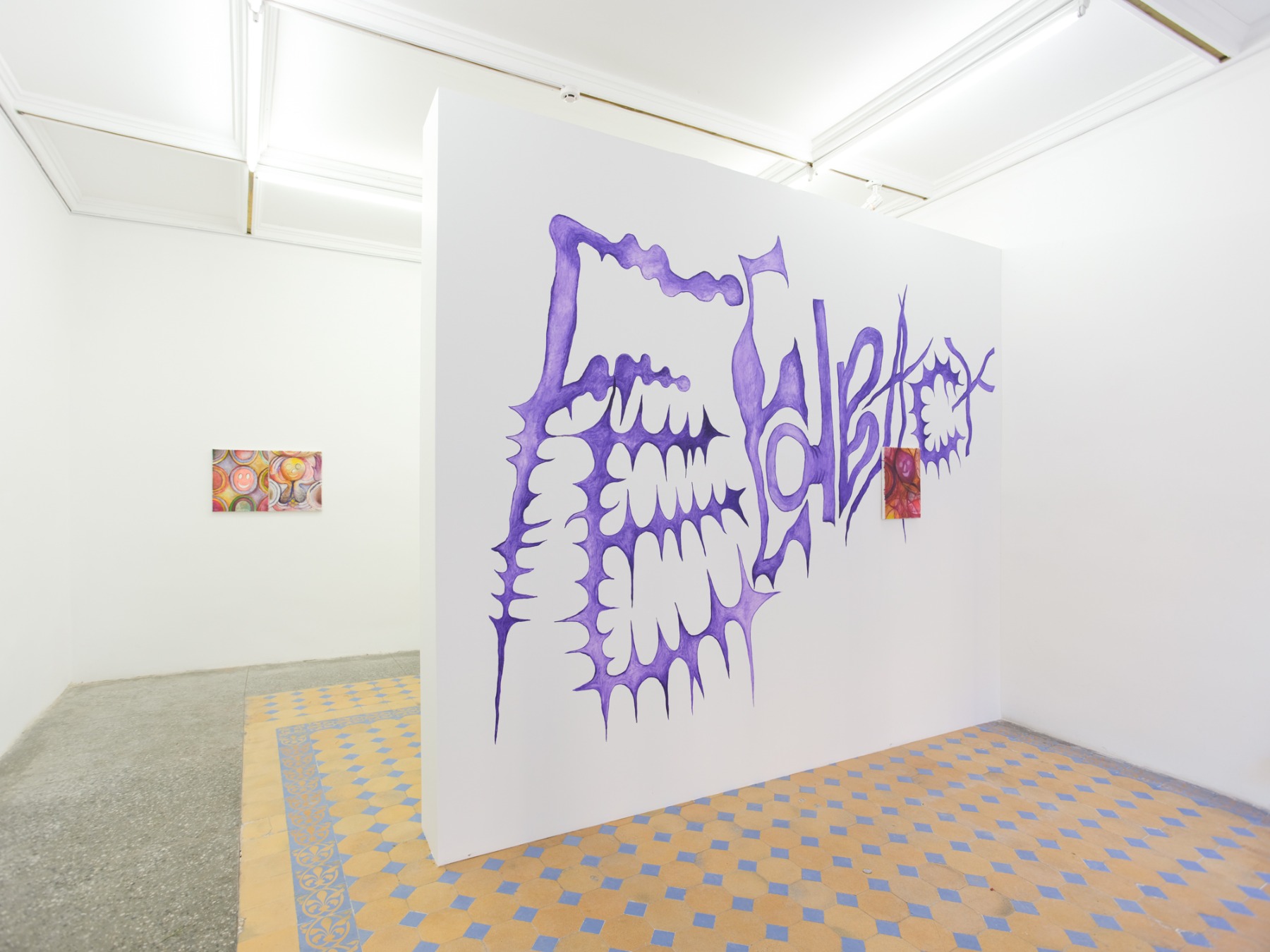
“Color and pattern build toward saturation, pushing the image to the edge of overload.” Is “overload” a keyword connected to the show’s title, “Feedback”?
Overload is certainly present in the sound installation titled "No Input Just Output" - the sound is being pushed to the limits there. However, the paintings may have come from the overload of life and its sometimes tragic turns of events. But I also would like to think that the show is rather light and playful - as a colorblind person, I take notice of contrasts, and I think there are different kinds of contrasts in the exhibition. Maybe also a contrast between overload and emptiness, just like the painting process itself, with extensive conversations that intertwine with long periods of silence.
Vilnius seems to be a meaningful city for you. What do you love about it? Is there something there that you feel is missing in Riga?
Ever since my punk/hardcore days a million years Vilnius has been a source of inspiration because of its people and landscape. In the early 2000's, their approach to punk seemed driven by uncompromised dedication, confidence and attitude. It almost seems like the art scene has absorbed the same qualities in its approach to things. Its poetry feels full of possibilities and continuations. Even though the city feels smaller than Riga, it feels the local audience is more enthusiastic and open to new experiences. Like Žanete Liekīte, the curator of my show, said: They're cool and they KNOW IT. I think here in Riga, we sometimes forget our true potential and we choose to pretend something we're not.
