


Haunting the rubber plantation
An interview with Singapore-born, Netherlands-based artist Priyageetha Dia, whose exhibition everything you need to see is already in front of you is on view at the Riga Contemporary Art Space until 7 June as part of the Riga Photography Biennial
The Riga Photography Biennial is an international contemporary art event dedicated to exploring visual culture and artistic representation. Rapid technological change has led to a reassessment of what images mean and how they communicate. In this context, “photography” is understood in a broad sense, covering diverse image-making practices that continue to reshape the language of contemporary art in the 21st century. Two of the main events of this year’s biennale are taking place at the Riga Contemporary Art Space. The exhibition Zoom In: Ecology in the big hall presents nine reflections on the merging of humans with digital technologies and/or nature. In the small hall, there is a solo exhibition by the young Southeast Asian artist Priyageetha Dia, “everything you need to see is already in front of you”.
Priyageetha Dia (1992, Singapore) is an interdisciplinary artist working across time-based media and installation. Her recent exhibitions include Munch Triennale in 2025, 4th Bangkok Art Biennale, Manifesta 15 Barcelona, 60th La Biennale di Venezia in 2024 and Kochi-Muziris Biennale in 2022. Her practice “braid themes of Southeast Asian labour histories, speculation of the tropics, and ancestral memory meeting machine logics”.
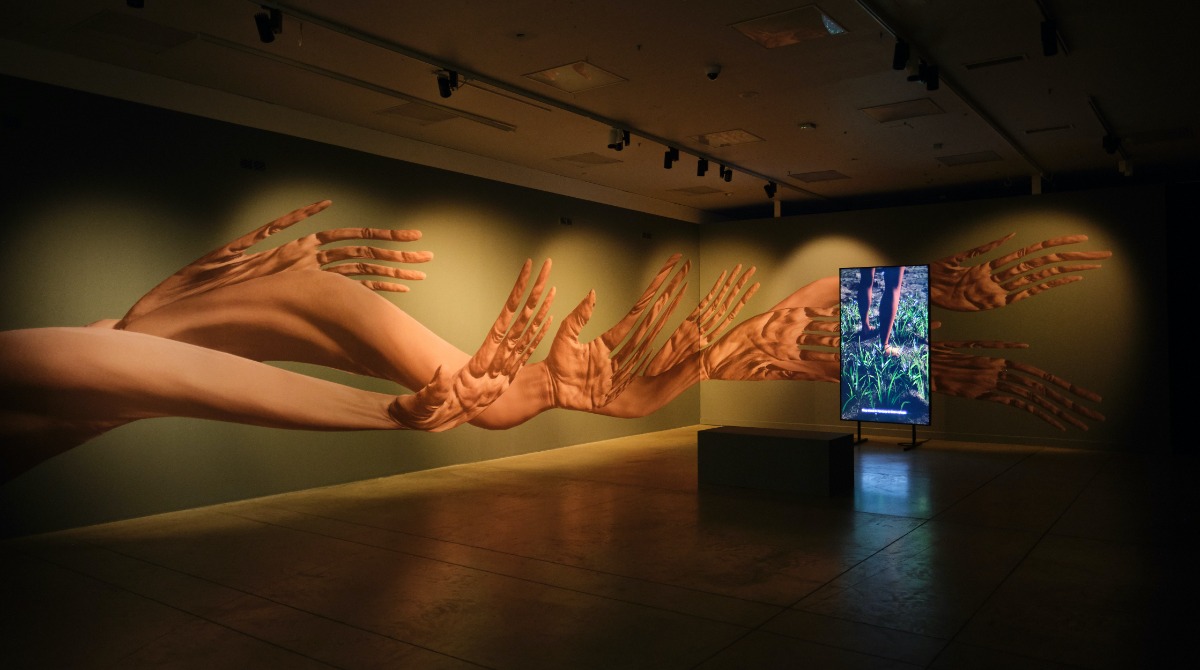
everything you need to see is already in front of you. Exhibition view at the Riga Contemporary Art Space. Photo: Pēteris Rūcis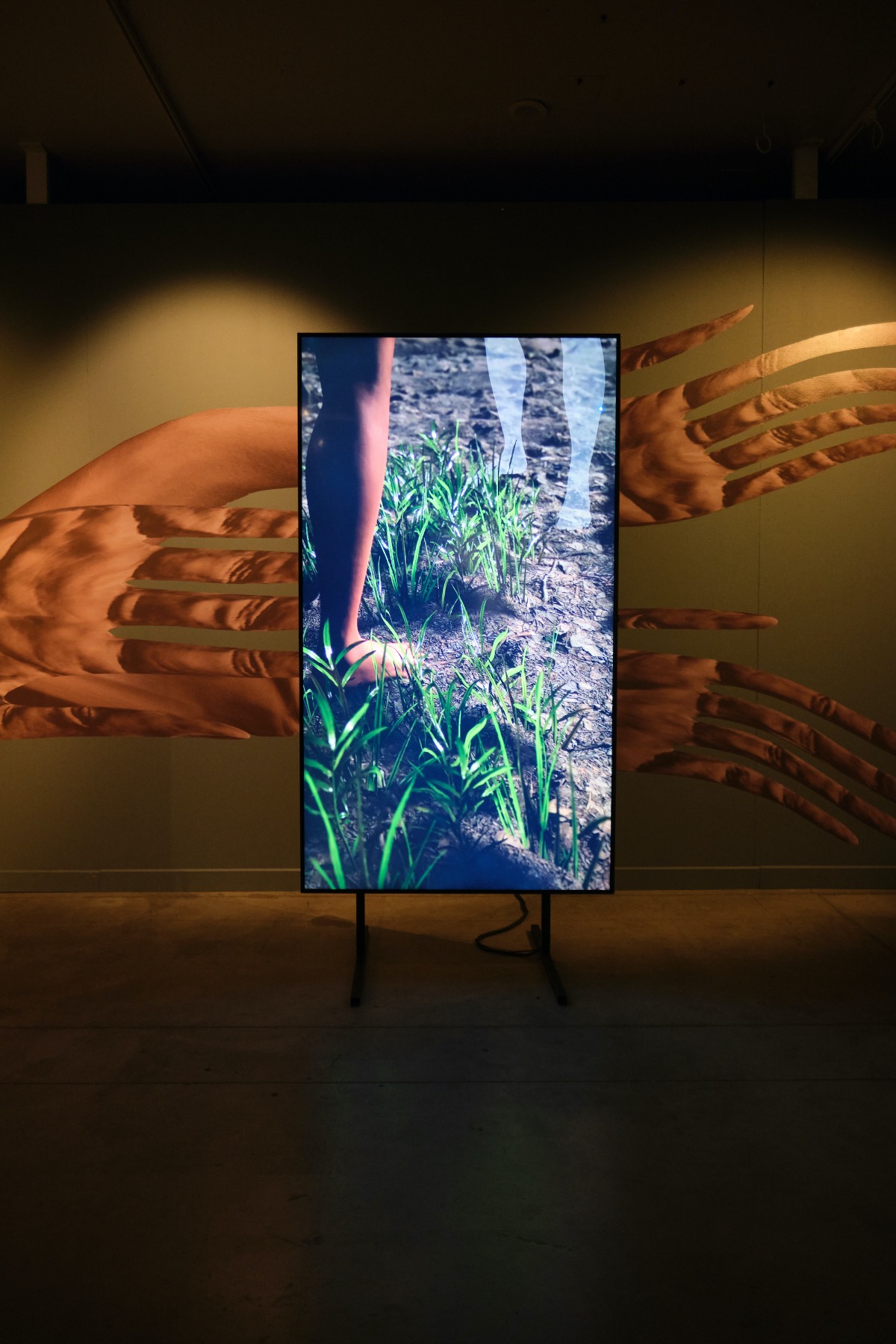
In her exhibition everything you need to see is already in front of you, Priyageetha Dia rethinks image as a carrier of memory through her family history in Southeast Asia and the legacy of British colonial rubber plantations built on indentured labour from South India. She explores hidden connections between land, labour, and memory, treating images as traces that hold ghost-like residues of the past. In Spectre System (2024), she constructs a gamified plantation world populated by Inaivu – memory-spirits linking Tamil and Malay concepts of remembrance. While Mesh: Prelude to Spectre System (2024) extends the tension between colonial past and present-day reality through distorted, elastic “arms in motion” that echo rubber itself, blurring the boundary between body and environment.
We spoke with Priyageetha Dia at the Riga Contemporary Art Space, where she took a half-hour break from installing her works to talk about the strange world of rubber plantations, the golden staircase in her Singaporean home, and the mysterious, spectral realm of animated images.
Priyageetha Dia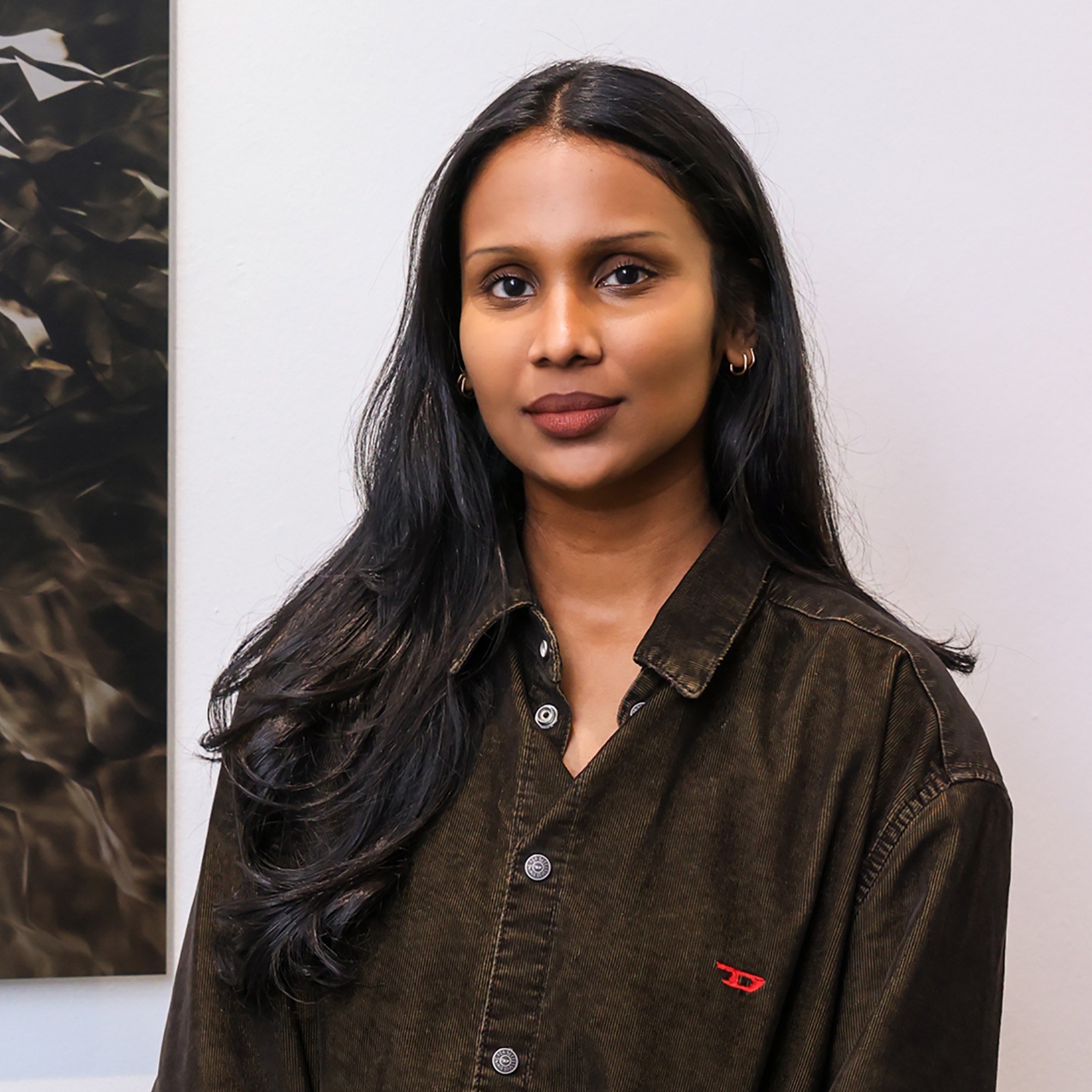
I noticed from your bio that you participated in the Kochi-Muziris Biennale in 2022. I was there as well, with a group of poets and artists from Latvia called Orbita. What work were you showing?
It was my first biennale, and I presented The Sea is a Blue Memory (2022) While working with archives, I realised there was a gap in the historical record, particularly in documenting labourers travelling from South India to Southeast Asia. This lacuna also speaks to the conditions under which photography operated as a tool: there is a greater sense of stability and control in capturing images on land than at sea. The sea possesses its own agency, its own movement and it is precisely this that accounts for the scarcity of visual documentation of that journey.
The work takes a speculative approach, attempting to imagine what that journey might have been like. It also draws on the presence of sea spirits within Southeast Asian contexts. The result is a highly poetic piece: there is no narration, only visuals and sound. I was also working extensively with animation, and I found that using speculation – almost fabulating a narrative –allowed for a different visual and narrative language, one that I’m particularly drawn to. That formed the core of the work I presented.
Alongside the video, I showed a series of prints. These focused on specific archival images I had encountered, including one depicting a group of labourers tending a plantation field in Malaysia.
In the original image, the individual figures are not clearly distinguishable. My intervention was to zoom in on each figure, isolating them and giving each their own frame. This was the work presented at Kochi.
The Sea is a Blue Memory. In Our Veins Flow Ink and Fire, Kochi-Muziris Biennale 2022
Kerala, India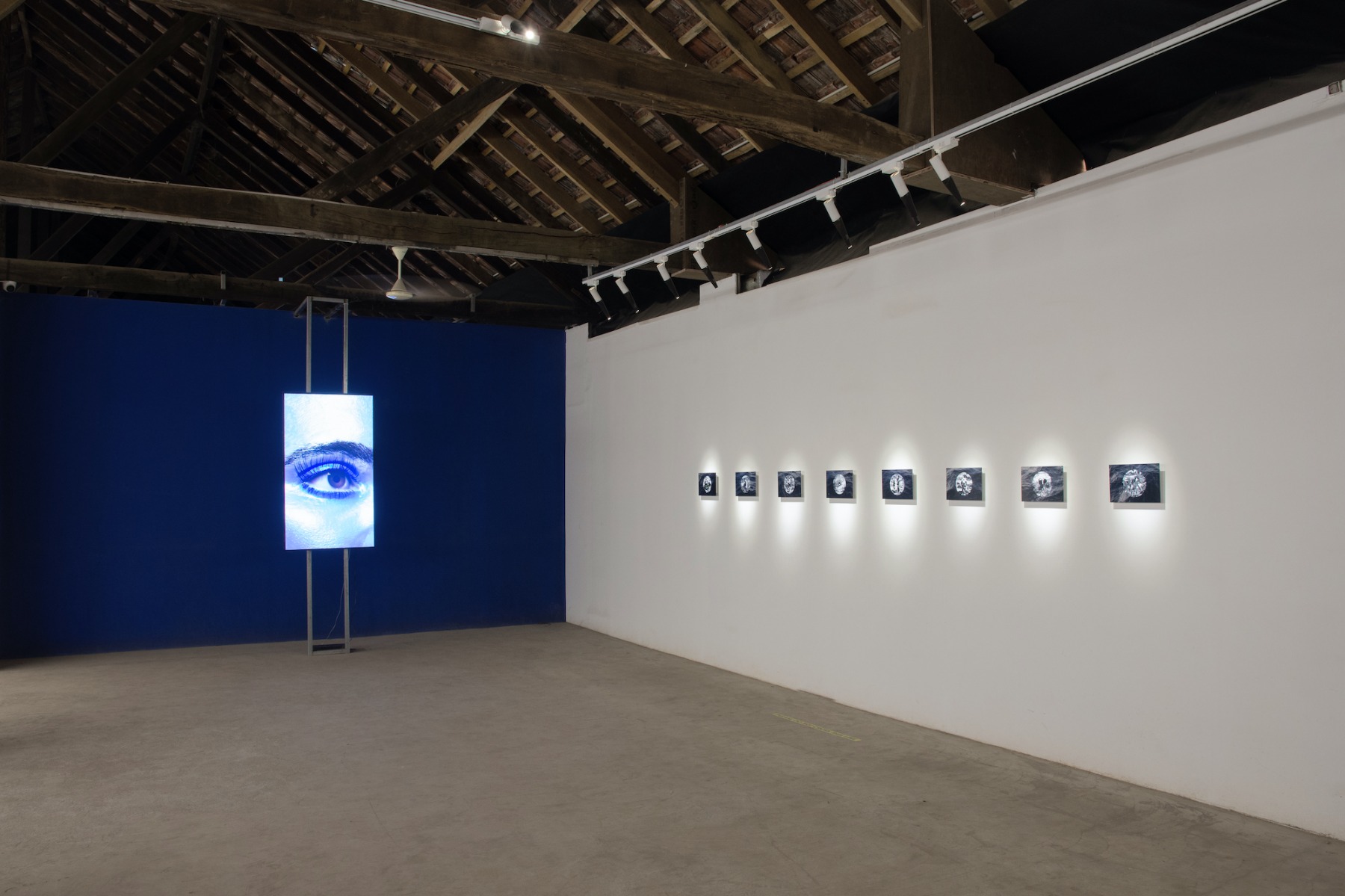
iquid.vision_nil.land (after MalayaRubberPlantation, Getty), 2022. Bitmap white screen print on dye sublimation chromaluxe silver printing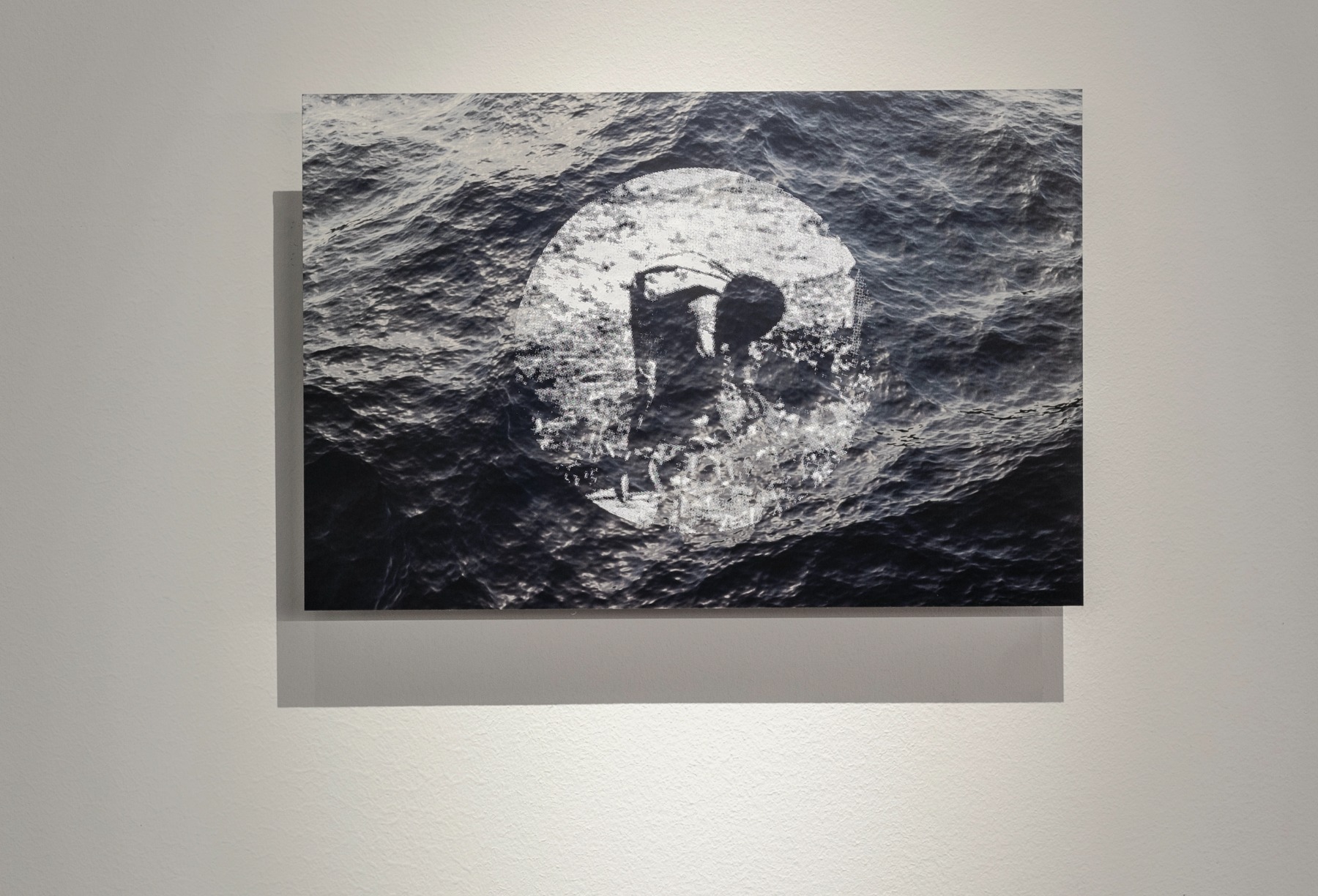
I didn’t have a chance to see it – nor, I suppose, did you see our work – as the biennale was postponed for two weeks at the last moment, and we left before the opening.
Yes, it was quite chaotically organised that year, and I also had to leave early, without the chance to see all the works, which is perhaps an irony particular to biennales of that scale, where the logistics of participation can preclude the possibility of encounter.
You were working with archival photographic images at the time. Would it be fair to say that your practice is rooted in photography, but extends into many other directions?
Actually, I’ve never had any formal training in photography. I would describe my practice more as image-based, whether I’m working with moving images or with prints. I think the visual language of how the image is situated is very present in my work, particularly in the context of animation.
I find that animation has a quality that feels almost mystical or spectral, with a sense of magic realism within the image – which is something I find genuinely generative to explore. I learned animation during the COVID lockdown and it also pushed me to engage more with screen-based space, given that I didn’t have access to a studio. Learning animation became a significant shift in my practice. On the one hand, I was attempting to understand the geographical and historical narratives of this community in Southeast Asia; on the other, I wanted to develop a kind of counter-visual vocabulary through which to approach that history.
I found animation, as an image-based practice, opened up a different way of understanding the image itself – particularly the archival image. It allowed me to reframe and reimagine these materials, rather than simply present them. That was what drew me to it.
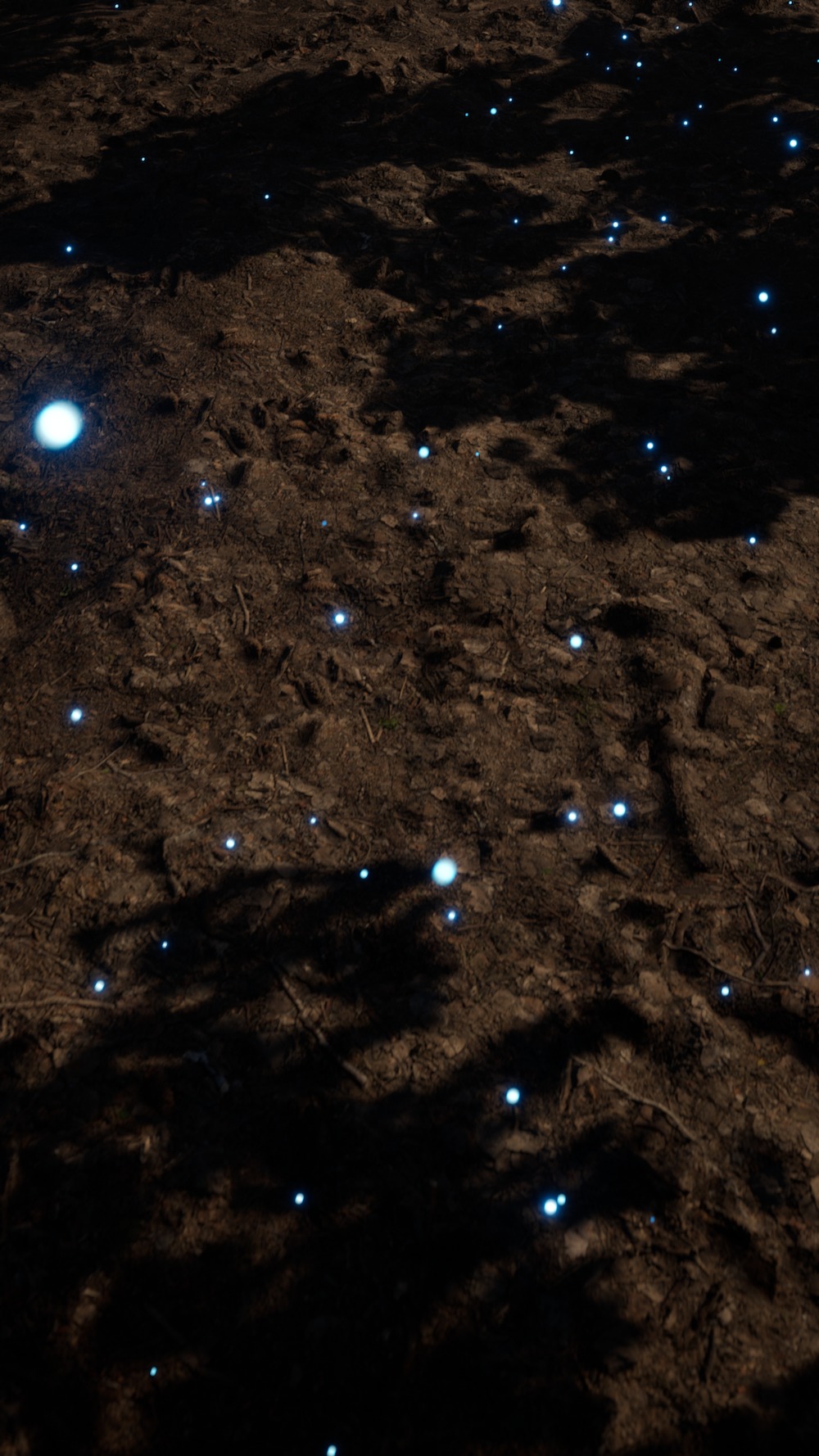
(Video still) Priyageetha Dia, Spectre System, 2024, Single-channel video, (colour and sound), 15 min. Edition of 3 plus 1 artist's proof. Image courtesy of the artist
You mentioned magic realism of the image. How do you see it? What is this magic?
For me, magic realism in the image is less about the literary tradition and more about the capacity of the image to hold contradictory realities simultaneously, to be of the past and yet not quite past, to feel document-like and yet resist documentation. The way I work with images operates within its own kind of temporality. It doesn’t sit neatly in the past or the future, but exists in a timeline of its own. That in-between quality is, I think, where the magic resides.
There is also, particularly in animation, a considerable scope for manipulating the image for constructing textures, materials, and surfaces that don’t necessarily replicate everyday reality, but instead generate their own internal logic. In that sense, the image creates its own reality within the environment that I build. It becomes something almost surreal in its look and feel where it is recognisable enough to carry historical weight, yet strange enough to open up a different kind of encounter with that history.
You were born in Singapore – did you receive your art education there?
Yes, I did my undergraduate studies in Singapore. I didn’t come from a family of artists; the closest connection was my grandfather, who was a craftsman – a goldsmith. Before that, I had a background in graphic design. I eventually decided to pursue fine art at undergraduate level, partly because I had become quite bored with design work. I was mainly working with advertising firms at the time, and it felt quite draining.
I decided that art school might be a good turn. However, I didn’t yet have a grounding in critical theory or philosophy, so when I first entered art school, I felt quite lost, and I would say I more or less disliked the experience initially. It wasn’t until my third year that things began to shift. I started working more closely with ideas around public space and the everyday environments of Singapore, thinking through their material conditions. At the time, I was also working with gold quite extensively, which in a way referenced my grandfather’s practice and that lineage.
I eventually created what I would describe as a site-specific installation in the public housing estate where I was living. It involved a flight of stairs covered in gold foil. My neighbour found what I was doing quite surprising or whatsoever and decided to document it and post it on Reddit. It circulated very quickly, and by the next day local media were trying to get in touch to cover what this “golden staircase hype” was about.
For me, it was quite unexpected, as I didn’t think anyone would really take notice of it. But because Singapore is such an authoritarian state, anything that goes beyond the very normal everyday life becomes, you know, highlighted and scrutinised in multiple ways. Because the work hadn’t been formally approved – I hadn’t discussed it with my lecturers or the school – it existed very much just between myself and the space. That led to this broader discussion around whether it should be understood as an artwork or as an act of vandalism.
And yes, there was this whole discourse that unfolded, and eventually I removed the work. That, in turn, prompted another discussion about whether art can even exist in Singapore. After that incident, it actually made me consider that perhaps I did have potential to continue my practice. At the same time, I had somewhat pigeonholed myself as a “gold artist”, someone only working with gold. I realised that wasn’t really me – I was tailoring my practice towards a certain demographic or audience. When COVID came, I used that period to revise and reconsider my practice. It was then that this whole process of working with animation emerged.
Golden Staircase. 2017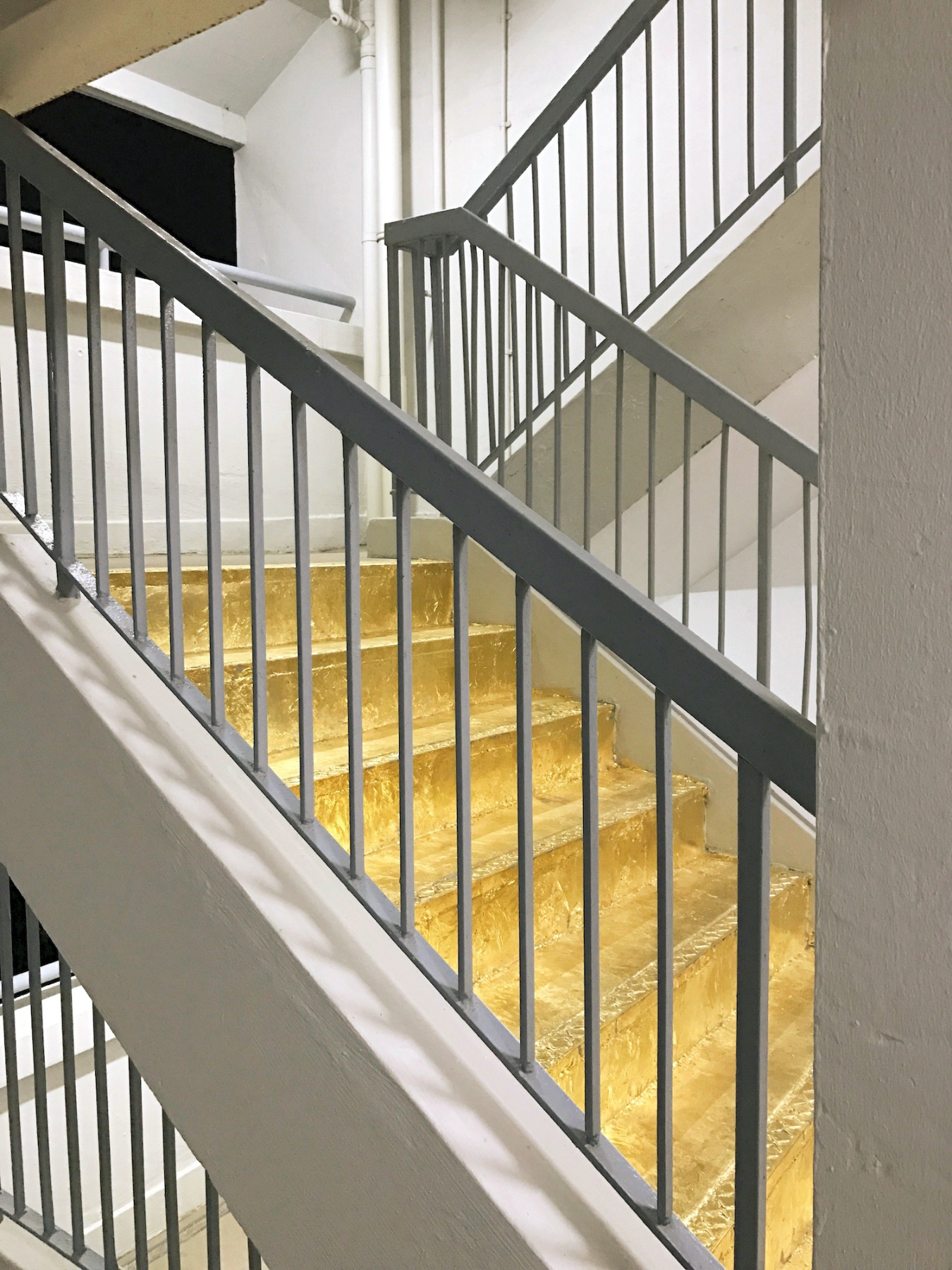
It was still based in Singapore at the time, but you’ve recently moved to the Netherlands?
Actually, at the beginning I did a research residency in Maastricht for three months. After that, I decided I wanted to come back and do my master’s here, so I moved to the Netherlands two years ago. I’m now finishing my studies in The Hague in summer.
But in your works you are still very much connected to South Asia history and heritage and you are trying to rethink it in a visual way…
Yes, I connect deeply with my family's history. There is a personal connection to understanding my identity within the context of Southeast Asia. During the British colonisation, a significant number of indentured labourers were sent from South India to work on plantations in Southeast Asia, predominantly for rubber. Part of my family was involved in this history, and learning about it was not a common experience in school. I felt that this aspect of history was greatly underrepresented and that it deserved proper recognition within the realm of art.
And it compelled me to push further, to think about this history through a different kind of visual narrative, a different form. That’s how I arrived at this line of research, which I’ve been developing over the past four or five years. But I’m not interested in reproducing the colonial account once again. I’m more interested in approaching the plantation as a subject through other lenses.
In this show, which you can see in Riga now, I am situating the work within a spectral, haunting framework. In other works, I reflect on ideas of resistance within the plantation – how certain practices brought by labourers helped consolidate their own forms of understanding in a new land. I also return to oral practices such as lamentation, which functioned as a method carried across. It is, in fact, a method that was traditionally performed at funerals, where women would gather to voice their grievances and collectively name the injustices they faced. It was also performed within plantation spaces. This is something I found particularly compelling to bring into my work and it is central to LAMENT H.E.A.T. (2023), a piece I have shown before, most recently in last year's edition for Loop Barcelona. .
And in my other works, such as Sap Sonic (2023), I look at archival images of plantations, considering how these images might be embedded as sound by inferring and speculating on the sonic possibilities within them. Beyond their visual representations, these images carry traces of the power dynamics and the move into sound is a way of accessing what the image holds but cannot show. I compose with sound as a way of understanding this history in a speculative register.
What drives this is a resistance to simply reproducing the colonial account, because I find that doing so also reproduces certain power structures and hierarchies embedded within these narratives and that is not a position I am interested in occupying.
everything you need to see is already in front of you. Exhibition view at the Riga Contemporary Art Space. Photo: Pēteris Rūcis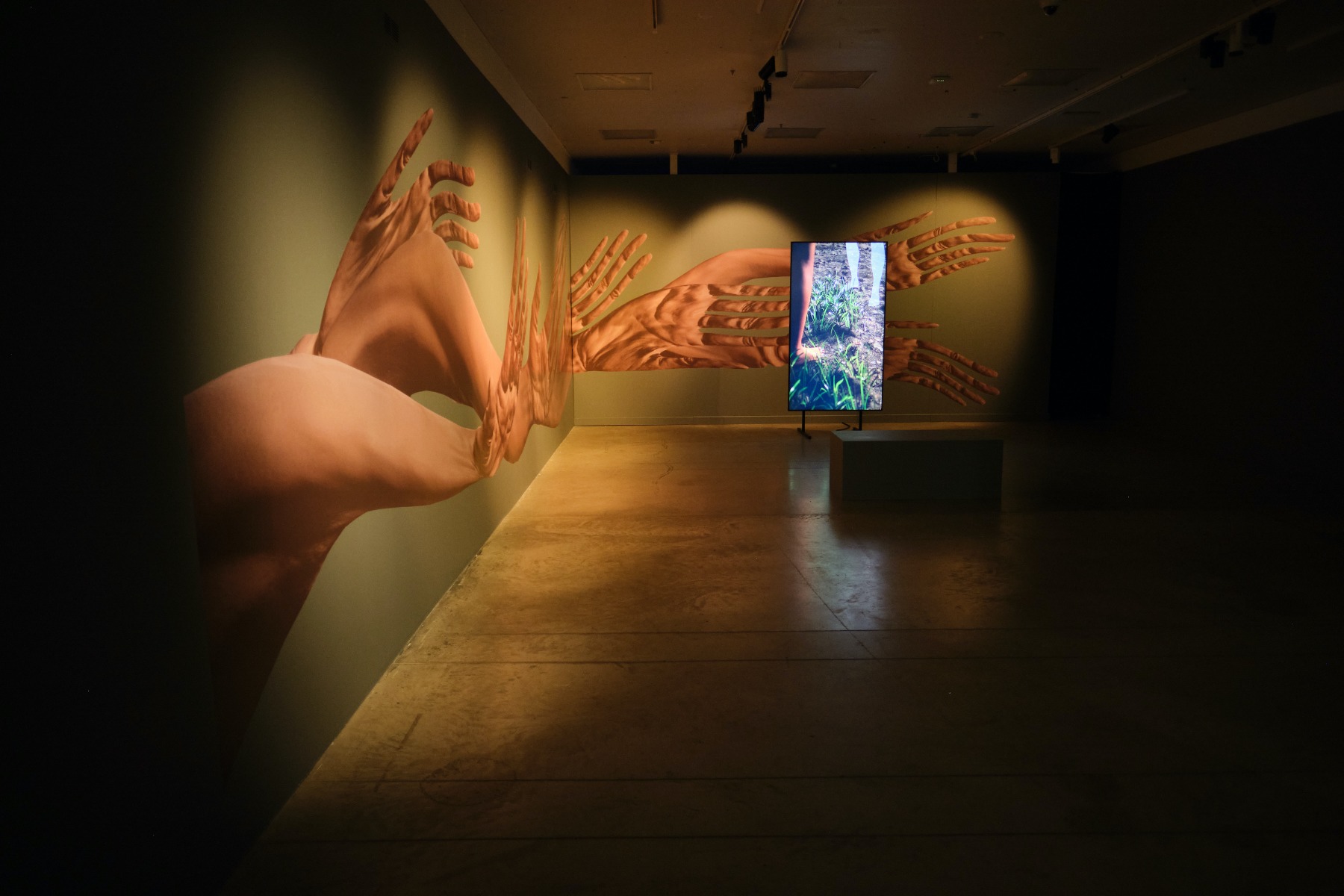
Could you tell us a little bit more about this exhibition currently on view at Riga Contemporary Art Space?
So, Inga Brūvere from Riga Photo Biennale approached me, and she was very interested in showing my work Spectre System (2024) . We were also thinking a lot about the title for this exhibition, “everything that you need to see is already in front of you”. It became a way of thinking about the conditions of seeing – or rather, being seen or unseen – and how sight is used to understand certain power structures and hierarchies within the image.
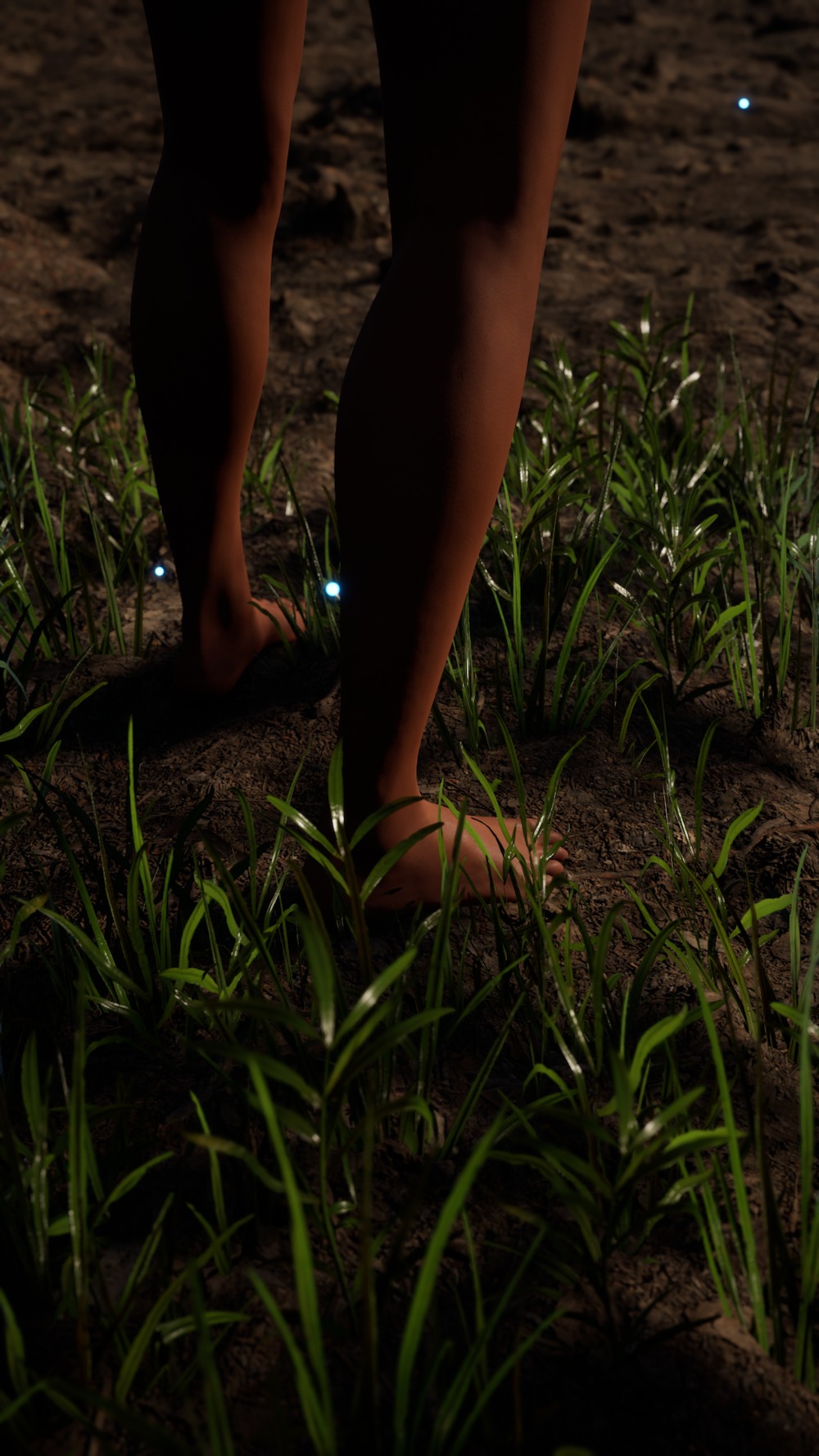
Spectre System emerged after I undertook fieldwork in Malaysia, where I was attempting to deepen my understanding of the plantation context. This was in fact my third fieldwork trip, and I conducted it independently . It was quite a complex, or rather complicated, fieldwork, because the plantation I went to had been turned into a kind of resort. I noticed that the closer one moved toward the resort, the grass was much more bright, green and vibrant. But walking further into the plantation itself – perhaps 30 or 40 minutes in – you were stepping into dry, brittle grass. The soil felt almost unviable, depleted by decades of chemicals and herbicides used to kill off any biodiversity that might threaten the livelihood of the rubber trees.
The rubber trees are arranged in a way that feels almost grid-like. So, as you move through it, you get the sense that you’re enclosed within the space. You lose any sense of time or orientation because you’re constantly framed by this grid.That was another very strong sensation I experienced – I almost felt claustrophobic, or even paranoid at times.
But the plantation was still an active site, and the rubber tappers would arrive early hours in the morning before sunrise. They wore reflective vests that would illuminate in the dark, and they carried head torches. It was quite interesting to see them from a distance, because it almost felt as though they were phantom figures moving through this dark space.
(Video still) Priyageetha Dia, Spectre System, 2024, Single-channel video, (colour and sound), 15 min. Edition of 3 plus 1 artist's proof. Image courtesy of the artist.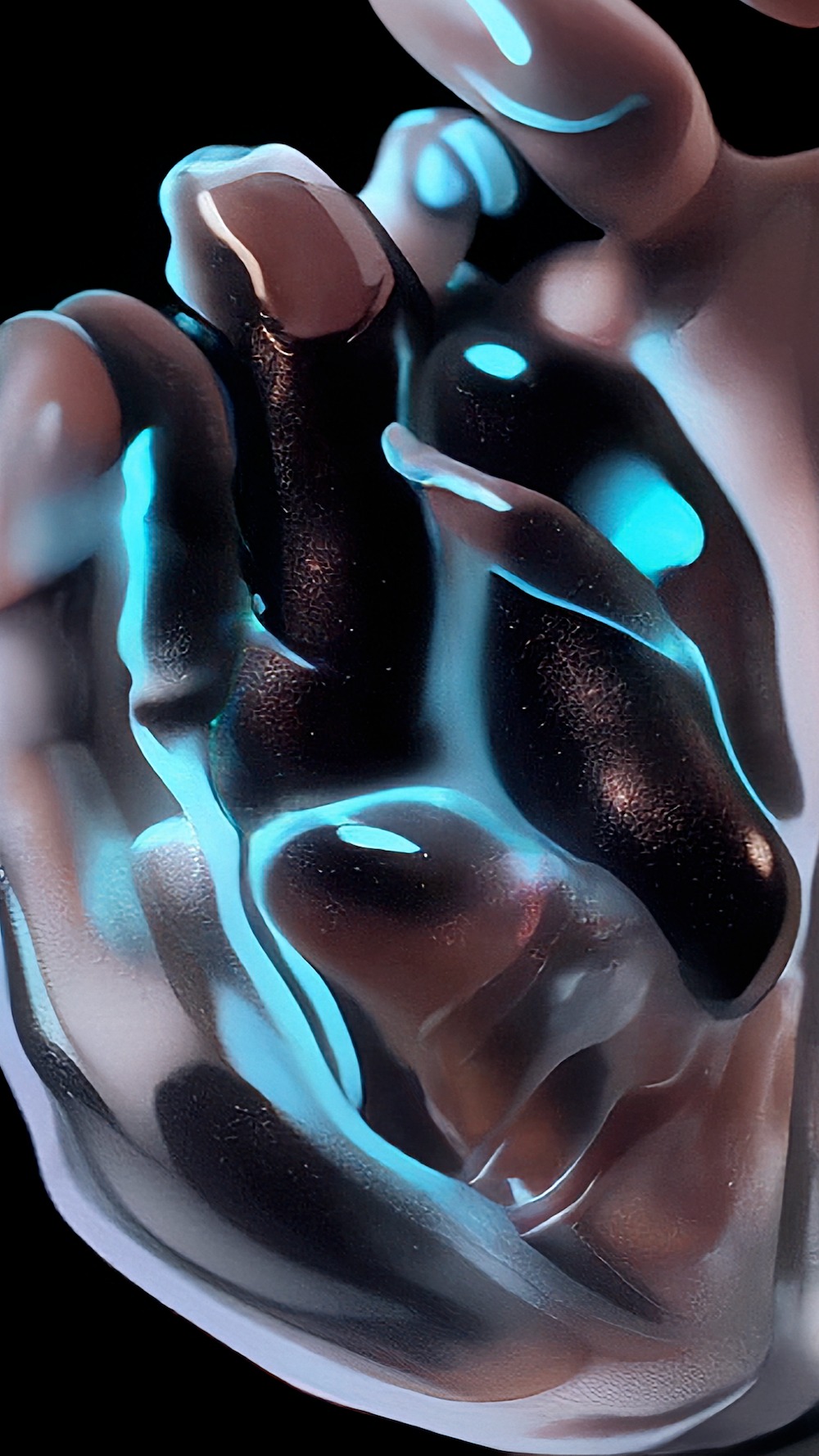
Completely magic realism.
Yes… And being in that space, there was also this sensation – a haunting feeling – that the labour performed there many years ago was still somehow present within it. I decided then that this should be translated into the work Spectre System.
In this piece, the video is accompanied by an extended print–a way of thinking through the figure of the hands as a means of considering the collective labour performed on the land. But it also takes on a distinctly spatial and material dimension within the exhibition space. It blurs the boundaries between body and environment, almost becoming its own landscape while guiding the viewer through the space and drawing them to engage with the video work.
In the video work itself, you’re presented with a gamified environment, alongside a sensation of heavy, laboured breathing, through which ideas of memory and labour are thought. The narration then enters, engaging with the notion of remembrance through an entity called Inaivu. Inaivu is a term that I developed – it draws from the word for memory in both Tamil and Malay: the Tamil word "ninaivu" and the Malay word "ingatan". I wanted to situate this history back through language, and to explore the relationship between memory and language by creating a new word: Inaivu.
What inaivu opens onto is the narration of memory through labour, through the land, and through economic infrastructures. The piece also marks my first and also my last engagement with generative image tool Midjourney, through which I was thinking about how the work moves from one portal into another by deploying the image as a kind of passage or threshold. The narration holds all of that together.
everything you need to see is already in front of you. Exhibition view at the Riga Contemporary Art Space. Photo: Pēteris Rūcis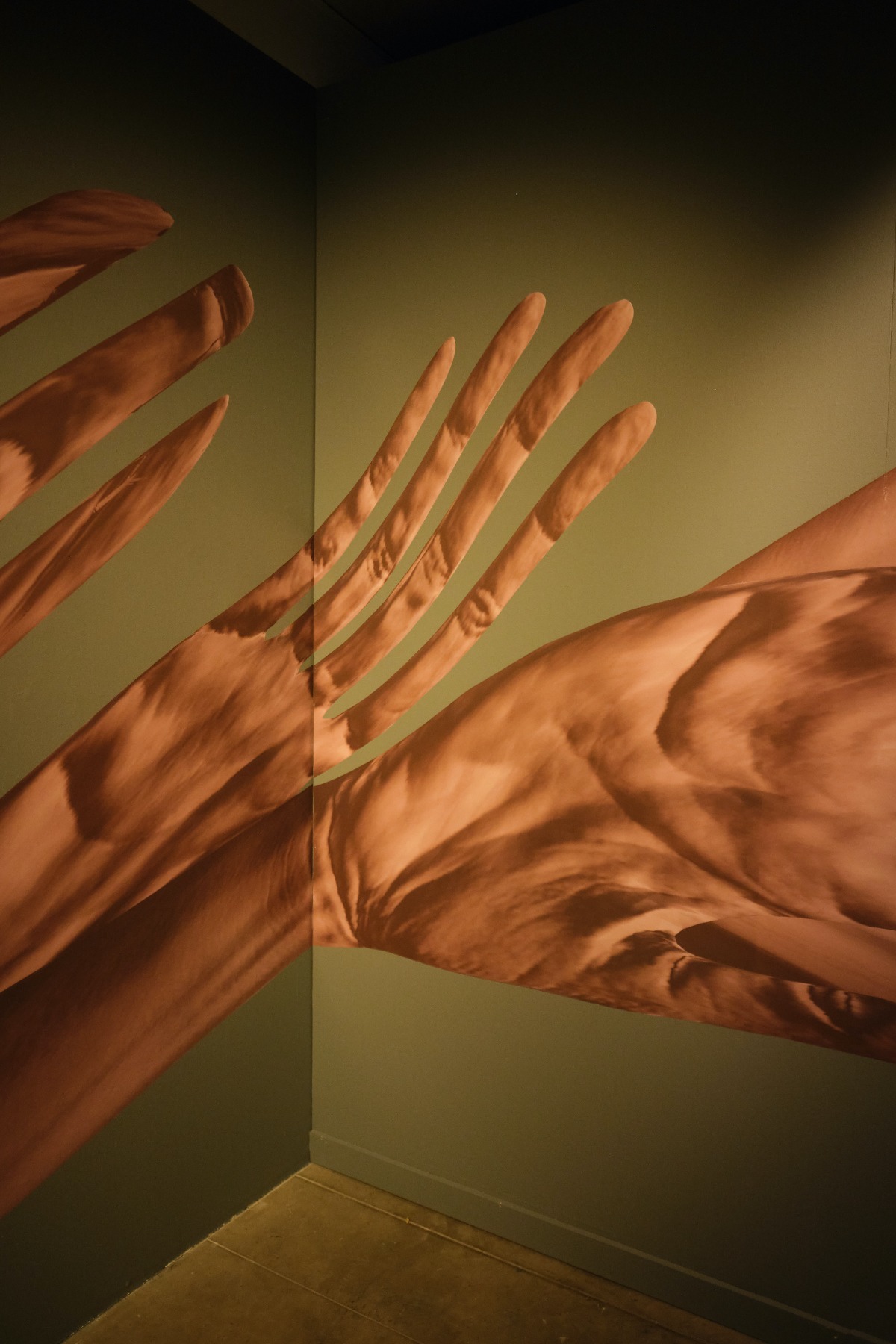
You were using AI also in the Night Shift work.
Yeah, that was later – it was produced last year.
Night Shift is an interesting combination of two subjects: labour and rave.
I think a great deal about the body – the body that performs this labour. I became particularly interested in approaching this through the lens of rave culture, and also in unpacking what the term rave actually constitutes. Within Western frameworks, it is often understood as a collective phenomenon associated with underground gatherings and subcultural practices.
But rave, when you think about it, is essentially about bodies coming together and performing collectively. It was this convergence of labour and exhaustion that I found most compelling. What animation permits is the capacity to push the body to perform again and again. It has this almost violent quality – you can reverse it, loop it, stretch it. The body is made to repeat these movements continuously. And what I did was to create this performing body, while also capturing the expressions that emerge from that performance using motion capture. While the figure was dancing, I captured my own facial expressions and transferred them onto the character. When you watch it, you realise that although the character is dancing, there is no sense of joy – only exhaustion, which keeps resurfacing again and again. It almost elicits a feeling of sympathy for this figure. When it ends, the viewer is introduced to the full narrative that situates where this character is performing. It constructs an outsider–insider perspective on the body within this environment, which I find particularly productive. . I wanted the viewer to remain with the work for the full length, and then, right at the 15-minute mark, it cuts and you are presented with the narration of the piece.
It’s a very different method from how I have worked with video, and with sound as well. The sound is something I composed myself. I don’t really have formal training d in sound production, but I was very interested in repetition of the beat as a means of generating an almost trance-like state. You almost feel as though you’re possessed by the rhythm. Combined with the effect of strobe light, these elements converge to produce a particular sensation, a kind of exhaustion.
Night Shift for 120 BPM - Bring Your Friends exhibition at Tin Sheds Gallery, Sydney. Below: Night Shift, 2025. Single-channel video, (colour and sound), 18:04 min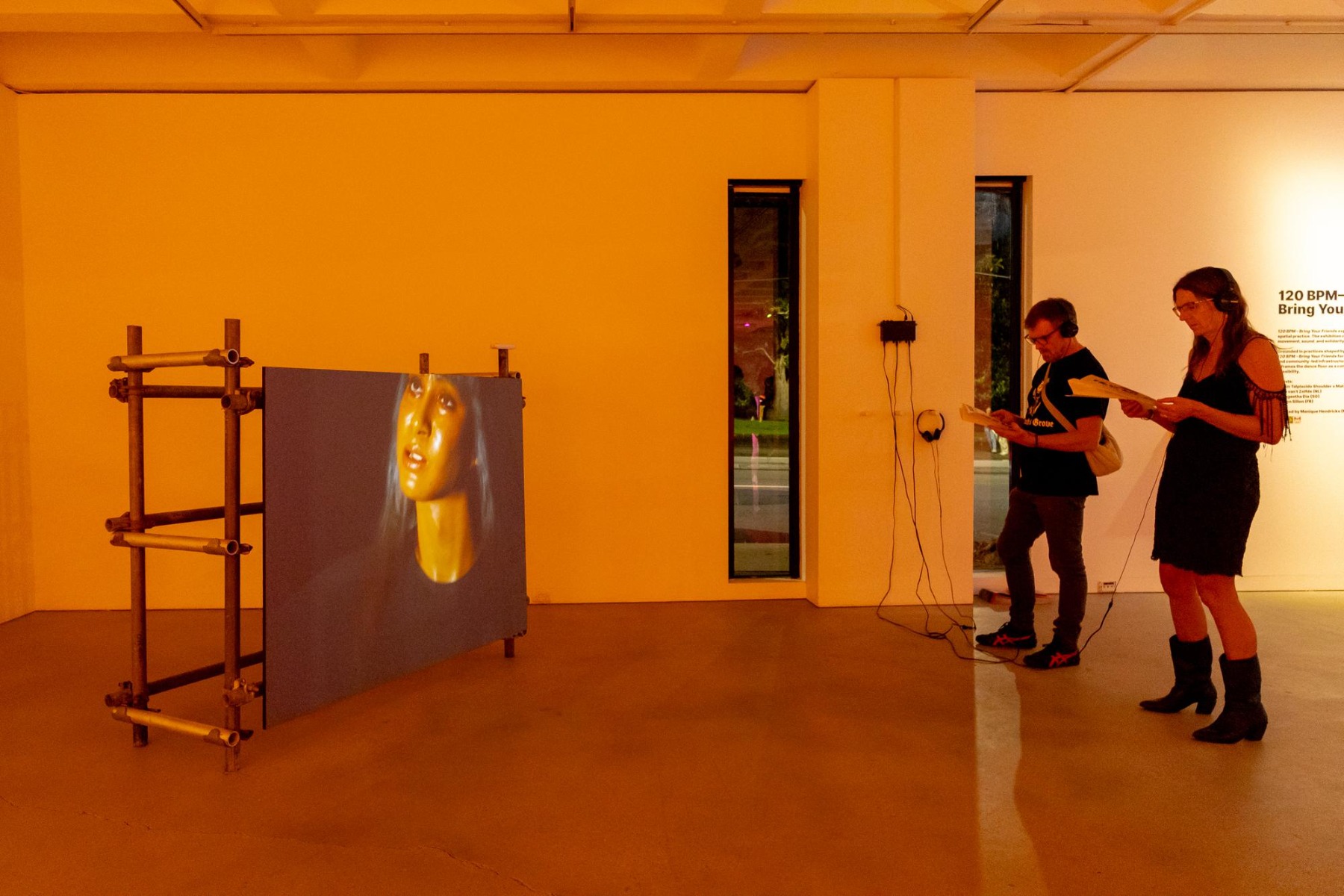
How do you feel about working with AI, given that many people are saying we are losing creativity, giving it away to this artificial mind?
I do feel very conflicted. I am aware that, especially when working with generated images, there is a kind of violence embedded within artificial intelligence, or in the way images are generated again and again. That’s why I stopped working with generative image tools, and I’m now more interested in a critique of AI itself. In my current research, I’m looking at generative sound, particularly voice cloning and large language models.
Large language models have a kind of sonic quality – a pattern recognition that moves from X to Y, Y to Z, through language. Working with that, I decided to create a sound work based on this logic. This piece emerged from a recent article about Peter Thiel the co-founder of Palantir, an AI weapons technology company.
What Thiel recently did was host a closed-door lecture series in Silicon Valley, where he spoke about ideas of the apocalypse and the Antichrist. He essentially suggested that those who try to oppose or regulate artificial intelligence could be considered the Antichrist, and he named Greta Thunberg as one such figure.
Greta is someone who speaks with moral urgency – she is a climate activist – and he frames her as someone who would impede or stop the progress of artificial intelligence or technological development. And I found this whole commentary so absurd that I decided I wanted to make a sound work out of it by creating a sermon based on LLM pattern recognition and cloned Greta’s voice to recite it, which also brings up questions around the ethics of voice cloning and the reduction of personhood into an artefact.
She becomes a hallucinatory voice within the system. I was very interested in how to situate this sound work within an installation context, and this is something I’m currently developing for my graduation show..
Are you thinking about working more with sound in the future?
My current focus is largely on sound. I am particularly interested in exploring what I am calling necrosonics – or "death sounds" – a term I am developing in departure from Achille Mbembe's theory of necropolitics. Necropolitics, in its essential formulation, concerns the sovereign power to determine who gets to live and who is made to die. This can be understood within spaces of conflict and war, how sovereign power operates, juridically, in adjudicating life and death. What I am thinking about is how sound can be understood at that same level through sonic warfare, and through the ways in which vibration can alter the physicality of the body from within, not merely externally.
I am interested in continuing this thread in my current research. Over the last four or five years, my practice has been oriented primarily around the visual – around moving images – and sound has tended to occupy a secondary position within that process. What I am working toward now is a more grounded engagement with sound as a primary medium; one that I feel has not yet been given the critical recognition it deserves within my practice.
(Video still) Priyageetha Dia, Spectre System, 2024, Single-channel video, (colour and sound), 15 min. Edition of 3 plus 1 artist's proof. Image courtesy of the artist.
Do you think of yourself as an artist from Singapore, or as an artist from Southeast Asia? Do you need a wider frame, or is Singapore enough?
Yeah, it’s always about how to constitute or contextualise where you come from. I feel like I’m often compelled to say I’m from Singapore, but I don’t feel like I fully belong there. Neither do I feel like I belong in the Netherlands. So, I feel like I’m just a citizen of the world.
It comes down to the very complex positioning of identity in this world. And I just say I was born and raised in Singapore, and I’m just existing… here.
